
Pre-Winter Sale Limited Time Flat 70% Discount offer - Ends in 0d 00h 00m 00s - Coupon code: 70spcl

Splunk SPLK-5002 Splunk Certified Cybersecurity Defense Engineer Exam Practice Test

Page: 1 / 11
Total 105 questions

Splunk Certified Cybersecurity Defense Engineer Questions and Answers

Question 1

The threat-hunting team has identified suspicious activity. An analyst manually creates a notable event using an event action to track the activity. How should a detection engineer ensure this activity automatically produces findings in the future?

Options:

A.

Create a SOAR playbook to identify events matching the activity and assign an urgency.

B.

Create a correlation search to produce notable events for the activity.

C.

Create a SOAR playbook to assign risk modifiers for events matching the activity.

D.

Create a risk modifier for events matching the activity.

Question 2

Which practices strengthen the development of Standard Operating Procedures (SOPs)? (Choose three)

Options:

A.

Regular updates based on feedback

B.

Focusing solely on high-risk scenarios

C.

Collaborating with cross-functional teams

D.

Including detailed step-by-step instructions

E.

Excluding historical incident data

Question 3

What can an engineer use to capture contextual values from a dashboard and create a drilldown to link to a new search?

Options:

A.

Aliases

B.

JSON

C.

Tokens

D.

Environment variables

Question 4

A SOC ' s Incident Response Standard Operating Procedure (SOP) calls for any phishing emails containing files to be detonated in Splunk Attack Analyzer for evaluation. Which of the following can an engineer implement to gain efficiency through automation?

Options:

A.

Automatically assign phishing-tagged findings to analysts to begin manual collection.

B.

Automatically send an email notification for all findings containing the phishing tag.

C.

Use a SOAR playbook to handle the Splunk Attack Analyzer submission and data-collection steps and make the information available to an assigned analyst.

D.

Use a SOAR playbook to submit the email to PhishTank and have it perform the Splunk Attack Analyzer submission.

Question 5

MITRE D3FEND is designed to compliment MITRE ' s list of adversarial tactics, techniques, and common knowledge (ATT & CK). Which tactics are associated with MITRE D3FEND in order to detect, deny, and disrupt adversarial efforts?

Options:

A.

Harden, Detect, Exclude, Deceive, Eradicate

B.

Harden, Detect, Isolate, Disrupt, Evict

C.

Harden, Detect, Exclude, Define, Eradicate

D.

Harden, Detect, Isolate, Deceive, Evict

Question 6

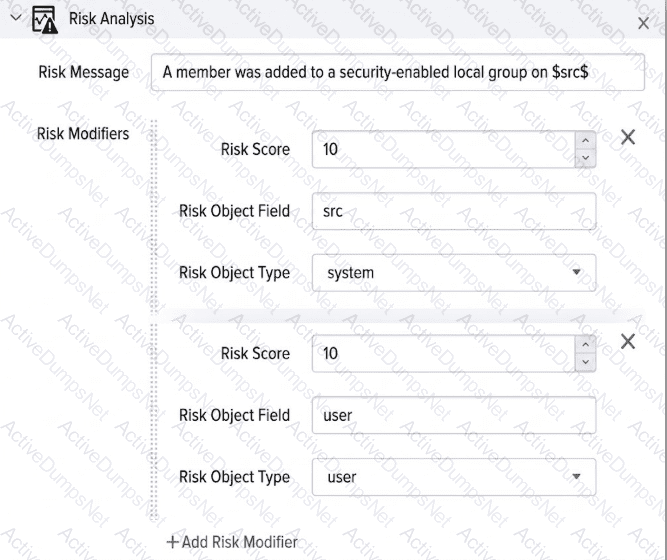
Based on this example image, if it is detected that a member has been added to a security-enabled local group, how many risk events will be created?
Question # 6

Options:

A.

20

B.

1

C.

10

D.

2

Question 7

The following SPL is designed to report on a certain SOC metric. Which metric is the most likely topic for this report?

| tstats summariesonly=true earliest(_time) as _time

FROM datamodel=Incident_Management

BY " Notable_Events.Meta.rule_id "

| rename " Notable_Events.Meta.* " as " * "

| lookup update=true incident_updates_lookup rule_id OUTPUTNEW time

| search time=*

| stats earliest(_time) as create_time, min(time) as triage_time by rule_id

| eval diff=triage_time-create_time,

stat_type=if(

create_time < relative_time(now(), " -7d@d " ),

" past " ,

" current "

),

past=if(stat_type= " past " , 1, 0),

current=if(stat_type= " current " , 1, 0),

past_diff=if(stat_type= " past " , diff, 0),

current_diff=if(stat_type= " current " , diff, 0)

| stats sum(past) AS past,

sum(current) AS current,

sum(past_diff) AS past_diff,

sum(current_diff) AS current_diff

| eval past=round(past_diff/past/60),

current=round(current_diff/current/60)

| table past, current

| transpose

Options:

A.

Mean time to Triage

B.

Mean time to Respond

C.

Mean time to Resolve

D.

Dwell Time

Question 8

An automation engineer for the Wonderland SOC has configured a new asset and is getting an HTTP 403 response code. Which of the following is a possible cause of the error code?

Options:

A.

The endpoint that the asset is configured for does not exist.

B.

Either the asset username or password is incorrect.

C.

The asset endpoint requires a token rather than a username and password.

D.

Asset credentials do not have adequate permissions.

Question 9

An engineer notices that a detection is creating multiple Findings (notables) for the same potential incident. Which setting can be adjusted to reduce the number of generated findings (notables)?

Options:

A.

Correlation search throttling

B.

Correlation search priority

C.

Adaptive risk modifier

D.

Adaptive response actions

Question 10

When setting Common Information Model (CIM) accelerations, which parameter should be defined to set how far back in time (specified as a relative time string) the Splunk platform creates its column stores?

Options:

A.

Max summarization search time

B.

Backfill range

C.

Accelerate until maximum time

D.

Summary range

Question 11

When creating a detection, how might an engineer ensure that all possible contextual fields about a given asset and identity are added to a risk event?

Options:

A.

Include the standard CIM fields for assets and identities in the detection output.

B.

Use an identity lookup to return all available identity information in the detection output.

C.

Use an asset lookup to return all available asset information in the detection output.

D.

Call an Active Directory adaptive response action to perform a real-time update.

Question 12

A detection engineer is using a threat defense informed strategy to define use cases. Which Splunk app would best facilitate their use case development process by cross referencing detections with the MITRE ATT & CK Framework?

Options:

A.

Enterprise Security Content Update App

B.

Splunk Security Essentials App

C.

Enterprise Security

D.

Supporting add-on for MITRE ATT & CK

Question 13

Which of the following actions will allow access to a list of alert actions via the API?

Options:

A.

| rest /services/alerts/adaptive_response_action

B.

| rest /services/alerts/correlationsearches

C.

| rest /services/alerts/alert actions/_acl

D.

| rest /services/alerts/alert_actions

Question 14

Once an engineer has determined that a new detection will fire, what is the next priority for that detection?

Options:

A.

Ensure that threat intelligence has been integrated for use with the detection.

B.

Ensure that all annotations, such as MITRE ATT & CK, are attached and understood with the detection.

C.

Ensure that the SOAR playbooks are available to automate the outcomes from the detection.

D.

Ensure that all fields that an analyst would need are present in the output from the detection.

Question 15

Consider the following series of events:

4:00 GMT Detection runs for interval 3:30–4:00

4:30 GMT Detection runs for interval 4:00–4:30

4:35 GMT Event 1 occurs on an endpoint

4:45 GMT Event 1 is indexed

5:00 GMT Detection runs for interval 4:30–5:00

5:05 GMT Event 1 finding is added to ES with timestamp 4:35

5:24 GMT Event 2 occurs on an endpoint

5:30 GMT Detection runs for interval 5:00–5:30

5:35 GMT Event 2 is indexed

6:00 GMT Detection runs for interval 5:30–6:00

What is the problem with the detection schedule chosen and how can it be solved?

Options:

A.

The logs are delayed so the detection time window needs to be decreased.

B.

The time window for the detection is too small, causing duplicate alerts.

C.

The time window for the detection is too large, causing duplicate alerts.

D.

The logs are delayed so the detection time window needs to be increased.

Question 16

In the context of Splunk ' s Common Information Model (CIM), which construct ensures that events from different data sources appear in the applicable data model?

Options:

A.

Hosts

B.

Tags

C.

Assets

D.

Field names

Question 17

In Enterprise Security, what is the name of the threat intelligence lookup pertaining to files?

Options:

A.

file_hash

B.

file_intel

C.

user_intel

D.

user_hash

Question 18

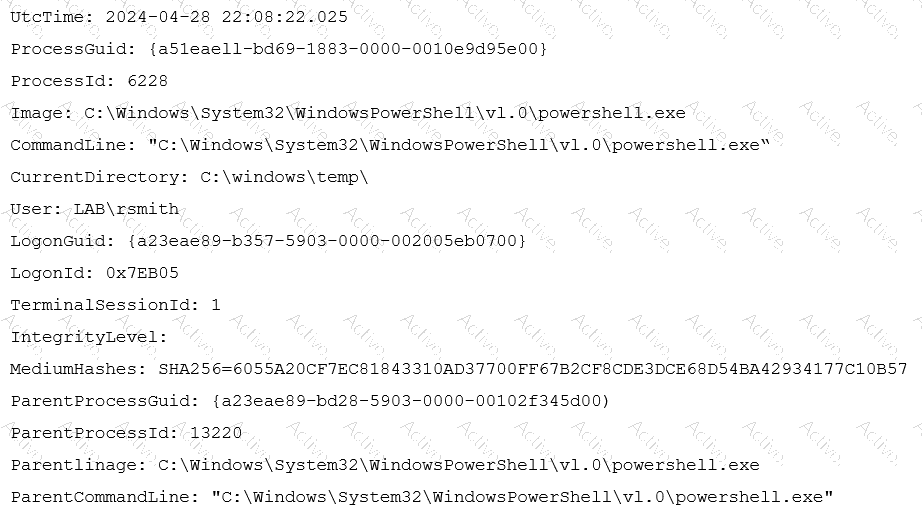
Below is an example of a Sysmon process create log. Which EventCode would be associated with this log entry?
Question # 18

Options:

A.

EventCode=1

B.

EventCode=4

C.

EventCode=3

D.

EventCode=2

Question 19

The SOC notices over the course of an investigation there are numerous logs similar to the following:

UDP: query: reallybad.c2.com IN A response: SERVFAIL

What detection should be created to alert on this behavior for the future?

Options:

A.

Excessive DNS Failures

B.

Excessive Authentication Failures

C.

Excessive Network Failures

D.

Excessive Endpoint Failures

Question 20

An EDR tool was recently purchased and needs to be integrated into existing Splunk SOAR playbooks. Which actions are typically associated with this type of asset?

Options:

A.

Block device, remove email, detonate URL, get indicator

B.

Block hash, block process, quarantine device, get indicator

C.

Block URL, block subdomain, quarantine device, get indicator, detonate URL

D.

Block hash, reset user password, quarantine device, get indicator

Question 21

Which Enterprise Security components provide enrichment to the Risk Framework?

Options:

A.

Assets & Identities Framework, Risk Factoring, Annotations

B.

Risk Object, Notable Framework, Data Models

C.

Assets & Identities Framework, Threat Intelligence, Notes

D.

Risk Object, Threat Intelligence, Data Models

Question 22

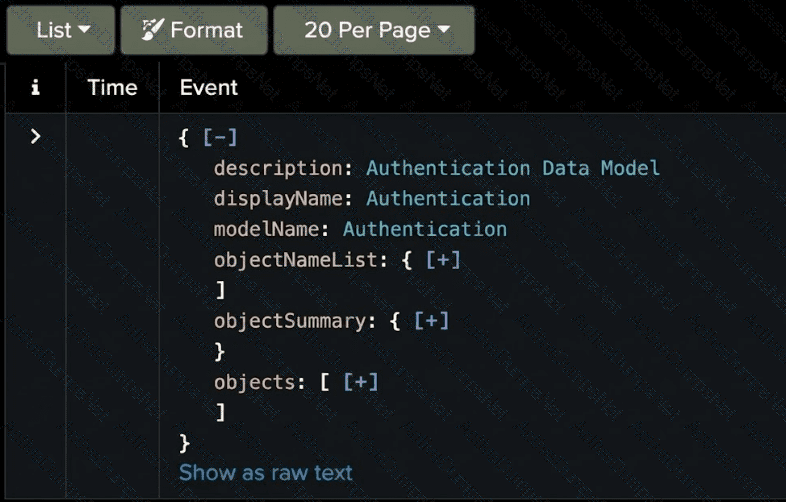
Which search command was used to generate the result in the image below?
Question # 22

Options:

A.

metadata

B.

datatype

C.

cim

D.

datamodel

Question 23

Which action improves the effectiveness of notable events in Enterprise Security?

Options:

A.

Limiting the search scope to one index

B.

Using only raw log data in searches

C.

Applying suppression rules for false positives

D.

Disabling scheduled searches

Question 24

Which of the following macro values will exclude all of the company networks if it is called from the following search?

index=firewall sourcetype=pan\:traffic NOT " company_networks "

Options:

A.

(src_ip IN (151.157.30.0/24, 26.06.18.0/24))

B.

NOT (src_ip IN (151.157.30.0/24, 26.06.18.0/24))

C.

NOT (src_ip=151.157.30.0/24 AND src_ip=26.06.18.0/24)

D.

(src_ip=151.157.30.0/24 AND src_ip=26.06.18.0/24)

Question 25

Which of the following is not a type of metadata that can be returned by the metadata command?

Options:

A.

hosts

B.

sources

C.

assets

D.

sourcetypes

Question 26

During a ransomware attack, an adversary might add a default user and password in registry, modify the wallpaper, and create bulk ransomware notes across multiple machines. What is Splunk ' s method for grouping these types of detections together?

Options:

A.

Threat Intelligence

B.

Data models

C.

Analytic Stories

D.

Assets & Identities framework

Question 27

Which of the following should be the primary reference when designing a new playbook in Splunk SOAR?

Options:

A.

Existing investigation actions

B.

MITRE ATT & CK® framework

C.

Existing Standard Operating Procedure

D.

CIS Framework

Question 28

Which type of correlation search reviews the events in the risk index and uses an aggregation of events impacting a single risk object to generate risk notables?

Options:

A.

Risk Category

B.

Risk Rule

C.

Risk Incident Rule

D.

Risk Incident Notable

Question 29

When using SOAR to automate a response with a zero trust approach, which of the following represents a valid order of operations?

Options:

A.

Contain, triage initial incident, identify scope, remediate and/or restore

B.

Triage initial incident, identify scope, contain, remediate and/or restore

C.

Identify, scope, remediate and/or restore, triage

D.

Observe, orient, decide, act

Question 30

When creating a new playbook to be called directly from Mission Control or Enterprise Security, which type of playbook must be used?

Options:

A.

Input

B.

Automation

C.

Process

D.

Response

Question 31

What is Enterprise Security ' s default way of determining the urgency of a finding (notable event)?

Options:

A.

Multiply the risk score of a detection by how many times it has run.

B.

Leverage the scheduling priority of the detection to know what ' s most critical.

C.

Add risk scores for associated objects within a network.

D.

Take into account the priority assigned to the asset/identity as well as the severity value assigned to the finding.

Page: 1 / 11
Total 105 questions