Big Cyber Monday Sale Limited Time Flat 70% Discount offer - Ends in 0d 00h 00m 00s - Coupon code: 70spcl

Salesforce MuleSoft-Platform-Architect-I Salesforce Certified MuleSoft Platform Architect (Mule-Arch-201) Exam Practice Test

Page: 1 / 15
Total 152 questions

Salesforce Certified MuleSoft Platform Architect (Mule-Arch-201) Questions and Answers

Question 1

An API implementation is deployed on a single worker on CloudHub and invoked by external API clients (outside of CloudHub). How can an alert be set up that is guaranteed to trigger AS SOON AS that API implementation stops responding to API invocations?

Options:

A.

Implement a heartbeat/health check within the API and invoke it from outside the Anypoint Platform and alert when the heartbeat does not respond

B.

Configure a "worker not responding" alert in Anypoint Runtime Manager

C.

Handle API invocation exceptions within the calling API client and raise an alert from that API client when the API Is unavailable

D.

Create an alert for when the API receives no requests within a specified time period

Question 2

Refer to the exhibit.

Question # 2

A RAML definition has been proposed for a new Promotions Process API, and has been published to Anypoint Exchange.

The Marketing Department, who will be an important consumer of the Promotions API, has important requirements and expectations that must be met.

What is the most effective way to use Anypoint Platform features to involve the Marketing Department in this early API design phase?

A) Ask the Marketing Department to interact with a mocking implementation of the API using the automatically generated API Console

Question # 2

B) Organize a design workshop with the DBAs of the Marketing Department in which the database schema of the Marketing IT systems is translated into RAML

C) Use Anypoint Studio to Implement the API as a Mule application, then deploy that API implementation to CloudHub and ask the Marketing Department to interact with it

D) Export an integration test suite from API designer and have the Marketing Department execute the tests In that suite to ensure they pass

Question # 2

Options:

A.

Option A

B.

Option B

C.

Option C

D.

Option D

Question 3

Which two statements are true about the technology architecture of an Anypoint Virtual Private Cloud (VPC)?

Choose 2 answers

Options:

A.

Ports 8081 and 8082 are used

B.

CIDR blacks are used

C.

Anypoint VPC is responsible for load balancing the applications

D.

Round-robin load balancing is used to distribute client requests across different applications

E.

By default, HTTP requests can be made from the public internet to workers at port 6091

Question 4

An IT Security Compliance Auditor is assessing which nonfunctional requirements (NFRs) are already being implemented to meet security measures.

* The Web API has Rate-Limiting SLA

* Basic Authentication - LDAP

* JSON Threat Protection

* TP Allowlist policies applied

Which two NFRs-are enforced?

Options:

A.

The API invocations are coming from a known subnet range

B.

Username/password supported to validate login credentials

C.

Sensitive data is masked to prevent compromising critical information

D.

The API is protected against XML invocation attacks

E.

Performance expectations are to be allowed up to 1,000 requests per second

Question 5

An Order API must be designed that contains significant amounts of integration logic and involves the invocation of the Product API.

The power relationship between Order API and Product API is one of "Customer/Supplier", because the Product API is used heavily throughout the organization and is developed by a dedicated development team located in the office of the CTO.

What strategy should be used to deal with the API data model of the Product API within the Order API?

Options:

A.

Convince the development team of the Product API to adopt the API data model of the Order API such that the integration logic of the Order API can work with one consistent internal data model

B.

Work with the API data types of the Product API directly when implementing the integration logic of the Order API such that the Order API uses the same (unchanged) data types as the Product API

C.

Implement an anti-corruption layer in the Order API that transforms the Product API data model into internal data types of the Order API

D.

Start an organization-wide data modeling initiative that will result in an Enterprise Data Model that will then be used in both the Product API and the Order API

Question 6

Several times a week, an API implementation shows several thousand requests per minute in an Anypoint Monitoring dashboard, Between these bursts, the

dashboard shows between two and five requests per minute. The API implementation is running on Anypoint Runtime Fabric with two non-clustered replicas, reserved vCPU 1.0

and vCPU Limit 2.0.

An API consumer has complained about slow response time, and the dashboard shows the 99 percentile is greater than 120 seconds at the time of the complaint. It also shows

greater than 90% CPU usage during these time periods.

In manual tests in the QA environment, the API consumer has consistently reproduced the slow response time and high CPU usage, and there were no other API requests at

this time. In a brainstorming session, the engineering team has created several proposals to reduce the response time for requests.

Which proposal should be pursued first?

Options:

A.

Increase the vCPU resources of the API implementation

B.

Modify the API client to split the problematic request into smaller, less-demanding requests

C.

Increase the number of replicas of the API implementation

D.

Throttle the APT client to reduce the number of requests per minute

Question 7

Refer to the exhibit.

Question # 7

An organization uses one specific CloudHub (AWS) region for all CloudHub deployments.

How are CloudHub workers assigned to availability zones (AZs) when the organization's Mule applications are deployed to CloudHub in that region?

Options:

A.

Workers belonging to a given environment are assigned to the same AZ within that region

B.

AZs are selected as part of the Mule application's deployment configuration

C.

Workers are randomly distributed across available AZs within that region

D.

An AZ is randomly selected for a Mule application, and all the Mule application's CloudHub workers are assigned to that one AZ

Question 8

A company deploys Mule applications with default configurations through Runtime Manager to customer-hosted Mule runtimes. Each Mule application is an API

implementation that exposes RESTful interfaces to API clients. The Mule runtimes are managed by the MuleSoft-hosted control plane. The payload is never used by any Logger

components.

When an API client sends an HTTP request to a customer-hosted Mule application, which metadata or data (payload) is pushed to the MuleSoft-hosted control plane?

Options:

A.

Only the data

B.

No data

C.

The data and metadata

D.

Only the metadata

Question 9

A set of tests must be performed prior to deploying API implementations to a staging environment. Due to data security and access restrictions, untested APIs cannot be granted access to the backend systems, so instead mocked data must be used for these tests. The amount of available mocked data and its contents is sufficient to entirely test the API implementations with no active connections to the backend systems. What type of tests should be used to incorporate this mocked data?

Options:

A.

Integration tests

B.

Performance tests

C.

Functional tests (Blackbox)

D.

Unit tests (Whitebox)

Question 10

An operations team is analyzing the effort needed to set up monitoring of their application network. They are looking at which API invocation metrics can be used to identify and predict trouble without having to write custom scripts or install additional analytics software or tools.

Which type of metrics can satisfy this goal of directly identifying and predicting failures?

Options:

A.

The number and types of API policy violations per day

B.

The effectiveness of the application network based on the level of reuse

C.

The number and types of past API invocations across the application network

D.

The ROI from each APT invocation

Question 11

A company is using an on-prem cluster in the data center as a runtime plane and MuleSoft-hosted control plane.

How can the company monitor the detailed performance metrics on the Mule applications deployed to the cluster from the control plane?

Options:

A.

The settings of the Monitoring section in the control plane must be updated to enable detailed logging on the metrics to be captured

B.

Monitoring Agent must be installed on each node in the cluster

C.

Due to the potential performance impact on the runtime nodes, the Monitoring agent should be installed on a separate server

D.

There is no action needed as the on-prem runtime automatically sends the performance data to the control plane

Question 12

A customer wants to host their MuleSoft applications in CloudHub 1.0, and these applications should be available at the domain https://api.acmecorp.com.

After creating a dedicated load balancer (DLB) called acme-dib-prod, which further action must the customer take to complete the configuration?

Options:

A.

Configure the DLB with a TLS certificate for api.acmecorp.com and create an A record for api.acmecorp.com to the public IP addresses associated with their DLB

B.

Configure the DLB with a TLS certificate for api.acmecorp.com and create a CNAME record from api.acmecorp.com to acme-dib-prod.|lb.anypointdns.net

C.

Configure the DLB with a TLS certificate for acme-dib-prod.Jb.anypointdns.net and create a CNAME record from api.acmecorp:com to acme-dlb-prod.lb.anypointdns.net

D.

Configure the DLB with a TLS certificate for aplacmecorp.com and create a CNAME record from api.aomecorp.com to acme-dib-prod.ei.cloubhub.io

Question 13

Which statement is true about identity management and client management on Anypoint Platform?

Options:

A.

If an external identity provider is configured, the SAML 2.0 bearer tokens issued by the identity provider cannot be used for invocations of the Anypoint Platform web APIs

B.

If an external client provider is configured, it must be configured at the Anypoint Platform organization level and cannot be assigned to individual business groups and environments

C.

Anypoint Platform supports configuring one external identity provider

D.

Both client management and identity management require an identity provider

Question 14

An online store's marketing team has noticed an increase in customers leaving online baskets without checking out. They suspect a technology issue is at the root cause of the baskets being left behind. They approach the Center for Enablement to ask for help identifying the issue. Multiple APIs from across all the layers of their application network are involved in the shopping application.

Which feature of the Anypoint Platform can be used to view metrics from all involved APIs at the same time?

Options:

A.

Custom dashboards

B.

Built-in dashboards

C.

Functional monitoring

D.

API Manager

Question 15

Refer to the exhibit. An organization is running a Mule standalone runtime and has configured Active Directory as the Anypoint Platform external Identity Provider. The organization does not have budget for other system components.

What policy should be applied to all instances of APIs in the organization to most effecuvelyKestrict access to a specific group of internal users?

Options:

A.

Apply a basic authentication - LDAP policy; the internal Active Directory will be configured as the LDAP source for authenticating users

B.

Apply a client ID enforcement policy; the specific group of users will configure their client applications to use their specific client credentials

C.

Apply an IP whitelist policy; only the specific users' workstations will be in the whitelist

D.

Apply an OAuth 2.0 access token enforcement policy; the internal Active Directory will be configured as the OAuth server

Question 16

An API has been updated in Anypoint Exchange by its API producer from version 3.1.1 to 3.2.0 following accepted semantic versioning practices and the changes have been communicated via the API's public portal.

The API endpoint does NOT change in the new version.

How should the developer of an API client respond to this change?

Options:

A.

The update should be identified as a project risk and full regression testing of the functionality that uses this API should be run

B.

The API producer should be contacted to understand the change to existing functionality

C.

The API producer should be requested to run the old version in parallel with the new one

D.

The API client code ONLY needs to be changed if it needs to take advantage of new features

Question 17

What is a typical result of using a fine-grained rather than a coarse-grained API deployment model to implement a given business process?

Options:

A.

A decrease in the number of connections within the application network supporting the business process

B.

A higher number of discoverable API-related assets in the application network

C.

A better response time for the end user as a result of the APIs being smaller in scope and complexity

D.

An overall tower usage of resources because each fine-grained API consumes less resources

Question 18

The asset version 2.0.0 of the Order API is successfully published in Exchange and configured in API Manager with the Autodiscovery API ID correctly linked to the

API implementation, A new GET method is added to the existing API specification, and after updates, the asset version of the Order API is 2.0.1,

What happens to the Autodiscovery API ID when the new asset version is updated in API Manager?

Options:

A.

The API ID changes, but no changes are needed to the API implementation for the new asset version in the API Autediscovery global element because the API ID is automatically updated

B.

The APL ID changes, so the API implementation must be updated with the latest API ID for the new asset version in the API Autodiscovery global element

C.

The APLID does not change, so no changes to the APT implementation are needed for the new asset version in the API Autodiscovery global element

D.

The APL ID does not change, but the API implementation must be updated in the AP] Autodiscovery global element to indicate the new asset version 2.0.4

Question 19

An organization requires several APIs to be secured with OAuth 2.0, and PingFederate has been identified as the identity provider for API client authorization, The

PingFederate Client Provider is configured in access management, and the PingFederate OAuth 2.0 Token Enforcement policy is configured for the API instances required by the

organization. The API instances reside in two business groups (Group A and Group B) within the Master Organization (Master Org).

What should be done to allow API consumers to access the API instances?

Options:

A.

The API administrator should configure the correct client discovery URL in both child business groups, and the API consumer should request access to the API in Ping Identity

B.

The API administrator should grant access to the API consumers by creating contracts in the relevant API instances in API Manager

C.

The APL consumer should create a client application and request access to the APT in Anypoint Exchange, and the API administrator should approve the request

D.

The APT consumer should create a client application and request access to the API in Ping Identity, and the organization's Ping Identity workflow will grant access

Question 20

An organization has several APIs that accept JSON data over HTTP POST. The APIs are all publicly available and are associated with several mobile applications and web applications.

The organization does NOT want to use any authentication or compliance policies for these APIs, but at the same time, is worried that some bad actor could send payloads that could somehow compromise the applications or servers running the API implementations.

What out-of-the-box Anypoint Platform policy can address exposure to this threat?

Options:

A.

Shut out bad actors by using HTTPS mutual authentication for all API invocations

B.

Apply an IP blacklist policy to all APIs; the blacklist will Include all bad actors

C.

Apply a Header injection and removal policy that detects the malicious data before it is used

D.

Apply a JSON threat protection policy to all APIs to detect potential threat vectors

Question 21

What API policy would LEAST likely be applied to a Process API?

Options:

A.

Custom circuit breaker

B.

Client ID enforcement

C.

Rate limiting

D.

JSON threat protection

Question 22

To minimize operation costs, a customer wants to use a CloudHub 1.0 solution. The customer's requirements are:

* Separate resources with two Business groups

* High-availability (HA) for all APIs

* Route traffic via Dedicated load balancer (DLBs)

* Separate environments into production and non-production

Which solution meets the customer's needs?

Options:

A.

One production and one non-production Virtual Private Cloud (VPC). Use availability zones to differentiate between Business groups. Allocate maximum CIDR per VPCs to ensure HA across availability zones

B.

One production and one non-production Virtual Private Cloud (VPC) per Business group. Minimize CIDR aligning with projected application total. Choose a MuleSoft CloudHub 1.0 region with multiple availability zones. Deploy multiple workers for HA,

C.

One production and one non-production Virtual Private Cloud (VPC) per Business group. Minimize CIDR aligning with projected application total. Divide availability zones during deployment of APIs for HA.

D.

One production and one non-production Virtual Private Claud (VPC). Configure subnet to differentiate between business groups. Allocate maximum CIDR per VPCs to make it easier to add Child groups. Span VPC to cover three availability zones.

Question 23

An API implementation is being designed that must invoke an Order API, which is known to repeatedly experience downtime.

For this reason, a fallback API is to be called when the Order API is unavailable.

What approach to designing the invocation of the fallback API provides the best resilience?

Options:

A.

Search Anypoint Exchange for a suitable existing fallback API, and then implement invocations to this fallback API in addition to the Order API

B.

Create a separate entry for the Order API in API Manager, and then invoke this API as a fallback API if the primary Order API is unavailable

C.

Redirect client requests through an HTTP 307 Temporary Redirect status code to the fallback API whenever the Order API is unavailable

D.

Set an option in the HTTP Requester component that invokes the Order API to instead invoke a fallback API whenever an HTTP 4xx or 5xx response status code is returned from the Order API

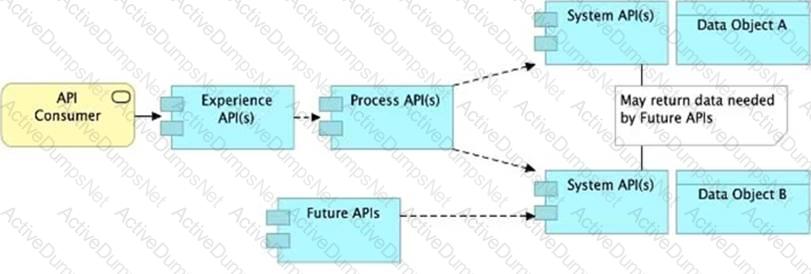
Question 24

Refer to the exhibit.

What is the best way to decompose one end-to-end business process into a collaboration of Experience, Process, and System APIs?

A) Handle customizations for the end-user application at the Process API level rather than the Experience API level

B) Allow System APIs to return data that is NOT currently required by the identified Process or Experience APIs

C) Always use a tiered approach by creating exactly one API for each of the 3 layers (Experience, Process and System APIs)

D) Use a Process API to orchestrate calls to multiple System APIs, but NOT to other Process APIs

Question # 24

Options:

A.

Option A

B.

Option B

C.

Option C

D.

Option D

Question 25

What best explains the use of auto-discovery in API implementations?

Options:

A.

It makes API Manager aware of API implementations and hence enables it to enforce policies

B.

It enables Anypoint Studio to discover API definitions configured in Anypoint Platform

C.

It enables Anypoint Exchange to discover assets and makes them available for reuse

D.

It enables Anypoint Analytics to gain insight into the usage of APIs

Question 26

An API implementation is deployed to CloudHub.

What conditions can be alerted on using the default Anypoint Platform functionality, where the alert conditions depend on the API invocations to an API implementation?

Options:

A.

When the API invocations are sent directly to the internal DNS record of the API implementation

B.

When the API invocations are not over-a- secure TLS/SSL communication channel

C.

When the APL invecations originate from a geography different than the API

D.

When the number of API invocations are below a threshold

Question 27

A Rate Limiting policy is applied to an API implementation to protect the back-end system. Recently, there have been surges in demand that cause some API client

POST requests to the API implementation to be rejected with policy-related errors, causing delays and complications to the API clients.

How should the API policies that are applied to the API implementation be changed to reduce the frequency of errors returned to API clients, while still protecting the back-end

system?

Options:

A.

Keep the Rate Limiting policy and add 9 Client ID Enforcement policy

B.

Remove the Rate Limiting policy and add an HTTP Caching policy

C.

Remove the Rate Limiting policy and add a Spike Control policy

D.

Keep the Rate Limiting policy and add an SLA-based Spike Control policy

Question 28

What is the most performant out-of-the-box solution in Anypoint Platform to track transaction state in an asynchronously executing long-running process implemented as a Mule application deployed to multiple CloudHub workers?

Options:

A.

Redis distributed cache

B.

java.util.WeakHashMap

C.

Persistent Object Store

D.

File-based storage

Question 29

How are an API implementation, API client, and API consumer combined to invoke and process an API?

Options:

A.

The API consumer creates an API implementation, which receives API invocations from an API such that they are processed for an API client

B.

The API client creates an API consumer, which receives API invocations from an API such that they are processed for an API implementation

C.

The ApI consumer creates an API client, which sends API invocations to an API such that they are processed by an API implementation

D.

The ApI client creates an API consumer, which sends API invocations to an API such that they are processed by an API implementation

Question 30

When using CloudHub with the Shared Load Balancer, what is managed EXCLUSIVELY by the API implementation (the Mule application) and NOT by Anypoint Platform?

Options:

A.

The assignment of each HTTP request to a particular CloudHub worker

B.

The logging configuration that enables log entries to be visible in Runtime Manager

C.

The SSL certificates used by the API implementation to expose HTTPS endpoints

D.

The number of DNS entries allocated to the API implementation

Question 31

An Anypoint Platform organization has been configured with an external identity provider (IdP) for identity management and client management. What credentials or token must be provided to Anypoint CLI to execute commands against the Anypoint Platform APIs?

Options:

A.

The credentials provided by the IdP for identity management

B.

The credentials provided by the IdP for client management

C.

An OAuth 2.0 token generated using the credentials provided by the IdP for client management

D.

An OAuth 2.0 token generated using the credentials provided by the IdP for identity management

Question 32

Question 10: Skipped

An API implementation returns three X-RateLimit-* HTTP response headers to a requesting API client. What type of information do these response headers indicate to the API client?

Options:

A.

The error codes that result from throttling

B.

A correlation ID that should be sent in the next request

C.

The HTTP response size

D.

The remaining capacity allowed by the API implementation

Question 33

What condition requires using a CloudHub Dedicated Load Balancer?

Options:

A.

When cross-region load balancing is required between separate deployments of the same Mule application

B.

When custom DNS names are required for API implementations deployed to customer-hosted Mule runtimes

C.

When API invocations across multiple CloudHub workers must be load balanced

D.

When server-side load-balanced TLS mutual authentication is required between API implementations and API clients

Question 34

An API with multiple API implementations (Mule applications) is deployed to both CloudHub and customer-hosted Mule runtimes. All the deployments are managed by

the MuleSoft-hosted control plane. An alert needs to be triggered whenever an API implementation stops responding to API requests, even if no API clients have called the API implementation for some time.

What is the most effective out-of-the-box solution to create these alerts to monitor the API implementations?

Options:

A.

Create monitors in Anypoint Functional Monitoring for the API implementations, where each monitor repeatedly invokes an API implementation endpoint

B.

Add code to each API client to send an Anypoint Platform REST API request to generate a custom alert in Anypoint Platform when an API invocation times out

C.

Handle API invocation exceptions within the calling API client and raise an alert from that API client when such an exception is thrown

D.

Configure one Worker Not Responding alert.in Anypoint Runtime Manager for all API implementations that will then monitor every API implementation

Question 35

Which of the following best fits the definition of API-led connectivity?

Options:

A.

API-led connectivity is not just an architecture or technology but also a way to organize people and processes for efficient IT delivery in the organization

B.

API-led connectivity is a 3-layered architecture covering Experience, Process and System layers

C.

API-led connectivity is a technology which enabled us to implement Experience, Process and System layer based APIs

Question 36

What do the API invocation metrics provided by Anypoint Platform provide?

Options:

A.

ROI metrics from APIs that can be directly shared with business users

B.

Measurements of the effectiveness of the application network based on the level of reuse

C.

Data on past API invocations to help identify anomalies and usage patterns across various APIs

D.

Proactive identification of likely future policy violations that exceed a given threat threshold

Question 37

Which of the below, when used together, makes the IT Operational Model effective?

Options:

A.

Create reusable assets, Do marketing on the created assets across organization, Arrange time to time LOB reviews to ensure assets are being consumed or not

B.

Create reusable assets, Make them discoverable so that LOB teams can self-serve and browse the APIs, Get active feedback and usage metrics

C.

Create resuable assets, make them discoverable so that LOB teams can self-serve and browse the APIs

Question 38

An organization wants MuleSoft-hosted runtime plane features (such as HTTP load balancing, zero downtime, and horizontal and vertical scaling) in its Azure environment. What runtime plane minimizes the organization's effort to achieve these features?

Options:

A.

Anypoint Runtime Fabric

B.

Anypoint Platform for Pivotal Cloud Foundry

C.

CloudHub

D.

A hybrid combination of customer-hosted and MuleSoft-hosted Mule runtimes

Question 39

What is a best practice when building System APIs?

Options:

A.

Document the API using an easily consumable asset like a RAML definition

B.

Model all API resources and methods to closely mimic the operations of the backend system

C.

Build an Enterprise Data Model (Canonical Data Model) for each backend system and apply it to System APIs

D.

Expose to API clients all technical details of the API implementation's interaction wifch the backend system

Question 40

When designing an upstream API and its implementation, the development team has been advised to NOT set timeouts when invoking a downstream API, because that downstream API has no SLA that can be relied upon. This is the only downstream API dependency of that upstream API.

Assume the downstream API runs uninterrupted without crashing. What is the impact of this advice?

Options:

A.

An SLA for the upstream API CANNOT be provided

B.

The invocation of the downstream API will run to completion without timing out

C.

A default timeout of 500 ms will automatically be applied by the Mule runtime in which the upstream API implementation executes

D.

A toad-dependent timeout of less than 1000 ms will be applied by the Mule runtime in which the downstream API implementation executes

Question 41

Refer to the exhibit.

What is a valid API in the sense of API-led connectivity and application networks?

A) Java RMI over TCP

B) Java RMI over TCP

Question # 41

C) CORBA over HOP

D) XML over UDP

Options:

A.

Option A

B.

Option B

C.

Option C

D.

Option D

Question 42

Refer to the exhibit.

Three business processes need to be implemented, and the implementations need to communicate with several different SaaS applications.

These processes are owned by separate (siloed) LOBs and are mainly independent of each other, but do share a few business entities. Each LOB has one development team and their own budget

In this organizational context, what is the most effective approach to choose the API data models for the APIs that will implement these business processes with minimal redundancy of the data models?

A) Build several Bounded Context Data Models that align with coherent parts of the business processes and the definitions of associated business entities

Question # 42

B) Build distinct data models for each API to follow established micro-services and Agile API-centric practices

C) Build all API data models using XML schema to drive consistency and reuse across the organization

D) Build one centralized Canonical Data Model (Enterprise Data Model) that unifies all the data types from all three business processes, ensuring the data model is consistent and non-redundant

Options:

A.

Option A

B.

Option B

C.

Option C

D.

Option D

Question 43

A retail company with thousands of stores has an API to receive data about purchases and insert it into a single database. Each individual store sends a batch of purchase data to the API about every 30 minutes. The API implementation uses a database bulk insert command to submit all the purchase data to a database using a custom JDBC driver provided by a data analytics solution provider. The API implementation is deployed to a single CloudHub worker. The JDBC driver processes the data into a set of several temporary disk files on the CloudHub worker, and then the data is sent to an analytics engine using a proprietary protocol. This process usually takes less than a few minutes. Sometimes a request fails. In this case, the logs show a message from the JDBC driver indicating an out-of-file-space message. When the request is resubmitted, it is successful. What is the best way to try to resolve this throughput issue?

Options:

A.

se a CloudHub autoscaling policy to add CloudHub workers

B.

Use a CloudHub autoscaling policy to increase the size of the CloudHub worker

C.

Increase the size of the CloudHub worker(s)

D.

Increase the number of CloudHub workers

Question 44

Which three tools automate the deployment of Mule applications?

Choose 3 answers

Options:

A.

Runtime Manager

B.

Anypoint Platform CLI

C.

Platform APIs

D.

Anypoint Studio

E.

Mule Mayen plugin

F.

API Community Manager

Question 45

What are the major benefits of MuleSoft proposed IT Operating Model?

Options:

A.

1. Decrease the IT delivery gap2. Meet various business demands without increasing the IT capacity3. Focus on creation of reusable assets first. Upon finishing creation of all the possible assets then inform the LOBs in the organization to start using them

B.

1. Decrease the IT delivery gap2. Meet various business demands by increasing the IT capacity and forming various IT departments3. Make consumption of assets at the rate of production

C.

1. Decrease the IT delivery gap2. Meet various business demands without increasing the IT capacity3. Make consumption of assets at the rate of production

Page: 1 / 15
Total 152 questions