Summer Sale Limited Time Flat 70% Discount offer - Ends in 0d 00h 00m 00s - Coupon code: 70spcl

HashiCorp Terraform-Associate-004 HashiCorp Certified: Terraform Associate (004) (HCTA0-004) Exam Practice Test

HashiCorp Certified: Terraform Associate (004) (HCTA0-004) Questions and Answers

Question 1

When does Terraform create the .terraform.lock.hc1 file?

Options:

A.

After your first terraform plan

B.

After your first terraform apply

C.

After your first terraform init

D.

When you enable state locking

Question 2

When you run terraform apply -refresh-only, which of the following is not consulted by Terraform to update the state file?

Options:

A.

Terraform configuration files defining the resources.

B.

Authentication credentials for the provider.

C.

The most recent state file.

D.

The actual infrastructure as reported by the provider API.

Question 3

Which task does terraform init not perform?

Options:

A.

Discovers all providers used in the configuration and downloads them.

B.

Validates that values are set for all required input variables.

C.

Connects to the configured backend.

D.

Discovers any remote modules and downloads them.

Question 4

You’ve updated your Terraform configuration, and you need to preview the proposed changes to your infrastructure. Which command should you run?

Options:

A.

terraform show

B.

terraform plan

C.

terraform validate

D.

terraform get

Question 5

Which of the following module source paths does not specify a remote module?

Options:

A.

Source = “module/consul’’

B.

Source = ‘’githhub.comicrop/example’’

C.

Source =’’git@github.com:hasicrop/example.git’’

D.

Source = ‘’hasicrop/consul/aws’’

Question 6

You can configure Terraform to log to a file using the TF_LOG environment variable.

Options:

A.

True

B.

False

Question 7

Exhibit:

resource " kubernetes_namespace " " example " {

name = " test "

}

A resource block is shown in the exhibit. How would you reference the name attribute of this resource in HCL?

Options:

A.

kubernetes_namespace.example,name

B.

kubernetes_namespace.test.name

C.

data.kubernetes_namespace.name

D.

resource.kubernetes_namespace.example.name

Question 8

Only the user that generated a plan may apply it.

Options:

A.

True

B.

False

Question 9

Which features do HCP Terraform workspaces provide that are not available in Terraform Community Edition? (Pick the 3 correct responses below.)

Options:

A.

State versions and run history.

B.

Automatic detection of common security issues.

C.

Store Terraform and environment variables in variable sets.

D.

Remote execution of Terraform operations.

E.

Store your configuration in a Version Control System (VCS).

F.

Support for multiple cloud providers.

Question 10

Terraform requires using a different provider for each cloud provider where you want to deploy resources.

Options:

A.

True

B.

False

Question 11

Which command(s) adds existing resources in a public cloud into Terraform state?

Options:

A.

terraform init

B.

terraform plan

C.

terraform refresh

D.

terraform import

E.

All of these

Question 12

When using a remote backend or terraform Cloud integration, where does Terraform save resource sate?

Options:

A.

In an environment variable

B.

On the disk

C.

In the remote backend or Terraform Cloud

D.

In memory

Question 13

You want to define multiple data disks as nested blocks inside the resource block for a virtual machine. What Terraform feature would help you define the blocks using the values in a variable?

Options:

A.

Local values

B.

Count arguments

C.

Collection functions

D.

Dynamic blocks

Question 14

You created infrastructure outside the Terraform workflow that you now want to manage using Terraform. Which command brings the infrastructure into Terraform state?

Options:

A.

terraform get

B.

terraform refresh

C.

terraform import

D.

terraform init

Question 15

Which are examples of infrastructure as code? Choose two correct answers.

Options:

A.

Cloned virtual machine images

B.

Versioned configuration files

C.

Change management database records

D.

Doctor files

Question 16

You’ve enabled DEBUG-level logging for Terraform, and you’d like to send the log data to a file. Which action should you take?

Options:

A.

Set the TF_LOG_PATH environment variable.

B.

Update the Terraform CLI configuration file.

C.

Add a path argument to the terraform block.

D.

Run the terraform output command.

Question 17

A developer on your team is going to leaf down an existing deployment managed by Terraform and deploy a new one. However, there is a server resource named aws instant.ubuntu[l] they would like to keep. What command should they use to tell Terraform to stop managing that specific resource?

Options:

A.

Terraform plan rm:aws_instance.ubuntu[1]

B.

Terraform state rm:aws_instance.ubuntu[1]

C.

Terraform apply rm:aws_instance.ubuntu[1]

D.

Terraform destory rm:aws_instance.ubuntu[1]

Question 18

A Terraform provider is NOT responsible for:

Options:

A.

Exposing resources and data sources based on an APUI

B.

Managing actions to take based on resources differences

C.

Understanding API interactions with some service

D.

Provisioning infrastructure in multiple

Question 19

Which Terraform collection type stores values as key/value pairs?

Options:

A.

map

B.

set

C.

list

D.

tuple

Question 20

Your team adopts AWS CloudFormation as the standardized method for provisioning public cloud resources. Which scenario presents a challenge for your team?

Options:

A.

Building a reusable code base that can deploy resources into any AWS region.

B.

Managing a new application stack built on AWS-native services.

C.

Automating a manual, web console-based provisioning process.

D.

Deploying new infrastructure into Microsoft Azure.

Question 21

You want to use API tokens and other secrets within your team ' s Terraform workspaces. Where does HashiCorp recommend you store these sensitive values?

(Pick 3 correct responses)

Options:

A.

In a plaintext document on a shared drive.

B.

In a terraform.tfvars file, checked into version control.

C.

In a terraform.tfvars file, securely managed and shared with your team.

D.

In an HCP Terraform/Terraform Cloud variable, with the sensitive option checked.

E.

In HashiCorp Vault.

Question 22

When using Terraform to deploy resources into Azure, which scenarios are true regarding state files? (Choose two.)

Options:

A.

When you change a Terraform-managed resource via the Azure Cloud Console, Terraform updates the state file to reflect the change during the next plan or apply

B.

Changing resources via the Azure Cloud Console records the change in the current state file

C.

When you change a resource via the Azure Cloud Console, Terraform records the changes in a new state file

D.

Changing resources via the Azure Cloud Console does not update current state file

Question 23

You corrected a typo in a resource name, changing it from aws_s3_bucket.photoes to aws_s3_bucket.photos. You want to update the Terraform state so that the existing resource is recognized under the new name, without destroying and recreating it. Which configuration should you use?

Options:

A.

Remove the old resource from your configuration and re-import it.

B.

Run terraform apply -refresh-only.

C.

Do nothing — Terraform will automatically update the state.

D.

Add a moved block to your configuration.

Question 24

You can execute terraform fmt to standardize all Terraform configurations within the current working directory to Terraform’s canonical format and style.

Options:

A.

True

B.

False

Question 25

Does terraform init create an example main.tf file in the current directory?

Options:

A.

True

B.

False

Question 26

When declaring a variable, setting the sensitive argument to true will prevent the value from being stored in the state file.

Options:

A.

True

B.

False

Question 27

Exhibit:

variable " sizes " {

type = list(string)

description = " Valid server sizes "

default = [ " small " , " medium " , " large " ]

}

A variable declaration is shown in the exhibit. Which is the correct way to get the value of medium from this variable?

Options:

A.

var.sizes[0]

B.

var.sizes[1]

C.

var.sizes[2]

D.

var.sizes[3]

Question 28

When should you use the terraform force-unlock command?

Options:

A.

When terraform apply has failed due to a state lock.

B.

When you have a high-priority change.

C.

When automatic unlocking has failed.

D.

When you see a status message stating that Terraform cannot acquire the lock.

Question 29

You are tasked with making a change to an infrastructure stack running in a public cloud using HCP Terraform/Terraform Cloud. Which pattern follows IaC best practices?

Options:

A.

Make the change via the public cloud API endpoint.

B.

Submit a pull request and wait for an approved merge of the proposed changes.

C.

Clone the repository containing your infrastructure code and then run the code.

D.

Use the public cloud console to make the change after approval.

E.

Make the change programmatically via the cloud CLI.

Question 30

What is the purpose of the .terraform directory in a Terraform workspace?

Options:

A.

The directory is where Terraform creates and maintains the state file to track the underlying resources it creates and manages.

B.

The directory is used to convert and store Terraform configuration files into API calls to communicate with the targeted platform.

C.

The directory contains the provider credentials and the .tfvars files to prevent them from being committed to version control by accident.

D.

The directory contains plugins and modules that Terraform downloads during initialization, along with other important information.

Question 31

Which is a recommended way to share Terraform state across teams?

Options:

A.

Use a remote state backend.

B.

No additional configuration is recommended.

C.

Store the terraform.tfstate file in version control.

D.

Store the terraform.tfstate file in HashiCorp Vault.

Question 32

You just scaled your VM infrastructure and realize you set the count variable to the wrong value. You correct the value and save your change. What must you do next to make your infrastructure match your configuration?

Options:

A.

Reinitialize because your configuration has changed.

B.

Inspect all Terraform outputs to make sure they are correct.

C.

Inspect your Terraform state because you want to change it.

D.

Run terraform apply and confirm the planned changes.

Question 33

Which of the following are advantages of using infrastructure as code (laC) instead of provisioning with a graphical user interface (GUI)? Choose two correct answers.

Options:

A.

Prevents manual modifications to your resources

B.

Lets you version, reuse, and share infrastructure configuration

C.

Secures your credentials

D.

Provisions the same resources at a lower cost

E.

Reduces risk of operator error

Question 34

The Terraform binary version and provider versions must match each other in a single configuration.

Options:

A.

True

B.

False

Question 35

When do you need to explicitly execute Terraform in refresh-only mode?

Options:

A.

Before every terraform plan.

B.

Before every terraform apply.

C.

Before every terraform import.

D.

None of the above.

Question 36

terraform destroy is the only way to remove infrastructure.

Options:

A.

True

B.

False

Question 37

Where in your Terraform configuration do you specify remote state storage settings?

Options:

A.

The resource block

B.

The provider block

C.

The data block

D.

The terraform block

Question 38

You ate making changes to existing Terraform code to add some new infrastructure. When is the best time to run terraform validate?

Options:

A.

After you run terraform apply so you can validate your infrastructure

B.

Before you run terraform apply so you can validate your provider credentials

C.

Before you run terraform plan so you can validate your code syntax

D.

After you run terraform plan so you can validate that your state file is consistent with your infrastructure

Question 39

What value does the Terraform Cloud private registry provide over the public Terraform Module Registry?

Options:

A.

The ability to share modules publicly with any user of Terraform

B.

The ability to restrict modules to members of Terraform Cloud or Enterprise organizations

C.

The ability to tag modules by version or release

D.

The ability to share modules with public Terraform users and members of Terraform Cloud Organizations

Question 40

You have used Terraform lo create an ephemeral development environment in the (loud and are now ready to destroy all the Infrastructure described by your Terraform configuration To be safe, you would like to first see all the infrastructure that Terraform will delete.

Which command should you use to show all of the resources that mil be deleted? Choose two correct answers.

Options:

A.

Run terraform state rm ‘

B.

Run terraform show :destroy

C.

Run terraform destroy and it will first output all the resource that will be deleted before prompting for approval

D.

Run terraform plan .destory

Question 41

Only the user that generated a terraform plan may apply it.

Options:

A.

True

B.

False

Question 42

What is the purpose of the terraform.lock.hcl file in Terraform?

Options:

A.

There is no such file.

B.

Storing references to workspaces, which are locked.

C.

Preventing Terraform runs from occurring.

D.

Tracking specific provider dependencies.

Question 43

You should run terraform fnt to rewrite all Terraform configurations within the current working directory to conform to Terraform-style conventions.

Options:

A.

True

B.

False

Question 44

You have never used Terraform before and would like to test it out using a shared team account for a cloud provider. The shared team account already contains 15 virtual machines (VM). You develop a Terraform configuration containing one VM. perform terraform apply, and see that your VM was created successfully. What should you do to delete the newly-created VM with Terraform?

Options:

A.

The Terraform state file contains all 16 VMs in the team account. Execute terraform destroy and select the newly-created VM.

B.

Delete the Terraform state file and execute terraform apply.

C.

The Terraform state file only contains the one new VM. Execute terraform destroy.

D.

Delete the VM using the cloud provider console and terraform apply to apply the changes to the Terraform state file.

Question 45

Question # 45

A resource block is shown in the Exhibit space of this page. What is the provider for this resource?

Options:

A.

test

B.

vpc

C.

aws

D.

main

Question 46

Which parameters does terraform import require? Choose two correct answers.

Options:

A.

Provider

B.

Resource ID

C.

Resource address

D.

Path

Question 47

Terraform installs its providers during which phase?

Options:

A.

Plan

B.

Init

C.

Refresh

D.

All of the above

Question 48

What type of block is used to construct a collection of nested configuration blocks?

Options:

A.

Dynamic

B.

For_each

C.

Nesting

D.

repeated.

Question 49

When you use a backend that requires authentication, it is best practice to:

Options:

A.

Run all Terraform commands on a shared server or container.

B.

Configure the authentication credentials in your Terraform configuration files, and store them in version control.

C.

Use environment variables to configure authentication credentials outside of your Terraform configuration.

D.

None of the above.

Question 50

What information does the public Terraform Module Registry automatically expose about published modules?

Options:

A.

Required input variables

B.

Optional inputs variables and default values

C.

Outputs

D.

All of the above

E.

None of the above

Question 51

Which command add existing resources into Terraform state?

Options:

A.

Terraform init

B.

Terraform plan

C.

Terraform refresh

D.

Terraform import

E.

All of these

Question 52

What is the primary purpose of IaC (Infrastructure as Code)?

Options:

A.

To provision infrastructure cheaply.

B.

To programmatically create and configure resources.

C.

To define a vendor-agnostic API.

D.

To define a pipeline to test and deliver software.

Question 53

You’ve just finished refactoring part of your Terraform workspace’s configuration to use a module to manage some of your resources. When you plan your changes, you notice that Terraform will destroy and recreate the affected resources. Doing so could cause unintended downtime in the application your workspace manages. What supported approach should you take to complete the refactor without destroying and recreating your resources?

Options:

A.

Add moved blocks to your configuration to let Terraform know the new resource addresses for the affected resources.

B.

Run the terraform console command to edit your workspace ' s state and update the resource names.

C.

Manually edit your terraform.tfstate file and update the resource names.

D.

Open your cloud provider ' s console and rename the affected resources.

Question 54

A Terraform backend determines how Terraform loads state and stores updates when you execute which command?

Options:

A.

apply

B.

destroy

C.

Both of these are correct.

D.

Neither of these are correct.

Question 55

Your team is collaborating on infrastructure using Terraform and wants to format code to follow Terraform language style conventions. How can you update your code to meet these requirements?

Options:

A.

Run terraform fmt to update your Terraform configurations.

B.

Replace all tabs with spaces within your Terraform configuration files.

C.

Run terraform validate prior to executing terraform plan or terraform apply.

D.

Terraform automatically formats configuration on terraform apply.

Question 56

You have just developed a new Terraform configuration for two virtual machines with a cloud provider. You would like to create the infrastructure for the first time.

Which Terraform command should you runfirst?

Options:

A.

terraform apply

B.

terraform init

C.

terraform plan

D.

terraform show

Question 57

You want to use API tokens and other secrets within your team ' s Terraform workspaces. Where does HashiCorp recommend you store these sensitive values? (Pick 3)

Options:

A.

In a plaintext document on a shared drive.

B.

In a terraform.tfvars file, checked into version control.

C.

In a terraform.tfvars file, securely managed and shared with your team.

D.

In an HCP Terraform/Terraform Cloud variable, with the sensitive option checked.

E.

In HashiCorp Vault.

Question 58

Why is it important to treat your Terraform state file as sensitive?

Options:

A.

It can contain information such as resource passwords and keys.

B.

It stores all environment variables from the machine that created it.

C.

It can be manually edited to change deployed resources.

D.

It contains personal information about the last user to update it.

Question 59

Which of the following should you add in the required_providers block to define a provider version constraint?

Options:

A.

version

B.

version = " 3.1 "

C.

version: 3.1

D.

version - 3.1

Question 60

Terraformrequiresthe Go runtime as a prerequisite for installation.

Options:

A.

True

B.

False

Question 61

The terraform output command shows outputs from child modules.

Options:

A.

True

B.

False

Question 62

Terraform configuration can only import modules from the public registry.

Options:

A.

True

B.

False

Question 63

What type of information can be found on the Terraform Registry when using published modules?

Options:

A.

Required input variables.

B.

Outputs.

C.

Optional input variables and default values.

D.

All of the above.

Question 64

Before you can use a new backend or HCP Terraform/Terraform Cloud integration, you must first execute terraform init.

Options:

A.

True

B.

False

Question 65

How is terraform import run?

Options:

A.

As a part of terraform init

B.

As a part of terraform plan

C.

As a part of terraform refresh

D.

By an explicit call

E.

All of the above

Question 66

Your team adopts AWS CloudFormation as the standardized method for provisioning public cloud resources.

Which scenario presents a challenge for your team?

Options:

A.

Building a reusable codebase that can deploy resources into any AWS region.

B.

Managing a new application stack built on AWS-native services.

C.

Deploying new infrastructure into Microsoft Azure.

D.

Automating a manual, web console-based provisioning process.

Question 67

Which of these commands makes your code more human readable?

Options:

A.

Terraform validate

B.

Terraform output

C.

Terraform show

D.

Terraform file

Question 68

Which is not a benefit of adopting IaC (Infrastructure as Code)?

Options:

A.

Reusability of code

B.

Automation

C.

A GUI (Graphical User Interface)

D.

Versioning

Question 69

When you include a module block in your configuration that references a module from the Terraform Registry, the " version " attribute is required.

Options:

A.

True

B.

False

Question 70

Your configuration contains a module block that references a module from the Terraform Registry and sets the version argument to 1.0. You just published a new version of the module and updated your configuration to point to version 1.1.

Which command must be run to install the new version?

Options:

A.

terraform init

B.

terraform modules

C.

terraform plan

D.

terraform apply

Question 71

Terraform configuration (including any module references) can contain only one Terraform provider type.

Options:

A.

True

B.

False

Question 72

Why does this backend configuration not follow best practices?

Question # 72

Options:

A.

An alias meta-argument should be included in backend blocks whenever possible

B.

You should use the local enhanced storage backend whenever possible

C.

You should not store credentials in Terraform configuration

D.

The backend configuration should contain multiple credentials so that more than one user can execute terraform plan and terraform apply

Question 73

You must use different Terraform commands depending on the cloud provider you use.

Options:

A.

True

B.

False

Question 74

The exhibit below shows part of a Terraform configuration you have been asked to update. The name of the Azure Virtual Network should be set to the name of the resource group followed by a dash and the word vnet.

Exhibit:

data " azurerm_resource_group " " example " {

name = var.resource_group_name

}

resource " azurerm_virtual_network " " example " {

name = ______________________

}

Which expression fulfills this requirement?

Options:

A.

" ${data.azurerm_resource_group.example.name}-vnet "

B.

concat(data.azurerm_resource_group.example.name, " - " , " vnet " )

C.

join( " - " , var.resource_group_name, " vnet " )

D.

" ${azurerm_resource_group.example.name}-vnet "

Question 75

Your security team scanned some Terraform workspaces and found secrets stored in plaintext in state files. How can you protect that data?

Options:

A.

Edit your state file to scrub out the sensitive data

B.

Always store your secrets in a secrets.tfvars file

C.

Delete the state file every time you run Terraform

D.

Store the state in an encrypted backend

Question 76

A module block used in your configuration is shown in the exhibit. You have been asked to update the version of this module from 4.2.1 to 5.0.0.

Exhibit:

module " compute " {

source = " Azure/compute/azurerm "

version = " 4.2.1 "

}

Which two steps must you take to accomplish this?

Options:

A.

Run the terraform init command.

B.

Run the terraform pull command.

C.

Update the version argument in the module block.

D.

Remove the version argument from the module block.

Question 77

Why would you use the -replace flag for terraform apply?

Options:

A.

You want Terraform to ignore a resource on the next apply

B.

You want Terraform to destroy all the infrastructure in your workspace

C.

You want to force Terraform to destroy a resource on the next apply

D.

You want to force Terraform to destroy and recreate a resource on the next apply

Question 78

You have deployed a new webapp with a public IP address on a cloud provider. However, you did not create any outputs for your code. What is the best method to quickly find the IP address of the resource you deployed?

Options:

A.

In a new folder, use the terraform_remote_state data source to load in the state file, then write an output for each resource that you find the state file

B.

Run terraform state list to find the name of the resource, then terraform state show to find the attributes including public IP address

C.

Run terraform output ip_address to view the result

D.

Run terraform destroy then terraform apply and look for the IP address in stdout

Question 79

One remote backend configuration always maps to a single remote workspace.

Options:

A.

True

B.

False

Question 80

Which configuration consistency errors does terraform validate report?

Options:

A.

Terraform module isn ' t the latest version

B.

Differences between local and remote state

C.

Declaring a resource identifier more than once

D.

A mix of spaces and tabs in configuration files

Question 81

Running terraform fmt without any flags in a directory with Terraform configuration files will check the formatting of those files, but will never change their contents.

Options:

A.

True

B.

False

Question 82

terraform apply will fail if you have not run terraform plan first to update the plan output.

Options:

A.

True

B.

False

Question 83

A developer accidentally launched a VM (virtual machine) outside of the Terraform workflow and ended up with two servers with the same name. They don ' t know which VM Terraform manages but do have a list of all active VM IDs.

Which of the following methods could you use to discover which instance Terraform manages?

Options:

A.

Run terraform state list to find the names of all VMs, then run terraform state show for each of them to find which VM ID Terraform manages

B.

Update the code to include outputs for the ID of all VMs, then run terraform plan to view the outputs

C.

Run terraform taint/code on all the VMs to recreate them

D.

Use terraform refresh/code to find out which IDs are already part of state

Question 84

Module variable assignments are inherited from the parent module and you do not need to explicitly set them.

Options:

A.

True

B.

False

Question 85

You have a simple Terraform configuration containing one virtual machine (VM) in a cloud provider. You run terraform apply and the VM is created successfully. What will happen if you terraform apply again immediately afterward without changing any Terraform code?

Options:

A.

Terraform will terminate and recreate the VM.

B.

Terraform will create another duplicate VM.

C.

Terraform will apply the VM to the state file.

D.

Nothing

Question 86

While attempting to deploy resources into your cloud provider using Terraform, you begin to see some odd behavior and experience slow responses. In order to troubleshoot you decide to turn on Terraform debugging. Which environment variables must be configured to make Terraform ' s logging more verbose?

Options:

A.

TF_LOG_PAIH

B.

TF_LOG

C.

TF_VAR_log_path

D.

TF_VAR_log_level

Question 87

Which of the following commands would you use to access all of the attributes and details of a resource managed by Terraform?

Options:

A.

terraform state list ‘provider_type.name’

B.

terraform state show ‘provider_type.name’

C.

terraform get ‘provider_type.name’

D.

terraform state list

Question 88

What is the Terraform style convention for indenting a nesting level compared to the one above it?

Options:

A.

With two spaces.

B.

With four spaces.

C.

With three spaces.

D.

With a tab.

Question 89

What is the primary purpose of Infrastructure as Code (IaC)?

Options:

A.

To provision infrastructure cheaply.

B.

To programmatically create and configure resources.

C.

To define a vendor-agnostic API

D.

To define a pipeline to test and deliver software.

Question 90

A developer launched a VM outside of the Terraform workflow and ended up with two servers with the same name. They are unsure which VM is managed with Terraform, but they do have a list of all active VM IDs. Which method could you use to determine which instance Terraform manages?

Options:

A.

Modify the Terraform configuration to add an import block for both of the virtual machines.

B.

Run a terraform apply -refresh to identify the virtual machine IDs that are already managed by Terraform.

C.

Run terraform state rm on both VMs, then terraform apply to recreate the correct one.

D.

Run terraform state list to find the names of all VMs, then run terraform state show for each of them to find which VM ID Terraform manages.

Question 91

What is one disadvantage of using dynamic blocks in Terraform?

Options:

A.

Dynamic blocks can construct repeatable nested blocks

B.

Terraform will run more slowly

C.

They cannot be used to loop through a list of values

D.

They make configuration harder to read and understand

Question 92

When using multiple configurations of the same Terraform provider, what meta-argument must you include in any non-default provider configurations?

Options:

A.

depends_on

B.

alias

C.

name

D.

id

Question 93

What’s the proper syntax for the plan command?

Options:

A.

terraform apply -var-file=tfplan

B.

terraform plan -target=tfplan

C.

terraform plan -generate-config-out=tfplan

D.

terraform plan -out=tfplan

Question 94

How can you configure a Terraform workspace to store its state remotely?

Options:

A.

Add a cloud block inside the terraform block.

B.

Add a backend block inside the terraform block.

C.

Set the TERAFORM_CLOUD environment variable.

D.

Set the TERRAFORM_BACKEND environment variable.

Question 95

Your DevOps team is currently using the local backend for your Terraform configuration. You would like to move to a remote backend to store the state file in a central location. Which of the following backends would not work?

Options:

A.

Artifactory

B.

Amazon S3

C.

Terraform Cloud

D.

Git

Question 96

A module can always refer to all variables declared in its parent module.

Options:

A.

True

B.

False

Question 97

What is modified when executing Terraform inrefresh-only mode?

Options:

A.

Your Terraform configuration.

B.

Your Terraform plan.

C.

Your state file.

D.

Your cloud infrastructure.

Question 98

Which of the following is not a valid source path for specifying a module?

Options:

A.

source - " github.com/hashicorp/examplePref-ul.0.8M

B.

source = " ./module?version=vl.6.0 "

C.

source - " hashicorp/consul/aws "

D.

source - " ./module "

Question 99

You ate creating a Terraform configuration which needs to make use of multiple providers, one for AWS and one for Datadog. Which of the following provider blocks would allow you to do this?

Question # 99

Options:

A.

Option A

B.

Option B

C.

Option C

Question 100

Which is a benefit of the Terraform state file?

Options:

A.

A state file can schedule recurring infrastructure tasks.

B.

A state file is the desired state expressed by the Terraform code files.

C.

A state file is a source of truth for resources provisioned with Terraform.

D.

A state file is a source of truth for resources provisioned with a public cloud console.

Question 101

terraform apply is failing with the following error. What next step should you take to determine the root cause of the problem?

Error:

yaml

CopyEdit

Error loading state: AccessDenied: Access Denied

status code: 403, request id: 288766CE5CCA24A0, host id: web.example.com

Options:

A.

Run terraform login to reauthenticate with the provider.

B.

Set TF_LOG=DEBUG.

C.

Review /var/log/terraform.log for error messages.

D.

Review syslog for Terraform error messages.

Question 102

Which command must you first run before performing further Terraform operations in a working directory?

Options:

A.

terraform import

B.

terraform workspace

C.

terraform plan

D.

terraform init

Question 103

Which of the following is not a benefit of adopting infrastructure as code?

Options:

A.

Versioning

B.

A Graphical User Interface

C.

Reusability of code

D.

Automation

Question 104

How would you reference the volume IDs associated with the ebs_block_device blocks in this configuration?
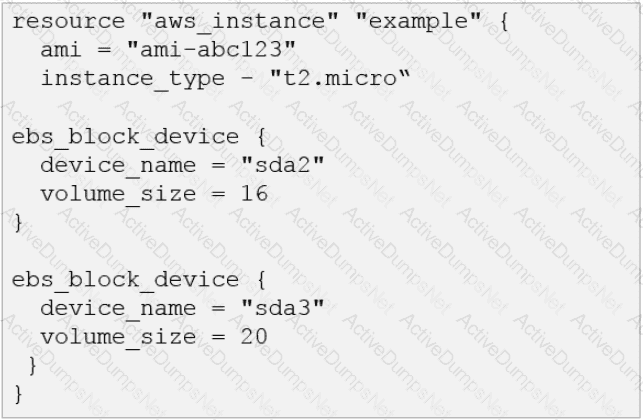
Question # 104

Options:

A.

aws_instance.example.ebs_block_device[sda2,sda3).volume_id

B.

aws_lnstance.example.ebs_block_device.[*].volume_id

C.

aws_lnstance.example.ebs_block_device.volume_ids

D.

aws_instance.example-ebs_block_device.*.volume_id

Question 105

Module version is required to reference a module on the Terraform Module Registry.

Options:

A.

True

B.

False

Question 106

terraform validate reports syntax check errors for which of the following?

Options:

A.

Code contains tabs for indentation instead of spaces

B.

There is a missing value for a variable

C.

The state file does not match the current infrastructure

D.

None of the above

Question 107

What kind of configuration block will create an infrastructure object with settings specified within the block?

Options:

A.

provider

B.

state

C.

data

D.

resource

Question 108

Your risk management organization requires that new AWS S3 buckets must be private and encrypted at rest. How can Terraform Cloud automatically and proactively enforce this security control?

Options:

A.

Auditing cloud storage buckets with a vulnerability scanning tool

B.

By adding variables to each Terraform Cloud workspace to ensure these settings are always enabled

C.

With an S3 module with proper settings for buckets

D.

With a Sentinel policy, which runs before every apply

Question 109

Which method for sharing Terraform modules fulfills the following criteria:

Keeps the module configurations confidential within your organization.

Supports Terraform ' s semantic version constraints.

Provides a browsable directory of your modules.

Options:

A.

A Git repository containing your modules.

B.

Public Terraform module registry.

C.

A subfolder within your workspace.

D.

HCP Terraform/Terraform Cloud private registry.