Summer Sale Limited Time Flat 70% Discount offer - Ends in 0d 00h 00m 00s - Coupon code: 70spcl

Fortinet NSE7_FSN_AR-7.6 Fortinet NSE 7 - Secure Networking 7.6 Architect Exam Practice Test

Fortinet NSE 7 - Secure Networking 7.6 Architect Questions and Answers

Question 1

During the SAML negotiation process, in which section does the Identity Provider (IdP) provide the SAML attributes used in the authentication process to the Service Provider (SP)?

Options:

A.

Bindings HTTP post

B.

Assertion dump

C.

Authentication request

D.

Authentication response

Question 2

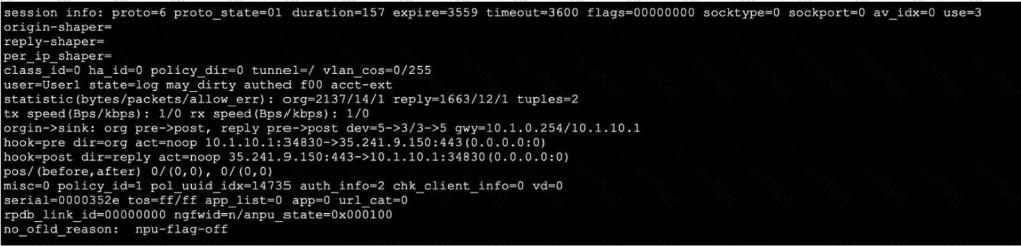
Exhibit.

Question # 2

Refer to the exhibit, which shows the output of a session. Which two statements are true? (Choose Iwo.)

Options:

A.

The TCP session has been successfully established.

B.

The session was initiated from an authenticated user.

C.

The session is being inspected using flow inspection.

D.

The session is being offloaded.

Question 3

You want to harden the SSL/SSH inspection profile for access to HTTPS web servers.

Which two configuration changes allow you to remove vulnerabilities? (Choose two answers.)

Options:

A.

Set unsupported-ssl-version to block.

B.

Set Server certificate SNI check to Enable .

C.

Set Untrusted SSL certificates to Ignore .

D.

Set min-allowed-ssl-version to ssl-3.0.

Question 4

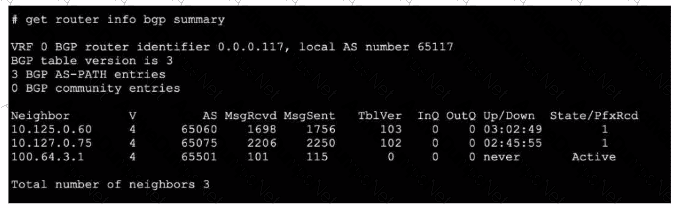
Refer to the exhibit, which shows the output of a BGP debug command.
Question # 4

What can you conclude about the router in this scenario?

Options:

A.

The router 100.64.3.1 needs to update the local AS number in its BGP configuration in order to bring up the 8GP session with the local router.

B.

An inbound route-map on local router is blocking the prefixes from neighbor 100.64.3.1.

C.

All of the neighbors displayed are part of a single BGP configuration on the local router with the neighbor-range set to a value of 4.

D.

The BGP session with peer 10.127.0.75 is up.

Question 5

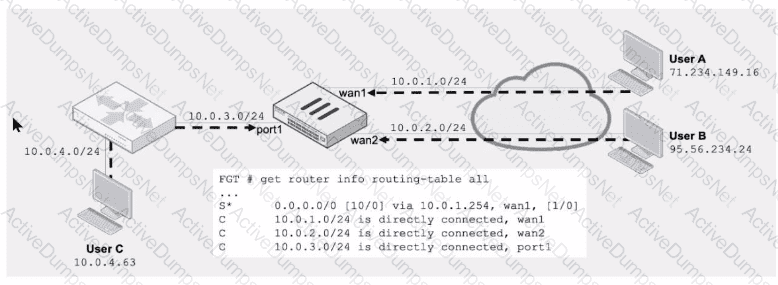
Refer to the exhibit.

Question # 5

Assuming a default configuration, which three statements are true? (Choose three.)

Options:

A.

Strict RPF is enabled by default.

B.

User B: Fail. There is no route to 95.56.234.24 .

C.

User A: Pass. The default static route through wan1 passes the RPF check regardless of the source IP address.

D.

User B: Pass. FortiGate will use asymmetric routing using wan1 to reply to traffic for 95.56.234.24.

E.

User C: Fail. There is no route to 10.0.4.63 using port1 in the touting table.

Question 6

When FortiGate enters conserve mode because of memory pressure, which action can FortiGate perform to preserve memory?

Options:

A.

FortiGate automatically reboots to clear memory and restore full operation.

B.

FortiGate switches to a less memory-intensive inspection mode, such as flow-based inspection.

C.

FortiGate reduces or stops non-essential processes like logging and antivirus scanning.

D.

FortiGate begins dropping all new sessions to protect resources.

Question 7

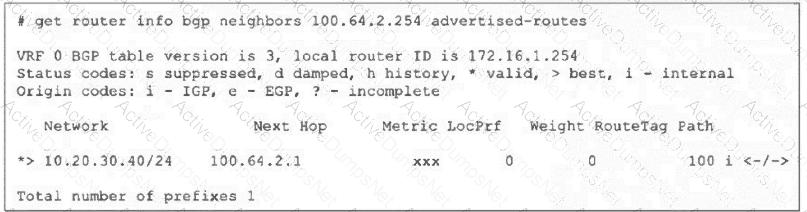
Refer to the exhibit, which shows the output of the command get router info bgp neighbors 100.64.2.254 advertised-routes.
Question # 7

What can you conclude from the output?

Options:

A.

The BGP state of the two BGP participants is OpenConfirm.

B.

The router ID of the neighbor is 100.64.2.254.

C.

The BGP neighbor is advertising the 10.20.30.40/24 network to the local router.

D.

The local router is advertising the 10.20.30.40/24 network to its BGP neighbor.

Question 8

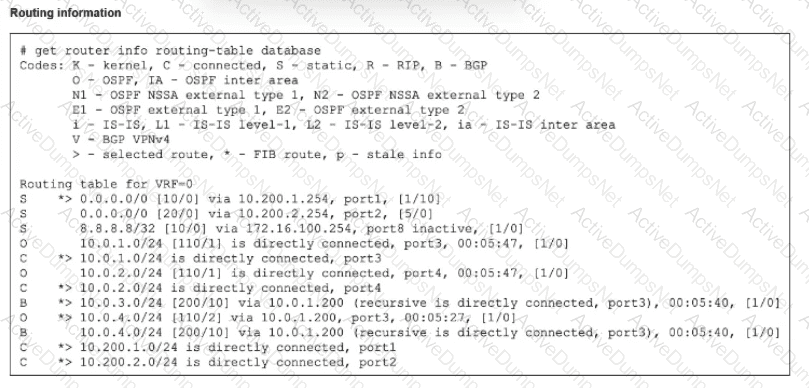
Refer to the exhibit.

Question # 8

The modified output of live routing kemel is shown

Which two statements about the output are (rue? (Choose two.)

Options:

A.

The BGP route to 10.0.4.0/24 is not in the forwarding information base.

B.

The default static route through 10.200.1 254 is in the forwarding information base.

C.

FortiGate is performing ECMP using both default static routes.

D.

The local FortiGate is receiving only one LSA from one OSPF neighbor.

Question 9

What are two reasons you might see iprope_in_check() check failed, drop when using the debug flow? (Choose two.)

Options:

A.

Packet was dropped because of policy route misconfiguration.

B.

Packet was dropped because of traffic shaping.

C.

Trusted host list misconfiguration.

D.

VIP or IP pool misconfiguration.

Question 10

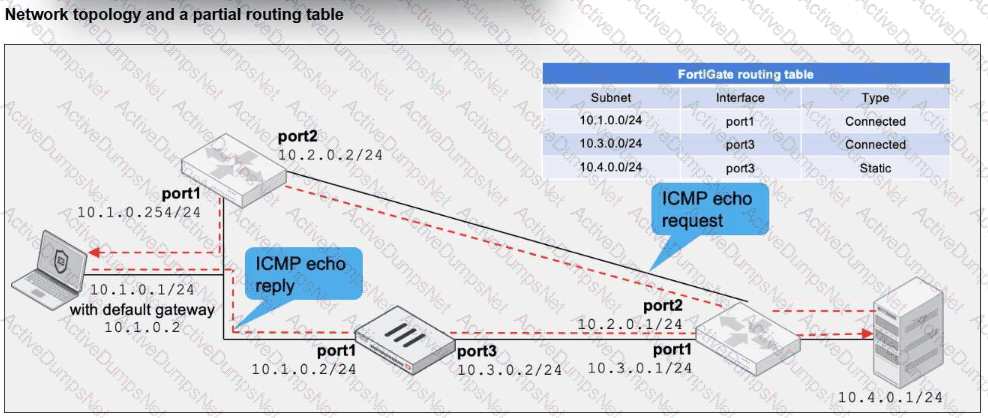
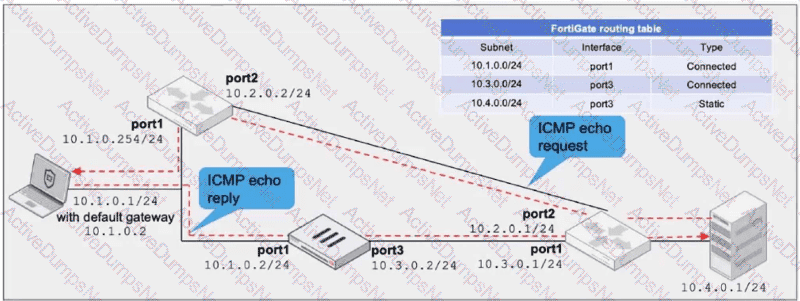
Refer to the exhibit, which a network topology and a partial routing table.
Question # 10

FortiGate has already been configured with a firewall policy that allows all ICMP traffic to flow from port1 to port3.

Which changes must the administrator perform to ensure the server at 10.4.0.1/24 receives the echo reply from the laptop at 10.1.0.1/24?

Options:

A.

Enable asymmetric routing under config system settings.

B.

Change the configuration from strict RPF check mode to feasible RPF check mode.

C.

A firewall policy that allows all ICMP traffic from port3 to port1.

D.

Modify the default gateway on the laptop from 10.1.0.2 to 10.2.0.2.

Question 11

Refer to the exhibit, which shows the output of a policy route table entry.

Question # 11

Which type of policy route does the output show?

Options:

A.

An ISDB route

B.

A regular policy route

C.

A regular policy route, which is associated with an active static route in the FIB

D.

An SD-WAN rule

Question 12

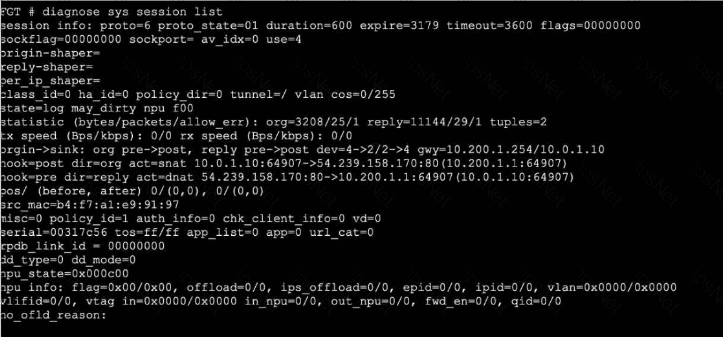
Refer to the exhibit, which shows a session entry.
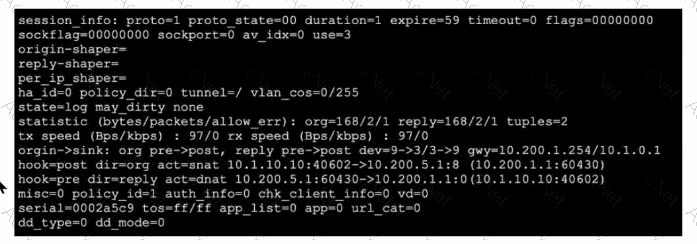
Question # 12

Which statement about this session is true?

Options:

A.

Return traffic to the initiator is sent to 10.1.0.1.

B.

Return traffic to the initiator is sent lo 10.200.1.254.

C.

It is an ICMP session from 10.1.10.10 to 10.200.1.1.

D.

It is an ICMP session from 10.1.10.1 to 10.200.5.1.

Question 13

Refer to the exhibit, which shows the output of a debug command.
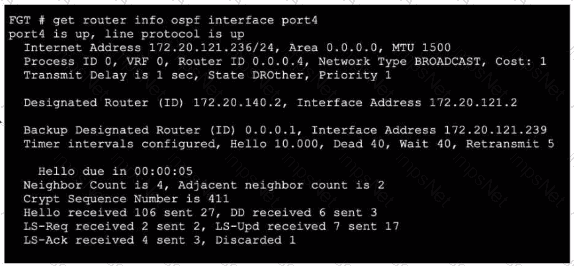
Question # 13

Which two statements about the output are true? (Choose two.)

Options:

A.

The interlace is part of the OSPF backbone area.

B.

There are a total of five OSPF routers attached to the vorz4 network segment

C.

One of the neighbors has a router ID of 0.0.0.4.

D.

In the network connected to port4, two OSPF routers are down.

Question 14

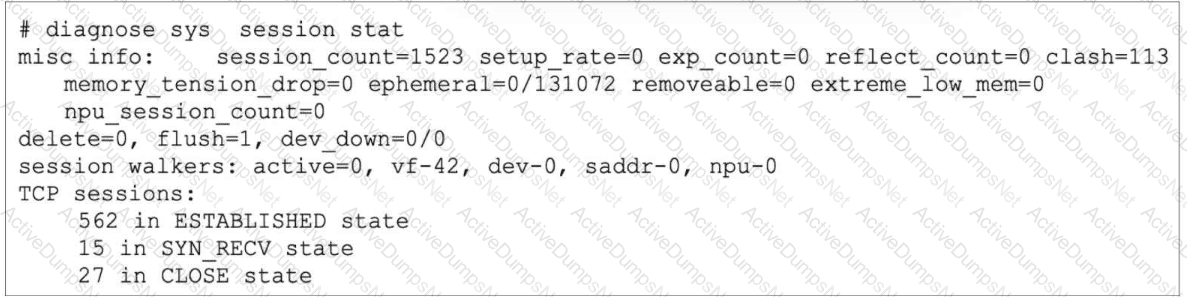
Refer to the exhibit.

Question # 14

The partial output of diagnose sys session stat command is shown.

Which statement about the output shown in the exhibit is correct?

Options:

A.

113 sessions have been dropped because of memory page exhaustion.

B.

There have been 131072 recorded ephemeral sessions but there are no current ones.

C.

562 TCP sessions have their proto_state set to 01 if there is no inspection.

D.

27 sessions have expired but are still in the session table in case any out-of-order packets arrive.

Question 15

Refer to the exhibit, which shows the partial output of command diagnose debug rating.
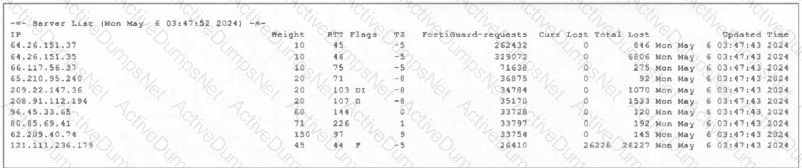
Question # 15

In this exhibit, which FDS server will the FortiGate algorithm choose?

Options:

A.

66.117.56.37

B.

208.91.112.194

C.

209.22.147.36

D.

64.26.151.37

Question 16

In IKEv2, which exchange establishes the first CHILD_SA?

Options:

A.

IKE_SA_INIT

B.

INFORMATIONAL

C.

CREATE_CHILD_SA

D.

IKE_AUTH

Question 17

Refer to the exhibit, which shows the output of get router info bgp summary.
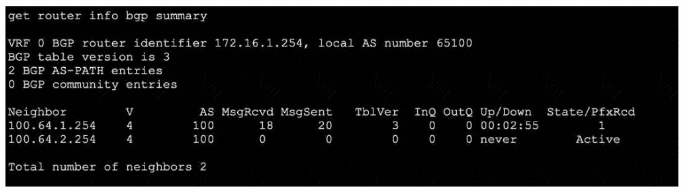
Question # 17

Which two statements are true? (Choose two.)

Options:

A.

The local ForliGate has received one prefix from BGP neighbor 100.64.1.254.

B.

The TCP connection with BGP neighbor 100.64.2.254 was successful.

C.

The local FortiGate has received 18 packets from a BGP neighbor.

D.

The local FortiGate is still calculating the prefixes received from BGP neighbor 100.64.2.264

Question 18

Refer to the exhibit, which shows the output of a diagnose command. What can you conclude from the RTT value?
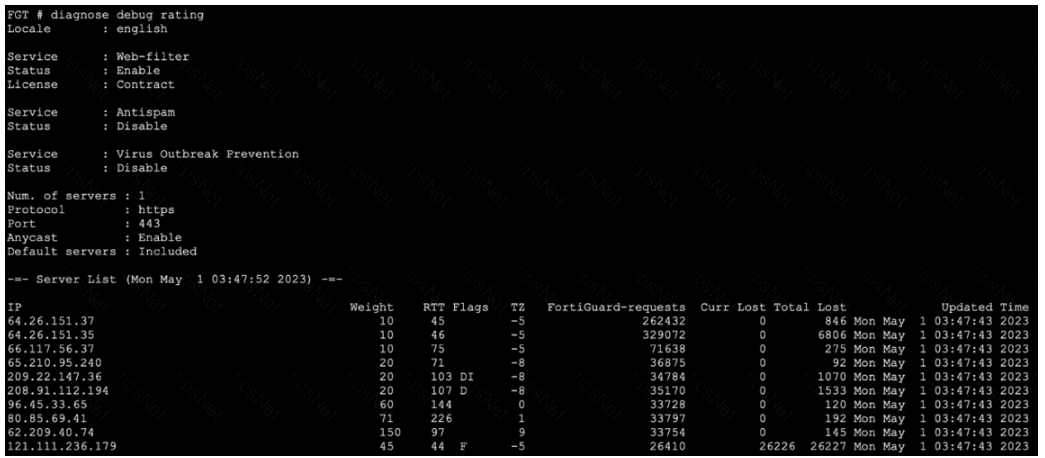
Question # 18

Options:

A.

Its value represents the time it takes to receive a response after a rating request is sent to a particular server.

B.

Its value is incremented with each packet lost.

C.

It determines which FortiGuard server is used for license validation.

D.

Its initial value is statically set to 10.

Question 19

Exhibit.

Question # 19

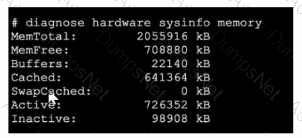
Refer to the exhibit, which shows a partial output of diagnose hardware aysinfo memory.

Which two statements about the output are true? (Choose two.)

Options:

A.

There are 98908 kB of memory that will never be used.

B.

The user space has 708880 kB of physical memory that is not used by the system.

C.

The I/O cache, which has 641364 kB of memory allocated to it.

D.

The value indicated next to the inactive heading represents the currently unused cache page.

Question 20

Refer to the exhibit.

Question # 20

A network topology and a partial routing table are shown.

FortiGate has already been configured with a firewall policy that allows all ICMP traffic to flow from port1 to port3.

Which two changes can the administrator perform to ensure the server at 10.4.0.1/24 receives the ICMP echo reply from the laptop at 10.1.0.1/24? (Choose two.)

Options:

A.

Enable asymmetric routing under config system settings.

B.

Change the FortiGate configuration from strict RPF check mode to feasible RPF check mode.

C.

Modify the default gateway on the laptop from 10.1.0.2 to 10.1.0.254.

D.

Add a default static route on FortiGate to forward all traffic to port3.

Question 21

Exhibit 1.

Question # 21

Exhibit 2.

Question # 21

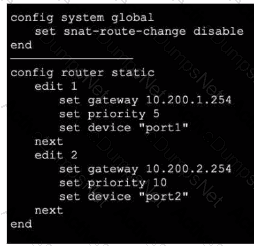
Refer to the exhibits, which show the configuration on FortiGate and partial internet session information from a user on the internal network.

An administrator would like to lest session failover between the two service provider connections.

Which two changes must the administrator make to force this existing session to immediately start using the other interface? (Choose two.)

Options:

A.

Change the priority of the port1 static route to 11.

B.

Change the priority of the port2 static route to 5.

C.

Configure unset snat-route-change to return it to the default setting.

D.

Configure set snat-route-change enable.

Question 22

Which Iwo actions does FortiGate take after an administrator enables the auxiliary session selling? (Choose two.)

Options:

A.

FortiGate only offloads auxiliary sessions.

B.

FortiGate accelerates all ECMP traffic to the NP6 processor

C.

FortiGates creates a now auxiliary session for each packet it receives.

D.

FortiGate creates two sessions in case of a routing change.

Question 23

Refer to the exhibit.

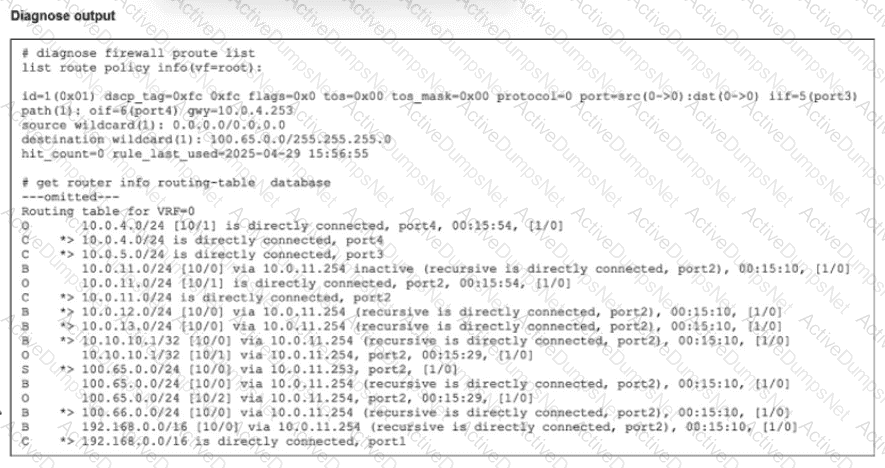
Question # 23

Which route will traffic take to get to the 100.65.0.0/24 network considering the routes are all configured with the same distance?

Options:

A.

The BGP route

B.

The policy route

C.

The static route

D.

The OS PF route

Question 24

Refer to the exhibit.

Question # 24

Which two observations can you make about the web filter traffic captured using the flow tool? (Choose two.)

Options:

A.

The session is offloaded to the NPU.

B.

The firewall policy is configured with proxy-based inspection mode.

C.

The web filter profile is configured with proxy-based inspection mode.

D.

The HTTPS port is mapped to 443 in the SSL/SSH Inspection Profile

Question 25

Refer to the exhibit.

Question # 25

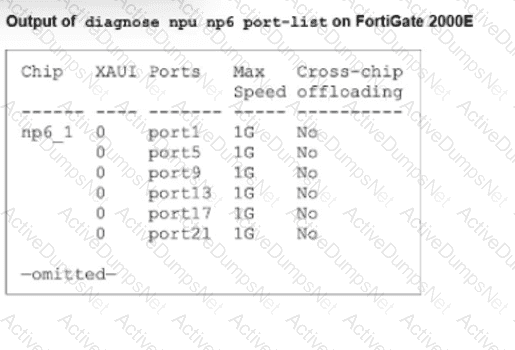
A partial output of diagnose npu up6 port-list on FortiGate 2000E is shown.

An administrator is unable to analyze traffic flowing between port1 and port17 using the diagnose sniffer command.

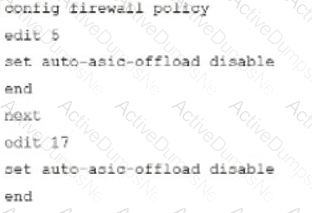
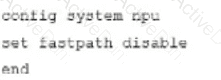
Which two commands allow the administrator to view the traffic? (Choose two.)

A)

Question # 25

B)

Question # 25

C)

Question # 25

D)

Question # 25

Options:

A.

Option A

B.

Option B

C.

Option C

D.

Option D

Question 26

Refer to the exhibit.

Question # 26

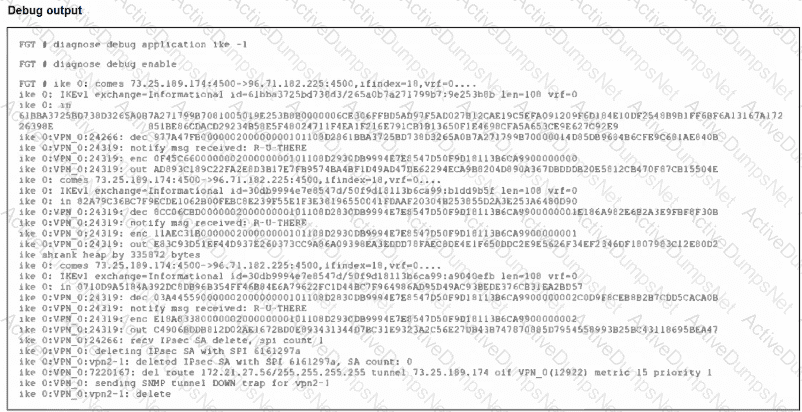
An IPsec VPN tunnel is dropping, as shown by the debug output.

Analyzing the debug output, what could be causing the tunnel to go down?

Options:

A.

Phase 2 drops but Phase 1 is up.

B.

Dead Peer Detection is not receiving its acknowledge packet.

C.

The tunnel drops during rekey negotiation.

D.

The tunnel drops after the timer expires.

Question 27

Which two statements about Security Fabric communications are true? (Choose two.)

Options:

A.

FortiTelemetry and Neighbor Discovery both operate using TCP.

B.

The default port for Neighbor Discovery can be modified.

C.

FortiTelemetry must be manually enabled on the FortiGate interface.

D.

By default, the downstream FortiGate establishes a connection with the upstream FortiGate using TCP port 8013.

Question 28

Which statement about protocol options is true?

Options:

A.

Protocol options allow administrators to configure a maximum number of sessions for each configured protocol.

B.

Protocol options give administrators a streamlined method to instruct FortiGate to block all sessions corresponding to disabled protocols.

C.

Protocol options allow administrators to configure the Any setting for all enabled protocols, which provides the most efficient use of system resources.

D.

Protocol options allow administrators to configure which Layer 4 port numbers map to upper-layer protocols, such as HTTP, SMTP, FTP, and so on.

Question 29

Refer to the exhibit, which shows the output of get router info ospf neighbor.
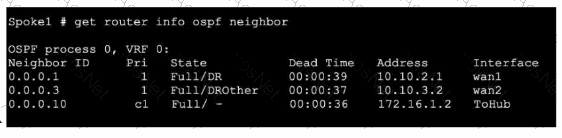
Question # 29

What can you conclude from the command output?

Options:

A.

The network type connecting the local Fortigate and OSPF neighbor 0.0.0.10 is point-to-point.

B.

All neighbors are in area 0.0.0.0.

C.

The local FortiGate is the BDR.

D.

The local FortiGate is not a DROther.

Question 30

Refer to the exhibit.

Question # 30

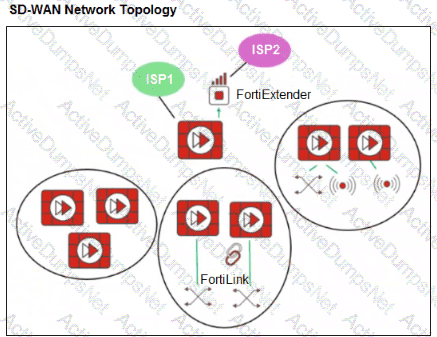
You want to configure SD-WAN on a network, as shown in the exhibit. The network contains many FortiGate devices. Some are used as next-generation firewalls (NGFWs), and some are deployed with extensions such as FortiSwitch, FortiAP, or FortiExtender.

Which factor should you consider when planning the deployment? (Choose one answer.)

Options:

A.

You can build an SD-WAN topology that includes all devices. The hubs must be devices without extensions.

B.

You should exclude FortiGate devices with FortiLink connections from the SD-WAN topology.

C.

You should build multiple SD-WAN topologies. Each topology should contain only one type of extension.

D.

You can build an SD-WAN topology that includes all devices. The hubs can be FortiGate devices with FortiExtender.

Question 31

Refer to the exhibit.

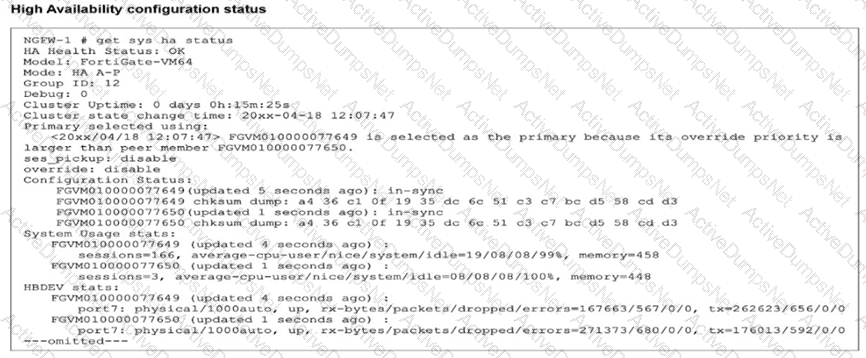
Question # 31

Which two statements about the output are true, considering NGFW-1 and NGFW-2 have been up for a week? (Choose two.)

Options:

A.

If FGVM...649 is rebooted, FGVM...650 will become the primary FortiGate and retain that role, even after FGVM...649 rejoins the cluster.

B.

If port7 becomes disconnected on the secondary FortiGate, both FortiGate devices will elect themselves as primary.

C.

If a configuration change is made to the secondary FortiGate, the Configuration Status will not change.

D.

If a configuration change is made to the primary FortiGate at this time, the secondary will initiate a synchronization reset.

Question 32

Refer to the exhibit.

Question # 32

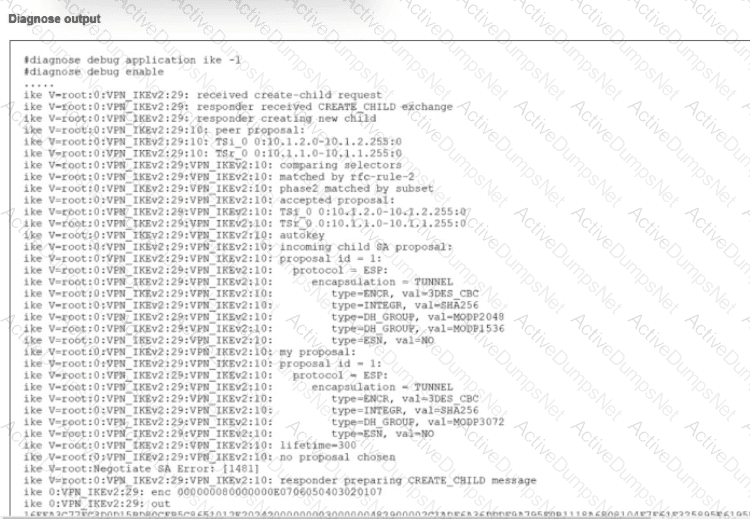
An IPsec VPN tunnel using IKEv2 was brought up successfully, but when the tunnel rekey takes place the tunnel goes down.

The debug command for IKE was enabled and, in the exhibit, you can review the partial output of the debug IKE while attempting to bring the tunnel up.

What is causing. The tunnel to be down?

Options:

A.

A Diffie-Hellman mismatch

B.

Blocked traffic on UDP port 500

C.

A mismatch m the Phase 1 negotiations

D.

A mismatch in the Phase 2 negotiations

Question 33

Exhibit.

Question # 33

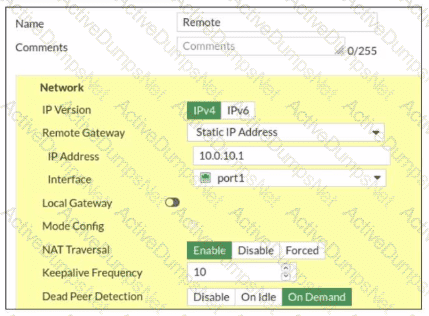
Refer to the exhibit, which contains a screenshot of some phase 1 settings.

The VPN is not up. To diagnose the issue, the administrator enters the following CLI commands on an SSH session on FortiGate:

Question # 33

However, the IKE real-time debug does not show any output. Why?

Options:

A.

The administrator must also run the command diagnose debug enable.

B.

The debug shows only error messages. If there is no output, then the phase 1 and phase 2 configurations match.

C.

The log-filter setting is incorrect. The VPN traffic does not match this filter.

D.

Replace diagnose debug application ike -1 with diagnose debug application ipsec -1.

Question 34

Which three conditions are required for two FortiGate devices to form an OSPF adjacency? (Choose three answers)

Options:

A.

OSPF link costs match.

B.

OSPF interface priority settings are unique.

C.

OSPF interface network types match.

D.

Authentication settings match.

E.

OSPF router IDs are unique.

Question 35

Refer to the exhibit, which shows the output of a diagnose command.
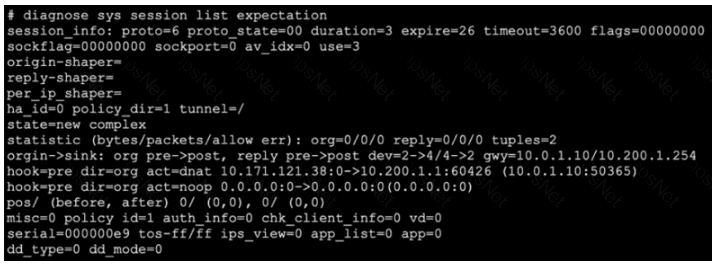
Question # 35

What two conclusions can you draw from the output shown in the exhibit? (Choose two answers)

Options:

A.

This is an expected session created by the IPS engine.

B.

Traffic in the original direction (coming from the IP address 10.171.121.38) will be routed to the next-hop IP address 10.0.1.10.

C.

Traffic in the original direction (coming from the IP address 10.171.121.38) will be routed to the next-hop IP address 10.200.1.1.

D.

This is a pinhole session created to allow traffic for a protocol that requires additional sessions to operate through FortiGate.

Question 36

Refer to the exhibit, which shows partial outputs from two routing debug commands.
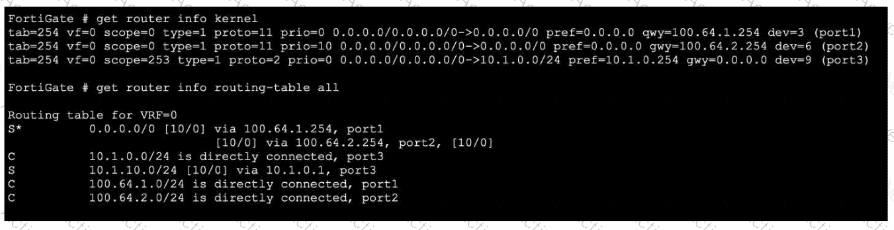
Question # 36

Which change must an administrator make on FortiGate to route web traffic from internal users to the internet, using ECMP?

Options:

A.

Set snat-route-change to enable.

B.

Set the priority of the static default route using port2 to 1.

C.

Set preserve-session-route to enable.

D.

Set the priority of the static default route using port1 to 10.

Question 37

Refer to the exhibit, which shows the modified output of the routing kernel.
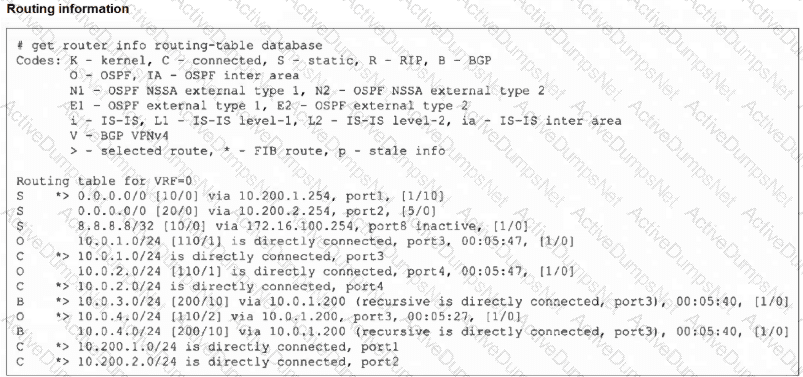
Question # 37

Which statement is true?

Options:

A.

The egress interface associated with static route 8.8.8.8/32 is administratively up.

B.

The default static route through 10.200.1.254 is not in the forwarding information base.

C.

The default static route through port2 is in the forwarding information base.

D.

The BGP route to 10.0.4.0/24 is not in the forwarding information base.

Question 38

Refer to the exhibit.

Partial output of a real-time OSPF debug is shown.
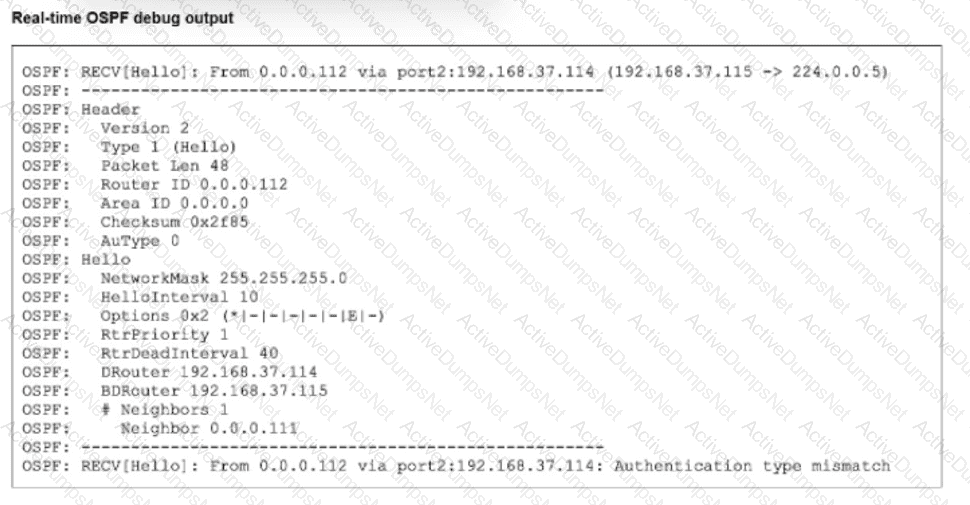
Question # 38

Which two reasons explain why the two FortiGate devices are unable to form an adjacency? (Choose two.)

Options:

A.

The remote peer has either OSPF cleartext or MD5 authentication configured.

B.

There is an OSPF authentication configuration mismatch.

C.

The local FortiGate does not have OSPF authentication configured

D.

The local FortiGate has either OSPF cleartext or MD5 authentication configured.

Question 39

Which two statements about conserve mode are true? (Choose two.)

Options:

A.

FortiGate enters conserve mode when the system memory reaches the configured extreme threshold.

B.

FortiGate starts taking the configured action for new sessions requiring content inspection when the system memory reaches the configured red threshold.

C.

FortiGate exits conserve mode when the system memory goes below the configured green threshold.

D.

FortiGate starts dropping all new sessions when the system memory reaches the configured red threshold.

Question 40

You want to configure two static routes: one that references a zone and a second one that references an SD-WAN member that belongs to that zone.

Which statement about this scenario is true? (Choose one answer.)

Options:

A.

You cannot create static routes for individual SD-WAN members.

B.

You cannot create static routes that reference an SD-WAN zone.

C.

The destination subnets must be different.

D.

The source subnets must be different.

Question 41

What are two functions of automation stitches? (Choose two.)

Options:

A.

You can configure automation stitches to run diagnostic commands and attach the results to an email message when CPU or memory usage exceeds specified thresholds.

B.

You can configure automation stitches to modify packet headers and payloads if specific traffic triggers an anomaly IPS event.

C.

You can configure automation stitches to insert a delay between actions if the automation stitches are set to execute actions in parallel.

D.

You can configure automation stitches to take parameters from previous actions as input for the next action if the automation stitches are set to execute actions in sequence.

Question 42

Which exchange lakes care of DoS protection in IKEv2?

Options:

A.

Create_CHILD_SA

B.

IKE_Auth

C.

IKE_Req_INIT

D.

IKE_SA_NIT

Question 43

Refer to the exhibit.

Question # 43

A network topology and the routing table of a FortiGate device are shown.

What must the administrator configure in the BGP section to add only the subnet 100.64.2.0/24 to the routing table of FortiGate_A? (Choose one answer.)

Options:

A.

The administrator must configure route-map-in on FortiGate_A.

B.

The administrator must configure connected-route redistribution on FortiGate_C.

C.

The administrator must configure the 100.64.2.0/24 network on FortiGate_C.

D.

The administrator must configure BGP route redistribution on FortiGate_B.