New Year Sale Limited Time Flat 70% Discount offer - Ends in 0d 00h 00m 00s - Coupon code: 70spcl

Fortinet FCSS_SDW_AR-7.6 FCSS - SD-WAN 7.6 Architect Exam Practice Test

FCSS - SD-WAN 7.6 Architect Questions and Answers

Question 1

Which two statements correctly describe what happens when traffic matches the implicit SD-WAN rule? (Choose two.)

Options:

A.

The session information output displays no SD-WAN service id.

B.

Traffic is load balanced using the algorithm set for the v4-ecmp-mode setting.

C.

The traffic is distributed, regardless of weight, through all available static routes.

D.

Traffic does not match any of the entries in the policy route table.

E.

FortiGate flags the session with may_dirty and vwl_def ault.

Question 2

(In the context of SD-WAN, the terms underlay and overlay are commonly used to categorize links.

Which two statements about underlay and overlay links are correct? Choose two answers.)

Options:

A.

A VLAN is a type of overlay link.

B.

Overlay links provide routing flexibility.

C.

FortiLink interface is considered an underlay link.

D.

Wireless connections can be used to build overlay links.

E.

Only wired connections can be used as underlay links.

Question 3

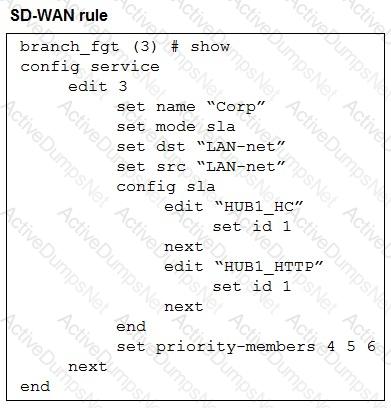
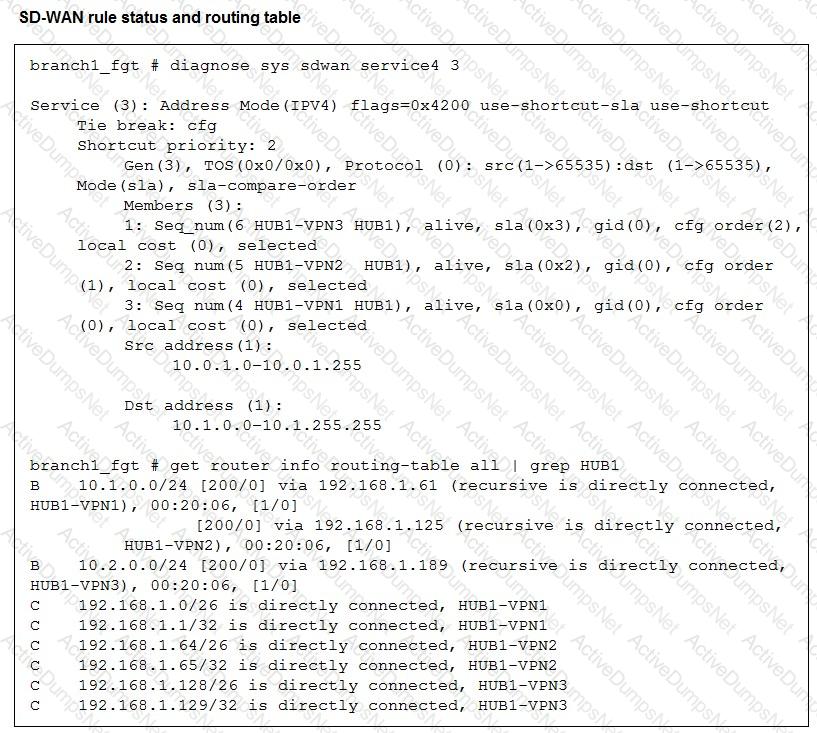
Refer to the exhibits, which show the configuration of an SD-WAN rule and the corresponding rule status and routing table.
Question # 3

Question # 3

The administrator wants to understand the expected behavior for traffic matching the SD-WAN rule.

Based on the exhibits, what can the administrator expect for traffic matching the SD-WAN rule?

Options:

A.

The traffic will be routed over HUB1-VPN3.

B.

The traffic will be routed over HUB1-VPN2

C.

The traffic will be routed over HUB1-VPN1.

D.

The traffic will be load balanced across all three overlays

Question 4

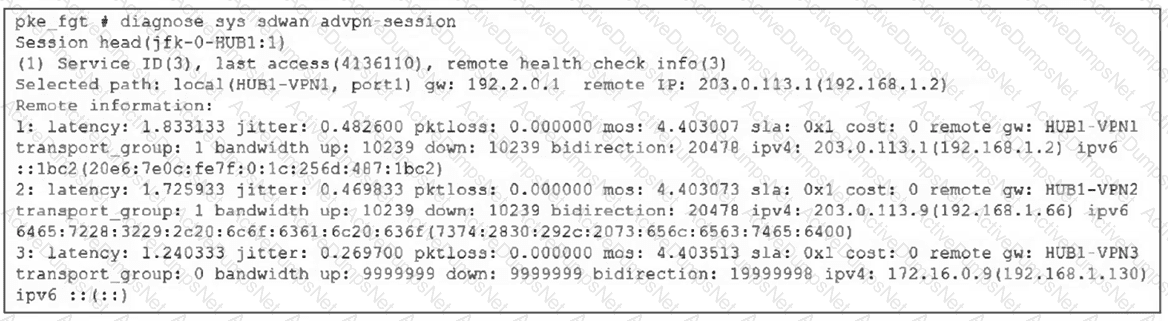
(Refer to the exhibit.

Question # 4

Based on the output shown in the exhibit, what can you conclude about the device role and how it handles health checks? Choose one answer.)

Options:

A.

The device is a spoke and it provides embedded health-check measures for each tunnel to the hub.

B.

The device is a spoke and it receives health-check measures for the tunnels of another spoke.

C.

The device is a hub and it receives embedded health-check measures for each tunnel from the spoke.

D.

The device is a hub and it receives health-check measures for the tunnels of a spoke.

Question 5

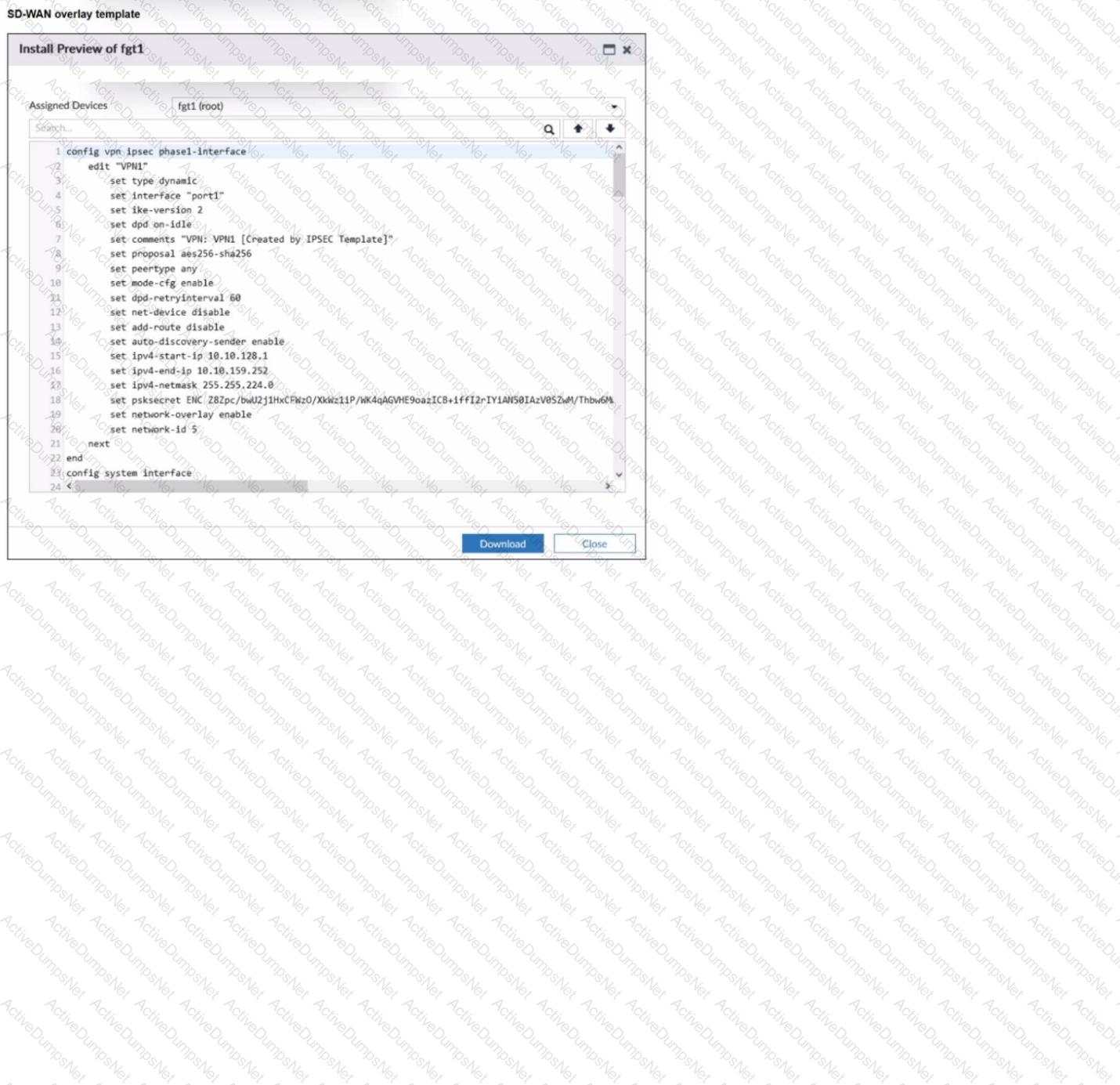
Refer to the exhibit.

Question # 5

The administrator used the SD-WAN overlay template to prepare an IPsec tunnels configuration for a hub-and-spoke SD-WAN topology. The exhibit shows the FortiManager installation preview for one FortiGate device.

Based on the exhibit, which statement best describes the configuration applied to the FortiGate device?

Options:

A.

It is a spoke device that establishes dynamic IPsec tunnels to the hub. The local subnet range is 10.10.128.0/23.

B.

It is a hub device. It can send ADVPN shortcut offers.

C.

It is a hub device. It will automatically discover the spoke devices and add them to the SD-WAN topology.

D.

It is a spoke device that establishes dynamic IPsec tunnels to the hub It can send ADVPN shortcut requests.

Question 6

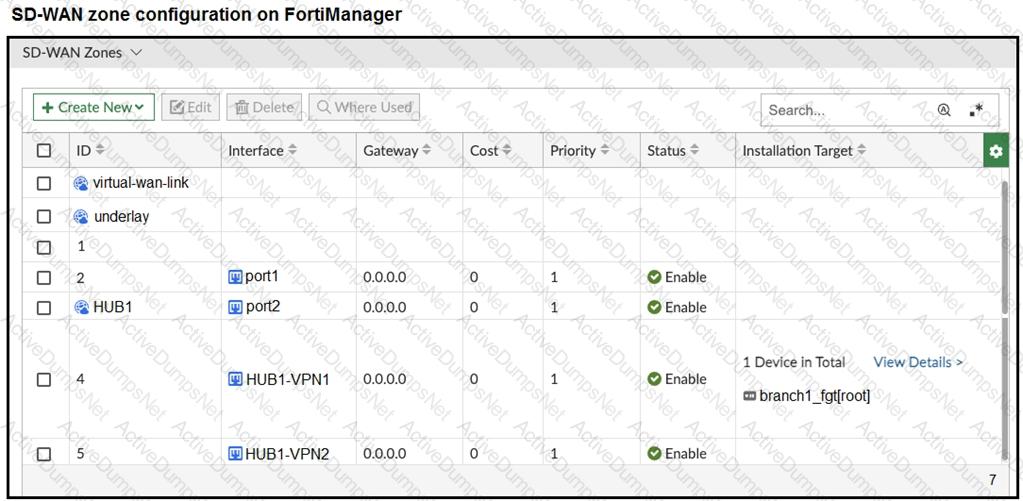
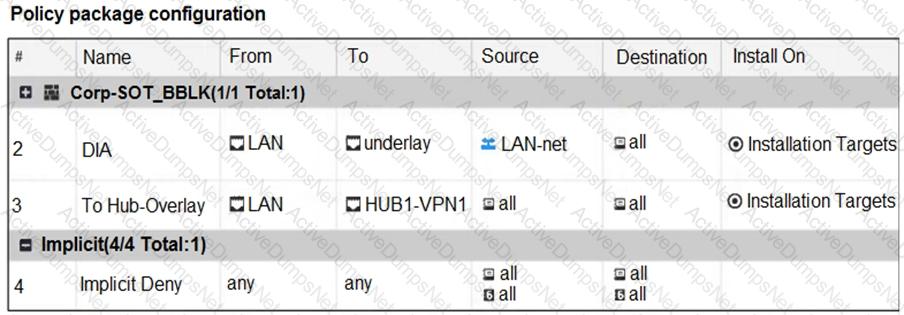
Refer to the exhibits.

Question # 6

Question # 6

The exhibits show the SD-WAN zone configuration of an SD-WAN template prepared on FortiManager and the policy package configuration.

When the administrator tries to install the configuration changes, FortiManager fails to commit.

What should the administrator do to fix the issue?

Options:

A.

Configure branch1_fgt as the installation target for policy 3.

B.

Configure HUB1 as the destination of policy 3.

C.

Configure a normalized interface for the IPsec tunnel HUB1-VPN1.

D.

Configure both HUB1-VPN1 and HUB1-VPN2 as the destination of policy 3

Question 7

Refer to the exhibit.

Question # 7

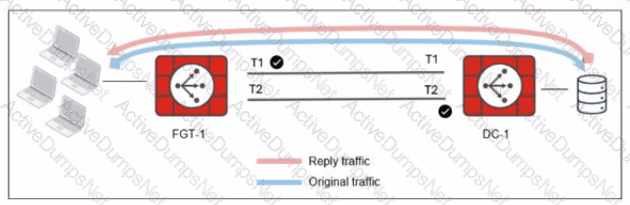
The administrator analyzed the traffic between a branch FortiGate and the server located in the data center, and noticed the behavior shown in the diagram.

When the LAN clients located behind FGT1 establish a session to a server behind DC-1, the administrator observes that, on DC-1, the reply traffic is routed overT2. even though T1 is the preferred member in

the matching SD-WAN rule.

What can the administrator do to instruct DC-1 to route the reply traffic through the member with the best performance?

Options:

A.

Enable snat-route-change under config system global.

B.

Enable reply-session under config system sdwan.

C.

Enable auxiliary-session under config system settings.

D.

FortiGate route lookup for reply traffic only considers routes over the original ingress interface.

Question 8

The administrator uses the FortiManager SD-WAN overlay template to prepare an SD-WAN deployment. Using information provided through the SD-WAN overlay template wizard, FortiManager creates templates ready to install on the spoke and hub devices.

What are the three templates created by the SD-WAN overlay template for a spoke device? (Choose three.)

Options:

A.

Static route template

B.

Rules template

C.

CLI template

D.

BGP template

E.

IPsec tunnel template

Question 9

When you use the command diagnose sys session list, how do you identify the sessions that correspond to traffic steered according to SD-WAN rules?

Options:

A.

You identify sessions steered according to SD-WAN rules with the flag vwl.

B.

You cannot identify SD-WAN sessions. You must use the sdwar. session filter.

C.

You identify sessions steered according to SD-WAN rules with the data vwl_mbr_seq.

D.

You identify sessions steered according to SD-WAN rules with the data 3dwan_service_id.

Question 10

(Refer to the exhibits.

Question # 10

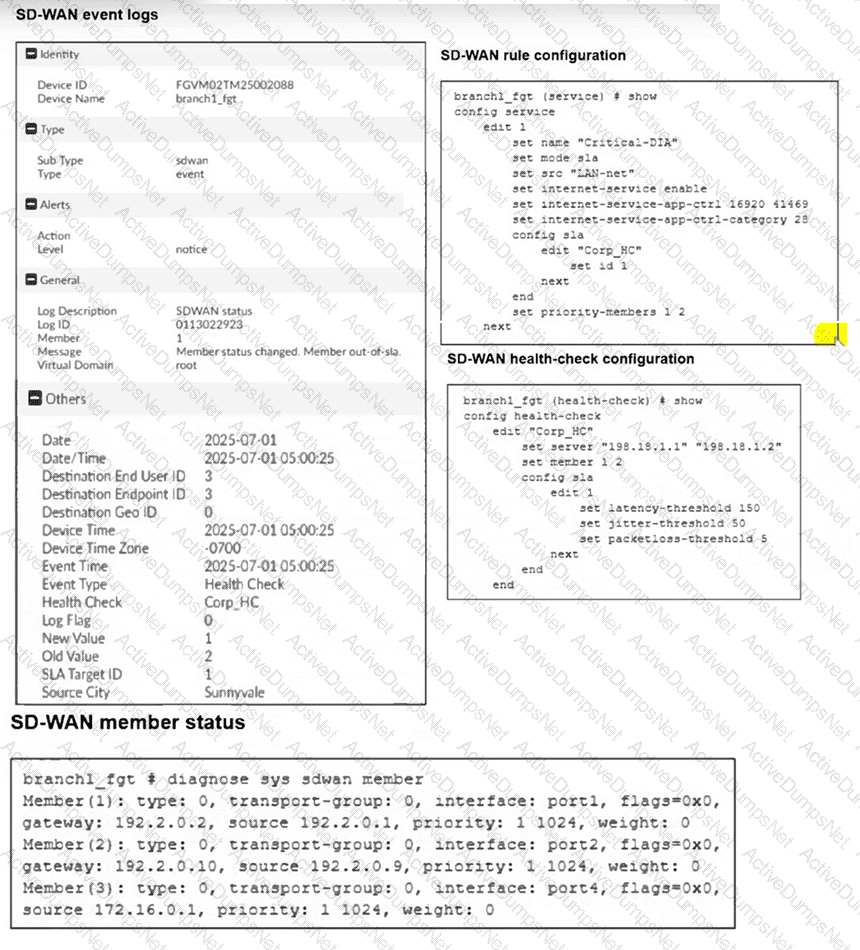
Two SD-WAN event logs, the member status, the SD-WAN rule configuration, and the health-check configuration for a FortiGate device are shown.

Immediately after the log messages are displayed, how will the FortiGate steer the traffic based on the information shown in the exhibits? Choose one answer.)

Options:

A.

FortiGate skips SD-WAN rule ID 1.

B.

FortiGate uses port2 to steer the traffic for SD-WAN rule ID 1.

C.

FortiGate uses port1 to steer the traffic for SD-WAN rule ID 1.

D.

FortiGate uses port1 or port2 to steer the traffic for SD-WAN rule ID 1.

Question 11

Refer to the exhibits.

Question # 11

Question # 11

Question # 11

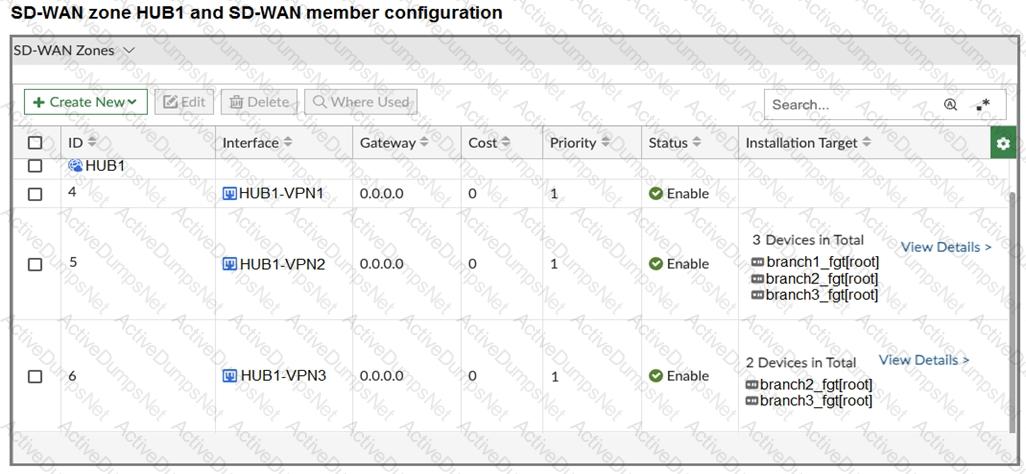
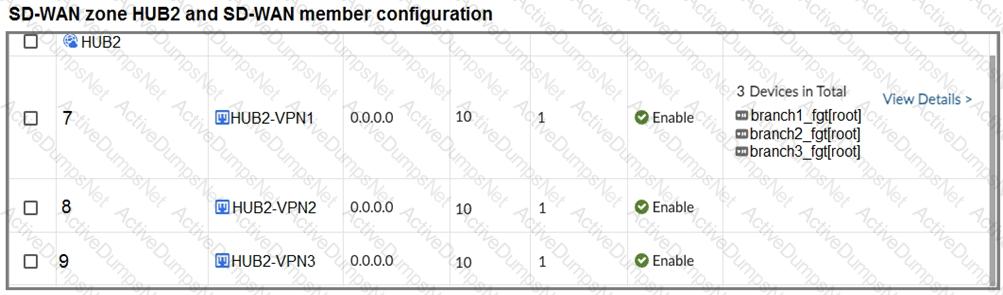
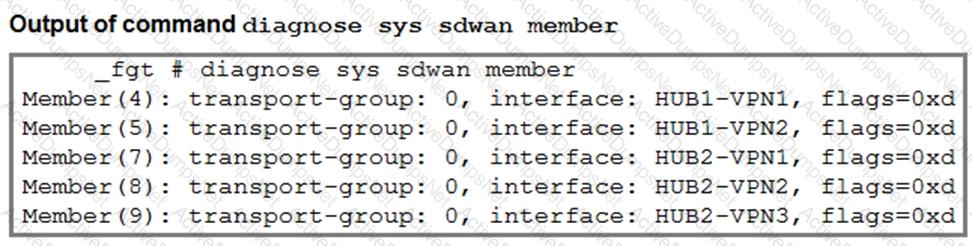
The first exhibit shows the SD-WAN zone HUB1 and SD-WAN member configuration from an SD-WAN template, and the second exhibit shows the output of command diagnose sys sdwan member collected on a FortiGate device.

Which statement best describes what the diagnose output shows?

Options:

A.

The diagnose output shows that HUB1-VPN1 and all HUBx-VPNy members are dead.

B.

The diagnose output does not correspond to a device configured with the SD-WAN template shown in the exhibit.

C.

The diagnose output was collected on the device branch2_fgt.

D.

The diagnose output was collected on the device branch1_fgt

Question 12

(Refer to the exhibits.

Question # 12

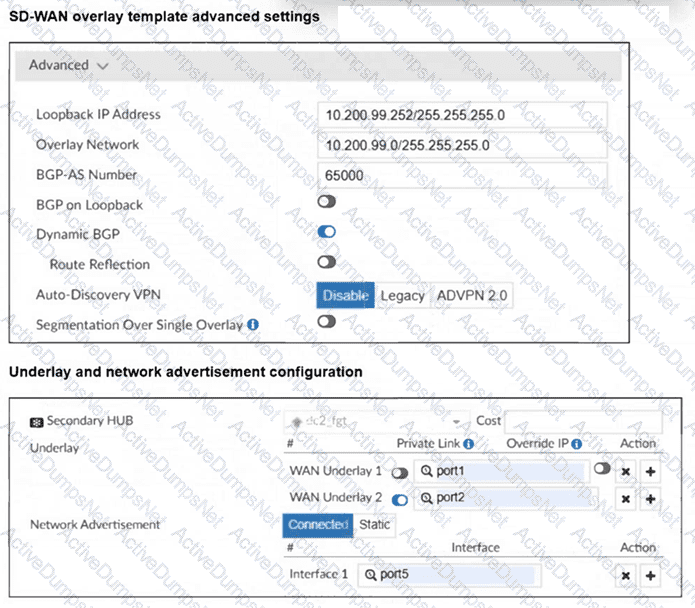
The SD-WAN overlay template advanced settings and the underlay and network advertisement settings are shown. These are the configurations for the secondary hub of a dual-hub SD-WAN topology created with the FortiManager SD-WAN overlay orchestrator.

Which two conclusions can you draw from the information shown in the exhibits? Choose two answers.)

Options:

A.

FortiManager will define port2 as a BGP neighbor.

B.

FortiManager will create an overlay tunnel on the port2 interface.

C.

FortiManager will create an overlay tunnel on the port1 interface.

D.

FortiManager will define port5 as a BGP neighbor.

Question 13

Refer to the exhibit.

Question # 13

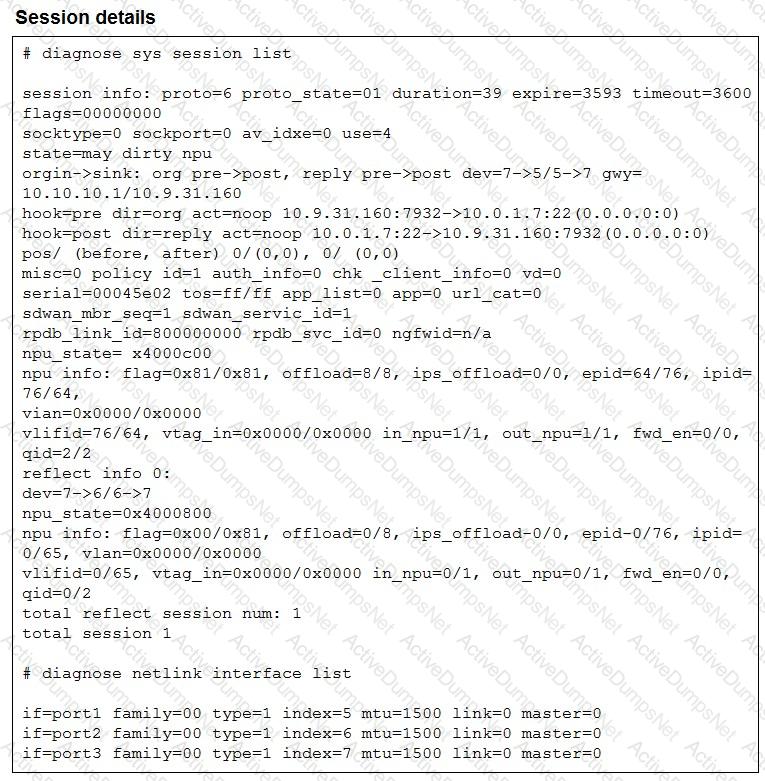
The exhibit shows the details of a session and the index numbers of some relevant interfaces on a FortiGate device that supports hardware offloading.

Based on the information shown in the exhibits, which two conclusions can you draw? (Choose two.)

Options:

A.

By default, FortiGate offloads symmetric and asymmetric flows.

B.

The original direction of the symmetric traffic flows from port3 to port2.

C.

The reply direction of the asymmetric traffic flows from port2 to port3.

D.

The auxiliary session can be offloaded to hardware.

Question 14

Refer to the exhibit.

Question # 14

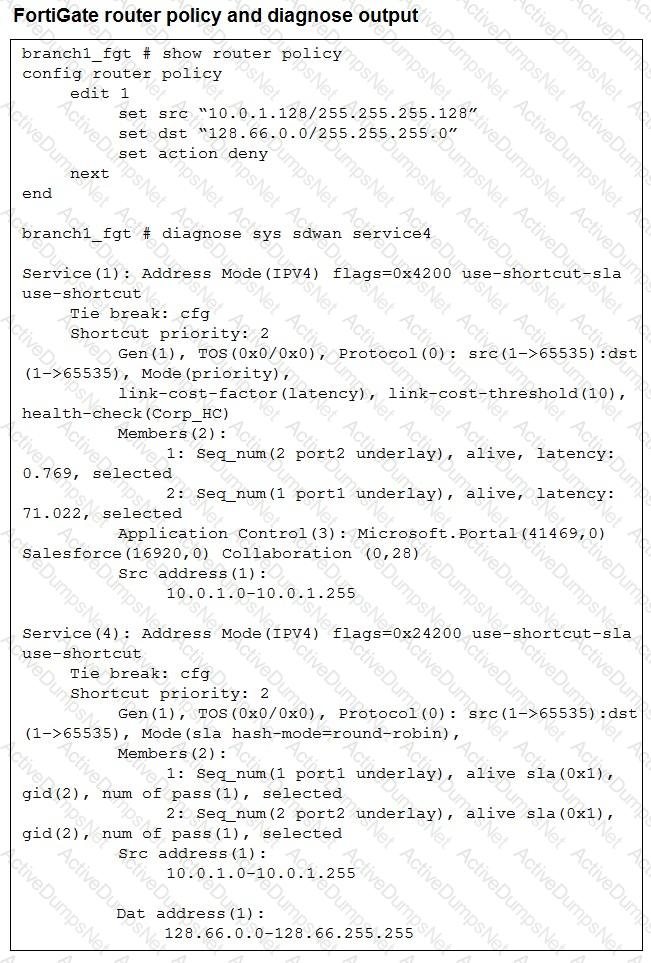
How does FortiGate handle the traffic with the source IP 10.0.1.130 and the destination IP 128.66.0 125?

Options:

A.

FortiGate drops the traffic flow.

B.

FortiGate routes the traffic flow according to the forwarding information base (FIB).

C.

FortiGate load balances the traffic flow through port7 and port8.

D.

FortiGate steers the traffic flow through port7.

Question 15

(When you deploy SD-WAN, you can choose from several common designs. Each design best applies to specific contexts.

Which two statements correctly associate a common SD-WAN design with its main indication or constraint? Choose two answers.)

Options:

A.

Use a cloud on-ramp topology to improve the performance of cloud applications.

B.

Use a standalone design for sites with only one WAN link to the cloud.

C.

Use remote breakout to centralize traffic inspection and limit local management requirements.

D.

Use a direct internet access (DIA) design to increase the traffic security and allow local devices with limited capabilities.

Question 16

(Refer to the exhibit.

Question # 16

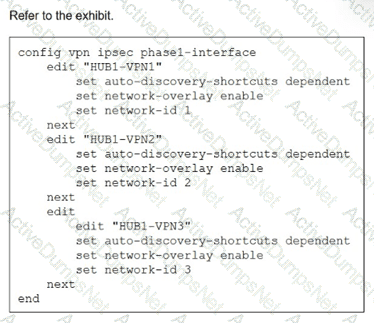
You update the spokes configuration of an existing auto-discovery VPN (ADVPN) topology by adding the parameters shown in the exhibit.

Which is a valid objective of those settings? Choose one answer.)

Options:

A.

Enable the tunnels as overlay links.

B.

Convert the configuration from ADVPN to ADVPN 2.0.

C.

Prevent cross-overlay shortcuts.

D.

Prevent multiple shortcuts from being established over the same overlay.

Question 17

Refer to the exhibits.

Question # 17

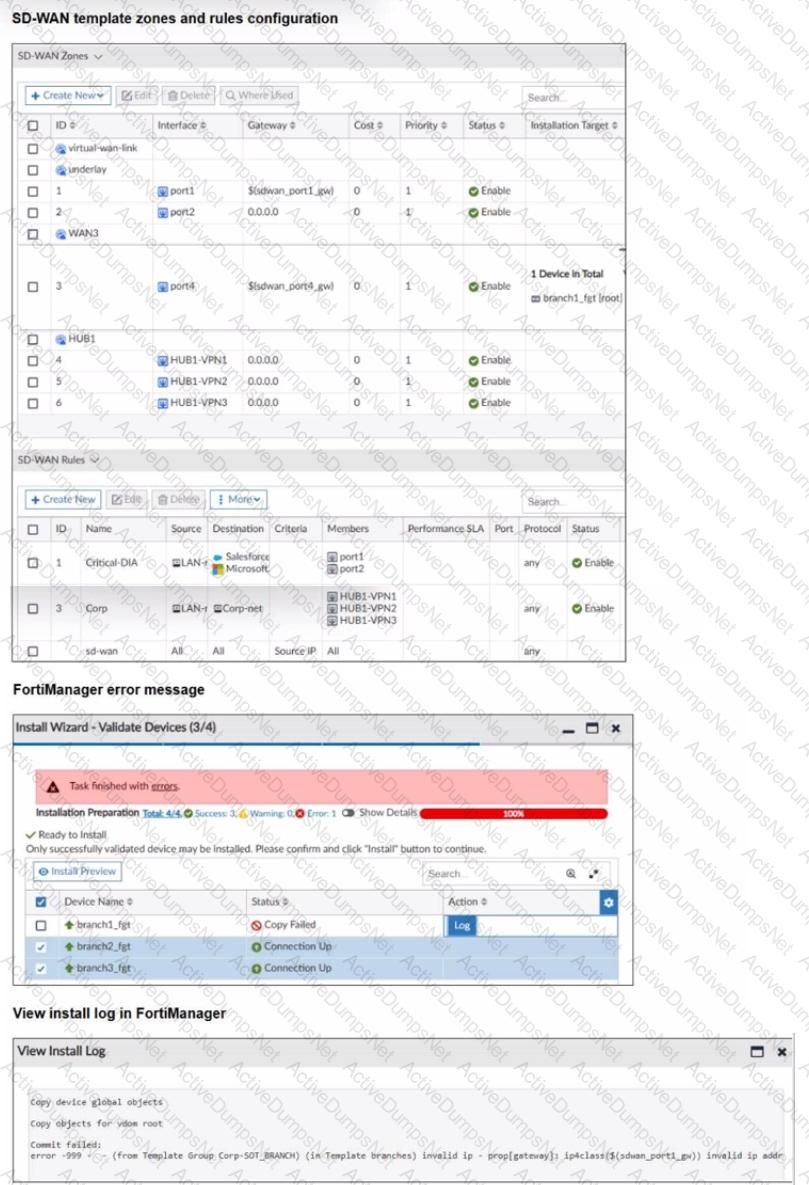
You use FortiManager to configure SD-WAN on three branch devices.

When you install the device settings. FortiManager prompts you with the error "Copy Failed" for the device branch1_fat When you click the log button. FortiManager displays the message shown in the exhibit.

Options:

A.

Based on the exhibits, which statement best describes the issue and how you can resolve it?

B.

Remove the installation target for the SD-WAN member port4. You cannot combine metadata variable and installation targets.

C.

Gateways for all members in a zone must be defined the same way. Specify the gateway of the SD-WAN member port! without metadata variables.

D.

Check the metadata variable definitions, and review the per-device mapping configuration.

E.

Check the connection between branch1_fgt and FortiManager

Question 18

You are planning a large SD-WAN deployment with approximately 1000 spokes and want to allow ADVPN between the spokes. Some remote sites use FortiSASE to connect to the company's SD-WAN hub. Which overlay routing configuration should you use?

Options:

A.

BGP on loopback with dynamic BGP for ADVPN shortcut routing.

B.

BGP on loopback with IPsec phase2 selectors for ADVPN shortcut routing.

C.

BGP per overlay with dynamic BGP for ADVPN shortcut routing.

D.

BGP per overlay with BGP next-hop convergence for ADVPN shortcut routing.

Question 19

Which three characteristics apply to provisioning templates available on FortiManager? (Choose three.)

Options:

A.

A template group can include a system template and an SD-WAN template.

B.

Each template group can contain up to three IPsec tunnel templates.

C.

CLI templates are applied in order, from top to bottom

D.

A CLI template group can contain CLI templates of both types.

E.

A CLI template can be of type CLI script or Perl script.

Question 20

Refer to the exhibit.

Question # 20

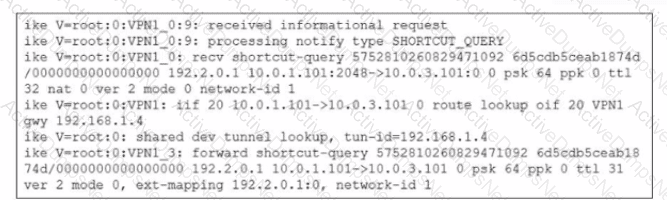
Which statement best describe the role of the ADVPN device in handling traffic?

Options:

A.

This is a hub that has received a query from a spoke and has forwarded it to another spoke.

B.

This is a hub in a dual-region topology. The remote hub tunnel ID is 10.0.2.101.

C.

This is a spoke that has received a shortcut query from another spoke and has forwarded the response to its hub.

D.

This is a spoke. The kernel received a shortcut request and forwards the query to another spoke.

Question 21

SD-WAN interacts with many other FortiGate features. Some of them are required to allow SD-WAN to steer the traffic.

Which three configuration elements that you must configure before FortiGate can steer traffic according to SD-WAN rules? (Choose three.)

Options:

A.

Firewall policies

B.

Interfaces

C.

Security profiles

D.

Traffic shaping

E.

Routing

Question 22

Refer to the exhibit.

Question # 22

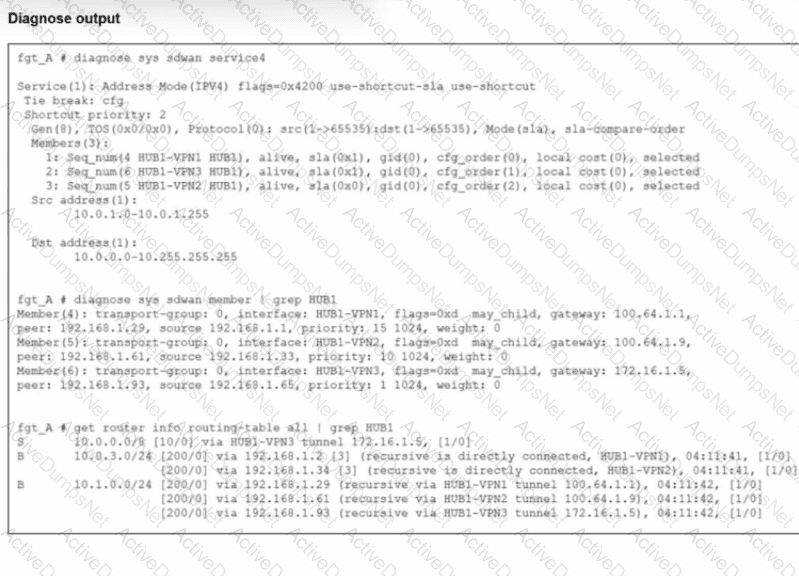
An administrator is troubleshooting SD-WAN on FortiGate. A device behind branch1_fgt generates traffic to the 10.0.0.0/8 network.

The administrator expects the traffic to match SD-WAN rule ID 1 and be routed over HUB1-VPN1. However, the traffic is routed over HUB1-VPN3.

Based on the output shown in the exhibit, which two reasons, individually or together, could explain the observed behavior? (Choose two.)

Options:

A.

HUB1-VPN3 has a higher member configuration priority than HUB1-VPN1.

B.

The traffic matches a regular policy route configured with HUB1-VPN3 as the outgoing device

C.

HUB1-VPN1 does not have a valid route to the destination

D.

HUB1-VPN3 has a lower route priority value (higher priority) than HUB1-VPN1.

Question 23

(In which order does FortiGate consider the following elements during the route lookup process? Choose one answer.)

Options:

A.

SD-WAN rules, ISDB routes, policy routes, BGP routes

B.

Policy routes, SD-WAN rules, Internet Service Database (ISDB) routes, BGP routes

C.

SD-WAN rules, policy routes, static routes, ISDB routes

D.

Policy routes, ISDB routes, SD-WAN rules, static routes

Question 24

You configured an SD-WAN rule with the best quality strategy and selected the predefined health check, Default_FortiGuard, to check the link performances against FortiGuard servers.

For the quality criteria, you selected Custom-profile-1.

Which factors does FortiGate use, and in which order. to determine the link that it should use to steer the traffic?

Options:

A.

Latency – Member configuration order – Link cost threshold

B.

Link quality index – Member configuration order – Link cost threshold

C.

Links that meet the SLA targets – Member configuration order – Member local cost

D.

Latency – Jitter - Packet loss – Bibandwidth – Member configuration order

Question 25

(Refer to the exhibit.

Question # 25

The administrator configured two SD-WAN rules to load balance traffic.

Which interfaces does FortiGate use to steer the traffic from 10.0.1.124 to 10.0.0.254? Choose one answer.)

Options:

A.

port1 or port2

B.

FortiGate routes the traffic according to the FIB.

C.

HUB1-VPN2

D.

Any interface in the HUB1 or HUB2 zones

Question 26

Refer to the exhibit.

Question # 26

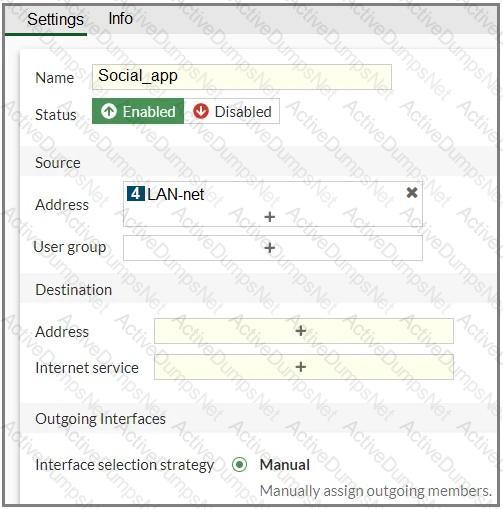
You configure SD-WAN on a standalone FortiGate device. You want to create an SD-WAN rule that steers Facebook and Linkedin traffic through the less costly internet link. The FortiGate GUI page appears as shown in the exhibit.

What should you do to set Facebook and LinkedIn as destinations?

Options:

A.

Install a license to allow applications as destinations of SD-WAN rules.

B.

In the Internet service field, select Facebook and LinkedIn.

C.

Enable the applications as destinations of the SD-WAN rule feature visibility.

D.

You cannot configure applications as destinations of an SD-WAN rule on a standalone FortiGate device.

Question 27

An administrator is configuring SD-WAN to load balance their network traffic. Which two things should they consider when setting up SD-WAN? (Choose two.)

Options:

A.

You can select the outbandwidth hash mode with all strategies that allow load balancing.

B.

Only the manual and best-quality strategies allow SD-WAN load balancing.

C.

When applicable. FortiGate load balances the traffic through all members that meet the SLA target.

D.

SD-WAN load balancing is possible only using the best quality and lowest cost (SLA) strategies.

Question 28

(Which two features must you configure before FortiGate can steer traffic according to SD-WAN rules? Choose two answers.)

Options:

A.

Security profiles

B.

Underlay links

C.

Overlay links

D.

Traffic shaping

E.

Firewall policies