
iSQI CTAL-TA_V4.0 ISTQB Certified Tester Advanced Level Test Analyst (CTAL-TA v4.0) Exam Practice Test
ISTQB Certified Tester Advanced Level Test Analyst (CTAL-TA v4.0) Questions and Answers
You are developing test cases for an application which performs complex calculations and have decided to model these calculations on a spreadsheet, to determine expected results from inputs.
Which solution to the test oracle problem BEST describes the approach you are using?
You are applying reliable coverage for domain testing. The software checks students’ exam scores, specifically identifying anyone who scored below 100 (whole numbers only).
Which of the following value sets for x must be tested to achieve 100% reliable coverage?
You are working on a project to build a purchasing system. The main requirements for the system are that it shall:
1. Allow users to enter details of items that they wish to have purchased and, from these details, create a purchase request.
2. Take each purchase request through a workflow that will allow the requestor’s line manager to approve the request, reject it or return it for clarification / modification.
3. Forward approved requests to the Purchasing Department.
4. Allow purchasers to find the best available supplier for each approved request and place the request on that supplier as a purchase order.
The solution is being developed according to the company’s traditional V-model methodology. The requirements are clearly documented and include a business process model.
System testing has finished and the test manager has asked you, the senior TA, to identify any parts of the product that should be focused on during acceptance testing. The results of this may be used to adjust the acceptance test plan.
You are using defect cluster analysis, only counting defects with severity levels 1 to 3, ignoring low severity levels 4 and 5. Function point analysis was used for estimating, so you have used function points as the unit of size for the various functional areas of the product. No numeric estimates of expected defect quantities were made for them individually but, as a result of product risk analysis, these functional areas have been ranked according to the amount of product risk that was predicted in them, with risk ranking 1 being the highest and 5 the lowest; the thoroughness of the testing performed so far has been proportional to that. The results are presented in the table below.
Functional area
Total function points
Product risk ranking
Defects found
Purchase Request entry
2000
2
30
Purchase Request workflow
1500
4
15
Purchase Request authorisation
1000
5
25
Supplier identification
2000
1
30
Purchase Order creation
1000
3
30
Which functional areas would you recommend for more test focus in acceptance testing?
a) Purchase Request entry
b) Purchase Request workflow
c) Purchase Request authorization
d) Supplier Identification
e) Purchase Order creation
In which of the following circumstances is the transition from a high-level test case to a low-level test case MOST LIKELY to be deferred from test design to test implementation?
Your regression test suite contains five test cases, TC1–TC5. They cover use-case scenarios UC1–UC10 as follows:
TC1 covers UC1, UC2, UC3, UC4, UC5, UC6, UC7, UC8
TC2 covers UC7, UC8
TC3 covers UC2, UC4, UC6, UC7
TC4 covers UC10
TC5 covers UC5, UC8, UC9
The system has three components: C1, C2, and C3.
C1 implements UC1, UC2, UC3, and UC4.
C2 implements UC5, UC6, and UC7.
C3 implements UC8, UC9, and UC10.
The latest project iteration refactored component C3. Your organization follows a scenario-coverage-based regression test-selection strategy.
Because of time constraints, only two regression tests can be run. Which TWO test cases should be executed?
Choose two
Which test technique would be most suitable for testing a database application that supports adding and deleting data, and that also controls which users can view the data and which users can update it?
Your organization is implementing a food-ordering application intended to provide an intuitive user interface—easy navigation and quick search—and functions such as:
personalization of the order (the option to modify ingredients and add comments for the restaurant)
verification that the order is correct before it is sent
real-time order tracking
viewing order history
You review a four-point checklist for functional testing that another test analyst prepared.
Which of these points is NOT a good example of an item for this checklist?
An unexpected result occurred while the system was being tested. The test analyst is now investigating the cause of this anomaly.
Which part of the test process is the test analyst performing?
Your company, which specializes in medical software, has designed an application for use on smartphones and tablets, that calculates a person’s BMI (Body Mass Index). How can a test analyst BEST contribute to adaptability testing for this application?
A written specification describes the rules for granting membership of your company’s sports facility, whether it must be paid for if granted and whether free transport to and from the facility will be provided. These actions depend upon employment status (permanent, temporary or probationary), the result of a medical exam (passed, failed or not taken) and whether the person is classed as a local resident. The best decision table that could be created from this specification is shown below.
id
Conditions
1
2
3
4
5
6
7
8
9
10
11
12
13
14
15
16
17
18
C2
Emp. status, Perm / Temp / Probationary
Pe
Pe
Pe
Pe
Pe
Pe
Te
Te
Te
Te
Te
Te
Pr
Pr
Pr
Pr
Pr
Pr
C1
Medical exam, Passed / Failed / Not Taken
P
P
F
F
N
N
P
P
F
F
N
N
P
P
F
F
N
N
C3
Local resident, Yes / No
T
F
T
F
T
F
T
F
T
F
T
F
T
F
T
F
T
F
A1
Grant free membership
Y
Y
Y
Y
Y
Y
Y
Y
Y
Y
Y
Y
N
N
N
N
?
?
A2
Grant paid membership
N
N
N
N
N
N
Y
Y
Y
Y
Y
Y
N
N
N
N
?
?
A3
(Re-)schedule medical exam
N
N
Y
Y
Y
Y
N
N
Y
Y
Y
Y
N
N
Y
Y
?
?
A4
Free transport
Y
N
Y
N
Y
N
Y
N
Y
N
Y
N
n/a
n/a
n/a
n/a
?
?
Which of the following conclusions is correct?
A test analyst defined four test cases for the test condition: “Verify that the system refuses to log in if the login information is incorrect.”
At which point in the test process did the test analyst perform this task?
You are your employer’s most experienced TA. The organisation performs root cause analysis (RCA) thoroughly, but infrequently and only on individual defects that went live at the highest of the five Severity levels.
After six months of live operation for one system, particular concern has been expressed about the volume of usability and security defects and there is a strong desire to reduce their quantities. You have recommended adding product quality characteristics, per ISO 25010, to the defect report template.
How might this recommendation support RCA?
What testing do test analysts carry out when verifying that the system complies with accessibility standards such as WCAG?
You are a TA in the development of a road traffic control application, which will be installed at busy road junctions, to control the operation of traffic signal lights according to sensors that detect traffic volume. This safety-critical project is still in the early stages of test planning and the project schedule is tight.
The Test Manager has asked you if crowd testing should be included in the project’s test strategy. You do NOT think it should. Which limitation of crowd testing MOST influences your view?
You have been reviewing the Defect Detection Percentage (DDP) for a recent test cycle. The DDP is at 46%. What should you do now?
The following table shows the software areas covered by the test cases.
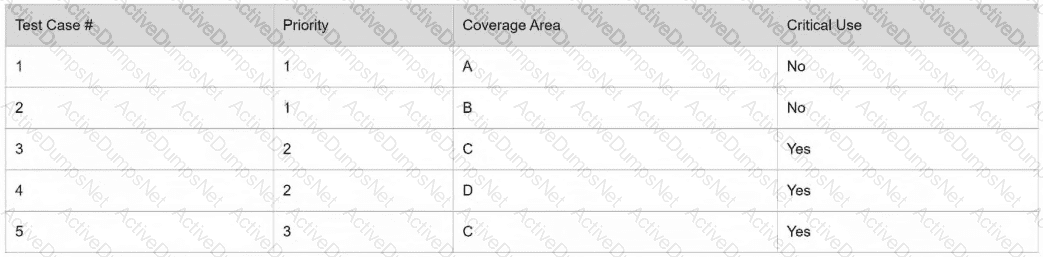
You want to use impact analysis to focus testing. Research shows that areas A, C, and D were affected by this change. Based on this information, which test cases should be run, and in what order?
You are applying metamorphic testing to a simple vacation calculation program. The metamorphic relationship being tested is that vacation days are calculated based on the number of days worked: for each day worked, 0.05 days of vacation time should be accrued.
Given this information, which input should be varied?
You have been assigned as Test Analyst on a project that is in the test design stage. Test cases have been written, which activity should you do next before test design is complete?
You have been working in an Agile model on a large software project. You developed a traceability matrix that records the risk for each requirement and maps it to the test case that tests that requirement. You have just received a new release in which developers have classified some areas as “high risk” for regression. Consider the following risk table (1 = highest risk):

Based on this information, in what sequence should the test cases be run to help mitigate regression risk?
Which of the following is an advantage of crowd testing?
Which activity is an example of FUNCTIONAL CORRECTNESS testing for a food-ordering app?
You are a test analyst on a project developing a multiplayer computer game in which players can cooperate or compete while communicating over a network. The game will also support players purchasing and exchanging various artifacts for use during gameplay.
Your organization expects the game to be a success and likely to be bought by tens of thousands of players worldwide. The following excerpt is from the risk analysis performed for this product:
Incompatibility when operating on different devices and hardware configurations
User-interface issues at different screen resolutions
Unpredictable player behavior causing crashes
Weak security mechanisms against fraudsters
Which test technique would be the BEST choice to mitigate these risks?
You are testing the functional correctness of an application which allows the driver of a car to control if the air that enters the passenger compartment is fresh or recycled. The car may be ordered in various configurations:
• Engine Size (can be: 1500cc, 1900cc, 2200cc, 2500cc)
• Gearbox type (can be: automatic, manual 5-speed, manual 6-speed)
• Cruise control (can be: yes or no)
• Electric sunroof (can be: yes or no)
It is expected that the most popular configuration will have a 1900cc engine and a manual 5-speed gearbox with cruise control and no electric sunroof. In order to achieve full BASE CHOICE coverage, how many configurations must be tested?
You are working on a project to build an application that will handle insurance claims. The main requirements for the system are that it shall:
• Allow users to enter details of claims that have been submitted by insured customers.
• Take each claim through a workflow that will allow an assessor to approve the request, reject it or request clarification from the claimant.
• Send approved requests to the accounts payable system for payment.
The solution is being developed according to the company’s standard V-model methodology. The requirements are clearly documented and include a business process model. Operational profiles have been created to guide performance testing.
A risk-based approach to testing is used; frequency of use and role of the user are major factors in feature risk assessment.
System testing has almost finished but a major change to the approval workflow is just about to be delivered. A standard regression test pack has not yet been established, but ad-hoc regression testing has already been performed on earlier builds.
As a TA, you have updated the list of product risks and must now decide the scope of the regression testing. Which pair of techniques will be MOST effective for selecting the regression tests?
a) History-based, driven by the results of the regression tests run so far
b) Risk-based, driven by the updated list of product risks and its traceability to the tests
c) Operational profile-based, driven by the likely patterns of use of the relevant transactions
d) Requirement traceability matrix-based, driven by the links from affected requirements to related tests
e) Impact analysis, driven by consultation with technical stakeholders to identify what might be affected.
A credit risk scoring system accepts two integer inputs, L and E, representing credit scores calculated by two independent systems. The system assesses credit risk using the following business logic:
IF L > = 50 OR E > = 50 THEN the risk is high
IF L < = 49 AND E < = 49 THEN the risk is low
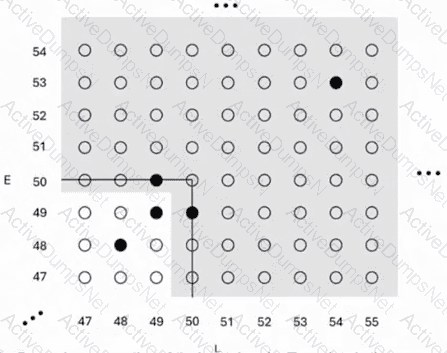
The figure displays a section of the input domain. Points in the gray area are part of the “high risk” equivalence partition, and points outside it are part of the “low risk” equivalence partition. The lines indicate the closed boundary of the “high risk” equivalence partition.
You use domain-based testing to verify the correct implementation of the above requirement. The test set contains the five black points in the figure: (L=48, E=48), (L=49, E=49), (L=49, E=50), (L=50, E=49), and (L=54, E=53).
What level of RELIABLE domain coverage does this set of test points achieve?
How does Orthogonal Defect Classification (ODC) work together with Root Cause Analysis (RCA)?
A simple DVD player is described in the following state transition diagram:
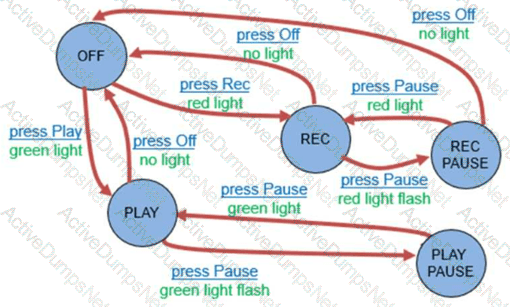
All round trips are feasible, even those that do not start at OFF. How many test cases will be needed for complete round-trip coverage?
You are working on a project to replace an old sales and merchandising system with a new system that will be based on modern platforms. The old system is still in production but is poorly documented and expensive to maintain. The new version will be developed using modern technology. The main requirements for the system are that it shall:
1. Load sales data, sent electronically from the stores each evening, into a central database.
2. Produce actual sales reports for the merchandisers, whose job is to manage stock levels in stores.
3. Produce sales forecast reports based on a combination of sales history and forecasting parameters. The parameters will be entered by the merchandisers into a browser-based front end and the reports will be produced overnight. The users will be able to see the reports next day, on screen or in print, by requesting this through the browser.
Requirements 1 and 2 are satisfied by the existing system and will be rewritten with no significant changes. Requirement 3 is new and has been clearly specified.
The entry of forecasting parameters and of requests to see the reports will be low volume, but the Merchandising Manager is concerned about usability because the forecasting parameters are complex.
Which test charter would be BEST for the initial exploratory testing of requirement 3?
A traceability matrix that shows the relationship between the requirements and the test cases is a way to help determine which of the following?
What is the typical relationship between high-level test cases and low-level test cases?
You are testing an e-commerce website. There have been issues with the shopping cart displaying the wrong number of items. You want to expand the tests to include varying numbers of items in the cart and checking the cart total. The metamorphic relationship is that the number of items selected should match the number of items in the cart.
Which of the following is the input for the test case?
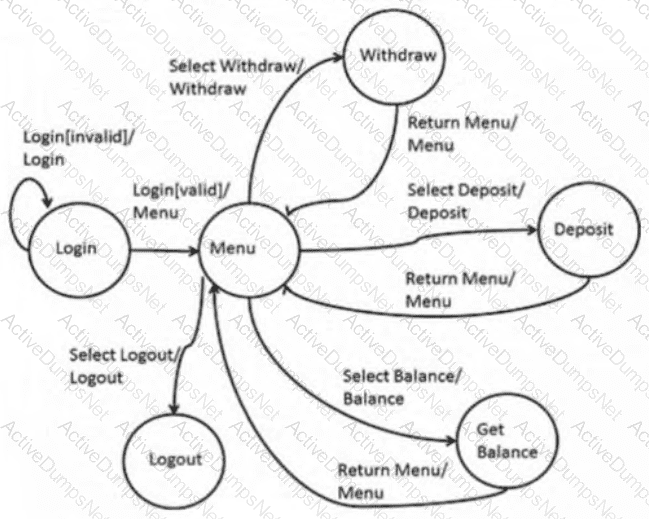
Examine the following state transition diagram for a simple ATM system.
Assuming that a test case stops as soon as it reaches the Menu state or the Logout state, how many test cases are needed to achieve full coverage of this state transition diagram?
You are testing a mobile application that has limited capabilities but must work in a wide variety of environments and connectivity situations. Which type of testing should you use to get a broad view of how the application will perform in the real world?
The following use case diagram shows the process of raising a Purchase Request (PR) and getting it authorized. Details are entered in batches; any that fail validation will be rejected and must be re-entered. The details will indicate whether the request is a normal one or an emergency one. Normal requests must be authorized by the department manager, who may refuse to do so. Emergency requests will be automatically authorized and reported to the manager.
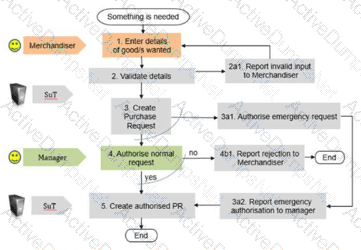
The test strategy states that:
• all combinations of extensions and exceptions, as well as the main scenario, shall be tested
• loops shall get simple loop coverage where the maximum number of iterations for validation exceptions is 3 and the typical number is 2.
What is the minimum quantity of test cases that will be needed to obtain this coverage?
You are designing test cases from the following state-transition diagram.
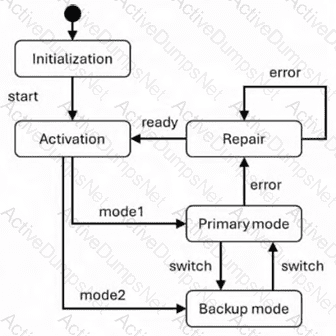
So far, the only test case designed is:
TC1: start, mode1, error, error, ready, mode1, switch, switch, switch, switch.
You use the ROUND-TRIP coverage approach. What round-trip coverage is achieved by this test case?
What is a common problem associated with using a pseudo-oracle in testing?
You are performing system integration testing to verify that two systems can exchange data properly. What type of testing are you performing?
How does root cause analysis help prevent defects?
Which of the following is a way to ensure your synthetic data is reflective of production data?