Weekend Special - 75% Discount Offer - Ends in 0d 00h 00m 00s - Coupon code: discactive

WatchGuard Network-Security-Essentials Network Security Essentials for Locally-Managed Fireboxes Exam Practice Test

Network Security Essentials for Locally-Managed Fireboxes Questions and Answers

Question 1

Which of these options are private IPv4 address spaces described in RFC 1918 Address Allocation for Private Internets? (Select three.)

Options:

A.

192.168.0.0/16

B.

172.16.0.0/12

C.

102.0.2.0/24

D.

172.0.0.0/16

E.

10.0.0.0/8

Question 2

Match each type of NAT with the correct descriptor:
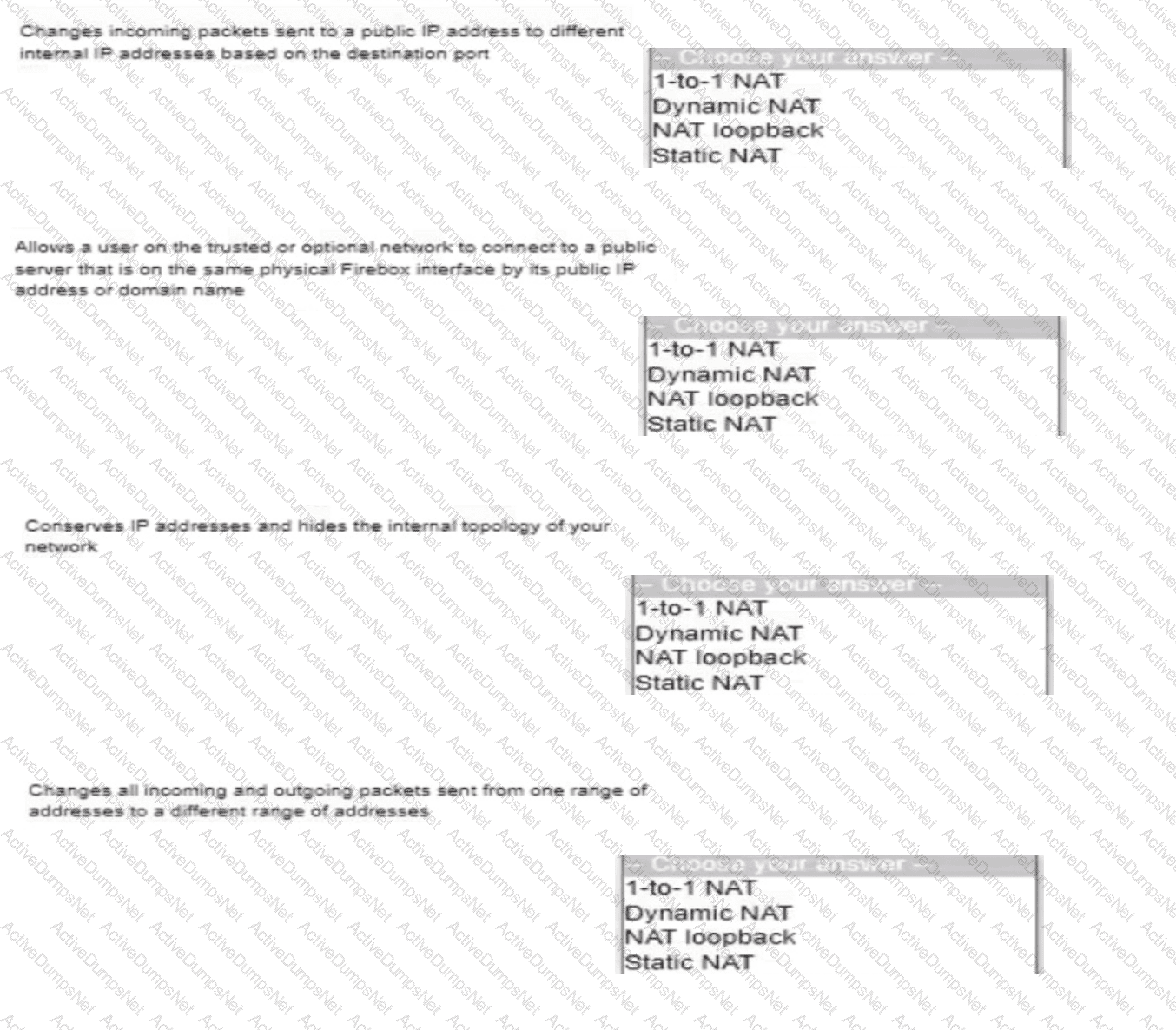
Question # 2

Options:

Question 3

You can run TCP Dump directly from the Firebox.

Options:

A.

True

B.

False

Question 4

If a Firebox has two trusted interfaces enabled, the default policies allow HTTPS connections between computers on different trusted networks.

Options:

A.

True

B.

False

Question 5

Match the network server to the protocol and port it uses:
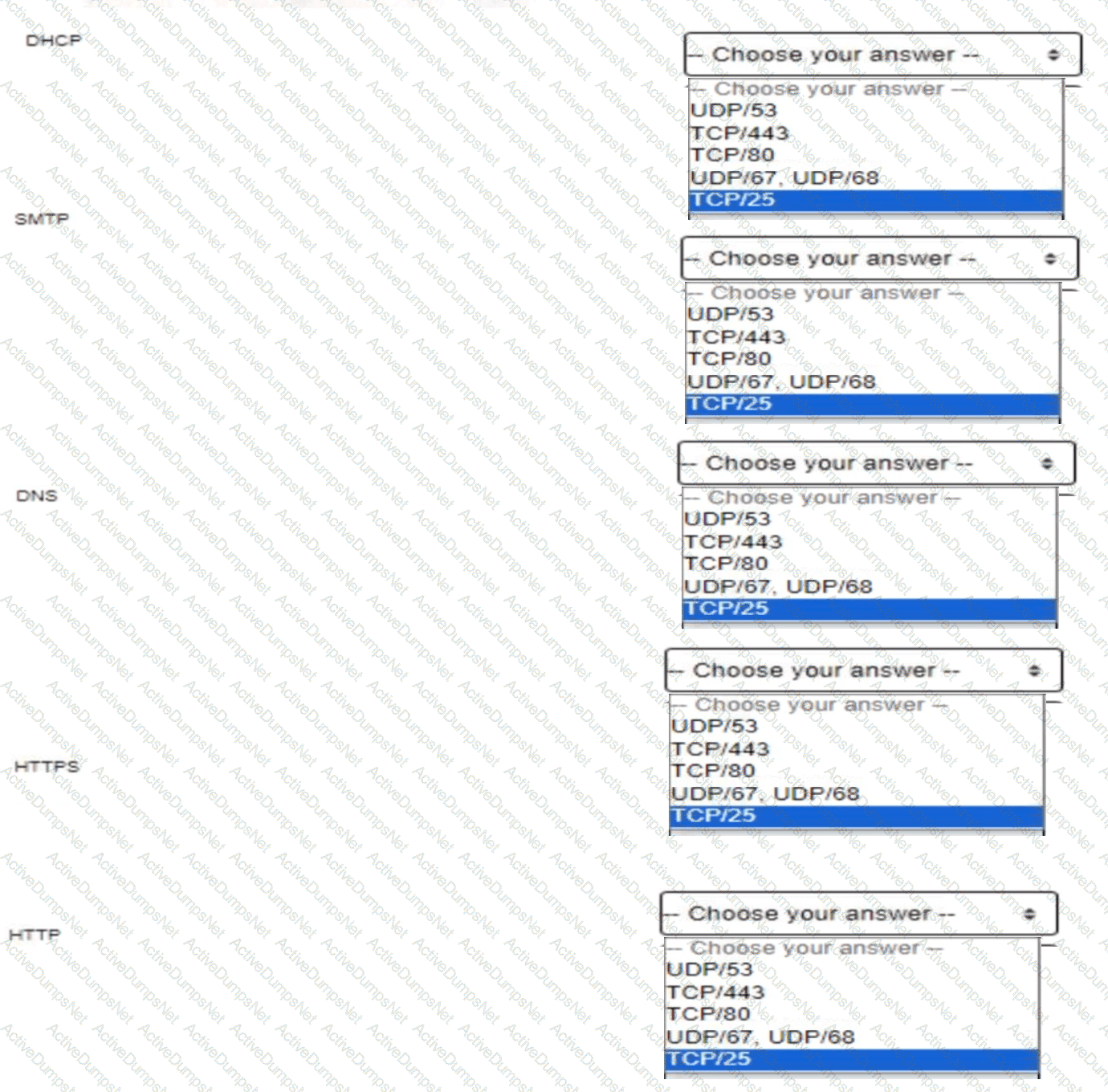
Question # 5

Options:

Question 6

If the Firebox does not have a feature key installed, which of these statements are true? (Select three.)

Options:

A.

You cannot upgrade the Firebox

B.

You cannot configure subscription services

C.

You cannot run the Web Setup Wizard

D.

You cannot save configuration changes to the Firebox

E.

Only one user can connect to the Internet through the Firebox

Question 7

Based on the configuration shown in this image, clients on the network can successfully connect to https://www.watchguard.com.

Question # 7

Options:

A.

True

B.

False

Question 8

A Firebox has an external IP address of 203.0.113.100. A public web server with the IP address 10.0.1.80 is connected to a Firebox internal network. What is the effect of the policy shown in this image? (Select one.)
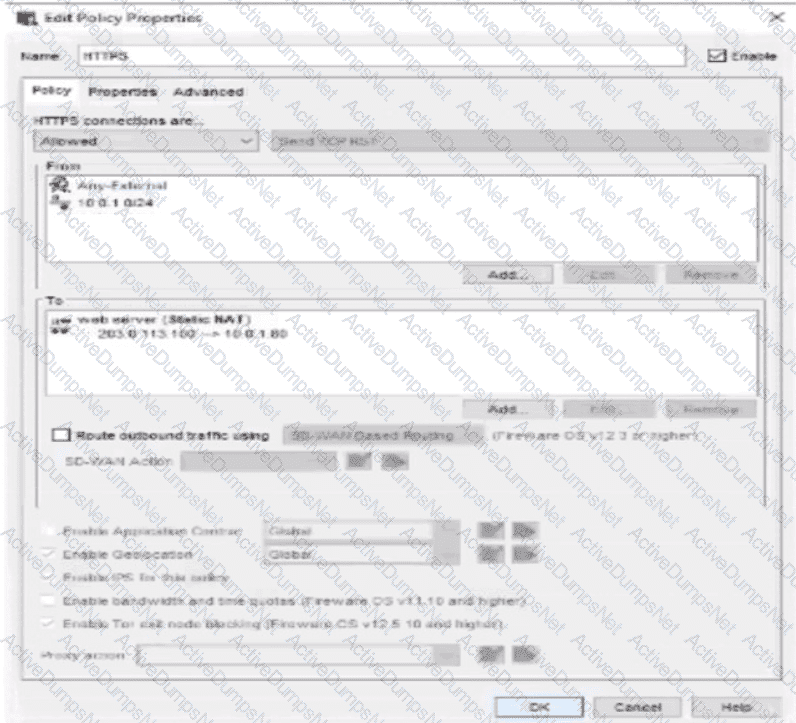
Question # 8

Options:

A.

Allows users on the Internet to connect to the 10.0.1.80 IP address of the web server

B.

Applies dynamic NAT to the 10.0.1.80 IP address of the web server to allow inbound connections

C.

Allows users on the Internet and the 10.0.1.0/24 network to use the internal IP address of the Firebox to connect to the web server

D.

Allows users on the Internet and the 10.0.1.0/24 network to use the external IP address of the Firebox to connect to the web server

Question 9

You enable a network device monitoring application on a server with IP address 10.0.1.22. After you run the application, it reports that it cannot ping the Firebox at 10.0.1.1, and you see this log message in Traffic Monitor. What is the most likely cause of this issue? (Select one.)

(Log: Deny 10.0.1.22 10.0.1.1 icmp/8 255-Unhandled Internal Packet-00)

Options:

A.

The server IP address is on the Blocked Sites list

B.

There is no route on the Firebox for the 10.0.1.0/24 subnet

C.

The dynamic NAT statement is not configured correctly for the 10.0.1.0/24 subnet

D.

The default Unhandled Internal Packet policy is at the top of the policy set

E.

There is no policy that allows Ping traffic from the server to the Firebox alias

Question 10

You can add your Firebox to WatchGuard Cloud but continue to manage it locally. When you do this, what additional features does WatchGuard Cloud provide for your locally-managed Firebox? (Select two.)

Options:

A.

Automatic Firebox firmware updates

B.

Ability to schedule Firebox firmware updates

C.

Real-time network traffic data

D.

Unified event correlation and analysis

E.

Live status and access to reports

Question 11

What are some advantages of BOVPN virtual interfaces (route-based VPN) over classic policy-based BOVPNs? (Select two.)

Options:

A.

Supports VPN connectivity to cloud services

B.

Additional keep-alive options

C.

More flexible routing options

D.

Increased BOVPN throughput

E.

Additional encryption options

Question 12

Which of these statements are true for this log message? (Select three.)

(Log context: A Traffic Monitor log entry detailing an HTTP connection through an HTTP-proxy policy that was terminated due to a signature match by Gateway AntiVirus)

Options:

A.

Application Control detected the application as a virus

B.

The URL path matched the proxy content type restrictions

C.

The connection used an HTTP Proxy

D.

Gateway AntiVirus detected a virus

E.

The connection was denied

F.

The connection used an HTTP Packet Filter

Question 13

Clients on the 10.0.10.0/24 network must connect to the server at 10.0.20.100. Based on this image, what static route must you add to the Firebox for traffic to reach the server? (Select one.)
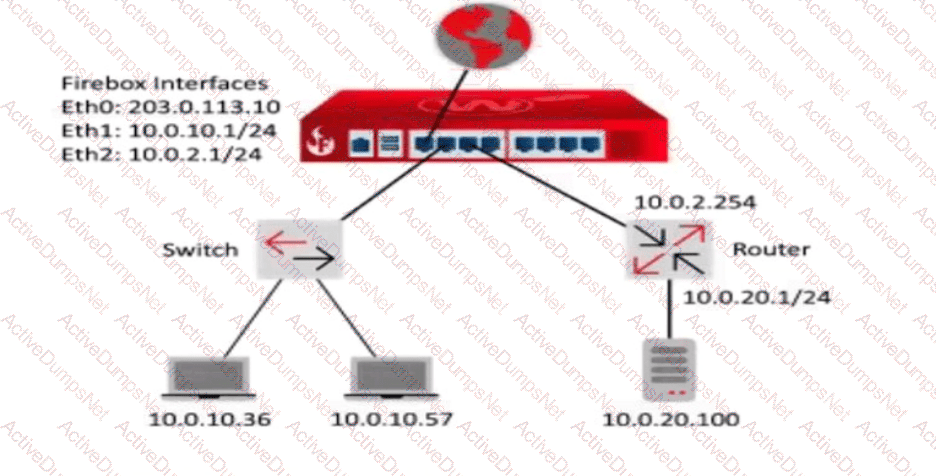
Question # 13

Options:

A.

Route to 10.0.10.0/24, Gateway 10.0.0.1

B.

Route to 10.0.20.0/24, Gateway 10.0.2.254

C.

Route to 10.0.20.0/24, Gateway 10.0.2.1

D.

Route to 10.0.2.0/24, Gateway 10.0.2.1

E.

Route to 10.0.20.0/24, Gateway 10.0.2.254

Question 14

Which of the following management interfaces can provide real-time diagnostic information? (Select two.)

Options:

A.

Dimension

B.

Firebox System Manager

C.

Policy Manager

D.

Fireware Web UI

E.

Log and Report Server

Question 15

You have five public IP addresses available from your ISP. When you create a Static NAT action, you want to specify one of the public IP addresses for inbound traffic but do not see it in the IP address drop-down list. How can you change the Firebox configuration to see additional public IP addresses in the Static NAT action? (Select one.)

Options:

A.

Add secondary IP addresses to the external interface

B.

Configure 1-to-1 NAT for your entire subnet

C.

Add the public IP addresses to the From field of the policy that uses the Static NAT action

D.

Enable the Set Source IP option in the policy

E.

Add the IP addresses to the Dynamic NAT configuration

Question 16

If policies are automatically ordered, which of these policies has the highest precedence? (Select one.)

Options:

A.

HTTPS policy - From: Any-Trusted, Any-Optional To: Any-External

B.

HTTPS policy - From: Trusted To: Any-External

C.

Outgoing policy - From: Any-Trusted, Any-Optional To: Any-External

D.

HTTPS policy - From: User1@Firebox-DB To: Any-External

Question 17

In a Mobile VPN configuration, why would you choose default-route (full tunnel) VPN instead of split tunnel VPN? (Select one.)

Options:

A.

Default-route VPN uses less bandwidth.

B.

Default-route VPN enables your Firebox to examine all remote user traffic.

C.

Default-route VPN uses less processing power.

D.

Default-route VPN automatically allows dynamic NAT.

E.

Default-route VPN is the only option you can use to apply security services to connections routed to your internal servers.

Question 18

You configured your Firebox as a DHCP server and want to verify the status of the leased addresses. You found this information in Firebox System Manager > Status Report. What is true about DHCP leases in this deployment? (Select two.)

DHCP Leases Log Extract:

lease 10.20.1.100 {

interface vlan20;

starts 4 2023/03/09 21:42:25;

ends 4 2023/03/09 22:42:25;

binding state active;

hardware ethernet 00:50:56:9a:75:d0;

client-hostname "Laptop1";

}

Summary for 10.20.1.0/24: 1 out of 51 IPs are leased

lease 10.0.1.2 {

interface eth1;

starts 4 2023/03/09 21:42:33;

ends 5 2023/03/10 05:42:33;

binding state active;

hardware ethernet 00:50:56:b6:22:9f;

client-hostname "Server1";

}

Summary for 10.0.1.0/24: 1 out of 253 IPs are leased

Summary for all: 2 out of 304 IPs are leased

Options:

A.

The MAC address for the host using 10.0.1.2 is 00:50:56:9a:75

B.

DHCP leases for the 10.0.1.0/24 network are valid for 8 hours

C.

DHCP leases for the 10.20.1.0/24 network are valid for 24 hours

D.

252 IP addresses are currently available in the address pool for the 10.0.1.0/24 network

E.

The hostname Server1 is associated with the IP address 10.20.1.100