
VMware 3V0-25.25 VMware Certified Advanced Professional - VMware Cloud Foundation 9.0 Networking Exam Practice Test
VMware Certified Advanced Professional - VMware Cloud Foundation 9.0 Networking Questions and Answers
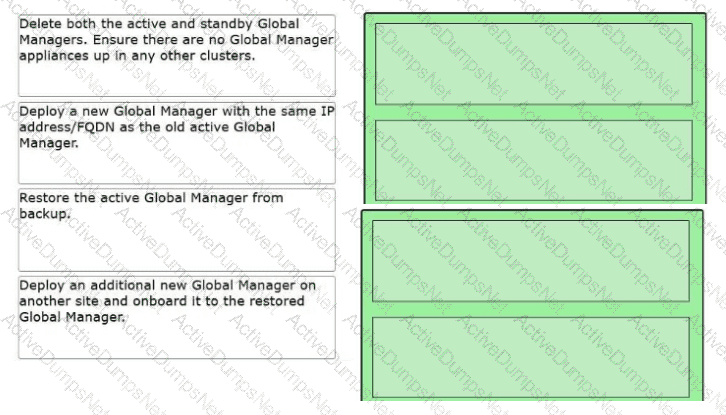
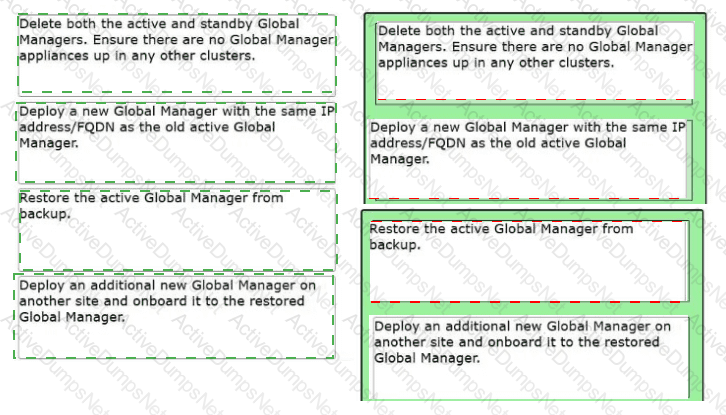
An administrator has noticed that both the active and standby Global Managers have gone offline.
What is the correct sequence of events to restore the Global Managers?
The administrator must configure Border Gateway Protocol (BGP) on the Tier-0 Gateway to establish neighbor relationships with upstream routers. Which two statements describe the Border Gateway Routing Protocol (BGP) configuration on a Tier-0 Gateway? (Choose two.)
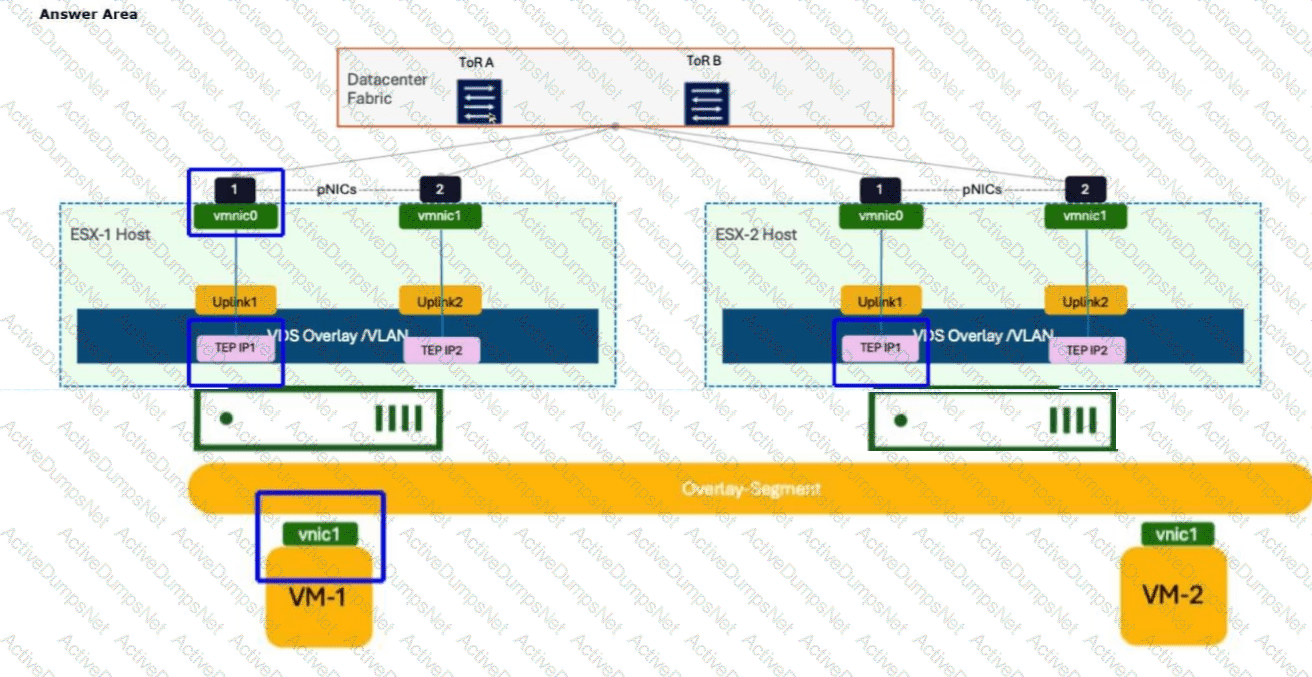
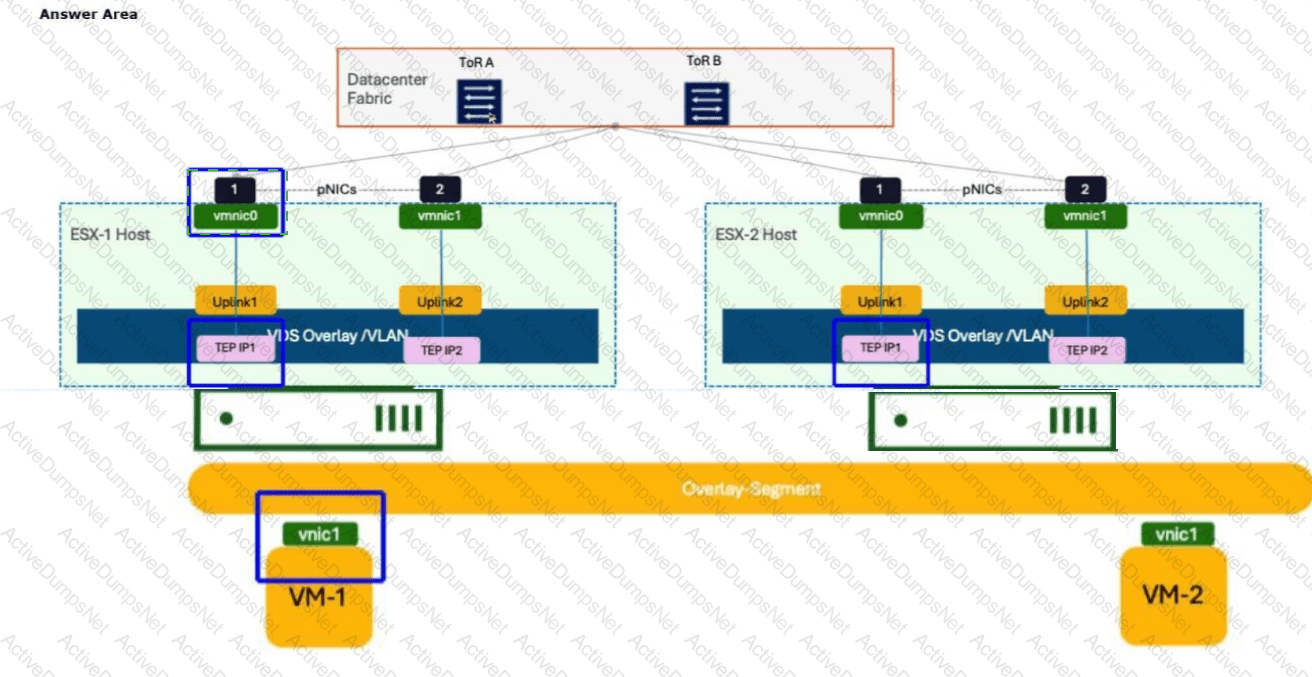
The administrator is working to ascertain the encapsulation of GENEVE by reviewing the capture on Wireshark.
The administrator instructed VM-1 to send a continuous ICMP request directed at VM-2.
Click to highlight where the administrator should observe the GENEVE encapsulated packet.
An administrator is configuring an NSX segment used by a nested hypervisor deployment where an ESXi VM runs on an ESXi host and multiple VMs run inside the ESXi VM. Which segment profile must be created to satisfy the request?
An administrator has deployed a workload domain in VMware Cloud Foundation (VCF). The workload domain was deployed with NSX managers using the XL form factor. After deployment, the administrator realizes the NSX manager is oversized and needs to change to a smaller form factor. What should the administrator do to accomplish this task?
An NSX Manager cluster has failed. The administrator deployed a new NSX Manager using the latest version and attempted to restore from a backup, but the restore operation failed. What would an administrator do to recover the cluster?
An administrator has a vSphere 8 Update 1a with NSX 4.1.0.2 environment. What option can the administrator use to converge this vSphere with NSX environment into a VMware Cloud Foundation (VCF) Workload Domain?
An administrator is tasked to create a development environment with a Tier-1 gateway to host overlay segments for only East/West workload communication. North/South communication is also required. The solution will not include the following services: NAT, DHCP, VPN. Which step must the administrator take when creating the Tier-1 gateway?
When using a DHCP Relay on a segment, which design restriction must be considered?
An administrator has been tasked with providing a networking solution including a Source and Destination NAT for a single Tenant. The tenant is using Centralized Connectivity with a Tier-0 Gateway named Ten-A-Tier-0 supported by an Edge cluster in Active-Active mode. The NAT solution must be available for multiple subnets within the Tenant space. The administrator chooses to deploy a Tier-1 Gateway to implement the NAT solution. How would the administrator complete the task?
Which two requirements are part of the registration process for Local Manager (LM) to a Global Manager (GM) in NSX for centralized management of network and security services across different workload domains deployed in separate locations? (Choose two.)
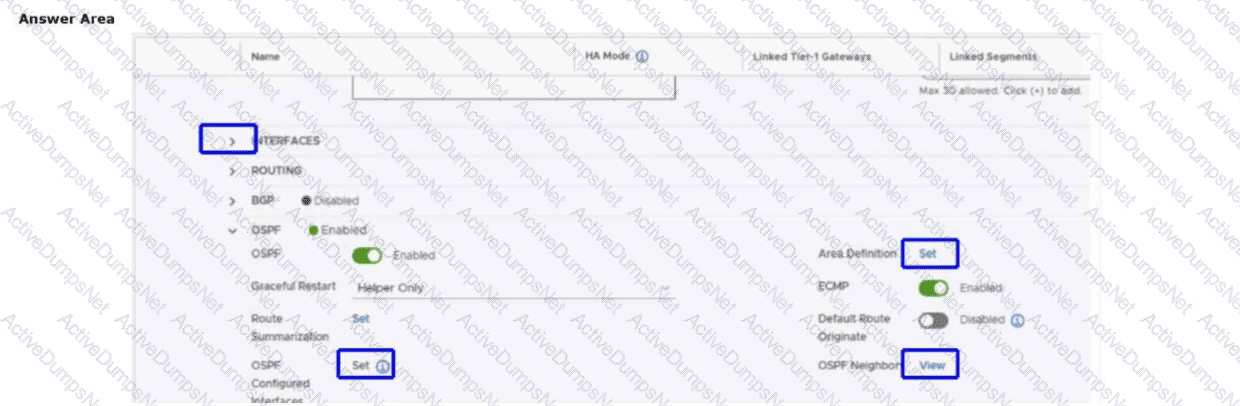
An administrator has been tasked with enabling OSPF as the routing protocol for a Tier-0 Gateway. Which two items must be configured to enable OSPF for a Tier-0 Gateway?
Mark two answers by clicking the two correct locations on the image. (Choose two.)

An administrator has deployed a new VMware Cloud Foundation (VCF) management domain. To be compliant with company policy, backups must be configured to occur anytime a change is made to the NSX configuration. How can the administrator ensure that complete configuration backups are captured every time a change occurs?
An administrator is troubleshooting BGP flapping in a VMware Cloud Foundation (VCF) 9 environment. A Tier-0 Gateway is running in Active/Active mode with two Edge nodes. BFD is enabled on the eBGP sessions to the upstream routers. Each Edge node uses its own uplink IP for BGP. After some network maintenance, one BGP session starts flapping every few minutes. The other BGP sessions stay stable. On the affected Edge node, the command get bfd-sessions shows:
• State: Down
• Diag: Detect Time Expired
Symptoms:
• The upstream router also shows the BFD session as Down with control Detection Time Expired.
• There are no interface errors, no packet loss for normal traffic, and clearing the BFD session temporarily brings it back up - but it flaps again after few minutes.
What is the root cause?
An administrator has noticed an issue in a freshly deployed VMware Cloud Foundation (VCF) environment where the BGP neighborship between the Tier-0 gateway and a physical router remains in the Idle state. Pings between the uplink IPs are successful. What is the issue?
How should the Global Managers (GMs) and Local Managers (LMs) be distributed to ensure high availability and optimal performance in a multi-site NSX Federation deployment comprised of three sites? (Choose two.)
An architect needs to allow users to deploy multiple copies of a test lab with public access to the internet. The design requires the same machine IPs be used for each deployment. What configuration will allow each lab to connect to the public internet?
An administrator is troubleshooting an issue where workloads connected to a Tier-1 Gateway named T1-App can no longer reach external North/South destinations.
• The Tier-1 is connected to an Active/Standby Tier-0 Gateway named T0-Prod.
Symptoms observed:
• VMs on segments attached to T1-App can ping each other.
• VMs on T1-App cannot reach any external IP outside T0-Prod.
• From a VM on the segment, ping to the T1-App Distributed Router (DR) IP succeeds.
• Ping from the VM to the T1-App Service Router (SR) fails.
• The Edge cluster hosting the T1-App SR shows both Edge nodes Up and Healthy.
• No failover has occurred — the same Edge node is still shown as Active for T1-App.
What is the most likely cause of this issue?