
VMware 3V0-24.25 Advanced VMware Cloud Foundation 9.0 vSphere Kubernetes Service Exam Practice Test
Advanced VMware Cloud Foundation 9.0 vSphere Kubernetes Service Questions and Answers
An administrator is tasked with making an existing vSphere Supervisor highly available by adding two additional vSphere Zones. How should the administrator perform this task?
What statement describes Cluster API?
An administrator runs several critical workloads on vSphere Kubernetes Service (VKS). An audit identified an outdated container image with a known CVE that exposed internal APIs to unauthorized access. To mitigate this risk and enhance image security, the administrator enabled Harbor as a Supervisor Service.
Which two Harbor registry capabilities help the organization prevent a recurrence of this type of security incident? (Choose two.)
Which four capabilities are provided by a VMware Kubernetes Service (VKS) cluster?
What tool can be used to back up and restore workloads on clusters provisioned by vSphere Supervisor?
What open-source project enables automated lifecycle management of VMware vSphere Kubernetes Service (VKS) clusters?
Refer to the exhibit in the following StorageClass manifest, which field is used to specify the Volume Plugin driver used for the underlying storage array?
YAML
apiVersion: storage.k8s.io/v1
kind: StorageClass
metadata:
name: standard
provisioner: kubernetes.io/aws-ebs
parameters:
type: gp2
reclaimPolicy: Retain
allowVolumeExpansion: true
mountOptions:
- debug
volumeBindingMode: Immediate
A cloud platform team is deploying multiple Supervisors in a VMware Cloud Foundation (VCF) environment to support a multi-tenant VKS architecture. Each Supervisor will host a distinct set of namespaces mapped to different organizational tenants such as Finance, Public Services, and R & D, where each tenant consumes resources from dedicated workload domains.
What is the purpose of the vcf context create command?
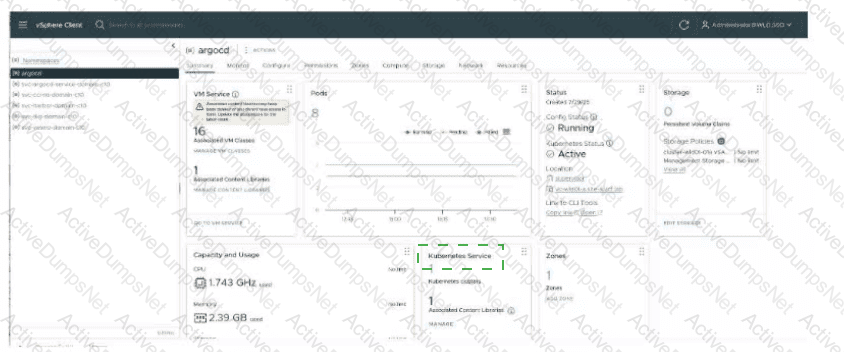
An administrator is adding a kubernetes cluster to an existing namespace. Click where the administrator navigates to create the cluster.
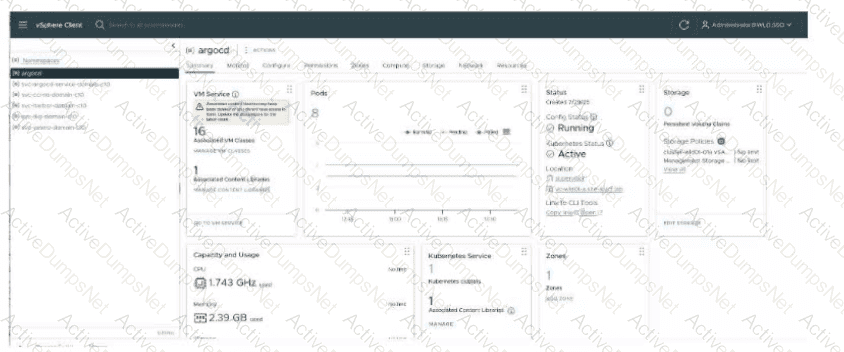
An administrator is maintaining several Kubernetes clusters deployed through a Supervisor Namespace in a vSphere Kubernetes Service environment. One of the micro-services (a containerized API gateway) is failing intermittently after a recent configuration update. The pod is entering aCrashLoopBackOffstate. The administrator needs to collect detailed runtime information directly from the pod, including both thestandard output (STDOUT)andstandard error (STDERR)streams, to analyze the application ' s behavior before the crash.
Which command produces the required output?
How would an administrator obtain the kubectl config file in the VMware vSphere Kubernetes Service (VKS)?
An administrator is operating a sovereign private cloud built on VMware Cloud Foundation (VCF) and is providing isolated Supervisor Namespaces as well as associated Kubernetes clusters. The architecture must ensure consistent provisioning, management, and monitoring of these clusters across tenants while maintaining compliance with internal governance and automation frameworks, considering:
• Deploying and scaling Kubernetes clusters
• Managing Supervisor Namespaces and configurations
• Monitoring cluster health, workloads, and resources across tenants
What three clients are supported for provisioning, managing, and monitoring VMware vSphere Kubernetes Service (VKS) clusters? (Choose three.)
An architect is working on the data protection design for a VMware Cloud Foundation (VCF) solution. The solution consists of a single Workload Domain that has vSphere Supervisor activated. During a customer workshop, the customer requested thatvSphere Podsmust be used for a number of third-party applications that have to be protected via backup.
Which backup method or tool should be proposed by the architect to satisfy this requirement?
What is a vSphere Pod in a VMware vSphere Kubernetes Service (VKS) cluster?
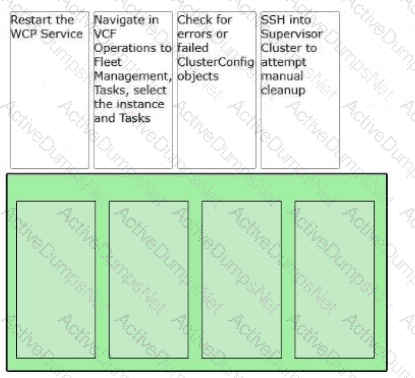
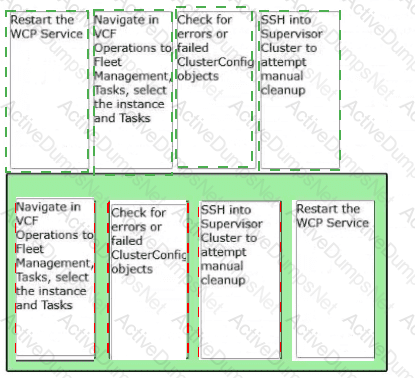
An administrator upgrades a VMware Cloud Foundation (VCF) Supervisor and the upgrade fails. Order the steps the administrator should take to determine the cause of the failure.
An administrator must create amulti-zone vSphere Supervisor deployment in a VMware Cloud Foundation (VCF) environment. What is the primary purpose of this configuration?
Which two capabilities are standard within a service mesh? (Choose two.)
A cloud operations team is managing multiple Supervisor Clusters across two regions. Each region hosts its own vSphere Kubernetes clusters, integrated through a federated service mesh to enable consistent service connectivity and policy enforcement across environments.
The application team wants to expose a multi-tier microservice named “GovApp”, which includes front-end, API, and database services distributed between the two regions. Uniform traffic routing, identity, and security policies are also needed for these workloads regardless of the cluster or region in which they are deployed.
To meet these requirements, the architects decide to create a Global Namespace that spans both Supervisor Clusters.
Which two statements describe the requirements for a Global Namespace in a vSphere Kubernetes Service Mesh deployment? (Choose two.)
An administrator has been tasked to temporarily scale the Control Plane of a VKS cluster with no service disruption. How should the administrator accomplish this task?
An administrator is building a secure, multi-tenant container registry strategy for their vSphere Kubernetes Services deployment running on VMware Cloud Foundation. Each workload domain hosts a Supervisor Cluster, and multiple development teams require private repositories to store and distribute container images for Kubernetes clusters. The organization enforces strict image security posture due to compliance requirements. The operations team deploys Harbor as an add-on service through the Supervisor control plane, and developers push/pull images from Harbor through Kubernetes manifests.
What requirement describes the role and purpose of Harbor?
An administrator is tasked to protect a VKS cluster at a point in time. To satisfy the request, the administrator creates a pre-provisioned snapshot of the target cluster.
Drag and drop the four configuration tasks Into the correct order from " Configuration Steps " on the left and place them into the " Configuration Order " on the right. (Choose four.)


What Kubernetes object is used to set permissions on namespaces?
What component is used to provision VMware vSphere Kubernetes Service (VKS) service mesh workload clusters?
An administrator has been tasked with enabling backup for a vSphere Kubernetes cluster. How does the administrator configure a backup?