
VMware 3V0-21.25 Advanced VMware Cloud Foundation 9.0 Automation Exam Practice Test
Advanced VMware Cloud Foundation 9.0 Automation Questions and Answers
A customer requires a backup of blueprints within VMware Cloud Foundation (VCF) Automation to a third-party solution each time the blueprint is released.
What construct will satisfy the requirement?
An administrator is designing a VCF Automation service catalog item that enables development teams from multiple business units to deploy standardized environments for microservices applications. The solution must support consistent configuration, minimize environment sprawl, and enforce automated decommissioning policies. Which three capabilities of VMware Cloud Foundation (VCF) Automation can be used to meet these requirements? (Choose three.)
Which service provides the ability to backup and restore vSphere pods?
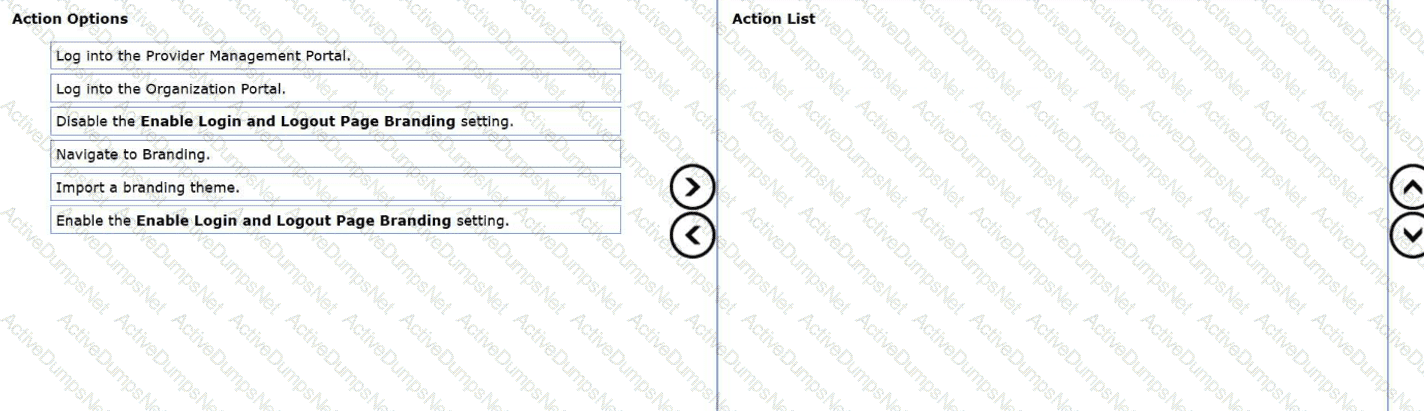
An administrator has been tasked with configuring tenant branding with the following requirements:
Organization branding should only appear when a user has logged in to the organization portal.
Select the three steps involved in configuring branding. (Choose three.)

An administrator has been tasked to enable developers to utilize Terraform to configure resources within VMware Cloud Foundation (VCF) Automation. The solution must:
• enable developers to configure Content Libraries.
• enable developers to configure Cloud Zones.
• enable developers to create flavor and image mappings.
What solution satisfies the requirements?
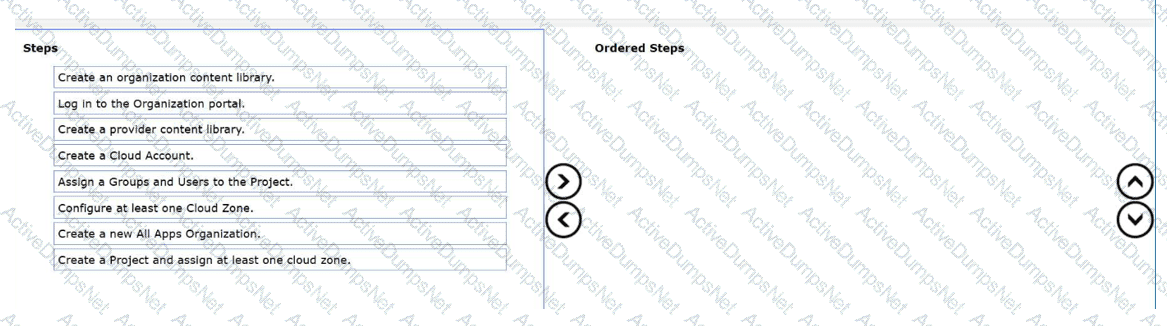
A company has deployed an new VMware Cloud Foundation (VCF) Fleet within their development environment. An administrator has been tasked with configuring the
organization for VM Apps so that developers can start to create new cloud templates and catalog items.
When creating the organization for VM Apps, the administrator successfully configured access control and assigned Organization-level and Service-level roles to the correct users
and groups.
Drag and drop the five steps the administrator must take from the Steps list into the Ordered Steps list and place them in the correct order so that the objective is completed.
(Choose five.)

An organization uses VMware Cloud Foundation (VCF) and requires the following across the private cloud environment:
• monitor IP space utilization.
• detect network anomalies.
• enforce consistent network policies.
What three capabilities are required? (Choose three.)
An organization uses a centralized external Configuration Management Database (CMDB) to track all infrastructure assets. Currently, when a new virtual machine (VM) is provisioned through VMware Cloud Foundation (VCF) Automation, operations teams are required to manually input associated metadata into the CMDB.
An administrator is tasked with reducing the manual effort and increasing efficiency of this process using VCF Automation.
Which three of the following can VCF Automation perform? (Choose three.)
An organization is experiencing rapid growth, and the VMware Cloud Foundation (VCF) administrator needs to ensure that the "Development" organization does not consume all available physical resources in the "West" region, which is shared with the "Production" organization.
What should the administrator configure to limit the total CPU and Memory consumption for the Development organization?
An administrator clicks on Orchestrator to create a workflow in a VMApps organization as shown in the image. Where would the administrator go next to enable Orchestrator?
An administrator has been tasked with creating a region to provide resources to an Organization in VMware Cloud Foundation (VCF) Automation.
The following information has been provided to the administrator for this task:
• Two workload domains are configured and will integrate with the region.
• All workload domains are configured to share a VMware NSX Manager.
• All workload domains are configured with VMware vSAN storage.
• All workload domain VMware vCenter instances have a Supervisor enabled.
Before creating the region, what two additional configurations should the administrator validate? (Choose two.)
In VMware Cloud Foundation (VCF) Automation, which construct within an AIIApps organization consists of one or more Supervisors and supplies compute, memory, storage, and network resources to the organization?
A VMware Cloud Foundation (VCF) Automation administrator has been tasked with ensuring that all newly-deployed virtual machines (VMs) provisioned in the Finance Organization are automatically configured for disaster recovery protection using VMware Live Recovery (VLR). Finance is an AIIApps Organization in VCFA.
Which statement meets this requirement?
A system administrator is tasked to create a region for use within an AIIApps organization. How would the administrator determine which vCenter Servers are available in the infrastructure?
The administrator is tasked with configuring hard tenancy in VMware Cloud Foundation (VCF) Automation. Which statement reflects how multi-tenancy is configured?
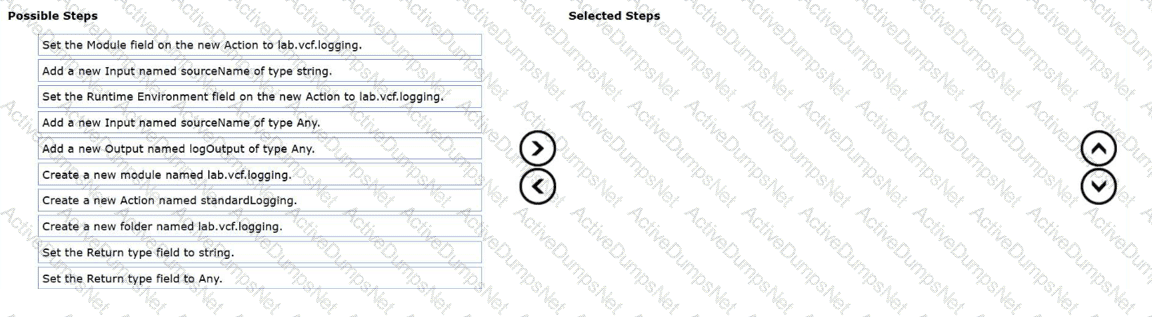
An administrator has been tasked with creating an action in VMware Cloud Foundation (VCF) Operations orchestrator. The action will be used within all custom created workflows and actions to print additional information into the logs to assist with troubleshooting. The following information has been provided for the action:
The action must be named standardLogging
The action must be stored in lab.vcf.logging
The action script will output a value that is in a JSON object format
The action must accept an input with the following configuration:
o Name: sourceName
o Type: string
Drag and drop the five correct steps the administrator must perform as part of this task from the Possible Steps list on the left and place them into the Selected Steps list
on the right in any order. (Choose five.)

An administrator has been tasked to provide workload storage that remains available even if one zone in a three-zone Supervisor cluster fails. Which action must the VMware Cloud Foundation (VCF) Automation administrator take to meet this requirement?
An administrator is responsible for managing a VMware Cloud Foundation (VCF) fleet and the administrator has been tasked with the following:
• Create DNS records before each virtual machine (VM) is deployed using VCF Automation.
The administrator has already completed the following tasks:
• Created two VCF Operations Orchestrator Workflows with corresponding Event Subscriptions:
Create DNS Record
Delete DNS Record
• Created a new blueprint to deploy a VM:
Added two string inputs, hostname and domainName
Added hostname: '${input.hostname}' as a custom property of the Virtual Machine resource.
Added domainName: '${input.domainName}' as a custom property of the Virtual Machine resource.
What should the administrator configure within the Event subscription to ensure that the DNS record is only created when the hostname is provided?