
Summer Sale Limited Time Flat 70% Discount offer - Ends in 0d 00h 00m 00s - Coupon code: 70spcl

Snowflake COF-C03 SnowPro Core Certification 2026 Exam Exam Practice Test

Page: 1 / 116
Total 1160 questions

SnowPro Core Certification 2026 Exam Questions and Answers

Question 1

Which minimum Snowflake edition allows for a dedicated metadata store?

Options:

A.

Standard

B.

Enterprise

C.

Business Critical

D.

Virtual Private Snowflake

Question 2

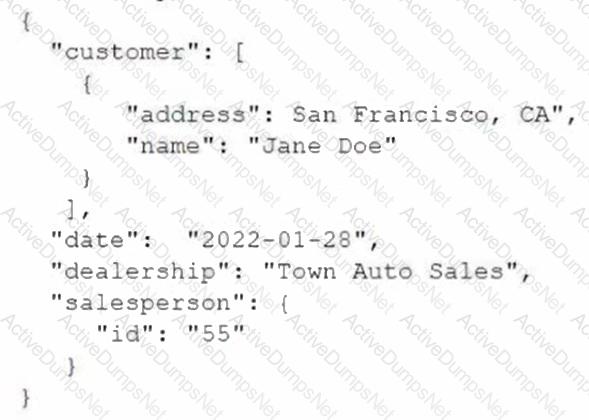
The following JSON is stored in a VARIANT column called src of the CAR_SALES table:
Question # 2

A user needs to extract the dealership information from the JSON.

How can this be accomplished?

Options:

A.

select src:dealership from car_sales;

B.

select src.dealership from car_sales;

C.

select src:Dealership from car_sales;

D.

select dealership from car_sales;

Question 3

Users are responsible for data storage costs until what occurs?

Options:

A.

Data expires from Time Travel

B.

Data expires from Fail-safe

C.

Data is deleted from a table

D.

Data is truncated from a table

Question 4

A user created a new worksheet within the Snowsight Ul and wants to share this with teammates

How can this worksheet be shared?

Options:

A.

Create a zero-copy clone of the worksheet and grant permissions to teammates

B.

Create a private Data Exchange so that any teammate can use the worksheet

C.

Share the worksheet with teammates within Snowsight

D.

Create a database and grant all permissions to teammates

Question 5

What affects whether the query results cache can be used?

Options:

A.

If the query contains a deterministic function

B.

If the virtual warehouse has been suspended

C.

If the referenced data in the table has changed

D.

If multiple users are using the same virtual warehouse

Question 6

How should a virtual warehouse be configured if a user wants to ensure that additional multi-clusters are resumed with no delay?

Options:

A.

Configure the warehouse to a size larger than generally required

B.

Set the minimum and maximum clusters to autoscale

C.

Use the standard warehouse scaling policy

D.

Use the economy warehouse scaling policy

Question 7

What is the MINIMUM edition of Snowflake that is required to use a SCIM security integration?

Options:

A.

Business Critical Edition

B.

Standard Edition

C.

Virtual Private Snowflake (VPS)

D.

Enterprise Edition

Question 8

What is the maximum total Continuous Data Protection (CDP) charges incurred for a temporary table?

Options:

A.

30 days

B.

7 days

C.

48 hours

D.

24 hours

Question 9

Which tasks are performed in the Snowflake Cloud Services layer? (Choose two.)

Options:

A.

Management of metadata

B.

Computing the data

C.

Maintaining Availability Zones

D.

Infrastructure security

E.

Parsing and optimizing queries

Question 10

A single user of a virtual warehouse has set the warehouse to auto-resume and auto-suspend after 10 minutes. The warehouse is currently suspended and the user performs the following actions:

1. Runs a query that takes 3 minutes to complete

2. Leaves for 15 minutes

3. Returns and runs a query that takes 10 seconds to complete

4. Manually suspends the warehouse as soon as the last query was completed

When the user returns, how much billable compute time will have been consumed?

Options:

A.

4 minutes

B.

10 minutes

C.

14 minutes

D.

24 minutes

Question 11

Which command should be used to download files from a Snowflake stage to a local folder on a client ' s machine?

Options:

A.

PUT

B.

GET

C.

COPY

D.

SELECT

Question 12

Which Snowflake architectural layer is responsible for a query execution plan?

Options:

A.

Compute

B.

Data storage

C.

Cloud services

D.

Cloud provider

Question 13

Which of the following features are available with the Snowflake Enterprise edition? (Choose two.)

Options:

A.

Database replication and failover

B.

Automated index management

C.

Customer managed keys (Tri-secret secure)

D.

Extended time travel

E.

Native support for geospatial data

Question 14

Why does Snowflake recommend file sizes of 100-250 MB compressed when loading data?

Options:

A.

Optimizes the virtual warehouse size and multi-cluster setting to economy mode

B.

Allows a user to import the files in a sequential order

C.

Increases the latency staging and accuracy when loading the data

D.

Allows optimization of parallel operations

Question 15

In the Snowflake access control model, which entity owns an object by default?

Options:

A.

The user who created the object

B.

The SYSADMIN role

C.

Ownership depends on the type of object

D.

The role used to create the object

Question 16

Which command can be used to load data files into a Snowflake stage?

Options:

A.

JOIN

B.

COPY INTO

C.

PUT

D.

GET

Question 17

When loading data into Snowflake, how should the data be organized?

Options:

A.

Into single files with 100-250 MB of compressed data per file

B.

Into single files with 1-100 MB of compressed data per file

C.

Into files of maximum size of 1 GB of compressed data per file

D.

Into files of maximum size of 4 GB of compressed data per file

Question 18

The Snowflake Cloud Data Platform is described as having which of the following architectures?

Options:

A.

Shared-disk

B.

Shared-nothing

C.

Multi-cluster shared data

D.

Serverless query engine

Question 19

Which of the following statements describe features of Snowflake data caching? (Choose two.)

Options:

A.

When a virtual warehouse is suspended, the data cache is saved on the remote storage layer.

B.

When the data cache is full, the least-recently used data will be cleared to make room.

C.

A user can only access their own queries from the query result cache.

D.

A user must set USE_METADATA_CACHE to TRUE to use the metadata cache in queries.

E.

The RESULT_SCAN table function can access and filter the contents of the query result cache.

Question 20

Which methods can be used to delete staged files from a Snowflake stage? (Choose two.)

Options:

A.

Use the DROP < file > command after the load completes.

B.

Specify the TEMPORARY option when creating the file format.

C.

Specify the PURGE copy option in the COPY INTO < table > command.

D.

Use the REMOVE command after the load completes.

E.

Use the DELETE LOAD HISTORY command after the load completes.

Question 21

A running virtual warehouse is suspended.

What is the MINIMUM amount of time that the warehouse will incur charges for when it is restarted?

Options:

A.

1 second

B.

60 seconds

C.

5 minutes

D.

60 minutes

Question 22

A Snowflake Administrator needs to ensure that sensitive corporate data in Snowflake tables is not visible to end users, but is partially visible to functional managers.

How can this requirement be met?

Options:

A.

Use data encryption.

B.

Use dynamic data masking.

C.

Use secure materialized views.

D.

Revoke all roles for functional managers and end users.

Question 23

What type of query benefits the MOST from search optimization?

Options:

A.

A query that uses only disjunction (i.e., OR) predicates

B.

A query that includes analytical expressions

C.

A query that uses equality predicates or predicates that use IN

D.

A query that filters on semi-structured data types

Question 24

True or False: Snowpipe via REST API can only reference External Stages as source.

Options:

A.

True

B.

False

Question 25

Which snowflake objects will incur both storage and cloud compute charges? (Select TWO)

Options:

A.

Materialized view

B.

Sequence

C.

Secure view

D.

Transient table

E.

Clustered table

Question 26

What is the minimum Snowflake edition required for row level security?

Options:

A.

Standard

B.

Enterprise

C.

Business Critical

D.

Virtual Private Snowflake

Question 27

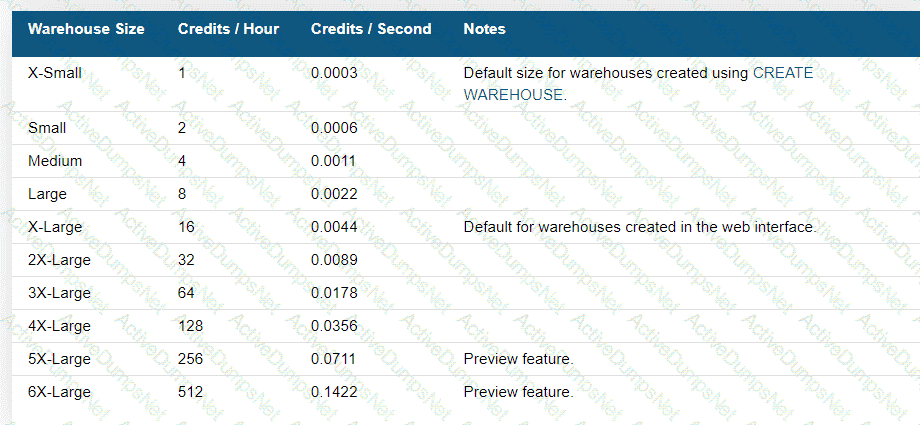
If 3 size Small virtual warehouse is made up of two servers, how many servers make up a Large warehouse?
Options:

A.

4

B.

8

C.

16

D.

32

Question 28

Which command sets the Virtual Warehouse for a session?

Options:

A.

COPY WAREHOUSE FROM < < config file > > ;

B.

SET WAREHOUSE = < < warehouse name > > ;

C.

USE WAREHOUSE < < warehouse name > > ;

D.

USE VIRTUAL_WAREHOUSE < < warehouse name > > ;

Question 29

Which of the following is a data tokenization integration partner?

Options:

A.

Protegrity

B.

Tableau

C.

DBeaver

D.

SAP

Question 30

In a Snowflake role hierarchy, what is the top-level role?

Options:

A.

SYSADMIN

B.

ORGADMIN

C.

ACCOUNTADMIN

D.

SECURITYADMIN

Question 31

Which data types are supported by Snowflake when using semi-structured data? (Choose two.)

Options:

A.

VARIANT

B.

VARRAY

C.

STRUCT

D.

ARRAY

E.

QUEUE

Question 32

A table needs to be loaded. The input data is in JSON format and is a concatenation of multiple JSON documents. The file size is 3 GB. A warehouse size small is being used. The following COPY INTO command was executed:

COPY INTO SAMPLE FROM @~/SAMPLE.JSON (TYPE=JSON)

The load failed with this error:

Max LOB size (16777216) exceeded, actual size of parsed column is 17894470.

How can this issue be resolved?

Options:

A.

Compress the file and load the compressed file.

B.

Split the file into multiple files in the recommended size range (100 MB - 250 MB).

C.

Use a larger-sized warehouse.

D.

Set STRIP_OUTER_ARRAY=TRUE in the COPY INTO command.

Question 33

Which of the following features, associated with Continuous Data Protection (CDP), require additional Snowflake-provided data storage? (Choose two.)

Options:

A.

Tri-Secret Secure

B.

Time Travel

C.

Fail-safe

D.

Data encryption

E.

External stages

Question 34

What is the purpose of multi-cluster virtual warehouses?

Options:

A.

To create separate data warehouses to increase query optimization

B.

To allow users the ability to choose the type of compute nodes that make up a virtual warehouse cluster

C.

To eliminate or reduce Queuing of concurrent queries

D.

To allow the warehouse to resize automatically

Question 35

Which statement is true about running tasks in Snowflake?

Options:

A.

A task can be called using a CALL statement to run a set of predefined SQL commands.

B.

A task allows a user to execute a single SQL statement/command using a predefined schedule.

C.

A task allows a user to execute a set of SQL commands on a predefined schedule.

D.

A task can be executed using a SELECT statement to run a predefined SQL command.

Question 36

Which of the following are best practices for loading data into Snowflake? (Choose three.)

Options:

A.

Aim to produce data files that are between 100 MB and 250 MB in size, compressed.

B.

Load data from files in a cloud storage service in a different region or cloud platform from the service or region containing the Snowflake account, to save on cost.

C.

Enclose fields that contain delimiter characters in single or double quotes.

D.

Split large files into a greater number of smaller files to distribute the load among the compute resources in an active warehouse.

E.

When planning which warehouse(s) to use for data loading, start with the largest warehouse possible.

F.

Partition the staged data into large folders with random paths, allowing Snowflake to determine the best way to load each file.

Question 37

What do the terms scale up and scale out refer to in Snowflake? (Choose two.)

Options:

A.

Scaling out adds clusters of the same size to a virtual warehouse to handle more concurrent queries.

B.

Scaling out adds clusters of varying sizes to a virtual warehouse.

C.

Scaling out adds additional database servers to an existing running cluster to handle more concurrent queries.

D.

Snowflake recommends using both scaling up and scaling out to handle more concurrent queries.

E.

Scaling up resizes a virtual warehouse so it can handle more complex workloads.

F.

Scaling up adds additional database servers to an existing running cluster to handle larger workloads.

Question 38

The Snowflake cloud services layer is responsible for which tasks? (Choose two.)

Options:

A.

Local disk caching

B.

Authentication and access control

C.

Metadata management

D.

Query processing

E.

Database storage

Question 39

Assume there is a table consisting of five micro-partitions with values ranging from A to Z.

Which diagram indicates a well-clustered table?

Options:

A.

B.

C.

D.

Question 40

The is the minimum Fail-safe retention time period for transient tables?

Options:

A.

1 day

B.

7 days

C.

12 hours

D.

0 days

Question 41

What is the SNOWFLAKE.ACCOUNT_USAGE view that contains information about which objects were read by queries within the last 365 days (1 year)?

Options:

A.

VIEWS_HISTORY

B.

OBJECT_HISTORY

C.

ACCESS_HISTORY

D.

LOGIN_HISTORY

Question 42

Network policies can be set at which Snowflake levels? (Choose two.)

Options:

A.

Role

B.

Schema

C.

User

D.

Database

E.

Account

F.

Tables

Question 43

Which columns are part of the result set of the Snowflake LATERAL FLATTEN command? (Choose two.)

Options:

A.

CONTENT

B.

PATH

C.

BYTE_SIZE

D.

INDEX

E.

DATATYPE

Question 44

What impacts the credit consumption of maintaining a materialized view? (Choose two.)

Options:

A.

Whether or not it is also a secure view

B.

How often the underlying base table is queried

C.

How often the base table changes

D.

Whether the materialized view has a cluster key defined

E.

How often the materialized view is queried

Question 45

Which SQL commands, when committed, will consume a stream and advance the stream offset? (Choose two.)

Options:

A.

UPDATE TABLE FROM STREAM

B.

SELECT FROM STREAM

C.

INSERT INTO TABLE SELECT FROM STREAM

D.

ALTER TABLE AS SELECT FROM STREAM

E.

BEGIN COMMIT

Question 46

What are best practice recommendations for using the ACCOUNTADMIN system-defined role in Snowflake? (Choose two.)

Options:

A.

Ensure all ACCOUNTADMIN roles use Multi-factor Authentication (MFA).

B.

All users granted ACCOUNTADMIN role must be owned by the ACCOUNTADMIN role.

C.

The ACCOUNTADMIN role must be granted to only one user.

D.

Assign the ACCOUNTADMIN role to at least two users, but as few as possible.

E.

All users granted ACCOUNTADMIN role must also be granted SECURITYADMIN role.

Question 47

Which of the following objects are contained within a schema? (Choose two.)

Options:

A.

Role

B.

Stream

C.

Warehouse

D.

External table

E.

User

F.

Share

Question 48

What is the default file size when unloading data from Snowflake using the COPY command?

Options:

A.

5 MB

B.

8 GB

C.

16 MB

D.

32 MB

Question 49

When cloning a database containing stored procedures and regular views, that have fully qualified table references, which of the following will occur?

Options:

A.

The cloned views and the stored procedures will reference the cloned tables in the cloned database.

B.

An error will occur, as views with qualified references cannot be cloned.

C.

An error will occur, as stored objects cannot be cloned.

D.

The stored procedures and views will refer to tables in the source database.

Question 50

What are supported file formats for unloading data from Snowflake? (Choose three.)

Options:

A.

XML

B.

JSON

C.

Parquet

D.

ORC

E.

AVRO

F.

CSV

Question 51

Which Snowflake SQL statement would be used to determine which users and roles have access to a role called MY_ROLE?

Options:

A.

SHOW GRANTS OF ROLE MY_ROLE

B.

SHOW GRANTS TO ROLE MY_ROLE

C.

SHOW GRANTS FOR ROLE MY_ROLE

D.

SHOW GRANTS ON ROLE MY_ROLE

Question 52

The Snowflake Search Optimization Services supports improved performance of which kind of query?

Options:

A.

Queries against large tables where frequent DML occurs

B.

Queries against tables larger than 1 TB

C.

Selective point lookup queries

D.

Queries against a subset of columns in a table

Question 53

What actions will prevent leveraging of the ResultSet cache? (Choose two.)

Options:

A.

Removing a column from the query SELECT list

B.

Stopping the virtual warehouse that the query is running against

C.

Clustering of the data used by the query

D.

Executing the RESULTS_SCAN() table function

E.

Changing a column that is not in the cached query

Question 54

Which of the following accurately describes shares?

Options:

A.

Tables, secure views, and secure UDFs can be shared

B.

Shares can be shared

C.

Data consumers can clone a new table from a share

D.

Access to a share cannot be revoked once granted

Question 55

Which of the following objects can be directly restored using the UNDROP command? (Choose two.)

Options:

A.

Schema

B.

View

C.

Internal stage

D.

Table

E.

User

F.

Role

Question 56

Which file formats are supported for unloading data from Snowflake? (Choose two.)

Options:

A.

Avro

B.

JSON

C.

ORC

D.

XML

E.

Delimited (CSV, TSV, etc.)

Question 57

Which Snowflake layer is associated with virtual warehouses?

Options:

A.

Cloud services

B.

Query processing

C.

Elastic memory

D.

Database storage

Question 58

When floating-point number columns are unloaded to CSV or JSON files, Snowflake truncates the values to approximately what?

Options:

A.

(12,2)

B.

(10,4)

C.

(14,8)

D.

(15,9)

Question 59

Which Snowflake edition offers the highest level of security for organizations that have the strictest requirements?

Options:

A.

Standard

B.

Enterprise

C.

Business Critical

D.

Virtual Private Snowflake (VPS)

Question 60

For Directory tables, what stage allows for automatic refreshing of metadata?

Options:

A.

User stage

B.

Table stage

C.

Named internal stage

D.

Named external stage

Question 61

Which view can be used to determine if a table has frequent row updates or deletes?

Options:

A.

TABLES

B.

TABLE_STORAGE_METRICS

C.

STORAGE_DAILY_HISTORY

D.

STORAGE USAGE

Question 62

How are network policies defined in Snowflake?

Options:

A.

They are a set of rules that define the network routes within Snowflake.

B.

They are a set of rules that dictate how Snowflake accounts can be used between multiple users.

C.

They are a set of rules that define how data can be transferred between different Snowflake accounts within an organization.

D.

They are a set of rules that control access to Snowflake accounts by specifying the IP addresses or ranges of IP addresses that are allowed to connectto Snowflake.

Question 63

User1, who has the SYSADMIN role, executed a query on Snowsight. User2, who is in the same Snowflake account, wants to view the result set of the query executed by User1 using the Snowsight query history.

What will happen if User2 tries to access the query history?

Options:

A.

If User2 has the sysadmin role they will be able to see the results.

B.

If User2 has the securityadmin role they will be able to see the results.

C.

If User2 has the ACCOUNTADMIN role they will be able to see the results.

D.

User2 will be unable to view the result set of the query executed by User1.

Question 64

How does a Snowflake stored procedure compare to a User-Defined Function (UDF)?

Options:

A.

A single executable statement can call only two stored procedures. In contrast, a single SQL statement can call multiple UDFs.

B.

A single executable statement can call only one stored procedure. In contrast, a single SQL statement can call multiple UDFs.

C.

A single executable statement can call multiple stored procedures. In contrast, multiple SQL statements can call the same UDFs.

D.

Multiple executable statements can call more than one stored procedure. In contrast, a single SQL statement can call multiple UDFs.

Question 65

What is the default value in the Snowflake Web Interface (Ul) for auto suspending a Virtual Warehouse?

Options:

A.

1 minutes

B.

5 minutes

C.

10 minutes

D.

15 minutes

Question 66

What is the only supported character set for loading and unloading data from all supported file formats?

Options:

A.

UTF-8

B.

UTF-16

C.

ISO-8859-1

D.

WINDOWS-1253

Question 67

What does the worksheet and database explorer feature in Snowsight allow users to do?

Options:

A.

Add or remove users from a worksheet.

B.

Move a worksheet to a folder or a dashboard.

C.

Combine multiple worksheets into a single worksheet.

D.

Tag frequently accessed worksheets for ease of access.

Question 68

Which function will provide the proxy information needed to protect Snowsight?

Options:

A.

SYSTEMADMIN_TAG

B.

SYSTEM$GET_PRIVATELINK

C.

SYSTEMSALLONTLIST

D.

SYSTEMAUTHORIZE

Question 69

When using the ALLOW_CLI£NT_MFA_CACHING parameter, how long is a cached Multi-Factor Authentication (MFA) token valid for?

Options:

A.

1 hour

B.

2 hours

C.

4 hours

D.

8 hours

Question 70

Why would a Snowflake user decide to use a materialized view instead of a regular view?

Options:

A.

The base tables do not change frequently.

B.

The results of the view change often.

C.

The query is not resource intensive.

D.

The query results are not used frequently.

Question 71

Which data types optimally store semi-structured data? (Select TWO).

Options:

A.

ARRAY

B.

CHARACTER

C.

STRING

D.

VARCHAR

E.

VARIANT

Question 72

Which command should be used to unload all the rows from a table into one or more files in a named stage?

Options:

A.

COPY INTO

B.

GET

C.

INSERT INTO

D.

PUT

Question 73

Which command removes a role from another role or a user in Snowflak?

Options:

A.

ALTER ROLE

B.

REVOKE ROLE

C.

USE ROLE

D.

USE SECONDARY ROLES

Question 74

What are characteristic of Snowsight worksheet? (Select TWO.)

Options:

A.

Worksheets can be grouped under folder, and a folder of folders.

B.

Each worksheet is a unique Snowflake session.

C.

Users are limited to running only one on a worksheet.

D.

The Snowflake session ends when a user switches worksheets.

E.

Users can import worksheets and share them with other users.

Question 75

Which privilege is required to use the search optimization service in Snowflake?

Options:

A.

GRANT SEARCH OPTIMIZATION ON SCHEMA < schema_name > TO ROLE < role >

B.

GRANT SEARCH OPTIMIZATION ON DATABASE < database_name > TO ROLE < role >

C.

GRANT ADD SEARCH OPTIMIZATION ON SCHEMA < schema_name > TO ROLE < role >

D.

GRANT ADD SEARCH OPTIMIZATION ON DATABASE < database name > TO ROLE < role >

Question 76

Which URL provides access to files in Snowflake without authorization?

Options:

A.

File URL

B.

Scoped URL

C.

Pre-signed URL

D.

Scoped file URL

Question 77

What is the MINIMUM permission needed to access a file URL from an external stage?

Options:

A.

MODIFY

B.

READ

C.

SELECT

D.

USAGE

Question 78

If a virtual warehouse runs for 61 seconds, shut down, and then restart and runs for 30 seconds, for how many seconds is it billed?

Options:

A.

60

B.

91

C.

120

D.

121

Question 79

What should be used when creating a CSV file format where the columns are wrapped by single quotes or double quotes?

Options:

A.

BINARY_FORMAT

B.

ESCAPE_UNENCLOSED_FIELD

C.

FIELD_OPTIONALLY_ENCLOSED_BY

D.

SKIP BYTE ORDER MARK

Question 80

What SnowFlake database object is derived from a query specification, stored for later use, and can speed up expensive aggregation on large data sets?

Options:

A.

Temporary table

B.

External table

C.

Secure view

D.

Materialized view

Question 81

A Snowflake user is writing a User-Defined Function (UDF) that includes some unqualified object names.

How will those object names be resolved during execution?

Options:

A.

Snowflake will resolve them according to the SEARCH_PATH parameter.

B.

Snowflake will only check the schema the UDF belongs to.

C.

Snowflake will first check the current schema, and then the schema the previous query used

D.

Snowflake will first check the current schema, and them the PUBLIC schema of the current database.

Question 82

There are two Snowflake accounts in the same cloud provider region: one is production and the other is non-production. How can data be easily transferred from the production account to the non-production account?

Options:

A.

Clone the data from the production account to the non-production account.

B.

Create a data share from the production account to the non-production account.

C.

Create a subscription in the production account and have it publish to the non-production account.

D.

Create a reader account using the production account and link the reader account to the non-production account.

Question 83

What criteria does Snowflake use to determine the current role when initiating a session? (Select TWO).

Options:

A.

If a role was specified as part of the connection and that role has been granted to the Snowflake user, the specified role becomes the current role.

B.

If no role was specified as part of the connection and a default role has been defined for the Snowflake user, that role becomes the current role.

C.

If no role was specified as part of the connection and a default role has not been set for the Snowflake user, the session will not be initiated and the log in will fail.

D.

If a role was specified as part of the connection and that role has not been granted to the Snowflake user, it will be ignored and the default role will become the current role.

E.

If a role was specified as part of the connection and that role has not been granted to the Snowflake user, the role is automatically granted and it becomes the current role.

Question 84

How does Snowflake describe its unique architecture?

Options:

A.

A single-cluster shared data architecture using a central data repository and massively parallel processing (MPP)

B.

A multi-duster shared nothing architecture using a soloed data repository and massively parallel processing (MPP)

C.

A single-cluster shared nothing architecture using a sliced data repository and symmetric multiprocessing (SMP)

D.

A multi-cluster shared nothing architecture using a siloed data repository and symmetric multiprocessing (SMP)

Question 85

Which Snowflow object does not consume and storage costs?

Options:

A.

Secure view

B.

Materialized view

C.

Temporary table

D.

Transient table

Question 86

Which Snowflake data type is used to store JSON key value pairs?

Options:

A.

TEXT

B.

BINARY

C.

STRING

D.

VARIANT

Question 87

Which file function generates a SnowFlake-hosted URL that must be authenticated when used?

Options:

A.

GET_STATE_LOCATION

B.

GET_PRESENT_URL

C.

BUILD_SCOPED_FILE_URL

D.

BUILD_STAGE_FILE_URL

Question 88

What is the MAXIMUM number of clusters that can be provisioned with a multi-cluster virtual warehouse?

Options:

A.

1

B.

5

C.

10

D.

100

Question 89

What is used to denote a pre-computed data set derived from a SELECT query specification and stored for later use?

Options:

A.

View

B.

Secure view

C.

Materialized view

D.

External table

Question 90

A user has semi-structured data to load into Snowflake but is not sure what types of operations will need to be performed on the data. Based on this situation, what type of column does Snowflake recommend be used?

Options:

A.

ARRAY

B.

OBJECT

C.

TEXT

D.

VARIANT

Question 91

Which use case does the search optimization service support?

Options:

A.

Disjuncts (OR) in join predicates

B.

LIKE/ILIKE/RLIKE join predicates

C.

Join predicates on VARIANT columns

D.

Conjunctions (AND) of multiple equality predicates

Question 92

Which data formats are supported by Snowflake when unloading semi-structured data? (Select TWO).

Options:

A.

Binary file in Avro

B.

Binary file in Parquet

C.

Comma-separated JSON

D.

Newline Delimited JSON

E.

Plain text file containing XML elements

Question 93

The VALIDATE table function has which parameter as an input argument for a Snowflake user?

Options:

A.

Last_QUERY_ID

B.

CURRENT_STATEMENT

C.

UUID_STRING

D.

JOB_ID

Question 94

Which role has the ability to create a share from a shared database by default?

Options:

A.

ACCOUNTADMIN

B.

SECURITYADMIN

C.

SYSADMIN

D.

ORGADMIN

Question 95

How does a Snowflake user extract the URL of a directory table on an external stage for further transformation?

Options:

A.

Use the SHOW STAGES command.

B.

Use the DESCRIBE STAGE command.

C.

Use the GET_ABSOLUTE_PATH function.

D.

Use the GET_STAGE_LOCATION function.

Question 96

While clustering a table, columns with which data types can be used as clustering keys? (Select TWO).

Options:

A.

BINARY

B.

GEOGRAPHY

C.

GEOMETRY

D.

OBJECT

E.

VARIANT

Question 97

Which service or feature in Snowflake is used to improve the performance of certain types of lookup and analytical queries that use an extensive set of WHERE conditions?

Options:

A.

Data classification

B.

Query acceleration service

C.

Search optimization service

D.

Tagging

Question 98

Which Snowflake mechanism is used to limit the number of micro-partitions scanned by a query?

Options:

A.

Caching

B.

Cluster depth

C.

Query pruning

D.

Retrieval optimization

Question 99

How long is a query visible in the Query History page in the Snowflake Web Interface (Ul)?

Options:

A.

60 minutes

B.

24 hours

C.

14 days

D.

30 days

Question 100

Regardless of which notation is used, what are considerations for writing the column name and element names when traversing semi-structured data?

Options:

A.

The column name and element names are both case-sensitive.

B.

The column name and element names are both case-insensitive.

C.

The column name is case-sensitive but element names are case-insensitive.

D.

The column name is case-insensitive but element names are case-sensitive.

Question 101

What type of function returns one value for each Invocation?

Options:

A.

Aggregate

B.

Scalar

C.

Table

D.

Window

Question 102

What is it called when a customer managed key is combined with a Snowflake managed key to create a composite key for encryption?

Options:

A.

Hierarchical key model

B.

Client-side encryption

C.

Tri-secret secure encryption

D.

Key pair authentication

Question 103

What are characteristics of reader accounts in Snowflake? (Select TWO).

Options:

A.

Reader account users cannot add new data to the account.

B.

Reader account users can share data to other reader accounts.

C.

A single reader account can consume data from multiple provider accounts.

D.

Data consumers are responsible for reader account setup and data usage costs.

E.

Reader accounts enable data consumers to access and query data shared by the provider.

Question 104

How can a user get the MOST detailed information about individual table storage details in Snowflake?

Options:

A.

SHOW TABLES command

B.

SHOW EXTERNAL TABLES command

C.

TABLES view

D.

TABLE STORAGE METRICS view

Question 105

A user wants to add additional privileges to the system-defined roles for their virtual warehouse. How does Snowflake recommend they accomplish this?

Options:

A.

Grant the additional privileges to a custom role.

B.

Grant the additional privileges to the ACCOUNTADMIN role.

C.

Grant the additional privileges to the SYSADMIN role.

D.

Grant the additional privileges to the ORGADMIN role.

Question 106

What will happen if a Snowflake user increases the size of a suspended virtual warehouse?

Options:

A.

The provisioning of new compute resources for the warehouse will begin immediately.

B.

The warehouse will remain suspended but new resources will be added to the query acceleration service.

C.

The provisioning of additional compute resources will be in effect when the warehouse is next resumed.

D.

The warehouse will resume immediately and start to share the compute load with other running virtual warehouses.

Question 107

What activities can a user with the ORGADMIN role perform? (Select TWO).

Options:

A.

Create an account for an organization.

B.

Edit the account data for an organization.

C.

Delete the account data for an organization.

D.

View usage information for all accounts in an organization.

E.

Select all the data in tables for all accounts in an organization.

Question 108

A Snowflake user wants to temporarily bypass a network policy by configuring the user object property MINS_TO_BYPASS_NETWORK_POLICY.

What should they do?

Options:

A.

Use the SECURITYADMIN role.

B.

Use the SYSADMIN role.

C.

Use the USERADMIN role.

D.

Contact Snowflake Support.

Question 109

Which statement accurately describes Snowflake ' s architecture?

Options:

A.

It uses a local data repository for all compute nodes in the platform.

B.

It is a blend of shared-disk and shared-everything database architectures.

C.

It is a hybrid of traditional shared-disk and shared-nothing database architectures.

D.

It reorganizes loaded data into internal optimized, compressed, and row-based format.

Question 110

Which common query problems are identified by the Query Profile? (Select TWO.)

Options:

A.

Syntax error

B.

Inefficient pruning

C.

Ambiguous column names

D.

Queries too large to fit in memory

E.

Object does not exist or not authorized

Question 111

What happens when a network policy includes values that appear in both the allowed and blocked IP address list?

Options:

A.

Those IP addresses are allowed access to the Snowflake account as Snowflake applies the allowed IP address list first.

B.

Those IP addresses are denied access lei the Snowflake account as Snowflake applies the blocked IP address list first.

C.

Snowflake issues an alert message and adds the duplicate IP address values lo both ' he allowed and blocked IP address lists.

D.

Snowflake issues an error message and adds the duplicate IP address values to both the allowed and blocked IP address list

Question 112

When referring to User-Defined Function (UDF) names in Snowflake, what does the term overloading mean?

Options:

A.

There are multiple SOL UDFs with the same names and the same number of arguments.

B.

There are multiple SQL UDFs with the same names and the same number of argument types.

C.

There are multiple SQL UDFs with the same names but with a different number of arguments or argument types.

D.

There are multiple SQL UDFs with different names but the same number of arguments or argument types.

Question 113

Which TABLE function helps to convert semi-structured data to a relational representation?

Options:

A.

CHECK_JSON

B.

TO_JSON

C.

FLATTEN

D.

PARSE_JSON

Question 114

Two users share a virtual warehouse named wh dev 01. When one of the users loads data, the other one experiences performance issues while querying data.

How does Snowflake recommend resolving this issue?

Options:

A.

Scale up the existing warehouse.

B.

Create separate warehouses for each user.

C.

Create separate warehouses for each workload.

D.

Stop loading and querying data at the same time.

Question 115

What file formats does Snowflake support for loading semi-structured data? (Choose three.)

Options:

A.

TSV

B.

JSON

C.

PDF

D.

Avro

E.

Parquet

F.

JPEG

Question 116

If a multi-cluster warehouse is using an economy scaling policy, how long will queries wait in the queue before another cluster is started?

Options:

A.

1 minute

B.

2 minutes

C.

6 minutes

D.

8 minutes

Question 117

Which native data types are used for storing semi-structured data in Snowflake? (Select TWO)

Options:

A.

NUMBER

B.

OBJECT

C.

STRING

D.

VARCHAR

E.

VARIANT

Question 118

What privilege should a user be granted to change permissions for new objects in a managed access schema?

Options:

A.

Grant the OWNERSHIP privilege on the schema.

B.

Grant the OWNERSHIP privilege on the database.

C.

Grant the MANAGE GRANTS global privilege.

D.

Grant ALL privileges on the schema.

Question 119

What can a Snowflake user do with the information included in the details section of a Query Profile?

Options:

A.

Determine the total duration of the query.

B.

Determine the role of the user who ran the query.

C.

Determine the source system that the queried table is from.

D.

Determine if the query was on structured or semi-structured data.

Question 120

What type of columns does Snowflake recommend to be used as clustering keys? (Select TWO).

Options:

A.

A VARIANT column

B.

A column with very low cardinality

C.

A column with very high cardinality

D.

A column that is most actively used in selective filters

E.

A column that is most actively used in join predicates

Question 121

How many network policies can be assigned to an account or specific user at a time?

Options:

A.

One

B.

Two

C.

Three

D.

Unlimited

Question 122

Which query contains a Snowflake hosted file URL in a directory table for a stage named bronzestage?

Options:

A.

list @bronzestage;

B.

select * from directory(@bronzestage);

C.

select metadata$filename from @bronzestage;

D.

select * from table(information_schema.stage_directory_file_registration_history(stage name= > ' bronzestage1));

Question 123

Which stream type can be used for tracking the records in external tables?

Options:

A.

Append-only

B.

External

C.

Insert-only

D.

Standard

Question 124

How can a user change which columns are referenced in a view?

Options:

A.

Modify the columns in the underlying table

B.

Use the ALTER VIEW command to update the view

C.

Recreate the view with the required changes

D.

Materialize the view to perform the changes

Question 125

What is cached during a query on a virtual warehouse?

Options:

A.

All columns in a micro-partition

B.

Any columns accessed during the query

C.

The columns in the result set of the query

D.

All rows accessed during the query

Question 126

A user needs to create a materialized view in the schema MYDB.MYSCHEMA. Which statements will provide this access?

Options:

A.

GRANT ROLE MYROLE TO USER USER1;GRANT CREATE MATERIALIZED VIEW ON SCHEMA MYDB.MYSCHEMA TO ROLE MYROLE;

B.

GRANT ROLE MYROLE TO USER USER1;GRANT CREATE MATERIALIZED VIEW ON SCHEMA MYDB.MYSCHEMA TO USER USER1;

C.

GRANT ROLE MYROLE TO USER USER1;GRANT CREATE MATERIALIZED VIEW ON SCHEMA MYDB. K " - ' SCHEMA TO USER! ;

D.

GRANT ROLE MYROLE TO USER USER1;GRANT CREATE MATERIALIZED VIEW ON SCHEMA MYDB.MYSCHEMA TO MYROLE;

Question 127

The first user assigned to a new account, ACCOUNTADMIN, should create at least one additional user with which administrative privilege?

Options:

A.

USERADMIN

B.

PUBLIC

C.

ORGADMIN

D.

SYSADMIN

Question 128

What is the MINIMUM Snowflake edition required to use the periodic rekeying of micro-partitions?

Options:

A.

Enterprise

B.

Business Critical

C.

Standard

D.

Virtual Private Snowflake

Question 129

What service is provided as an integrated Snowflake feature to enhance Multi-Factor Authentication (MFA) support?

Options:

A.

Duo Security

B.

OAuth

C.

Okta

D.

Single Sign-On (SSO)

Question 130

When would Snowsight automatically detect if a target account is in a different region and enable cross-cloud auto-fulfillment?

Options:

A.

When using a paid listing on the Snowflake Marketplace

B.

When using a private listing on the Snowflake Marketplace

C.

When using a personalized listing on the Snowflake Marketplace

D.

When using a Direct Share with another account

Question 131

A company needs to read multiple terabytes of data for an initial load as part of a Snowflake migration. The company can control the number and size of CSV extract files.

How does Snowflake recommend maximizing the load performance?

Options:

A.

Use auto-ingest Snowpipes to load large files in a serverless model.

B.

Produce the largest files possible, reducing the overall number of files to process.

C.

Produce a larger number of smaller files and process the ingestion with size Small virtual warehouses.

D.

Use an external tool to issue batched row-by-row inserts within BEGIN TRANSACTION and COMMIT commands.

Question 132

What internal stages are available in Snowflake? (Choose three.)

Options:

A.

Schema stage

B.

Named stage

C.

User stage

D.

Stream stage

E.

Table stage

F.

Database stage

Question 133

How many resource monitors can be assigned at the account level?

Options:

A.

1

B.

2

C.

3

D.

4

Question 134

What column type does a Kafka connector store formatted information in a single column?

Options:

A.

ARRAY

B.

OBJECT

C.

VARCHAR

D.

VARIANT

Question 135

When unloading data to an external stage, what is the MAXIMUM file size supported?

Options:

A.

1 GB

B.

5 GB

C.

10 GB

D.

16 GB

Question 136

Which statement MOST accurately describes clustering in Snowflake?

Options:

A.

The database ACCOUNTADMIN must define the clustering methodology for each Snowflake table.

B.

Clustering is the way data is grouped together and stored within Snowflake micro-partitions.

C.

The clustering key must be included in the COPY command when loading data into Snowflake.

D.

Clustering can be disabled within a Snowflake account.

Question 137

What can a Snowflake user do in the Activity section in Snowsight?

Options:

A.

Create dashboards.

B.

Write and run SQL queries.

C.

Explore databases and objects.

D.

Explore executed query performance.

Question 138

Which data type can store more than one type of data structure?

Options:

A.

JSON

B.

BINARY

C.

VARCHAR

D.

VARIANT

Question 139

How would a user execute a series of SQL statements using a task?

Options:

A.

Include the SQL statements in the body of the task CREATE TASK mytask .. AS INSERT INTO target1 SELECT .. FROM stream_s1 WHERE .. INSERT INTO target2 SELECT .. FROM stream_s1WHERE ..

B.

A stored procedure can have only one DML statement per stored procedure invocation and therefore the user should sequence stored procedure calls in the taskdefinition CREATE TASK mytask .... AScall stored_proc1(); call stored_proc2();

C.

Use a stored procedure executing multiple SQL statements and invoke the stored procedure from the task. CREATE TASK mytask .... AS call stored_proc_multiple_statements_inside();

D.

Create a task for each SQL statement (e.g. resulting in task1, task2, etc.) and string the series of SQL statements by having a control task calling task1, task2, etc. sequentially.

Question 140

Which query profile statistics help determine if efficient pruning is occurring? (Choose two.)

Options:

A.

Bytes sent over network

B.

Percentage scanned from cache

C.

Partitions total

D.

Bytes spilled to local storage

E.

Partitions scanned

Question 141

What happens when a database is cloned?

Options:

A.

It does not retain any privileges granted on the source object.

B.

It replicates all granted privileges on the corresponding source objects.

C.

It replicates all granted privileges on the corresponding child objects.

D.

It replicates all granted privileges on the corresponding child schema objects.

Question 142

Which of the following is the Snowflake Account_Usage.Metering_History view used for?

Options:

A.

Gathering the hourly credit usage for an account

B.

Compiling an account ' s average cloud services cost over the previous month

C.

Summarizing the throughput of Snowpipe costs for an account

D.

Calculating the funds left on an account ' s contract

Question 143

Network policies can be applied to which of the following Snowflake objects? (Choose two.)

Options:

A.

Roles

B.

Databases

C.

Warehouses

D.

Users

E.

Accounts

Question 144

A tabular User-Defined Function (UDF) is defined by specifying a return clause that contains which keyword?

Options:

A.

ROW_NUMBER

B.

TABLE

C.

TABULAR

D.

VALUES

Question 145

If a virtual warehouse runs for 61 seconds, shuts down, and then restarts and runs for 30 seconds, for how many seconds is it billed?

Options:

A.

60

B.

91

C.

120

D.

121

Question 146

What is a characteristic of the Snowflake Query Profile?

Options:

A.

It can provide statistics on a maximum number of 100 queries per week.

B.

It provides a graphic representation of the main components of the query processing.

C.

It provides detailed statistics about which queries are using the greatest number of compute resources.

D.

It can be used by third-party software using the Query Profile API.

Question 147

Which database objects can be shared with the Snowflake secure data sharing feature? (Choose two.)

Options:

A.

Files

B.

External tables

C.

Secure User-Defined Functions (UDFs)

D.

Sequences

E.

Streams

Question 148

What role is required to use Partner Connect?

Options:

A.

ACCOUNTADMIN

B.

ORGADMIN

C.

SECURITYADMIN

D.

SYSADMIN

Question 149

Which statement describes how Snowflake supports reader accounts?

Options:

A.

A reader account can consume data from the provider account that created it and combine it with its own data.

B.

A consumer needs to become a licensed Snowflake customer as data sharing is only supported between Snowflake accounts.

C.

The users in a reader account can query data that has been shared with the reader account and can perform DML tasks.

D.

The SHOW MANAGED ACCOUNTS command will view all the reader accounts that have been created for an account.

Question 150

For the ALLOWED VALUES tag property, what is the MAXIMUM number of possible string values for a single tag?

Options:

A.

10

B.

50

C.

64

D.

256

Question 151

What is the MAXIMUM size limit for a record of a VARIANT data type?

Options:

A.

8MB

B.

16MB

C.

32MB

D.

128MB

Question 152

Which of the following statements describes a schema in Snowflake?

Options:

A.

A logical grouping of objects that belongs to a single database

B.

A logical grouping of objects that belongs to multiple databases

C.

A named Snowflake object that includes all the information required to share a database

D.

A uniquely identified Snowflake account within a business entity

Question 153

What technique does Snowflake use to limit the number of micro-partitions scanned by each query?

Options:

A.

B-tree

B.

Indexing

C.

Map reduce

D.

Pruning

Question 154

Which operations are handled in the Cloud Services layer of Snowflake? (Select TWO).

Options:

A.

Security

B.

Data storage

C.

Data visualization

D.

Query computation

E.

Metadata management

Question 155

What are benefits of using Snowpark with Snowflake? (Select TWO).

Options:

A.

Snowpark uses a Spark engine to generate optimized SQL query plans.

B.

Snowpark automatically sets up Spark within Snowflake virtual warehouses.

C.

Snowpark does not require that a separate cluster be running outside of Snowflake.

D.

Snowpark allows users to run existing Spark code on virtual warehouses without the need to reconfigure the code.

E.

Snowpark executes as much work as possible in the source databases for all operations including User-Defined Functions (UDFs).

Question 156

Which kind of Snowflake table stores file-level metadata for each file in a stage?

Options:

A.

Directory

B.

External

C.

Temporary

D.

Transient

Question 157

Which Snowflake objects can be shared with other Snowflake accounts? (Choose three.)

Options:

A.

Schemas

B.

Roles

C.

Secure Views

D.

Stored Procedures

E.

Tables

F.

Secure User-Defined Functions (UDFs)

Question 158

Which features make up Snowflake ' s column level security? (Select TWO).

Options:

A.

Continuous Data Protection (CDP)

B.

Dynamic Data Masking

C.

External Tokenization

D.

Key pair authentication

E.

Row access policies

Question 159

Which privilege must be granted to a share to allow secure views the ability to reference data in multiple databases?

Options:

A.

CREATE_SHARE on the account

B.

SHARE on databases and schemas

C.

SELECT on tables used by the secure view

D.

REFERENCE_USAGE on databases

Question 160

If a Snowflake user decides a table should be clustered, what should be used as the cluster key?

Options:

A.

The columns that are queried in the select clause.

B.

The columns with very high cardinality.

C.

The columns with many different values.

D.

The columns most actively used in the select filters.

Question 161

When should a user consider disabling auto-suspend for a virtual warehouse? (Select TWO).

Options:

A.

When users will be using compute at different times throughout a 24/7 period

B.

When managing a steady workload

C.

When the compute must be available with no delay or lag time

D.

When the user does not want to have to manually turn on the warehouse each time it is needed

E.

When the warehouse is shared across different teams

Question 162

Which objects together comprise a namespace in Snowflake? (Select TWO).

Options:

A.

Account

B.

Database

C.

Schema

D.

Table

E.

Virtual warehouse

Question 163

What does Snowflake ' s search optimization service support?

Options:

A.

External tables

B.

Materialized views

C.

Tables and views that are not protected by row access policies

D.

Casts on table columns (except for fixed-point numbers cast to strings)

Question 164

What does Snowflake recommend regarding database object ownership? (Select TWO).

Options:

A.

Create objects with ACCOUNTADMIN and do not reassign ownership.

B.

Create objects with SYSADMIN.

C.

Create objects with SECURITYADMIN to ease granting of privileges later.

D.

Create objects with a custom role and grant this role to SYSADMIN.

E.

Use only MANAGED ACCESS SCHEMAS for66 objects owned by ACCOUNTADMIN.

Question 165

Which items are considered schema objects in Snowflake? (Select TWO).

Options:

A.

Pipe

B.

File format

C.

Resource monitor

D.

Storage integration

E.

Virtual warehouse

Question 166

Which of the following describes the Snowflake Cloud Services layer?

Options:

A.

Coordinates activities in the Snowflake account

B.

Executes queries submitted by the Snowflake account users

C.

Manages quotas on the Snowflake account storage

D.

Manages the virtual warehouse cache to speed up queries

Question 167

What is the name of the SnowSQLfile that can store connection information?

Options:

A.

history

B.

config

C.

snowsqLcnf

D.

snowsql.pubkey

Question 168

A Snowflake user executed a query and received the results. Another user executed the same query 4 hours later. The data had not changed.

What will occur?

Options:

A.

No virtual warehouse will be used, data will be read from the result cache.

B.

No virtual warehouse will be used, data will be read from the local disk cache.

C.

The default virtual warehouse will be used to read all data.

D.

The virtual warehouse that is defined at the session level will be used to read all data.

Question 169

Which of the following objects can be shared through secure data sharing?

Options:

A.

Masking policy

B.

Stored procedure

C.

Task

D.

External table

Question 170

Which of the following compute resources or features are managed by Snowflake? (Select TWO).

Options:

A.

Execute a COPY command

B.

Updating data

C.

Snowpipe

D.

AUTOMATIC__CLUSTERING

E.

Scaling up a warehouse

Question 171

What is a machine learning and data science partner within the Snowflake Partner Ecosystem?

Options:

A.

Informatica

B.

Power Bl

C.

Adobe

D.

Data Robot

Question 172

What is the purpose of an External Function?

Options:

A.

To call code that executes outside of Snowflake

B.

To run a function in another Snowflake database

C.

To share data in Snowflake with external parties

D.

To ingest data from on-premises data sources

Question 173

How long is Snowpipe data load history retained?

Options:

A.

As configured in the create pipe settings

B.

Until the pipe is dropped

C.

64 days

D.

14 days

Question 174

How often are encryption keys automatically rotated by Snowflake?

Options:

A.

30 Days

B.

60 Days

C.

90 Days

D.

365 Days

Question 175

A user has unloaded data from Snowflake to a stage

Which SQL command should be used to validate which data was loaded into the stage?

Options:

A.

list @file__stage

B.

show @file__stage

C.

view @file__stage

D.

verify @file__stage

Question 176

What Snowflake features allow virtual warehouses to handle high concurrency workloads? (Select TWO)

Options:

A.

The ability to scale up warehouses

B.

The use of warehouse auto scaling

C.

The ability to resize warehouses

D.

Use of multi-clustered warehouses

E.

The use of warehouse indexing

Question 177

What is a limitation of a Materialized View?

Options:

A.

A Materialized View cannot support any aggregate functions

B.

A Materialized View can only reference up to two tables

C.

A Materialized View cannot be joined with other tables

D.

A Materialized View cannot be defined with a JOIN

Question 178

A company strongly encourages all Snowflake users to self-enroll in Snowflake ' s default Multi-Factor Authentication (MFA) service to provide increased login security for users connecting to Snowflake.

Which application will the Snowflake users need to install on their devices in order to connect with MFA?

Options:

A.

Okta Verify

B.

Duo Mobile

C.

Microsoft Authenticator

D.

Google Authenticator

Question 179

Which Snowflake technique can be used to improve the performance of a query?

Options:

A.

Clustering

B.

Indexing

C.

Fragmenting

D.

Using INDEX__HINTS

Question 180

What features does Snowflake Time Travel enable?

Options:

A.

Querying data-related objects that were created within the past 365 days

B.

Restoring data-related objects that have been deleted within the past 90 days

C.

Conducting point-in-time analysis for Bl reporting

D.

Analyzing data usage/manipulation over all periods of time

Question 181

A sales table FCT_SALES has 100 million records.

The following Query was executed

SELECT COUNT (1) FROM FCT__SALES;

How did Snowflake fulfill this query?

Options:

A.

Query against the result set cache

B.

Query against a virtual warehouse cache

C.

Query against the most-recently created micro-partition

D.

Query against the metadata excite

Question 182

What is a key feature of Snowflake architecture?

Options:

A.

Zero-copy cloning creates a mirror copy of a database that updates with the original

B.

Software updates are automatically applied on a quarterly basis

C.

Snowflake eliminates resource contention with its virtual warehouse implementation

D.

Multi-cluster warehouses allow users to run a query that spans across multiple clusters

E.

Snowflake automatically sorts DATE columns during ingest for fast retrieval by date

Question 183

A marketing co-worker has requested the ability to change a warehouse size on their medium virtual warehouse called mktg__WH.

Which of the following statements will accommodate this request?

Options:

A.

ALLOW RESIZE ON WAREHOUSE MKTG__WH TO USER MKTG__LEAD;

B.

GRANT MODIFY ON WAREHOUSE MKTG WH TO ROLE MARKETING;

C.

GRANT MODIFY ON WAREHOUSE MKTG__WH TO USER MKTG__LEAD;

D.

GRANT OPERATE ON WAREHOUSE MKTG WH TO ROLE MARKETING;

Question 184

A virtual warehouse ' s auto-suspend and auto-resume settings apply to which of the following?

Options:

A.

The primary cluster in the virtual warehouse

B.

The entire virtual warehouse

C.

The database in which the virtual warehouse resides

D.

The Queries currently being run on the virtual warehouse

Question 185

What is the default character set used when loading CSV files into Snowflake?

Options:

A.

UTF-8

B.

UTF-16

C.

ISO S859-1

D.

ANSI_X3.A

Question 186

What SQL command would be used to view all roles that were granted to user.1?

Options:

A.

show grants to user USER1;

B.

show grants of user USER1;

C.

describe user USER1;

D.

show grants on user USER1;

Question 187

In which use cases does Snowflake apply egress charges?

Options:

A.

Data sharing within a specific region

B.

Query result retrieval

C.

Database replication

D.

Loading data into Snowflake

Question 188

True or False: A 4X-Large Warehouse may, at times, take longer to provision than a X-Small Warehouse.

Options:

A.

True

B.

False

Question 189

Which of the following are benefits of micro-partitioning? (Select TWO)

Options:

A.

Micro-partitions cannot overlap in their range of values

B.

Micro-partitions are immutable objects that support the use of Time Travel.

C.

Micro-partitions can reduce the amount of I/O from object storage to virtual warehouses

D.

Rows are automatically stored in sorted order within micro-partitions

E.

Micro-partitions can be defined on a schema-by-schema basis

Question 190

What happens to the underlying table data when a CLUSTER BY clause is added to a Snowflake table?

Options:

A.

Data is hashed by the cluster key to facilitate fast searches for common data values

B.

Larger micro-partitions are created for common data values to reduce the number of partitions that must be scanned

C.

Smaller micro-partitions are created for common data values to allow for more parallelism

D.

Data may be colocated by the cluster key within the micro-partitions to improve pruning performance

Question 191

Which of the following are best practice recommendations that should be considered when loading data into Snowflake? (Select TWO).

Options:

A.

Load files that are approximately 25 MB or smaller.

B.

Remove all dates and timestamps.

C.

Load files that are approximately 100-250 MB (or larger)

D.

Avoid using embedded characters such as commas for numeric data types

E.

Remove semi-structured data types

Question 192

What can be used to view warehouse usage over time? (Select Two).

Options:

A.

The load HISTORY view

B.

The Query history view

C.

The show warehouses command

D.

The WAREHOUSE_METERING__HISTORY View

E.

The billing and usage tab in the Snowflake web Ul

Question 193

True or False: It is possible for a user to run a query against the query result cache without requiring an active Warehouse.

Options:

A.

True

B.

False

Question 194

During periods of warehouse contention which parameter controls the maximum length of time a warehouse will hold a query for processing?

Options:

A.

STATEMENT_TIMEOUT__IN__SECONDS

B.

STATEMENT_QUEUED_TIMEOUT_IN_SECONDS

C.

MAX_CONCURRENCY__LEVEL

D.

QUERY_TIMEOUT_IN_SECONDS

Question 195

Which command can be used to load data into an internal stage?

Options:

A.

LOAD

B.

copy

C.

GET

D.

PUT

Question 196

Which of the following are valid methods for authenticating users for access into Snowflake? (Select THREE)

Options:

A.

SCIM

B.

Federated authentication

C.

TLS 1.2

D.

Key-pair authentication

E.

OAuth

F.

OCSP authentication

Question 197

What is the minimum Snowflake edition required to create a materialized view?

Options:

A.

Standard Edition

B.

Enterprise Edition

C.

Business Critical Edition

D.

Virtual Private Snowflake Edition

Question 198

What data is stored in the Snowflake storage layer? (Select TWO).

Options:

A.

Snowflake parameters

B.

Micro-partitions

C.

Query history

D.

Persisted query results

E.

Standard and secure view results

Question 199

What are two ways to create and manage Data Shares in Snowflake? (Choose two.)

Options:

A.

Via the Snowflake Web Interface (Ul)

B.

Via thedata_share=trueparameter

C.

Via SQL commands

D.

Via Virtual Warehouses

Question 200

Which of the following describes how clustering keys work in Snowflake?

Options:

A.

Clustering keys update the micro-partitions in place with a full sort, and impact the DML operations.

B.

Clustering keys sort the designated columns over time, without blocking DML operations

C.

Clustering keys create a distributed, parallel data structure of pointers to a table ' s rows and columns

D.

Clustering keys establish a hashed key on each node of a virtual warehouse to optimize joins at run-time

Question 201

Where would a Snowflake user find information about query activity from 90 days ago?

Options:

A.

account__usage . query history view

B.

account__usage.query__history__archive View

C.

information__schema . cruery_history view

D.

information__schema - query history_by_ses s i on view

Question 202

Which Snowflake object enables loading data from files as soon as they are available in a cloud storage location?

Options:

A.

Pipe

B.

External stage

C.

Task

D.

Stream

Question 203

What is the recommended file sizing for data loading using Snowpipe?

Options:

A.

A compressed file size greater than 100 MB, and up to 250 MB

B.

A compressed file size greater than 100 GB, and up to 250 GB

C.

A compressed file size greater than 10 MB, and up to 100 MB

D.

A compressed file size greater than 1 GB, and up to 2 GB

Question 204

Which command can be used to stage local files from which Snowflake interface?

Options:

A.

SnowSQL

B.

Snowflake classic web interface (Ul)

C.

Snowsight

D.

.NET driver

Question 205

Which account__usage views are used to evaluate the details of dynamic data masking? (Select TWO)

Options:

A.

ROLES

B.

POLICY_REFERENCES

C.

QUERY_HISTORY

D.

RESOURCE_MONIT ORS

E.

ACCESS_HISTORY

Question 206

What tasks can be completed using the copy command? (Select TWO)

Options:

A.

Columns can be aggregated

B.

Columns can be joined with an existing table

C.

Columns can be reordered

D.

Columns can be omitted

E.

Data can be loaded without the need to spin up a virtual warehouse

Question 207

Will data cached in a warehouse be lost when the warehouse is resized?

Options:

A.

Possibly, if the warehouse is resized to a smaller size and the cache no longer fits.

B.

Yes. because the compute resource is replaced in its entirety with a new compute resource.

C.

No. because the size of the cache is independent from the warehouse size

D.

Yes. became the new compute resource will no longer have access to the cache encryption key

Question 208

A user unloaded a Snowflake table called mytable to an internal stage called mystage.

Which command can be used to view the list of files that has been uploaded to the staged?

Options:

A.

list @mytable;

B.

list @%raytable;

C.

list @ %m.ystage;

D.

list @mystage;

Question 209

The Information Schema and Account Usage Share provide storage information for which of the following objects? (Choose three.)

Options:

A.

Users

B.

Tables

C.

Databases

D.

Internal Stages

Question 210

Which of the following Snowflake features provide continuous data protection automatically? (Select TWO).

Options:

A.

Internal stages

B.

Incremental backups

C.

Time Travel

D.

Zero-copy clones

E.

Fail-safe

Question 211

Which Snowflake partner specializes in data catalog solutions?

Options:

A.

Alation

B.

DataRobot

C.

dbt

D.

Tableau

Question 212

What transformations are supported in a CREATE PIPE ... AS COPY ... FROM (....) statement? (Select TWO.)

Options:

A.

Data can be filtered by an optional where clause

B.

Incoming data can be joined with other tables

C.

Columns can be reordered

D.

Columns can be omitted

E.

Row level access can be defined

Question 213

How would you determine the size of the virtual warehouse used for a task?

Options:

A.

Root task may be executed concurrently (i.e. multiple instances), it is recommended to leave some margins in the execution window to avoid missing instances of execution

B.

Querying(select)the size of the stream content would help determine the warehouse size. For example, if querying large stream content, use a larger warehouse size

C.

If using the stored procedure to execute multiple SQL statements, it ' s best to test run the stored procedure separately to size the compute resource first

D.

Since task infrastructure is based on running the task body on schedule, it ' s recommended to configure the virtual warehouse for automatic concurrency handling using Multi-cluster warehouse (MCW) to match the task schedule

Question 214

When reviewing a query profile, what is a symptom that a query is too large to fit into the memory?

Options:

A.

A single join node uses more than 50% of the query time

B.

Partitions scanned is equal to partitions total

C.

An AggregateOperacor node is present

D.

The query is spilling to remote storage

Question 215

A user needs to create a materialized view in the schema MYDB.MYSCHEMA.

Which statements will provide this access?

Options:

A.

GRANT ROLE MYROLE TO USER USER1;CREATE MATERIALIZED VIEW ON SCHEMA MYDB.MYSCHEMA TO ROLE MYROLE;

B.

GRANT ROLE MYROLE TO USER USER1;CREATE MATERIALIZED VIEW ON SCHEMA MYDB.MYSCHEMA TO USER USER1;

C.

GRANT ROLE MYROLE TO USER USER1;CREATE MATERIALIZED VIEW ON SCHEMA MYDB.MYSCHEMA TO USER1;

D.

GRANT ROLE MYROLE TO USER USER1;CREATE MATERIALIZED VIEW ON SCHEMA MYDB.MYSCHEMA TO MYROLE;

Question 216

Which data type can be used to store geospatial data in Snowflake?

Options:

A.

Variant

B.

Object

C.

Geometry

D.

Geography

Question 217

The fail-safe retention period is how many days?

Options:

A.

1 day

B.

7 days

C.

45 days

D.

90 days

Question 218

User-level network policies can be created by which of the following roles? (Select TWO).

Options:

A.

ROLEADMIN

B.

ACCOUNTADMIN

C.

SYSADMIN

D.

SECURITYADMIN

E.

USERADMIN

Question 219

Which of the following is a valid source for an external stage when the Snowflake account is located on Microsoft Azure?

Options:

A.

An FTP server with TLS encryption

B.

An HTTPS server with WebDAV

C.

A Google Cloud storage bucket

D.

A Windows server file share on Azure

Question 220

In which scenarios would a user have to pay Cloud Services costs? (Select TWO).

Options:

A.

Compute Credits = 50 Credits Cloud Services = 10

B.

Compute Credits = 80 Credits Cloud Services = 5

C.

Compute Credits = 10 Credits Cloud Services = 9

D.

Compute Credits = 120 Credits Cloud Services = 10

E.

Compute Credits = 200 Credits Cloud Services = 26

Question 221

Which feature is only available in the Enterprise or higher editions of Snowflake?

Options:

A.

Column-level security

B.

SOC 2 type II certification

C.

Multi-factor Authentication (MFA)

D.

Object-level access control

Question 222

Which cache type is used to cache data output from SQL queries?

Options:

A.

Metadata cache

B.

Result cache

C.

Remote cache

D.

Local file cache

Question 223

When unloading to a stage, which of the following is a recommended practice or approach?

Options:

A.

Set SINGLE: = true for larger files

B.

Use OBJECT_CONSTRUCT ( * ) when using Parquet

C.

Avoid the use of the CAST function

D.

Define an individual file format

Question 224

What are the default Time Travel and Fail-safe retention periods for transient tables?

Options:

A.

Time Travel - 1 day. Fail-safe - 1 day

B.

Time Travel - 0 days. Fail-safe - 1 day

C.

Time Travel - 1 day. Fail-safe - 0 days

D.

Transient tables are retained in neither Fail-safe nor Time Travel

Question 225

Which components make up the Snowflake Cortex AI suite? Select TWO.

Options:

A.

Document AI

B.

Snowpipe

C.

Streams

D.

Secure views

E.

Cortex Analyst

Question 226

Which type of charts are supported by Snowsight? {Select TWO)

Options:

A.

Flowcharts

B.

Gantt charts

C.

Line charts

D.

Pie charts

E.

Scatterplots

Question 227

What command will grant the SELECT privilege on all new tables created in the mydb.myschema schema to the read_only role?

Options:

A.

GRANT SELECT ON ALL TABLES IN SCHEMA mydb.myschema TO ROLE read_only;

B.

GRANT USAGE ON FUTURE SCHEMAS IN DATABASE mydb TO ROLE read_only;

C.

GRANT SELECT ON FUTURE TABLES IN SCHEMA mydb.myschema TO ROLE read_only;

D.

GRANT USAGE ON ALL SCHEMAS IN DATABASE mydb TO ROLE read_only;

Question 228

When an ACCOUNTADMIN gives a user a custom role, what privilege or privileges is the user granted by default?

Options:

A.

All privileges that have been granted to the ACCOUNTADMIN

B.

All privileges on objects allowed by the custom role

C.

Access to the PUBLIC role

D.

Access to all the objects owned by the USERADMIN role

Question 229

Which functions can be used to extract values from a VARIANT column by specifying a hierarchy name? Select TWO.

Options:

A.

GET()

B.

TO_JSON()

C.

GET_PATH()

D.

PARSE_JSON()

E.

LATERAL FLATTEN

Question 230

What are streams used for in Snowflake?

Options:

A.

To execute data pipelines

B.

To track DML changes that have been made to tables

C.

To define the data file formats being loaded into Snowflake

D.

To cache data to be used to improve future query performance

Question 231

What is a benefit of using Snowflake directory tables?

Options:

A.

Directory tables store file-level metadata about the data files in a temporary table.

B.

Directory table owners can configure the tables to have unique privileges.

C.

Any directory table user can configure the tables to have unique privileges.

D.

Directory tables can be joined with other tables in Snowflake.

Question 232

Which Snowflake privilege is required on a pipe object to pause or resume pipes?

Options:

A.

OPERATE

B.

READ

C.

SELECT

D.

USAGE

Question 233

A user manages a 2 TB sales table clustered by order_date. Multiple teams query this data, but one specific team repeatedly filters on the region column, retrieving only a few thousand rows per query across hundreds of daily requests. The table is refreshed weekly, and no other teams report performance problems. Which action should be taken to optimize query performance for this specific team?

Options:

A.

Enable clustering on region.

B.

Use the Search Optimization Service.

C.

Use a materialized view with region as clustering key.

D.

Use a standard view with GROUP BY region.

Question 234

Which types of subqueries does Snowflake support? (Select TWO).

Options:

A.

Uncorrelated scalar subqueries in WHERE clauses

B.

Uncorrelated scalar subqueries in any place that a value expression can be used

C.

EXISTS, ANY / ALL, and IN subqueries in WHERE clauses: these subqueries can be uncorrelated only

D.

EXISTS, ANY / ALL, and IN subqueries in where clauses: these subqueries can be correlated only

E.

EXISTS, ANY /ALL, and IN subqueries in WHERE clauses: these subqueries can be correlated or uncorrelated

Question 235

By default, when is a resource monitor reset to 0?

Options:

A.

At the beginning of each day

B.

At the beginning of each week

C.

At the beginning of each month

D.

At the beginning of each year

Question 236

Based on Snowflake recommendations, when creating a hierarchy of custom roles, the top-most custom role should be assigned to which role?

Options:

A.

ACCOUNTADMIN

B.

SECURITYADMIN

C.

SYSADMIN

D.

USERADMIN

Question 237

What is the EXPLAIN function used for in Snowflake?

Options:

A.

To compile a SQL statement and provide an execution plan using a virtual warehouse

B.

To compile a SQL statement and provide an execution plan while consuming cloud service credits

C.

To execute a SQL statement and provide a history of the query execution and the number of compute credits consumed

D.

To execute a SQL statement and provide a history of the query execution, including the number of cloud services credits consumed

Question 238

What action will change a customized schedule for a resource monitor back to the default schedule?

Options:

A.

Changing the monitoring frequency to the default value

B.

Changing the monitoring start timestamp to the default value

C.

Dropping and re-creating the monitor

D.

Cloning the monitor and then editing the cloned monitor schedule

Question 239

What is SnowSQL used for?

Options:

A.

Developing dashboards

B.

Loading and unloading data

C.

Developing Snowflake Native Apps

D.

Monitoring data transformation activity

Question 240

What happens to event notifications that are received when an automated Snowpipe is paused?

Options:

A.

They are immediately dropped from the internal metadata.

B.

They are stored indefinitely in the internal metadata until the pipe is manually resumed.

C.

They are permanently stored in the internal metadata and processed once the pipe is resumed.

D.

They enter a retention period of 14 days, after which they are dropped from the internal metadata.

Question 241

Which function is used to retrieve the filename for a file stored on a stage?

Options:

A.

GET_RELATIVE_PATH

B.

GET_STAGE_LOCATION

C.

BUILD_STAGE_FILE_URL

D.

GET_OBJECT_REFERENCES

Question 242

Which statements reflect valid commands when using secondary roles? (Select TWO).

Options:

A.

Use SECONDARY ROLES RESUME

B.

USE SECONDARY ROLES SUSPEND

C.

USE SECONDARY RLES ALL

D.

USE SECONDARY ROLES ADD < Role Name >

E.

Use SECONDARY ROLES NONE

Question 243

Who can create network policies within Snowflake? (Select TWO).

Options:

A.

SYSADMIN only

B.

ORCADMIN only

C.

SECURITYADMIN or higher roles

D.

A role with the CREATE NETWORK POLICY privilege

E.

A role with the CREATE SECURITY INTEGRATION privilege

Question 244

Which drivers or connectors are supported by Snowflake? (Select TWO)

Options:

A.

Perl Connector

B.

MongoDB Rust Driver

C.

Go Snowflake Driver

D.

Cobol Driver

E.

Snowflake Connector for Python

Question 245

A Snowflake account holds data that will be consumed by a BI tool. Most of the BI users are located in the United States, but some users will require access from abroad with different levels of concurrency.

What virtual warehouse would be MOST cost-efficient?

Options:

A.

A maximized multi-cluster warehouse with the minimum number of clusters that are big enough to handle the expected maximum concurrency.

B.

A large enough standard warehouse able to handle the expected maximum concurrency.

C.

A large enough Snowpark-optimized warehouse that will have sufficient memory to handle the expected maximum concurrency.

D.

An auto-scale, multi-cluster warehouse with a maximum number of clusters that are large enough to handle the expected maximum concurrency.

Question 246

Which Snowflake objects consume storage? (Select TWO)

Options:

A.

Views

B.

Materialized views

C.

Temporary schemas

D.

Permanent tables

E.

External tables

Question 247

Which function is used to unload a relational table into a JSON file*?

Options:

A.

PARSE_JSON

B.

JSON_EXTRACT_PATH_TEXT

C.

OBJECT_CONSTRUCT

D.

TO_JSON

Question 248

While preparing to unload data in Snowflake, the file format option can be specified in which commands? (Select TWO).

Options:

A.

GET

B.

CREATE STAGE

C.

PUT

D.

COPY INTO < location >

E.

CREATE PIPE

Question 249

Who can activate a network policy for users in a Snowflake account? (Select TWO)

Options:

A.

ACCOUNTADMIN

B.

USERADMIN

C.

PUBLIC

D.

SYSADMIN

E.

Any role that has the global ATTACH POLICY privilege

Question 250

By default, which role is required to change the refresh frequency for an auto-fulfilled application package?

Options:

A.

ACCOUNTADMIN

B.

SYSADMIN

C.

GLOBALORGADMIN

D.

SECURITYADMIN

Question 251

What takes the highest precedence in Snowflake file format options, when specified in multiple locations during data loading?

Options:

A.

The stage definition

B.

The table definition

C.

The use of a copy into < table > statement

D.

The use of a copy INTO < location > statement

Question 252

Which task is supported by the use of Access History in Snowflake?

Options:

A.

Data backups

B.

Cost monitoring

C.

Compliance auditing

D.

Performance optimization

Question 253

Which privilege grants the ability to set a column-level security masking policy on a table or view column?

Options:

A.

APPLY

B.

CREATE

C.

SET

D.

MODIFY

Question 254

Which privilege enables the ability to resume or suspend a task?

Options:

A.

MONITOR

B.

OPERATE

C.

CREATE TASK

D.

EXECUTE TASK

Question 255

What impact does dropping a column from a table have on the micro-partitions of that table?

Options:

A.

The data associated with the dropped column will be removed from all existing micro-partitions.

B.

New micro-partitions will be created containing only the data for the remaining columns.

C.

The existing micro-partitions will not be affected.

D.

The current micro-partitions will not be available for Time Travel, and new micro-partitions will be created.

Question 256

When would creating and using a standard view be preferable to using a materialized view?

Options:

A.

The underlying query of the view takes a lot of time to run.

B.

The underlying query of the view is resource-intensive.

C.

The underlying query of the view is run on large data sets.

D.

The view results change often.

Question 257

Which privilege allows a user to change the state of a virtual warehouse that was set to AUTO_RESUME = FALSE?

Options:

A.

APPLYBUDGET

B.

MONITOR

C.

OPERATE

D.

USAGE

Question 258

What optional properties can a Snowflake user set when creating a virtual warehouse? (Select TWO).

Options:

A.

Auto-suspend

B.

Cache size

C.

Default role

D.

Resource monitor

E.

Storage size

Question 259

What should be considered before implementing a Snowflake Data Clean Room?

Options:

A.

Participants can run unrestricted SQL queries directly against another participant’s protected data.

B.

Providers can configure and share clean rooms only with individual users in other Snowflake accounts.

C.

A consumer must be approved by a clean-room administrator before the consumer can be invited.

D.

The regional locations of the participating Snowflake accounts must be considered because collaboration availability and cross-region requirements depend on the clean-room deployment.

Question 260

Which table function should be used to view details on a Directed Acyclic Graphic (DAG) run that is presently scheduled or is executing?

Options:

A.

TASK_HISTORY

B.

TASK_DEPENDENTS

C.

CURRENT_TASK_GRAPHS

D.

COMPLETE_TASK_GRAPHS

Question 261

What does a Query Profile metric that shows excessive spillage indicate?

Options:

A.

Poor query optimization

B.

Expired temporary tables

C.

Improper virtual warehouse sizing

D.

Improper Common Table Expressions (CTEs)

Question 262

What is the most efficient method to share a subset of data from a table with a consumer account?

Options:

A.

Create a secure User-Defined Function, or UDF.

B.

Use a dynamic table.

C.

Create an external table.

D.

Create a secure view.

Question 263

Taking which step will minimize the number of queries waiting to run on a virtual warehouse?

Options:

A.

Increase the WAREHOUSE_SIZE.

B.

Increase the value of the AUTO_SUSPEND parameter.

C.

Set the WAIT_FOR_COMPLETION parameter to FALSE.

D.

Increase the value of the MAX_CLUSTER_COUNT.

Question 264

What is the LEAST-PRIVILEGED role that can create a share in Snowflake by default?

Options:

A.

SYSADMIN

B.

SECURITYADMIN

C.

USERADMIN

D.

ACCOUNTADMIN

Question 265

A Snowflake user is trying to load a 125 GB file using SnowSQL. The file continues to load for almost an entire day. What will happen at the 2 < hour mark?

Options:

A.

The file will continue to load until all contents arc loaded.

B.

The tile will slop loading and all data up to that point will be committed.

C.

The file loading could be aborted without any portion of the file being committed.

D.

The file ' s number of allowable hours to load can be programmatically controlled to load easily into Snowflake

Question 266

A user creates a stage using the following command:

What will be the outcome?

Options:

A.

A stage with a directory table set to automatically refresh will be created.

B.

A stage with a directory table that has metadata that must be manually refreshed will be created.

C.

An error will be received stating that the storage location for the stage must be identified when creating a stage with a directory table.

D.

The command will fail to run because the name of the directory table is not specified.

Question 267

Which action will scale-out a Snowflake virtual warehouse?

Options:

A.

Removing 1 cluster from a multi-cluster warehouse

B.

Adding 2 additional clusters to a multi-cluster warehouse

C.

Resizing a warehouse from size Small to X-Large

D.

Resizing a warehouse from size Large to Medium

Question 268

A user frequently runs a reporting query that returns the total record count and the minimum and maximum timestamp from a 100 TB fact table.

The table is loaded once per week and remains static between loads. The reporting query runs hundreds of times per day and causes significant warehouse-credit consumption because it repeatedly scans the fact table.

Which object will improve performance, minimize repeated query-compute costs, and provide the fastest response time?

Options:

A.

Standard view

B.

Dynamic table

C.

Temporary table

D.

Materialized view

Question 269

Which Snowflake storage object can be used to store data beyond a single session and will not incur Fail-safe costs?

Options:

A.

Permanent table

B.

External table

C.

Temporary table

D.

Transient table

Question 270

Which data types are supported by the Search Optimization Service? Select TWO.

Options:

A.

INTEGER

B.

GEOMETRY

C.

FLOAT

D.

VARIANT

E.

BOOLEAN

Question 271

How does the search optimization service use the search access path?

Options:

A.

By generating a real-time index for all data in a database

B.

By creating an up-to-date catalog of all of the tables in a database

C.

By listing all of the queries that have been executed on the table data

D.

By identifying where column-level values are located in each micro-partition

Question 272

What are the main differences between the account usage views and the information schema views? (Select TWO).

Options:

A.

No active warehouse to needed to query account usage views but one is needed to query information schema views.

B.

Account usage views do not contain data about tables but information schema views do.

C.

Account issue views contain dropped objects but information schema views do not.

D.

Data retention for account usage views is 1 year but is 7 days to 6 months for information schema views, depending on the view.

E.

Information schema views are read-only but account usage views are not.

Question 273

Which Snowflake objects can be restored using Time Travel? (Select VNO).

Options:

A.

Roles

B.

Users

C.

Databases

D.

Schemas

E.

Virtual warehouses

Question 274

A user executed a SELECT query in Snowsight which returned a 1 GB result set. The user then downloads the files.

What will occur?

Options:

A.

The result set will be successfully downloaded from Snowsight.

B.

The result set will be automatically compressed and the data will be downloaded as individual files.

C.

The download will fail because the result set needs to be broken up into files no greater than 50 MB before downloading.

D.

The download will result in an error because the filters of the SELECT query need to be changed so that Snowsight returns a smaller result set.

Question 275

What data-type constructs are used to create a hierarchy when organizing semi-structured data? (Select TWO).

Options:

A.

A VARIANT can hold a value of any other data type.

B.

An ARRAY or OBJECT holds a value of type INTEGER.

C.

An ARRAY or OBJECT holds a value of type VARIANT.

D.

An ARRAY or OBJECT holds a value of type VARCHAR.

E.

An ARRAY or OBJECT holds a value of type VECTOR.

Question 276

When used with the UNLOAD command, which parameter specifies the destination of unloaded data?

Options:

A.

COPY INTO < table name >

B.

COPY INTO < stage name >

C.

GET < file name >

D.

PUT < file name >

Question 277

How can data be shared in Snowflake with another account located in the same region without the need to copy or move the data?

Options:

A.

Use the Snowflake Marketplace

B.

Use a stream

C.

Use a Data Exchange

D.

Use a direct share

Question 278

Why would a Snowflake user load JSON data into a VARIANT column instead of a string column?

Options:

A.

A VARIANT column is more secure than a string column

B.

A VARIANT column compresses data and a string column does not.

C.

A variant column can be used to create a data hierarchy and a string column cannot

D.

A VARIANT column will have a better query performance than a string column.

Question 279

Which of the following SQL statements will list the version of the drivers currently being used?

Options:

A.

Execute SELECT CURRENT_ODBC_CLlENT(); from the Web Ul

B.

Execute SELECT CURRENT_JDBC_VERSION() ; from SnowSQL

C.

Execute SELECT CURRENT_CLIENT(); from an application

D.

Execute SELECT CURRENT_VERSION (); from the Python Connector

Question 280

A virtual warehouse has the same value for MIN_CLUSTER_COUNT and MAX_CLUSTER_COUNT. What will happen when the warehouse is started?

Options:

A.

Snowflake will start all available clusters.

B.

Snowflake will start enough clusters to handle the current workload.

C.

Snowflake will start a single cluster and will start additional clusters as soon as queries are in the queue for more than 6 minutes.

D.

Snowflake will start a single cluster and will start an additional cluster once it estimates there is enough query load to keep the new cluster running for 6 minutes.

Question 281

What is the purpose of the Snowflake SPLIT TO_TABLE function?

Options:

A.

To count the number of characters in a string

B.

To split a string into an array of sub-strings

C.

To split a string and flatten the results into rows

D.

To split a string and flatten the results into columns

Question 282

When enabling access to unstructured data, which URL permits temporary access to a staged file without the need to grant privileges to the stage or to issue access tokens?

Options:

A.

File URL

B.

Scoped URL

C.

Relative URL

D.

Pre-Signed URL

Question 283

Which commands can only be executed using SnowSQL? (Select TWO).

Options:

A.

COPY INTO

B.

GET

C.

LIST

D.

PUT

E.

REMOVE

Question 284

For which use cases is running a virtual warehouse required? (Select TWO).

Options:

A.

When creating a table

B.

When loading data into a table

C.

When unloading data from a table

D.

When executing a show command

E.

When executing a list command

Question 285

Which ACCOUNT_USAGE schema database role provides visibility into policy-related information?

Options:

A.

USAGE_VIEWER

B.

GOVERNANCE_VIEWER

C.

OBJECT_VIEWER

D.

SECURITY_VIEWER

Question 286

At what level is the MIN_DATA_RETENTION_TIME_IN_DAYS parameter set?

Options:

A.

Account

B.

Database

C.

Schema

D.

Table

Question 287

A user with which privileges can create or manage other users in a Snowflake account? (Select TWO).

Options:

A.

GRANT

B.

SELECT

C.

MODIFY

D.

OWNERSHIP

E.

CREATE USER

Question 288

Who can activate and enforce a network policy for all users in a Snowflake account? (Select TWO).

Options:

A.

A user with an USERADMIN or higher role

B.

A user with a SECURITYADMIN or higher role

C.

A role that has been granted the ATTACH POLICY privilege

D.

A role that has the NETWORK_POLlCY account parameter set

E.

A role that has the ownership of the network policy

Question 289

A JSON file, that contains lots of dates and arrays, needs to be processed in Snowflake. The user wants to ensure optimal performance while querying the data.

How can this be achieved?

Options:

A.

Flatten the data and store it in structured data types in a flattened table. Query the table.

B.

Store the data in a table with a variant data type. Query the table.

C.

Store the data in a table with a vai : ant data type and include STRIP_NULL_VALUES while loading the table. Query the table.

D.

Store the data in an external stage and create views on top of it. Query the views.

Question 290

How can a Snowflake administrator determine which user has accessed a database object that contains sensitive information?

Options:

A.

Review the granted privileges to the database object.

B.

Review the row access policy for the database object.

C.

Query the ACCESS_HlSTORY view in the ACCOUNT_USAGE schema.

D.

Query the REPLICATION USAGE HISTORY view in the ORGANIZATION USAGE schema.

Question 291

A Snowflake account has activated federated authentication.

What will occur when a user with a password that was defined by Snowflake attempts to log in to Snowflake?

Options:

A.

The user will be unable to enter a password.

B.

The user will encounter an error, and will not be able to log in.

C.

The user will be able to log into Snowflake successfully.

D.

After entering the username and password, the user will be redirected to an Identity Provider (IdP) login page.

Question 292

Which object can be used with Secure Data Sharing?

Options:

A.

View

B.

Materialized view

C.

External table

D.

User-Defined Function (UDF)

Question 293

Which Snowflake role can manage any object grant globally, including modifying and revoking grants?

Options:

A.

USERADMIN

B.

ORGADMIN

C.

SYSADMIN

D.

SECURITYADMIN

Question 294

Which data types can be used in Snowflake to store semi-structured data? (Select TWO)

Options:

A.

ARRAY

B.

BLOB

C.

CLOB

D.

JSON

E.

VARIANT

Question 295

Which command is used to unload data from a Snowflake database table into one or more files in a Snowflake stage?

Options:

A.

CREATE STAGE

B.

COPY INTO < table >

C.

COPY INTO < location >

D.

CREATE PIPE

Question 296

How can a Snowflake user validate data that is unloaded using the COPY INTO < location > command?

Options:

A.

Load the data into a CSV file.

B.

Load the data into a relational table.

C.

Use the VALlDATlON_MODE - SQL statement.

D.

Use the validation mode = return rows statement.

Question 297

Which Snowflake table objects can be shared with other accounts? (Select TWO).

Options:

A.

Temporary tables

B.

Permanent tables

C.

Transient tables

D.

External tables

E.

User-Defined Table Functions (UDTFs)

Question 298

What does SnowCD help Snowflake users to do?

Options:

A.

Copy data into files.

B.

Manage different databases and schemas.

C.

Troubleshoot network connections to Snowflake.

D.

Write SELECT queries to retrieve data from external tables.

Question 299

What Snowflake feature provides a data hub for secure data collaboration, with a selected group of invited members?

Options:

A.

Data Replication

B.

Secure Data Sharing

C.

Data Exchange

D.

Snowflake Marketplace

Question 300

Which Snowflake feature allows a user to track sensitive data for compliance, discovery, protection, and resource usage?

Options:

A.

Tags

B.

Comments

C.

Internal tokenization

D.

Row access policies

Question 301

Which privilege must be granted by one role to another role, and cannot be revoked?

Options:

A.

MONITOR

B.

OPERATE

C.

OWNERSHIP

D.

ALL

Question 302

What will prevent unauthorized access to a Snowflake account from an unknown source?

Options:

A.

Network policy

B.

End-to-end encryption

C.

Multi-Factor Authentication (MFA)

D.

Role-Based Access Control (RBAC)

Question 303

What does a Notify & Suspend action for a resource monitor do?

Options:

A.

Send an alert notification to all account users who have notifications enabled.

B.

Send an alert notification to all virtual warehouse users when thresholds over 100% have been met.

C.

Send a notification to all account administrators who have notifications enabled, and suspend all assigned warehouses after all statements being executed by the warehouses have completed.

D.

Send a notification to all account administrators who have notifications enabled, and suspend all assigned warehouses immediately, canceling any statements being executed by the warehouses.

Question 304

How is unstructured data retrieved from data storage?

Options:

A.

SQL functions like the GET command can be used to copy the unstructured data to a location on the client.

B.

SQL functions can be used to create different types of URLs pointing to the unstructured data. These URLs can be used to download the data to a client.

C.

SQL functions can be used to retrieve the data from the query results cache. When the query results are output to a client, the unstructured data will be output to the client as files.

D.

SQL functions can call on different web extensions designed to display different types of files as a web page. The web extensions will allow the files to be downloaded to the client.

Question 305

Which Snowflake command can be used to unload the result of a query to a single file?

Options:

A.

Use COPY INTO < external stage > followed by a GET command to download the file.

B.

Use COPY INTO < internal stage > followed by a put command to download the file.

C.

Use COPY INTO < internal stage > with SINGLE = TRUE followed by a GET command to download the file.

D.

Use COPY INTO < external stage > with SINGLE = TRUE followed by a PUT command to download the file.

Question 306

Which Snowflake function is maintained separately from the data and helps to support features such as Time Travel, Secure Data Sharing, and pruning?

Options:

A.

Column compression

B.

Data clustering

C.

Micro-partitioning

D.

Metadata management

Question 307

Which solution improves the performance of point lookup queries that return a small number of rows from large tables using highly selective filters?

Options:

A.

Automatic clustering

B.

Materialized views

C.

Query acceleration service

D.

Search optimization service

Question 308

What type of query will benefit from the query acceleration service?

Options:

A.

Queries without filters or aggregation

B.

Queries with large scans and selective filters

C.

Queries where the GROUP BY has high cardinality

D.

Queries of tables that have search optimization service enabled

Question 309

A column named " Data " contains VARIANT data and stores values as follows:

How will Snowflake extract the employee ' s name from the column data?

Options:

A.

Data:employee.name

B.

DATA:employee.name

C.

data:Employee.name

D.

data:employee.name

Question 310

What tasks can an account administrator perform in the Data Exchange? (Select TWO).

Options:

A.

Add and remove members.

B.

Delete data categories.

C.

Approve and deny listing approval requests.

D.

Transfer listing ownership.

E.

Transfer ownership of a provider profile.

Question 311

Which type of loop requires a BREAK statement to stop executing?

Options:

A.

FOR

B.

LOOP

C.

REPEAT

D.

WHILE

Question 312

What is the primary purpose of a directory table in Snowflake?

Options:

A.

To store actual data from external stages

B.

To automatically expire file URLs for security

C.

To manage user privileges and access control

D.

To store file-level metadata about data files in a stage

Question 313

While working with unstructured data, which file function generates a Snowflake-hosted file URL to a staged file using the stage name and relative file path as inputs?

Options:

A.

GET_PRESIGNED_URL

B.

GET_ABSOLUTE_PATH

C.

BUILD_STAGE_FILE_URL

D.

BUILD SCOPED FILE URL

Question 314

Which function unloads data from a relational table to JSON?

Options:

A.

TO_OBJECT

B.

TO_JSON

C.

TO_VARIANT

D.

OBJECT CONSTRUCT

Question 315

When working with a managed access schema, who has the OWNERSHIP privilege of any tables added to the schema?

Options:

A.

The database owner

B.

The object owner

C.

The schema owner

D.

The Snowflake user ' s role

Question 316

What is the purpose of the STRIP NULL_VALUES file format option when loading semi-structured data files into Snowflake?

Options:

A.

It removes null values from all columns in the data.

B.

It converts null values to empty strings during loading.

C.

It skips rows with null values during the loading process.

D.

It removes object or array elements containing null values.

Question 317

A user wants to access files stored in a stage without authenticating into Snowflake. Which type of URL should be used?

Options:

A.

File URL

B.

Staged URL

C.

Scoped URL

D.

Pre-signed URL

Question 318

Which Snowflake feature allows administrators to identify unused data that may be archived or deleted?

Options:

A.

Access history

B.

Data classification

C.

Dynamic Data Masking

D.

Object tagging

Question 319

What information is found within the Statistic output in the Query Profile Overview?

Options:

A.

Operator tree

B.

Table pruning

C.

Most expensive nodes

D.

Nodes by execution time

Question 320

What does the LATERAL modifier for the FLATTEN function do?

Options:

A.

Casts the values of the flattened data

B.

Extracts the path of the flattened data

C.

Joins information outside the object with the flattened data

D.

Retrieves a single instance of a repeating element in the flattened data

Question 321

What is a directory table in Snowflake?

Options:

A.

A separate database object that is used to store file-level metadata

B.

An object layered on a stage that is used to store file-level metadata

C.

A database object with grantable privileges for unstructured data tasks

D.

A Snowflake table specifically designed for storing unstructured files

Question 322

How can performance be optimized for a query that returns a small amount of data from a very large base table?

Options:

A.

Use clustering keys

B.

Create materialized views

C.

Use the search optimization service

D.

Use the query acceleration service

Question 323

Which operation can be performed on Snowflake external tables?

Options:

A.

INSERT

B.

JOIN

C.

RENAME

D.

ALTER

Question 324

Which Snowflake object does not consume any storage costs?

Options:

A.

Secure view

B.

Materialized view

C.

Temporary table

D.

Transient table

Question 325

What is the purpose of a Query Profile?

Options:

A.

To profile how many times a particular query was executed and analyze its u^age statistics over time.

B.

To profile a particular query to understand the mechanics of the query, its behavior, and performance.

C.

To profile the user and/or executing role of a query and all privileges and policies applied on the objects within the query.

D.

To profile which queries are running in each warehouse and identify proper warehouse utilization and sizing for better performance and cost balancing.

Question 326

What is the relationship between a Query Profile and a virtual warehouse?

Options:

A.

A Query Profile can help users right-size virtual warehouses.

B.

A Query Profile defines the hardware specifications of the virtual warehouse.

C.

A Query Profile can help determine the number of virtual warehouses available.

D.

A Query Profile automatically scales the virtual warehouse based on the query complexity.

Question 327

Which command is used to start configuring Snowflake for Single Sign-On (SSO)?

Options:

A.

CREATE SESSION POLICY

B.

CREATE NETWORK RULE

C.

CREATE SECURITY INTEGRATION

D.

CREATE PASSWORD POLICY

Question 328

How can a dropped internal stage be restored?

Options:

A.

Enable Time Travel.

B.

Clone the dropped stage.

C.

Execute the UNDROP command.

D.

Recreate the dropped stage.

Question 329

Which metadata table will store the storage utilization information even for dropped tables?

Options:

A.

DATABASE_STORAGE_USAGE_HISTORY

B.

TABLE_STORAGE_METRICS

C.

STORAGE_DAILY_HISTORY

D.

STAGE STORAGE USAGE HISTORY

Question 330

What does a masking policy consist of in Snowflake?

Options:

A.

A single data type, with one or more conditions, and one or more masking functions

B.

A single data type, with only one condition, and only one masking function

C.

Multiple data types, with only one condition, and one or more masking functions

D.

Multiple data types, with one or more conditions, and one or more masking functions

Question 331

What is the minimum Snowflake Edition that supports secure storage of Protected Health Information (PHI) data?

Options:

A.

Standard Edition

B.

Enterprise Edition

C.

Business Critical Edition

D.

Virtual Private Snowflake Edition

Question 332

What factors impact storage costs in Snowflake? (Select TWO).

Options:

A.

The account type

B.

The storage file format

C.

The cloud region used by the account

D.

The type of data being stored

E.

The cloud platform being used

Question 333

Which statements describe benefits of Snowflake ' s separation of compute and storage? (Select TWO).

Options:

A.

The separation allows independent scaling of computing resources.

B.

The separation ensures consistent data encryption across all virtual data warehouses.

C.

The separation supports automatic conversion of semi-structured data into structured data for advanced data analysis.

D.

Storage volume growth and compute usage growth can be tightly coupled.

E.

Compute can be scaled up or down without the requirement to add more storage.

Question 334

What objects in Snowflake are supported by Dynamic Data Masking? (Select TWO). '

Options:

A.

Views

B.

Materialized views

C.

Tables

D.

External tables

E.

Future grants

Question 335

What are the least privileges needed to view and modify resource monitors? (Select TWO).

Options:

A.

SELECT

B.

OWNERSHIP

C.

MONITOR

D.

MODIFY

E.

USAGE

Question 336

What step can reduce data spilling in Snowflake?

Options:

A.

Using a larger virtual warehouse

B.

Increasing the virtual warehouse maximum timeout limit

C.

Increasing the amount of remote storage for the virtual warehouse

D.

Using a common table expression (CTE) instead of a temporary table

Page: 1 / 116
Total 1160 questions