New Year Sale Limited Time Flat 70% Discount offer - Ends in 0d 00h 00m 00s - Coupon code: 70spcl

Salesforce MuleSoft-Integration-Architect-I Salesforce Certified MuleSoft Platform Integration Architect (Mule-Arch-202) Exam Practice Test

Salesforce Certified MuleSoft Platform Integration Architect (Mule-Arch-202) Questions and Answers

Question 1

An organization is designing the following two Mule applications that must share data via a common persistent object store instance:

- Mule application P will be deployed within their on-premises datacenter.

- Mule application C will run on CloudHub in an Anypoint VPC.

The object store implementation used by CloudHub is the Anypoint Object Store v2 (OSv2).

what type of object store(s) should be used, and what design gives both Mule applications access to the same object store instance?

Options:

A.

Application P uses the Object Store connector to access a persistent object store Application C accesses this persistent object store via the Object Store REST API through an IPsec tunnel

B.

Application C and P both use the Object Store connector to access the Anypoint Object Store v2

C.

Application C uses the Object Store connector to access a persistent object Application P accesses the persistent object store via the Object Store REST API

D.

Application C and P both use the Object Store connector to access a persistent object store

Question 2

49 of A popular retailer is designing a public API for its numerous business partners. Each business partner will invoke the API at the URL 58. https://api.acme.com/partnefs/vl. The API implementation is estimated to require deployment to 5 CloudHub workers.

The retailer has obtained a public X.509 certificate for the name apl.acme.com, signed by a reputable CA, to be used as the server certificate.

Where and how should the X.509 certificate and Mule applications be used to configure load balancing among the 5 CloudHub workers, and what DNS entries should be configured in order for the retailer to support its numerous business partners?

Options:

A.

Add the X.509 certificate to the Mule application's deployable archive, then configure a CloudHub Dedicated Load Balancer (DLB) for each of the Mule application's CloudHub workersCreate a CNAME for api.acme.com pointing to the DLB's A record

B.

Add the X.509 certificate to the CloudHub Shared Load Balancer (SLB), not to the Mule applicationCreate a CNAME for api.acme.com pointing to the SLB's A record

C.

Add the X.509 certificate to a CloudHub Dedicated Load Balancer (DLB), not to the Mule applicationCreate a CNAME for api.acme.com pointing to the DLB's A record

D.

Add the x.509 certificate to the Mule application's deployable archive, then configure the CloudHub Shared Load Balancer (SLB)for each of the Mule application's CloudHub workersCreate a CNAME for api.acme.com pointing to the SLB's A record

Question 3

To implement predictive maintenance on its machinery equipment, ACME Tractors has installed thousands of IoT sensors that will send data for each machinery asset as sequences of JMS messages, in near real-time, to a JMS queue named SENSOR_DATA on a JMS server. The Mule application contains a JMS Listener operation configured to receive incoming messages from the JMS servers SENSOR_DATA JMS queue. The Mule application persists each received JMS message, then sends a transformed version of the corresponding Mule event to the machinery equipment back-end systems.

The Mule application will be deployed to a multi-node, customer-hosted Mule runtime cluster. Under normal conditions, each JMS message should be processed exactly once.

How should the JMS Listener be configured to maximize performance and concurrent message processing of the JMS queue?

Options:

A.

Set numberOfConsumers = 1Set primaryNodeOnly = false

B.

Set numberOfConsumers = 1Set primaryNodeOnly = true

C.

Set numberOfConsumers to a value greater than oneSet primaryNodeOnly = true

D.

Set numberOfConsumers to a value greater than oneSet primaryNodeOnly = false

Question 4

One of the backend systems involved by the API implementation enforces rate limits on the number of request a particle client can make.

Both the back-end system and API implementation are deployed to several non-production environments including the staging environment and to a particular production environment. Rate limiting of the back-end system applies to all non-production environments.

The production environment however does not have any rate limiting.

What is the cost-effective approach to conduct performance test of the API implementation in the non-production staging environment?

Options:

A.

Including logic within the API implementation that bypasses in locations of the back-end system in the staging environment and invoke a Mocking service that replicates typical back-end system responsesThen conduct performance test using this API implementation

B.

Use MUnit to simulate standard responses from the back-end system.Then conduct performance test to identify other bottlenecks in the system

C.

Create a Mocking service that replicates the back-end system'sproduction performance characteristicsThen configure the API implementation to use the mockingservice and conduct the performance test

D.

Conduct scaled-down performance tests in the staging environment against rate-limiting back-end system. Then upscale performance results to full production scale

Question 5

A manufacturing company is planning to deploy Mule applications to its own Azure Kubernetes Service infrastructure.

The organization wants to make the Mule applications more available and robust by deploying each Mule application to an isolated Mule runtime in a Docker container while managing all the Mule applications from the MuleSoft-hosted control plane.

What is the most idiomatic (used for its intended purpose) choice of runtime plane to meet these organizational requirements?

Options:

A.

Anypoint Platform Private Cloud Edition

B.

Anypoint Runtime Fabric

C.

CloudHub

D.

Anypoint Service Mesh

Question 6

An airline is architecting an API connectivity project to integrate its flight data into an online aggregation website. The interface must allow for secure communication high-performance and asynchronous message exchange.

What are suitable interface technologies for this integration assuming that Mulesoft fully supports these technologies and that Anypoint connectors exist for these interfaces?

Options:

A.

AsyncAPI over HTTPSAMQP with RabbitMQ JSON/REST over HTTPS

B.

XML over ActiveMQ XML over SFTP XML/REST over HTTPS

C.

CSV over FTP YAM L over TLS JSON over HTTPS

D.

SOAP over HTTPS HOP over TLS gRPC over HTTPS

Question 7

An integration Mule application is deployed to a customer-hosted multi-node Mule 4 runtime duster. The Mule application uses a Listener operation of a JMS connector to receive incoming messages from a JMS queue.

How are the messages consumed by the Mule application?

Options:

A.

Depending on the JMS provider's configuration, either all messages are consumed by ONLY the primary cluster node or else ALL messages are consumed by ALL cluster nodes

B.

Regardless of the Listener operation configuration, all messages are consumed by ALL cluster nodes

C.

Depending on the Listener operation configuration, either all messages are consumed by ONLY the primary cluster node or else EACH message is consumed by ANY ONE cluster node

D.

Regardless of the Listener operation configuration, all messages are consumed by ONLY the primary cluster node

Question 8

According to MuleSoft, which major benefit does a Center for Enablement (C4E) provide for an enterprise and its lines of business?

Options:

A.

Enabling Edge security between the lines of business and public devices

B.

Centralizing project management across the lines of business

C.

Centrally managing return on investment (ROI) reporting from lines of business to leadership

D.

Accelerating self-service by the lines of business

Question 9

What is true about automating interactions with Anypoint Platform using tools such as Anypoint Platform REST API's, Anypoint CLI or the Mule Maven plugin?

Options:

A.

By default, the Anypoint CLI and Mule Maven plugin are not included in the Mule runtime

B.

Access to Anypoint Platform API;s and Anypoint CLI can be controlled separately thruough the roles and permissions in Anypoint platform, so that specific users can get access to Anypoint CLI while others get access to the platform API's

C.

Anypoint Platform API's can only automate interactions with CloudHub while the Mule maven plugin is required for deployment to customer hosted Mule runtimes

D.

API policies can be applied to the Anypoint platform API's so that only certain LOS's has access to specific functions

Question 10

An organization is using Mulesoft cloudhub and develops API's in the latest version. As a part of requirements for one of the API's, third party API needs to be called. The security team has made it clear that calling any external API needs to have include listing

As an integration architect please suggest the best way to accomplish the design plan to support these requirements?

Options:

A.

Implement includelist IP on the cloudhub VPC firewall to allow the traffic

B.

Implement the validation of includelisted IP operation

C.

Implement the Any point filter processor to implement the include list IP

D.

Implement a proxy for the third party API and enforce the IPinclude list policy and call this proxy from the flow of the API

Question 11

An organization is implementing a Quote of the Day API that caches today's quote. What scenario can use the CloudHub Object Store connector to persist the cache's state?

Options:

A.

When there is one deployment of the API implementation to CloudHub and another one to customer hosted mule runtime that must share the cache state.

B.

When there are two CloudHub deployments of the API implementation by two Anypoint Platform business groups to the same CloudHub region that must share the cache state.

C.

When there is one CloudHub deployment of the API implementation to three workers that must share the cache state.

D.

When there are three CloudHub deployments of the API implementation to three separate CloudHub regions that must share the cache state.

Question 12

According to MuteSoft, which principle is common to both Service Oriented Architecture (SOA) and API-led connectivity approaches?

Options:

A.

Service centralization

B.

Service statefulness

C.

Service reusability

D.

Service interdependence

Question 13

Which key DevOps practice and associated Anypoint Platform component should a MuteSoft integration team adopt to improve delivery quality?

Options:

A.

A Continuous design with API Designer

B.

Automated testing with MUnit

C.

Passive monitoring with Anypoint Monitoring

D.

Manual testing with Anypoint Studio

Question 14

A mule application must periodically process a large dataset which varies from 6 GB lo 8 GB from a back-end database and write transform data lo an FTPS server using a properly configured bad job scope.

The performance requirements of an application are approved to run in the cloud hub 0.2 vCore with 8 GB storage capacity and currency requirements are met.

How can the high rate of records be effectively managed in this application?

Options:

A.

Use streaming with a file storage repeatable strategy for reading records from the database and batch aggregator with streaming to write to FTPS

B.

Use streaming with an in-memory reputable store strategy for reading records from the database and batch aggregator with streaming to write to FTPS

C.

Use streaming with a file store repeatable strategy for reading records from the database and batch aggregator with an optimal size

D.

Use streaming with a file store repeatable strategy reading records from the database and batch aggregator without any required configuration

Question 15

An organization if struggling frequent plugin version upgrades and external plugin project dependencies. The team wants to minimize the impact on applications by creating best practices that will define a set of default dependencies across all new and in progress projects.

How can these best practices be achieved with the applications having the least amount of responsibility?

Options:

A.

Create a Mule plugin project with all the dependencies and add it as a dependency in each application's POM.xml file

B.

Create a mule domain project with all the dependencies define in its POM.xml file and add each application to the domain Project

C.

Add all dependencies in each application's POM.xml file

D.

Create a parent POM of all the required dependencies and reference each in each application's POM.xml file

Question 16

The AnyAirline organization's passenger reservations center is designing an integration solution that combines invocations of three different System APIs (bookFlight, bookHotel, and bookCar) in a business transaction. Each System API makes calls to a single database.

The entire business transaction must be rolled back when at least one of the APIs fails.

What is the most idiomatic (used for its intended purpose) way to integrate these APIs in near real-time that provides the best balance of consistency, performance, and reliability?

Options:

A.

Implement eXtended Architecture (XA) transactions between the API implementationsCoordinate between the API implementations using a Saga patternImplement caching in each API implementation to improve performance

B.

Implement local transactions within each API implementationConfigure each API implementation to also participate in the same eXtended Architecture (XA) transactionImplement caching in each API implementation to improve performance

C.

Implement local transactions in each API implementationCoordinate between the API implementations using a Saga patternApply various compensating actions depending on where a failure occurs

D.

Implement an eXtended Architecture (XA) transaction manager in a Mule application using a Saga patternConnect each API implementation with the Mule application using XA transactionsApply various compensating actions depending on where a failure occurs

Question 17

What Mule application can have API policies applied by Anypoint Platform to the endpoint exposed by that Mule application?

Options:

A.

A Mule application that accepts requests over HTTP/1x

B.

A Mule application that accepts JSON requests over TCP but is NOT required to provide a response.

C.

A Mule application that accepts JSON requests over WebSocket

D.

A Mule application that accepts gRPC requests over HTTP/2

Question 18

Following MuleSoft best practices, what MuleSoft runtime deployment option best meets the company's goals to begin its digital transformation journey?

Options:

A.

Runtime Fabric on VMs/bare metal

B.

CloudHub runtimes

C.

Customer-hosted runtimes provisioned by a MuleSoft services partner

D.

Customer-hosted self-provisioned runtimes

Question 19

An organization is successfully using API led connectivity, however, as the application network grows, all the manually performed tasks to publish share and discover, register, apply policies to, and deploy an API are becoming repetitive pictures driving the organization to automate this process using efficient CI/'CD pipeline. Considering Anypoint platforms capabilities how should the organization approach automating is API lifecycle?

Options:

A.

Use runtime manager rest apis for API management and mavenforAPI deployment

B.

Use Maven with a custom configuration required for the API lifecycle

C.

Use Anypoint CLI or Anypoint Platform REST apis with scripting language such as groovy

D.

Use Exchange rest api's for API management and MavenforAPI deployment

Question 20

An insurance company is using a CIoudHub runtime plane. As a part of requirement, email alert should

be sent to internal operations team every time of policy applied to an API instance is deleted As an integration architect suggest on how this requirement be met?

Options:

A.

Use audit logs in Anypoint platform to detect a policy deletion and configure the Audit logs alert feature to send an email to the operations team

B.

Use Anypoint monitoring to configure an alert that sends an email to the operations team every time a policy is deleted in API manager

C.

Create a custom connector to be triggered every time of policy is deleted in API manager

D.

Implement a new application that uses the Audit log REST API todetect the policy deletion and send an email to operations team the SMTP connector

Question 21

Which type of communication is managed by a service mesh in a microservices architecture?

Options:

A.

Communication between microservices runtime administrators

B.

Communication between microservices developers

C.

Communication between microservices

D.

Communication between trading partner services

Question 22

A bank is implementing a REST API in a Mule application to receive an array of accounts from an online banking platform user interface (UI),retrieve account balances for those accounts from a backend Finance system, and then return the account balances so they can be displayed inthe online banking platform UI. As part of the processing, the MuleSoft API also needs to insert the retrieved account data into an AuditDatabase for auditing purposes. the auditing process should not add latency to the account balance retrieval response back to the onlinebanking platform UI.

The retrieveBalances flow in the Mule application is designed to use an operation in a connector to the Finance system (the Finance operation) that

can only look up one account record at a time, and a operation from a different connector to the Audit system (the Audit operation) that can only

insert one account record at a time.

To best meet the performance-related requirements, what scope or scopes should be used and how should they be used to incorporate the Finance

operation and Audit operation into the retrieveBalances flow?

Options:

A.

Wrap the Finance operation in a Parallel For-Each scope. Wrap the Audit operation in a Async scope.

B.

Wrap the Finance operation in a Until-Successful scope. Wrap the Audit operation in a Try-Catch scope.

C.

Wrap both connector operations in a Async scope.

D.

Wrap both connector operations in a For-Each scope.

Question 23

An Integration Mule application is being designed to synchronize customer data between two systems. One system is an IBM Mainframe and the other system is a Salesforce Marketing Cloud (CRM) instance. Both systems have been deployed in their typical configurations, and are to be invoked using the native protocols provided by Salesforce and IBM.

What interface technologies are the most straightforward and appropriate to use in this Mute application to interact with these systems, assuming that Anypoint Connectors exist that implement these interface technologies?

Options:

A.

IBM: DB access CRM: gRPC

B.

IBM: REST CRM:REST

C.

IBM: Active MQ CRM: REST

D.

IBM: CICS CRM: SOAP

Question 24

A REST API is being designed to implement a Mule application.

What standard interface definition language can be used to define REST APIs?

Options:

A.

Web Service Definition Language(WSDL)

B.

OpenAPI Specification (OAS)

C.

YAML

D.

AsyncAPI Specification

Question 25

A leading e-commerce giant will use Mulesoft API's on runtime fabric (RTF) to process customer orders. Some customer's sensitive information such as credit card information is also there as a part of a API payload.

What approach minimizes the risk of matching sensitive data to the original and can convert back to the original value whenever and wherever required?

Options:

A.

Apply masking to hide the sensitive information and then use API

B.

manager to detokenize the masking format to return the original value

C.

create a tokenization format and apply a tokenization policy to the API Gateway

D.

Used both masking and tokenization

E.

Apply a field level encryption policy in the API Gateway

Question 26

A Mule application currently writes to two separate SQL Server database instances across the internet using a single XA transaction. It is 58. proposed to split this one transaction into two separate non-XA transactions with no other changes to the Mule application.

What non-functional requirement can be expected to be negatively affected when implementing this change?

Options:

A.

Throughput

B.

Consistency

C.

Response time

D.

Availability

Question 27

The ABC company has an Anypoint Runtime Fabric on VMs/Bare Metal (RTF-VM) appliance installed on its own customer-hosted AWS infrastructure.

Mule applications are deployed to this RTF-VM appliance. As part of the company standards, the Mule application logs must be forwarded to an external log management tool (LMT).

Given the company's current setup and requirements, what is the most idiomatic (used for its intended purpose) way to send Mule application logs to the external LMT?

Options:

A.

In RTF-VM, install and configure the external LTM's log-forwarding agent

B.

In RTF-VM, edit the pod configuration to automatically install and configure an Anypoint Monitoring agent

C.

In each Mule application, configure custom Log4j settings

D.

In RTF-VM. configure the out-of-the-box external log forwarder

Question 28

An organization has chosen Mulesoft for their integration and API platform.

According to the Mulesoft catalyst framework, what would an integration architect do to create achievement goals as part of their business outcomes?

Options:

A.

Measure the impact of the centre for enablement

B.

build and publish foundational assets

C.

agree upon KPI's and help develop and overall success plan

D.

evangelize API's

Question 29

An organization plans to use the Anypoint Platform audit logging service to log Anypoint MQ actions.

What consideration must be kept in mind when leveraging Anypoint MQ Audit Logs?

Options:

A.

Anypoint MQ Audit Logs include logs for sending, receiving, or browsing messages

B.

Anypoint MQ Audit Logs include fogs for failed Anypoint MQ operations

C.

Anypoint MQ Audit Logs include logs for queue create, delete, modify, and purge operations

Question 30

A system administrator needs to determine when permissions were last changed for an Anypoint Platform user.

Which Anypoint Platform component should the administrator use to obtain this information?

Options:

A.

Audit Logging

B.

Anypoint Monitoring

C.

Anypiont Studio

D.

Mule Stack Traces

Question 31

A new Mule application under development must implement extensive data transformation logic. Some of the data transformation functionality is already available as external transformation services that are mature and widely used across the organization; the rest is highly specific to the new Mule application.

The organization follows a rigorous testing approach, where every service and application must be extensively acceptance tested before it is allowed to go into production.

What is the best way to implement the data transformation logic for this new Mule application while minimizing the overall testing effort?

Options:

A.

Implement and expose all transformation logic as mlaoservices using DataWeave, so it can be reused by any application component that needs it, including the new Mule application

B.

Implement transformation logic in the new Mute application using DataWeave, replicating the transformation logic of existing transformation services

C.

Extend the existing transformation services with new transformation logic and Invoke them from the new Mule application

D.

Implement transformation logic in the new Mute application using DataWeave, invoking existing transformation services when possible

Question 32

In which order are the API Client, API Implementation, and API interface components called in a typical REST request?

Options:

A.

API Client > API implementation > API Interface

B.

API interface > API Client > API Implementation

C.

API Client > API Interface > API implementation

D.

API Implementation > API Interface > API Client

Question 33

An organization is sizing an Anypoint VPC to extend their internal network to Cloudhub.

For this sizing calculation, the organization assumes 150 Mule applications will be deployed among three(3) production environments and will use Cloudhub’s default zero-downtime feature. Each Mule application is expected to be configured with two(2) Cloudhub workers.This is expected to result in several Mule application deployments per hour.

Options:

A.

10.0.0.0/21(2048 IPs)

B.

10.0.0.0/22(1024IPs)

C.

10.0.0.0/23(512 IPs)

D.

10.0.0.0/24(256 IPs)

Question 34

A customer wants to use the mapped diagnostic context (MDC) and logging variables to enrich its logging and improve tracking by providing more context in the logs.

The customer also wants to improve the throughput and lower the latency of message processing.

As an Mulesoft integration architect can you advise, what should the customer implement to meet these requirements?

Options:

A.

Use synchronous logging and use pattern layout with [%MDC] in the log4j2.xml configuration file and then configure the logging variables

B.

Useasync logger at the level greater than INFO and use pattern layout with [%MDC] in the log4j2,xml configuration file and then configure the logging variables

C.

Useasync logger at the level equal to DEBUG orTRACEand use patternlayout with [%MDC] in the log4j2.xml configuration file and then configure the logging variables

D.

Use synchronous logging at the INFO DEBUG or Trace level and use pattern layout with [%MDC] in the log4j2.xml configuration file and then configure the logging variables

Question 35

An architect is designing a Mule application to meet the following two requirements:

1. The application must process files asynchronously and reliably from an FTPS server to a back-end database using VM intermediary queues for

load-balancing Mule events.

2. The application must process a medium rate of records from a source to a target system using a Batch Job scope.

To make the Mule application more reliable, the Mule application will be deployed to two CloudHub 1.0 workers.

Following MuleSoft-recommended best practices, how should the Mule application deployment typically be configured in Runtime Manger to best

support the performance and reliability goals of both the Batch Job scope and the file processing VM queues?

Options:

A.

Check the Persistent VM queues checkbox in the application deployment configuration

B.

Check the Non-persistent VM queues checkbox in the application deployment configuration

C.

In the Runtime Manager Properties tab, disable persistent VM queues for Batch Job scopes

D.

In the Runtime Manager Properties tab, enable persistent VM queues for the FTPS connector

Question 36

Refer to the exhibit.

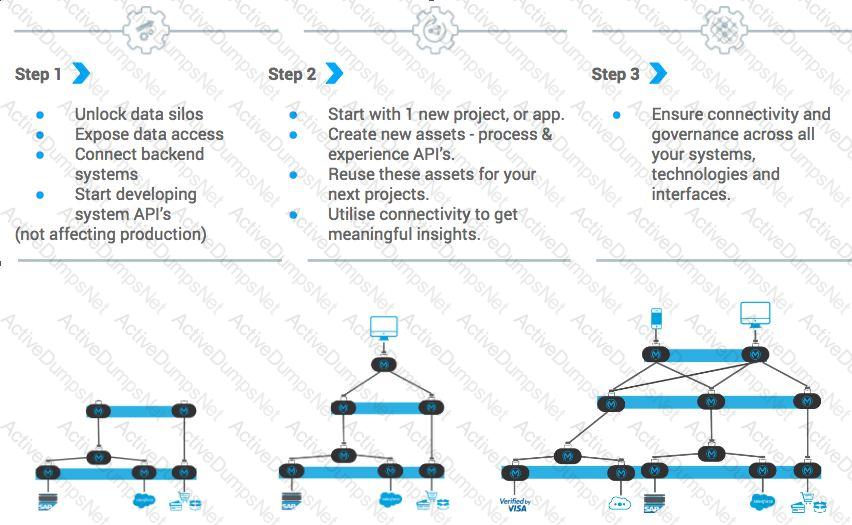
A business process involves the receipt of a file from an external vendor over SFTP. The file needs to be parsed and its content processed, validated, and ultimately persisted to a database. The delivery mechanism is expected to change in the future as more vendors send similar files using other mechanisms such as file transfer or HTTP POST.

What is the most effective way to design for these requirements in order to minimize the impact of future change?
Options:

A.

Use a MuleSoft Scatter-Gather and a MuleSoft Batch Job to handle the different files coming from different sources

B.

Create a Process API to receive the file and process it using a MuleSoft Batch Job while delegating the data save process to a System API

C.

Create an API that receives the file and invokes a Process API with the data contained In the file, then have the Process API process the data using a MuleSoft Batch Job and other System APIs as needed

D.

Use a composite data source so files can be retrieved from various sources and delivered to a MuleSoft Batch Job for processing

Question 37

Refer to the exhibit.

A Mule application has an HTTP Listener that accepts HTTP DELETE requests. This Mule application Is deployed to three CloudHub workers under the control of the CloudHub Shared Load Balancer.

A web client makes a sequence of requests to the Mule application's public URL.

How is this sequence of web client requests distributed among the HTTP Listeners running in the three CloudHub workers?

Options:

A.

Each request is routed to the PRIMARY CloudHub worker in the PRIMARY Availability Zone (AZ)

B.

Each request is routed to ONE ARBiTRARY CloudHub worker in the PRIMARY Availability Zone (AZ)

C.

Each request Is routed to ONE ARBiTRARY CloudHub worker out of ALL three CloudHub workers

D.

Each request is routed (scattered) to ALL three CloudHub workers at the same time

Question 38

According to MuleSoft, what is a major distinguishing characteristic of an application network in relation to the integration of systems, data, and devices?

Options:

A.

It uses a well-organized monolithic approach with standards

B.

It is built for change and self-service

C.

It leverages well-accepted internet standards like HTTP and JSON

D.

It uses CI/CD automation for real-time project delivery

Question 39

An integration Mute application is being designed to process orders by submitting them to a backend system for offline processing. Each order will be received by the Mute application through an HTTPS POST and must be acknowledged immediately. Once acknowledged, the order will be submitted to a backend system. Orders that cannot be successfully submitted due to rejections from the backend system will need to be processed manually (outside the backend system).

The Mule application will be deployed to a customer-hosted runtime and is able to use an existing ActiveMQ broker if needed.

The backend system has a track record of unreliability both due to minor network connectivity issues and longer outages.

What idiomatic (used for their intended purposes) combination of Mule application components and ActiveMQ queues are required to ensure automatic submission of orders to the backend system, while minimizing manual order processing?

Options:

A.

An On Error scope Non-persistent VM ActiveMQ Dead Letter Queue for manual processing

B.

An On Error scope MuleSoft Object Store ActiveMQ Dead Letter Queue for manual processing

C.

Until Successful component MuleSoft Object Store ActiveMQ is NOT needed or used

D.

Until Successful component ActiveMQ long retry Queue ActiveMQ Dead Letter Queue for manual processing

Question 40

A project team uses RAML specifications to document API functional requirements and deliver API definitions. As per the current legal requirement, all designed API definitions to be augmented with an additional non-functional requirement to protect the services from a high rate of requests according to define service level agreements.

Assuming that the project is following Mulesoft API governance and policies, how should the project team convey the necessary non-functional requirement to stakeholders?

Options:

A.

Create proxies in API manager for the non functional requirement and publish to exchange

B.

Add all non functional requirements as comments to RAML specification and publish to exchange

C.

Create various SLA's in API manager for the non functional requirement and publish to exchange

D.

Update API definitions with the fragment for the appropriate policy and publish to exchange

Question 41

A retail company is implementing a MuleSoft API to get inventory details from two vendors by Invoking each vendor's online applications. Due to network issues, the invocations to the vendor applications are timing out intermittently, but the requests are successful after re-invoking each

vendor application.

What is the most performant way of implementing the API to invoke each vendor application and to retry invocations that generate timeout errors?

Options:

A.

Use a For-Each scope to invoke the two vendor applications in series, one after the other.Place the For-Each scope inside an Until-Successful scope to retry requests that raise timeout errors.

B.

Use a Choice scope to Invoke each vendor application on a separate route.Place the Choice scope inside an Until-Successful scope to retry requests that raisetimeout errors.

C.

Use a Scatter-Gather scope to invoke each vendor application on a separate route.Use an Until-Successful scope in each route to retry requests that raise timeout errors.

D.

Use a Round-Robin scope to invoke each vendor application on a separate route.Use a Try-Catch scope in each route to retry requests that raise timeout errors.

Question 42

According to MuleSoft's IT delivery and operating model, which approach can an organization adopt in order to reduce the frequency of IT project delivery failures?

Options:

A.

Decouple central IT projects from the innovation that happens within each line of business

B.

Adopt an enterprise data model

C.

Prevent technology sprawl by reducing production of API assets

D.

Stop scope creep by centralizing requirements-gathering

Question 43

A team would like to create a project skeleton that developers can use as a starting point when creating API Implementations with Anypoint Studio. This skeleton should help drive consistent use of best practices within the team.

What type of Anypoint Exchange artifact(s) should be added to Anypoint Exchange to publish the project skeleton?

Options:

A.

A custom asset with the default API implementation

B.

A RAML archetype and reusable trait definitions to be reused across API implementations

C.

An example of an API implementation following best practices

D.

a Mule application template with the key components and minimal integration logic

Question 44

What API policy would LEAST likely be applied to a Process API?

Options:

A.

Custom circuit breaker

B.

Client ID enforcement

C.

Rate limiting

D.

JSON threat protection

Question 45

A retailer is designing a data exchange interface to be used by its suppliers. The interface must support secure communication over the public internet. The interface must also work with a wide variety of programming languages and IT systems used by suppliers.

What are suitable interface technologies for this data exchange that are secure, cross-platform, and internet friendly, assuming that Anypoint Connectors exist for these interface technologies?

Options:

A.

EDJFACT XML over SFTP JSON/REST over HTTPS

B.

SOAP over HTTPS HOP over TLS gRPC over HTTPS

C.

XML over ActiveMQ XML over SFTP XML/REST over HTTPS

D.

CSV over FTP YAML over TLS JSON over HTTPS

Question 46

An organization has implemented a continuous integration (CI) lifecycle that promotes Mule applications through code, build, and test stages. To standardize the organization's CI journey, a new dependency control approach is being designed to store artifacts that include information such as dependencies, versioning, and build promotions.

To implement these process improvements, the organization will now require developers to maintain all dependencies related to Mule application code in a shared location.

What is the most idiomatic (used for its intended purpose) type of system the organization should use in a shared location to standardize all dependencies related to Mule application code?

Options:

A.

A MuleSoft-managed repository at repository.mulesoft.org

B.

A binary artifact repository

C.

API Community Manager

D.

The Anypoint Object Store service at cloudhub.io

Question 47

An API client is implemented as a Mule application that includes an HTTP Request operation using a default configuration. The HTTP Request operation invokes an external API that follows standard HTTP status code conventions, which causes the HTTP Request operation to return a 4xx status code.

What is a possible cause of this status code response?

Options:

A.

An error occurred inside the external API implementation when processing the HTTP request that was received from the outbound HTTP Request operation of the Mule application

B.

The external API reported that the API implementation has moved to a different external endpoint

C.

The HTTP response cannot be interpreted by the HTTP Request operation of the Mule application after it was received from the external API

D.

The external API reported an error with the HTTP request that was received from the outbound HTTP Request operation of the Mule application

Question 48

A large life sciences customer plans to use the Mule Tracing module with the Mapped Diagnostic Context (MDC) logging operations to enrich logging in its Mule application and to improve tracking by providing more context in the Mule application logs. The customer also wants to improve throughput and lower the message processing latency in its Mule application flows.

After installing the Mule Tracing module in the Mule application, how should logging be performed in flows in Mule applications, and what should be changed In the log4j2.xml files?

Options:

A.

In the flows, add Mule Tracing module Set logging variable operations before any Core Logger components.In log4j2.xml files, change the appender's pattern layout to use %MDC and then assign the appender to a Logger or Root element.

B.

In the flows, add Mule Tracing module Set logging variable operations before any CoreLogger components.In log4j2.xmI files, change the appender’s pattern layout to use the %MDC placeholder and then assign the appender to an AsyncLogger element.

C.

In the flows, add Mule Tracing module Set logging variable operations before any CoreLogger components.In log4j2.xmI files, change the appender’'s pattern layout to use %asyncLogger placeholder and then assign the appender to an AsyncLogger element.

D.

In the flows, wrap Logger components in Async scopes. In log4j2.xmI files, change the appender's pattern layout to use the %asyncLoggerplaceholder and then assign the appender to a Logger or Root element.

Question 49

When designing an upstream API and its implementation, the development team has been advised to not set timeouts when invoking downstream API. Because the downstream API has no SLA that can be relied upon. This is the only donwstream API dependency of that upstream API. Assume the downstream API runs uninterrupted without crashing. What is the impact of this advice?

Options:

A.

The invocation of the downstream API will run to completion without timing out.

B.

An SLA for the upstream API CANNOT be provided.

C.

A default timeout of 500 ms will automatically be applied by the Mule runtime in which the upstream API implementation executes.

D.

A load-dependent timeout of less than 1000 ms will be applied by the Mule runtime in which the downstream API implementation executes.

Question 50

A rale limiting policy has been applied to a soap VI.2 API published in Clondhub. The API implementation catches errors in a global error handler on error propagate in the main flow for HTTP: RETRY_EXHAUSTED with HTTP status set to 429 and any with the HTTP status set to 500.

What is the expected H1TP status when the client exceeds the quota of the API calls?

Options:

A.

HTTP status 429 as defined in the HTTP:RETRY EXHAUSTED error handler in the API B. HTTP status 500 as defined in the ANY error handler in the API since an API:RETRY_EXHAUSTED will be generated

B.

HTTP status 401 unauthorized for policy violation

C.

HTTP status 400 from the rate-limiting policy violation since the call does not reach the back-end

Question 51

Customer has deployed mule applications to different customer hosted mule run times. Mule applications are managed from Anypoint platform.

What needs to be configured to monitor these Mule applications from Anypoint monitoring and what sends monitoring data to Anypoint monitoring?

Options:

A.

Enable monitoring of individual applications from runtime manager application settingsRuntime manager agent sends monitoring data from the mule applications to Anypoint monitoring

B.

Install runtime manager agent on each mule runtimeRuntime manager agent since monitoring data from the mule applications to Anypoint monitoring

C.

Anypoint monitoring agent on each mule runtimeAnypoint monitoring agent sends monitoring data from the mule applications to Anypoint monitoring

D.

By default, Anypoint monitoring agent will be installed on each Mule run timeAnypoint Monitoring agent automatically sends monitoring data from the Mule applications to Anypoint monitoring

Question 52

Refer to the exhibit.

This Mule application is deployed to multiple Cloudhub workers with persistent queue enabled. The retrievefile flow event source reads a CSV file from a remote SFTP server and then publishes each record in the CSV file to a VM queue. The processCustomerRecords flow’s VM Listner receives messages from the same VM queue and then processes each message separately.

How are messages routed to the cloudhub workers as messages are received by the VM Listener?

Options:

A.

Each message is routed to ONE of the Cloudhub workers in a DETERMINSTIC round robin fashion thereby EXACTLY BALANCING messages among the cloudhub workers

B.

Each messages routes to ONE of the available Clouhub workers in a NON- DETERMINSTIC non round-robin fashion thereby APPROXIMATELY BALANCING messages among the cloudhub workers

C.

Each message is routed to the SAME Cloudhub worker that retrieved the file, thereby BINDING ALL messages to ONLY that ONE Cloudhub worker

D.

Each message is duplicated to ALL of the Cloudhub workers, thereby SHARING EACH message with ALL the Cloudhub workers.

Question 53

As a part of design , Mule application is required call the Google Maps API to perform a distance computation. The application is deployed to cloudhub.

At the minimum what should be configured in the TLS context of the HTTP request configuration to meet these requirements?

Options:

A.

The configuration is built-in and nothing extra is required for the TLS context

B.

Request a private key from Google and create a PKCS12 file with it and add it in keyStore as a part of TLS context

C.

Download the Google public certificate from a browser, generate JKS file from it and add it in key store as a part of TLS context

D.

Download the Google public certificate from a browser, generate a JKS file from it and add it in Truststore as part of the TLS context

Question 54

A company is planning to migrate its deployment environment from on-premises cluster to a Runtime Fabric (RTF) cluster. It also has a requirement to enable Mule applications deployed to a Mule runtime instance to store and share data across application replicas and restarts.

How can these requirements be met?

Options:

A.

Anypoint object store V2 to share data between replicas in the RTF cluster

B.

Install the object store pod on one of the cluster nodes

C.

Configure Persistence Gateway in any of the servers using Mule Object Store

D.

Configure Persistent Gateway at the RTF

Question 55

A Mule application contains a Batch Job with two Batch Steps (Batch_Step_l and Batch_Step_2). A payload with 1000 records is received by the Batch Job.

How many threads are used by the Batch Job to process records, and how does each Batch Step process records within the Batch Job?

Options:

A.

Each Batch Job uses SEVERAL THREADS for the Batch Steps Each Batch Step instance receives ONE record at a time as the payload, and RECORDS are processed IN PARALLEL within and between the two Batch Steps

B.

Each Batch Job uses a SINGLE THREAD for all Batch steps Each Batch step instance receives ONE record at a time as the payload, and RECORDS are processed IN ORDER, first through Batch_Step_l and then through Batch_Step_2

C.

Each Batch Job uses a SINGLE THREAD to process a configured block size of record Each Batch Step instance receives A BLOCK OF records as the payload, and BLOCKS of records are processed IN ORDER

D.

Each Batch Job uses SEVERAL THREADS for the Batch Steps Each Batch Step instance receives ONE record at a time as the payload, and BATCH STEP INSTANCES execute IN PARALLEL to process records and Batch Steps in ANY order as fast as possible

Question 56

A Mule application contains a Batch Job scope with several Batch Step scopes. The Batch Job scope is configured with a batch block size of 25.

A payload with 4,000 records is received by the Batch Job scope.

When there are no errors, how does the Batch Job scope process records within and between the Batch Step scopes?

Options:

A.

The Batch Job scope processes multiple record blocks in parallel, and a block of 25 records can jump ahead to the next Batch Step scope over an earlier block of recordsEach Batch Step scope is invoked with one record in the payload of the received Mule eventFor each Batch Step scope, all 25 records within a block are processed in parallelAll the records in a block must be completed before the block of 25 records is available to the next Bat

B.

The Batch Job scope processes each record block sequentially, one at a timeEach Batch Step scope is invoked with one record in the payload of the received Mule eventFor each Batch Step scope, all 25 records within a block are processed sequentially, one at a timeAll 4000 records must be completed before the blocks of records are available to the next Batch Step scope

C.

The Batch Job scope processes multiple record blocks in parallel, and a block of 25 records can jump ahead to the next Batch Step scope over an earlier block of recordsEach Batch Step scope is invoked with one record in the payload of the received Mule eventFor each Batch Step scope, all 25 records within a block are processed sequentially, one record at a timeAll the records in a block must be completed before the block of 25 records is av

D.

The Batch Job scope processes multiple record blocks in parallelEach Batch Step scope is invoked with a batch of 25 records in the payload of the received Mule eventFor each Batch Step scope, all 4000 records are processed in parallelIndividual records can jump ahead to the next Batch Step scope before the rest of the records finish processing in the current Batch Step scope

Question 57

An integration team follows MuleSoft’s recommended approach to full lifecycle API development.

Which activity should this team perform during the API implementation phase?

Options:

A.

Validate the API specification

B.

Use the API specification to build the MuleSoft application

C.

Design the API specification

D.

Use the API specification to monitor the MuleSoft application

Question 58

Why would an Enterprise Architect use a single enterprise-wide canonical data model (CDM) when designing an integration solution using Anypoint Platform?

Options:

A.

To reduce dependencies when integrating multiple systems that use different data formats

B.

To automate Al-enabled API implementation generation based on normalized backend databases from separate vendors

C.

To leverage a data abstraction layer that shields existing Mule applications from nonbackward compatible changes to the model's data structure

D.

To remove the need to perform data transformation when processing message payloads in Mule applications

Question 59

A global, high-volume shopping Mule application is being built and will be deployed to CloudHub. To improve performance, the Mule application uses a Cache scope that maintains cache state in a CloudHub object store. Web clients will access the Mule application over HTTP from all around the world, with peak volume coinciding with business hours in the web client's geographic location. To achieve optimal performance, what Anypoint Platform region should be chosen for the CloudHub object store?

Options:

A.

Choose the same region as to where the Mule application is deployed

B.

Choose the US-West region, the only supported region for CloudHub object stores

C.

Choose the geographically closest available region for each web client

D.

Choose a region that is the traffic-weighted geographic center of all web clients

Question 60

An IT integration tram followed an API-led connectivity approach to implement an order-fulfillment business process. It created an order processing AP that coordinates stateful interactions with a variety of microservices that validate, create, and fulfill new product orders

Which interaction composition pattern did the integration architect who designed this order processing AP| use?

Options:

A.

Orchestration

B.

Streaming

C.

Aggregation

D.

Multicasting

Question 61

Refer to the exhibit.

Question # 61

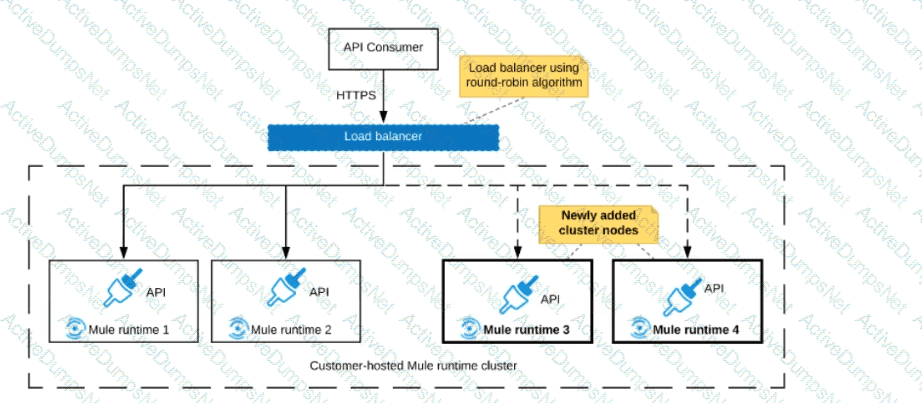
An organization uses a 2-node Mute runtime cluster to host one stateless API implementation. The API is accessed over HTTPS through a load balancer that uses round-robin for load distribution.

Two additional nodes have been added to the cluster and the load balancer has been configured to recognize the new nodes with no other change to the load balancer.

What average performance change is guaranteed to happen, assuming all cluster nodes are fully operational?

Options:

A.

50% reduction in the response time of the API

B.

100% increase in the throughput of the API

C.

50% reduction In the JVM heap memory consumed by each node

D.

50% reduction In the number of requests being received by each node

Question 62

A Mule application is running on a customer-hosted Mule runtime in an organization's network. The Mule application acts as a producer of asynchronous Mule events. Each Mule event must be broadcast to all interested external consumers outside the Mule application. The Mule events should be published in a way that is guaranteed in normal situations and also minimizes duplicate delivery in less frequent failure scenarios.

The organizational firewall is configured to only allow outbound traffic on ports 80 and 443. Some external event consumers are within the organizational network, while others are located outside the firewall.

What Anypoint Platform service is most idiomatic (used for its intended purpose) for publishing these Mule events to all external consumers while addressing the desired reliability goals?

Options:

A.

CloudHub VM queues

B.

Anypoint MQ

C.

Anypoint Exchange

D.

CloudHub Shared Load Balancer

Question 63

Mule application muleA deployed in cloudhub uses Object Store v2 to share data across instances. As a part of new requirement , application muleB which is deployed in same region wants to access this Object Store.

Which of the following option you would suggest which will have minimum latency in this scenario?

Options:

A.

Object Store REST API

B.

Object Store connector

C.

Both of the above option will have same latency

D.

Object Store of one mule application cannot be accessed by other mule application.

Question 64

An organization is in the process of building automated deployments using a CI/CD process. As a part of automated deployments, it wants to apply policies to API Instances.

What tool can the organization use to promote and deploy API Manager policies?

Options:

A.

Anypoint CLI

B.

MUnit Maven plugin

C.

Mule Maven plugin

D.

Runtime Manager agent

Question 65

What metrics about API invocations are available for visualization in custom charts using Anypoint Analytics?

Options:

A.

Request size, request HTTP verbs, response time

B.

Request size, number of requests, JDBC Select operation result set size

C.

Request size, number of requests, response size, response time

D.

Request size, number of requests, JDBC Select operation response time

Question 66

An organization plans to migrate all its Mule applications to Runtime Fabric (RTF). Currently, all Mule applications have been deployed to CloudHub using automated CI/CD scripts.

What steps should be taken to properly migrate the applications from CloudHub to RTF, while keeping the same automated CI/CD deployment strategy?

Options:

A.

A runtimefabric dependency should be added as a mule-plugin to the pom.xml file in all the Mule applications.

B.

runtimeFabric command-line parameter should be added to the CI/CD deployment scripts.

C.

A runtimefFabricDeployment profile should be added to Mule configuration properties YAML files in all the Mule applications.CI/CD scripts must be modified to use the new configuration properties.

D.

runtimefabricDeployment profile should be added to the pom.xml file in all the Mule applications. CI/CD scripts must be modified to use the new RTF profile.

E.

- The pom.xml and Mule configuration YAML files can remain unchanged in each Mule application.A --runtimeFabric command-line parameter should be added to the CI/CD deployment scripts

Question 67

According to the National Institute of Standards and Technology (NIST), which cloud computing deployment model describes a composition of two or more distinct clouds that support data and application portability?

Options:

A.

Private cloud

B.

Hybrid cloud 4

C.

Public cloud

D.

Community cloud

Question 68

A corporation has deployed Mule applications to different customer-hosted Mule runtimes. Mule applications deployed to these Mule runtimes are managed by Anypoint Platform.

What needs to be installed or configured (if anything) to monitor these Mule applications from Anypoint Monitoring, and how is monitoring data from each Mule application sent to Anypoint Monitoring?

Options:

A.

Enable monitoring of individual Mule applications from the Runtime Managerapplication settings.Runtime Manager sends monitoring data to Anypoint Monitoring for each deployed Mule application.

B.

Install a Runtime Manager agent on each Mule runtime.Each Runtime Manager agent sends monitoring data from the Mule applicationsrunning in its Mule runtime to Runtime Manager, then Runtime Manager sendsmonitoring data to Anypoint Monitoring.

C.

Leave the out-of-the-box Anypoint Monitoring agent unchanged in its default Muleruntime installation.Each Anypoint Monitoring agent sends monitoring data from the Mule applicationsrunning in its Mule runtime to Runtime Manager, then Runtime Manager sendsmonitoring data to Anypoint Monitoring.

D.

Install an Anypoint Monitoring agent on each Mule runtime.Each Anypoint Monitoring agent sends monitoring data from the Mule applicationsrunning in its Mule runtime to Anypoint Monitoring.

Question 69

An organization designing a hybrid, load balanced, single cluster production environment. Due to performance service level agreement goals, it is looking into running the Mule applications in an active-active multi node cluster configuration.

What should be considered when running its Mule applications in this type of environment?

Options:

A.

All event sources, regardless of time , can be configured as the target source by the primary node in the cluster

B.

An external load balancer is required to distribute incoming requests throughout the cluster nodes

C.

A Mule application deployed to multiple nodes runs in an isolation from the other nodes in the cluster

D.

Although the cluster environment is fully installed configured and running, it will not process any requests until an outage condition is detected by the primary node in the cluster.

Question 70

A marketing organization is designing a Mule application to process campaign data. The Mule application will periodically check for a file in a SFTP location and process the records in the file. The size of the file can vary from 10MB to 5GB. Due to the limited availabiltty of vCores, the Mule application is deployed to a single CloudHub worker configured with vCore size 0.2.

The application must transform and send different formats of this file to three different downstream SFTP locations.

What is the most idiomatic (used for its intended purpose) and performant way to configure the SFTP operations or event sources to process the large files to support these deployment requirements?

Options:

A.

Use an in-memory repeatable stream

B.

Use a file-stored non-repeatable stream

C.

Use an in-memory non-repeatable stream

D.

Use a file-stored repeatable stream

Question 71

Refer to the exhibit.

Question # 71

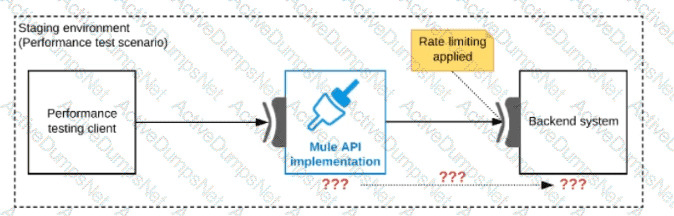
One of the backend systems invoked by an API implementation enforces rate limits on the number of requests a particular client can make. Both the backend system and the API implementation are deployed to several non-production environments in addition to production.

Rate limiting of the backend system applies to all non-production environments. The production environment, however, does NOT have any rate limiting.

What is the most effective approach to conduct performance tests of the API implementation in a staging (non-production) environment?

Options:

A.

Create a mocking service that replicates the backend system's production performance characteristics. Then configure the API implementation to use the mocking service and conduct the performance tests

B.

Use MUnit to simulate standard responses from the backend system then conduct performance tests to identify other bottlenecks in the system

C.

Include logic within the API implementation that bypasses invocations of the backend system in a performance test situation. Instead invoking local stubs that replicate typical backend system responses then conduct performance tests using this API Implementation

D.

Conduct scaled-down performance tests in the staging environment against the rate limited backend system then upscale performance results to full production scale

Question 72

What is an advantage that Anypoint Platform offers by providing universal API management and Integration-Platform-as-a-Service (iPaaS) capabilities in a unified platform?

Options:

A.

Ability to use a single iPaaS to manage and integrate all API gateways

B.

Ability to use a single connector to manage and integrate all APis

C.

Ability to use a single control plane for both full-lifecycle AP] management and integration

D.

Ability to use a single iPaaS to manage all API developer portals

Question 73

An organization plans to migrate its deployment environment from an onpremises cluster to a Runtime Fabric (RTF) cluster. The on-premises Mule applications are currently configured with persistent object stores.

There is a requirement to enable Mule applications deployed to the RTF cluster to store and share data across application replicas and through restarts of the entire RTF cluster,

How can these reliability requirements be met?

Options:

A.

Replace persistent object stores with persistent VM queues in each Mule application deployment

B.

Install the Object Store pod on one of the cluster nodes

C.

Configure Anypoint Object Store v2 to share data between replicas in the RTF cluster

D.

Configure the Persistence Gateway in the RTF installation

Question 74

During a planning session with the executive leadership, the development team director presents plans for a new API to expose the data in the company’s order database. An earlier effort to build an API on top of this data failed, so the director is recommending a design-first approach.

Which characteristics of a design-first approach will help make this API successful?

Options:

A.

Building MUnit tests so administrators can confirm code coverage percentage during deployment

B.

Publishing the fully implemented API to Exchange so all developers can reuse the API

C.

Adding global policies to the API so all developers automatically secure the implementation before coding anything

D.

Developing a specification so consumers can test before the implementation is built

Question 75

A payment processing company has implemented a Payment Processing API Mule application to process credit card and debit card transactions, Because the Payment Processing API handles highly sensitive information, the payment processing company requires that data must be encrypted both In-transit and at-rest.

To meet these security requirements, consumers of the Payment Processing API must create request message payloads in a JSON format specified by the API, and the message payload values must be encrypted.

How can the Payment Processing API validate requests received from API consumers?

Options:

A.

A Transport Layer Security (TLS) - Inbound policy can be applied in API Manager to decrypt the message payload and the Mule application implementation can then usethe JSON Validation module to validate the JSON data

B.

The Mule application implementation can use the APIkit module to decrypt and then validate the JSON data

C.

The Mule application implementation can use the Validation module to decrypt and then validate the JSON data

D.

The Mule application implementation can use DataWeave to decrypt the message payload and then use the JSON Scheme Validation module to validate the JSON data

Question 76

A corporation has deployed multiple mule applications implementing various public and private API's to different cloudhub workers. These API's arc Critical applications that must be highly available and in line with the reliability SLA as defined by stakeholders.

How can API availability (liveliness or readiness) be monitored so that Ops team receives outage notifications?

Options:

A.

Enable monitoring of individual applications from Anypoint monitoring

B.

Configure alerts with failure conditions in runtime manager

C.

Configure alerts failure conditions in API manager

D.

Use any point functional monitoring test API's functional behavior

Question 77

A Mule application is being designed To receive nightly a CSV file containing millions of records from an external vendor over SFTP, The records from the file need to be validated, transformed. And then written to a database. Records can be inserted into the database in any order.

In this use case, what combination of Mule components provides the most effective and performant way to write these records to the database?

Options:

A.

Use a Parallel for Each scope to Insert records one by one into the database

B.

Use a Scatter-Gather to bulk insert records into the database

C.

Use a Batch job scope to bulk insert records into the database.

D.

Use a DataWeave map operation and an Async scope to insert records one by one into the database.

Question 78

An organization is evaluating using the CloudHub shared Load Balancer (SLB) vs creating a CloudHub dedicated load balancer (DLB). They are evaluating how this choice affects the various types of certificates used by CloudHub deplpoyed Mule applications, including MuleSoft-provided, customer-provided, or Mule application-provided certificates.

What type of restrictions exist on the types of certificates that can be exposed by the CloudHub Shared Load Balancer (SLB) to external web clients over the public internet?

Options:

A.

Only MuleSoft-provided certificates are exposed.

B.

Only customer-provided wildcard certificates are exposed.

C.

Only customer-provided self-signed certificates are exposed.

D.

Only underlying Mule application certificates are exposed (pass-through)

Question 79

A new Mule application has been deployed through Runtime Manager to CloudHub 1.0 using a CI/CD pipeline with sensitive properties set as cleartext. The Runtime Manager Administrator opened a high priority incident ticket about this violation of their security requirements indicating

these sensitive properties values must not be stored or visible in Runtime Manager but should be changeable in Runtime Manager by Administrators with proper permissions.

How can the Mule application be deployed while safely hiding the sensitive properties?

Options:

A.

Add an ArrayList of all the sensitive properties’ names in the mule-artifact.json file ofthe application

B.

Add encrypted versions of the sensitive properties as global configuration properties inthe Mule application

C.

Add a new wrapper.java.additional.xx parameter for each sensitive property in thewrapper.conf file used by the CI/CD pipeline scripts

D.

Create a variable for each sensitive property and declare them as hidden in the CI/CDpipeline scripts

Question 80

As a part of project , existing java implementation is being migrated to Mulesoft. Business is very tight on the budget and wish to complete the project in most economical way possible.

Canonical object model using java is already a part of existing implementation. Same object model is required by mule application for a business use case. What is the best way to achieve this?

Options:

A.

Make use of Java module

B.

Create similar model for Mule applications

C.

Create a custom application to read Java code and make it available for Mule application

D.

Use Anypoint exchange

Question 81

An API client makes an HTTP request to an API gateway with an Accept header containing the value’’ application’’.

What is a valid HTTP response payload for this request in the client requested data format?

Options:

A.

healthy

B.

{"status" "healthy"}

C.

status(‘healthy")

D.

status: healthy