
Weekend Special - 75% Discount Offer - Ends in 0d 00h 00m 00s - Coupon code: discactive

Salesforce Mule-Dev-301 Salesforce Certified MuleSoft Developer II Exam Practice Test

Salesforce Certified MuleSoft Developer II Questions and Answers

Question 1

Refer to the exhibits.

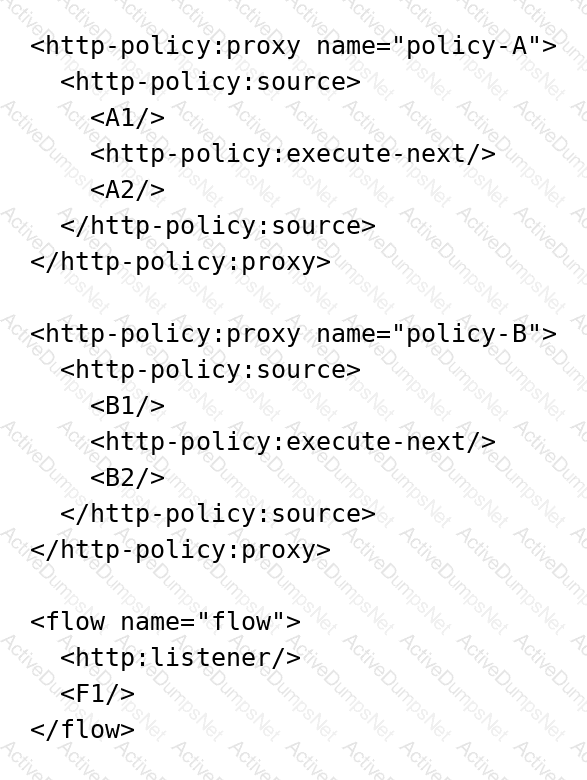
A Mule application contains two policies: Policy A and Policy B. Policy A has order 1, and Policy B has order 2. Policy A, Policy B, and a flow are defined by the configurations below.

When an HTTP request arrives at the Mule application's endpoint, what will be the execution order?

Exhibit:
Question # 1

Options:

A.

A1, B1, F1, B2, A2

B.

B1, A1, F1, A2, B2

C.

F1, A1, B1, B2, A2

D.

F1, B1, A1, A2, B2

Question 2

A Mule application exposes an API for creating payments. An Operations team wants to ensure that the Payments API is up and running at all times in production.

Which approach should be used to test that the Payments API is working in production?

Options:

A.

Create a health check endpoint that reuses the same port number and HTTP Listener configuration as the API itself

B.

Configure the application to send health data to an external system

C.

Create a health check endpoint that listens on a separate port and uses a separate HTTP Listener configuration from the API

D.

Monitor the Payments API directly, sending real customer payment data

Question 3

Which statement is true about using mutual TLS to secure an application?

Options:

A.

Mutual TLS requires a hardware security module to be used

B.

Mutual TLS increases the encryption strength versus server-side TLS alone

C.

Mutual TLS authenticates the identity of the server before the identity of the client

D.

Mutual TLS ensures only authorized end users are allowed to access an endpoint

Question 4

In a Mule project, Flow-1 contains a flow-ref to Flow-2. Flow-2 depends on data from Flow-1 to execute successfully.

Which action ensures the test suites and test cases written for Flow-1 and Flow-2 will execute successfully?

Options:

A.

Use "After Test Case" to produce the data needed from Flow-1 test cases to pass to Flow-2 test cases

B.

Use "Before Test Case" to collect data from Flow-1 test cases before running Flow-2 test cases

C.

Chain together the test suites and test cases for Flow-1 and Flow-2

D.

Use "Set Event" to pass the input data that is needed, and keep the test cases for Flow-1 and Flow-2 independent

Question 5

A Mule application uses API autodiscovery to access and enforce policies for a RESTful implementation.

What needs to be configured for the flowRef attribute of the autodiscovery global element?

Options:

A.

The name of the flow that has APIkit Console to receive all incoming RESTful operation requests

B.

Nothing because flowRef is an optional attribute which can be passed during runtime

C.

The name of the flow that has HTTP Listener to receive all incoming RESTful operation requests

D.

Any of the APIkit generated implementation flows

Question 6

A Mule application deployed to a standalone Mule runtime uses VM queues to publish messages to be consumed asynchronously by another flow.

In the case of a system failure, what will happen to in-flight messages in the VM queues that have not been consumed?

Options:

A.

For persistent queues, the message will be processed after the system comes online

B.

For transient queues, the message will be processed after the system comes online

C.

For any type of queue, the message will be lost

D.

For any type of queue, the message will be processed after the system comes online

Question 7

Which statement is true when using XML SDK for creating custom message processors?

Options:

A.

Operations can be reused in recursive calls

B.

An XML SDK provides both inbound and outbound operations

C.

Properties are fields defined by an end user of the XML SDK component and serve as a global configuration for the entire Mule project in which they are used

D.

All operations are public

Question 8

A Mule application for processing orders must log the order ID for every log message output.

What is a best practice to enrich every log message with the order ID?

Options:

A.

Use the Tracing module to set logging variables with a Mapped Diagnostic Context

B.

Set a flow variable and edit the log4j2.xml file to output the variable as part of the message pattern

C.

Use flow variables within every logger processor to log the order ID

D.

Create a custom XML SDK component to wrap the logger processor and automatically add the order ID within the connector

Question 9

Refer to the exhibits.

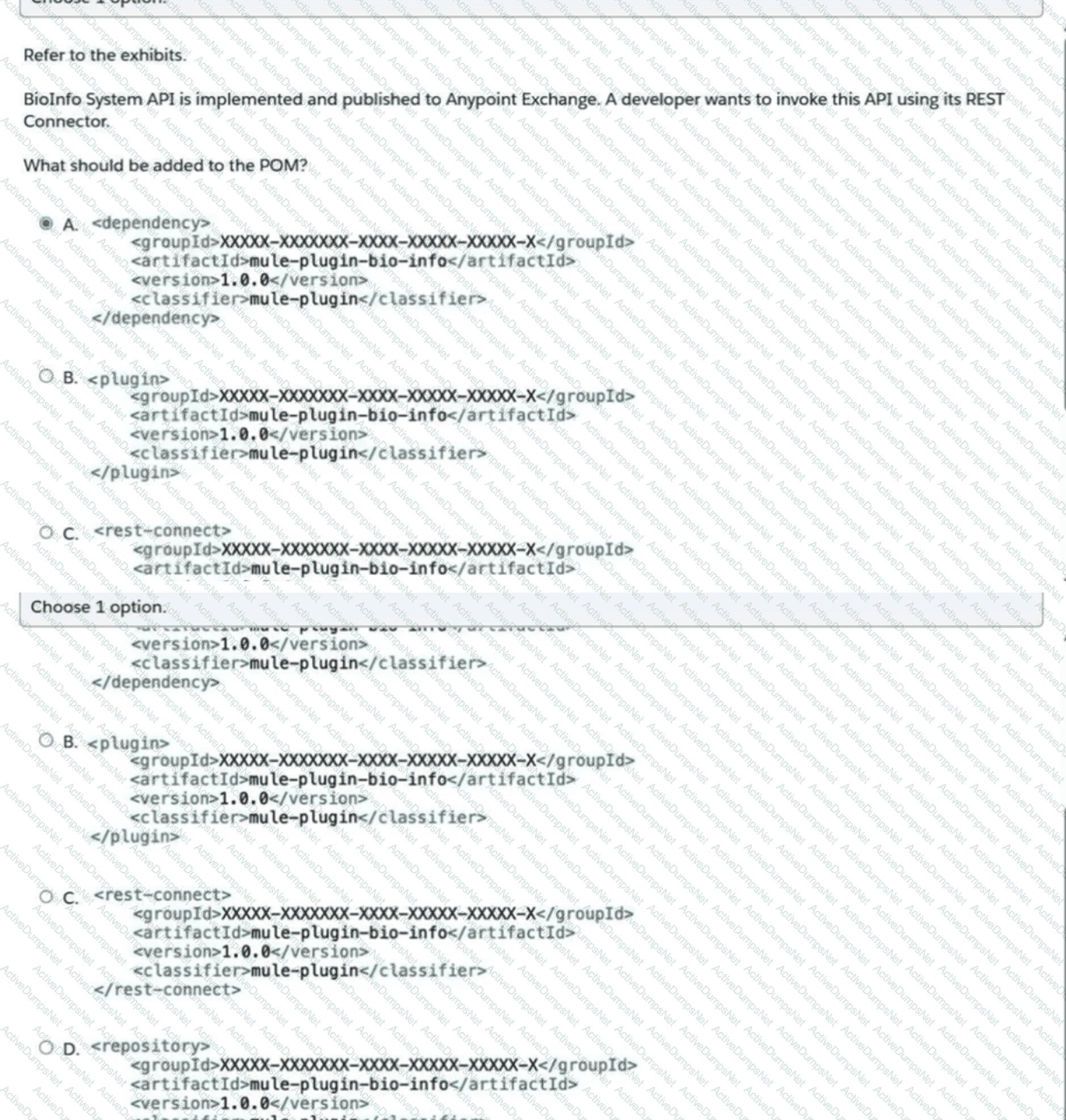
BioInfo System API is implemented and published to Anypoint Exchange. A developer wants to invoke this API using its REST Connector.

What should be added to the POM?

Exhibit / Answer Configurations:
Question # 9

Options:

A.

Add the generated asset as a Maven < dependency > with the Exchange groupId, artifactId, version, and < classifier > mule-plugin < /classifier > .

B.

Add the generated asset as a Maven < plugin > .

C.

Add the generated asset through a < rest-connect > element.

D.

Add the generated asset as a < repository > entry.

Question 10

A developer deploys an API to CloudHub and applies an OAuth API policy in API Manager. During testing, the API response is slow, so the developer reconfigures the API so that the out-of-the-box HTTP Caching policy is applied first, and the OAuth API policy is applied second.

What will happen when an HTTP request is received?

Options:

A.

In case of a cache hit, both the OAuth and HTTP Caching policies are evaluated; then the cached response is returned to the caller

B.

In case of a cache miss, both the OAuth and HTTP Caching policies are evaluated; then the API retrieves the data from the API implementation, and the policy does not store the data in Object Store

C.

In case of a cache miss, only the HTTP Caching policy is evaluated; then the API retrieves the data from the API implementation, and the policy stores the data to be cached in Object Store

D.

In case of a cache hit, only the HTTP Caching policy is evaluated; then the cached response is returned to the caller

Question 11

Refer to the exhibit.

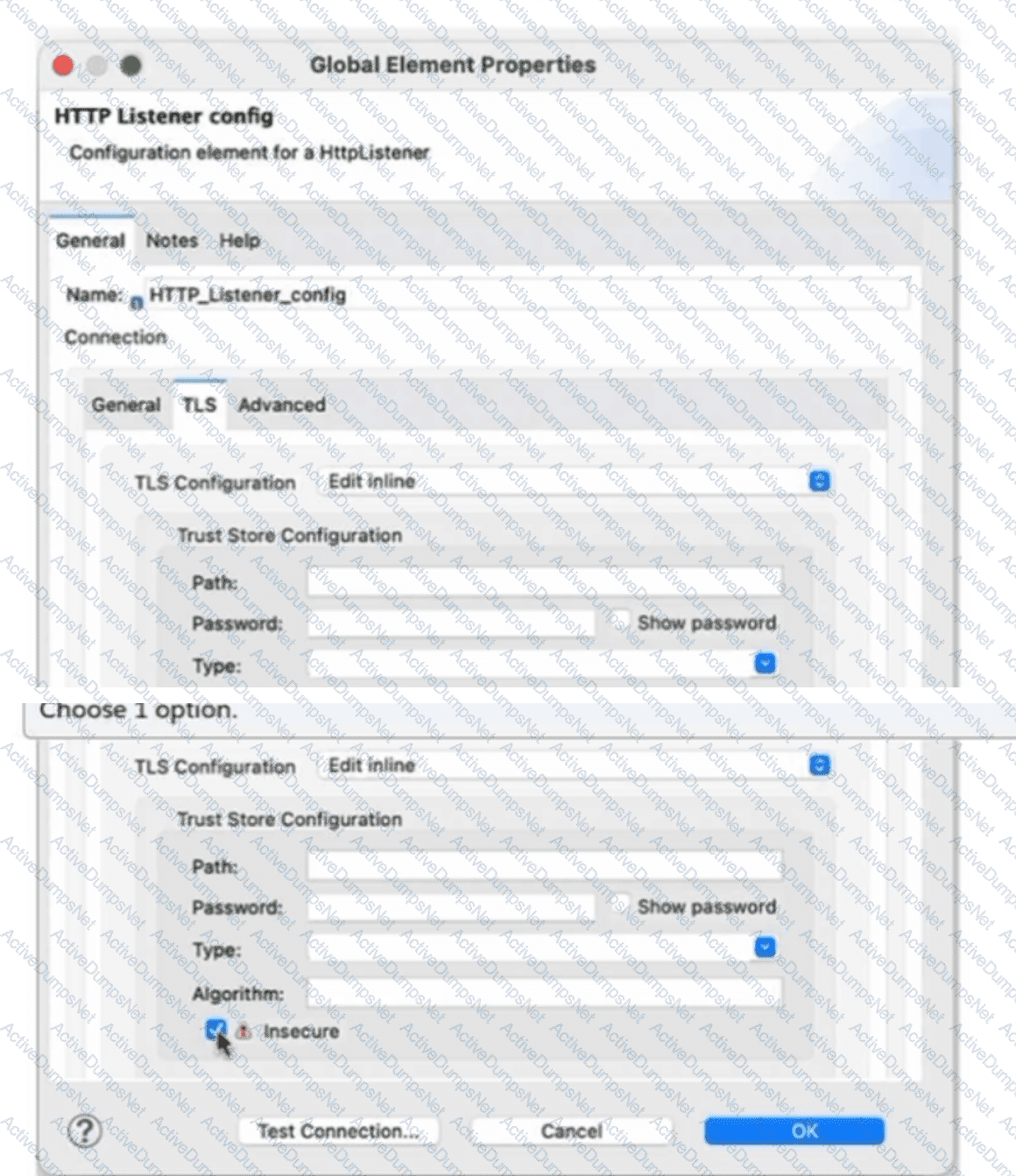
What is the result if "Insecure" is selected as part of the HTTP Listener configuration?

Exhibit:
Question # 11

Options:

A.

The HTTP Listener will trust any certificate presented by the HTTP client

B.

The HTTP Listener will only accept HTTP requests

C.

Mutual TLS authentication will be enabled between this HTTP Listener and an HTTP client

D.

The HTTP Listener will accept any unauthenticated request

Question 12

A healthcare portal needs to validate the token that it sends to a Mule API. The developer plans to implement a custom policy using the HTTP Policy Transform Extension to match the token received in the header from the healthcare portal.

Which files does the developer need to create in order to package the custom policy?

Options:

A.

XML template file, YAML configuration file

B.

Deployable ZIP file, YAML configuration file

C.

JSON properties file, XML template file

D.

JSON properties file, YAML configuration file

Question 13

An API has been developed and deployed to CloudHub. Among the policies applied to this API is an allowlist of IP addresses. A developer wants to run a test in Anypoint Studio and does not want any policies applied because their workstation is not included in the allowlist.

What must the developer do in order to run this test locally without the policies applied?

Options:

A.

Pass in the runtime parameter "-Danypoint.platform.gatekeeper=disabled"

B.

Deactivate the API in API Manager so the Autodiscovery element will not find the application when it runs in Studio

C.

Run the test as-is, with no changes, because the Studio runtime will not attempt to connect to API Manager

D.

Create a properties file specifically for local development and set the API instance ID to a value that is not used in API Manager

Question 14

Refer to the exhibits.

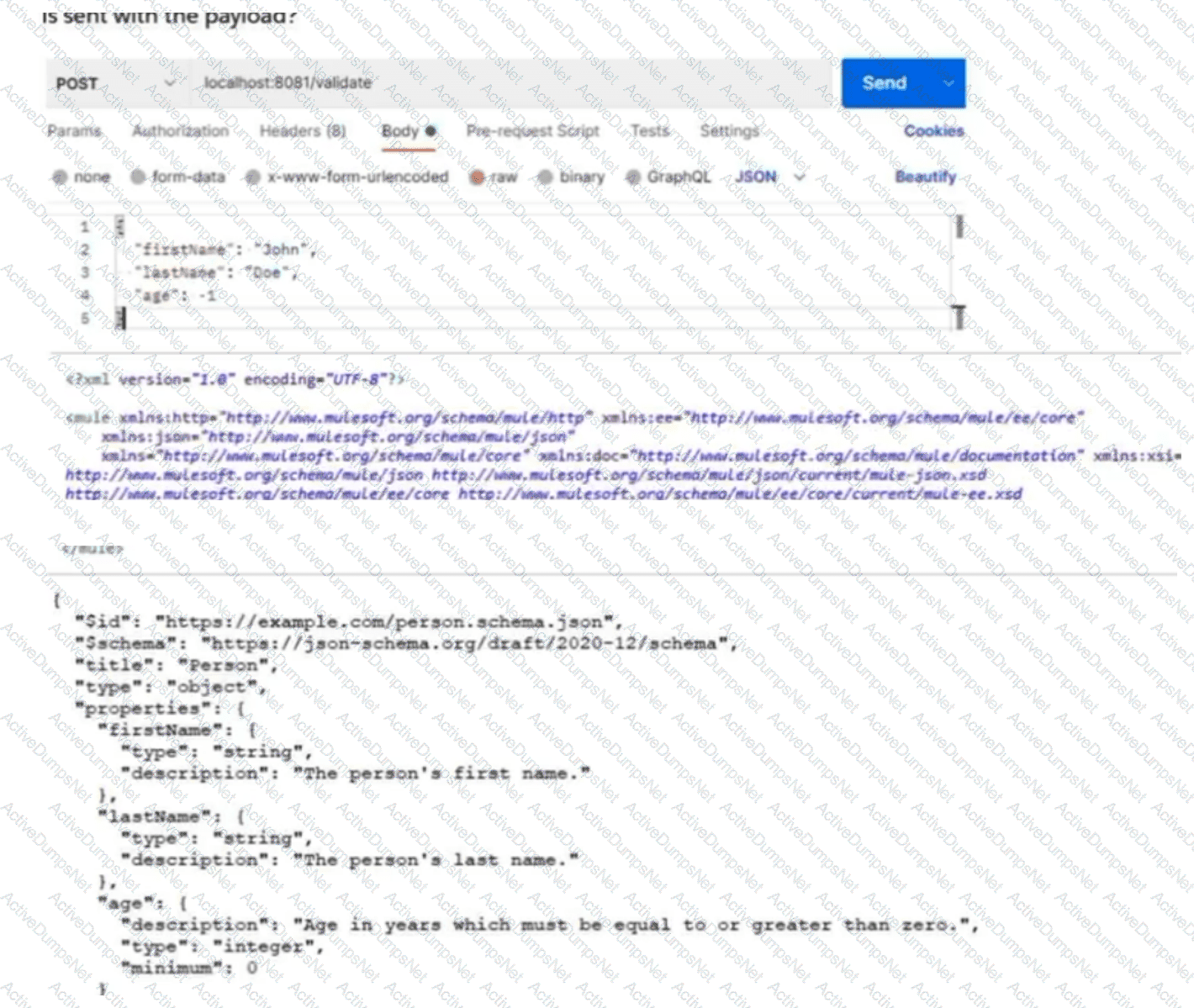
Based on the code snippet, schema.json file, and payload below, what is the outcome of the given code snippet when a request is sent with the payload?

Exhibits:
Question # 14

Options:

A.

The Mule flow will execute successfully with status code 204

B.

The Mule flow will execute successfully with status code 200, and in response will display the message "Age in years which must be equal to or greater than zero."

C.

The Mule flow will throw the exception "JSON:SCHEMA_NOT_HONOURED"

D.

The Mule flow will execute successfully with status code 200, and the response will be the JSON sent in request

Question 15

Multiple individual Mule applications need to use the Mule Maven plugin to deploy to CloudHub. The plugin configuration should be reused where necessary and anything project-specific should be property-based.

Where should the Mule Maven plugin details be configured?

Options:

A.

A Bill of Materials (BOM) parent pom

B.

A parent pom.xml

C.

pom.xml

D.

settings.xml

Question 16

A developer has created the first version of an API designed for business partners to work with commodity prices.

What should the developer do to allow more than one major version of the same API to be exposed by the implementation?

Options:

A.

In Design Center, open the RAML and modify each operation to include the major version number

B.

In Anypoint Studio, generate scaffolding from the RAML, and then modify the < http:listener > in the generated flows to include a parameter to replace the version number

C.

In Design Center, open the RAML and modify baseUri to include a variable that indicates the version number

D.

In Anypoint Studio, generate scaffolding from the RAML, and then modify the flow names generated by APIkit to include a variable with the major version number

Question 17

The Center for Enablement team published a common application as a reusable module to the central Nexus repository.

How can the common application be included in all API implementations?

Options:

A.

Add a Maven dependency in the POM file with mule-plugin as < classifier >

B.

Add a Maven dependency in the POM file with jar as < classifier >

C.

Copy the common application's source XML file and put it in a new flow file in the src/main/mule folder

D.

Download the common application from Nexus and copy it to the src/main/resources folder in the API

Question 18

A Mule application needs to invoke an API hosted by an external system to initiate a process. The external API takes anywhere between one minute and 24 hours to complete its process.

Which implementation should be used to get response data from the external API after it completes processing?

Options:

A.

Expose an HTTP callback API in Mule and register it with the external system

B.

Use a Scheduler to check for a response every minute

C.

Use an HTTP Connector inside Async scope to invoke the API and wait for a response

D.

Use an HTTP Connector to invoke the API and wait for a response