
Salesforce Integration-Architect Salesforce Certified Platform Integration Architect (Plat-Arch-204) Exam Practice Test
Total 138 questions
Salesforce Certified Platform Integration Architect (Plat-Arch-204) Questions and Answers
A customer of Salesforce has used Platform Events to integrate their Salesforce instance with an external third-party artificial intelligence (AI) system. The AI system provides a prediction score for each lead that is received by Salesforce. Once the prediction score is received, the lead information is saved to Platform Events for other processes. The trigger on the Platform Events has failed ever since it was rolled out to production. Which type of monitoring should the integration consultant have considered to monitor this integration?
What should an integration architect consider when recommending Platform Events as an integration solution?
A company captures orders and needs to send them to the Order fulfillment system. The user is not required to have confirmation from the fulfillment system. Which system constraint question should be considered when designing this integration?
Universal Containers (UC) is currently managing a custom monolithic web service that runs on an on-premise server. This monolithic web service is responsible for Point-to-Point (P2P) integrations between Salesforce and a legacy billing application, a cloud-based ERP, and a data lake. UC has found that the tight interdependencies are causing failures. What should an integration architect recommend to decouple the systems and improve performance?
Northern Trail Outfitters (NTO) has recently changed its Corporate Security Guidelines requiring all cloud applications to pass through a secure firewall before accessing on-premise resources. NTO is evaluating middleware solutions. Which consideration should an integration architect evaluate before choosing a middleware solution?
Universal Containers (UC) is planning to implement Salesforce as its CRM system. Currently, UC has a marketing system for leads, Microsoft Outlook for contacts and emails, and an ERP for billing and payments. The proposed CRM should provide a single customer view. What should an integration architect consider to support this strategy?
A company accepts payment requests 24/7. Once the company accepts a payment request, its service level agreement (SLA) r5equires it to make sure each payment request is processed by its Payment System. The co6mpany tracks payment requests using a globally unique identifier created at the Data Entry Point. The company’s simplified flow is as shown in the diagram.
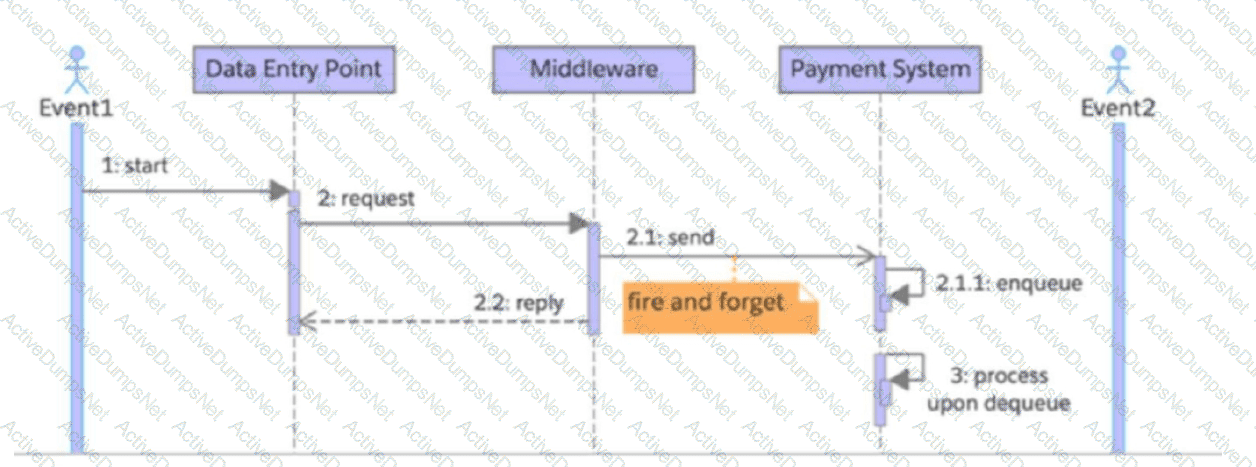
The company encounters intermittent update errors when two or more processes try to update the same Payment Request record at the same time.
Which recommendation should an integration architect make to improve the company’s SLA and update conflict handling?
Northern Trail Outfitters (NTO) has an affiliate company that would like immediate notifications of changes to opportunities in the NTO Salesforce Instance. The affiliate company has a CometD client available. Which solution is recommended in order to meet the requirement?
Universal Containers (UC) support agents would like to open bank accounts on the spot. During the process, agents execute credit checks through external agencies. At any given time, up to 30 concurrent reps will be using the service. Which error handling mechanisms should be built to display an error to the agent when the credit verification process has failed?
The director of customer service at Northern Trail Outfitters (NTO) wants to capture and trend specific business events that occur in Salesforce in real time. The metrics will be accessed in an ad-hoc manner using an external analytics system. The events include product exchanges, authorization clicks, subscription cancellations, and refund initiations via Cases. Which solution should meet these business requirements?
A new Salesforce program requires data updates between internal systems and Salesforce. Which relevant detail should an integration architect seek to solve for integration architecture needs?
Northern Trail Outfitters (NTO) has a requirement to encrypt a few widely-used standard fields. NTO also wants to be able to use these fields in record-triggered flows.
Which security solution should an integration architect recommend to fulfill the business use case?
Northern Trail Outfitters submits orders to the manufacturing system web service. Recently, the system has experienced outages that keep service unavailable for several days. Which solution should an integration architect recommend to handle errors during these types of service outages?1718
Northern Trail Outfitters needs to send order and line items directly to an existing finance application webservice when an order is fulfilled. It is critical that each order reach the finance application exactly once for accurate invoicing. Which solution should an architect propose?
Considering Salesforce capabilities, what should the integration architect evaluate when integrating Salesforce with the current system landscape?
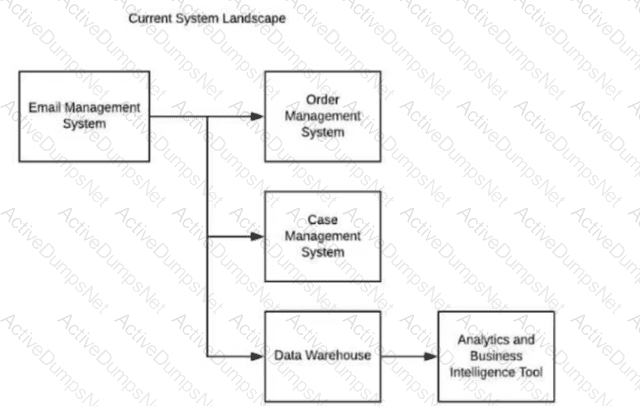
A new Salesforce program has the following high-level abstract requirement: Business processes executed on Salesforce require data updates between some internal systems and Salesforce. Which relevant details should a Salesforce integration architect seek to specifically solve for the integration architecture needs of the program?
An enterprise customer with more than 10 million customers has a landscape including an Enterprise Billing System (EBS), a Document Management System (DMS), and Salesforce CRM. Customer Support needs seamless access to customer billing information from the EBS and generated bills from the DMS. Which authorization and authentication need should an integration consultant consider while integrating the DMS and EBS with Salesforce?
NTO is merging two orgs but needs the retiring org available for lead management (connected to web forms). New leads must be in the new instance within 30 minutes. Which approach requires the least amount of development effort?
Northern Trail Outfitters needs to use Shield Platform Encryption to encrypt social security numbers in order to meet a business requirement. Which action should an integration architect take prior to the implementation of Shield Platform Encryption?
Northern Trail Outfitters is planning to perform nightly batch loads into Salesforce using the Bulk API. The CIO is curious about monitoring recommendations for the jobs from the technical architect. Which recommendation should help meet the requirements?
A company’s security assessment noted vulnerabilities on the unmanaged packages in its Salesforce orgs; notably, secrets that are easily accessible and in plain text, such as usernames, passwords, and OAuth tokens used in callouts from Salesforce. Which persistence mechanisms should an integration architect require to be used to ensure that secrets are protected from deliberate or inadvertent exposure?
Salesforce is considered to be the system of record for the customer. UC plans on using middleware to integrate Salesforce with external systems (ERP, ticketing, data lake). UC has a requirement to update the proper external system with record changes in Salesforce and vice versa. Which solution should an integration architect recommend?
Universal Containers (UC) is decommissioning its legacy CRM system and migrating data to Salesforce. The data migration team asked for a recommendation to optimize the performance of the data load. Which approach should be used to meet the requirement?
A customer imports data from an external system into Salesforce using Bulk API. These jobs have batch sizes of 2,000 and are run in parallel mode. The batches fail frequently with the error “Max CPU time exceeded”. A smaller batch size will fix this error. What should be considered when using a smaller batch size?
Universal Containers (UC) is a leading provider of management training globally. UC embarked on a Salesforce transformation journey to allow students to register for courses in the Salesforce Community. UC has a learning system that masters all courses and student registration. UC requested a near real-time feed of student registration from Salesforce to the learning system. The integration architect recommends using Salesforce Platform Events. Which API should be used for the Salesforce pl1atform event solution?
An integration developer is developing an HR synchronization app for a client. The app synchronizes Salesforce record data changes with an HR system that’s external to Salesforce. What should the integration architect recommend to ensure notifications are stored for up to 3 days if data replication fails?
Northern Trail Outfitters uses Salesforce to track leads and opportunities, and to capture order details. However, Salesforce isn’t the system that holds or processes orders. After the order details are captured in Salesforce, an order must be created in the Remote system, which manages the order’s lifecycle. The integration architect for the project is recommending a remote system that will subscribe to the platform event defined in Salesforce. Which integration pattern should be used for this business use case?
An architect decided to use Platform Events for integrating Salesforce with an external system for a company. What should an architect consider when proposing this type of integration mechanism?
The URL for a business-critical external service providing exchange rates changed without notice. Which solutions should be implemented to minimize potential downtime for users in this situation?
An enterprise architect has requested the Salesforce integration architect to review the following (see diagram and description) and provide recommendations after carefully considering all constraints of the enterprise systems and Salesforce Platform limits.
There are multiple eligibility systems that provide this service and are hosted externally.34
However, their current response times could take up to 90 seconds to process and return.
These eligibility systems can be acc8essed through APIs orchestrated via ESB (MuleSoft).
All requests from Salesforce must traverse the customer’s API Gateway layer, which imposes a constraint of timing out requests after 9 seconds.
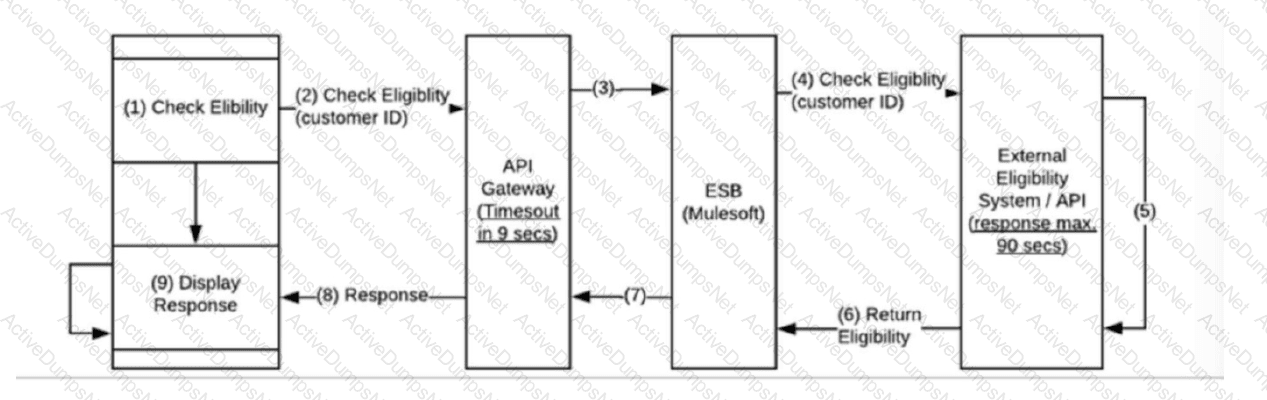
Which recommendation should the integration architect make?
An enterprise customer is implementing Salesforce for Case Management. Based on the landscape (Email, Order Management, Data Warehouse, Case Management), what should the integration architect evaluate?
An integration architect has been tasked with integrating Salesforce with an on-premises system. Due to some established policies, this system must remain on-premises. What should the integration architect use to build a solution for this requirement?
Northern Trail Outfitters needs to send order and line items directly to an existing finance application webservice when an order is fulfilled. It is critical that each order reach the finance application exactly once for accurate invoicing. Which solution should an architect propose?
Universal Containers (UC) is planning to implement Salesforce as its CRM system. Currently, UC has the following systems:
Leads are managed in a Marketing system.
Sales people use Microsoft Outlook to enter contacts and emails, and manage activities.
Inventory, Billing, and Payments are managed in UC’s Enterprise Resource Planning (ERP) system.
The proposed CRM system is expected to provide sales and support people with a single view of their customers and the ability to manage their contacts, emails, and activities in the Salesforce CRM.
What should an integration architect consider to support the proposed CRM system strategy?
What should an integration architect consider when recommending Platform Events as an integration solution?
Northern Trail Outfitters needs a synchronous callout from Salesforce to an Order Management System (OMS) when an opportunity is "Closed/Won" with products attached. What should an integration architect do to satisfy these requirements?
Northern Trail Outfitters is creating a distributable Salesforce package. The package needs to call into a Custom Apex REST endpoint in the central org. The security team wants to ensure a specific integration account is used in the central org that they will authorize after installation. Which item should an architect recommend?
Salesforce users need to read data from an external system via an HTTP request. Which security methods should an integration architect leverage within Salesforce to secure the integration?
A customer is evaluating the Platform Events solution and would like help in comparing/contrasting it with Outbound Messaging for real-time/near-real time needs. They expect 3,000 customers to view messages in Salesforce. What should be evaluated and highlighted when deciding between the solutions?12
Northern Trail Outfitters (NTO) has recently changed its Corporate Security Guidelines. The guidelines require that all cloud applications pass through a secure firewall before accessing on-premise resources. NTO is evaluating middleware solutions to integrate cloud applications with on-premise resources and services. Which consideration should an integration architect evaluate before choosing a middleware solution?
Universal Containers (UC) is a global financial company that sells financial products and services. There is a daily scheduled Batch Apex job that generates invoices from a given set of orders. UC requested building a resilient integration for this Batch Apex job in case the invoice generation fails. What should an integration architect recommend to fulfill the requirement?
Total 138 questions