Pre-Summer Sale Limited Time Flat 70% Discount offer - Ends in 0d 00h 00m 00s - Coupon code: 70spcl

Proofpoint PPAN01 Certified Threat Protection Analyst Exam Exam Practice Test

Page: 1 / 5
Total 52 questions

Certified Threat Protection Analyst Exam Questions and Answers

Question 1

Why do some domains generate a warning when they are added to the custom blocklist in TAP?

Options:

A.

Because they are already blocked and restricted by default in the network system.

B.

Because they are already blocked by other security measures, such as IPS and firewall.

C.

Because they are less popular and low-risk domains that do not pose a threat.

D.

Because entire domains of popular and prominent services on the web should not be blocked.

Question 2

An analyst is reviewing a quarantined threat within Threat Protection Workbench.
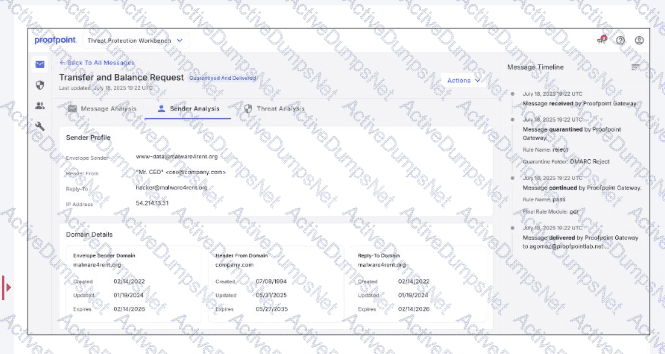
Question # 2

Based on the indicators shown in the exhibit, what is the most likely reason the threat was quarantined?

Options:

A.

The threat was quarantined because it contained malware.

B.

The threat was quarantined because there is a sender impersonation risk.

C.

The threat was quarantined because it is from a newly created domain.

D.

The threat was quarantined because it is from a known malicious IP address.

Question 3

Which TAP condemnation results from an analysis of emails submitted via Proofpoint ZenGuide Report Suspicious (formerly PhishAlarm)?

Options:

A.

Anomalous Traffic Detection

B.

Proofpoint Threat Analyst

C.

End User via CLEAR

D.

Customer Administrator via Blocklist

Question 4

Which activity is part of the Preparation phase in the NIST lifecycle?

Options:

A.

Restoring systems from backups.

B.

Documenting postmortem reports.

C.

Identifying compromised accounts.

D.

Conducting response drill scenarios.

Question 5

What is the first action a security analyst should take when beginning to review and prioritize alerts from Targeted Attack Protection (TAP)?

Options:

A.

Use filtering options on the TAP Threats page to organize and prioritize threat alerts.

B.

Assess claims of false positives by analyzing forensic details and threat indicators.

C.

Open and examine the contents of an email using the associated .eml file.

D.

Investigate false negatives by identifying root causes in source policy configurations.

Question 6

Which of the following is an item that should be included in an incident report as part of the post-incident debrief?

Options:

A.

Network diagrams

B.

Incident response plan

C.

Adversary tactics and techniques

D.

Proofpoint threat landscape reporting

Question 7

Which TAP Reports tab provides a view of the distribution of threats against your organization, including quantity of messages, variation of threat campaigns seen, and the number of individual threats that weren’t part of a campaign?

Options:

A.

Landscape

B.

Objectives

C.

Effectiveness

D.

Organization

Question 8

As a new analyst, you need to review threat intelligence related to threats in your environment. Which Proofpoint product provides this data?

Options:

A.

Proofpoint on Demand (PoD)

B.

Proofpoint Smart Search

C.

Proofpoint TAP Dashboard

D.

Proofpoint TRAP

Question 9

When filtering for threats on the TAP People page, which two filters have the highest chance of finding compromises? (Select two.)

Options:

A.

Exposure > Permitted Clicks

B.

Users > Locations

C.

Exposure > Delivered with Accessible Threat

D.

Threats > False Positives Only

E.

Users > VIP

Question 10

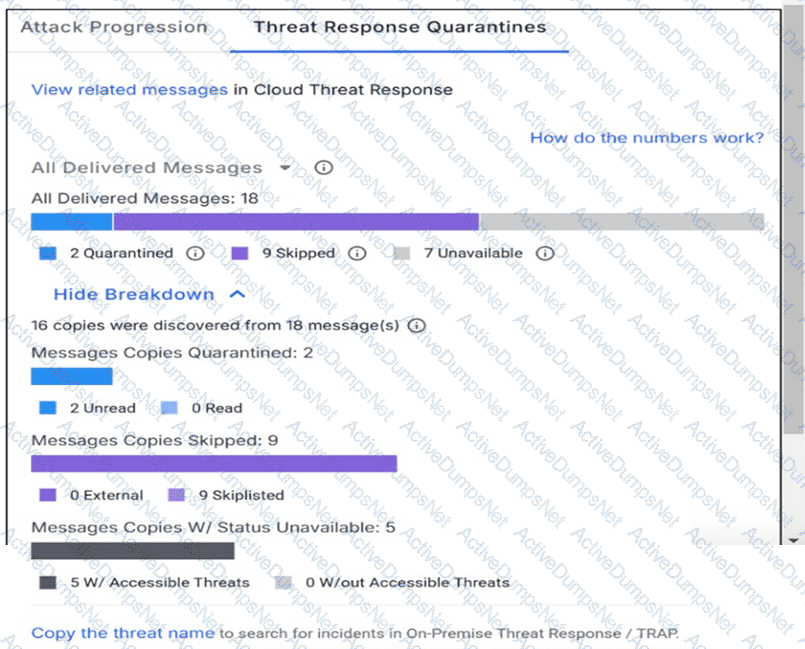
Refer to the exhibit.

Question # 10

How many messages were sent to a mailbox configured to bypass quarantine for monitoring purposes?

Options:

A.

18

B.

7

C.

9

D.

2

Question 11

What best describes the nature of the NIST incident response lifecycle?

Options:

A.

A cyclical process focused on continuous improvement.

B.

A linear process from detection to recovery.

C.

A reactive-only approach to cyber threats.

D.

A one-time checklist for handling incidents.

Question 12

What is a defining characteristic of Advanced Persistent Threat (APT) actors?

Options:

A.

They primarily use social engineering to gain access.

B.

They operate independently without government affiliation.

C.

They focus on short-term financial scams.

D.

They are state-sponsored and target strategic assets.

Question 13

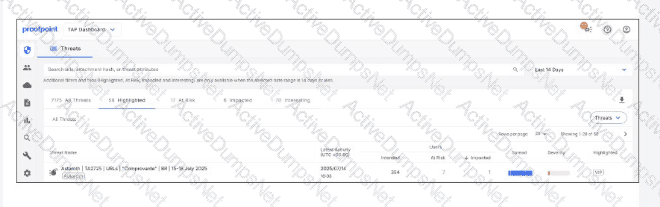
Refer to the exhibit.

Question # 13

Which two determinations can be made by the data shown on the TAP Dashboard in the exhibit? (Select two.)

Options:

A.

The threat has been seen by all Proofpoint customers.

B.

The impacted user was definitely a VIP.

C.

Seven users received this threat message.

D.

354 users are at risk from this phishing campaign.

E.

One user clicked on a rewritten URL.

Question 14

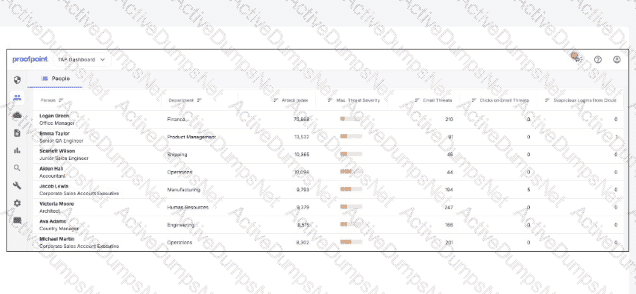
Based on the exhibit,

Question # 14

which user would most benefit from attending security awareness training based on their behavior?

Options:

A.

Logan Green

B.

Scarlett Wilson

C.

Emma Taylor

D.

Jacob Lewis

Question 15

An analyst is reviewing the Threat Response Quarantines card for a message in TAP Dashboard, as shown in the exhibit.
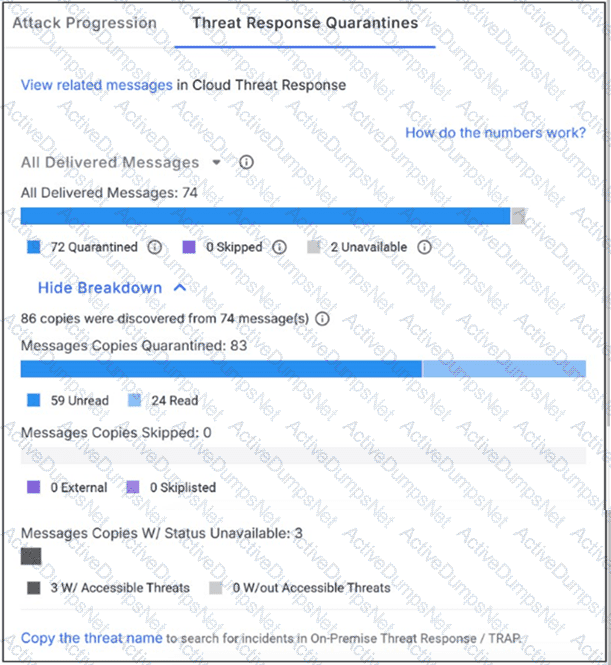
Question # 15

Why might a message be flagged with status “unavailable”?

Options:

A.

The message was deleted from the mailbox before it could be quarantined.

B.

The message was automatically moved into a user-created folder for archiving.

C.

The message was delayed in delivery because of large attachment size.

D.

The message was marked as read by the user before it could be quarantined.

Page: 1 / 5
Total 52 questions