
Spring Sale Limited Time Flat 70% Discount offer - Ends in 0d 00h 00m 00s - Coupon code: 70spcl

PeopleCert MSP-Practitioner MSP Practitioner, 5th edition Exam Exam Practice Test

MSP Practitioner, 5th edition Exam Questions and Answers

Question 1

Here are three statements about the programme justification for the Smart Meter Programme. In which document should the statements be recorded?
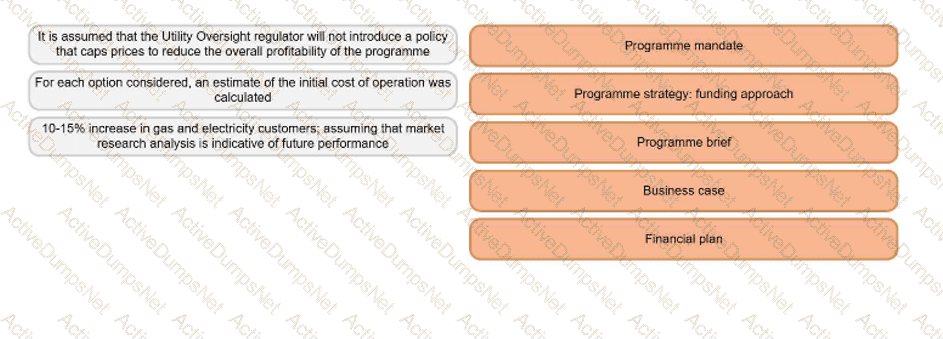
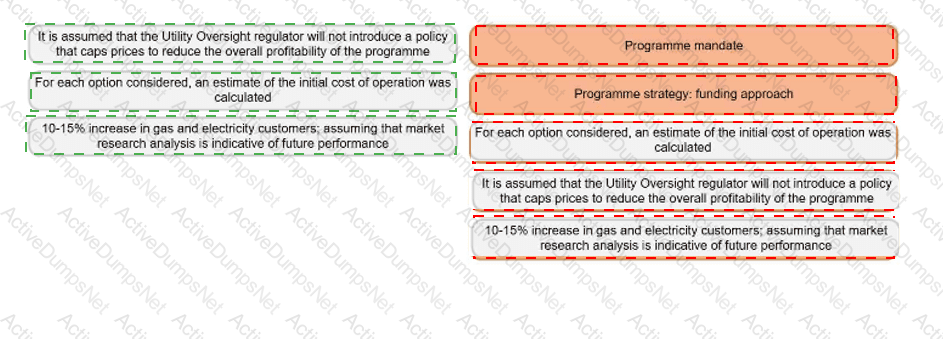
Question # 1

Options:

Question 2

The programme is in the ‘design the outcomes’ process. One risk to the programme is that new and improved meter technology may be developed during implementation. This risk has been assessed as high probability and high impact and is therefore a high priority. The initial delivery approach proposes a phased roll-out of the meters so that the programme can exploit any new technology that emerges. The CTO has been appointed as the owner of this risk.

Is this appointment an appropriate application of the identify and prioritize risks’ activity, and why?

Options:

A.

Yes, because the exposure created by this risk warrants the appointment of a senior risk owner

B.

Yes, because this risk would impact on the expected increased number of gas and electricity customers

C.

No, because the phased roll-out should be documented as landing points during the ‘develop the target operating model' activity

D.

No, because the phased roll-out should be planned for as part of the ‘develop programme plans’ activity

Question 3

The CFO has been appointed as the SRO for the Smart Meter Programme.

Is this appointment an appropriate application of the ‘organization’ theme, and why?

Options:

A.

Yes, because the CFO is able to monitor whether the increase in customers and reduction in costs is achieved

B.

Yes, because the CFO can direct the programme, providing new insights as they are new to UU

C.

No, because the CFO has no previous experience or working knowledge of the utility industry operations

D.

No, because the CEO, who has industry knowledge, is better qualified to develop the programme vision

Question 4

During the ‘plan progressive delivery’ process, it was decided that the call centre managers would hold a weekly meeting with all call centre staff to update them on progress and understand any concerns that they might have. This information was documented by the programme manager.

Which theme is being applied?

Options:

A.

Organization

B.

Design

C.

Decisions

D.

Knowledge

Question 5

Which of the following is Management document?

Options:

A.

Programme brief

B.

Project Dossier

C.

Issue Register

D.

Programme Mandate

Question 6

Which type of cost is associated in training, moving and supporting an operational unit?

Options:

A.

Programme management cost

B.

Capital cost

C.

Business change and transition cost

D.

Benefits realization cost

Question 7

The programme is in the ‘deliver the capabilities’ process. When the Call Centre Rationalization Project is complete, it will be important to inform all staff and customers. This is because there will be new contact details for the new single call centre with longer opening hours. The programme manager has planned for both internal and external announcements to publicize this.

Which theme is MOST relevant to these planned activities?

Options:

A.

Decisions

B.

Knowledge

C.

Organization

D.

Structure

Question 8

The programme is in the first tranche. The programme manager met with the project managers from the Employment Contracts and Call Centre Rationalization projects as well as the BCM. Many topics were discussed. After the meeting, the programme manager reviewed the information gathered at the meeting.

Which information should result in an addition to the risk register?

Options:

A.

Customer service staff will be trained on all call centre systems in order to answer calls from customers and cross-sell all of UU's products

B.

Currently customer service staff have specialist areas of expertise in either electricity, gas or water and do not answer calls from other customers

C.

Tranche 3 could be delayed as the Customer Processes Project has not yet started, and it is unclear what training the call centre staff will need

D.

Due to staff sickness, the Call Centre Rationalization Project is delayed in delivering the call centre integration, but the project is expected to finish on time

Question 9

When approval to proceed is given at the end of Defining a Programme, what does this mean?

Options:

A.

The approval authorizes the work of all projects in the first tranche of programme.

B.

The approval authorizes the SRO to proceed with the whole programme.

C.

The approval authorizes the start of the first project in the first tranche only.

D.

The approval only acknowledges that the documents developed so far are acceptable.

Question 10

Which of the following is an Information Baseline?

Options:

A.

Governance

B.

Boundary

C.

Management

D.

All of above

Question 11

The Employment Contracts Project in Tranche 1 will identify the skills needed by sales staff. However, the Customer Processes Project in Tranche 2 will define new ways to sell gas and electricity to existing water customers which may result in changes to the previously defined skills requirements. If any rework is required, this would delay increasing the number of electricity and gas customers. The programme manager has set up a process to independently monitor the situation, so they can be warned immediately if this becomes likely to happen.

Which principle is being applied MOST by the programme manager when implementing the independent monitoring, and why?

Options:

A.

Align with priorities, because the content of Tranche 2 should be changed to reflect any emerging information

B.

Align with priorities, because the business case should be updated as a result of any identified delays to benefits

C.

Realize measurable benefits, because outcomes of benefit should be embedded at intermediate landing points at the end of each tranche

D.

Realize measurable benefits, because assuring risks to the benefits should contribute to improved decision-making

Question 12

Which activity from the Smart Meter Programme should be delivered using a continual improvement approach?

Options:

A.

Align the terms and conditions for customer-facing staff

B.

Develop integrated billing and accounting services

C.

Develop automatic water leak detection systems

D.

Switch to installing new water meters gradually

Question 13

POTI model is part of which governance theme?

Options:

A.

Business Case

B.

Blueprint

C.

Vision

D.

Risk and issue management

Question 14

The following statement needs to be recorded:

"The vision statement will be developed and tested in a facilitated workshop with the senior officers from each department, before final approval by the CEO."

In which section of the programme strategy should this be recorded?

Options:

A.

Governance approach

B.

Stakeholder engagement approach

C.

Design approach

D.

Decision-making approach

Question 15

Which of the following is NOT normally a characteristic of the Vision Statement?

Options:

A.

It must describe a desirable future

B.

It is short

C.

Key benefits are implicit

D.

It must be time dependent

Question 16

The ‘identify the programme’ process has started. The programme manager organized a meeting to discuss the work being planned for the ‘design the outcomes’ process. It was agreed that the Call Centre Manager and the CEngO should be included in future planning meetings.

Which theme is being applied?

Options:

A.

Organization

B.

Design

C.

Justification

D.

Structure

Question 17

Here are three actions to be performed during the Smart Meter Programme. Which role has an area of focus associated with each statement?
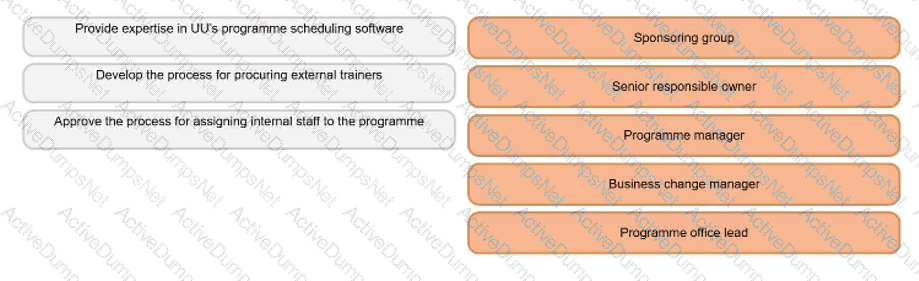
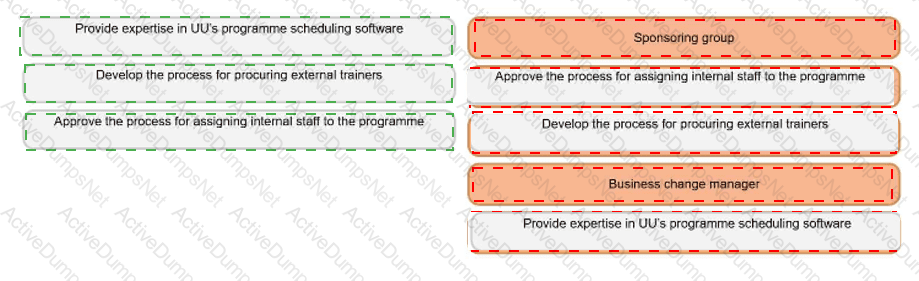
Question # 17

Options:

Question 18

The project team working on the Training Project in Tranche 3 needs to understand the new processes and knowledge required by staff members to develop a coherent set of training materials. The project team also needs to know the skills and qualifications for each role, and any new processes. The project manager is concerned that some of the documentation provided is outdated and does not now reflect the current processes being developed.

Which aspect of information management, if applied correctly, is MOST LIKELY to address these concerns?

Options:

A.

Access control

B.

Integrity

C.

Storage

D.

Version control

Question 19

At which transformational flow basic programme controls are established?

Options:

A.

Identifying the programme

B.

Defining the programme

C.

Managing the tranches

D.

None of above

Question 20

The programme is in the ‘design the outcomes’ process for the first time. The Research and Development Project team has recommended that UU sources an imported next generation smart meter. This is an alternative to the development of the smart meter internally. The imported meter can be fully implemented before the CEO retires in three years' time. However, there is a possibility that this meter could lead to future information security risks.

Is this recommendation an appropriate application of the ‘decisions' theme, and why?

Options:

A.

Yes, because the proposed option should gain the CEO’s full support

B.

Yes, because providing a clear recommendation should bring pace and value

C.

No, because there are security risks identified with the option proposed

D.

No, because a ‘do-nothing’ option and at least two others should be provided

Question 21

Which of following is not expected from senior leadership of programme?

Options:

A.

Skilful in active management of cultural and people issues

B.

Ability to create a compelling vision portraying a beneficial future

C.

Empowered decision making

D.

Good budgeting and resource allocation skills

Question 22

Which of following groups can be a stakeholder for building a city programme?

Options:

A.

Employees

B.

Political leadership

C.

People interested in being residents

D.

All of above

Question 23

In delivering the capability, which role is responsible for aligning projects with programme objectives?

Options:

A.

SRO

B.

BCM

C.

Programme Manager

D.

Programme Office

Question 24

The programme manager has analysed the costs of using an expert external company to work on the Research and Development Project. Although using the external experts is likely to produce a higher quality solution which would lead to increased organizational adoption, the SRO has insisted that the project only uses internal staff to minimize costs.

Is the SRO's response an appropriate application of the ‘deploy diverse skills' principle, and why?

Options:

A.

Yes, because the programme should minimize its reliance on external suppliers to minimize costs

B.

Yes, because it is important to build internal skills for the future during the programme

C.

No, because the sponsoring group should approve decisions on how the programme will be resourced

D.

No, because programme delivery should use the right mix of skills to achieve the outcomes of benefit

Question 25

Which of following Best defines capital cost?

Options:

A.

Costs associated to roles for programme management

B.

Costs of activities associated in realizing the benefits

C.

Cost of BCM and change team

D.

Cost of fixed assets

Question 26

Select the best option defined by following sentence: 'Action of carrying out the coordinated organization, direction and implementation of dossier of projects and transformation activities to achieve desired outcomes'

Options:

A.

Project Management

B.

Programme Management

C.

Portfolio Management

D.

Organizational Management

Question 27

Which of the following statements is NOT TRUE?

Options:

A.

The SRO is accountable for confirming Programme Mandate.

B.

The SRO is accountable for the Programme Brief.

C.

The Programme Manager is responsible for the Vision Statement.

D.

The Programme Manager is responsible for the Blueprint.

Question 28

Which of following is output of 'Defining the programme'?

Options:

A.

Programme Mandate

B.

Governance Baseline

C.

Programme preparation plan

D.

Benefits measures

Question 29

Which of the following is not true about programme control?

Options:

A.

Programme control provides supporting activities to refine and improve delivery

B.

Programme control minimizes impact of ambiguity

C.

Programme control defines reporting mechanism

D.

Programme control justifies continuance of programme

Question 30

Which is not a valid response for a threat?

Options:

A.

Avoid

B.

Enhance

C.

Accept

D.

Reduce

Question 31

As the influence of a stakeholder increases, it is recommended that a 'higher' level of engagement is appropriate. Which of the following describes this increasing engagement?

Options:

A.

Keep informed, active consultation, maintain interest

B.

Active consultation, keep informed, maintain interest

C.

Keep informed, maintain interest, active consultation

D.

Maintain interest, active consultation, keep informed

Question 32

The programme is starting Tranche 1 and there is a lot of dissatisfaction in the workforce about the planned merging of the engineering roles. The programme board has made some proposals on how to deal with this issue but is unsure whether to involve the sponsoring group.

According to the ‘decisions’ theme, which document should be consulted to clarify whether it is necessary to escalate this issue to the sponsoring group?

Options:

A.

Programme strategy: issue resolution approach

B.

Issue register

C.

Programme strategy: decision-making approach

D.

Decision register

Question 33

UU has always used a linear project management methodology in the past with varying degrees of success. During the ‘design the outcomes’ process, UU has decided to trial an agile approach to deliver projects throughout Tranche 1.

Which theme is being applied to the ‘design the outcomes' process?

Options:

A.

The ‘knowledge' theme is being applied by making use of lessons from their previous agile projects

B.

The ‘decisions’ theme is being applied by coming to a conclusive decision to use an agile approach for delivery

C.

The ’structure' theme is being applied by using an agile delivery method to a complex piece of work

D.

The ‘design’ theme is being applied by deliberately designing the work to make use of an iterative approach

Question 34

The programme has successfully completed all projects and work according to the delivery plan and is in the ‘close the programme' process. All internal staff, who had worked on the programme, must now be transferred back into business as usual roles.

Which role should be responsible for managing these activities?

Options:

A.

Sponsoring group members

B.

Senior responsible owner

C.

Programme manager

D.

Business change manager

Question 35

For a programme that focuses on Political and societal change which scenario will lead to lower probability of success?

Options:

A.

New legislation reacting to societal trends

B.

Change to current legislation

C.

Changes to public service delivery model

D.

Long term societal effects

Question 36

Which of the following is an activity in Defining a Programme?

Options:

A.

Design the Projects Dossier

B.

Manage transition

C.

Produce the Programme Brief

D.

Align the projects with benefits realization

Question 37

There is a risk that the utilities market is changing, with green energy solutions becoming more attractive to customers. As UU does not currently offer this type of green energy, the benefits gained from cross-selling electricity and gas to current water customers may be overestimated.

Which activity is relevant in the ‘plan’ phase of the Plan-Do-Check-Act (PDCA) cycle?

Options:

A.

Scheduling daily monitoring of how many current water customers also buy either electricity or gas services

B.

Analysing the market trends for utility companies offering green energy solutions and how many customers they gain

C.

Surveying customers to assess if they are aware of UU's new green tariff introduced in response to this risk

D.

Purchasing and selling a small amount of energy from renewable sources to provide an element of environmental credibility

Question 38

During the 'identify the programme’ process, the SRO identified that the utility regulator may be considering a fair pricing policy to protect vulnerable customers. The introduction of this policy would have a significant impact on the benefits expected by UU. The programme manager included this information in the programme brief.

How well does this apply the 'deal with ambiguity’ principle, and why?

Options:

A.

It applies it well, because the sponsoring group needs to understand the possible impact of this risk when deciding whether to proceed

B.

It applies it well, because UU needs to understand their risk appetite in the current business climate before they start the programme

C.

It applies it poorly, because a formal, documented, risk management process should be used to assess the risk before it is included in the programme brief

D.

It applies it poorly, because this risk is so significant that it should have been identified in the programme mandate by the sponsoring group

Question 39

The engineering department has been asked to produce a weekly report for the programme board. The report will include data on how many new water meters have been installed in the last seven days. The programme manager is writing the assurance approach. The engineering department report has been included as part of the first line of defence.

Is this an appropriate application of the assurance’ theme, and why?

Options:

A.

Yes, because the increased number of gas and electricity customers is dependent on the new water meters being installed

B.

Yes, because the programme board should use the report to monitor the progress of ongoing engineering work

C.

No, because the reporting progress by the engineering department demonstrates application of the ‘decisions' theme

D.

No, because everyone in the programme should have access to progress information, not just the programme board