
PMI PMP Project Management Professional (PMP) July 2026 Update Exam Practice Test
Project Management Professional (PMP) July 2026 Update Questions and Answers
A new government project is taking place in a period of regulatory instability. Despite previous meetings between regulators and project stakeholders, progress toward
project goals is uncertain. The project team is frustrated by scope changes. Some project team members are openly considering moving to another project.
What should the project manager do?
Solution Development Case Study
A project manager was assigned to a project to deliver a corporate IT security solution within a 12-month timeline and a budget of $2.5 million USD. To help ensure project success, the project manager established a governance framework featuring a steering committee of senior executives from relevant functional areas. The project manager conducted a detailed stakeholder analysis using a power/interest grid to prioritize engagement strategies and developed a quality management plan incorporating quality metrics, control charts, and acceptance criteria for each deliverable.
Project work required specialized security testing tools, so the project manager collaborated with the procurement team to develop vendor selection criteria and contract terms. The team used an agile approach to develop software coupled with a predictive approach to manage other aspects of the project. The project manager implemented a configuration management system to track changes and maintain version control of project information.
During execution, the project manager coordinated between various teams, including software development, cybersecurity, quality assurance, compliance, and customer experience, each with its own methodologies and tools. To address integration challenges, the project manager developed a comprehensive project management plan, with a detailed work breakdown structure (WBS), a master schedule using the critical path method, and earned value management (EVM). The team helped the project manager create and tailor a risk management plan focusing on integration points between teams, along with a communications matrix to ensure consistent cross-functional meetings with stakeholders.
During the project, challenges such as resource conflicts, scope creep, and technical integration issues arose. The project manager addressed these challenges using a resource optimization plan, a formal change control process, and technical working groups.
The project was delivered within budget and was concluded 2 months later than the original baseline due to an approved change. Stakeholders accepted the delay due to additional security features added during execution. The final product met all quality metrics and received positive feedback from beta customers. The project provided valuable lessons on early stakeholder alignment, integrated change control, cross-functional communication, and regular risk reassessment, which informed good practices for future projects within the organization.
What should the project manager create to provide project oversight and senior-level decision-making during the project life cycle?
(Refer to the Solution Development Case Study exhibit.)
A developer has been assigned to complete a project task. At the end of a project meeting, the developer expresses concern about their lack of experience in the technology being used, compromising the project schedule.
What should the project manager do?
Solution Development Case Study
A project manager was assigned to a project to deliver a corporate IT security solution within a 12-month timeline and a budget of $2.5 million USD. To help ensure project success, the project manager established a governance framework featuring a steering committee of senior executives from relevant functional areas. The project manager conducted a detailed stakeholder analysis using a power/interest grid to prioritize engagement strategies and developed a quality management plan incorporating quality metrics, control charts, and acceptance criteria for each deliverable.
Project work required specialized security testing tools, so the project manager collaborated with the procurement team to develop vendor selection criteria and contract terms. The team used an agile approach to develop software coupled with a predictive approach to manage other aspects of the project. The project manager implemented a configuration management system to track changes and maintain version control of project information.
During execution, the project manager coordinated between various teams, including software development, cybersecurity, quality assurance, compliance, and customer experience, each with its own methodologies and tools. To address integration challenges, the project manager developed a comprehensive project management plan, with a detailed work breakdown structure (WBS), a master schedule using the critical path method, and earned value management (EVM). The team helped the project manager create and tailor a risk management plan focusing on integration points between teams, along with a communications matrix to ensure consistent cross-functional meetings with stakeholders.
During the project, challenges such as resource conflicts, scope creep, and technical integration issues arose. The project manager addressed these challenges using a resource optimization plan, a formal change control process, and technical working groups.
The project was delivered within budget and was concluded 2 months later than the original baseline due to an approved change. Stakeholders accepted the delay due to additional security features added during execution. The final product met all quality metrics and received positive feedback from beta customers. The project provided valuable lessons on early stakeholder alignment, integrated change control, cross-functional communication, and regular risk reassessment, which informed good practices for future projects within the organization.
What should the project manager do to facilitate and improve communications between the multiple teams within this project?
(Refer to the Solution Development Case Study exhibit.)
An engineering consulting firm is hired to support a client in designing technical documents for a new construction site. The project has a tight schedule. The client
does not have a complete scope, but the client cannot wait for the scope to be defined before starting the project.
What should the project manager do?
A project manager is leading a project for a pharmaceutical company. Due to changes in the international market, the project has to be terminated. The project
manager is following company procedures to document the reasons for early termination.
What should the project manager do?
Asubject matter expert (SME) working for the client ' s company is coming up with new project requirements periodically. This causes confusion, time is wasted
rearranging the requirements. The project manager has learned that this SME is a new to the project.
What should the project manager do?
Members of a cross-functional team are collaborating for the first time on a project. The project manager aims to enhance decision-making, communication, and
compliance within the team.
What should the project manager do?
Ahigh-performing team is working diligently to deliver a project ahead of schedule. While the deliverables meet the necessary quality standards, the team member
responsible for this aspect of the project exhibits inadequate skills in quality management and lacks enthusiasm for the task.
What should the project manager do?
The project manager of an international marketing campaign is coordinating with global teams and must align activities across several time zones. With such
geographical diversity, what should the project manager do?
A project manager is working for a multinational financial services company that does business in more than 100 countries. The company is rolling out a time
management system in multiple countries.
What should the project manager do?
Aglobal company initiates a project for a new centralized system that aims to unify several document management tools used in different countries. During the
requirements gathering sessions, users from country A are descoping a feature users from country B consider relevant.
What should the project manager do?
Health Records Modernization at Hospital Case Study
A project manager led a health records modernization project at a hospital with a project budget of $US5 million and an 18-month timeline. The project involved multiple stakeholder groups including medical, administrative, and IT staff; board members; patients; insurance companies; external vendors; regulatory bodies; and union representatives.
Stakeholder management was complex and a major undertaking for the project manager, but it was critical to achieve a positive project outcome. When the project started, the project manager conducted stakeholder analysis, using the information to create both a power/interest and an influence/impact matrix. The analysis showed that while the hospital board members and regulatory bodies had high power but moderate interest, the medical staff (doctors and nurses) had both high influence and high impact on the project. Administrative staff showed high interest but lower power, while patients and insurance companies had moderate interest and varying levels of influence. Based on the analysis, the project manager created a stakeholder engagement strategy that documented expectations, communication preferences, and influence levels in a stakeholder register. The project manager also made a RACI (responsible, accountable, consulted, informed) chart to show roles and responsibilities; and created communication channels and frequency for each stakeholder group, an issue escalation system, and a feedback system for continuous stakeholder input.
To execute the modernization process of health records, the project manager realized that medical staff members would need to change their daily workflows. To facilitate change management for these stakeholders, the project manager created a clinical advisory committee, appointed department-specific “champions,” created focus groups for requirements gathering, started a training program, and developed key performance indicators (KPIs) to measure satisfaction.
During project execution, several challenges emerged. The doctors expressed concerns about the system’s impact on patient care, the nurses’ union raised workload concerns, the IT department faced resource constraints, the insurance companies requested additional features, and the administrative staff worried about data security. The project manager responded to these challenges by increasing the frequency of stakeholder meetings, implementing a change management program, creating a beta system for stakeholder testing, developing contingency plans for various stakeholder scenarios, and establishing an issue resolution process.
Despite these mitigation efforts, the medical staff required additional training, leading to a change request for a 2-month extension and a 10% budget increase. The board of directors approved this to help ensure high adoption and satisfaction rates among staff members. The project helped establish new good practices in future programs for stakeholder management in the organization’s project management office (PMO). The documented lessons learned became a reference for future projects of similar scope and complexity.
The project manager leading the project to modernize health records in a hospital has a particular concern about clinical stakeholders—the doctors and nurses. As part of the stakeholder engagement plan, the project manager created the clinical advisory committee.
What was the objective of the project manager’s action?
(Refer to the Health Records Modernization at Hospital Case Study exhibit.)
A project team is visualizing the value resulting from their project throughout the project life cycle. What should the project manager advise the team to do to keep the momentum?
At the beginning of a project, a project manager forms development teams comprised of internal and external team members. Some of these team members possess
diverse experience and seniority, The project manager knows that the project work will include challenging tasks and require expert skills.
What should the project manager do?
A project manager works for a company that recently won a big government contract. The company has a flat hierarchy and self-organized teams. The client wants
the project manager to use a predictive management approach and an up-front project management plan. However, the project manager knows that a more agile
approach would be better due to the high uncertainty of the project scope.
What should the project manager do?
Asmall, fast-growing engineering consultancy recently completed a high-profile infrastructure project. With high staff turnover and frequent new hires, the project
manager wants to ensure that critical knowledge gained from projects is available for future projects.
What should the project manager do?
At the postevent review of an annual conference, the project manager realizes that the team could benefit from improvements in how they handle sponsorship
agreements and event logistics. Specifically, the team found that having clearer contracts with sponsors earlier in the planning process would help avoid last-minute
issues.
How should the project manager handle the organizational process assets (OPAs)?
A project team is working to plan a professional networking event. A RACI (responsible, accountable, consulted, informed) matrix was developed and validated by all
stakeholders. Two months before the event, enrollment is much lower than expected. It appears that the marketing team did not promote the event.
What should the project manager do next?
A strategic project is nearing completion. The project manager discovers the project team is reluctant to prepare the knowledge transfer documentation to the relevant business department because they are being assigned to a new, urgent project.
What should the project manager do?
Alarge company is planning on automating their current manual processes. The project manager wishes to assess whether there are monetary benefits to be gained
by automating these processes.
What should the project manager do?
Aclient in a consulting firm presents an aggressive product implementation schedule. Key aspects of the scope have not been defined, and several internal
stakeholder decisions are still pending. This situation is delaying the request for proposals (RFPs) from the vendors.
What should the project manager do?
The project manager calculates the current cost performance index (CP!) and determines that it is > 1 compared with actual value added. What should the project
manager do first?
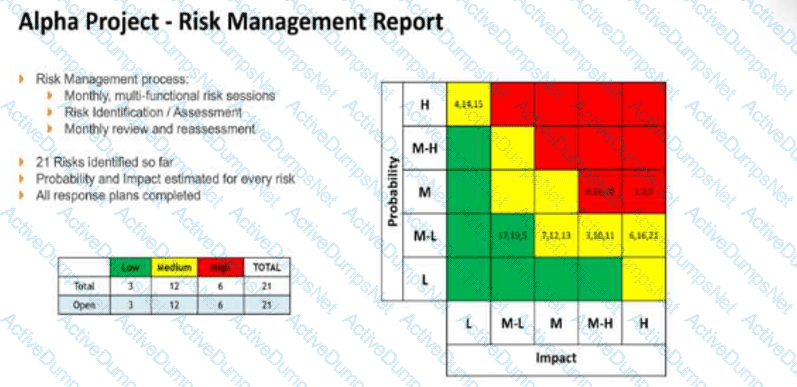
According to the Alpha project’s risk management report, which risks should the project manager prioritize?
(Refer to Alpha Project — Risk Management Report exhibit.)
Health Records Modernization at Hospital Case Study
A project manager led a health records modernization project at a hospital with a project budget of $US5 million and an 18-month timeline. The project involved multiple stakeholder groups including medical, administrative, and IT staff; board members; patients; insurance companies; external vendors; regulatory bodies; and union representatives.
Stakeholder management was complex and a major undertaking for the project manager, but it was critical to achieve a positive project outcome. When the project started, the project manager conducted stakeholder analysis, using the information to create both a power/interest and an influence/impact matrix. The analysis showed that while the hospital board members and regulatory bodies had high power but moderate interest, the medical staff (doctors and nurses) had both high influence and high impact on the project. Administrative staff showed high interest but lower power, while patients and insurance companies had moderate interest and varying levels of influence. Based on the analysis, the project manager created a stakeholder engagement strategy that documented expectations, communication preferences, and influence levels in a stakeholder register. The project manager also made a RACI (responsible, accountable, consulted, informed) chart to show roles and responsibilities; and created communication channels and frequency for each stakeholder group, an issue escalation system, and a feedback system for continuous stakeholder input.
To execute the modernization process of health records, the project manager realized that medical staff members would need to change their daily workflows. To facilitate change management for these stakeholders, the project manager created a clinical advisory committee, appointed department-specific “champions,” created focus groups for requirements gathering, started a training program, and developed key performance indicators (KPIs) to measure satisfaction.
During project execution, several challenges emerged. The doctors expressed concerns about the system’s impact on patient care, the nurses’ union raised workload concerns, the IT department faced resource constraints, the insurance companies requested additional features, and the administrative staff worried about data security. The project manager responded to these challenges by increasing the frequency of stakeholder meetings, implementing a change management program, creating a beta system for stakeholder testing, developing contingency plans for various stakeholder scenarios, and establishing an issue resolution process.
Despite these mitigation efforts, the medical staff required additional training, leading to a change request for a 2-month extension and a 10% budget increase. The board of directors approved this to help ensure high adoption and satisfaction rates among staff members. The project helped establish new good practices in future programs for stakeholder management in the organization’s project management office (PMO). The documented lessons learned became a reference for future projects of similar scope and complexity.
During the execution phase of a project to modernize a hospital’s records system, the insurance company stakeholders requested additional features to support integration to their systems.
What should the project manager do first?
(Refer to the Health Records Modernization at Hospital Case Study exhibit.)
A digital health development team is tasked with designing a new product, which is a pioneering effort for the organization and one of the few available in a
‘competitive market. The planning and auditing processes have been notably time-consuming. The development team has reported limited rework and minimal
customer complaints; however, the current budget significantly exceeds the typical project baselines for previous product development initiatives within the
organization. The project manager is currently analyzing the total cost of quality for the project.
What should the project manager do?
A project team is working for a client in the international banking sector, where frequent regulatory changes are common. On the current project, the team will verify compliance with a new
legal framework which aims to strengthen regulation, supervision, and risk management.
What should the project manager do first?
A project manager is leading an important development project. A key deliverable has been completed but does not meet the quality standards defined in the quality management plan.
What should the project manager do?
A project manager of a software company is working with a cross-functional team to deliver a product to an important client. While preparing the backlog items, it
becomes clear that the responsibility for an important component lies with another product division. This division has not been involved in the project concept phase.
What should the project manager do?
A project manager has proposed starting to use artificial intelligence (Al) on a project to senior management. Some of the team members are skeptical due to security
and privacy challenges.
What should the project manager do?
During project implementation, the project manager is communicating information about changes only at the executive level. Many people within the organization are uncertain about the project ' s status. There are rumors about changes to the project and how they may affect work activities.
What should the project manager do?
An external development team is working on a large project to build a custom application for the organization. Since the requirements are not fully clear, the project
manager decides with the project sponsor to take a hybrid approach. The project manager also agrees with the vendor to fulfill minimum viable product (MVP)
requirements within the set number of sprints and to update the application according to newly identified requirements.
Which metrics should the project manager monitor and analyze?
A project is delayed because of an unknown risk impacting the budget. The project manager requests the project management office review the recommendation for a
budget increase.
What should the project manager have done to avoid going over budget?
In the last project status meeting, a team member reported some tasks with conflicting priorities. Now, other team members are delayed in their tasks due to the
dependencies.
What should the project manager do to address this situation?
After finishing a project, the project manager organized a lessons learned meeting. What should the project manager do next?
As part of a restructuring effort, a company has transitioned from a projectized to a functional organization. The project manager is concerned that the team members will become disengaged from their work on the current project because they are now reporting to a functional manager.
What should the project manager do?
Health Records Modernization at Hospital Case Study
A project manager led a health records modernization project at a hospital with a project budget of $US5 million and an 18-month timeline. The project involved multiple stakeholder groups including medical, administrative, and IT staff; board members; patients; insurance companies; external vendors; regulatory bodies; and union representatives.
Stakeholder management was complex and a major undertaking for the project manager, but it was critical to achieve a positive project outcome. When the project started, the project manager conducted stakeholder analysis, using the information to create both a power/interest and an influence/impact matrix. The analysis showed that while the hospital board members and regulatory bodies had high power but moderate interest, the medical staff (doctors and nurses) had both high influence and high impact on the project. Administrative staff showed high interest but lower power, while patients and insurance companies had moderate interest and varying levels of influence. Based on the analysis, the project manager created a stakeholder engagement strategy that documented expectations, communication preferences, and influence levels in a stakeholder register. The project manager also made a RACI (responsible, accountable, consulted, informed) chart to show roles and responsibilities; and created communication channels and frequency for each stakeholder group, an issue escalation system, and a feedback system for continuous stakeholder input.
To execute the modernization process of health records, the project manager realized that medical staff members would need to change their daily workflows. To facilitate change management for these stakeholders, the project manager created a clinical advisory committee, appointed department-specific “champions,” created focus groups for requirements gathering, started a training program, and developed key performance indicators (KPIs) to measure satisfaction.
During project execution, several challenges emerged. The doctors expressed concerns about the system’s impact on patient care, the nurses’ union raised workload concerns, the IT department faced resource constraints, the insurance companies requested additional features, and the administrative staff worried about data security. The project manager responded to these challenges by increasing the frequency of stakeholder meetings, implementing a change management program, creating a beta system for stakeholder testing, developing contingency plans for various stakeholder scenarios, and establishing an issue resolution process.
Despite these mitigation efforts, the medical staff required additional training, leading to a change request for a 2-month extension and a 10% budget increase. The board of directors approved this to help ensure high adoption and satisfaction rates among staff members. The project helped establish new good practices in future programs for stakeholder management in the organization’s project management office (PMO). The documented lessons learned became a reference for future projects of similar scope and complexity.
How should the project manager handle the IT department’s resource constraints while at the same time maintaining project momentum?
(Refer to the Health Records Modernization at Hospital Case Study exhibit.)
The project manager is leading a project to develop a new product. A representative from the legal team approaches the project team requesting the product go
through a legal review before entering the market. This review would lengthen the schedule and would cause the product to miss an important launch window.
What should the project manager do?
A project to replace a legacy process is in the initiation phase. The project manager needs to send requests for proposals to potential vendors. The business case contains the project’s high-level goals, and all potential vendors have previously delivered similar projects.
What should the project manager do to ensure that activities and tools from the legacy process are retained when necessary?
A project to launch a new financial product is on its fifth out of eight iterations. During the iteration review, a financial stakeholder announces a competitor is launching
a similar product soon. As a result, the stakeholder asks the team to increase velocity.
What should the project manager do?
An organization is planning a new initiative to improve services to their customers, to be executed in an adaptive manner. What should the project manager do to continuously improve processes throughout the course of the project?
During the execution of a project, the product manager receives a new product feature request from the organization ' s highest revenue-generating client. The team
estimates the work will take three days.
What should the project manager do?
Health Records Modernization at Hospital Case Study
A project manager led a health records modernization project at a hospital with a project budget of $US5 million and an 18-month timeline. The project involved multiple stakeholder groups including medical, administrative, and IT staff; board members; patients; insurance companies; external vendors; regulatory bodies; and union representatives.
Stakeholder management was complex and a major undertaking for the project manager, but it was critical to achieve a positive project outcome. When the project started, the project manager conducted stakeholder analysis, using the information to create both a power/interest and an influence/impact matrix. The analysis showed that while the hospital board members and regulatory bodies had high power but moderate interest, the medical staff (doctors and nurses) had both high influence and high impact on the project. Administrative staff showed high interest but lower power, while patients and insurance companies had moderate interest and varying levels of influence. Based on the analysis, the project manager created a stakeholder engagement strategy that documented expectations, communication preferences, and influence levels in a stakeholder register. The project manager also made a RACI (responsible, accountable, consulted, informed) chart to show roles and responsibilities; and created communication channels and frequency for each stakeholder group, an issue escalation system, and a feedback system for continuous stakeholder input.
To execute the modernization process of health records, the project manager realized that medical staff members would need to change their daily workflows. To facilitate change management for these stakeholders, the project manager created a clinical advisory committee, appointed department-specific “champions,” created focus groups for requirements gathering, started a training program, and developed key performance indicators (KPIs) to measure satisfaction.
During project execution, several challenges emerged. The doctors expressed concerns about the system’s impact on patient care, the nurses’ union raised workload concerns, the IT department faced resource constraints, the insurance companies requested additional features, and the administrative staff worried about data security. The project manager responded to these challenges by increasing the frequency of stakeholder meetings, implementing a change management program, creating a beta system for stakeholder testing, developing contingency plans for various stakeholder scenarios, and establishing an issue resolution process.
Despite these mitigation efforts, the medical staff required additional training, leading to a change request for a 2-month extension and a 10% budget increase. The board of directors approved this to help ensure high adoption and satisfaction rates among staff members. The project helped establish new good practices in future programs for stakeholder management in the organization’s project management office (PMO). The documented lessons learned became a reference for future projects of similar scope and complexity.
A project to modernize a hospital’s records has a large and diverse stakeholder population. As stakeholders request changes, the project manager is aware that some will cause a negative impact to the project timeline and finances.
What should the project manager do?
(Refer to the Health Records Modernization at Hospital Case Study exhibit.)
A project manager is overseeing a hybrid project with two distinct workstreams: hardware operating predictively and software operating adaptively. However, the procurement contract for the software vendor has been finalized with clauses based on a predictive way of working. Meanwhile, many software work items are undergoing different prioritizations on the Kanban board.
What should the project manager do?
A city infrastructure project aims to construct a bridge to enhance traffic flow and alleviate congestion. The project is under tight deadlines due to upcoming major events in the city. The team is employing a hybrid approach by incorporating agile practices into a traditionally structured project schedule.
A key stakeholder asks the project manager to expedite the delivery of specific work packages. The project manager determines that this request will affect the project cost.
What should the project manager do?
A team is working on a hospital construction project and is using a predictive approach. The team has encountered a challenge affecting their deadline because a
critical team member is on medical leave. The project is in jeopardy of falling behind schedule.
What should the project manager do first?
A project manager is leading a project for a large company. During project execution, an engineer discovers that a spare part should be immediately changed to avoid
a power outage. The replacement part will take time to obtain through the organization ' s procurement process.
What should the project manager do?
A project sponsor provides a charter and appoints a project manager to implement a large project over 5 years. The sponsor then requests the project budget and
outcomes from the project manager.
What should the project manager do first?
The regional sales manager (RSM) calls the project manager and expresses the need to add functionalities to the project scope and change the project ' s priorities. Making these alterations as soon as possible will significantly increase the project ' s adoption.
What should the project manager do?
An agile project in progress has a large number of blocked items and the project manager does not have visibility on the underlying issues. What should the project manager do to allow transparency and remove the blockers?
A team lead tells the project manager about a potential issue. Two project teams are working on parts of a project that are highly dependent on each other. The team
lead is concerned that this might create integration issues when the two teams ' outputs are combined.
What should the project manager do?
A project manager is overseeing the development of a reporting system for a security trading company using an adaptive approach. During the development process,
a change in requirements is identified, necessitating the submission of a soft copy of the report to the regulator. The team suggests submitting the report manually to
avoid further delays.
What should the project manager do first?
Health Records Modernization at Hospital Case Study
A project manager led a health records modernization project at a hospital with a project budget of $US5 million and an 18-month timeline. The project involved multiple stakeholder groups including medical, administrative, and IT staff; board members; patients; insurance companies; external vendors; regulatory bodies; and union representatives.
Stakeholder management was complex and a major undertaking for the project manager, but it was critical to achieve a positive project outcome. When the project started, the project manager conducted stakeholder analysis, using the information to create both a power/interest and an influence/impact matrix. The analysis showed that while the hospital board members and regulatory bodies had high power but moderate interest, the medical staff (doctors and nurses) had both high influence and high impact on the project. Administrative staff showed high interest but lower power, while patients and insurance companies had moderate interest and varying levels of influence. Based on the analysis, the project manager created a stakeholder engagement strategy that documented expectations, communication preferences, and influence levels in a stakeholder register. The project manager also made a RACI (responsible, accountable, consulted, informed) chart to show roles and responsibilities; and created communication channels and frequency for each stakeholder group, an issue escalation system, and a feedback system for continuous stakeholder input.
To execute the modernization process of health records, the project manager realized that medical staff members would need to change their daily workflows. To facilitate change management for these stakeholders, the project manager created a clinical advisory committee, appointed department-specific “champions,” created focus groups for requirements gathering, started a training program, and developed key performance indicators (KPIs) to measure satisfaction.
During project execution, several challenges emerged. The doctors expressed concerns about the system’s impact on patient care, the nurses’ union raised workload concerns, the IT department faced resource constraints, the insurance companies requested additional features, and the administrative staff worried about data security. The project manager responded to these challenges by increasing the frequency of stakeholder meetings, implementing a change management program, creating a beta system for stakeholder testing, developing contingency plans for various stakeholder scenarios, and establishing an issue resolution process.
Despite these mitigation efforts, the medical staff required additional training, leading to a change request for a 2-month extension and a 10% budget increase. The board of directors approved this to help ensure high adoption and satisfaction rates among staff members. The project helped establish new good practices in future programs for stakeholder management in the organization’s project management office (PMO). The documented lessons learned became a reference for future projects of similar scope and complexity.
How should the project manager address the administrative staff’s data security concerns related to project scope implementation?
(Refer to the Health Records Modernization at Hospital Case Study exhibit.)
A project lead is working on a large-scale, high-profile hardware development project for a new smartphone. The project sponsor has requested that a major priority feature almost fully
developed be considered optional. At the same time, a new priority feature that has never been discussed is being added.
Which two actions should the project lead take? (Choose 2)
A project team repeatedly misses delivery target dates for the main project releases because of new requests from the client. Client satisfaction is high, even though the project is behind schedule.
What should the project manager do?
A project manager has compared the monthly actual costs with the planned costs and estimated the forecast to complete the remaining part of the project. The project
manager realizes that the project will require additional funding.
What should the project manager do first?