
- Home
- Nokia
- Nokia Certified Data Center Fabric Professional
- 4A0-D03
- 4A0-D03 - Nokia SR Linux EVPN and Data Center Interconnect
Nokia 4A0-D03 Nokia SR Linux EVPN and Data Center Interconnect Exam Practice Test
Nokia SR Linux EVPN and Data Center Interconnect Questions and Answers
Consider the exhibit.
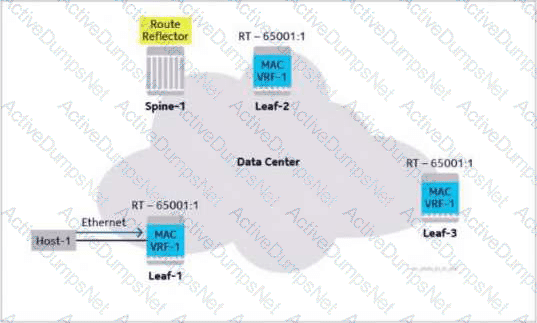
All three of the leafs have a MP-BGP EVPN session to the route-reflector Spine-1. Leaf-1, Leaf-2 and Leaf-3 have existing instances of an L2 EVPN named MAC VRF-1. Host-1 has just sent its first Ethernet frame into MAC VRF-1 on Leaf-1.
Which of the following steps is FALSE?
Options:
Leaf-1 populates Host-1's MAC address learnt on the local interface to its MAC table.
Leaf-1 generates an EVPN route-type 5 update with Host-1's MAC address and sends it to the route reflector.
The route-reflector forwards the EVPN update to Leaf-2 and Leaf-3.
Leaf-2 and Leaf-3 import the EVPN update based upon the route target.
Answer:
BExplanation:
Comprehensive and Detailed 150 to 250 words of Explanation From [SR Linux EVPN and Data Center Interconnect/Course Guide/topics]:
When Host-1 sends its first Ethernet frame into MAC VRF-1, Leaf-1 performs normal local data-plane MAC learning on the access interface and installs Host-1's MAC address into the MAC forwarding table. In an L2 EVPN MAC-VRF, host MAC reachability is then advertised into the EVPN control plane using EVPN route type 2, the MAC/IP Advertisement route. Route type 5 is not used for host MAC advertisement; RT-5 is used for IP prefix advertisement in Layer 3 EVPN services. Therefore, option B is false because it incorrectly states that Leaf-1 generates an EVPN RT-5 update with the host MAC address. In this topology, Leaf-1 sends the correct EVPN update to the route reflector, Spine-1. The route reflector then reflects the update to Leaf-2 and Leaf-3, and those remote leaves import the route if the route target matches their MAC VRF-1 import policy. The route target controls service membership, ensuring that only PEs participating in the same EVPN instance import the MAC route. Reference: L2 EVPN MAC learning, RT-2 MAC/IP advertisement, route-reflector distribution, route-target import.
================
When providing L3 multi-homing on two or more leaf routers, which of the following is FALSE?
Options:
In a single-active multi-homing scenario, the DF-election is used to identify the active leaf router.
In an all-active multi-homing scenario, the DF-election is used to identify the leaf router that is responsible for forwarding BUM traffic to the host.
All learned 3rd party prefixes are advertised using EVPN route type 5.
The Ethernet segment is associated with the next-hop for the 3rd party prefixes.
Answer:
BExplanation:
Comprehensive and Detailed 150 to 250 words of Explanation From [SR Linux EVPN and Data Center Interconnect/Course Guide/topics]:
Layer 3 multi-homing is fundamentally about redundant or load-balanced L3 reachability for external prefixes, not about Layer 2 broadcast-domain flooding toward a host. In single-active L3 multi-homing, DF election determines which attached leaf is active for the Ethernet Segment, and only that leaf advertises or forwards for the attached customer route as required by the redundancy model. In all-active L3 multi-homing, multiple leaf routers can be valid next-hops for the same learned third-party prefix, and remote PEs may load-balance toward them based on the Ethernet Segment association. Learned external prefixes are carried as EVPN route type 5 IP Prefix routes, which is the correct route type for L3 reachability. The Ethernet Segment is associated with the next-hop for those prefixes so that remote PEs understand the multi-homed nature of the path. Option B is false because BUM forwarding is a Layer 2 EVPN concern. In an all-active L3 multi-homing scenario, DF election is not used to identify a BUM-forwarding leaf for host traffic in the same way it is used in Layer 2 multi-homing services. Reference: L3 EVPN multi-homing, RT-5 prefix routes, ES next-hop behavior.
================
Which of the following statements about the decoupled gateway-based data center interconnect solution is TRUE?
Options:
The IP addresses of all the leaf routers and route-reflectors must be reachable by the routers in the WAN.
There is a clear demarcation for security and QoS between the data center border leaf and the WAN PE.
The WAN PE maintains a peering session with the data center route reflector.
VXLAN tunnels are established between the leaf routers in the different data centers.
Answer:
BExplanation:
Comprehensive and Detailed 150 to 250 words of Explanation From [SR Linux EVPN and Data Center Interconnect/Course Guide/topics]:
A decoupled gateway-based DCI model separates the data center border-leaf function from the WAN PE function. This separation is the key design point. The border leaf remains part of the data center EVPN/VXLAN environment, while the WAN PE participates in WAN VPN transport and policy enforcement. Because the roles are split across two devices, the handoff between the border leaf and WAN PE provides a clean administrative and operational boundary. That boundary is useful for security policy, QoS marking, traffic classification, and troubleshooting ownership. The WAN does not need direct reachability to every leaf and route reflector as in a gateway-less model. The WAN PE also does not peer directly with the data center route reflector in a decoupled model; route exchange occurs through the border-leaf/WAN-PE handoff. VXLAN tunnels between leaf routers across different data centers are characteristic of gateway-less extension, not decoupled gateway operation. Therefore, the statement about clear demarcation between the data center border leaf and WAN PE is the accurate description. Reference: decoupled gateway-based DCI, security/QoS demarcation, WAN PE separation.
================
Consider the exhibit.

Which of the following is NOT configured on dcgw10 to support the Layer 3 VPN connectivity?
Options:
The base BGP instance to support vpn-ipv4 and evpn address families.
A routed VXLAN interface for the VPRN instance.
A binding of the VPRN instance to the MPLS tunnels towards dcgw20.
A vrf-target matching the vrf-target on dcgw20 in the VPRN instance.
Answer:
BExplanation:
Comprehensive and Detailed 150 to 250 words of Explanation From [SR Linux EVPN and Data Center Interconnect/Course Guide/topics] :
In an integrated gateway-based data center interconnect design, the gateway must interwork between the data center EVPN/VXLAN domain and the WAN VPN transport domain. For Layer 3 VPN connectivity on a Nokia 7750 SR integrated gateway, the base BGP instance must support the relevant VPN address families, such as VPN-IPv4 and EVPN, because the gateway participates in control-plane exchange between the data center and WAN sides. The VPRN must also be associated with the WAN transport, normally through MPLS tunnel binding, and the VRF target must match the corresponding VPRN on the remote gateway so that VPN routes are imported and exported correctly. A routed VXLAN interface, however, is an SR Linux IP-VRF/VXLAN construct used for symmetric L3 EVPN forwarding inside a VXLAN-based data center fabric. In this question, dcgw10 is acting as the integrated WAN gateway for L3VPN connectivity, so a routed VXLAN interface is not the required configuration item on the VPRN instance. Reference: integrated gateway DCI, VPRN over MPLS, EVPN-to-VPN interworking.
================
Which of the following statements about PE-CE routing is FALSE?
Options:
There are two methods to implement routing between the PE and CE, static and dynamic.
BGP is the preferred option for PE-CE routing as it scales better than static routing.
eBGP is preferred which means that the PE and CE are required to be in different autonomous systems.
The CE advertises BGP EVPN route type 5 updates to the PE and the PE forwards to other PEs.
Answer:
DExplanation:
Comprehensive and Detailed 150 to 250 words of Explanation From [SR Linux EVPN and Data Center Interconnect/Course Guide/topics]:
PE-CE routing is the mechanism used to exchange customer prefix reachability between a provider edge or data center leaf and the attached customer edge router. It can be implemented statically or dynamically. Static routing is operationally simple but does not scale well when many prefixes or frequent changes are involved. BGP is preferred for larger deployments because it supports policy, route filtering, attributes, and automated advertisement of changing reachability. In most EVPN PE-CE designs, eBGP is preferred because it creates a clean routing boundary between the PE and CE, with each device operating in a different autonomous system. Option D is false because the CE does not advertise BGP EVPN route type 5 updates to the PE. The CE advertises ordinary IPv4 or IPv6 unicast prefixes over the PE-CE routing session. The PE then imports those customer prefixes into the IP-VRF and advertises them into the EVPN overlay as route type 5 IP Prefix routes toward other PEs. This distinction matters: EVPN signaling is a PE-to-PE overlay function, not a CE-originated EVPN control-plane role. Reference: PE-CE routing, eBGP, EVPN RT-5 prefix advertisement.
================
Consider the exhibit.
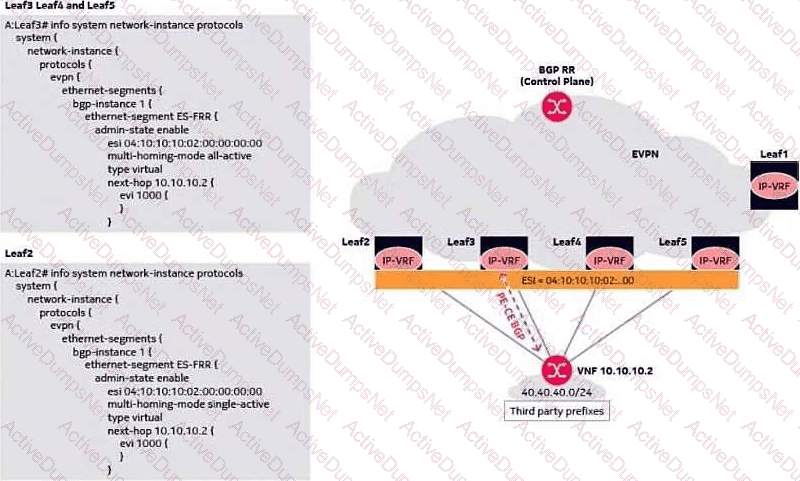
All IP-VRFs are configured properly and are operational.
Which of the following statements is FALSE?
Options:
One of the connected leaf routers will be elected DF.
The elected DF will use the AD per EVI update to identify itself as primary.
Only the elected DF will advertise the customer IP prefix route to the BGP route reflector.
All connected leaf routers will use an AD per ES update to advertise single-active redundancy.
Answer:
BExplanation:
Comprehensive and Detailed 150 to 250 words of Explanation From [SR Linux EVPN and Data Center Interconnect/Course Guide/topics] :
In a single-active EVPN multi-homing design, the connected PE routers perform Designated Forwarder election to determine which PE is active for the relevant service or Ethernet Segment. The DF is responsible for forwarding toward the attached segment and, in a Layer 3 multi-homing case, only the active/DF PE advertises the customer IP prefix route toward the EVPN control plane. Single-active redundancy is communicated using Ethernet Segment-related EVPN procedures, including Ethernet A-D information, so remote PEs can identify the redundancy behavior and avoid forwarding traffic to an inactive attachment. The false statement is that the elected DF uses an AD per EVI update to identify itself as primary. AD per EVI is primarily used to advertise per-service Ethernet Segment reachability and support aliasing/load-balancing behavior in multi-homed services. DF election itself is driven by Ethernet Segment route procedures, not by the DF declaring itself primary through AD per EVI. Therefore, option B misstates the role of AD per EVI in the single-active L3 multi-homing control plane. Reference: EVPN DF election, single-active multi-homing, Ethernet A-D routes.
================
When PEs are connected to an Ethernet segment with at least one active MAC-VRF, which of the following statements about the AD per EVI updates sent by a PE is FALSE?
Options:
It contains the VNI information that is to be used in the data plane.
It contains the multi-homing type used for the Ethernet segment.
It contains the route-target so that the update can be imported into the correct MAC-VRF instance.
A PE will advertise one AD per EVI update for each MAC-VRF associated to the Ethernet segment.
Answer:
BExplanation:
Comprehensive and Detailed 150 to 250 words of Explanation From [SR Linux EVPN and Data Center Interconnect/Course Guide/topics]:
Ethernet Auto-Discovery per EVI routes are EVPN route type 1 advertisements used in multi-homing at the service-instance level. A PE sends an AD per EVI route for each MAC-VRF associated with the Ethernet Segment. These routes allow remote PEs to understand that the advertising PE has reachability to a given EVI through the shared ES. They are also used for aliasing and fast convergence, because a remote PE can treat multiple attached PEs as valid paths for traffic toward the same multihomed segment. In VXLAN EVPN, the update can include data-plane information such as the VNI, and it carries route-target information so the route is imported into the correct MAC-VRF. Option B is false because the multi-homing type or redundancy mode is not carried in the AD per EVI update as stated. Redundancy behavior is associated with Ethernet Segment-level signaling and configuration, especially ES discovery and related route attributes, not with AD per EVI as the mechanism that declares the multi-homing type. Reference: EVPN RT-1 AD per EVI, MAC-VRF association, route target, VNI, aliasing.
================
Which of the following is always found in an extended community associated with an EVPN update?
Options:
The route target
The AFI/SAFI
The VXLAN network ID
The EVPN route type
Answer:
AExplanation:
Comprehensive and Detailed 150 to 250 words of Explanation From [SR Linux EVPN and Data Center Interconnect/Course Guide/topics]:
The route target is the extended community consistently associated with EVPN updates to control route import and export between EVPN instances. In SR Linux EVPN services, route targets determine which MAC-VRF or IP-VRF should import a received EVPN route. This is essential for tenant separation because multiple tenants may use overlapping MAC or IP address spaces while sharing the same physical fabric and BGP control plane. The AFI/SAFI is not an extended community; it identifies the BGP address family and subsequent address family used to carry EVPN NLRI. The EVPN route type is also not an extended community; it is part of the EVPN NLRI structure and identifies whether the route is RT-1, RT-2, RT-3, RT-4, RT-5, and so on. The VXLAN network ID may be carried or inferred through service and encapsulation-specific attributes, but it is not universally present as the required extended community in every EVPN update. The route target is the mandatory policy element that enables receiving PEs to place EVPN routes into the correct service context. Reference: EVPN extended communities, route-target import/export policy, tenant service identification.
================
Consider the exhibit.
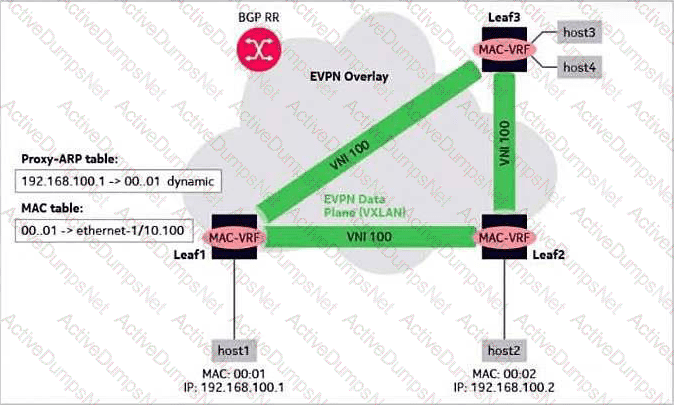
Leaf-1 has received an ARP request from host-1 for host-2. Leaf-1 has added host-1's MAC address in its MAC table and host-1's MAC/IP addresses in its proxy-ARP table.
Which of the following steps is FALSE?
Options:
Leaf-1 sends a route-type 2 EVPN update with host-1's MAC with the IP address set to 0.0.0.0 to the remote peers.
Leaf-1 sends a route-type 2 EVPN update with host-1's MAC with the IP address set to 192.168.100.1 to the remote peers.
The remote peers ignore the EVPN update with the IP address set to 0.0.0.0 and use the update with the IP address set to 192.168.100.1 to populate their MAC forwarding tables.
The remote peers generate a gratuitous ARP towards their directly connected hosts to announce the learned IP/MAC mapping information.
Answer:
AExplanation:
Comprehensive and Detailed 150 to 250 words of Explanation From [SR Linux EVPN and Data Center Interconnect/Course Guide/topics]:
When Leaf-1 receives an ARP request from Host-1, it learns the source MAC address in the local MAC table and learns the source IP/MAC binding in the proxy ARP table. For EVPN distribution, the relevant control-plane advertisement is an EVPN route type 2 MAC/IP advertisement containing Host-1's MAC and the actual host IP address, 192.168.100.1. This allows remote PEs to populate their EVPN-derived forwarding and proxy ARP state with the correct endpoint binding. Option A is false because advertising the host MAC with the IP address set to 0.0.0.0 does not represent the learned MAC/IP binding required for proxy ARP synchronization. A MAC-only RT-2 advertisement may exist in EVPN contexts, but the question specifically states that Leaf-1 has learned the MAC/IP binding through ARP and is distributing that information. Therefore, the valid advertisement must include the real host IP address. Remote PEs use the MAC/IP route to learn the endpoint, not an all-zero IP placeholder for this proxy ARP learning event. Reference: EVPN RT-2 MAC/IP advertisement, proxy ARP table population, endpoint synchronization.
================
Which of the following statements about the configuration of a Layer 3 multi-homing with a centralized router is FALSE?
Options:
The centralized router must be a member of the Ethernet segment.
All routers participating in the Ethernet segment must have the multi-homing mode set to all-active.
Remote leaf routers can load balance traffic to customer prefixes through the leaf routers connected to the Ethernet segment.
The centralized router will advertise the customer prefixes using an EVPN route-type 5 update.
Answer:
BExplanation:
Comprehensive and Detailed 150 to 250 words of Explanation From [SR Linux EVPN and Data Center Interconnect/Course Guide/topics]:
Layer 3 EVPN multi-homing with a centralized router uses an Ethernet Segment to associate multiple leaf routers with a common external L3 attachment. The centralized router is part of that attached segment from the forwarding perspective, and the connected leaf routers advertise third-party or customer prefixes into EVPN so that remote leaves can reach those prefixes through the multi-homed attachment. For L3 EVPN, learned customer prefixes are normally advertised using EVPN route type 5, which carries IP prefix reachability. In an all-active design, remote leaf routers may load balance traffic to the customer prefix through multiple attached leaf routers because the ES next-hop allows the remote PE to understand that the prefix is reachable through a multi-homed Ethernet Segment. The false statement is that every router participating in the Ethernet Segment must be configured with all-active mode. Multi-homing mode is a design and configuration property of the EVPN PEs participating in the ES, and designs may use single-active or all-active behavior depending on redundancy and forwarding requirements. Reference: L3 EVPN multi-homing, centralized router attachment, EVPN RT-5 prefix advertisement.
================
Which of the following statements about utilizing VXLAN for the data plane in the data center is FALSE?
Options:
It allows the creation of a Layer 2 overlay network that can span the entire data center.
VXLAN was developed to support EVPN networks in the data center.
It may use ECMP to provide efficient utilization of the underlay interfaces within the data center.
It has the capability to isolate up to 16 million different overlays.
Answer:
BExplanation:
Comprehensive and Detailed 150 to 250 words of Explanation From [SR Linux EVPN and Data Center Interconnect/Course Guide/topics]:
VXLAN provides a Layer 2 overlay over a Layer 3 underlay by encapsulating Ethernet frames in UDP/IP. This allows tenant bridge domains to span a routed IP fabric without requiring the underlay itself to behave like one large Layer 2 network. VXLAN uses a 24-bit VXLAN Network Identifier, which supports approximately 16 million logical overlays, far exceeding the scale of traditional 12-bit VLAN IDs. Because the VXLAN underlay is IP-routed, traffic can benefit from ECMP across equal-cost paths, improving fabric utilization and resiliency. The false statement is B. VXLAN was not originally developed specifically to support EVPN. VXLAN began as a data-plane overlay encapsulation technology, while EVPN later became the preferred control plane for distributing MAC, MAC/IP, multicast, and prefix reachability in VXLAN-based fabrics. In modern data center design, EVPN and VXLAN are commonly paired: VXLAN supplies the encapsulation and VNI-based segmentation, while EVPN supplies scalable control-plane learning and signaling. Reference: VXLAN data plane, EVPN control plane, ECMP underlay, VNI-based tenant isolation.
================
Consider the exhibit.
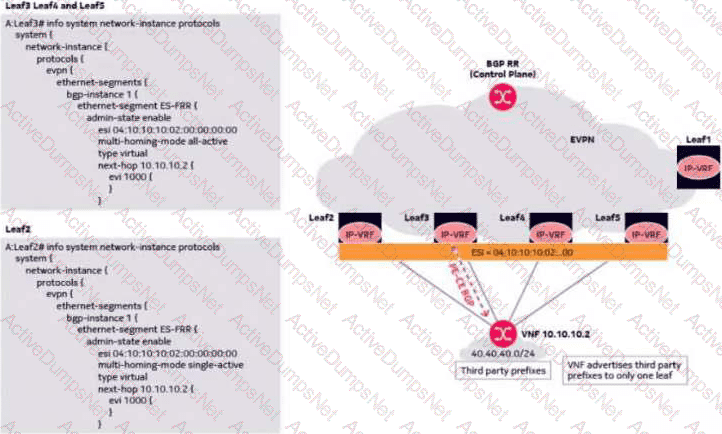
All IP-VRFs are configured properly and are operational.
Which of the following statements is FALSE?
Options:
One of the leaf routers will be elected DF.
All connected leaf routers will use single active redundancy.
The AD per EVI update will be used to identify which connected leaf is primary.
All traffic destined to 40.40.40.0/24 will be forwarded through Leaf3 due to the BGP connection to the CE VNF.
Answer:
BExplanation:
Comprehensive and Detailed 150 to 250 words of Explanation From [SR Linux EVPN and Data Center Interconnect/Course Guide/topics]:
The scenario describes Layer 3 EVPN multi-homing with an IP-VRF service and an external CE VNF advertising the 40.40.40.0/24 prefix through BGP. A DF election can occur among the leaf routers participating in the Ethernet Segment, and the active/primary forwarding node is used for the relevant service behavior. The AD per EVI route can participate in identifying service-level reachability for the Ethernet Segment, and the prefix traffic follows the valid advertised path toward the CE VNF. Because Leaf3 has the BGP connection to the CE VNF, traffic for 40.40.40.0/24 is forwarded through Leaf3. Option B is false because it incorrectly states that all connected leaf routers will use single-active redundancy. The exhibit and answer context indicate a more specific forwarding/primary selection for the service, not a blanket statement that every connected leaf operates using single-active redundancy. In L3 multi-homing, redundancy behavior depends on the ES mode, prefix advertisement, next-hop association, and CE connectivity. The forwarding decision for the customer prefix is tied to the active/valid route advertisement, not to every leaf uniformly acting as single-active. Reference: L3 EVPN multi-homing, DF election, AD per EVI role, PE-CE BGP prefix forwarding.
================
Consider the exhibit.
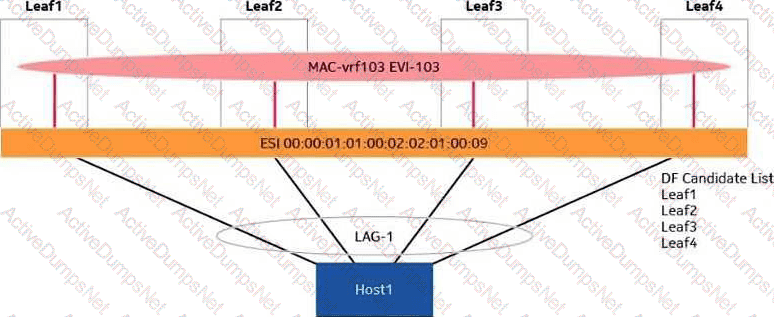
Leaf1 and Leaf2 have the Ethernet segment configured to use the default election algorithm while Leaf3 and Leaf4 are configured to use the preference-based algorithm with Leaf3 having the higher preference value. The DF candidate list is the same on all leaf routers.
Which of the following leafs is the DF for mac-vrf103?
Options:
Leaf1
Leaf2
Leaf3
Leaf4
Answer:
CExplanation:
Comprehensive and Detailed 150 to 250 words of Explanation From [SR Linux EVPN and Data Center Interconnect/Course Guide/topics]:
Designated Forwarder election determines which PE forwards BUM traffic from the EVPN overlay toward a multi-homed Ethernet Segment for a given service. In this scenario, all leaf routers share the same DF candidate list for mac-vrf103, but the election configuration is not identical. Leaf1 and Leaf2 use the default algorithm, while Leaf3 and Leaf4 use the preference-based algorithm. Under preference-based DF election, the candidate with the highest configured preference is selected over lower-preference candidates, assuming the candidate list is valid and consistent. The question states that Leaf3 has the higher preference value compared with Leaf4. Therefore, Leaf3 becomes the DF for mac-vrf103. This is the correct outcome because the preference-based election explicitly overrides simple default behavior by assigning operator-defined priority to a PE. In production designs, this is useful when the operator wants deterministic forwarding placement, maintenance control, or service-specific primary-path selection rather than relying only on the default modulo-based DF selection process. Reference: EVPN DF election, preference-based algorithm, MAC-VRF service forwarding.
================
Which of the following statements about the configuration of a distributed Layer 2 EVPN in a Nokia SR Linux is FALSE?
Options:
Each PE participating in the Layer 2 EVPN must be configured with the same EVPN instance ID (EVI).
The route distinguisher is auto-generated using the autonomous system number and EVI.
Only one VXLAN-interface can be associated to the Layer 2 EVPN.
The route-targets are manually configured when the leaf routers are in different autonomous systems.
Answer:
AExplanation:
Comprehensive and Detailed 150 to 250 words of Explanation From [SR Linux EVPN and Data Center Interconnect/Course Guide/topics]:
A distributed Layer 2 EVPN in SR Linux is implemented using MAC-VRF network instances, EVPN control-plane signaling, and VXLAN data-plane encapsulation. A common mistake is assuming that every PE must use the same EVI value for the same L2 service. In SR Linux, the important operational requirement is that the correct EVPN routes are imported and exported using matching route-target policy, not necessarily that every PE has the same locally configured EVI. Therefore, option A is false. The route distinguisher can be automatically generated using local values such as the autonomous system number and EVI, giving each PE's EVPN routes uniqueness in MP-BGP. A MAC-VRF is associated with VXLAN encapsulation for its data-plane service mapping, and route targets may need to be manually configured when leaf routers are in different autonomous systems because automatic derivation may not produce matching import/export policy across AS boundaries. The key separation is this: the RD gives uniqueness, the route target controls service membership, and the EVI is a local service identifier rather than a universal mandatory match in all designs. Reference: SR Linux distributed L2 EVPN configuration, EVI, RD auto-generation, route-target policy.
================
When PEs are connected to an Ethernet segment with at least one active MAC-VRF, which of the following statements about the AD per EVI updates sent by a PE is FALSE?
Options:
It is used by the remote peers for aliasing.
It advertises the multi-homing mode used by the PEs for the Ethernet segment.
It contains the VNI that is to be used by the remote peers in the data plane.
It contains the route-target so that the update can be imported into the correct MAC-VRF instance.
Answer:
DExplanation:
Comprehensive and Detailed 150 to 250 words of Explanation From [SR Linux EVPN and Data Center Interconnect/Course Guide/topics]:
Ethernet Auto-Discovery per EVI information is used in EVPN multi-homing to advertise that a PE has reachability to a particular Ethernet Segment for a specific EVPN instance. Remote PEs use this information for aliasing, allowing them to forward known unicast traffic toward a multi-homed Ethernet Segment through eligible PEs rather than relying only on the PE that advertised a specific MAC route. In VXLAN-based EVPN, the update also carries information needed by remote peers to select the proper data-plane encapsulation and VNI for the service. The multi-homing behavior advertised with the Ethernet Segment enables remote peers to understand whether the attachment is operating in all-active or single-active mode. Option D is the false statement in this context because route-target handling is a general BGP EVPN import/export mechanism associated with VPN route policy and extended communities; it is not the specific operational function that defines AD per EVI behavior. The AD per EVI route's purpose is Ethernet Segment reachability for an EVI, not route-target-based service identification by itself. Reference: EVPN route type 1, AD per EVI, aliasing and multi-homing signaling.
================
Which of the following statements about a L3 EVPN network using symmetric routing is FALSE?
Options:
Each participating PE must support the use of EVPN route-type 5.
Ingress and egress PEs perform MAC and IP forwarding.
A routed-VXLAN interface is required on a per IP-VRF basis.
Each MAC-VRF used in the L3 EVPN network must exist on each PE.
Answer:
DExplanation:
Comprehensive and Detailed 150 to 250 words of Explanation From [SR Linux EVPN and Data Center Interconnect/Course Guide/topics]:
Symmetric L3 EVPN routing uses an IP-VRF-based overlay model in which both ingress and egress PEs participate in routed forwarding. The ingress PE receives the frame from the local MAC-VRF, routes it into the IP-VRF, and sends it across the VXLAN routed interface. The egress PE receives the routed overlay packet, performs the corresponding IP-VRF lookup, and then forwards it into the locally attached destination MAC-VRF. Because the routed overlay is built per IP-VRF, a routed-VXLAN interface is required for that IP-VRF. EVPN route type 5 support is also required because RT-5 carries IP prefix reachability across the EVPN control plane. The false statement is option D. Symmetric routing specifically removes the requirement for every MAC-VRF to exist on every PE. A PE only needs the MAC-VRFs for locally attached subnets, plus the shared IP-VRF and routed overlay state. This is the major scaling advantage of symmetric routing compared with designs that require broad MAC-VRF instantiation across the fabric. Reference: symmetric L3 EVPN routing, routed VXLAN interface, RT-5 prefix reachability, MAC-VRF scaling.
================
Unlock 4A0-D03 Features
- 4A0-D03 All Real Exam Questions
- 4A0-D03 Exam easy to use and print PDF format
- Download Free 4A0-D03 Demo (Try before Buy)
- Free Frequent Updates
- 100% Passing Guarantee by Activedumpsnet
Questions & Answers PDF Demo
- 4A0-D03 All Real Exam Questions
- 4A0-D03 Exam easy to use and print PDF format
- Download Free 4A0-D03 Demo (Try before Buy)
- Free Frequent Updates
- 100% Passing Guarantee by Activedumpsnet