
Netskope NSK300 Netskope Certified Cloud Security Architect Exam Exam Practice Test
Netskope Certified Cloud Security Architect Exam Questions and Answers
A recent report states that users are using non-sanctioned Cloud Storage platforms to share data Your CISO asks you for a list of aggregated users, applications, and instance IDs to increase security posture
Which Netskope tool would be used to obtain this data?
You have enabled CASB traffic steering using the Netskope Client, but have not yet enabled a Real-time Protection policy. What is the default behavior of the traffic in this scenario?
You are the security administrator for a medical devices manufacturer. Your CISO asks you which type of protection Netskope provides for zero-day malware. Which two statements are correct in this scenario? (Choose two.)
You are configuring Administrator SSO using SAML 2.0 with roles based on group membership. In this scenario, how is the administrator group passed from the IdP within the SAML assertion to Netskope?
You deployed the Netskope Client for Web steering in a large enterprise with dynamic steering. The steering configuration includes a bypass rule for an application that is IP restricted. What is the source IP for traffic to this application when the user is on-premises at the enterprise?
You receive a report from your endpoint team that a device may no longer be running the Netskope Client. You only know the hostname of the machine in question. You want to remotely verify whether the client is still installed and steering traffic and which user is assigned to the device. In this scenario, how would you accomplish this task?
You are the network architect for a company using Netskope Private Access. Multiple users are reporting that they are unable to access an application using Netskope Private Access that was working previously. You have verified that the Real-time Protection policy allows access to the application, private applications are steered for the users, and the application is reachable from internal machines. You must verify that the application is reachable through Netskope Publisher
In this scenario, which two tools in the Netskope UI would you use to accomplish this task? (Choose two.)
You are deploying the Netskope Client in a multi-user VDI environment and need to determine the command to deploy the MSI.
Which three parameters are required in this scenario? (Choose three.)
Review the exhibit.
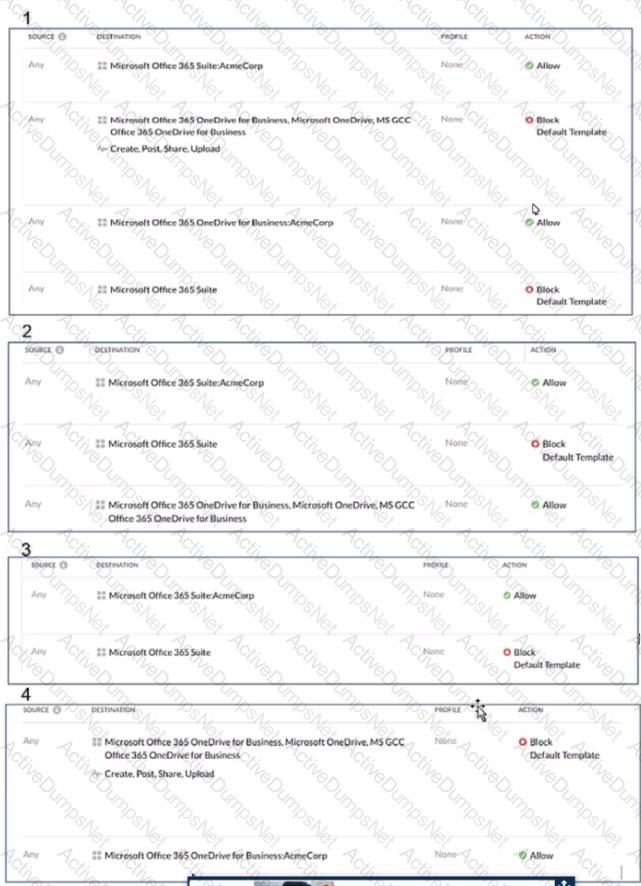
AcmeCorp has recently begun using Microsoft 365. The organization is concerned that employees will start using third-party non-AcmeCorp OneDrive instances to store company data. The CISO asks you to use Netskope to create a policy that ensures that no data is being uploaded to non-AcmeCorp instances of OneDrive.
Referring to the exhibit, which two policies would accomplish this posture? (Choose two.)
You do not want a scheduled Advanced Analytics dashboard to be automatically updated when Netskope makes improvements to that dashboard. In this scenario, what would you do to retain the original dashboard?
Review the exhibit.
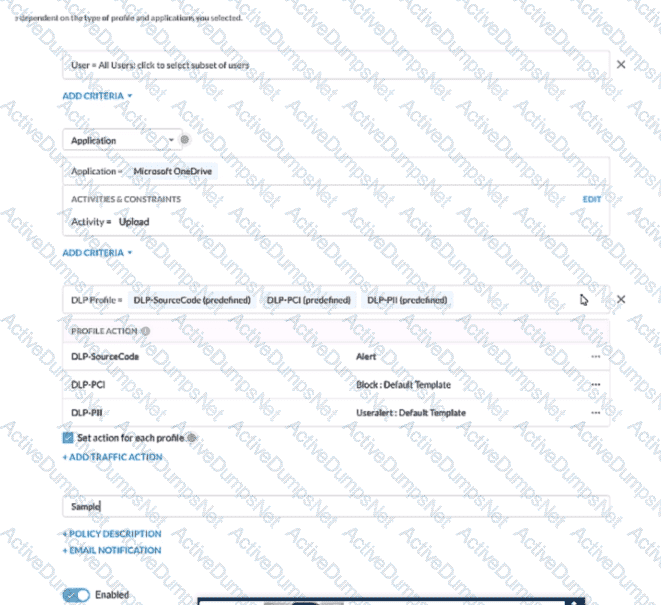
A user has attempted to upload a file to Microsoft OneDrive that contains source code with Pll and PCI data.
Referring to the exhibit, which statement is correct?
Your company purchased Netskope ' s Next Gen Secure Web Gateway You are working with your network administrator to create GRE tunnels to send traffic to Netskope Your network administrator has set up the tunnel, keepalives. and a policy-based route on your corporate router to send all HTTP and HTTPS traffic to Netskope. You want to validate that the tunnel is configured correctly and that traffic is flowing.
In this scenario, which two statements are correct? (Choose two.)
You are deploying the Netskope Client to Windows devices. The following command line would be used to install the client MSI file:

In this scenario, what is < token > referring to in the command line?
You have users connecting to Netskope from around the world You need a way for your NOC to quickly view the status of the tunnels and easily visualize where the tunnels are located. Which Netskope monitoring tool would you use in this scenario?
You are architecting a Netskope steering configuration for devices that are not owned by the organization The users could be either on-premises or off-premises and the architecture requires that traffic destined to the company ' s instance of Microsoft 365 be steered to Netskope for inspection.
How would you achieve this scenario from a steering perspective?
You are asked to create a customized restricted administrator role in your Netskope tenant for a newly hired employee. Which two statements are correct in this scenario? (Choose two.)
Review the exhibit.

Netskope has been deployed using Cloud Explicit Proxy and PAC files. Authentication using Active Directory Federation Services (ADFS) has been configured for SAML Forward Proxy auth. When the users open their browser and try to go to a site, they receive the error shown in the exhibit.
What is a reason for this error?
You received a malicious file hash from a third party and you want to see all instances of the hash that have been detected by Netskope. In this scenario, which two tools show the desired information? (Choose two.)
What is a Fast Scan component of Netskope Threat Detection?
You want to integrate with a third-party DLP engine that requires ICAP. In this scenario, which Netskope platform component must be configured?
Your CISO asks that you to provide a report with a visual representation of the top 10 applications (by number of objects) and their risk score. As the administrator, you decide to use a Sankey visualization in Advanced Analytics to represent the data in an efficient manner.
In this scenario, which two field types are required to produce a Sankey Tile in your report? {Choose two.)
You are asked to create a Real-time Protection policy to inspect outbound e-mail for DLP violations. You must prevent sensitive e-mail from leaving the corporate mail relay.
In this scenario, which Real-time Protection policy action must be specified?
You are implementing Netskope Cloud Exchange in your company lo include functionality provided by third-party partners. What would be a reason for using Netskope Cloud Risk Exchange in this scenario?
You are responsible for data security at a large hospital. You need to protect patient personal data including patient ID numbers, e-mail addresses, billing addresses, and credit card numbers that are stored in your database. You want to reduce false positives because you have limited resources for incident response. Which Netskope DLP capability would you use in this scenario?