Redeem Your Black Friday Code: 75% Off All Exam Bundles! Use coupon code below! - Ends in 0d 00h 00m 00s - Coupon code: discactive

Microsoft GH-200 GitHub Actions Exam Exam Practice Test

Page: 1 / 15
Total 150 questions

GitHub Actions Exam Questions and Answers

Question 1

As a DevOps engineer, you are developing a composite action. You have a step that needs to be executed against a subdirectory. Which code snippet should you use within the composite action to specify the directory?

Options:

A.

runs: using: " composite " steps: - run: $GITHUB_ACTION_PATH/script.sh directory: ${{ inputs.dir }} shell: bash

B.

runs: using: " composite " steps: - run: $GITHUB_ACTION_PATH/script.sh working-directory: ${{ inputs.dir }} shell: bash

Question 2

As a developer, you are using a Docker container action in your workflow. What is required for the action to run successfully?

Options:

A.

The job env must be set to a Linux environment.

B.

The job runs-on must specify a Linux machine with Docker installed.

C.

The referenced action must be hosted on Docker Hub.

D.

The action must be published to the GitHub Marketplace.

Question 3

Which workflow commands send information from the runner? (Choose two.)

Options:

A.

reading from environment variables

B.

setting a debug message

C.

populating variables in a Dockerfile

D.

setting output parameters

Question 4

When should you use the GITHUB_TOKEN in a workflow?

Options:

A.

When you want to make authenticated calls to the GitHub API.

B.

When you want to connect to the runner via SSH.

C.

When you want to access repository-level secrets.

D.

When you want to call an action from GitHub Marketplace.

Question 5

What is the simplest action type to run a shell script?

Options:

A.

Docker container action

B.

Composite action

C.

Bash script action

D.

JavaScript action

Question 6

What are the two types of environment protection rules you can configure? (Choose two.)

Options:

A.

required reviewers

B.

branch protections

C.

wait timer

D.

artifact storage

Question 7

What are the advantages of using a matrix strategy in a job definition? (Choose two.)

Options:

A.

It can test code in multiple versions of a programming language.

B.

It can decrease the costs for running multiple combinations of programming language/operating systems.

C.

It can run up to 512 jobs per workflow run.

D.

It can test code in multiple operating systems.

Question 8

As a developer, you are configuring GitHub Actions to deploy VMs to production. A member of the VMOps team must provide approval before the deployment occurs. Which of the following steps should you take?

(Each correct answer presents part of the solution. Choose two.)

Options:

A.

Specify the environment named Production in the workflow jobs that deploy to the VMs.

B.

Navigate to the organization settings and create a Production environment with the VMOps team as a required reviewer.

C.

Navigate to the repository settings and create a Production environment with the VMOps team as a required reviewer.

D.

Specify the VMOps team as the owner of the environment.

E.

Add the VMs to the environment.

Question 9

Which two actions ensure that a GitHub Actions workflow can be triggered manually? Each correct answer presents a complete solution.

NOTE: Each correct selection is worth one point.

Options:

A.

Define a workflow_dispatch event and specify inputs that enable users to provide values when triggering the workflow manually.

B.

Use a schedule event and add a manual: false parameter.

C.

Define a workflow_dispatch event in the on field of the workflow YAML file.

D.

Trigger a workflow manually by using a workflow_call event that has a button on the UI.

Question 10

Without the need to use additional infrastructure, what is the simplest and most maintainable method for configuring a workflow job to provide access to an empty PostgreSQL database?

Options:

A.

Use service containers with a Postgres database from Docker hub.

B.

Run the actions/postgres action in a parallel job.

C.

It is currently impossible to access the database with GitHub Actions.

D.

Dynamically provision and deprovision an environment.

Question 11

Based on the YAML below, which two statements are correct? (Choose two.)

Options:

A.

This workflow will publish a package to an npm registry.

B.

This workflow will publish a package to GitHub Packages.

C.

This workflow file is using a matrix strategy.

D.

The workflow job publish-npm will only run after the build job passes.

Question 12

As a DevOps engineer, you are trying to leverage an organization secret in a repo. The value received in the workflow is not the same as that set in the secret. What is the most likely reason for the difference?

Options:

A.

There is a different value specified at the rego level.

B.

There is a different value specified at the workflow level.

C.

The Codespace secret doesn ' t match the expected value.

D.

The Encrypt Secret setting was not configured for the secret.

E.

There is a different value specified at the enterprise level.

Question 13

Which files are required for a Docker container action in addition to the source code? (Choose two.)

Options:

A.

Dockerfile

B.

Actionfile

C.

metadata.yml

D.

action.yml

Question 14

Which command can you include in your workflow file to set the output parameter for an action?

Options:

A.

echo " action_color=purple " > > $GITHUB_OUTPUT

B.

echo " action_color=purple " > > $GITHUB_ENV

C.

echo " ::add-mask::$ACTION_COLOR "

D.

echo " ::debug::action_color=purple "

Question 15

When reviewing an action for use, what file defines its available inputs and outputs?

Options:

A.

inputs.yml

B.

config.json

C.

defaults.json

D.

workflow.yml

E.

action.yml

Question 16

Which default GitHub environment variable indicates the name of the person or app that initiated a workflow?

Options:

A.

ENV_ACTOR

B.

GITHUB_WORKFLOW_ACTOR

C.

GITHUB_ACTOR

D.

GITHUB_USER

Question 17

You installed specific software on a Linux self-hosted runner. You have users with workflows that need to be able to select the runner based on the identified custom software. Which steps should you perform to prepare the runner and your users to run these workflows? (Choose two.)

Options:

A.

Create the group custom-software-on-linux and move the runner into the group.

B.

Inform users to identify the runner based on the group.

C.

Add the label custom-software to the runner.

D.

Configure the webhook and network to enable GitHub to trigger workflow.

E.

Add the label linux to the runner.

Question 18

Your organization needs to simplify reusing and maintaining automation in your GitHub Enterprise Cloud. Which components can be directly reused across all repositories in an organization? (Choose three.)

Options:

A.

self-hosted runners

B.

actions stored m private repositories in the organization

C.

encrypted secrets

D.

custom Docker actions stored in GitHub Container Registry

E.

actions stored in an organizational partition in the GitHub Marketplace

F.

workflow templates

Question 19

A development team has been using a Powershell script to compile and package their solution using existing tools on a Linux VM, which has been configured as a self-hosted runner. They would like to use the script as-is in an automated workflow. Which of the following should they do to invoke their script within a workflow step?

Options:

A.

Configure a self-hosted runner on Windows with the requested tools.

B.

Use the YAML powershell: step.

C.

Run the pwsh2bash command to convert the script so it can be run on Linux.

D.

Use the YAML shell: pwsh in a run step.

E.

Use the actions/run-powershell action to invoke the script.

Question 20

Which default environment variable specifies the branch or tag that triggered a workflow?

Options:

A.

GITHUB_TAG

B.

GITHUB_REF

C.

ENV_BRANCH

D.

GITHUB_BRANCH

Question 21

Your organization is managing secrets using GitHub encrypted secrets, including a secret named SuperSecret. As a developer, you need to create a version of that secret that contains a different value for use in a workflow that is scoped to a specific repository named MyRepo. How should you store the secret to access your specific version within your workflow?

Options:

A.

Create a duplicate entry for SuperSecret in the encrypted secret store and specify MyRepo as the scope.

B.

Create MyRepo_SuperSecret in GitHub encrypted secrets to specify the scope to MyRepo.

C.

Create a file with the SuperSecret. information in the .qithub/secrets folder in MyRepo.

D.

Create and access SuperSecret from the secrets store in MyRepo.

Question 22

What are two reasons to keep an action in its own repository instead of bundling it with other application code?

(Each correct answer presents a complete solution. Choose two.)

Options:

A.

It makes it easier for the GitHub community to discover the action.

B.

It decouples the action ' s versioning from the versioning of other application code.

C.

It allows sharing workflow secrets with other users.

D.

It widens the scope of the code base for developers fixing issues and extending the action.

E.

It makes the action.yml file optional.

Question 23

As a DevOps engineer, you are developing workflows to build an application. You have a requirement to create the build targeting multiple node versions. Which code block should you use to define the workflow?

Options:

A.

jobs:build-app:strategy:matrix:node-ver: [10, 12, 14]steps:- uses: actions/setup-node@v3with:node-version: ${{ strategy.node-ver }}

B.

jobs:build-app:strategy:matrix:node-ver: [10, 12, 14]steps:- uses: actions/setup-node@v3with:node-version: ${{ matrix.node-ver }}

C.

jobs:build-app:matrix-strategy:node-ver: [10, 12, 14] steps:- uses: actions/setup-node@v3with:node-version: ${{ matrix-strategy.node-ver }}

D.

jobs:build-app:matrix:strategy:node-ver: [10, 12, 14]steps:- uses: actions/setup-node@v3with:node-version: ${{ matrix.node-ver }}

Question 24

You need to perform a task that requires running a custom script in a GitHub Actions workflow. The script must run within the workflow environment without requiring an external container or prebuilt image.

What should you use?

Options:

A.

a JavaScript action

B.

a Docker container action

C.

a run step

D.

a composite action

Question 25

In which scenarios could the GITHUB_TOKEN be used? (Choose two.)

Options:

A.

to leverage a self-hosted runner

B.

to create a repository secret

C.

to publish to GitHub Packages

D.

to create issues in the repo

E.

to read from the file system on the runner

F.

to add a member to an organization

Question 26

As a developer, what options should you recommend to implement standards for automation reuse? (Choose two.)

Options:

A.

Create workflow templates and store them in the organization ' s .github repository.

B.

Create reusable actions and workflows that can be called from other workflows.

C.

Create a marketplace partition to publish reusable automation for the company.

D.

Store shared corporate actions in subfolders in a defined and documented internally accessible repository.

Question 27

As a developer, you need to create a custom action written in Python. Which action type should you choose?

As a developer, you need to create a custom action written in Python. Which action type should you choose?

Options:

A.

JavaScript action

B.

composite run step

C.

Python action

D.

Docker container action

Question 28

You need to create a reusable GitHub Actions workflow template named ci.yml. The solution must ensure that ci.yml appears on the New workflow interface of GitHub Actions. Where should you store ci.yml?

Options:

A.

.github/workflows

B.

.github/templates

C.

.github/workflow-templates

D.

the root directory of each repository

Question 29

Which workflow command would output the debug message " action successfully debugged " ?

Options:

A.

echo :debug::message=action successfully debugged "

B.

echo " debug-action successfully debugged "

C.

echo " ::debug::action successfully debugged "

D.

echo " :debug:action successfully debugged: "

Question 30

As a developer, you are authoring a workflow that will deploy to both DevCloud and TestCloud resources. Each cloud resource is accessed with a different deployment key. Which approach best allows you to use the same reusable workflow in separate jobs to target the different cloud resources?

Options:

A.

Create repository secrets named DevCloud.DEPLOY_KEY and TestCloud.DEPLOY_KEY so that the reusable workflow parses the secrets by resource name.

B.

Store the different keys in a DEPLOY_KEY environment secret in the DevCloud and TestCloud environments. Specify DEPLOY_KEY in the secrets section of the reusable workflow.

C.

Use a marketplace action to conditionally parse the DEPLOY_KEY repository secret based on the cloud resource name.

D.

Populate a DEPLOY_KEY repository secret with a JSON object containing DevCloud and TestCloud properties. Then specify DEPLOY_KEY.DevCloud in the secrets sections of the reusable workflow.

Question 31

What is the minimal syntax for declaring an output named foo for an action?

A)

B)

C)

D)

Options:

A.

Option A

B.

Option B

C.

Option C

D.

Option D

Question 32

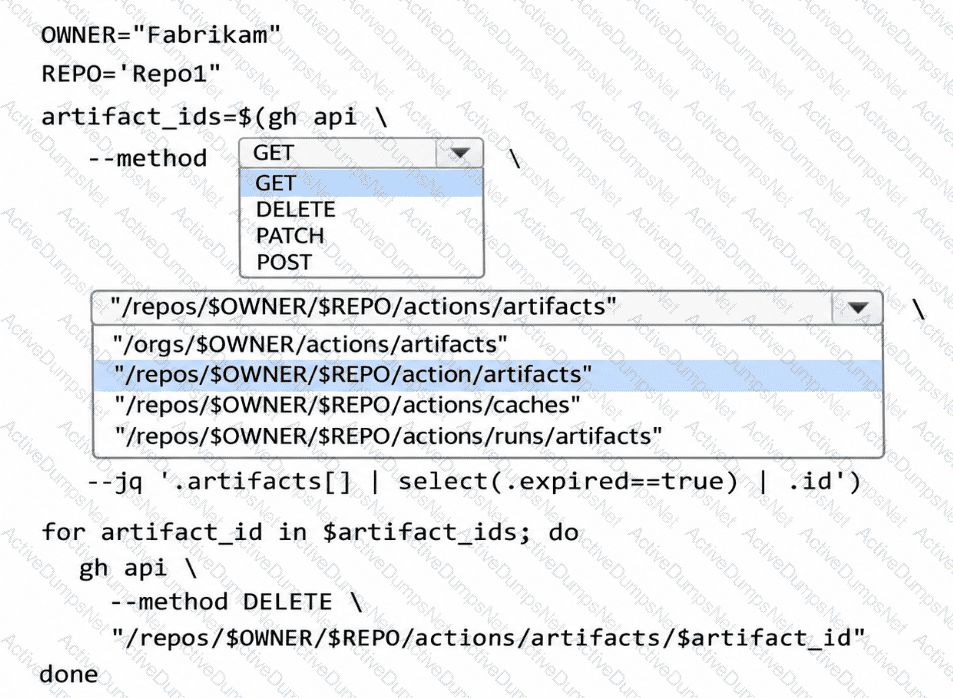
You have a GitHub repository named Repo1. Repo1 uses GitHub Actions workflows that upload build artifacts

You plan to change the artifact and log retention period to 30 days.

You need to remove expired GitHub Actions artifacts from Report. The solution must explicitly identify and delete existing expired artifacts by using the REST API.

How should you complete the script? To answer, select the appropriate options in the answer area.

NOTE: Each correct selection is worth one point.
Question # 32

Options:

Question 33

You are a developer working on developing reusable workflows for your organization. What keyword should be included as part of the reusable workflow event triggers?

Options:

A.

check_run

B.

workflow_run

C.

workflow_call

D.

pull_request

Question 34

Which step is using the dbserver environment variable correctly?

Options:

A.

steps: - name: Hello world run: echo $dbserver variables: dbserver: orgserver1

B.

steps: - name: Hello world run: echo $dbserver env: dbserver: orgserver1

C.

steps: - name: Hello world run: echo $dbserver env: - name: dbserver value: orgserver1

D.

steps: - name: Hello world run: echo $dbserver environment: dbserver: orgserver1

Question 35

You create a self-hosted runner labeled as runner1.

You need to ensure that a GitHub Actions workflow job runs only on runner1.

Which YAML statement should you use?

Options:

A.

runs-on: [self-hosted, linux-xlarge]

B.

runs-on: - self-hosted - ubuntu-latest

C.

runs-on: [self-hosted, runner1]

D.

runs-on: self-hosted

Question 36

As a DevOps engineer, you need to execute a deployment to different environments such as development and testing based on labels added to a pull request. The deployment should use the releases branch and trigger only when there is a change in files under the apps folder. Which code block should be used to define the deployment workflow trigger?

Options:

A.

on: pull_request_review: types: [labeled] branches: - ' releases ' paths: - ' apps/** '

B.

on: pull_request: types: [labeled] branches: - ' releases/** ' paths: - ' apps '

C.

on: pull_request: types: [labeled] branches: - ' releases ' paths: - ' apps/** '

D.

on: pull_request_label: branches: - ' releases ' paths: - ' apps/** '

Question 37

As a developer, you need to use GitHub Actions to deploy a microservice that requires runtime access to a secure token. This token is used by a variety of other microservices managed by different teams in different repos. To minimize management overhead and ensure the token is secure, which mechanisms should you use to store and access the token? (Choose two.)

Options:

A.

Store the token in a configuration file in a private repository. Use GitHub Actions to deploy the configuration file to the runtime environment.

B.

Store the token as a GitHub encrypted secret in the same repo as the code. Create a reusable custom GitHub Action to access the token by the microservice at runtime.

C.

Use a corporate non-GitHub secret store (e.g., HashiCorp Vault) to store the token. During deployment, use GitHub Actions to store the secret in an environment variable that can be accessed at runtime.

D.

Store the token as a GitHub encrypted secret in the same repo as the code. During deployment, use GitHub Actions to store the secret in an environment variable that can be accessed at runtime.

E.

Store the token as an organizational-level encrypted secret in GitHub. During deployment, use GitHub Actions to store the secret in an environment variable that can be accessed at runtime.

Question 38

You need to stop a GitHub Actions workflow from running. The solution must retain the configuration and execution history of the workflow.

What should you do?

Options:

A.

Rename the workflow YAML file.

B.

Select Actions and disable the workflow.

C.

Archive the workflow in a new branch.

D.

Delete the workflow YAML file from the repository.

Question 39

How should you install the bats NPM package in your workflow?

A)

B)

C)

D)

Options:

A.

Option A

B.

Option B

C.

Option C

D.

Option D

Question 40

As a developer, you are designing a workflow and need to communicate with the runner machine to set environment variables, output values used by other actions, add debug messages to the output logs, and other tasks. Which of the following options should you use?

Options:

A.

environment variables

B.

workflow commands

C.

self-hosted runners

D.

enable debug loggingE composite run step

Question 41

What is the proper syntax to reference the system-provided run number variable?

Options:

A.

$GITHUB_RUN_NUMBER

B.

${{ env.GITHUB_RUN_NUMBER }}

C.

${{ var.GITHUB_RUN_NUMBER }}

D.

$github.run_number

E.

${{ GITHUB_RUN_NUMBER }}

Question 42

What is the most suitable action type for a custom action written in TypeScript?

Options:

A.

Composite run step

B.

Bash script action

C.

JavaScript action

D.

Docker container action

Question 43

As a DevOps engineer, you are developing a composite action. You have a step that needs to be executed against a subdirectory. Which code snippet should you use within the composite action to specify the directory?

Options:

A.

runs:using: " composite " steps:- run: $GITHUB_ACTION_PATH/script.shdirectory: ${{ inputs.dir }}shell: bash

B.

runs:using: " composite " directory: ${{ inputs.dir }}steps:- run: $GITHUB_ACTION_PATH/script.shshell: bash

C.

runs:using: " composite " working-directory: ${{ inputs.dir }}steps:- run: $GITHUB_ACTION_PATH/script.shshell: bash

D.

runs:using: " composite " steps:- run: $GITHUB_ACTION_PATH/script.shworking-directory: ${{ inputs.dir }}shell: bash

Question 44

As a developer, you need to create a custom action written in Python. Which action type should you choose?

Options:

A.

Python action

B.

JavaScript action

C.

Docker container action

D.

Composite run step

Question 45

What menu options in a repository do you need to select in order to use a starter workflow that is provided by your organization?

Options:

A.

Actions > Load workflow

B.

Workflow > New workflow

C.

Workflow > Load workflow

D.

Actions > New workflow

Page: 1 / 15
Total 150 questions