
Microsoft AI-300 Operationalizing Machine Learning and Generative AI Solutions Exam Practice Test
Operationalizing Machine Learning and Generative AI Solutions Questions and Answers
You need to recommend an experiment-tracking strategy that ensures consistent experiment results.
What should you recommend?
You need to standardize how Fabrikam Inc. manages machine learning assets.
Which action should you perform first?
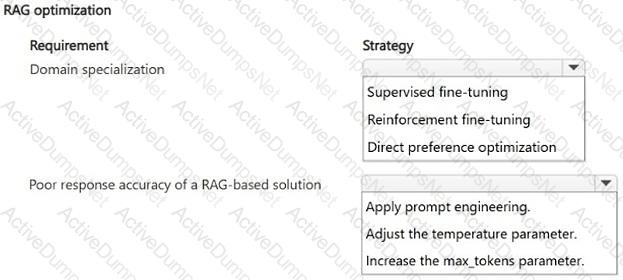
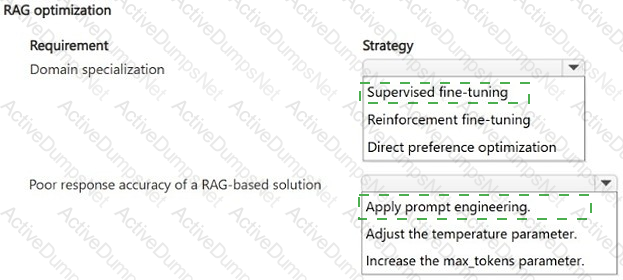
Fabrikam Inc. needs to improve the performance of a GPT-5 model based on the stated technical requirements.
Which action should you perform first?
You need to configure an optimization method to meet Fabrikam Inc.’s technical requirements.
Which strategy should you apply first? To answer, select the appropriate options in the answer area.
NOTE: Each correct selection is worth one point.
Fabrikam Inc. must improve its deployment process because traditional machine learning models are deployed manually and the organization has limited rollback capability .
You need to recommend a deployment approach that supports staged rollout and rollback while minimizing operational overhead.
Which deployment approach should you recommend?
You need to isolate training workloads while remaining cost-aware to address Fabrikam Inc.’s issues, constraints, and technical requirements.
What should you implement?
-
A team operates a generative AI-powered customer support assistant built on Microsoft Foundry. The application serves users globally and supports both real-time chat interactions and batch summarization jobs.
The team must ensure that the application continues to meet defined service-level objectives (SLO) as usage increases.
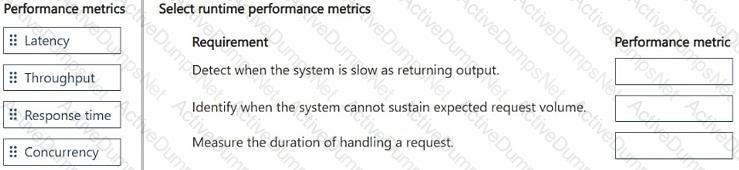
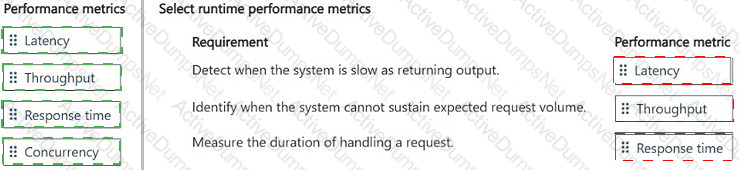
The team requires visibility into runtime behavior to identify performance regressions that affect the user experience and system capacity.
You need to select the performance metrics that meet the requirements.
Which performance metric should you monitor for each requirement? To answer, move the appropriate performance metrics to the correct requirements. You may use each performance metric once, more than once, or not at all. You may need to move the split bar between panes or scroll to view content.
NOTE: Each correct selection is worth one point.
You create an Azure Machine Learning workspace.
You must use the Python SDK v2 to implement an experiment from a Jupiter notebook in the workspace. The experiment must log string metrics.
You need to implement the method to log the string metrics.
Which method should you use?
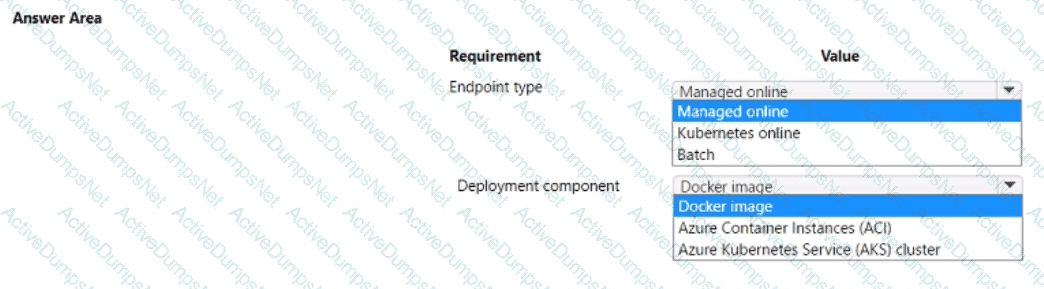
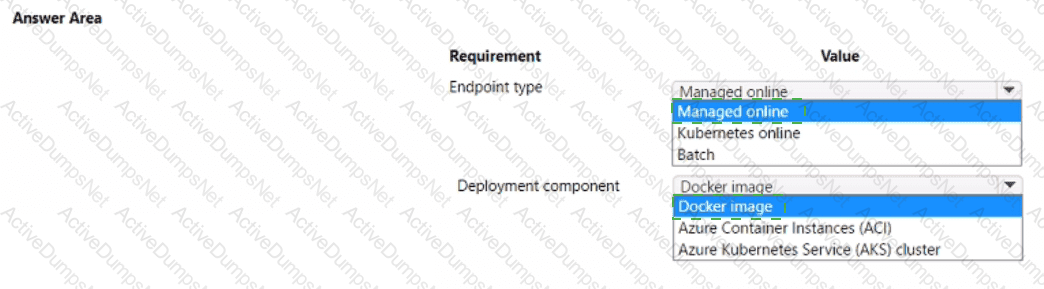
You create an Azure Machine Learning model to include model files and a scorning script. You must deploy the model. The deployment solution must meet the following requirements:
• Provide near real-time inferencing.
• Enable endpoint and deployment level cost estimates.
• Support logging to Azure Log Analytics.
You need to configure the deployment solution.
What should you configure? To answer, select the appropriate options in the answer area.
NOTE: Each correct selection is worth one point.
An organization uses Microsoft Foundry to develop generative AI projects that access shared Azure resources such as storage accounts and vector databases.
The organization s security policy requires eliminating secret key-based authentication and enforcing least-privilege access.
You must configure identity and access so that:
Services authenticate without stored credentials.
Permissions are scoped appropriately across projects and shared resources.
You need to configure the appropriate identity or access mechanism for each requirement.
What should you configure in Microsoft Foundry to meet each requirement? To answer, move the appropriate configuration mechanisms to the correct requirements. You may use each configuration mechanism once, more than once, or not at all. You may need to move the split bar between panes or scroll to view content. NOTE: Each correct selection is worth one point.



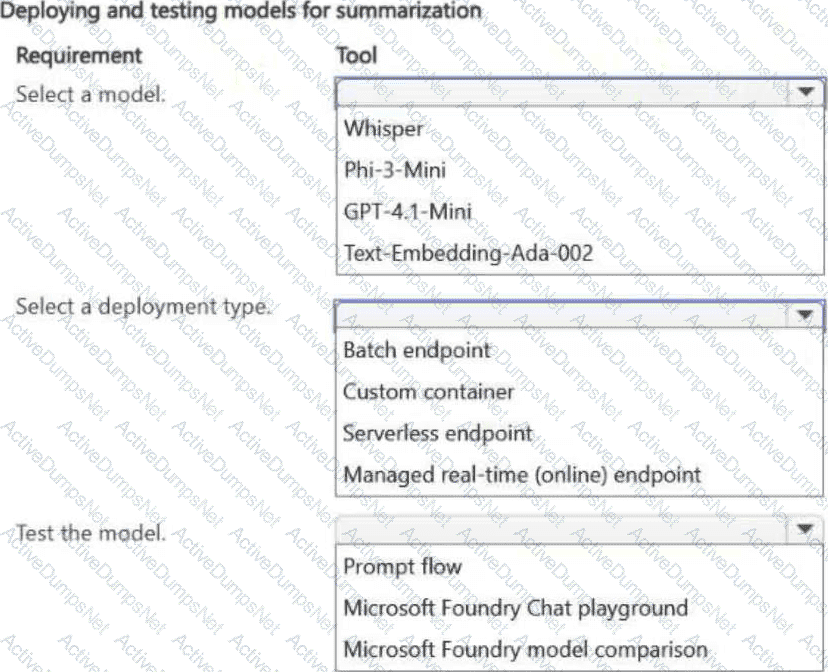
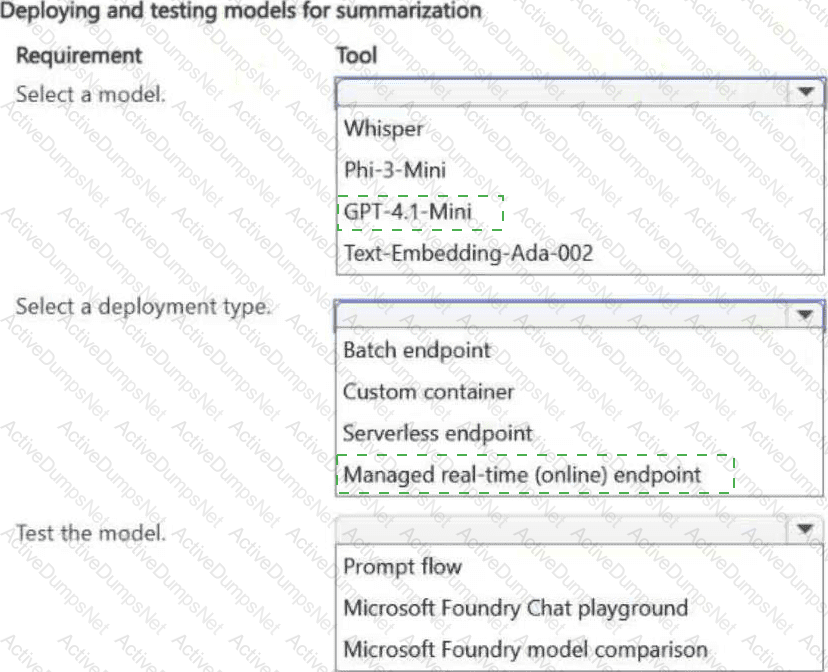
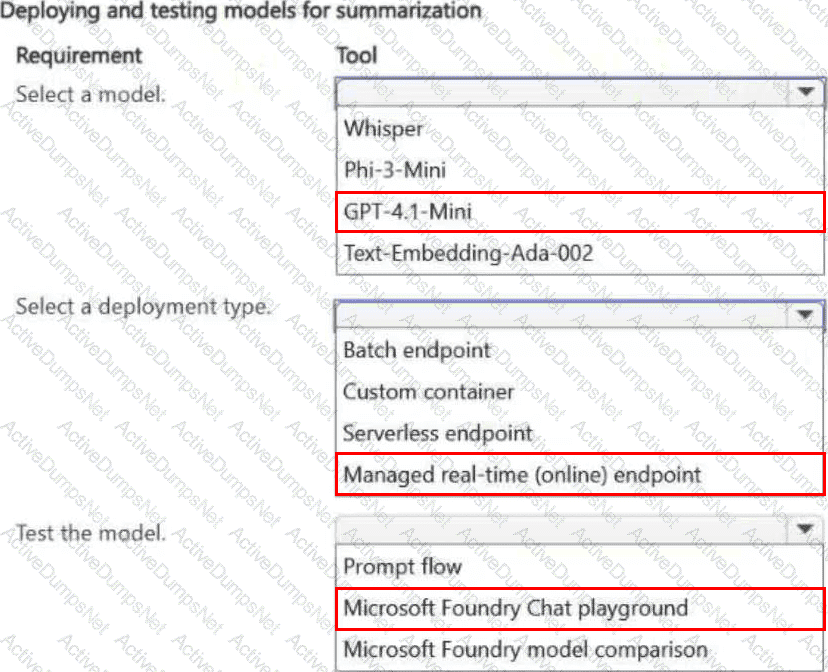
A company is creating an internal tool that summarizes long meeting transcripts and extracts action items.
The model must:
Process text inputs up to 200k tokens long.
Generate concise summaries in seconds.
Support interactive testing before integration into the app.
You need to select, deploy, and test a model that supports summarization with low latency.
How should you complete the configuration plan? To answer, select the appropriate options in the answer area. NOTE: Each correct selection is worth one point.
You create an Azure Machine Learning workspace named workspaces. You create a Python SDK v2 notebook to perform custom model training in workspace1. You need to run the notebook from Azure Machine Learning Studio in workspace1. What should you provision first?
A team manages prompts that are used by a generative AI application built on Microsoft Foundry. Multiple developers contribute prompt updates, and changes must be reviewed and tracked over time.
The team requires that:
Prompt changes are reviewed before being applied to the version in production.
Previous prompt versions can be restored if issues occur.
Prompt updates follow the same governance practices as the application code.
You need to implement a controlled process for managing and updating prompts in production.
How should you manage prompt updates to meet the requirements? To answer, move the appropriate actions to the correct requirements. You may use each action once, more than once, or not at all. You may need to move the split bar between panes or scroll to view content. NOTE: Each correct selection is worth one point.



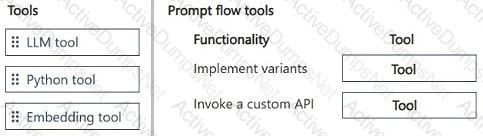
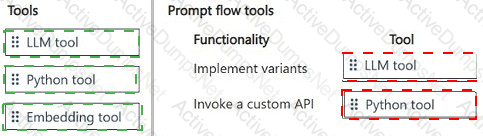
You develop a Prompt flow in Microsoft Foundry project.
You plan to use variants and invoke a custom API in the flow.
You need to add tools to the flow that will implement the planned functionality. Your solution must minimize development efforts.
Which tools should you use? To answer, move the appropriate tools to the correct functionalities. You may use each tool once, more than once, or not at all. You may need to move the split bar between panes or scroll to view content.
NOTE: Each correct selection is worth one point.
A team manages an Azure Machine Learning workspace where they deploy models to online endpoints.
The team needs to introduce a new version of a model to production without disrupting existing users.
The team must validate the new version before full rollout.
You need to reduce risk during deployment.
What should you do?
You manage an Azure Machine Learning workspace. You have a folder that contains a CSV file. The folder is registered as a folder data asset.
You plan to use the folder data asset for data wrangling during interactive development.
You need to access and load the folder data asset into a Pandas data frame.
Which method should you use to achieve this goal?
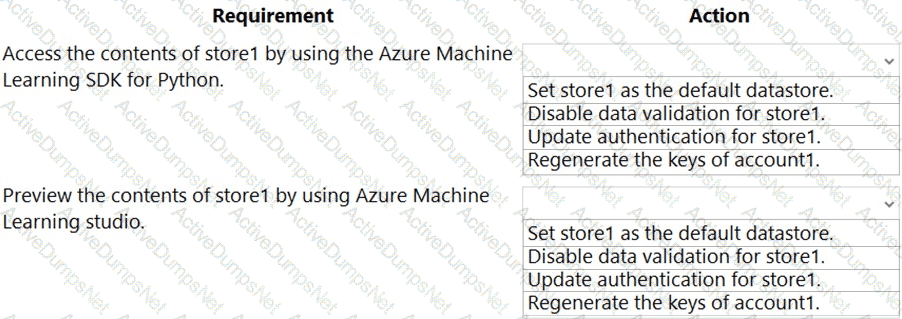
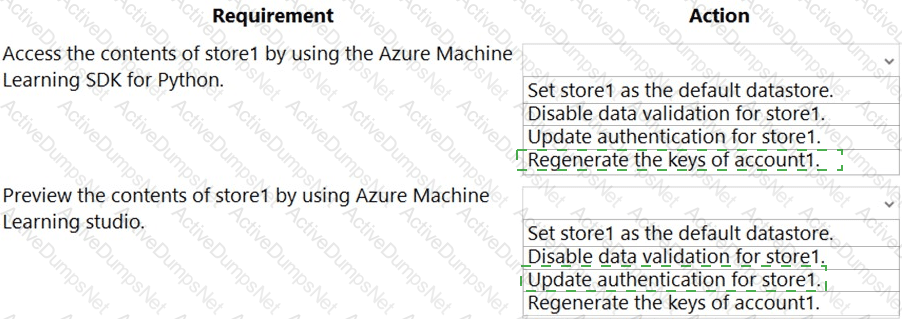
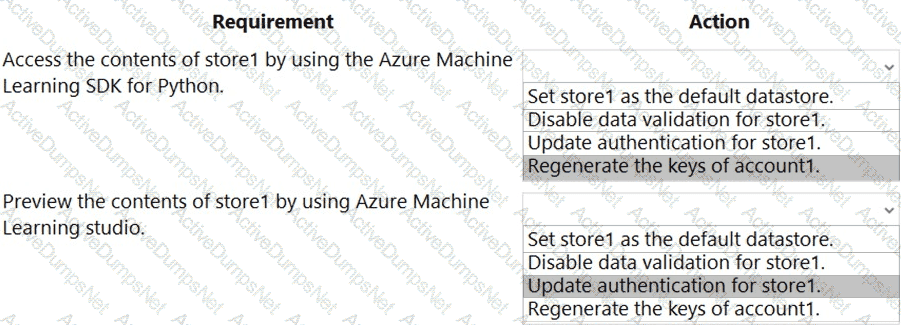
You have an Azure Machine Learning workspace named workspace1 that is accessible from a public endpoint. The workspace contains an Azure Blob storage datastore named store1 that represents a blob container in an Azure storage account named account1. You configure workspace1 and account1 to be accessible by using private endpoints in the same virtual network.
You must be able to access the contents of store1 by using the Azure Machine Learning SDK for Python. You must be able to preview the contents of store1 by using Azure Machine Learning studio.
You need to configure store1.
What should you do? To answer, select the appropriate options in the answer area.
NOTE: Each correct selection is worth one point.
A company ' s platform engineers manage the resource settings and governance of Microsoft Foundry.
Developers must be able to create and update project assets but must not be able to change resource-level configurations.
You need to enforce least privilege access for the engineers and developers.
Which two actions should you perform? Each correct answer presents part of the solution. NOTE: Each correct selection is worth one point. Choose two.
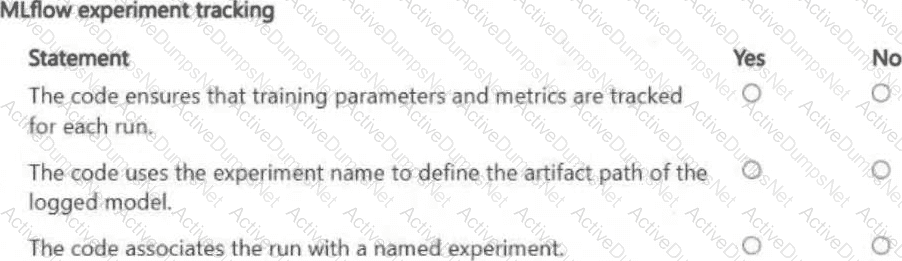
You train a model in Azure Machine Learning.
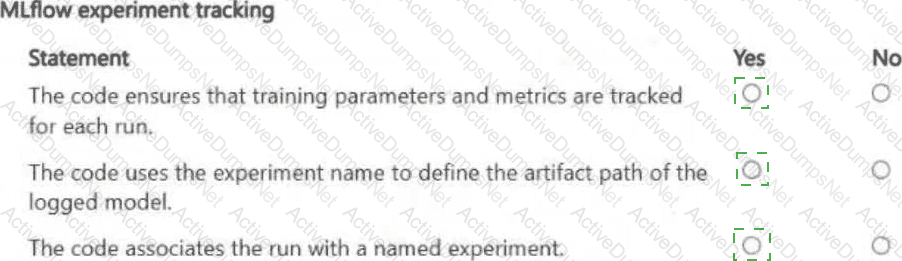
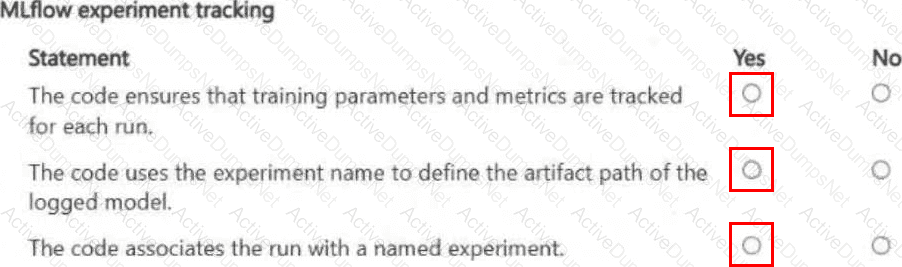
You plan to capture experiment details for later comparison. The training code must log parameters and metrics for each run.
You review the following training script.
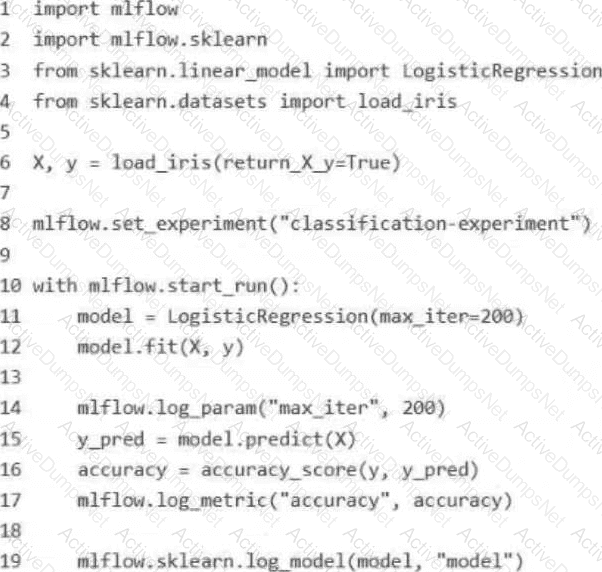
You need to verify whether the training script meets the experiment tracking requirement.
For each of the following statements, select Yes if the statement is true. Otherwise, select No. NOTE: Each correct selection is worth one point.
You manage an Azure Machine Learning workspace That has an Azure Machine Learning datastore.
Data must be loaded from the following sources:
• a credential-less Azure Blob Storage
• an Azure Data Lake Storage (ADLS) Gen 2 which is not a credential-less datastore
You need to define the authentication mechanisms to access data in the Azure Machine Learning datastore.
Which data access mechanism should you use? To answer, move the appropriate data access mechanisms to the correct storage types. You may use each data access mechanism once, more than once, or not at all. You may need to move the split bar between panes or scroll to view content.
NOTE: Each correct selection is worth one point.


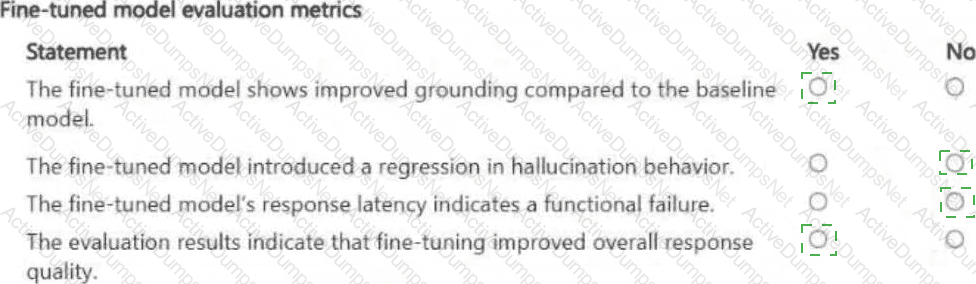
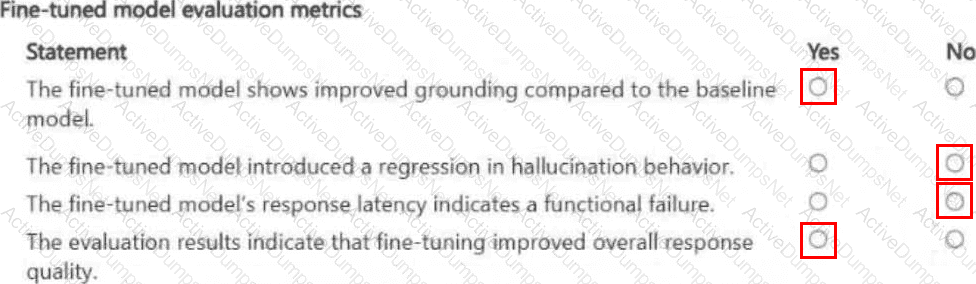
You are monitoring a fine-tuned large language model deployed in Microsoft Foundry.
You evaluate the model before and after fine-tuning by using the same evaluation dataset.
You review the following evaluation results:
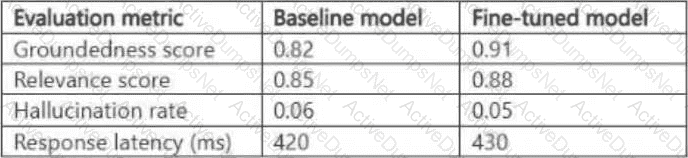
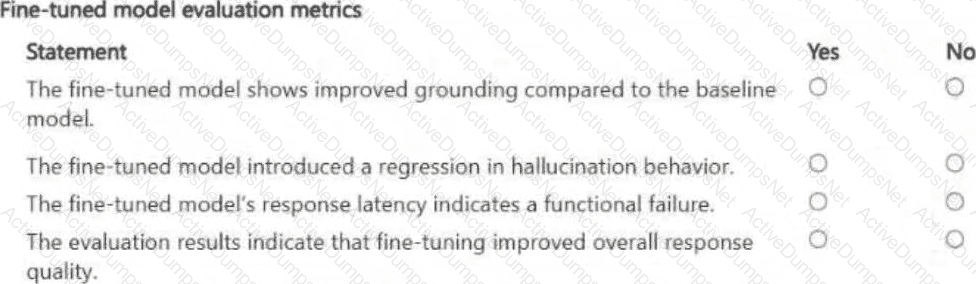
You need to determine whether the fine-tuned model shows improved performance without introducing regression.
For each of the following statements, select Yes if the statement is true. Otherwise, select No. NOTE: Each correct selection is worth one point.
You train and register an Azure Machine Learning model
You plan to deploy the model to an online endpoint
You need to ensure that applications will be able to use the authentication method with a non-expiring artifact to access the model.
Solution:
Create a managed online endpoint with the default authentication settings. Deploy the model to the online endpoint.
Does the solution meet the goal?
You manage an Azure Machine Learning workspace. You have an environment for training jobs which uses an existing Docker image.
A new version of the Docker image is available.
You need to use the latest version of the Docker image for the environment configuration by using the Azure Machine Learning SDK v2.
What should you do?
You have an Azure Machine Learning workspace.
You plan to run a job to tram a model as an MLflow model output.
You need to specify the output mode of the MLflow model.
Which three modes can you specify? Each correct answer presents a complete solution.
NOTE: Each correct selection is worth one point.
You are authoring a notebook in Azure Machine Learning studio.
You must install packages from the notebook into the currently running kernel. The installation must be limited to the currently running kernel only.
You need to install the packages.
Which magic function should you use?
A data science team completes multiple training runs within an experiment by using MLflow.
The team wants to store a selected model in Azure Machine Learning so that it can be versioned and deployed later.
The model must be versioned centrally for reuse across environments.
You need to version the trained model.
Which two actions should you perform? Each correct answer presents part of the solution. NOTE: Each correct selection is worth one point. Choose two.
You have an Azure Machine Learning workspace. You are running an experiment on your local computer.
You need to use MLflow Tracking to store metrics and artifacts from your local experiment runs in the workspace.
In which order should you perform the actions? To answer, move all actions from the list of actions to the answer area and arrange them in the correct order.


An organization validates generative AI applications during CI/CD Microsoft Foundry.
Evaluation must run automatically and block releases when quality thresholds are NOT met. Manual evaluation is no longer acceptable.
Evaluation must use both predefined quality metrics and custom safety checks.
You need to implement an automated evaluation workflow that supports both built-in and custom metrics.
What should you do?