Spring Sale Limited Time Flat 70% Discount offer - Ends in 0d 00h 00m 00s - Coupon code: 70spcl

Juniper JN0-650 Enterprise Routing and Switching - Professional (JNCIP-ENT) Exam Practice Test

Page: 1 / 7
Total 65 questions

Enterprise Routing and Switching - Professional (JNCIP-ENT) Questions and Answers

Question 1

You have deployed 802.1X with server fail fallback enabled on an EX Series switch and specified the vlan-name feature for all access ports. The RADIUS server is unavailable.

Which two statements are correct in this scenario? (Choose two )

Options:

A.

All clients already authenticated will immediately be disconnected before the re-authentication timer expires.

B.

All clients already authenticated will be unaffected until reauthentication is required.

C.

All new clients will be granted access only if their requested VLAN matches the configuration

D.

All new clients will be placed in the referenced VLAN in the configuration and given access.

Question 2

Which two statements are correct about multicast routing tables? (Choose two.)

Options:

A.

inet. 2 is used when the multicast forwarding topology differs from unicast forwarding

B.

MBGP and IS-IS place routes in met. l directly.

C.

inet. 0 is used for RPF checks.

D.

IS-IS and OSPFv3 place routes in met. 2 directly.

Question 3

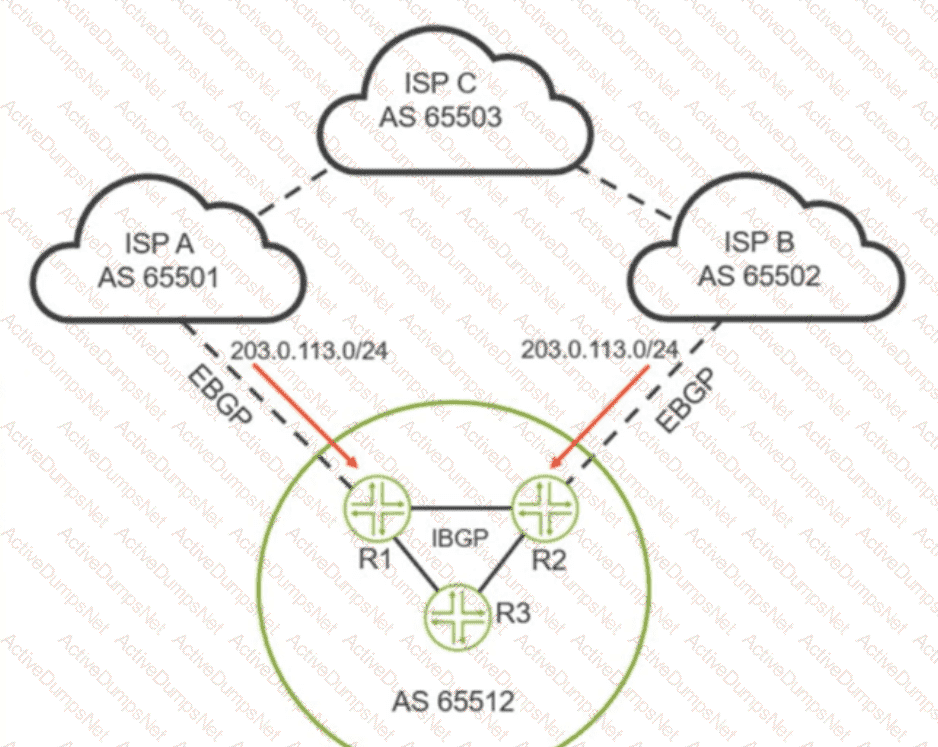
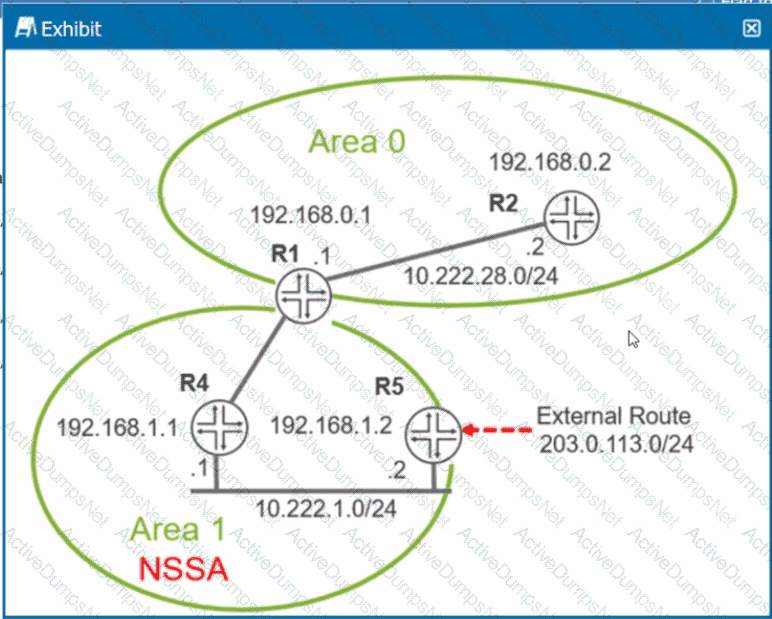
Exhibit.

Question # 3

Referring to the exhibit, which two statements are correct? (Choose two.)

Options:

A.

R1 will advertise the 203 0.113.0724 route as an OSPF Type 7 LSA into Area 0.

B.

R5 will advertise the 203 0.113 0/24 route as an OSPF Type 5 LSA into Area 1.

C.

R1 will advertise the 203 0.113.0/24 route as an OSPF Type 5 LSA into Area 0

D.

R5 will advertise the 203 0.113.0/24 route as an OSPF Type 7 LSA into Area 1.

Question 4

You need to perform maintenance on one of your OSPF routers. You do not want the other OSPF routers on the network to forward traffic to this router dunng the maintenance window

Which OSPF configuration parameter would you implement to accomplish this task?

Options:

A.

traffic-engineering

B.

overload

C.

preference

D.

spf-options

Question 5

Exhibit

Question # 5

Referring to the exhibit, which two statements are correct? (Choose two.)

Options:

A.

The BGP configuration is for IBGP

B.

The BGP configuration includes the multipath parameter.

C.

This route has two next hops available.

D.

This route has a hidden next hop.

Question 6

An incorrectly configured routing policy at your service provider led to several hundred thousand routes being placed in your edge router's routing table In this scenario, how would you limit the number of prefixes received on a BGP peer session?

Options:

A.

Enable the damping BGP parameter in the edge router configuration

B.

Enable the prefix-limit BGP parameter in the edge router configuration.

C.

Enable the graceful-restart BGP parameter in the edge router configuration.

D.

Enable the advertise-inactive BGP parameter in the edge router configuration.

Question 7

Which two statements correctly describe how EX Series switches use captive portal for Layer 2 authentication? (Choose two.)

Options:

A.

The captive portal is the default Layer 2 authentication method that is applied before other methods such as 802 1X or MAC RADIUS.

B.

The captive portal authentication allowlist works for devices that do not have HTTP capabilities.

C.

The captive portal is configured on Layer 3 interfaces and does not participate in Layer 2 authentication on EX Series switches.

D.

The captive portal is used as a fallback mechanism for clients that fail 802.1X or MAC RADIUS authentication.

Question 8

Your router is discarding an EBGP route because the next hop is not directly connected. Which BGP configuration would you use to override this behavior?

Options:

A.

accept-remote-nexthop

B.

multihop

C.

advertise-inactive

D.

multipath

Question 9

You have two multicast receivers connected to the same VLAN. You notice that the switch that they are connected to is forwarding multicast traffic out of all the ports in the same VLAN, instead of just the two ports for the connected multicast receivers

In this scenario, what would you configure to optimize multicast forwarding?

Options:

A.

promiscuous mode

B.

spanning tree

C.

IGMP snooping

D.

IRB interface

Question 10

You want to implement a system in your network to simplify VLAN management that can also dynamically create and prune VLANs. How would you accomplish this task?

Options:

A.

Enable GVRP on access interfaces.

B.

Enable MVRP and GVRP on all interfaces.

C.

Enable MVRP on trunk interfaces.

D.

Enable MVRP on access interfaces.

Question 11

Which statement accurately describes the operation of OSPF within the Junos OS?

Options:

A.

OSPF calculates routes using a distance vector algorithm.

B.

OSPF is used for routing information and neighbor discovery within a single autonomous system (AS).

C.

OSPF does not automatically advertise directly connected routes.

D.

OSPF is used for routing information and neighbor discovery between multiple autonomous systems.

Question 12

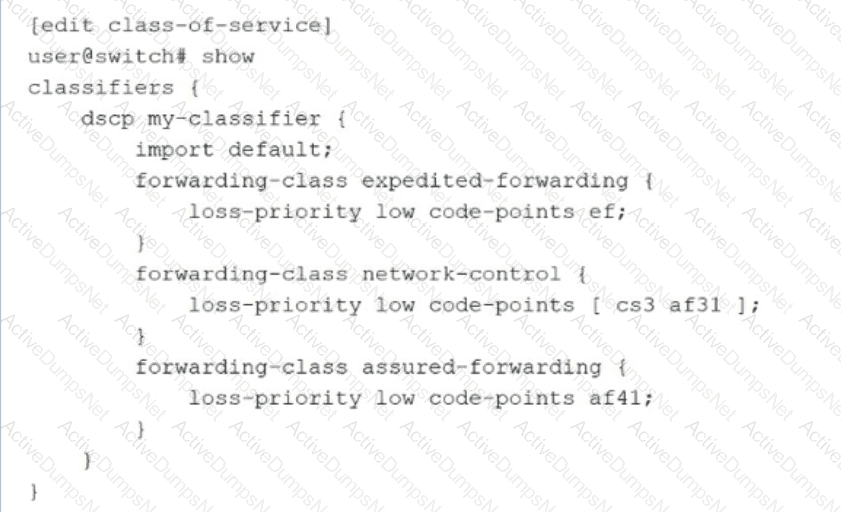
You have configured DSCP CoS in your network and have applied BA and multifield classifiers to all interfaces.

In this scenario, which statement is correct?

Options:

A.

If traffic matches both classifiers, then the multifield classifier determines into which forwarding class the traffic is assigned

B.

You must set the BA classifier to take precedence over the multifield classifier or the configuration is ignored

C.

You must set the multifield classifier to take precedence over the BA classifier or the configuration is ignored.

D.

If traffic matches both classifiers, then the BA classifier determines into which forwarding class the traffic is assigned.

Question 13

Which two statements are correct when using the no-loss forwarding class? (Choose two.)

Options:

A.

Use the default scheduler map

B.

Use forwarding class sets.

C.

Use priority-based flow control.

D.

Use the default drop profile.

Question 14

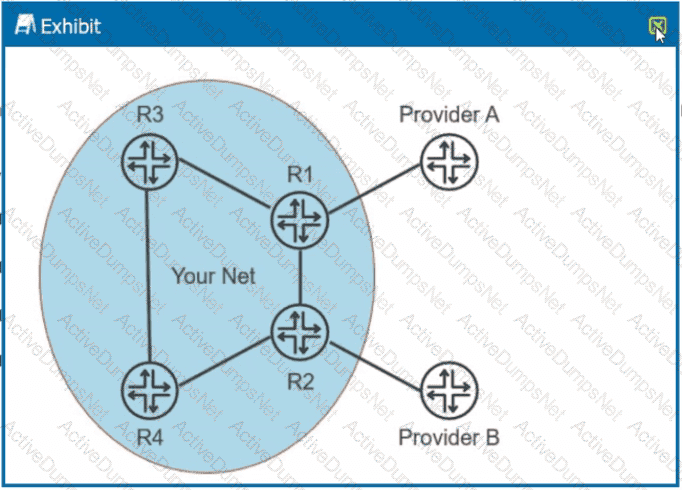
Exhibit

Question # 14

You want to provide better performance for the video traffic that traverses your network The video traffic enters your network without any class-of-service markings

According to Juniper Networks, which two classification methods are performed by the routers shown in the exhibit? (Choose two.)

Options:

A.

R1 performs behavior aggregate classification.

B.

R1 performs multifield classification.

C.

R2 and R3 perform multifield classification

D.

R2 and R3 perform behavior aggregate classification

Question 15

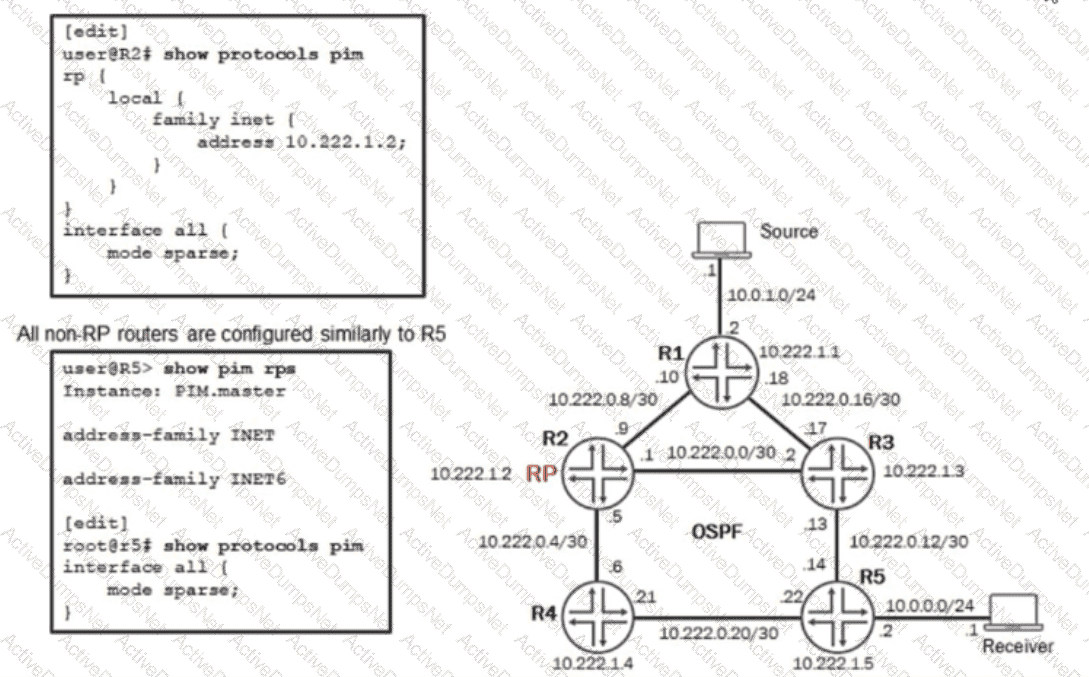
Exhibit

Question # 15

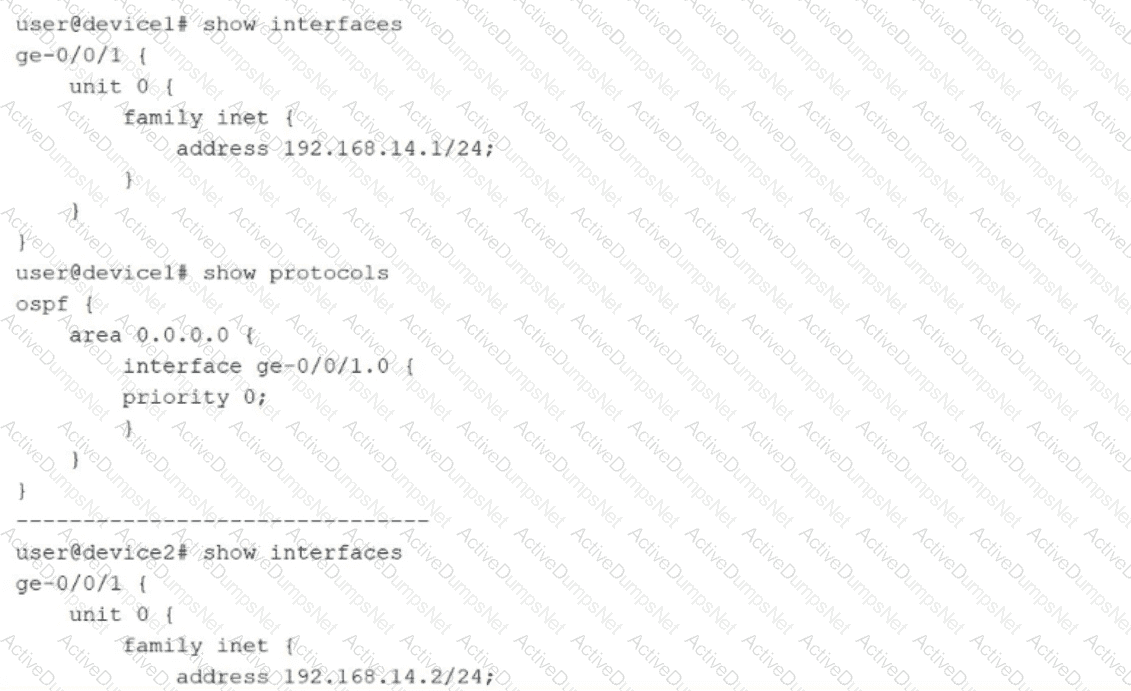
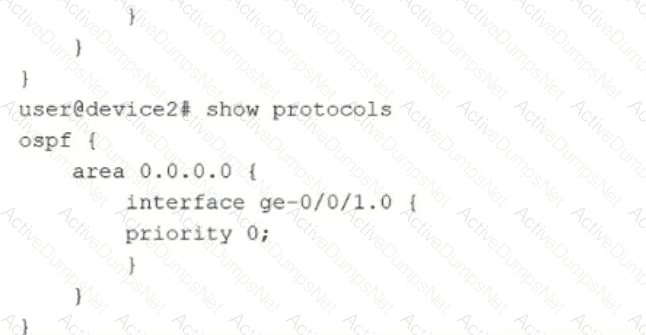
You need to configure the non-RP routers in your network to dynamically learn the location of the RP using standard protocols only. You have already applied the configuration shown in the exhibit, but the routers have not learned the location of the RP.

Which additional step must you take to fulfill these requirements?

Options:

A.

Configure MSDP.

B.

Configure BSR.

C.

Configure Anycast RP.

D.

Configure Auto-RP

Question 16

You have several switches in your network that use Cisco's PVST+ protocol. You want your Juniper switches to interoperate with those devices.

In this scenario, which protocol would you use?

Options:

A.

RPVST+

B.

MSTP

C.

VSTP

D.

RSTP

Question 17

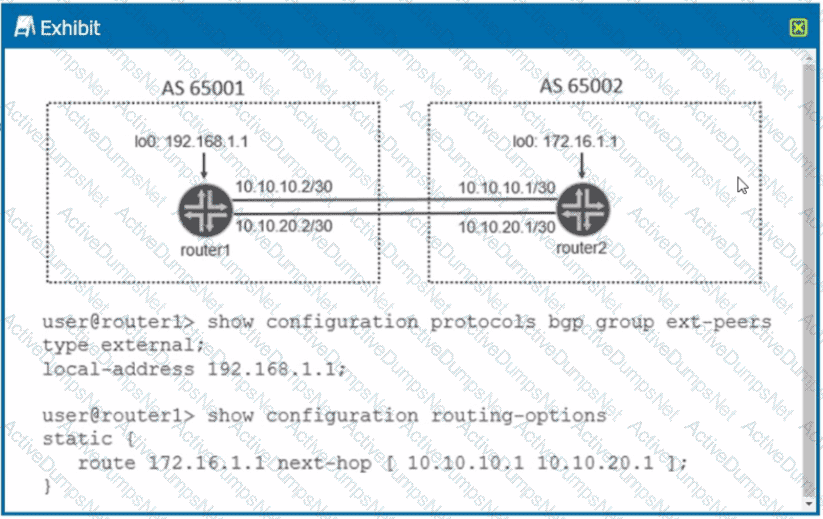
Exhibit

Question # 17

Referring to the exhibit, what will enable active routes from both peers?

Options:

A.

Configure neighbor 172.16.1.1 multipath under the ext-peers hierarchy.

B.

Configure multipath under the ext-peers hierarchy

C.

Configure neighbor 172.16.1.1 under the ext-peers hierarchy.

D.

Configure neighbor 10.10.20.2 multipath under the ext-peers hierarchy.

Question 18

You want to validate a recursive lookup for an EVPN route designation. Which route table query will accomplish this task?

Options:

A.

inet.2

B.

default-switch.evpn.0

C.

inet.3

D.

vxlan.inet.

Question 19

Which statement about LLDP and LLDP-MED operations on EX Series devices is correct?

Options:

A.

LLDP only operates on interfaces configured for Layer 2

B.

EX Series devices flood LLDP frames across a Layer 2 domain to calculate a network topology

C.

EX Series devices support LLDP-MED power negotiation, enabling dynamic allocation of PoE power based on endpoint device needs.

D.

LLDP-MED focuses on discovering network connectivity devices like routers and switches.

Page: 1 / 7
Total 65 questions