
Juniper JN0-336 Security, Specialist (JNCIS-SEC) Exam Practice Test
Security, Specialist (JNCIS-SEC) Questions and Answers
You need to deploy an SRX Series device in your virtual environment.
In this scenario, what are two benefits of using a CSRX? (Choose two.)
Options:
The cSRX supports Layer 2 and Layer 3 deployments.
The cSRX default configuration contains three default zones: trust, untrust, and management.
The cSRX supports firewall, NAT, IPS, and UTM services.
The cSRX has low memory requirements.
Answer:
C, DExplanation:
The correct answers are C and D. The cSRX is Juniper’s containerized SRX firewall, intended for lightweight virtual and container environments where rapid deployment and high density matter. Juniper’s cSRX documentation lists supported security capabilities including basic firewall policy, NAT, Intrusion Detection and Prevention, content security/UTM functions, ATP Cloud, SSL Proxy, AppID, AppFW, and AppTrack. That supports option C, because cSRX provides SRX security services in a containerized footprint rather than requiring a full VM-based firewall appliance.
Option D is also correct because Juniper identifies the cSRX’s small footprint and minimum resource reservation requirements as key benefits; it is designed to scale more densely than VM-based firewall options. Juniper’s Day One cSRX guide specifically identifies faster deployment, a small footprint, and reduced resource consumption as major benefits. Option A is not the best answer for this exam item because the question asks for cSRX deployment benefits, not merely forwarding-mode support. Option B is wrong because the tested cSRX advantage is not a default three-zone configuration. Reference topics: cSRX container firewall, virtual SRX deployment, firewall/NAT/IPS/UTM services, lightweight resource footprint.
Which two statements are correct about client-protection Secure Socket Layer (SSL) proxy configurations? (Choose two.)
Options:
Server certificate is required.
Root certificate authority (CA) configuration is required.
Root certificate authority (CA) configuration is not required.
Server certificate is not required.
Answer:
B, DExplanation:
The correct answers are B and D. In Junos SSL proxy terminology, client protection maps to SSL forward proxy. In a forward-proxy deployment, the SRX sits between internal clients and external SSL/TLS servers. The firewall intercepts the server certificate, generates a substitute certificate, signs it with the configured root CA, decrypts the SSL session for inspection, and then re-encrypts traffic toward the destination server. Juniper’s SSL proxy configuration table shows that a forward-proxy profile uses root-ca configured = Yes and server-certificate configured = No. It also states that configuring neither certificate type fails commit validation, while configuring both root-ca and server-certificate in the same profile is unsupported.
Option A is wrong because a server certificate is required for reverse proxy/server protection, not for client-protection forward proxy. Option C is wrong because without a trusted root CA, client browsers would not trust the certificates generated by the SRX during interception. Juniper separately notes that the root CA certificate is required for client browsers to trust certificates signed by the firewall. Reference topics: SSL Proxy, client protection, SSL forward proxy, root CA, server protection, SSL reverse proxy.
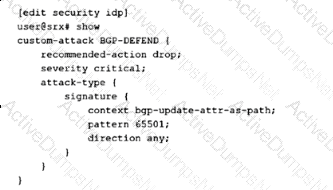
Which action will the SRX Series device take if traffic matches the custom attack object shown in the exhibit?
Options:
the action taken is defined in the IDP policy that includes this attack object.
the action taken is defined by the security policy.
The SRX Series device will reject the traffic.
The SRX series device will drop the traffic.
Answer:
AExplanation:
The correct answer is A. the action taken is defined in the IDP policy that includes this attack object. The exhibit defines a custom attack object named BGP-DEFEND under the security idp custom-attack hierarchy. The custom object includes metadata such as recommended-action drop, severity critical, and signature match conditions such as BGP update AS-path context and pattern 65501. However, an attack object by itself does not determine the final enforcement behavior. The attack object defines what to match; the IDP policy rule that references the object defines what action to take when that match occurs. Juniper describes attack objects as objects used inside IDP rules to identify malicious activity, while IDP rules include rule actions such as drop-packet, drop-connection, close-client, close-server, recommended, and others.
Option B is wrong because the firewall security policy enables IDP inspection by applying an IDP policy, but the IDP action is not selected directly by the normal security policy. Options C and D are too absolute. Even though the custom object shows recommended-action drop, that is only used if the IDP rule action invokes recommended behavior. Without seeing the IDP policy rule action, you cannot conclude reject or drop. Reference topics: IDP custom attack objects, IDP policy rule actions, recommended action, signature-based attack matching.
Which three actions does Junos Space Security Director perform during the device discovery process? (Choose three.)
Options:
It imports the device’s active device configuration.
it reboots the device.
It imports device status information.
It adds a local superuser account to the device configuration.
It connects to the device using SSH.
Answer:
A, C, EExplanation:
The correct answers are A, C, and E. During Security Director device discovery, Junos Space first finds and connects to the managed device, then synchronizes the device inventory and configuration into the Junos Space database. Juniper’s Security Director documentation states that discovery uses a discovery profile containing target information, authentication credentials, probes, and SSH fingerprints. During discovery, Junos Space connects to the physical device and retrieves the running configuration and status information. It also states that Junos Space uses SSH, with optional ping and SNMP, to discover network devices.
Option B is wrong because device discovery is not a reboot operation. Rebooting would be disruptive and is not part of onboarding a managed SRX into Security Director. Option D is wrong because discovery does not automatically inject a local superuser into the SRX configuration. Security Director authenticates using credentials supplied in the discovery profile; it does not create privileged local accounts as a discovery action. The tested workflow is management-plane discovery: connect, authenticate, retrieve inventory/status, and import configuration state. Reference topics: Security Director, device discovery, discovery profiles, SSH, running configuration import, device status synchronization.
Which statement is correct about Active Directory as an identity source for identity-aware security policies?
Options:
It supports a maximum of two domains.
It supports logical systems.
It supports 20 Active Directory servers per domain.
It tracks non-Windows Active Directory users.
Answer:
AExplanation:
The correct answer is A. It supports a maximum of two domains. Juniper’s Active Directory identity-source configuration guidance states that an SRX Series Firewall using the integrated user firewall/Active Directory identity source can be configured for a maximum of two domains. That is the exact limit relevant to this question. The same Juniper configuration page separately states that a maximum of 10 domain controllers can be configured, which directly eliminates option C because the supported figure is not 20 Active Directory servers per domain.
Option B is wrong because Active Directory identity source is not presented as a logical-systems feature in the JNCIS-SEC identity-aware firewall context. Option D is wrong because the primary Active Directory mechanism reads Windows domain controller event logs and uses WMI/DCOM plus LDAP to build IP-to-user and group mappings. Juniper describes the SRX as reading and monitoring the Windows event log on the domain controller, then using LDAP to obtain user/group information. Non-domain or non-Windows cases typically require alternate authentication behavior such as captive portal, not native Active Directory event-log tracking.
Reference topics: Identity-Aware Security Policies, Active Directory identity source, integrated user firewall, domain limits, domain controllers, WMIC, LDAP mapping.
Which three different objects would be created, modified, cloned, and deleted in the Shared Objects workspace of Junos Space Security Director? (Choose three.)
Options:
geo IP
IP address
audit logs
policy enforcement groups
policy rules
Answer:
A, B, DExplanation:
The correct answers are A, B, and D. In Security Director, the Shared Objects workspace is used for reusable objects that can be referenced by policies across managed devices. Juniper documentation shows that address objects are created from Configure > Shared Objects > Addresses, and those address objects can be used across devices in firewall, NAT, IPS, and VPN services. This supports option B, because IP address/address objects are classic shared objects.
Option A is correct because Geo IP policies are created from Configure > Shared Objects > Geo IP. Juniper’s procedure explicitly places Geo IP under the Shared Objects path. Option D is also correct because policy enforcement groups are created from Configure > Shared Objects > Policy Enforcement Groups and are used to group endpoints such as IP addresses, subnets, or locations for policy-enforcement workflows.
Option C is wrong because audit logs are monitoring records, not reusable shared objects; Juniper places them under Monitor > Audit Logs, where they track login history and user-initiated tasks. Option E is wrong because policy rules are created and managed inside firewall, NAT, IPS, or threat policies, not as independent Shared Objects. Reference topics: Security Director, Shared Objects, address objects, Geo IP, policy enforcement groups.
Which SRX Series device configuration setting must be configured first to use Juniper ATP Cloud?
Options:
Start up the anti-malware service on the SRX Series device.
Apply the firewall rules on the SRX Series device.
Enable connectivity between the SRX Series device and Juniper ATP Cloud.
Configure the anti-malware policies on the SRX Series device.
Answer:
CExplanation:
The correct answer is C. Enable connectivity between the SRX Series device and Juniper ATP Cloud. Juniper ATP Cloud cannot inspect files, receive verdicts, or apply cloud-based malware intelligence until the SRX is enrolled and has a working secure connection to the ATP Cloud service. Juniper states that SRX enrollment establishes a secure connection between the SRX Series Firewall and the Juniper ATP Cloud server, downloads and installs certificate authorities, creates local certificates, enrolls them with the cloud server, and establishes the secure cloud connection.
Option A is not the first required configuration setting because the anti-malware service depends on successful cloud onboarding and connectivity. Option B is premature because firewall/security policies can reference malware inspection only after the device is properly connected and enrolled. Option D is also later in the workflow; anti-malware policies define how files are inspected and what action is taken, but those policies are useless if the SRX cannot communicate with ATP Cloud. Juniper also notes that ATP Cloud requires both the Routing Engine and Packet Forwarding Engine to reach the Internet, and DNS must resolve the cloud URL. Reference topics: ATP Cloud onboarding, SRX enrollment, advanced anti-malware connection, secure cloud connectivity, anti-malware policy deployment.
Which two statements are correct about Juniper ATP Cloud malware analysis? (Choose two.)
Options:
If no match exists in cache, the remaining analysis features are processed with the cumulative threat score transmitted to the SRX Series device.
If a match exists in cache, that threat score is sent to the SRX Series device and the analysis continues.
If a match exists in cache, that threat score is sent to the SRX Series device and the analysis stops.
If no match exists in cache, the first analysis feature to generate a threat score is transmitted to the SRX Series device.
Answer:
A, CExplanation:
The correct answers are A and C. Juniper ATP Cloud uses a malware-analysis pipeline. When a file is submitted, the first step is a cache lookup based on the file hash. Juniper explains that if the file has already been analyzed, the stored verdict is returned to the SRX Series Firewall and there is no need to re-analyze the file. That directly supports C and eliminates B, because analysis does not continue when a cached verdict is found.
If the cache lookup does not return a verdict, the remaining ATP Cloud analysis techniques are used. Juniper describes the pipeline model in which each analysis technique creates a verdict number, and those verdicts are combined into a final verdict score from 0 to 10. That final threat score is what the SRX compares against ATP Cloud policy settings to permit or block the session.
Option D is wrong because ATP Cloud does not simply return the first score generated by any one feature. The expected behavior is cumulative/final scoring across the remaining analysis pipeline. Reference topics: Juniper ATP Cloud, malware analysis pipeline, cache lookup, verdict number, threat score, SRX enforcement.
Which two statements are correct about Juniper Secure Connect? (Choose two.)
Options:
Juniper Secure Connect uses a policy-based VPN.
Juniper Secure Connect can use a self-signed certificate.
Juniper Secure Connect uses a route-based VPN.
Juniper Secure Connect cannot use a self-signed certificate.
Answer:
B, CExplanation:
The correct answers are B and C. Juniper Secure Connect uses route-based VPN connectivity, not policy-based VPN connectivity. Juniper’s Secure Connect user guide contrasts Dynamic VPN and Juniper Secure Connect and identifies Juniper Secure Connect as using route-based VPN connectivity, with a tunnel interface selected or created to bind the VPN. This is why SRX configurations for Juniper Secure Connect use an st0 tunnel interface and routing/security policy logic, rather than policy-based encryption tied directly to individual firewall policies.
Option B is also correct because Juniper Secure Connect can use a self-signed certificate. Juniper’s certificate deployment guidance states that before deploying Juniper Secure Connect, the SRX should use an appropriate certificate, which can be a signed certificate, a self-signed certificate, or a Let’s Encrypt-signed certificate. The documentation also shows generating a self-signed certificate and binding it to the SRX for Secure Connect use.
Option A is wrong because policy-based VPN describes older Dynamic VPN behavior, not Juniper Secure Connect. Option D is directly contradicted by Juniper’s certificate guidance. Reference topics: Juniper Secure Connect, route-based VPN, st0 tunnel interface, certificate deployment, self-signed certificate support.
Which two statements about PC probes sent by the JIMS server are correct? (Choose two.)
Options:
PC probes are triggered only when there is no IP-to-username mapping present in the event log.
PC probes are sent by the JIMS server to domain PCs every 30 seconds.
PC probes are sent by the JIMS server to domain PCs every 60 seconds.
If a probe is successful, the authentication entry is updated on the JIMS server and pushed to the SRX.
Answer:
A, DExplanation:
The correct answers are A and D. Juniper documentation describes domain PC probing as a supplement to event-log reading. When a user logs in to the domain, the domain controller event log normally provides the user-to-IP mapping. If that IP address-to-username mapping is not available from the event log, JIMS initiates a domain PC probe to the endpoint to obtain the active username and domain. JIMS can also use probes to determine a device’s status after the logged-in state expires, so the operational idea is not blind periodic probing; it is used to resolve or validate identity state when normal event-log information is missing or stale.
Option D is correct because the result of identity collection is reported back to SRX Series devices. JIMS generates reports containing IP address, username, and group relationship information, keeps a list of reports communicated to SRX devices, and sends those reports so SRX devices can create authentication-table entries for identity-aware policy enforcement. Options B and C are wrong because the tested PC-probe behavior is not “every 30 seconds” or “every 60 seconds.” Those values confuse PC probing with other timers or query intervals. Reference topics: JIMS, domain PC probing, event-log identity mapping, SRX authentication table, identity-aware security policies.
An administrator decides to designate a node as the primary node for the chassis cluster.
Which statement is correct in this scenario?
Options:
Configure the burnt-in-address (BIA) to the highest value to bring the node as the primary node.
The node with the highest priority will become a primary node.
The node with the lowest priority will become a primary node.
Nodes with a priority of one are ineligible to participate in the election process.
Answer:
BExplanation:
The correct answer is B. The node with the highest priority will become a primary node. In an SRX chassis cluster, redundancy groups determine which node is primary and which node is secondary. Juniper states that when priorities are assigned to nodes in a redundancy group, the node with the higher configured priority is initially designated as the primary, while the other node becomes secondary. This is the direct mechanism an administrator uses to influence primary-node selection for a redundancy group.
Option A is wrong because the burnt-in address is not the administrative method used to designate the primary node. BIA can be part of deterministic hardware identity behavior, but primary election is controlled through redundancy-group priority, preemption behavior, and failover state. Option C is the opposite of Juniper behavior; the lower-priority node does not win the election. Option D is also wrong because a priority of one is still a valid low priority. The ineligible value is 0, and Juniper specifically warns about failover behavior involving nodes with priority 0 because such nodes are not ready to accept traffic.
Reference topics: HA Clustering, redundancy groups, node priority, primary/secondary election, preemption, chassis cluster failover.
Regarding static attack object groups, which two statements are true? (Choose two.)
Options:
Matching attack objects are automatically added to a custom group.
Group membership automatically changes when Juniper updates the IPS signature database.
Group membership does not automatically change when Juniper updates the IPS signature database.
You must manually add matching attack objects to a custom group.
Answer:
C, DExplanation:
The correct answers are C and D. Static attack object groups are manually defined groups. Juniper states that custom attack groups are static in nature because the attacks are explicitly specified in the group; therefore, those attack groups do not change when the security database is updated. This is the key difference between static groups and dynamic groups. Dynamic groups use matching criteria and can automatically update membership when the signature database changes, but static groups do not behave that way.
Option C is correct because updating the IPS/IDP signature database does not automatically add or remove members from a static attack group. Option D is correct because the administrator must explicitly add the desired attack objects to the custom static group. Option A describes dynamic matching behavior, not static group behavior. Option B is also dynamic-group behavior; Juniper Security Director documentation says dynamic group membership is automatically updated during signature updates based on the group’s matching criteria. Static groups are intentionally deterministic: they include only the attacks manually selected by the administrator. Reference topics: IDP attack objects, static attack groups, custom attack groups, dynamic attack groups, IPS signature database updates.
Which two statements accurately describe the role of hashing in VPNs? (Choose two.)
Options:
Hashing compresses data in VPN communications.
Hashing generates a fixed-size string of characters.
Hashing encrypts data to ensure confidentiality.
Hashing verifies that data has not been altered during transmission.
Answer:
B, DExplanation:
The correct answers are B and D. In VPN cryptography, hashing is used for authentication and integrity checking, not confidentiality. Juniper’s IPsec documentation describes MD5 as producing a 128-bit hash, also called a digital signature or message digest, from a message of arbitrary length. It also describes SHA as producing a 160-bit hash from a message of arbitrary length. That directly supports option B because a hash function takes variable-length input and produces a fixed-size digest.
Option D is also correct because Juniper states that the resulting hash is used like a fingerprint of the input to verify content and source authenticity and integrity. Juniper’s IPsec overview further explains that Junos compares the calculated message digest against the expected digest to verify that the message has not been tampered with.
Option A is wrong because hashing is not compression; it is one-way digest generation. Option C is wrong because encryption protects confidentiality, while hashing validates integrity and authenticity. In IPsec, algorithms such as AES, DES, and 3DES provide encryption, while MD5, SHA-1, and SHA-2 provide hashing/HMAC-based authentication. Reference topics: IPsec VPN, hashing, HMAC, MD5, SHA, message digest, data integrity.
How does the SSL proxy detect if a particular session is SSL encrypted?
Options:
It uses AppID services.
It verifies the length of the packet.
It looks at the destination port number.
It uses a certificate authority (CA).
Answer:
AExplanation:
The correct answer is A. It uses AppID services. Juniper SSL proxy does not rely only on TCP/443 or a static destination-port assumption. It uses Application Identification services to dynamically determine whether the session is SSL/TLS encrypted. Juniper states directly that SSL proxy uses application identification services to detect whether a session is SSL encrypted, and SSL proxy is allowed only when the session is identified as encrypted. If the application system cache marks the session as Encrypted=Yes, SSL proxy can transition into proxy processing; if the session is marked Encrypted=No, SSL proxy ignores it.
Option B is wrong because packet length does not reliably identify SSL/TLS encryption. Option C is a common trap: many SSL/TLS sessions use port 443, but SSL/TLS can run on nonstandard ports, and non-SSL applications can also use port 443. Junos uses AppID to avoid that weak assumption. Option D is wrong because a CA is used to sign or validate certificates during SSL forward or reverse proxy operations; it is not the mechanism used to detect whether a session is encrypted. Reference topics: SSL Proxy, AppID, encrypted session detection, application system cache, SSL/TLS inspection.
What is a function of the Juniper Identity Management Service?
Options:
encrypting user e-mail
logging malicious code sent through ingress and egress ports
encrypting network data traffic
maintaining a centralized authentication table
Answer:
DExplanation:
The correct answer is D. maintaining a centralized authentication table. Juniper Identity Management Service, or JIMS, is used with SRX Series Firewalls to collect user-identity information from identity sources such as Microsoft Active Directory, domain controllers, and Exchange servers, then provide that identity data to SRX enforcement points. Juniper describes JIMS as storing IP address, username, and group-relationship information in its cache and generating authentication entries used for user-based or group-based access control on SRX firewalls. Juniper’s Identity-Aware Firewall documentation also states that the authentication table contains the IP address, username, and group mapping information used as the authentication source.
Option A is wrong because JIMS is not an email-encryption service. Option B is wrong because malicious-code logging belongs to security inspection features such as antivirus, IDP, or ATP workflows, not JIMS. Option C is wrong because network data encryption is handled by technologies such as IPsec VPN or SSL/TLS, not identity management. JIMS exists to centralize identity-to-IP mapping so identity-aware security policies can match users and groups instead of relying only on source IP addresses. Reference topics: Identity-Aware Security Policies, JIMS, authentication table, user-to-IP mapping, group-based policy enforcement.
Using Junos Space Security Director, you want to configure a unique firewall policy for a specific SRX Series device.
Which firewall policy rule would satisfy the requirement?
Options:
all devices policy prerules
group policy prerules
device policy rules
all devices policy postrules
Answer:
CExplanation:
The correct answer is C. device policy rules. In Junos Space Security Director, a firewall rule that must apply uniquely to one SRX Series device belongs in the device-specific policy layer, not in global or group-level policy. Juniper’s Security Director documentation states that a device can have a device-specific policy and can also be part of multiple group policies; the rule processing order places policies applied before device-specific policies first, then device-specific policies, then policies applied after device-specific policies. Juniper also explains that rules applied before device-specific policies take priority and cannot be overridden, while rules applied after device-specific policies can be overridden by adding a rule in the device-specific policy.
Option A is wrong because all-devices prerules are global mandatory rules applied before device-specific policy, not unique device exceptions. Option B is wrong because group policy prerules apply to a group of devices, not one specific SRX. Option D is wrong because all-devices postrules are still global policy rules, although they can be overridden. For a unique policy requirement on one SRX device, device policy rules are the precise Security Director construct. Reference topics: Security Director, firewall policies, device-specific policies, policy rule precedence, global/group/device rule hierarchy.
You are configuring a redundancy group using Ethernet interfaces.
In this scenario, which two actions must be performed? (Choose two.)
Options:
Assign a physical interface from each node to the reth0 interface.
Set the retry interval
Define the number of reth interfaces in a cluster under the chassis cluster hierarchy.
Configure the heartbeat interval.
Answer:
A, CExplanation:
The correct answers are A and C. In an SRX chassis cluster, redundant Ethernet interfaces are configured as reth interfaces. Juniper defines a reth interface as a pseudointerface that includes at least one physical interface from each node in the cluster. Therefore, assigning a physical interface from node0 and a physical interface from node1 to the same reth interface is mandatory for redundant Ethernet operation. Juniper also states that before configuring chassis cluster redundant Ethernet interfaces, you must set the number of redundant Ethernet interfaces.
Option C maps to the required reth-count configuration under the chassis cluster hierarchy. Without defining the number of reth interfaces, Junos does not know how many redundant Ethernet pseudointerfaces are available for the cluster configuration. Option B is wrong because setting a retry interval is not a required step for creating a reth interface or redundancy group. Option D is wrong because heartbeat behavior belongs to cluster control-link monitoring and chassis-cluster node health, not to the required configuration steps for Ethernet reth membership. The required design steps are: define reth capacity, create/configure the reth interface, assign child physical links from both nodes, and associate the reth with the proper redundancy group. Reference topics: HA Clustering, redundant Ethernet interfaces, reth-count, reth child interfaces, redundancy groups.
How does Juniper’s identity-aware firewall facilitate compliance with security policies and regulations?
Options:
by granting access based on user roles or identities
by simplifying the design of the network architecture
by increasing network capacity to accommodate user requirements
by enforcing the need for user confidentiality
Answer:
AExplanation:
The correct answer is A. by granting access based on user roles or identities. Juniper identity-aware firewall moves enforcement beyond simple IP-address-based policy by associating traffic with authenticated users, groups, devices, and roles. Juniper states that identity parameters can be used to configure security policies so that policies provide the appropriate level of access to authenticated users. It further explains that identity helps secure access to resources based on username, roles, and groups, and that firewalls can create and enforce rules based on user identity rather than only an IP address.
This directly supports compliance because regulated environments usually require least-privilege access, auditable user-based control, and role-based authorization. Option B is wrong because identity-aware security might simplify policy operations in some cases, but network architecture simplification is not its compliance function. Option C is wrong because capacity expansion has no direct relationship to identity-based regulatory enforcement. Option D is too vague and not the mechanism being tested; confidentiality is a security goal, but identity-aware firewall enforces access decisions by mapping traffic to users and groups. Reference topics: Identity-Aware Security Policies, user identity, role-based access control, group-based policy enforcement, authentication table.
You are asked to configure a cluster between SRX1 and SRX2.
Which two commands must be used to accomplish this task? (Choose two.)
Options:
user@SRX2# set chassis cluster cluster-id 0 node 1
user@SRX1 > set chassis cluster cluster-id 1 node 0
user@SRX2 > set chassis cluster cluster-id 1 node 1
user@SRX1# set chassis cluster cluster-id 0 node 2
Answer:
B, CExplanation:
The correct answers are B and C. To form an SRX chassis cluster, both devices must be assigned the same cluster ID and different node IDs. Juniper states that the cluster ID identifies the cluster, while the node ID identifies the individual node within that cluster. A valid two-node SRX chassis cluster uses node 0 on one chassis and node 1 on the other chassis. Juniper’s example shows the operational-mode commands as set chassis cluster cluster-id 1 node 0 reboot on the first device and set chassis cluster cluster-id 1 node 1 reboot on the second device.
Option A is wrong because cluster-id 0 disables clustering rather than forming a cluster. It also shows configuration-mode prompt #, while this chassis cluster node assignment is performed from operational mode. Option D is doubly wrong: cluster-id 0 disables clustering, and node 2 is invalid because SRX chassis cluster node IDs are limited to 0 and 1. The exam options omit the reboot keyword, but the only logically valid pair is still SRX1 as node 0 and SRX2 as node 1 under the same nonzero cluster ID. Reference topics: HA Clustering, chassis cluster ID, node ID, operational-mode cluster enablement.
Which two statements are correct about cluster components? (Choose two.)
Options:
Cluster ID values range from 1 through 255.
Node ID values are either 0 or 1.
Cluster ID values are either 0 or 1.
Node ID values range from 1 through 255.
Answer:
A, BExplanation:
The correct answers are A and B. In an SRX chassis cluster, the cluster ID identifies the chassis cluster itself, while the node ID identifies the individual SRX device inside that two-node cluster. Juniper states that a cluster is identified by a cluster-id value from 1 through 255, and that setting the cluster ID to 0 is equivalent to disabling clustering. Therefore, option A is correct and option C is wrong.
Option B is also correct because Juniper states that a cluster node is identified by a node ID specified as a number from 0 through 1. A normal SRX chassis cluster has two nodes: node0 and node1. The two devices must use the same nonzero cluster ID so they belong to the same cluster, but each device must use a different node ID so Junos can apply node-specific configuration, interface numbering, redundancy-group ownership, and management settings correctly. Option D is wrong because node IDs do not range from 1 through 255; that range applies to cluster IDs, not node IDs. Reference topics: HA Clustering, cluster ID, node ID, chassis cluster formation, node0/node1 identification.
Unlock JN0-336 Features
- JN0-336 All Real Exam Questions
- JN0-336 Exam easy to use and print PDF format
- Download Free JN0-336 Demo (Try before Buy)
- Free Frequent Updates
- 100% Passing Guarantee by Activedumpsnet
Questions & Answers PDF Demo
- JN0-336 All Real Exam Questions
- JN0-336 Exam easy to use and print PDF format
- Download Free JN0-336 Demo (Try before Buy)
- Free Frequent Updates
- 100% Passing Guarantee by Activedumpsnet