
Juniper JN0-281 Data Center Associate (JNCIA-DC) Exam Practice Test
Data Center Associate (JNCIA-DC) Questions and Answers
How does a Layer 2 switch create an Ethernet switching table? Choose one.
Options:
It records the source MAC address of the received frames.
It downloads the table from the root bridge of the STP domain.
It uses a Layer 2 firewall filter.
It records the destination MAC address of the received frames.
Answer:
AExplanation:
A Layer 2 switch builds its Ethernet switching table through a learning process based on the source MAC addresses of incoming frames. When a frame arrives on an interface within a VLAN or bridge domain, the switch examines the source MAC address and associates it with the ingress interface and VLAN context. If the MAC address is new, the switch creates a new entry; if it already exists but is seen on a different interface, the switch updates the entry to reflect the new location. This dynamic learning is fundamental to efficient unicast forwarding and is why option A is correct.
Once the switch has learned MAC-to-port mappings, it can forward subsequent frames destined to those MAC addresses as known unicast out the specific egress interface rather than flooding them. If the destination MAC is unknown, the switch typically floods the frame within the VLAN or bridge domain to discover the correct destination. When the destination replies, the switch learns that MAC as a source, completing the learning cycle.
Spanning Tree Protocol does not provide a MAC table and there is no concept of downloading an Ethernet switching table from a root bridge. STP’s role is loop prevention and topology control at Layer 2, not MAC learning distribution. Firewall filters can enforce policy but do not create the switching table. Recording destination MAC addresses would not correctly learn endpoint locations because the destination can be unknown when the first frames are sent; source learning is reliable because every received frame carries the sender’s MAC address.
You are troubleshooting BGP routing and want to verify that you are sending a default route to peer address 10.100.25.6. Which command would satisfy the requirement?
Options:
show route protocol bgp 0.0.0.0
show route receive-protocol bgp 10.100.25.6 0.0.0.0
show route protocol static 0.0.0.0
show route advertising-protocol bgp 10.100.25.6 0.0.0.0
Answer:
DExplanation:
To confirm that your router is sending a specific route to a particular BGP neighbor, you must inspect the outbound advertisements toward that neighbor. In Junos, the command that shows routes being advertised to a peer is show route advertising-protocol bgp with the neighbor address specified. Adding 0.0.0.0 to the command filters the output to the default route, making it the most direct way to validate that the default route is actually being exported to peer 10.100.25.6. This is especially important in data center deployments where default route advertisement is often controlled by policy, conditional origination, or specific export terms, and where you want to verify the real operational result rather than just configuration intent.
The receive-protocol variant shows what you are learning from that neighbor, not what you are sending to it. The show route protocol bgp 0.0.0.0 command only confirms that the default route exists in your local routing table as a BGP-learned route, which does not prove it is being exported to the neighbor. The show route protocol static 0.0.0.0 command would confirm the presence of a static default route locally, but again it does not confirm that it is being advertised over BGP. Therefore, the outbound advertisement command is the correct verification method.
A switch receives an Ethernet frame that contains source and destination MAC addresses that are not in the Ethernet switching table. In this scenario, which two actions does the switch perform? Choose two.
Options:
The switch floods the frame out every port in the broadcast domain except the ingress port.
The switch adds the source MAC address to the Ethernet switching table.
The switch drops the frame.
The switch forwards the frame to the Routing Engine.
Answer:
A, BExplanation:
On Junos-based Ethernet switching platforms used in data centers, Layer 2 forwarding is handled primarily in the forwarding plane. When a switch receives a frame, it first performs source MAC learning. If the source MAC address is not already present in the Ethernet switching table for that VLAN or bridge domain, the switch creates a new entry that maps the source MAC to the ingress interface and the associated VLAN context. This learning step is fundamental to building the MAC table dynamically and enables efficient forwarding for subsequent frames destined back to that source.
Next, the switch attempts to forward the frame based on the destination MAC lookup in the same VLAN or bridge domain. Because the destination MAC is also not in the Ethernet switching table, the frame is treated as an unknown unicast. The default behavior for unknown unicast in a Layer 2 broadcast domain is to flood the frame out all other interfaces that belong to that VLAN or bridge domain, excluding the ingress interface. Flooding ensures the frame has the best chance of reaching the correct destination host. When the destination responds, the switch then learns that MAC address as a source on the return traffic, allowing future traffic to be forwarded as known unicast instead of flooded.
The switch does not drop the frame by default, and it does not forward the frame to the Routing Engine because this is normal Layer 2 bridging behavior, not a control-plane routing decision.
Which two statements about EBGP are correct? Choose two.
Options:
EBGP is used between ASs.
EBGP is used within a single AS.
EBGP does not require a supporting IGP.
EBGP requires a supporting IGP.
Answer:
A, CExplanation:
EBGP is defined as BGP peering between different autonomous systems, which makes statement A correct. In data center IP fabrics, it is common to assign different private AS numbers to leaves and spines or to use a structured AS design so that every leaf forms EBGP sessions to each spine. This provides clear policy boundaries, straightforward troubleshooting, and predictable route propagation without needing an additional interior gateway protocol to carry underlay reachability.
Statement C is also correct because EBGP can be deployed without a supporting IGP. BGP itself can distribute the underlay routes needed for fabric reachability, such as loopback addresses and point to point link prefixes. This is a widely used approach for leaf spine fabrics because it reduces protocol complexity and avoids running multiple control planes for the underlay. Convergence can be improved using multipath, rapid failure detection mechanisms, and consistent routing policy.
Statement B is incorrect because BGP within a single AS is IBGP, not EBGP. Statement D is incorrect because while some designs may choose to run an IGP and use BGP only for certain functions, EBGP does not inherently require an IGP to operate or to provide underlay connectivity in a fabric design.
You are asked to ensure that traffic and routing information is not interrupted if your primary Routing Engine fails or switches to the backup Routing Engine. In this scenario, which high availability feature will accomplish this behavior?
Options:
nonstop active routing NSR
graceful Routing Engine switchover GRES
link aggregation control protocol LACP
bidirectional forwarding detection BFD
Answer:
AExplanation:
Nonstop active routing is the Junos high availability feature designed to keep routing protocol operation and routing information continuous across a Routing Engine switchover on platforms with redundant Routing Engines. With NSR enabled, the control-plane routing state is replicated so that protocol sessions and routing information can remain stable when the device transitions from the primary to the backup Routing Engine. The goal is a transparent switchover that minimizes or eliminates routing reconvergence caused by a Routing Engine failure.
This is especially important in data center environments where routing stability underpins EVPN VXLAN control-plane operation, underlay BGP or OSPF adjacencies, and service reachability. By maintaining the routing protocol process state across the switchover, NSR helps prevent neighbor resets and reduces churn in the routing table, which directly protects application traffic paths from disruption that would otherwise occur during a control-plane restart.
GRES is closely related but has a different focus: it preserves forwarding and certain kernel and interface states so that packet forwarding can continue, but by itself it does not preserve the full routing protocol control plane. That is why NSR is the best match when the requirement explicitly includes routing information continuity in addition to traffic continuity. LACP and BFD are valuable availability tools, but they address link bundling and fast failure detection, not Routing Engine stateful failover.
What are two available modes when using LACP with an aggregated Ethernet bundle? Choose two.
Options:
aggressive
mixed
passive
active
Answer:
C, DExplanation:
On Junos devices used in data centers, an aggregated Ethernet bundle can run either static bundling or dynamic bundling using LACP. When LACP is used, Junos supports two negotiation modes: active and passive. These modes control whether the device initiates LACP negotiation by transmitting LACP Data Units or whether it waits to respond to LACP Data Units sent by its peer. In active mode, the system periodically sends LACP control frames to begin and maintain the negotiation. In passive mode, the system does not initiate negotiation but will respond if it receives LACP control frames from the neighbor.
From an operational perspective, active is typically recommended on at least one side of the link so the bundle reliably forms even if the peer is configured to be passive. If both ends are passive, each side waits for the other to start, and the aggregated link might not come up as expected. This is a common cause of down or partially formed bundles in leaf spine uplinks and server dual-homing scenarios.
Options aggressive and mixed are not Junos LACP modes for aggregated Ethernet. In Junos, you configure LACP under the aggregated-ether-options hierarchy and select active or passive behavior, along with optional timing such as periodic fast for quicker detection.
By default, which two statements about trunk and access ports are correct? Choose two.
Options:
Trunk ports forward untagged traffic.
Access ports forward untagged traffic.
Access ports forward tagged traffic.
Trunk ports forward tagged traffic.
Answer:
B, DExplanation:
On Junos Ethernet switching, access and trunk ports serve different purposes and therefore treat VLAN tags differently by default. An access port is intended for a single VLAN and is designed to connect to endpoints that do not tag their frames. Because of that, access ports forward traffic as untagged on the wire and internally associate those untagged frames to the configured access VLAN. This makes access ports the standard choice for single-VLAN server NICs, management devices, and any endpoint expecting a plain Ethernet connection.
A trunk port is intended to carry traffic for multiple VLANs over a single link, which is typical for switch-to-switch uplinks, leaf-to-spine connectivity where VLAN services are extended, and hosts or appliances that use VLAN tagging. By default, trunk ports forward tagged traffic and require VLAN tags to identify the VLAN membership of each frame. Untagged behavior on a trunk is not assumed by default and is typically governed by configuring a native VLAN or equivalent untagged VLAN handling, depending on platform and design. Without such configuration, untagged frames are not treated as a normal expected case for a trunk link in data center fabrics.
Therefore, the correct default statements are that access ports forward untagged traffic and trunk ports forward tagged traffic, matching options B and D.
You are asked to ensure that traffic and routing information is not interrupted if your primary Routing Engine fails or switches to the backup Routing Engine. In this scenario, which high availability feature will accomplish this behavior?
Options:
nonstop active routing NSR
graceful Routing Engine switchover GRES
link aggregation control protocol LACP
bidirectional forwarding detection BFD
Answer:
AExplanation:
Nonstop active routing is the Junos high availability capability that focuses on preserving routing protocol operation and routing information across a Routing Engine switchover. In platforms with redundant Routing Engines, a failure of the primary Routing Engine can otherwise reset routing protocol processes, tear down adjacencies, and trigger reconvergence. NSR mitigates this by synchronizing routing protocol state so that the backup Routing Engine can continue routing protocol operations with minimal disruption. This includes maintaining protocol session continuity and keeping the routing information base stable, which directly protects traffic that depends on those routes.
In data center environments, this is particularly important for routed fabrics where BGP or OSPF underlay reachability supports overlay services and east west application traffic. By keeping routing information consistent during the control-plane transition, NSR reduces route churn and helps avoid transient blackholing or microbursts caused by reconvergence.
GRES is closely related but addresses a different scope. GRES helps the forwarding plane continue forwarding during a Routing Engine switchover by preserving certain system and interface states. However, GRES alone does not guarantee that routing protocol sessions and routing information remain uninterrupted. BFD and LACP are valuable availability tools, but they are not Routing Engine redundancy features and do not preserve routing state during a Routing Engine failover.
Which statement about the qualified next-hop feature is correct when configuring a static route?
Options:
Qualified next-hop is used for specifying redundant next-hops.
Qualified next-hop is used when the next-hop address is not within the route table of the local device.
Qualified next-hop is only required when a link-state protocol is configured.
Qualified next-hop uses pings to verify that the next hop is up.
Answer:
AExplanation:
Qualified next hop is the Junos mechanism that lets you configure more than one next hop for the same static route and control which one is preferred. This is most commonly used to build primary and backup forwarding behavior with deterministic selection. You configure a primary next hop and then add one or more qualified next hops with a different preference value. The route installs the best, lowest preference next hop as active, while keeping the alternate next hop available as standby. If the primary next hop becomes unusable, Junos can switch to the qualified next hop so traffic continues to flow.
This approach is widely used in data center edge and services routing, for example toward management networks, service appliances, or external gateways where you want a static default or summary route with predictable failover. It is not the same as resolving a non-directly-connected next hop. That scenario is handled by recursive resolution behavior, not by qualification. Qualified next hop also does not depend on any specific routing protocol, and it is not limited to link-state environments.
Finally, qualified next hop does not rely on sending pings to test reachability. Health tracking can be achieved through other mechanisms such as interface state, next hop resolution changes, or integration with failure detection features, but the qualified next hop feature itself is about preference-ranked redundancy for static routes.
In a three-stage IP fabric, what is the sequence of fabric node stages that a packet passes through?
Options:
leaf to spine to spine to leaf
spine to leaf to spine
leaf to spine to leaf
superspine to spine to leaf
Answer:
AExplanation:
A three-stage IP fabric is a scaled leaf-spine design that adds an additional layer above the spine layer to increase port scale and bandwidth. In common data center terminology, the stages are leaf, spine, and an upper spine layer often referred to as superspine. Traffic sourced from an endpoint attached to a leaf switch first enters the fabric at that leaf. If the destination is attached to a different leaf and the fabric is truly three-stage, the packet typically traverses from the source leaf up to a spine, then continues upward to the upper layer spine, then down to a destination spine, and finally down to the destination leaf. The option that best represents this stage progression is leaf to spine to spine to leaf, where the second spine in the sequence corresponds to the upper layer spine tier in a three-stage design.
By contrast, leaf to spine to leaf describes a two-tier leaf-spine fabric where a single spine hop connects any two leaves. The other options do not represent the standard end-to-end progression for traffic between leaves in a three-stage fabric. In practice, the underlay uses routed links with equal-cost multipath, so there can be multiple equal paths that still follow the same stage order. This preserves predictable forwarding behavior while allowing the fabric to scale beyond what a two-tier topology can support.
You have configured a static route to be used for management traffic. You want to ensure that this route is not propagated to other routers. In this scenario, which parameter would you add to this route configuration?
Options:
reject
preference 255
no-readvertise
discard
Answer:
CExplanation:
In Junos, static routes are eligible to be exported into dynamic routing protocols if you configure an export policy that matches them. For management-only routes, especially default routes or specific management subnets used for out-of-band access, you often want to ensure they never leak into the production routing domain. The no-readvertise parameter is designed for this purpose. When you mark a static route as no-readvertise, Junos flags it so other routing protocols do not export or readvertise it, even if an export policy would otherwise match it. This helps keep the management plane isolated from the data plane and prevents accidental propagation of management reachability into the fabric underlay or overlay.
The reject and discard options control how packets are handled if they match the route, not whether the route is eligible to be exported. Preference 255 changes the route’s selection priority relative to other routes, but it does not prevent export. Therefore, no-readvertise is the correct configuration knob when the explicit goal is to prevent propagation of a management static route to other routers.
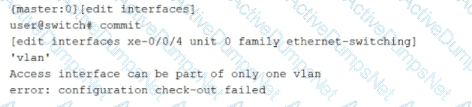
What are two ways to solve the configuration error shown in the exhibit? Choose two.
Options:
Connect the xe-0/0/4 interface to the network.
Configure the xe-0/0/4.0 interface as a member of a single VLAN.
Configure the xe-0/0/4.0 interface as a trunk port.
Configure the logical unit number to match the default VLAN ID.
Answer:
B, CExplanation:
The commit error indicates that the interface is being treated as an access port while the configuration attempts to associate it with more than one VLAN. In Junos Ethernet switching, an access mode interface represents a single untagged VLAN membership. Because access ports accept and transmit frames without 802.1Q tags, the switch must map all ingress untagged traffic to exactly one VLAN. For that reason, Junos enforces the rule that an access interface can be part of only one VLAN, and it rejects configurations that try to add multiple VLAN members under access mode.
There are two valid ways to resolve this, depending on the intended design. First, if the port truly connects to a single endpoint that should live in only one broadcast domain, configure the interface as a member of only one VLAN. This aligns with access port semantics and eliminates the conflict that causes the commit to fail.
Second, if the endpoint or downstream device needs to carry multiple VLANs over the same physical link, change the interface to trunk mode. A trunk port is designed to transport multiple VLANs using 802.1Q tagging, so multiple VLAN members are valid and expected. In data center environments, trunking is common for server virtualization hosts, appliance uplinks, and switch-to-switch links.
Connecting the interface to the network does not affect configuration validation, and logical unit numbering is unrelated to VLAN membership rules for access ports.
Referring to the exhibit,
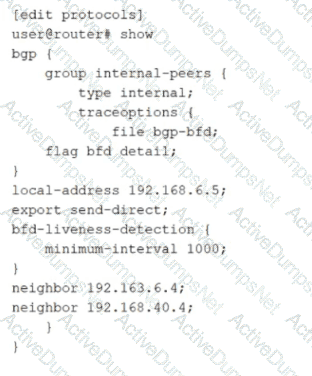
how much time must pass before a neighbor is considered down?
Options:
5000 ms
2000 ms
1000 ms
3000 ms
Answer:
DExplanation:
The exhibit shows BFD liveness detection configured under a BGP group with minimum-interval set to 1000 milliseconds. In Junos, BFD provides rapid failure detection by sending periodic BFD control packets between neighbors. The minimum-interval value is the negotiated minimum transmit and receive interval used for BFD control packets for that session. A neighbor is declared down when the local system fails to receive a certain number of consecutive BFD packets within the expected time window.
That time window is determined by the BFD detection time, which is calculated as the minimum-interval multiplied by the BFD multiplier. The multiplier represents how many BFD control packets can be missed before the session is considered failed. If the multiplier is not explicitly configured, Junos uses the default multiplier value of 3. Therefore, with minimum-interval set to 1000 ms and the default multiplier of 3, the detection time becomes 3000 ms. After approximately 3 seconds without receiving the expected BFD control packets, the BFD session transitions to down and BGP can react by treating the associated peer as unreachable for fast convergence.
This behavior is commonly used in data center underlays and EVPN fabrics to reduce convergence time compared to relying only on BGP hold timers.
Exhibit:
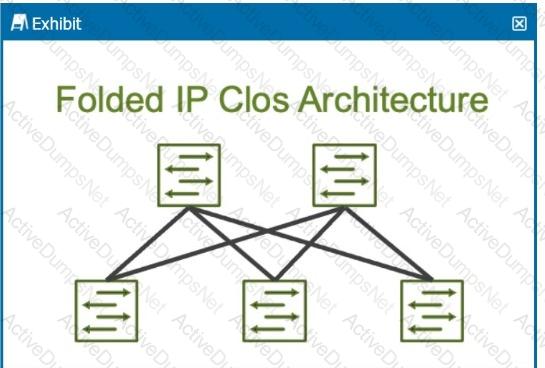
How many stages are shown in the exhibit?
Options:
2
5
6
3
Answer:
DExplanation:
The exhibit shows a Folded IP Clos Architecture, which is also referred to as a 3-stage Clos network design. This architecture typically consists of two layers of switches:
Spine Layer: The top row of switches.
Leaf Layer: The bottom row of switches.
Step-by-Step Breakdown:
Clos Architecture:A 3-stage Clos network has two types of devices: spine and leaf. In this design, each leaf switch connects to every spine switch, providing a high level of redundancy and load balancing.
Stage Explanation:
Stage 1: The first set of leaf switches.
Stage 2: The spine switches.
Stage 3: The second set of leaf switches.
The Folded Clos architecture shown here effectively "folds" the 3-stage design by combining the ingress and egress leaf layers into one, reducing it to two visible layers, but still maintaining the overall 3-stage architecture.
Juniper Reference:
IP Clos Architecture: The 3-stage Clos design is commonly used in modern data centers for high availability, redundancy, and scalability.
You are creating a static route with a next hop that is not directly connected. Which feature should be used to accomplish this task?
Options:
install
resolve
qualified next hop
retain
Answer:
BExplanation:
In Junos, a static route normally expects its next hop to be directly reachable on a connected interface. When the configured next hop is not directly connected, the router must determine how to reach that next hop using an existing route in the routing table. The resolve feature provides this behavior by allowing Junos to recursively resolve the configured static next hop through another route, such as an IGP learned route, a directly connected route to an intermediate device, or even another static route. Once the system can resolve the next hop to a usable outgoing interface and a final forwarding next hop, the static route becomes active and can be installed in the forwarding table.
This is common in data center environments where you want to point a static route at a loopback address, a service node address, or a next hop that is reachable through the fabric underlay rather than a directly connected subnet. With resolve enabled, the static route’s validity follows the reachability of the recursive path. If the supporting route used for resolution disappears, the static route is withdrawn, helping avoid blackholing traffic toward an unreachable next hop.
The qualified next hop feature is used to define primary and backup next hops with different preferences for the same static route, not to solve indirect reachability by itself. The install and retain options influence route installation and retention behaviors but do not provide recursive resolution of a non-direct next hop.
You are creating an IP fabric underlay and want to use OSPF as your routing protocol.
In this scenario, which statement is correct?
Options:
All leaf devices must be configured in separate OSPF areas.
All leaf and spine devices must be the same model to ensure the proper load-balancing behavior.
Interface speeds should be the same throughout the fabric to ensure that all links are utilized.
All spine devices must use the same router ID.
Answer:
CExplanation:
When creating an IP fabric underlay using OSPF as the routing protocol, consistent interface speeds are important to ensure optimal traffic distribution and utilization of all links.
Step-by-Step Breakdown:
OSPF and Interface Speeds:OSPF calculates the cost of a link based on its bandwidth. The default cost calculation in OSPF is:

If interface speeds vary significantly, OSPF may choose paths with lower cost (higher bandwidth), resulting in some links being underutilized.
Equal Utilization:To ensure that all links are equally utilized in an IP fabric, it is recommended to maintain uniform interface speeds across the fabric. This ensures balanced load sharing across all available paths.
Juniper Reference:
IP Fabric with OSPF: Juniper recommends consistent interface speeds to maintain even traffic distribution and optimal link utilization in IP fabric underlay designs.
Which two statements about VLANs are true? Choose two.
Options:
By default, ports in a VLAN operate in trunk mode.
A single VLAN is limited to only half of a switch's physical ports.
A single VLAN can include all of a switch's physical ports.
By default, ports in a VLAN operate in access mode.
Answer:
C, DExplanation:
In Junos Ethernet switching, a VLAN is a Layer 2 broadcast domain and can include any set of switch ports that you assign to it. There is no generic rule that limits a VLAN to only half of a switch’s physical ports. Practically, a single VLAN can include all physical ports on the switch if that is how the environment is designed, for example in a flat Layer 2 segment for a specific purpose or during a migration. This makes statement C correct.
For interface mode behavior, access mode is the default expectation for endpoint-facing Layer 2 ports where traffic is normally untagged. In Junos, when an interface is configured for Ethernet switching and no explicit trunk configuration is applied, the operational intent aligns with access behavior: the port is associated with a single VLAN and forwards frames as untagged on the wire. Trunk mode must be explicitly configured when the link needs to carry multiple VLANs using 802.1Q tagging, such as switch-to-switch uplinks or server connections that tag multiple VLANs. Therefore, statement D is correct and statement A is incorrect because trunk mode is not the default behavior.
This distinction is important in data center operations because misidentifying an access port as a trunk can lead to dropped traffic, VLAN mismatch, or unexpected flooding behavior.
Verification sources from Juniper documentation
https://www.juniper.net/documentation/us/en/software/junos/multicast-l2/topics/topic-map/bridging-and-vlans.html
https://www.juniper.net/documentation/us/en/software/junos/multicast-l2/topics/task/interfaces-configuring-ethernet-switching-access.html
When evaluating BGP routes, what will be evaluated first?
Options:
The local preference value
The AS path
The MED value
The origin value
Answer:
AExplanation:
In BGP (Border Gateway Protocol), when evaluating multiple routes to the same destination, the first attribute that is considered is the local preference value. The local preference is a BGP attribute used to influence outbound routing decisions within an Autonomous System (AS).
Step-by-Step Breakdown:
Local Preference:The local preference attribute is used to determine which path is preferred for traffic leaving the AS. The higher the local preference value, the more preferred the route.
BGP Path Selection:The BGP path selection process evaluates the following attributes in this order:
Local Preference (higher is preferred)
AS Path (shorter is preferred)
Origin (IGP > EGP > incomplete)
MED (Multi-Exit Discriminator) (lower is preferred)
Juniper Reference:
BGP Path Selection: In Junos, the local preference attribute is the first to be evaluated when determining the best path for outbound traffic.
Which statement is correct about the native VLAN ID feature? Choose one.
Options:
It restricts a trunk port to only send and receive tagged traffic.
It enables an access port to send and receive tagged traffic.
It restricts the usable VLAN IDs from 0 to 1024.
It enables trunk ports to send and receive untagged traffic.
Answer:
DExplanation:
In Junos Ethernet switching, a trunk interface is intended to carry multiple VLANs using 802.1Q tags. The native VLAN ID feature defines how the trunk handles frames that arrive without an 802.1Q tag and how it can transmit untagged frames when required. When a native VLAN is configured on a trunk, untagged inbound frames are mapped into the native VLAN’s Layer 2 broadcast domain. Likewise, traffic belonging to the native VLAN can be sent untagged on that trunk, depending on how the receiving device expects to process untagged frames. This is commonly used in data center environments to interoperate with devices that require one VLAN to be carried untagged, or for specific control-plane or legacy connectivity requirements.
Option A is incorrect because native VLAN does not restrict the trunk to tagged-only traffic; it explicitly provides a mechanism to accept or emit untagged frames on a trunk. Option B is incorrect because access ports are designed for a single VLAN and normally treat traffic as untagged by default; they do not become “tagged access” by using native VLAN. Option C is incorrect because native VLAN does not change the VLAN ID range; VLAN ID ranges are determined by the 802.1Q standard and platform support, not by the native VLAN feature.
Which two statements are correct about configuring VLANs? Choose two.
Options:
You must assign an IRB interface to each VLAN.
You must assign a VLAN name or ID and a Layer 2 interface to the VLAN.
You can assign one or more VLANs to a trunk mode interface.
You can assign one or more VLANs to an access mode interface.
Answer:
B, CExplanation:
On Junos switching platforms commonly used in data centers, a VLAN is a Layer 2 construct that defines a broadcast domain. To make a VLAN usable, you define the VLAN using a name and typically a VLAN ID, then associate Layer 2 interfaces with it so traffic entering those interfaces is placed into that VLAN. Without membership on interfaces, the VLAN exists in configuration but does not carry user traffic, because no ports participate in that broadcast domain.
Trunk mode interfaces are specifically designed to carry traffic for multiple VLANs over a single physical link, such as between switches, to servers using tagging, or to other network devices that understand VLAN tags. In Junos, trunking is implemented by allowing a list of VLAN IDs on the trunk so the interface accepts and forwards frames for those VLANs. This makes statement C correct.
An IRB interface is not mandatory for every VLAN. IRB is used when you want Layer 3 routing for a VLAN, typically to provide a default gateway and enable inter VLAN routing. Pure Layer 2 VLANs do not require IRB, which makes statement A incorrect.
Access mode interfaces are intended to connect to a single endpoint and carry traffic for a single VLAN, so assigning multiple VLANs to an access interface is not correct in standard access mode behavior, making statement D incorrect.
Unlock JN0-281 Features
- JN0-281 All Real Exam Questions
- JN0-281 Exam easy to use and print PDF format
- Download Free JN0-281 Demo (Try before Buy)
- Free Frequent Updates
- 100% Passing Guarantee by Activedumpsnet
Questions & Answers PDF Demo
- JN0-281 All Real Exam Questions
- JN0-281 Exam easy to use and print PDF format
- Download Free JN0-281 Demo (Try before Buy)
- Free Frequent Updates
- 100% Passing Guarantee by Activedumpsnet