
Juniper JN0-106 Junos - Associate (JNCIA-Junos) Junos OS 21.2 Exam Practice Test
Junos - Associate (JNCIA-Junos) Junos OS 21.2 Questions and Answers
Your system administrator notified the infrastructure team that all server NICs will be moving to jumbo frames. All of the NICs used by servers are 1 gigabit. The starting frame size will be 4K. The exact frame size may change depending on testing results. In this scenario, which choice would provide a flexible solution?
Options:
Create a group that adjusts MTU size on 1 gigabit interfaces and apply at the interfaces level.
Apply the MTU to each interface family for each 1 gigabit interface.
Set the app-engine compute-cluster Ethernet MTU size for the Junos VM.
Use the system internet-options path-mtu-discovery to dynamically adjust MTU.
Answer:
AExplanation:
In large-scale Junos deployments, efficiency and flexibility are achieved through the use of configuration groups . When faced with a requirement like moving all 1-gigabit interfaces to jumbo frames—with the caveat that the exact MTU value (e.g., 4000 bytes) might change after testing—manually editing every interface is both tedious and prone to error.
By creating a configuration group under the [edit groups] hierarchy, you can define the MTU parameter once. You then use the apply-groups statement at the [edit interfaces] level or on specific interface ranges. This creates a " template " effect. The flexibility comes into play during the testing phase: if results indicate that a 9000-byte MTU is preferable to 4000 bytes, the architect only needs to modify the value in the group definition. The Junos OS inheritance mechanism automatically propagates this update to every interface associated with that group.
Applying MTU at the family level (Option B) is less efficient and doesn ' t handle the physical Layer 2 MTU requirements of jumbo frames as effectively. Path-MTU discovery (Option D) is a protocol-level function for avoiding fragmentation but does not configure the local interface ' s hardware capability to accept larger frames. Thus, groups represent the best practice for centralized, scalable management.
When multiple routes exist to the same destination IP address, which rule do routers use to select the next hop?
Options:
They choose the route with the longest prefix match.
They choose a route at random to balance paths.
They choose the route with the largest administrative distance.
They choose the route learned most recently.
Answer:
AExplanation:
The primary and most critical rule used by Junos OS (and routers in general) to determine the next hop for a specific packet is the Longest Prefix Match (LPM) algorithm. When the Routing Engine or Packet Forwarding Engine looks up a destination IP address in the routing or forwarding table, it may find several entries that technically encompass that address. The LPM rule dictates that the router must select the most specific route available—that is, the entry with the highest number of matching bits in its subnet mask (the longest prefix).
For example, if a router has a route for 10.1.1.0/24 and another for 10.1.1.0/28, a packet destined for 10.1.1.1 will always be forwarded according to the /28 route, as it is more specific. Longest prefix match takes precedence over all other selection criteria, including route preference (administrative distance) and metrics. Preference and metrics are only evaluated when the router has multiple entries for the exact same prefix length (e.g., two different paths to 10.1.1.0/24). This logic ensures that traffic is guided along the most precise path defined in the network topology. Routers never choose paths at random or based on the most recent update as their primary selection mechanism, as doing so would result in non-deterministic and inefficient routing behavior. Reference: Routing Fundamentals, Routing Table and Forwarding Table Selection.
==========
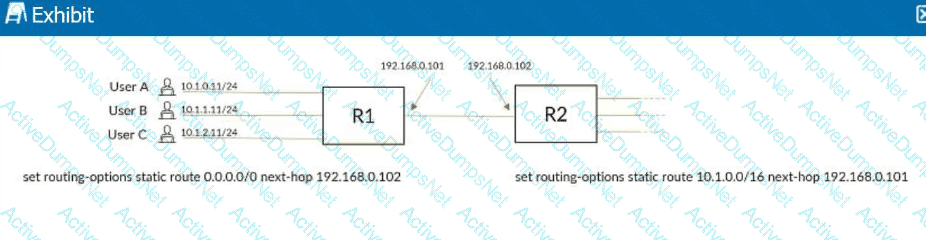
Which statement is correct about traffic flow in the network shown in the exhibit?
Options:
A routing loop can occur if one of the users sends packets to 10.1.99.1.
Only User A can reach destinations beyond Router R1.
Router R2 will drop packets destined for user B and user C.
Router R1 will discard all packets from all three users.
Answer:
AExplanation:
The configuration exhibit demonstrates a classic scenario where mismatched static routing leads to a routing loop . Router R1 is configured with a default route ( 0.0.0.0/0 ) pointing to R2 as its next hop. Conversely, R2 is configured with a broad static route for 10.1.0.0/16 pointing back to R1 .
If a user sends a packet to an unassigned IP address such as 10.1.99.1 , the following sequence occurs:
R1 receives the packet and consults its routing table. Finding no specific match for the 10.1.99.1 host, it uses the default route and forwards the packet to R2 .
R2 receives the packet and identifies that 10.1.99.1 falls within its defined static route for 10.1.0.0/16 .
Following its configuration, R2 forwards the packet back to R1 . This process repeats indefinitely—or until the packet ' s Time to Live (TTL) reaches zero—because the broad summary on R2 encompasses addresses that R1 does not actually have a local path for. This illustrates the critical importance of ensuring that summary routes or default routes do not overlap in a way that creates circular forwarding paths for non-existent destinations. Reference: Routing Fundamentals, Static Route Configuration, Routing Loops and TTL.
==========
Your team alerts you that users connected to ge-0/0/5 are experiencing intermittent slowness. You log in to the switch and want to see live, real-time traffic updates for that interface to determine whether the link is being over-utilized. Which monitoring command should you use in this scenario?
Options:
show chassis hardware
monitor interface ge-0/0/5
show interfaces terse
show interfaces ge-0/0/5 extensive
Answer:
BExplanation:
In the Junos OS environment, distinguishing between static diagnostic data and real-time telemetry is crucial for effective troubleshooting. While commands like show interfaces provide a cumulative snapshot of counters since the last reboot or counter clear, they do not easily reveal instantaneous spikes or fluctuating utilization patterns. To address the requirement for " live, real-time traffic updates, " the monitor interface command is the correct operational tool.
When an architect executes monitor interface ge-0/0/5, the CLI launches an interactive, ncurses-based screen that refreshes every second. This display provides immediate visibility into input and output bits-per-second (bps), packets-per-second (pps), and error increments. Unlike static commands, this real-time stream allows a technician to observe micro-bursts or sustained high-utilization periods as they occur, which is essential for diagnosing " intermittent slowness " caused by congestion. In contrast, show chassis hardware focuses on physical inventory, and show interfaces terse only provides administrative and operational status. Even the extensive version of the show command only offers a point-in-time calculation of averages. Therefore, monitor interface is the primary mechanism for interactive performance auditing of individual ports on the Packet Forwarding Engine.
Which two statements are correct about SNMPv3? (Choose two.)
Options:
It uses plain-text community strings.
It protects against tampering and eavesdropping.
It is simpler to configure than SNMPv2c.
It provides encrypted passwords for secure communication.
Answer:
B, DExplanation:
Simple Network Management Protocol version 3 (SNMPv3) represents a significant security evolution over its predecessors, SNMPv1 and SNMPv2c. While earlier versions relied on " community strings " sent in plain-text—which are easily intercepted and provide minimal security—SNMPv3 introduces a comprehensive security framework known as the User-based Security Model (USM). The primary benefit of SNMPv3 is that it protects against tampering and eavesdropping. It achieves this through two main mechanisms: message integrity (authentication), which ensures that a packet has not been altered in transit, and data confidentiality (privacy), which encrypts the payload of the SNMP packets using advanced algorithms like AES or DES.
Furthermore, SNMPv3 provides for secure communication by utilizing encrypted credentials rather than cleartext strings. Administrators define specific users and assign them security levels: noAuthNoPriv, authNoPriv, or authPriv. In the most secure mode (authPriv), the system requires both a password for authentication (validated via MD5 or SHA hashes) and a separate password for encryption. This architecture ensures that management traffic—including sensitive device telemetry and configuration data—remains confidential and authenticated as it traverses the network. While SNMPv3 is inherently more complex to configure than SNMPv2c due to these additional security parameters, it is the required standard for any production Junos environment where management plane integrity is a priority.
Which two traffic types are processed by a Routing Engine using Junos OS? (Choose two.)
Options:
traffic with CoS markings
transit traffic
routing updates
local management traffic
Answer:
C, DExplanation:
The Routing Engine (RE) in a Junos device serves as the centralized intelligence and management hub, primarily responsible for the control and management planes of the system. In this capacity, the RE is tasked with processing routing updates, such as OSPF Link State Advertisements (LSAs) or BGP Update messages. These updates are vital for the RE to maintain the Routing Information Base (RIB), calculate the shortest paths, and subsequently populate the Forwarding Information Base (FIB) which is then pushed to the Packet Forwarding Engine (PFE).
Furthermore, the Routing Engine handles all local management traffic. This category encompasses administrative access through the Command Line Interface (CLI) via SSH or Telnet, SNMP queries from network management systems, and system logging processes. Because the RE runs the Junos OS kernel, it must directly interpret and respond to these management-level requests to ensure the device remains configurable and observable. Conversely, transit traffic—the data passing through the device from one ingress port to an egress port—is offloaded to the PFE to be handled at wire speed. While the PFE manages the heavy lifting of data forwarding and Class of Service (CoS) application, the RE remains focused on high-level protocol maintenance and system administration, ensuring that control plane stability is maintained even under heavy traffic loads. Reference: Junos OS Fundamentals, Control Plane Functions, Routing Engine Traffic.
==========
What does the Junos CLI prompt indicate when it ends with a hash symbol (#)?
Options:
The user is in operational mode.
The user is in configuration mode.
The user is in shell mode.
The user is in recovery mode
Answer:
BExplanation:
In the Junos OS, the Command Line Interface (CLI) uses distinct prompt symbols to provide the administrator with immediate contextual awareness of their current operating environment. When the prompt ends with a hash symbol (#) , it indicates that the user is in configuration mode .
This mode is the " engine room " of the device, where you modify the candidate configuration. Here, you can add, delete, or modify statements across the various hierarchies like [edit system], [edit interfaces] , or [edit protocols]. It is important to remember that changes made while the # prompt is visible are not active until a commit command is successfully executed.
Contrast this with the operational mode , which is indicated by a greater-than symbol ( > ) . Operational mode is used for monitoring, troubleshooting, and viewing the system status (e.g., show commands). Moving between these modes is a fundamental part of the Junos workflow: you enter configuration mode by typing configure and return to operational mode by typing exit or quit. If you see a percent sign (%), you ' ve wandered into the FreeBSD shell mode , which is a lower-level Unix environment typically reserved for advanced system maintenance. Recognizing that # means you have the power to change the system ' s " brain " is a key safety check for any network architect.
Options:
Configure an NTP server.
Configure a DNS server.
Set the date and time setting manually.
Reboot the device.
Answer:
A, CExplanation:
In Junos OS, configuring the time-zone (such as America/LosAngeles) within the [edit system] hierarchy establishes the offset from Coordinated Universal Time (UTC) and governs how the device displays timestamps for logs and system events. However, simply setting the timezone does not adjust the underlying system hardware clock; it only dictates how that clock ' s data is interpreted and presented. To ensure the device reflects the correct local time, the administrator must either synchronize the system with an external reference or manually input the current date and time.
Configuring a Network Time Protocol (NTP) server is the preferred professional method, as it allows the device to automatically synchronize its clock with a reliable stratum source, ensuring long-term accuracy and consistency across the network. Alternatively, the set date operational mode command can be used to manually define the current year, month, day, hour, and minute. While a DNS server is necessary for resolving the hostnames of NTP servers, it does not provide time data itself. Furthermore, rebooting the device will not correct a fundamentally unset or drifting clock. Therefore, combining the correct timezone with either NTP synchronization or a manual date setting is the standard procedure for establishing temporal accuracy on a Junos platform. Reference: Operational Monitoring and Maintenance, System Time and NTP.
==========
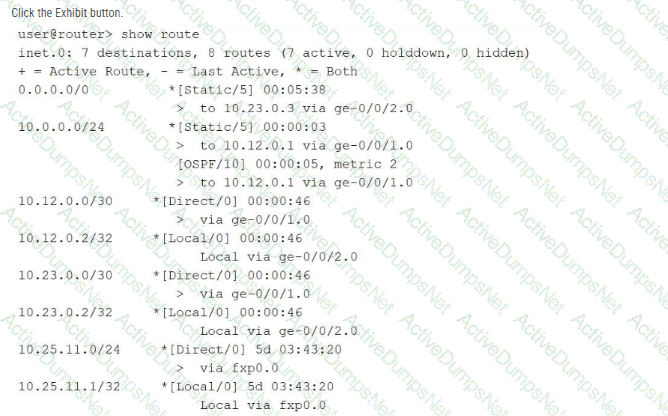
Referring to the exhibit, what would be the next-hop address for the packet destined for the 10.0.0.0/24 network if the ge-0/0/1 interface goes down?
Options:
10.23.0.3
10.12.0.2
10.12.0.1
10.25.11.1
Answer:
AExplanation:
Analyzing the provided exhibit of the inet.0 routing table reveals that the destination network 10.0.0.0/24 currently has two viable paths: a static route with a preference of 5 and an OSPF route with a preference of 10. Both routes are configured to use 10.12.0.1 via the ge-0/0/1.0 interface as their primary next hop. The static route is currently marked with an asterisk (*), indicating it is the active path chosen by the Routing Engine due to its lower preference value.
In the event that the ge-0/0/1 interface transitions to a " down " state, the physical layer failure triggers the immediate invalidation of all routes associated with that link. Consequently, both the specific static and OSPF routes for the 10.0.0.0/24 prefix are purged from the active forwarding table. The Routing Engine must then perform a re-evaluation of the routing table to identify the next best match for any traffic destined for that range. Since there are no other more specific or equally specific routes available for the 10.0.0.0/24 network, the router falls back to the default route (0.0.0.0/0) . As shown in the exhibit, the default route points to the next-hop address 10.23.0.3 via interface ge-0/0/2.0 . Therefore, if the primary interface fails, traffic will be redirected through this secondary gateway.
Which two statements describe rollback configuration behavior in Junos OS? (Choose two.)
Options:
Rollback configurations are applied automatically after a commit confirmed timeout.
Rollback 0 always refers to the factory default configuration.
Rollback files are stored automatically after each commit.
Up to 100 rollback configurations are maintained by default.
Answer:
A, CExplanation:
Junos OS incorporates a robust configuration versioning and recovery system designed to protect against configuration errors and human oversight. A key feature of this system is that rollback files are stored automatically by the device after each successful commit. These files represent a historical record of previous active configurations. By default, the system maintains a set number of these files, allowing an administrator to revert to a previous state (e.g., rollback 1) if the most recent changes result in unexpected network instability.
Another critical safety mechanism is the behavior associated with the commit confirmed command. If an administrator issues this command but fails to provide a subsequent confirmation within a designated timeframe (defaulting to 10 minutes), the system assumes a loss of management connectivity. Consequently, the rollback configurations are applied automatically after the commit confirmed timeout to restore the previous known-good state. This is an essential best practice for remote configuration management. It is important to note that rollback 0 refers to the currently active configuration, not the factory default, and that while Junos supports maintaining a large number of rollback files, the primary operational benefit lies in the automated storage and confirmation-based recovery processes that ensure the device remains reachable and stable. Reference: Configuration Basics, Rollback Configurations, Commit Confirmed Logic.
==========
Click the Exhibit button.
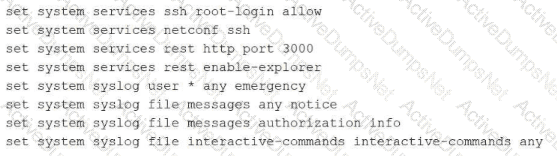
Which command displays the output in the format shown in the exhibit?
Options:
show configuration | display inheritance
show configuration | display set
show configuration
show configuration | display detail
Answer:
BExplanation:
The exhibit illustrates a Junos configuration rendered as a sequence of flat, executable lines that each begin with the set keyword. This is commonly referred to as the " set format. " By default, Junos OS displays the configuration in a hierarchical, brace-delimited format (often called " staza " or " curly brace " format). While the default format is excellent for visualizing the structural relationship between different configuration objects, the set format is often preferred for documentation, scripting, or copying specific configuration snippets between different devices.
To produce the output seen in the exhibit, an administrator must append the pipe filter | display set to the show configuration command. This filter instructs the CLI parser to flatten the hierarchical structure and prepend the necessary context to every individual leaf statement. These lines are highly functional because they can be pasted directly into the CLI of another device while in configuration mode to recreate the exact settings. In contrast, display inheritance is used to reveal hidden settings applied via configuration groups, and display detail provides additional technical metadata about the objects. Neither of those options would transform the output into the discrete set command lines shown in the exhibit. Understanding how to toggle between these display formats is a fundamental skill for any architect managing Junos infrastructures through the Command Line Interface.
Which two statements about firewall filters are correct? (Choose two.)
Options:
Firewall filters are stateful.
Firewall filters can match Layer 4 parameters.
Firewall filters can match Layer 7 parameters.
Firewall filters are stateless.
Answer:
B, DExplanation:
In Junos OS, standard firewall filters operate as a primary security and traffic management tool within the forwarding plane. These filters are fundamentally stateless, meaning they evaluate each packet individually and in isolation without maintaining a session table or tracking the state of network connections. This stateless nature allows the Packet Forwarding Engine (PFE) to process filters at hardware speeds, ensuring minimal latency for transit traffic. This distinguishes them from the stateful security policies found on Junos security devices like the SRX Series, which track the entire lifecycle of a flow.
Furthermore, firewall filters are designed to inspect and match header information up to Layer 4 of the OSI model. This capability allows administrators to define terms based on parameters such as source and destination IP addresses (Layer 3) as well as TCP or UDP port numbers and protocol types (Layer 4). While they provide granular control over packet flow, they do not natively inspect Layer 7 application payloads, which is typically reserved for advanced services like Intrusion Detection and Prevention (IDP). By combining stateless execution with Layer 4 matching, Junos firewall filters provide an efficient method for implementing transit protection, rate limiting through policing, and protecting the local Routing Engine through loopback interface filtering. Reference: Routing Policy and Firewall Filters, Firewall Filter Framework.
==========
According to HPE Juniper Networking, what are two recommended tasks you should perform before upgrading Junos OS on a device? (Choose two.)
Options:
Delete all rollback configurations.
Verify available storage space using the show system storage command.
Disable all interfaces to prevent traffic during the upgrade.
Back up the active current configuration.
Answer:
B, DExplanation:
Upgrading the Junos OS is a high-impact operation that requires thorough preparation to minimize risk and potential downtime. According to Juniper ' s best practices, one of the most critical preliminary steps is to verify that the device has sufficient available storage space. Using the show system storage command, an administrator can inspect the /var partition, which is the primary directory where software packages are temporarily stored and expanded during the installation process. If the storage is nearly full, the upgrade may fail midway, potentially leaving the device in an inconsistent state or requiring manual intervention via the boot loader.
The second mandatory task is to back up the active configuration . While Junos automatically maintains rollback files locally, these could be lost if the storage media fails or if a " clean install " (format install) becomes necessary. Having an external backup on a remote server or a local workstation ensures that the device ' s identity, policies, and interface settings can be restored quickly regardless of the upgrade outcome. Other tasks, such as creating a rescue configuration or performing a file system cleanup, are also highly recommended to ensure the " last known good " state is preserved. Disabling interfaces is generally unnecessary as Junos manages the transition gracefully, and deleting rollbacks would counterproductively remove historical recovery points. Ensuring these two pillars—storage availability and off-box backups—provides the safest foundation for a successful software lifecycle management event.
What are two functions of the Routing Engine? (Choose two.)
Options:
It evaluates firewall filters for transit traffic.
It runs Junos OS.
It processes all management traffic.
It processes transit traffic.
Answer:
B, CExplanation:
The Routing Engine (RE) is the " brains " of a Juniper device, representing the control plane in the Junos dual-plane architecture. One of its primary functions is that it runs the Junos OS . The RE is essentially a high-performance workstation running a specialized version of FreeBSD that hosts the various software daemons responsible for the device ' s logic, such as the Routing Protocol Process (rpd) and the Device Control Process (dcd).
The second core function is that the RE processes all management traffic . Any packet destined for the router itself—such as an SSH session, an SNMP poll, a NETCONF request, or an NTP update—is handled by the Routing Engine ' s CPU. The RE also maintains the master routing table, manages configuration commits, and provides the CLI environment for the administrator.
It is critical to distinguish these control-plane duties from the duties of the Packet Forwarding Engine (PFE) . The PFE is responsible for the " heavy lifting, " such as processing transit traffic (data passing through the router) and evaluating firewall filters at wire speed. While the RE defines the policies and routing tables, it hands off a streamlined version of this information to the PFE so the RE isn ' t bogged down by millions of individual packets. This separation ensures that a busy management session or a complex routing calculation on the RE doesn ' t impact the device ' s ability to forward traffic at maximum capacity.
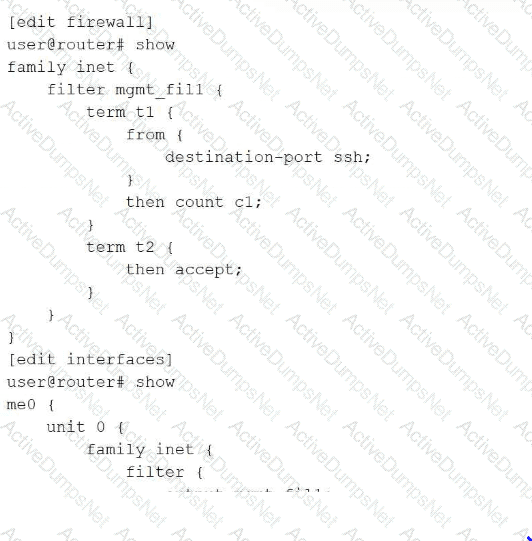
Which two statements are true about the firewall filter configuration shown in the exhibit? (Choose two.)
Options:
It applies the filter to a physical interface.
It counts the number of SSH packets that egress from the source SSH interface.
It evaluates SSH packets egressing from the management interface.
It sends filtered data to a syslog file.
Answer:
A, CExplanation:
The exhibit illustrates the configuration of a firewall filter named mgmt_fill and its subsequent application to an interface. The first true statement is that the filter is applied to a physical interface . The configuration shows the filter attached to me0 , which in Junos nomenclature represents the Management Ethernet port—a dedicated physical port for out-of-band management traffic. This is separate from logical or virtual interfaces, as me0 provides the physical link for administrative access.
The second true statement is that the filter evaluates SSH packets egressing from the management interface . In the provided snippet, term t1 specifically matches the destination-port ssh , and the filter is applied to the interface unit. When a filter is applied to an interface, it can monitor traffic entering or leaving the device. Furthermore, the filter utilizes a count action (count c1), which is a non-terminating action used to provide telemetry on specific traffic types passing through that physical port. There is no mention of a syslog or log action in the configuration, meaning that while packets are counted, they are not being written to the system log files. This configuration is a standard method for hardening the management plane and tracking administrative session activity on the Routing Engine. Reference: Routing Policy and Firewall Filters, Firewall Filter Actions, Management Interfaces.
==========
You must securely log in to a Junos device to perform maintenance.
Which command would you use to accomplish this task?
Options:
ftp 172.16.10.1
traceroute 172.16.10.1
telnet 172.16.10.1
ssh 172.16.10.1
Answer:
DExplanation:
Secure remote administrative access to a Junos OS device is performed by using SSH (Secure Shell) . Therefore, ssh 172.16.10.1 is the correct command. Juniper defines the Junos CLI ssh operational command as a mechanism for opening a secure connection between a local router or switch and a remote system. The destination can be specified by hostname or IP address.
SSH provides authenticated and encrypted remote access, protecting login credentials and management traffic while the administrator performs configuration, monitoring, or maintenance operations. Junos devices can accept incoming SSH sessions when SSH is enabled under the [edit system services ssh] configuration hierarchy.
telnet 172.16.10.1 can establish a remote terminal session, but Telnet does not provide the encryption required for secure administrative access. ftp is principally a file-transfer protocol and is not the appropriate mechanism for interactive device maintenance. traceroute is an operational diagnostic utility used to identify the Layer 3 path toward a destination; it does not provide device login functionality.
Study Guide Reference Topics: User Interfaces — CLI remote access; Junos OS Fundamentals — system services; Operational Monitoring and Maintenance — secure device management.
Which interface type prefix represents a 10-Gigabit Ethernet interface?
Options:
ge
xe
et
fe
Answer:
BExplanation:
In Junos OS, the naming convention for physical interfaces is highly structured, providing immediate information regarding the media type, hardware location, and port number. The prefix of an interface name is a two-letter or three-letter code that identifies the speed and physical transmission characteristics of the interface. For 10-Gigabit Ethernet (GbE) interfaces, the correct prefix is xe. This prefix is a standard identifier across Junos platforms, regardless of whether the interface is fixed or modular.
Understanding these prefixes is essential for navigating the Junos configuration hierarchy and performing operational monitoring. For comparison, other common prefixes include fe for Fast Ethernet (10/100 Mbps), ge for Gigabit Ethernet (1 Gbps), and et for higher-speed interfaces such as 40-GbE or 100-GbE. When an administrator views the output of commands like show interfaces terse, identifying the xe prefix allows for the quick verification of high-bandwidth links within the network fabric. This standardized nomenclature ensures consistency across different hardware families, such as the EX, MX, and QFX series, facilitating easier management and troubleshooting for network architects. This concludes the provided set of questions from the Junos Associate (JNCIA-Junos) curriculum. Reference: Junos OS Fundamentals, Interface Naming Conventions.
Which statement describes the primary purpose of a routing policy in Junos OS?
Options:
It controls which routes are accepted or advertised by a routing protocol. B. It determines the physical interface used for forwarding traffic. C. It sets the maximum number of routes in the routing table. D. It enables automatic rollback of routing changes.
Answer:
AExplanation:
In Junos OS, a routing policy is a powerful tool used to manage the flow of routing information between the Routing Information Base (RIB) and routing protocols. Unlike forwarding decisions, which are handled by the Packet Forwarding Engine, routing policies function within the control plane on the Routing Engine. Their primary purpose is to define specific criteria for importing routes into the routing table from neighbors or exporting routes from the routing table to neighbors.
Routing policies consist of terms containing from (match) and then (action) statements. They allow administrators to filter prefixes (e.g., denying specific BGP routes), modify route attributes (e.g., changing OSPF metrics or BGP communities), and manipulate path selection behavior. For example, an export policy might be used to ensure that only specific internal subnets are advertised to an ISP via BGP, preventing the accidental leakage of private infrastructure addresses. By default, Junos applies " default policies " for each protocol (such as OSPF accepting all OSPF routes), but custom policies allow for granular control over how the device interacts with the rest of the network. This ensures that the routing table contains only the desired paths for optimal traffic engineering.
Which Junos tool should you use to identify the path that packets take through the network to a destination?
Options:
monitor interface traffic
traceroute
SNMP
ping
Answer:
BExplanation:
When you need to visualize the hop-by-hop journey of a packet across a multi-vendor or Junos-based network, traceroute is the definitive operational tool. Unlike ping , which merely confirms end-to-end reachability by eliciting an Echo Reply, traceroute provides a clinical breakdown of every Layer 3 device (router or switch) in the path.
The mechanics of this tool are quite clever: it sends out a sequence of packets (usually UDP or ICMP) with an increasing Time-to-Live (TTL) value, starting at 1. When the first router receives the packet, it decrements the TTL to 0, discards the packet, and sends an ICMP " Time Exceeded " message back to the source. This informs your Junos device of the first hop ' s identity. This process repeats, incrementing the TTL each time, until the packet reaches the final destination. This path discovery is vital for identifying where traffic might be diverted by a misconfigured routing policy or where latency is being introduced in the network fabric. While monitor interface traffic gives you real-time throughput on a local port and SNMP provides historical telemetry to a management station, neither can map the external topological path like traceroute. In the Junos CLI, you can even specify the source address or bypass the routing table to test specific egress paths.
Which two tasks should be performed when creating a new user account on a Junos device? (Choose two.)
Options:
Assign the user to a login class.
Enable SSH for the user explicitly.
Configure a password for the user.
Configure the user to bypass authentication.
Answer:
A, CExplanation:
Creating a new user account in Junos OS involves several specific steps within the [edit system login] configuration hierarchy. To establish a functional and secure user account, an administrator must first define the username and assign that user to a login class. Login classes are essential because they define the permissions and access levels for the user, such as super-user, read-only, or operator. Without a login class, a user would have no permissions to perform tasks within the CLI.
The second mandatory task is to configure an authentication method for the user, most commonly a password. This is typically done using the authentication plain-text-password command, which prompts the administrator to enter and confirm the secret string that the system then hashes and stores. While Junos also supports public-key authentication for SSH, a local password remains the standard for basic access control. It is important to note that SSH access is generally controlled at the system level under [edit system services] and does not need to be enabled on a per-user basis individually. Furthermore, allowing a user to bypass authentication is contrary to the Junos security model and is not a standard task in user account creation. Reference: User Interfaces, User Management, Login Classes.
You are using the factory default configuration on a new Juniper router. You must successfully commit the configuration and activate the device. Which component must be configured before Junos OS will allow you to accomplish this task?
Options:
a system hostname
a root-authentication password
at least one logical interface with family inet enabled
a management IP address on the fxp0 interface
Answer:
BExplanation:
When a Junos device is initialized for the first time or after a factory reset, it operates with a " factory-default " configuration. This configuration contains the minimum settings necessary for the device to boot, but it lacks essential security parameters. The Junos OS kernel enforces a strict security mechanism that prevents any administrator from successfully executing a commit command until a root-level password has been defined.
Specifically, the root-authentication object must be configured under the [edit system] hierarchy. This requirement ensures that no Junos device is deployed into a production environment with an open, unauthenticated root account. If an administrator attempts to commit changes without this setting, the configuration parser will return a " missing mandatory statement " error and the commit process will fail. While other settings—such as a system hostname, management IP address (on the fxp0 or me0 interfaces), or logical interface configurations—are critical for operational readiness, they are not strictly enforced by the system validation logic for the initial activation. Only the root-authentication (which can be a plain-text password or an encrypted key) is a hard prerequisite for transitioning the device from a default state to an active, running configuration.
What are two characteristics of transit traffic in Junos OS? (Choose two.)
Options:
It includes routing protocol packets.
It is traffic destined for the Routing Engine.
It does not require control plane processing.
It is forwarded by the Packet Forwarding Engine.
Answer:
C, DExplanation:
Transit traffic represents the primary " workload " of a Junos device; it is the data that enters one network interface and exits another, destined for a remote host. Unlike exception traffic, transit traffic is forwarded exclusively by the Packet Forwarding Engine (PFE) . The PFE uses specialized Application-Specific Integrated Circuits (ASICs) or programmable NPUs to perform lookups in the hardware-based forwarding table (FIB) at wire speed.
A defining characteristic of transit traffic is that it does not require control plane processing . Once the Routing Engine (RE) has populated the PFE with the necessary forwarding instructions, the RE steps out of the way. The packets pass through the PFE ' s ingress processing, lookups, and egress queuing without ever consuming CPU cycles on the Routing Engine. This bypass is what allows Junos devices to maintain massive throughput and low latency, even if the RE is busy recalculating a complex BGP table. Routing protocol packets (like OSPF updates) and traffic destined for the router ' s own management IP address are explicitly not transit traffic; they are control plane traffic because they terminate at the device ' s " brain. " Transit traffic is strictly " pass-through " data.
After the factory default configuration is loaded, which configuration object must be created prior to the first commit?
Options:
host name
loopback IP address
out-of-band connectivity
root authentication
Answer:
DExplanation:
When a Junos device is initialized with its factory default configuration, it essentially exists in a " blank slate " state with minimal operational parameters. The most critical security requirement imposed by Junos OS during this initial setup phase is the mandatory configuration of a root-level password. Specifically, the root-authentication object must be defined within the [edit system] hierarchy before the system will allow the candidate configuration to be successfully committed for the first time.
This is a built-in safety mechanism designed to prevent the device from being deployed in an insecure state with an empty administrative password. If an administrator attempts to execute a commit command without having set the root password, the Junos OS parser will return an error and fail the commit process. While setting a host name or configuring management interfaces are best practices for operational readiness, they are not strictly required by the Junos commit-check logic. Only the root-authentication (typically a plain-text password or an encrypted string) is a hard prerequisite to transition the device from the factory-default state to an active, running configuration. Reference: Configuration Basics, Initial Configuration, Security Requirements.
You must add a large hierarchical configuration to your Junos device. You also want to completely replace the existing candidate configuration with a new configuration file. Which command would allow you to accomplish these tasks?
Options:
load merge terminal
load override terminal
load factory default
load set terminal
Answer:
BExplanation:
The load command in Junos OS provides several operational methods for importing configuration data into the candidate buffer. When an administrator needs to perform a " clean slate " update—where the objective is to completely replace the existing candidate configuration with a new hierarchical file—the override option is the correct tool. Unlike load merge, which blends new data with the existing configuration, or load replace, which only updates specifically tagged sections, load override discards every statement currently in the candidate configuration and substitutes it entirely with the new content.
Using the terminal keyword in conjunction with override allows the architect to paste a large hierarchical configuration directly into the Command Line Interface (CLI). This is the most efficient method for applying validated templates, restoring full system backups, or migrating configurations between devices without having to manually delete existing parameters. After the data is pasted and the process is finalized (typically with a Ctrl+D sequence), the Junos OS kernel validates the new candidate configuration against the device ' s hardware and software capabilities. To make these changes active and operational, a subsequent commit command must be executed. This comprehensive replacement mechanism ensures configuration integrity by eliminating any potential remnants of previous, unwanted settings that might conflict with the new deployment.
Exhibit:
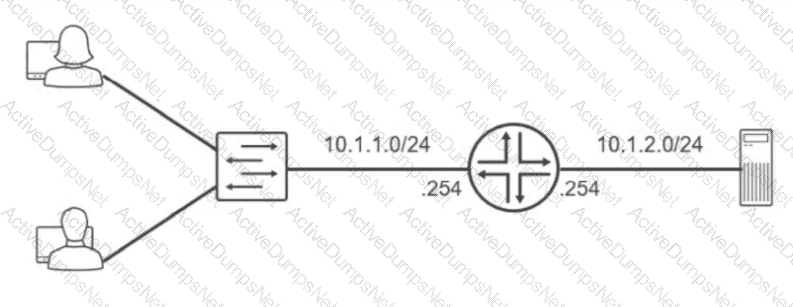
Referring to the exhibit, which routing configuration is required for these two users to access the remote server?
Options:
Users and the server require a default gateway.
Trunk ports must be enabled on the switch.
Users must connect directly to the router.
A routing protocol must be enabled on the router.
Answer:
AExplanation:
The network topology illustrates two distinct IP subnets, 10.1.1.0/24 and 10.1.2.0/24 , separated by a Layer 3 router. For hosts on the first subnet to communicate with the server on the second subnet, an intermediary device must perform inter-subnet routing. The router acts as the exit point for each local segment, utilizing its interfaces assigned with the .254 host address as the logical path to external networks.
The fundamental requirement for this communication is the configuration of a default gateway on all end-nodes. When the users (on 10.1.1.0/24 ) attempt to send data to the server (on 10.1.2.0/24 ), their local TCP/IP stack recognizes the destination is not on the local wire. Without a defined default gateway, the hosts would simply drop the traffic as unroutable. By setting the default gateway to 10.1.1.254 for users and 10.1.2.254 for the server, the hosts are instructed to forward all off-net traffic to the router. The router then consults its routing table—which contains these directly connected routes—and forwards the packets to the appropriate egress interface. While VLAN tagging or routing protocols could exist in more complex environments, the primary necessity for basic reachability between these two specific segments is a correctly configured gateway on the terminal devices. Reference: Networking Fundamentals, IP Routing Basics, Default Gateway Configuration.
==========
Which two types of traffic are processed by the Routing Engine? (Choose two.)
Options:
transit traffic
management traffic
line-card traffic
control traffic
Answer:
B, DExplanation:
The Routing Engine (RE) is the control-plane component of a Junos OS device. Its primary responsibilities include routing protocol processing, system management, maintaining routing tables, running Junos OS processes, and providing administrative access. Consequently, management traffic and control traffic are processed by the Routing Engine. Juniper specifically describes the Routing Engine as controlling routing updates and system management , while routing protocol packets from the network are directed to the Routing Engine.
Management traffic includes traffic associated with services such as SSH, Telnet, SNMP, and other traffic whose destination is the device itself. Control traffic includes routing protocol communications such as OSPF, BGP, and other protocol packets required to establish and maintain the device ' s control-plane state. Juniper categorizes these as local packets , which are handled by the Routing Engine.
By contrast, transit traffic enters one physical interface and is forwarded toward another destination. This forwarding operation is normally handled by the Packet Forwarding Engine (PFE) rather than the Routing Engine. The separation of forwarding and control functions is fundamental to Junos OS architecture.
Study Guide Reference Topics: Junos OS Fundamentals — Routing Engine and Packet Forwarding Engine; control plane versus forwarding plane; management and protocol traffic.
===============
Which two statements are correct about logical units? (Choose two.)
Options:
A physical interface can host multiple logical units.
Logical units can have multiple IP addresses.
Logical units are used only for management interfaces.
A physical interface can host only one logical unit.
Answer:
A, BExplanation:
In the Junos OS architecture, interfaces are strictly divided into physical and logical components. The physical interface represents the actual hardware port (e.g., ge-0/0/0), while logical units (e.g., ge-0/0/0.0) define the protocol-specific parameters and logical segmentation required for traffic processing. A fundamental characteristic of this model is that a single physical interface can host multiple logical units. This is a mandatory requirement for technologies such as 802.1Q VLAN tagging, where each logical unit corresponds to a different VLAN ID on the same physical link, allowing for efficient micro-segmentation of traffic.
Furthermore, Junos OS allows logical units to have multiple IP addresses assigned to them within the same address family or across different families (such as inet and inet6). This flexibility enables a single logical interface to reside on multiple subnets simultaneously, which is essential for complex routing scenarios, multi-homing, or transitional dual-stack environments. It is a common misconception that logical units are reserved for management; in reality, every physical interface must have at least one logical unit (typically unit 0) configured for the device to process any transit or local traffic. Understanding the hierarchical relationship between the physical port and its logical subdivisions is critical for successful interface management and protocol deployment on Junos platforms. Reference: Junos OS Fundamentals, Interface Naming and Hierarchy.
==========
Which two operational mode commands would you use to verify CPU and memory utilization on a Junos device? (Choose two.)
Options:
show chassis routing-engine
show chassis environment
show system processes extensive
show system resource-monitor summary
Answer:
A, CExplanation:
In the Junos OS architecture, maintaining visibility into the health of the Routing Engine (RE) is paramount for ensuring control plane stability. The command show chassis routing-engine is the primary tool for a high-level hardware status overview. It provides critical telemetry regarding the RE ' s current CPU utilization (broken down by user, background, and kernel tasks), memory usage statistics, and uptime. This command is essential for identifying if the device ' s " brain " is under significant stress due to heavy protocol processing or management tasks.
For a more granular, process-specific analysis, the show system processes extensive command is utilized. Similar to the ' top ' utility in Unix-based systems, it lists all active software daemons (such as rpd for routing, dcd for interfaces, and mgd for management) and ranks them by their real-time CPU and memory consumption. This allows an architect to pinpoint exactly which process might be causing a performance bottleneck. While show chassis environment focuses on physical hardware health like temperatures and fan speeds, and resource-monitor provides summary data, the combination of show chassis routing-engine and show system processes extensive offers the most comprehensive diagnostic view of the device ' s internal computational resources. Reference: Operational Monitoring and Maintenance, System Health Monitoring.
==========
Which two characteristics describe Junos OS software? (Choose two.)
Options:
Junos OS is a monolithic code base.
Junos OS supports automation features.
Junos OS runs only on routers.
Junos OS uses a modular architecture with independent processes.
Answer:
B, DExplanation:
Junos OS is distinguished from legacy network operating systems by its modern, modular architecture . Unlike a monolithic system where a single failure can crash the entire kernel, Junos runs various software functions—such as the routing protocol process (rpd), the interface process (dcd), and the management daemon (mgd)—as independent processes in their own protected memory spaces. This modularity ensures high availability; if one daemon encounters an error, it can be restarted without impacting the overall system stability or traffic forwarding.
Furthermore, Junos OS is a leader in automation features . It was built with a programmable foundation, utilizing an XML-based configuration database and supporting NETCONF for standardized remote management. This allows network architects to utilize modern DevOps tools like Ansible, Python (PyEZ), and SaltStack to automate complex configuration tasks, perform bulk upgrades, and enforce state compliance. By treating the network as code, Junos enables high-velocity operations that reduce human error. While Junos originally powered routers, it now runs across a vast portfolio including EX/QFX switches and SRX firewalls, proving its versatility far beyond just routing platforms.
Unlock JN0-106 Features
- JN0-106 All Real Exam Questions
- JN0-106 Exam easy to use and print PDF format
- Download Free JN0-106 Demo (Try before Buy)
- Free Frequent Updates
- 100% Passing Guarantee by Activedumpsnet
Questions & Answers PDF Demo
- JN0-106 All Real Exam Questions
- JN0-106 Exam easy to use and print PDF format
- Download Free JN0-106 Demo (Try before Buy)
- Free Frequent Updates
- 100% Passing Guarantee by Activedumpsnet