
New Year Sale Limited Time Flat 70% Discount offer - Ends in 0d 00h 00m 00s - Coupon code: 70spcl

ISTQB CT-AI ISTQB Certified Tester AI Testing Exam Exam Practice Test

Page: 1 / 12
Total 120 questions

ISTQB Certified Tester AI Testing Exam Questions and Answers

Question 1

Which ONE of the following options describes a scenario of A/B testing the LEAST?

SELECT ONE OPTION

Options:

A.

A comparison of two different websites for the same company to observe from a user acceptance perspective.

B.

A comparison of two different offers in a recommendation system to decide on the more effective offer for same users.

C.

A comparison of the performance of an ML system on two different input datasets.

D.

A comparison of the performance of two different ML implementations on the same input data.

Question 2

The training of an ML model… What type of bias is LEAST important to look for when testing the model?

Choose ONE option (1 out of 4)

Options:

A.

Inappropriate bias

B.

Automation bias

C.

Algorithmic bias

D.

Sample bias

Question 3

Which ONE of the following types of coverage SHOULD be used if test cases need to cause each neuron to achieve both positive and negative activation values?

SELECT ONE OPTION

Options:

A.

Value coverage

B.

Threshold coverage

C.

Sign change coverage

D.

Neuron coverage

Question 4

Which of the following statements about explainable AI is correct?

Choose ONE option (1 out of 4)

Options:

A.

Interpretability refers to how easily users can determine whether the result provided by the AI-based system is correct

B.

Explainability refers to how easily the algorithms and training data needed to create the model can be determined

C.

According to The Royal Society, one reason for explainable AI is to increase user confidence in the system

D.

According to The Royal Society, one reason for explainable AI is to eliminate the need for risk and vulnerability assessments

Question 5

Which of the following options is an example of the concept of overfitting?

Choose ONE option (1 out of 4)

Options:

A.

A model for predicting academic performance was trained with data from students at one university. The model shows low predictive accuracy when applied to other universities.

B.

A model for the recognition of dogs was trained predominantly with pictures of dogs in parks. On pictures with other animals in parks, dogs are also falsely recognized.

C.

A previously trained model for recognizing cars is adapted and extended so that it can also identify the make of the car beyond its original function.

D.

A model for predicting IT system failures delivers too many false-negative predictions because the failures cannot be adequately explained via the log files used for training.

Question 6

Which of the following decisions is BEST as a test approach for the described situation?

Choose ONE option (1 out of 4)

Options:

A.

You plan to manually execute regular regression tests of the new camera function, particularly for system tests.

B.

You execute the test cases from the old camera model at the integration test level; no further dynamic tests of the operating data pipeline are necessary.

C.

You plan experience-based testing by the entire team at the system test level to ensure that the end users are satisfied.

D.

You plan to perform reviews and exploratory data analysis of the image data sets to reduce the risk of a lack of representativeness of this data.

Question 7

Which option gives the correct values for accuracy and precision from the confusion matrix?

Choose ONE option (1 out of 4)

Options:

A.

Accuracy = 50%, Precision = 75%

B.

Accuracy = 80%, Precision = 75%

C.

Accuracy = 75%, Precision = 80%

D.

Accuracy = 80%, Precision = 50%

Question 8

Which ONE of the following options is the MOST APPROPRIATE stage of the ML workflow to set model and algorithm hyperparameters?

SELECT ONE OPTION

Options:

A.

Evaluating the model

B.

Deploying the model

C.

Tuning the model

D.

Data testing

Question 9

Which ONE of the following approaches to labelling requires the least time and effort?

SELECT ONE OPTION

Options:

A.

Outsourced

B.

Pre-labeled dataset

C.

Internal

D.

Al-Assisted

Question 10

Which of the following is a technique used in machine learning?

Options:

A.

Decision trees

B.

Equivalence partitioning

C.

Boundary value analysis

D.

Decision tables

Question 11

A beer company is trying to understand how much recognition its logo has in the market. It plans to do that by monitoring images on various social media platforms using a pre-trained neural network for logo detection. This particular model has been trained by looking for words, as well as matching colors on social media images. The company logo has a big word across the middle with a bold blue and magenta border.

Which associated risk is most likely to occur when using this pre-trained model?

Options:

A.

There is no risk, as the model has already been trained

B.

Insufficient function: the model was not trained to check for colors or words

C.

Improper data preparation

D.

Inherited bias: the model could have inherited unknown defects

Question 12

A neural network has been designed and created to assist day-traders improve efficiency when buying and selling commodities in a rapidly changing market. Suppose the test team executes a test on the neural network where each neuron is examined. For this network, the shortest path indicates a "buy" and it will only occur when the one-day predicted value of the commodity is greater than the spot price by 0.75%. The neurons are stimulated by entering commodity prices and testers verify that they activate only when the future value exceeds the spot price by at least 0.75%.

Which of the following statements BEST explains the type of coverage being tested on the neural network?

Options:

A.

Threshold coverage

B.

Neuron coverage

C.

Sign-change coverage

D.

Value-change coverage

Question 13

A system is to be developed to detect lung cancer using X-ray images.

Which statement BEST describes the difference between a conventional system and an AI system with supervised machine learning?

Choose ONE option (1 out of 4)

Options:

A.

The results of analyzing an X-ray for lung cancer using an AI system are more understandable than with a conventional system.

B.

The X-ray images that an AI system can analyze must be structurally different from X-ray images used in a conventional system.

C.

An AI system independently determines patterns in X-rays during training; a conventional system requires a human to program in those patterns.

D.

The implementation of an AI system consists mainly of training data, whereas that of a conventional system consists of branches and loops.

Question 14

Consider a machine learning model where the model is attempting to predict if a patient is at risk for stroke. The model collects information on each patient regarding their blood pressure, red blood cell count, smoking status, history of heart disease, cholesterol level, and demographics. Then, using a decision tree the model predicts whether or not the associated patient is likely to have a stroke in the near future. Once the model is created using a training dataset, it is used to predict a stroke in 80 additional patients. The table below shows a confusion matrix on whether or not the model made a correct or incorrect prediction.
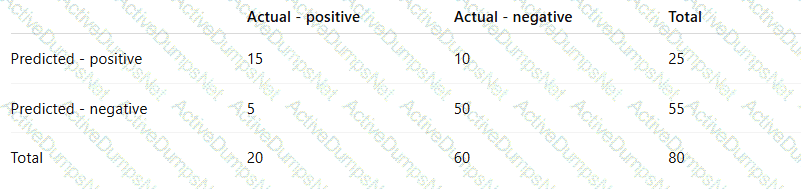
Question # 14

The testers have calculated what they believe to be an appropriate functional performance metric for the model. They calculated a value of 0.6667.

Which metric did the testers calculate?

Options:

A.

F1-score

B.

Precision

C.

Recall

D.

Accuracy

Question 15

Which ONE of the following characteristics is the least likely to cause safety related issues for an Al system?

SELECT ONE OPTION

Options:

A.

Non-determinism

B.

Robustness

C.

High complexity

D.

Self-learning

Question 16

Which ONE of the following options does NOT describe an Al technology related characteristic which differentiates Al test environments from other test environments?

SELECT ONE OPTION

Options:

A.

Challenges resulting from low accuracy of the models.

B.

The challenge of mimicking undefined scenarios generated due to self-learning

C.

The challenge of providing explainability to the decisions made by the system.

D.

Challenges in the creation of scenarios of human handover for autonomous systems.

Question 17

Written requirements are given in text documents, which ONE of the following options is the BEST way to generate test cases from these requirements?

SELECT ONE OPTION

Options:

A.

Natural language processing on textual requirements

B.

Analyzing source code for generating test cases

C.

Machine learning on logs of execution

D.

GUI analysis by computer vision

Question 18

Which ONE of the following options represents a technology MOST TYPICALLY used to implement Al?

SELECT ONE OPTION

Options:

A.

Search engines

B.

Procedural programming

C.

Case control structures

D.

Genetic algorithms

Question 19

Consider an AI-system in which the complex internal structure has been generated by another software system. Why would the tester choose to do black-box testing on this particular system?

Options:

A.

Test automation can be built quickly and easily from the test cases developed during black-box testing

B.

The tester wishes to better understand the logic of the software used to create the internal structure

C.

The black-box testing method will allow the tester to check the transparency of the algorithm used to create the internal structure

D.

Black-box testing eliminates the need for the tester to understand the internal structure of the AI-system

Question 20

Data used for an object detection ML system was found to have been labelled incorrectly in many cases.

Which ONE of the following options is most likely the reason for this problem?

SELECT ONE OPTION

Options:

A.

Security issues

B.

Accuracy issues

C.

Privacy issues

D.

Bias issues

Question 21

Which statement regarding the use of training, validation, and test data sets is correct?

Choose ONE option (1 out of 4)

Options:

A.

If only limited data is available, validation and test data sets can be combined in multiple ways during training.

B.

If limited data is available, it may be better to work without a separate test data set.

C.

Optimally, the data should be distributed equally between the training, validation, and test data sets.

D.

The data in the test data set must be equivalent to the data in the training data sets and to the data in the validation data sets.

Question 22

Which ONE of the following statements is a CORRECT adversarial example in the context of machine learning systems that are working on image classifiers.

SELECT ONE OPTION

Options:

A.

Black box attacks based on adversarial examples create an exact duplicate model of the original.

B.

These attack examples cause a model to predict the correct class with slightly less accuracy even though they look like the original image.

C.

These attacks can't be prevented by retraining the model with these examples augmented to the training data.

D.

These examples are model specific and are not likely to cause another model trained on same task to fail.

Question 23

A transportation company operates three types of delivery vehicles in its fleet. The vehicles operate at different speeds (slow, medium, and fast). The transportation company is attempting to optimize scheduling and has created an AI-based program to plan routes for its vehicles using records from the medium-speed vehicle traveling to selected destinations. The test team uses this data in metamorphic testing to test the accuracy of the estimated travel times created by the AI route planner with the actual routes and times.

Which of the following describes the next phase of metamorphic testing?

Options:

A.

The team tests the time required for the fast and slow vehicles to travel the same route as the medium vehicle. Then, by calculating the speed difference, they then predict how much faster or slower the vehicles will travel. That information is then used to verify that the arrival time of the vehicles meets the expected result.

B.

The team decomposes each route into the relevant components that affect the travel time, such as traffic density and vehicle power. The team then uses statistical analysis to characterize the influence of each component to calculate the fast and slow vehicle route times.

C.

The team uses an AI system to select the most dissimilar routes. With this information, any of the AI routes can be metaphorically transformed into a fast or slow route.

D.

The team uses the same AI route planner to create routes that are longer and shorter but follow the same track. Finally, by driving the fast vehicles on the long routes and slow vehicles on the short routes and vice versa, the AI system will have enough information to infer travel times for all vehicles on all routes.

Question 24

You have access to the training data that was used to train an AI-based system. You can review this information and use it as a guideline when creating your tests. What type of characteristic is this?

Options:

A.

Autonomy

B.

Explorability

C.

Transparency

D.

Accessibility

Question 25

Which of the following technologies for implementing AI is considered to be a reasoning technique?

Choose ONE option (1 out of 4)

Options:

A.

Deductive classifiers

B.

Linear regression

C.

Random Forest

D.

Genetic algorithms

Question 26

A startup company has implemented a new facial recognition system for a banking application for mobile devices. The application is intended to learn at run-time on the device to determine if the user should be granted access. It also sends feedback over the Internet to the application developers. The application deployment resulted in continuous restarts of the mobile devices.

Which of the following is the most likely cause of the failure?

Options:

A.

The feedback requires a physical connection and cannot be sent over the Internet

B.

Mobile operating systems cannot process machine learning algorithms

C.

The size of the application is consuming too much of the phone's storage capacity

D.

The training, processing, and diagnostic generation are too computationally intensive for the mobile device hardware to handle

Question 27

Which statement regarding data preparation in the ML workflow is correct?

Choose ONE option (1 out of 4)

Options:

A.

A key challenge in data transformation is the removal or correction of erroneous data.

B.

Since data preparation is time-consuming, all steps should be automated.

C.

One challenge of data gathering is obtaining high-quality data from multiple sources.

D.

Sampling is so well researched that it is no longer considered risky.

Question 28

Which of the following is THE LEAST appropriate tests to be performed for testing a feature related to autonomy?

SELECT ONE OPTION

Options:

A.

Test for human handover to give rest to the system.

B.

Test for human handover when it should actually not be relinquishing control.

C.

Test for human handover requiring mandatory relinquishing control.

D.

Test for human handover after a given time interval.

Question 29

Which ONE of the following models BEST describes a way to model defect prediction by looking at the history of bugs in modules by using code quality metrics of modules of historical versions as input?

SELECT ONE OPTION

Options:

A.

Identifying the relationship between developers and the modules developed by them.

B.

Search of similar code based on natural language processing.

C.

Clustering of similar code modules to predict based on similarity.

D.

Using a classification model to predict the presence of a defect by using code quality metrics as the input data.

Question 30

An image classification system is being trained for classifying faces of humans. The distribution of the data is 70% ethnicity A and 30% for ethnicities B, C and D. Based ONLY on the above information, which of the following options BEST describes the situation of this image classification system?

SELECT ONE OPTION

Options:

A.

This is an example of expert system bias.

B.

This is an example of sample bias.

C.

This is an example of hyperparameter bias.

D.

This is an example of algorithmic bias.

Question 31

Which challenge to testing self-learning systems puts you at risk of a data attack?

Choose ONE option (1 out of 4)

Options:

A.

Inadequate specification of the operating environment

B.

Complex test environment

C.

Insufficient testing time

D.

Unexpected changes

Question 32

Which ONE of the following options describes the LEAST LIKELY usage of Al for detection of GUI changes due to changes in test objects?

SELECT ONE OPTION

Options:

A.

Using a pixel comparison of the GUI before and after the change to check the differences.

B.

Using a computer vision to compare the GUI before and after the test object changes.

C.

Using a vision-based detection of the GUI layout changes before and after test object changes.

D.

Using a ML-based classifier to flag if changes in GUI are to be flagged for humans.

Question 33

A car insurance company is using a new AI service to reward defensive driving behavior among its policyholders. The driving behavior is recorded in a rating number (score).

The AI service determines this score from the following input values:

Reference speed v_max in km/h

Average speed v_mean in km/h

Average acceleration a_pos in m/s²

Average braking deceleration a_neg in m/s²

The more defensive the driving behavior is (slow driving, low acceleration, low braking deceleration), the higher is the score.

Three initial test cases (Test 1 to Test 3) are used for testing the AI service. In addition, new test cases A–D are proposed.
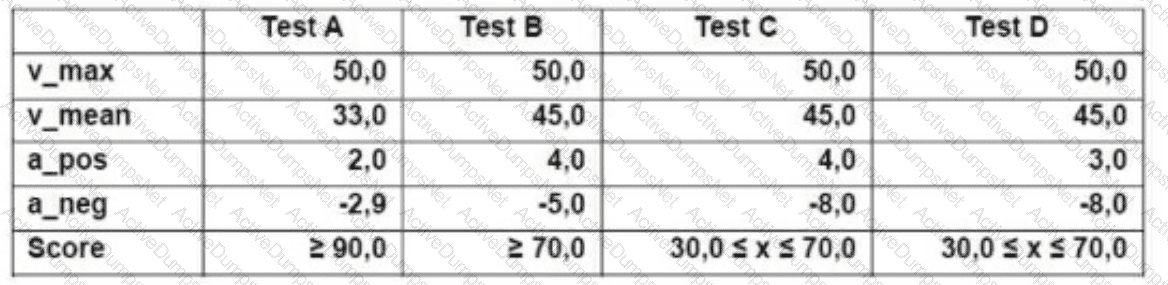
Question # 33

Which of the new tests is NOT a follow-up test case for metamorphic testing?

Choose ONE option! (1 out of 4)

Options:

A.

Test A is not a follow-up test case.

B.

Test C is not a follow-up test case.

C.

Test B is not a follow-up test case.

D.

Test D is not a follow-up test case.

Question 34

Which statement describes factors related to test data that make testing AI-based systems difficult?

Choose ONE option (1 out of 4)

Options:

A.

Using the same implementation for data acquisition by data scientists and testers prevents defect masking

B.

Creating and managing large amounts of test data can be difficult, especially when it needs to be representative

C.

The input data must always be the same over time, especially in real-world systems

D.

Artificially generated data requires legal approval and must be sanitized and encrypted

Question 35

Max. Score: 2

Al-enabled medical devices are used nowadays for automating certain parts of the medical diagnostic processes. Since these are life-critical process the relevant authorities are considenng bringing about suitable certifications for these Al enabled medical devices. This certification may involve several facets of Al testing (I - V).

I.Autonomy

II.Maintainability

III.Safety

IV.Transparency

V.Side Effects

Which ONE of the following options contains the three MOST required aspects to be satisfied for the above scenario of certification of Al enabled medical devices?

SELECT ONE OPTION

Options:

A.

Aspects II, III and IV

B.

Aspects I, II, and III

C.

Aspects III, IV, and V

D.

Aspects I, IV, and V

Question 36

Which ONE of the following options BEST DESCRIBES clustering?

SELECT ONE OPTION

Options:

A.

Clustering is classification of a continuous quantity.

B.

Clustering is supervised learning.

C.

Clustering is done without prior knowledge of output classes.

D.

Clustering requires you to know the classes.

Page: 1 / 12
Total 120 questions