
Winter Sale- Special Discount Limited Time 65% Offer - Ends in 0d 00h 00m 00s - Coupon code: netdisc

IIC C11 Principles and Practice of Insurance Exam Practice Test

Page: 1 / 10
Total 100 questions

Principles and Practice of Insurance Questions and Answers

Question 1

[Regulatory Framework / Automobile Insurance]

What is the name of the pooling agreement where all high-risk drivers are underwritten in a common pool?

Options:

A.

Facility Association

B.

Substandard Group

C.

Underwriters Association

D.

High-risk Drivers of Canada

Question 2

[Introduction to Risk and Insurance]

Jack is a first-time homeowner. How can he mitigate his risk?

Options:

A.

Purchase insurance

B.

Increase his volume of risk

C.

Decrease his volume of risk

D.

Purchase many different kinds of goods

Question 3

[Insurance Documents and Processes]

What type of wording is written on a custom basis for a specific situation?

Options:

A.

Standard

B.

Chattel

C.

Treaty

D.

Manuscript

Question 4

[Claims]

Antonio lights a firecracker and throws it to Brett. Brett tosses it to Sandra. Sandra catches it and throws it to Celina. It explodes in Celina’s hands, injuring her. Who is the immediate cause of the loss?

Options:

A.

Brett

B.

Sandra

C.

Antonio and Brett

D.

Celina and Antonio

Question 5

[Introduction to Risk and Insurance]

Why does the need for liability insurance arise?

Options:

A.

Reduce personal risk to oneself

B.

Fulfill legal obligations to others

C.

Meet societal obligations and norms

D.

Uphold ethical feelings of responsibility

Question 6

[Sales and Distribution of Insurance]

What should the broker provide in the broker report?

Options:

A.

Their suggested premium for the client

B.

Any personal knowledge of the client

C.

The client’s past premium and deductibles

D.

Comparable accounts to assist the insurer in rating

Question 7

[Insurance Documents and Processes]

What is a cover note?

Options:

A.

Purchase agreement between the agent or broker and the insurer

B.

An amendment added to a written document that alters its provisions

C.

File notes confirming insurance discussions between the intermediary and the insured

D.

Document issued by intermediaries to inform the insured that coverage has been arranged

Question 8

[Introduction to Risk and Insurance]

Which action reduces a hazard?
Options:

A.

Installing anti-slip floor tile in the hallway

B.

Using high beams at night on a busy highway

C.

Shutting off sprinkler systems during renovations

D.

Removing protective packaging around items being moved

Question 9

[Insurance Companies]

Who has authority from a company to manage that company's business within their territory, to appoint other agents, and to settle claims?

Options:

A.

Analyst

B.

Wholesaler

C.

General agent

D.

Operating agent

Question 10

[Claims]

How are staff adjusters and independent adjusters similar?

Options:

A.

Neither is allowed to perform an investigation

B.

Both work on behalf of, and are paid by, the insurer

C.

Both are licensed only in Quebec and New Brunswick

D.

Neither has any limitation on their authority to settle claims

Question 11

[Underwriting – Rates, Hazards, Perils]

What is the effect of perils and hazards on insurance rates for the underwriter?

Options:

A.

An underwriter may increase the rate if the insured event is likely to increase the hazard

B.

The rate is determined by the law of large numbers for the hazards listed on the policy

C.

An underwriter may use a higher rate if a hazard increases the likelihood of a loss by an insured peril

D.

The rate is calculated by multiplying the premium by the amount insured for each peril

Question 12

[Insurance Companies]

Which statement reflects how an insurer invests their capital?

Options:

A.

Insurers are compelled by regulations to invest in non-liquid assets

B.

Provincial regulations allow insurers to invest in foreign bond markets

C.

There are no restrictions as to how an insurer can invest their capital

D.

Government regulations specify the types of investmentsnot permittedto insurers

Question 13

[Insurance Categories and Functions]

Which risk could be insured bychattel coverage?

Options:

A.

Trip cancellation for a honeymoon

B.

A mobile home belonging to a family

C.

A half-court shot contest at a basketball game

D.

Errors and omissions for a lawyer’s office

Question 14

[Underwriting and Rating: Setting Insurance Rates]

Which factor could explain poorer performance of renewal clients as opposed to new business clients?

Options:

A.

An automated renewal process

B.

More strict underwriting criteria for renewal risks

C.

Reinsurance only being available on renewal policies

D.

New business clients limit claims in order to keep premiums low

Question 15

[Insurance Companies]

Ace Brokerage Inc., a liability insurer, has been in business for three years. It is suffering financial difficulties despite writing a significant amount of new business. What is the most likely reason?

Options:

A.

Poor handling of its accounts receivable

B.

Lack of profit-sharing commissions earned

C.

Many clients have added endorsements to their policies

D.

Premiums were discounted when policyholders paid in full

Question 16

[Insurance as a Contract – Subject of Insurance]

What does the term "subject of insurance" refer to?

Options:

A.

The thing being insured

B.

The perils associated with the risk

C.

The company providing the coverage

D.

The type of wording applicable to the policy

Question 17

[Insurance Documents and Processes]

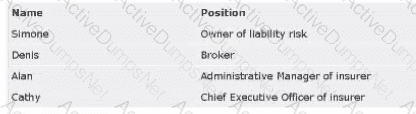
Whose signatures wouldusuallyappear on therisk’s policy?
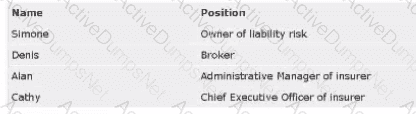
Question # 17

Options:

A.

Alan and Cathy

B.

Denis and Cathy

C.

Simone and Alan

D.

Denis and Simone

Question 18

A company suffers a $100,000 property loss at its commercial location. If Insurer X and Insurer Y have policies subject to the same terms and conditions, and there is no deductible, what will each insurer pay based on the information below?

Question # 18

Insurer X insured amount: $400,000

Insurer Y insured amount: $100,000

Options:

A.

Insurer X pays $0; Insurer Y pays $100,000

B.

Insurer X pays $50,000; Insurer Y pays $50,000

C.

Insurer X pays $80,000; Insurer Y pays $20,000

D.

Insurer X pays $100,000; Insurer Y pays $0

Question 19

[Insurance as a Contract: The Insurance Policy]

George emails his cousin offering to buy her textbooks for $500. He states that unless she replies “no,” they have a deal. Which essential element of a binding contract is missing?

Options:

A.

Consideration

B.

Legality of object

C.

Capacity to contract

D.

Offer and acceptance

Question 20

[Insurance Companies]

Which role is directly employed by the Canadian property and casualty insurance industry?

Options:

A.

Lawyer

B.

Mechanic

C.

Travel agent

D.

Health professional

Question 21

[Claims]

How are staff adjusters and independent adjusters similar?

Options:

A.

Neither is allowed to perform an investigation

B.

Both work on behalf of, and are paid by, the insurer

C.

Both are licensed only in Quebec and New Brunswick

D.

Neither has any limitation on their authority to settle claims

Question 22

[Claims]

Mark was involved in an at-fault accident one year ago. As there was minimal vehicle damage and no apparent injuries, Mark settled with the third party and did NOT report the accident to his insurer. Today, Mark has been served a statement of claim alleging long-term injuries. Which action will Mark's insurer MOST LIKELY take, and why?

Options:

A.

Deny the claim because a limitation period is in effect

B.

Deny the claim because Mark had forfeited the right of recovery

C.

Pay the claim because accident benefit coverages have no expiration date

D.

Pay the claim because Mark's current policy must respond to a liability claim

Question 23

A company suffers an $80,000 theft loss from its commercial property.

Insurer A covers the property for $300,000.

Insurer B covers the same property for $100,000.

Assuming both policies have identical terms, how is the $80,000 loss shared?

Options:

A.

Insurer A pays $0; Insurer B pays $60,000

B.

Insurer A pays $40,000; Insurer B pays $40,000

C.

Insurer A pays $60,000; Insurer B pays $20,000

D.

Insurer A pays $80,000; Insurer B pays $0

Question 24

[Sales and Distribution of Insurance / Broker Responsibilities]

A commercial brokerage failed to advise the insurer of a client's modified risk. The insurer discovered this only at the time of a major loss and denied the claim due to material change. How will the client MOST LIKELY proceed?

Options:

A.

Pay for the loss, and cancel the policy backdated to before the loss

B.

Pay for the loss, and oblige the brokerage to reimburse the deductible

C.

Take legal action against the insurer, stating the insurer knew the full risk

D.

Take legal action against the brokerage, stating it had a contractual responsibility to disclose the material change

Question 25

[Regulatory Framework]

Which legal term describes the time in which a claim may be brought by the policyholder?

Options:

A.

Waiver

B.

Release

C.

Non-waiver

D.

Prescription

Question 26

Which insurance industry impact is an example of a surety?

Options:

A.

A bank issuing a mortgage on an insured building

B.

A doctor providing malpractice-covered services

C.

A developer advancing funds to a building contractor for a guaranteed project

D.

A manufacturer accepting shipping risks that are insured

Question 27

[Sales and Distribution of Insurance]

Orianna is an insurance professional who acts on behalf of the insurerandthe insured. She owns her client list and is paid commission once policies are arranged. What is her profession?

Options:

A.

Broker

B.

Underwriter

C.

Exclusive agent

D.

Independent adjuster

Question 28

[Risk Management – Pre-Loss Objectives]

Which is a pre-loss objective of risk management for an organization?

Options:

A.

External obligations

B.

Sustained growth

C.

Operational continuity

D.

Business development

Question 29

Which financial outcome would be expected when engaging in a speculative risk?

Options:

A.

No possibility of loss

B.

No possibility of gain

C.

Possibility of gain only

D.

Possibility of either gain or loss

Question 30

[Underwriting and Rating: Setting Insurance Rates]

What is the annual premium for a building insured for$500,000at a rate of$0.80 per $100?

Options:

A.

$800

B.

$2,500

C.

$4,000

D.

$6,250

Page: 1 / 10
Total 100 questions