
Redeem Your Black Friday Code: 75% Off All Exam Bundles! Use coupon code below! - Ends in 0d 00h 00m 00s - Coupon code: discactive

Huawei H35-831 HCIE-Datacom-Carrier (Written) V1.0 Exam Practice Test

Page: 1 / 6
Total 60 questions

HCIE-Datacom-Carrier (Written) V1.0 Questions and Answers

Question 1

Which of the following statements regarding the telco cloud network are correct?

Select all that apply.

Options:

A.

If two DC GWs are single-homed to PEs, you are advised to adjust route preference in a way that traffic from the two DC GWs uses different PEs as next hops. Otherwise, one PE may become overloaded.

B.

If the management & storage network and service network are deployed independently, they are physically isolated. If one network is attacked, the other network continues to run as usual, ensuring overall security.

C.

The service network uses the flattened spine-leaf architecture to provide high bandwidth, elastic scalability, and flexible access.

D.

As the telco cloud network expands, some sites that use box-shaped devices as DC GWs may fail to meet the bandwidth requirements of north-south service traffic, yet carriers may not want to replace existing DC GWs with high-capacity ones. In this case, the egress bandwidth of the telco cloud network can be increased by adding more DC GWs.

Question 2

Which of the following key factors must be considered when designing an IGW for an IP core network?

Select all that apply.

Options:

A.

Routing policy scale

B.

Hardware capacity of devices

C.

Route transport capability

D.

Security

Question 3

When synchronizing LSDBs over a P2P network, IS-IS does not need to send CSNPs.

Options:

A.

TRUE

B.

FALSE

Question 4

In the ONAP framework, which of the following closed-loop automation processes is used to respond to changing network and service conditions?

Options:

A.

Create > Collect > Detect > Publish > Analyze > Respond

B.

Design > Create > Collect > Analyze > Detect > Publish > Respond

C.

Design > Create > Collect > Detect > Analyze > Publish > Respond

D.

Design > Create > Collect > Detect > Publish > Analyze > Respond

Question 5

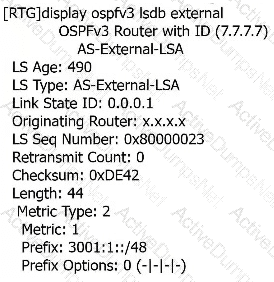
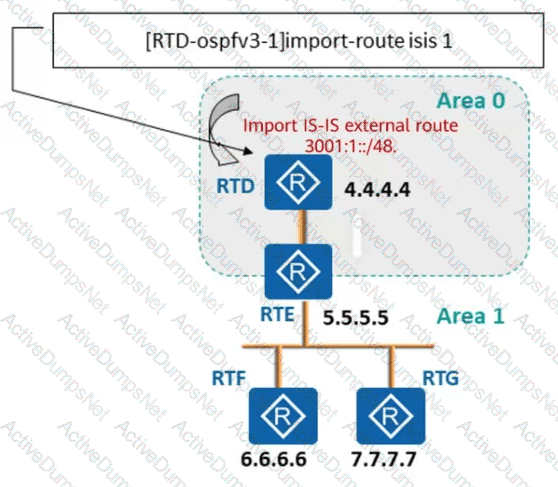
In the OSPFv3 network shown, RTD imports an external route. The AS-External-LSA details are checked on RTG. Based on the following information, what should the Originating Router be?
Question # 5

Exhibit 37.1 — Original topology/configuration figure
Question # 5

Exhibit 37.2 — Original topology/configuration figure

Options:

A.

4.4.4.4

B.

7.7.7.7

C.

5.5.5.5

D.

6.6.6.6

Question 6

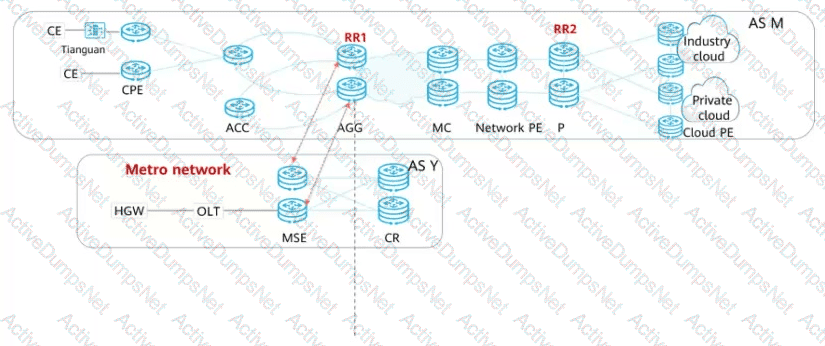
The figure illustrates the fixed-broadband cloudification acceleration scenario of the intelligent cloud-network. Which statements about this network are incorrect?
Question # 6

Exhibit 16.1 — Original topology/configuration figure

Select all that apply.

Options:

A.

On the public network plane, IS-ISv6 peer relationships are established between MSEs and AGGs to transmit SRv6 loopback routes.

B.

On the private network plane, EBGP peer relationships are established between MSEs and AGGs to transmit VPN routes.

C.

On the public network plane, EBGP peer relationships are established between MSEs and AGGs to transmit locator routes.

D.

On the private network plane, IS-ISv6 peer relationships are established between MSEs and AGGs to transmit SRv6 SIDs.

Question 7

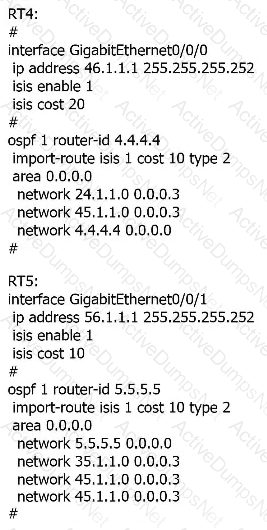
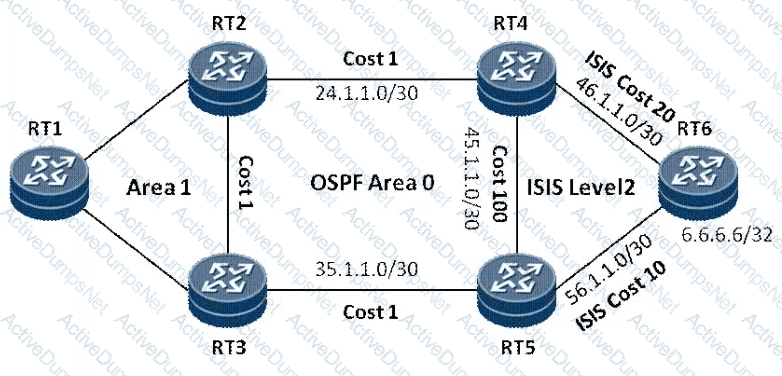
In the network shown, RT4 and RT5 function as ASBRs and import IS-IS routes into OSPF. Only OSPF is used for interworking between RT4 and RT5. The link costs are shown in the figure. The key configurations of RT4 and RT5 are as follows:
Question # 7

Exhibit 36.1 — Original topology/configuration figure
Question # 7

Exhibit 36.2 — Original topology/configuration figure

Options:

A.

RT1 accesses 6.6.6.6 through the RT2 - > RT4 - > RT6 path.

B.

RT1 has two routes to 6.6.6.6, and traffic is balanced between the two routes.

C.

RT1 accesses 6.6.6.6 through the RT3 - > RT5 - > RT6 path.

D.

RT1 has two routes to 6.6.6.6 and selects one of them to forward traffic.

Question 8

Which backup modes do vBRAS-UPs support?

Select all that apply.

Options:

A.

N+1 warm backup

B.

N+1 hot backup

C.

N:1 cold backup

D.

N:1 warm backup

Question 9

In an EVPN L3VPNv4-over-SRv6 BE scenario, must P routers in a carrier network also support SRv6?

Options:

A.

TRUE

B.

FALSE

Question 10

The new metro network is anticipated to converge fixed and mobile networks. In this type of network, every device must process services and forward data.

Options:

A.

TRUE

B.

FALSE

Question 11

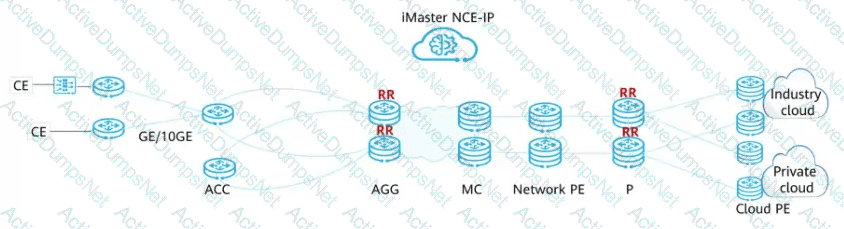
In an intelligent cloud-network scenario, NCE centrally computes and delivers SRv6 Policies. Which statements about the BGP-LS IPv6 design are correct?
Question # 11

Exhibit 15.1 — Original topology/configuration figure

Select all that apply.

Options:

A.

The ACC and AGG establish a BGP-LS peer relationship. The ACC uses IGP to flood information such as the topology, bandwidth, and link delay to the AGG.

B.

The AGG establishes a BGP-LS peer relationship with the P on the cloud backbone network, and advertises information such as the collected topology, bandwidth, and link delay to the P through BGP-LS.

C.

The MC, cloud PE, and network PE use IGP to flood information about the aggregation and core layers, such as the topology, bandwidth, and link delay, to the P. The P establishes a BGP-LS IPv6 peer relationship with iMaster NCE-IP, and uses BGP-LS to report the information to iMaster NCE-IP.

D.

BGP-LS IPv6 is deployed between the headend of an SRv6 Policy and the RR and between the headend and the controller to deliver SRv6 Policy information.

Question 12

OSPF NSR is implemented by synchronizing protocol running data from the active main control board to the standby main control board in real time. Which of the following data can be synchronized from the active main control board to the standby main control board in real time?

Select all that apply.

Options:

A.

Shortest path tree information

B.

Routing table

C.

Configuration data

D.

LSDB

Question 13

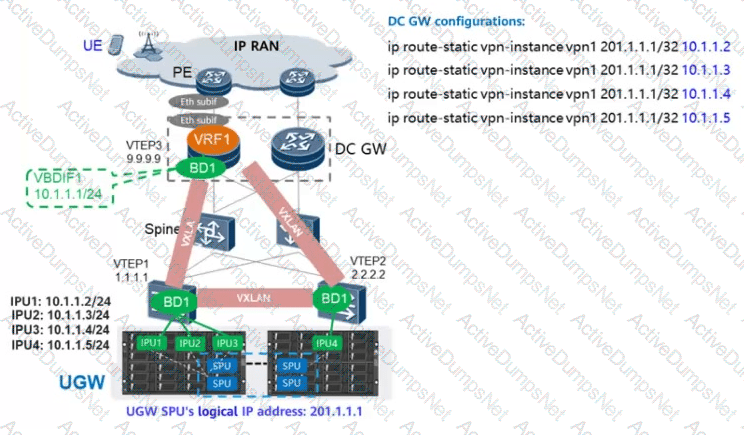
In the distributed telco-cloud network shown, traffic is sent from the external network to the VNF. The route configurations on the relevant DC GW are shown. How is the traffic forwarded within the telco-cloud network, from the DC GW to the leaf node?
Question # 13

Exhibit 14.1 — Original topology/configuration figure

Options:

A.

Forwarded over a Layer 2 VXLAN tunnel

B.

Forwarded over a Layer 3 VXLAN tunnel

C.

Forwarded over a VPN after being encapsulated with VPN and public network labels

D.

Directly forwarded by the IP network

Question 14

Which of the following statements is incorrect about the SR-TE tunnel configuration below?

[R1] interface tunnel1

[R1-Tunnel1] ip address unnumbered interface LoopBack0

[R1-Tunnel1] tunnel-protocol mpls te

[R1-Tunnel1] destination 3.3.3.3

[R1-Tunnel1] mpls te tunnel-id 1

[R1-Tunnel1] mpls te signal-protocol segment-routing

[R1-Tunnel1] mpls te pce delegate

Select all that apply.

Options:

A.

The tunnel ID of the tunnel is 1. Other SR-TE tunnels on the device cannot have the same tunnel ID as this tunnel.

B.

The tunnel interface borrows the address of the Loopback 0 interface.

C.

The tunnel interface uses SR as the tunneling protocol.

D.

The tunnel interface uses a manually specified path.

Question 15

Which of the following statements regarding EVPN on a 5G transport network is incorrect?

Options:

A.

EVPN L3VPN routes appear only in the EVPN routing table, not in the display bgp vpnv4 all routing-table command output.

B.

In the IP VPN instance of each device, the RT needs to be changed to be advertised in the EVPN address family.

C.

If EVPN is used to carry L3VPN services, you must run the advertise l2vpn evpn command in the BGP-VPN instance IPv4 address family view. Otherwise, routes are advertised through VPNv4 by default.

D.

When SR tunnels are used to carry EVPN traffic, the evpn mpls routing enable command must be run in the VPN instance view.

Question 16

With sub-interface-based HQoS, only one flow queue profile may be applied to a channelized sub-interface.

Options:

A.

TRUE

B.

FALSE

Question 17

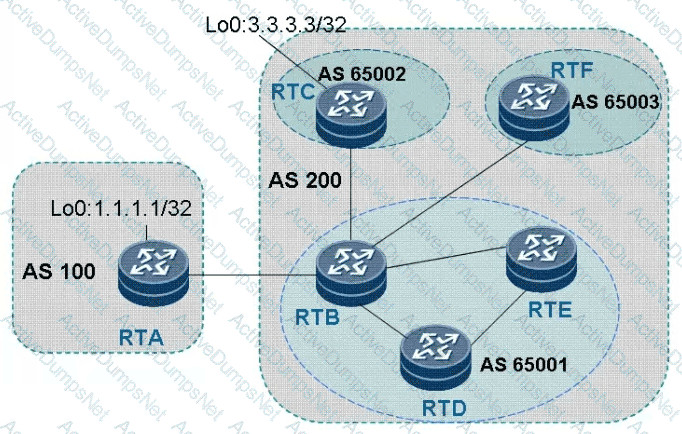
In the network shown, RTA is in AS 100 and forms an EBGP peer relationship with RTB. RTB, RTC, RTD, RTE, and RTF are in AS 200. RTB, RTD, and RTE are also in sub-AS 65001, RTC is also in sub-AS 65002, and RTF is also in sub-AS 65003.

1. RTA imports route 1.1.1.1/32. What is the route's AS_Path after RTF receives it?

2. RTC imports route 3.3.3.3/32. What is the route's AS_Path after RTA receives it?

3. RTC imports route 3.3.3.3/32. What is the route's AS_Path after RTE receives it?
Question # 17

Exhibit 29.1 — Original topology/configuration figure

Options:

A.

100; 200; empty

B.

(65003) (65001) 200 100; 200; 200

C.

(65001) 100; 200; (65002)

D.

(65001) 200 100; (65002) (65001) 200; (65002)

Question 18

The topology shown is a typical transport-network access-layer structure. Each core-network device is dual-homed to two CEs, and the CEs and PEs are interconnected in a square-loop topology. The access layer must carry voice and signaling services. Two VPN instances must be configured on each CE to isolate voice services from signaling services and provide security and QoS. Signaling services are transmitted in active/standby mode, while voice services are transmitted in load-balancing mode. VRRP must be enabled between the two CEs to terminate signaling flows. From the perspectives of network robustness and architectural suitability, which statements about this topology are correct?
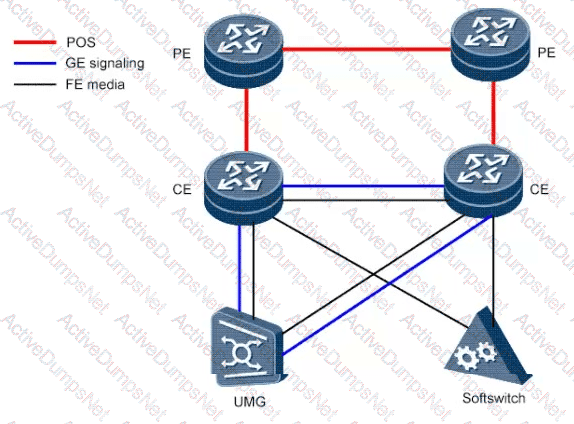
Question # 18

Exhibit 60.1 — Original topology/configuration figure

Select all that apply.

Options:

A.

GE links, not POS links, should be used between CEs and PEs.

B.

GE and FE links between two CEs need be added to an Eth-Trunk to improve reliability.

C.

The total bandwidth of the link between two CEs should be greater than or equal to the bandwidth of the CE-PE interconnection link.

D.

The voice services should be carried on GE links, and the signaling services should be carried on FE links.

Page: 1 / 6
Total 60 questions