
Huawei H12-841_V1.5 HCIP-Datacom-Campus Network Planning and Deployment V1.5 Exam Practice Test
HCIP-Datacom-Campus Network Planning and Deployment V1.5 Questions and Answers
(The centralized VXLAN gateway manages inter-subnet traffic in a centralized manner. The gateway deployment and management are simple. However, ARP entries of all terminals need to be generated on the Layer 3 gateway, and the number of ARP entries on the Layer 3 gateway is limited. Therefore, the centralized VXLAN gateway is not suitable for scenarios with a large number of terminals.)
(Which of the following encryption algorithms isnot supportedby IPsec VPN?)
(On a campus network, iMaster NCE-Campus is used to deploy two VNs: R&D VN and marketing VN, users in these two VNs belong to two security groups, respectively. The campus network requires R&D personnel and sales personnel to communicate with each other. To meet this requirement, which of the following tasks does a network administrator need to perform?)
(Which of the following are the typical deployment scenarios when iMaster NCE-Campus is used to deploy a network?)
(Both SNMP and NETCONF can be used to manage network devices. Which of the following statements about the two protocols is true?)
(On a campus network, which of the following address allocation modes is recommended to facilitate management of devices such as servers, print servers, and video surveillance devices?)
(Which of the following statements about static VXLAN tunnel configuration are true?Choose all that apply.)
(Portal authentication is recommended for scenarios with high mobility and numerous terminal types, such as shopping malls and supermarkets. MAC address authentication is recommended for dumb terminals that do not support Portal authentication, such as printers, fax machines, and IP phones.)
(iMaster NCE-Campus has multiple networking planes. The single-plane networking is optional only in single-node system deployment.)
(DHCP dynamically configures and centrally manages IP addresses of hosts. Which of the following statements about DHCP is false?)
(After the Huawei CloudCampus Solution is deployed on a campus network, which of the following protocol packets may be exchanged between the management layer and network layer?)
(An MSP administrator creates a tenant account. Which of the following logs records the operation?)
(After NAT traversal is enabled, if a NAT device is detected during IKE negotiation between two gateways, ESP packets are encapsulated with a UDP header. Both the source and destination port numbers are set to ________ (Enter only digits.) in the header. This enables ESP packets to pass through the NAT device.)
(On a VXLAN-based virtualized campus network, terminals communicate with each other through VXLAN tunnels. When the campus network needs to communicate with external networks, the data must pass through border nodes.)
(Network Quality Analysis (NQA) is a real-time network performance detection and measurement technology. It monitors the performance of multiple protocols running on a network. Which of the following can be monitored by NQA?)
(iMaster NCE-Campus provides independent working interfaces on different planes: management plane and service plane. You can log in to each plane through a specific IP address and port number. The port number of the service plane is _____.)
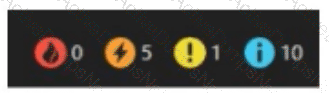
(An administrator monitors the network status on iMaster NCE-Campus. The figure shows alarm information displayed on iMaster NCE-Campus. How manywarning alarmsare generated on the network?)
(ESP is an IP-based transport-layer protocol. Which of the following is its protocol number?)
(The Huawei CloudCampus Solution supports various rate limiting modes for wireless users in small- and medium-sized campus scenarios. Which of the following modes is suitable for refined traffic control of each user?)
(Which of the following statements about authentication profile configuration is true?)
(During WLAN planning and design, channels 1, 6, and 11 are recommended on the 2.4 GHz frequency band, and channels 1, 5, 9, and 13 are recommended in high-density scenarios. On the 5 GHz frequency band, it is recommended that high-frequency and low-frequency channels of adjacent APs be staggered to prevent overlapping.)
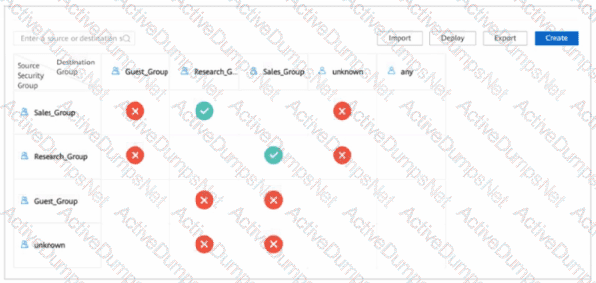
(The following figure shows a policy control matrix on a virtualized network deployed using iMaster NCE-Campus. Which of the following statements about the policy control matrix are true?Choose all that apply.)
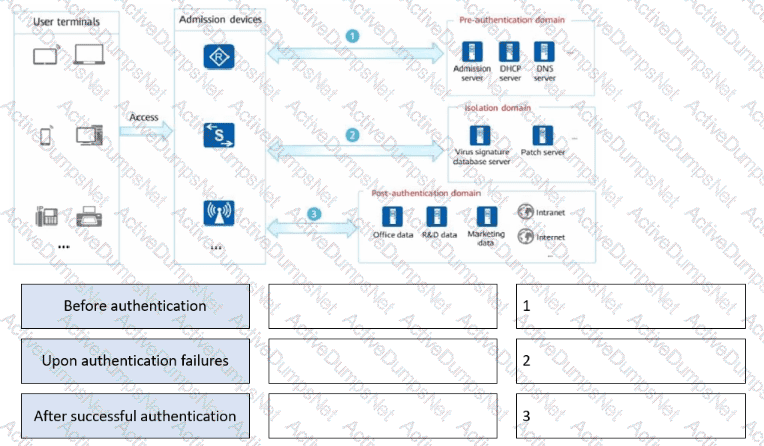
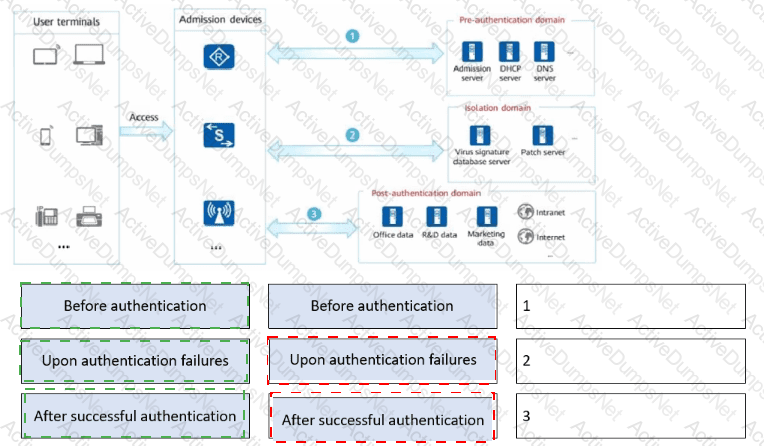
Drag the user authentication results to the corresponding network access rights.
(Which of the following fields is not carried in a BGP EVPN Type 2 route?)
(MAC address learning of a static VXLAN tunnel depends on exchange of packets, such as ARP packets, between hosts.)
(Which of the following is used to implement inter-subnet communication on a VXLAN network and allow access from a VXLAN network to an external non-VXLAN network?)
(Free mobility is deployed on a campus network through iMaster NCE-Campus. To enable a policy enforcement point to obtain IP-security group entries, which of the following methods can be used?)
(The Huawei CloudCampus Solution divides the network architecture into three layers: network layer, management layer, and application layer.)
(On a virtualized network deployed using iMaster NCE-Campus, after an administrator performs an operation, iMaster NCE-Campus delivers the following configuration to devices. Which of the following operations did the administrator perform?)
acl number9997
rule1permit ip source ucl-groupnameResearch_Group destination ucl-groupnameSales_Group
rule2permit ip source ucl-groupnameResearch_Group destination ucl-groupnameGuest_Group
(Which of the following roles is not a core role in Huawei's free mobility solution?)
(On a virtualized network deployed using iMaster NCE-Campus, after an administrator performs an operation, iMaster NCE-Campus delivers the following configuration to devices. Which operation did the administrator perform?
ip vpn-instance MKT
ipv4-family
route-distinguisher 3:6
vpn-target 0:6 export-extcommunity
vpn-target 0:6 export-extcommunity evpn
vpn-target 0:6 import-extcommunity
vpn-target 0:6 import-extcommunity evpn
vxlan vni 6