
Huawei H12-811_V2.0 HCIA-Datacom V2.0 Exam Practice Test
HCIA-Datacom V2.0 Questions and Answers
Which of the following statements are true about the Python code shown below? (Select all that apply)
import paramiko
import time
ssh = paramiko.SSHClient()
ssh.set_missing_host_key_policy(paramiko.AutoAddPolicy())
ssh.connect( ' 192.168.1.254 ' , username= ' python ' , password= ' Huawei@123 ' )
channel = ssh.invoke_shell()
channel.send( ' screen-length 0 temporary\n ' )
time.sleep(1)
output = channel.recv(65535).decode( ' utf-8 ' )
print(output)
ssh.close()
Defining OSPF areas in a large network helps reduce the size of the LSDB maintained by each router. If both R1 and R2 are assigned to area 1, they have the same LSDB within that area.
Huawei network devices such as switches and routers can establish NETCONF channels with iMaster NCE-Campus through DHCP. The DHCP server notifies DHCP clients of the URL/IP address and port number of iMaster NCE-Campus through Option_____. (Enter only digits.)
What is the broadcast address of the network that contains a host with IP address 192.168.1.147/28?
On a switched network where STP is enabled on all devices, when a downstream device detects a topology change, it continuously sends configuration BPDUs to the upstream device until the root bridge is informed of the topology change.
R1 has the following configurations:
[R1] radius-server template 1
[R1-radius-1] radius-server authentication 10.1.6.6 1812
[R1-radius-1] radius-server accounting 10.1.6.6 1813
[R1-radius-1] radius-server shared-key cipher YsHsjx_202206139
[R1-radius-1] quit
[R1] aaa
[R1-aaa] authentication-scheme auth1
[R1-aaa-authen-auth1] authentication-mode radius
[R1-aaa-authen-auth1] quit
[R1-aaa] accounting-scheme acc1
[R1-aaa-accounting-acc1] accounting-mode radius
[R1-aaa-accounting-acc1] quit
[R1-aaa] domain huawei.com
[R1-aaa-domain-huawei.com] authentication-scheme auth1
[R1-aaa-domain-huawei.com] accounting-scheme acc1
[R1-aaa-domain-huawei.com] radius-server 1
[R1-aaa-domain-huawei.com] quit
[R1-aaa] quit
Which of the following statements is true?
PC1 and PC2 are connected to the same switch, but they cannot learn each other’s ARP information. This may be caused by incorrect VLAN configuration on the switch.
In the Fat AP networking architecture, Fat AP can provide wireless user access without being managed by a WAC, making them suitable for scenarios such as homes and mini stores.
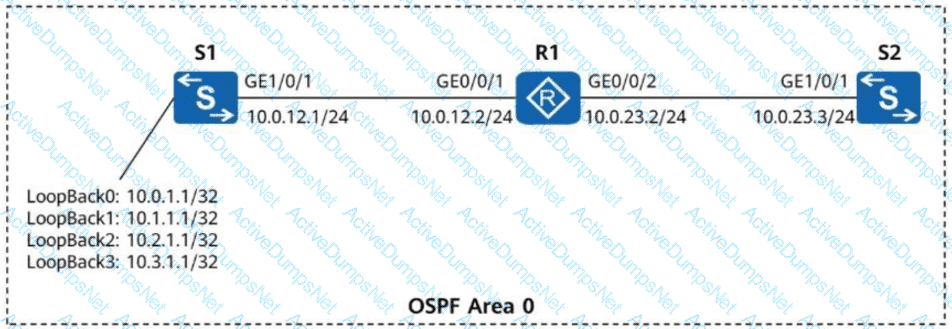
On the OSPF network shown in the figure, all IP addresses can communicate with each other. Then the following configurations are added on R1:
[R1] acl 3000
[R1-acl4-advance-3000] rule deny ip source 10.0.1.1 0.0.0.0
[R1-acl4-advance-3000] rule deny ip source 10.1.1.1 0.0.0.0
[R1-acl4-advance-3000] rule permit ip source 10.3.1.1 0.0.0.0
[R1-acl4-advance-3000] rule permit ip
[R1-acl4-advance-3000] quit
[R1] traffic classifier test
[R1-classifier-test] if-match acl 3000
[R1-classifier-test] quit
[R1] traffic behavior test
[R1-behavior-test] permit
[R1-behavior-test] quit
[R1] traffic policy test
[R1-trafficpolicy-test] classifier test behavior test
[R1-trafficpolicy-test] quit
[R1] interface GE 0/0/1
[R1-GE0/0/1] traffic-policy test outbound
[R1-GE0/0/1] quit
Which IP addresses of S1 can successfully ping 10.0.23.3? (Select all that apply)
In a wireless communication system, information is first converted into digital signals for easy circuit calculation and processing by the transmitter through source coding, and then converted into radio waves through channel coding and modulation. Which of the following parameters of a carrier are modified during the modulation process based on signal changes? (Select all that apply)
When a Huawei network device functions as an FTP server, which of the following are possible causes of an FTP client failing to log in to the FTP server? (Select all that apply)
In the WAC + Fit AP networking, an AP fails to go online. The output of the display ap all command run on the WAC is shown below. According to the command output, which of the following is the possible cause of the AP’s failure to go online?

Secure Shell (SSH) is a protocol that uses encryption and authentication mechanisms to implement network services, such as secure access and file transfer, securely over an insecure network. Which of the following protocols use SSH? (Select all that apply)
R1 has two equal-cost routes to 10.0.12.0/24 after the following commands are configured.
[R1] ip route-static 10.0.12.0 24 10.0.12.2 preference 60
[R1] ip route-static 10.0.12.0 24 10.0.21.2 preference 60

The IPv6 header is also called a fixed header, which contains eight fields. The total length of the fixed header is 40 bytes. Which of the following fields does an IPv6 header include?
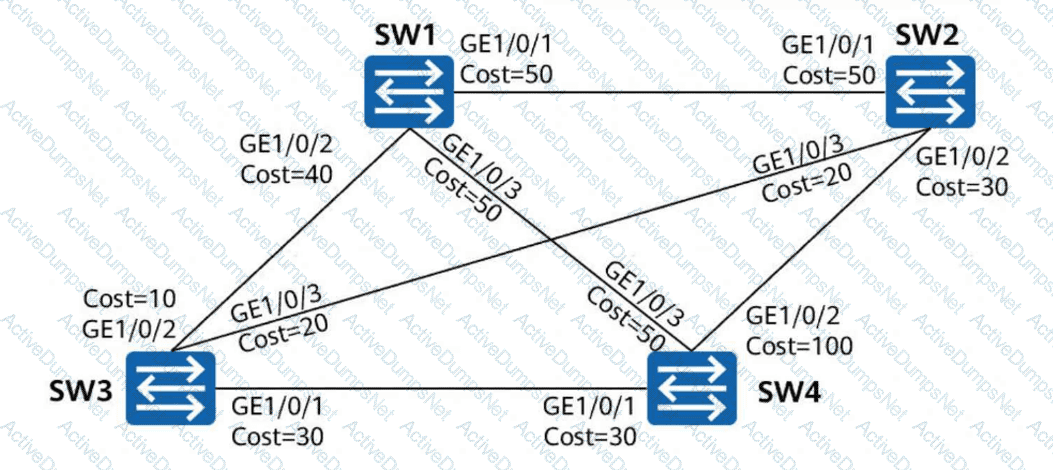
On the switched network shown in the figure, STP is enabled on all devices. SW1 is the root bridge. The port costs are shown in the figure. Other parameters retain the default values. After the network is stable, which of the following paths is used by SW1 to send traffic to SW4?
Which of the following protocols cannot be used for accounting between an AAA client and an AAA server?
An administrator attempts to add the following rule to ACL 2001 on R1:
[R1] acl 2001
[R1-acl4-basic-2001] rule deny tcp destination-port eq telnet source 192.168.1.3 0 destination 192.168.2.0 0.0.0.255
In this case, the rule cannot be configured successfully.
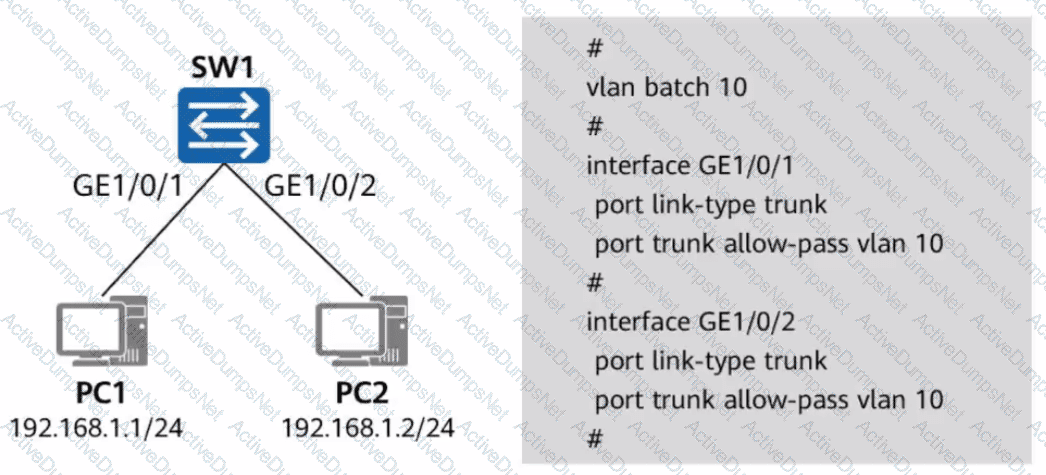
On a switched network, the administrator has completed the VLAN-related configuration shown in the figure on SW1. If the administrator runs the ping 192.168.1.2 command on PC1, the ping will fail.
When source NAT is configured on an enterprise egress device, which of the following may prevent intranet users from accessing the public network?
During VLAN planning for a campus network, VLAN IDs for different service types must be allocated consecutively, without redundancy, to prevent omissions in future allocations.
R1 has four static routes, each of which has a reachable next hop. Given this static route configuration, what is the next hop of the route to 20.0.0.0/30 in R1’s routing table?

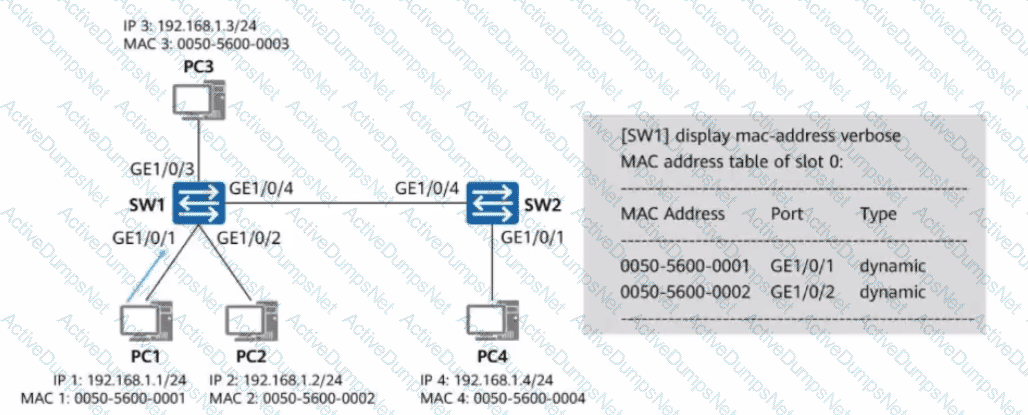
The MAC address table of SW1 is shown in the figure. If SW1 receives a data frame with the destination MAC address 0050-5600-0003 from PC1, through which of the following interfaces does SW1 send the data frame?
With the release of Wi-Fi 7, wireless networks are now faster, more stable, and more latency-tolerant than ever. Which of the following frequency bands are supported by Wi-Fi 7? (Select all that apply)
OSPF has five types of packets. Which type is used to notify an OSPF neighbor of its required LSAs?
The figure shows the simplified topology of an enterprise campus network. On this network, the aging time of dynamic MAC address entries on switches is 300 seconds.
The administrator connects PC1 to GE1/0/1 of SW1 and successfully pings the IP address of PC2 from PC1. Then, the administrator disconnects the Ethernet cable of PC1
from GE1/0/1 of SW1, immediately connects the cable to GE1/0/2 of SW1, and pings the IP address of PC2 from PC1. Which of the following operations does SW1
perform after receiving a data frame from PC1 when PC1 is connected to GE1/0/2 of SW1?
During WLAN deployment, a Fit AP fails to go online on the WAC. You log in to the WAC and run the display ap online-fail-record command to locate the fault. The command output shows that the cause is Insufficient license resources . This means that the license resources on the WAC are insufficient and that you need to expand the license capacity.
Four links between two switches establish an Eth-Trunk in manual mode, and the bandwidth of each link is 1 Gbit/s. One of the links fails. Which of the following statements are true about this scenario? (Select all that apply)
On the OSPF network shown in the figure, all IP addresses can communicate with each other. Then the following configurations are added on R1:
Which IP address of S1 can successfully ping 10.2.23.3?
On the network shown in the figure, all switches run STP. All links have a path cost of 20, and SW1 is the root bridge. What is the root path cost (RPC) of SW4?