
- Home
- Huawei
- HCIP-WLAN
- H12-323_V2.0
- H12-323_V2.0 - HCIP-WLAN V2.0
Huawei H12-323_V2.0 HCIP-WLAN V2.0 Exam Practice Test
HCIP-WLAN V2.0 Questions and Answers
Which of the following standards was the first to support a transmission rate exceeding 1,000 Mbps by bonding eight channels into a 160 MHz channel?
Options:
802.11ax
802.11n
802.11a
802.11ac
Answer:
DExplanation:
IEEE 802.11ac, commonly known as Wi-Fi 5, introduced major improvements in wireless transmission capacity through wider operating channels, higher-order modulation, and enhanced MIMO capabilities.
The standard supports operating channel bandwidths of 20 MHz, 40 MHz, 80 MHz, and 160 MHz.
A 160 MHz channel can be constructed by bonding eight contiguous, non-overlapping 20 MHz channels. This increases the available transmission bandwidth and supports higher physical-layer data rates.
IEEE 802.11ac also introduced 256-QAM modulation, enabling each modulated symbol to represent eight information bits under suitable radio conditions.
Combined with multiple spatial streams, these improvements allow theoretical transmission rates exceeding 1 Gbps.
IEEE 802.11a supports a maximum theoretical rate of 54 Mbps and does not implement the channel-bonding capabilities described.
IEEE 802.11n introduced significant MIMO and channel-bonding improvements but supports channel widths up to 40 MHz rather than 160 MHz.
IEEE 802.11ax supports 160 MHz operation and higher spectral efficiency, but it was introduced after IEEE 802.11ac.
Therefore, IEEE 802.11ac was the first listed standard supporting the required 160 MHz channel-bonding capability and gigabit-class wireless transmission rates.
Technical qualification: A 160 MHz channel alone does not guarantee a rate exceeding 1 Gbps; the number of spatial streams and selected modulation and coding scheme also determine the achievable PHY rate.
Training Material reference: WLAN Radio Resource Management → Dynamic Bandwidth Selection, PDF p. 305; WLAN Planning Basics → Theoretical WLAN Rate Calculation, pp. 364–365; Channel Bonding, p. 372.
────────────────────────────────────────────────────────
Like broadcast packets, multicast packets are transmitted at a low rate on a WLAN. It is recommended to enable multicast packet suppression when no multicast service is operating, so wireless network resources can be fully utilized.
Options:
TRUE
FALSE
Answer:
AExplanation:
Multicast traffic can consume substantial wireless airtime because group-addressed frames are typically transmitted using rates and reliability mechanisms different from those employed for individually addressed unicast traffic.
On an IEEE 802.11 WLAN, multicast and broadcast packets are commonly transmitted at basic transmission rates to accommodate receiving stations with different radio capabilities.
Consequently, excessive multicast traffic can occupy a disproportionate amount of wireless channel time, reduce resources available for unicast communication, and negatively affect application performance.
Huawei recommends controlling unnecessary multicast traffic through multicast packet suppression.
When no operational application depends on multicast communication, suppression can reduce unnecessary wireless traffic and improve utilization of the shared radio medium.
The Training Material describes controlling multicast traffic on both the uplink and downlink paths.
For direct-forwarding deployments, multicast traffic can be regulated using traffic policies on the switch interfaces connected to APs.
For STA-originated traffic, Huawei supports multicast suppression within a WLAN traffic profile. The course provides an example using:
traffic-optimize multicast-suppression packets 1000
If multicast-dependent services exist, the suppression configuration must be adjusted to their operational requirements.
Because the statement specifically assumes that no multicast service is operating, enabling suppression is consistent with Huawei's optimization guidance.
Training Material reference: WLAN Optimization Solution → Wired-Side Function Optimization → Multicast Packet Suppression, PDF p. 848, slide 17.
────────────────────────────────────────────────────────
A VLAN pool can be configured to supply service VLANs. Which of the following statements about a VLAN pool is false?
Options:
If the VLAN assignment algorithm is set to hash and a STA goes online multiple times, the STA is preferentially assigned the IP addresses it uses previously.
Configuring a VLAN pool to provide service VLANs can reduce the number of STAs in each VLAN and also the size of the broadcast domain.
If the VLAN assignment algorithm is set to even and a STA goes online multiple times, the STA obtains different IP addresses each time.
Nonexistent VLANs cannot be added to a VLAN pool.
Answer:
DExplanation:
VLAN pools allow a Huawei WAC to distribute wireless users across multiple service VLANs instead of assigning every station associated with an SSID to a single VLAN. This reduces the concentration of users in an individual broadcast domain and improves address allocation scalability.
Huawei supports two primary VLAN assignment algorithms: hash and even.
Under hash assignment, the controller uses the station's MAC address to determine its service VLAN. Provided the pool membership remains unchanged, a returning station is ordinarily assigned the same VLAN and preferentially obtains its previous IP address. Therefore, option A is correct.
Under even assignment, VLAN selection follows the order in which stations connect. Repeated associations can result in different VLAN assignments and IP addresses, supporting option C. Option B correctly describes the scalability advantage of VLAN pooling.
Option D is false because Huawei permits an administrator to reference a VLAN ID in a VLAN pool even when the corresponding VLAN has not yet been created.
However, the configuration does not make the nonexistent VLAN operational. The administrator must subsequently create that VLAN and ensure the required forwarding path is configured; otherwise, traffic associated with it cannot function correctly.
Training Material reference: WLAN Networking Technologies → VLAN Pool Configuration → VLAN Assignment Algorithms. Huawei WLAN-AC Command Reference → vlan in VLAN Pool View.
────────────────────────────────────────────────────────
Which of the following statements are accurate about the wireless health evaluation feature in CampusInsight?
CHOOSE THREE
Options:
This function can be used to rank different networks or different areas of one network based on comprehensive experience evaluation results, so as to identify the networks or areas ranking lowest in terms of overall health status or key metrics.
This function can be used to diagnose and display details of key experience metrics, including the health of the experience metrics and factors that affect the metrics.
A wireless health report can be sent to users in the corresponding user groups as a PDF document. The report contains the analysis of metrics such as the access success rate, time required for access, throughput fulfillment rate, capacity health, signal and interference, and roaming fulfillment rate.
This function can be used to evaluate the following key metrics: access success rate, time required for access, signal coverage and interference, and AP forwarding efficiency, as well as roaming, capacity, and throughput fulfillment rates.
Answer:
A, B, CExplanation:
Huawei CampusInsight provides intelligent network operations and maintenance capabilities by collecting telemetry information and evaluating network-wide wireless service experience.
Option A is correct. The wireless network health function can rank networks or areas according to comprehensive experience evaluations, enabling administrators to identify poorly performing network segments and prioritize optimization activities.
Option B is correct. CampusInsight diagnoses individual experience metrics and presents the factors affecting them. This assists engineers in distinguishing authentication problems, weak radio coverage, excessive interference, and capacity-related degradation.
Option C is the intended third selection. The Training Material confirms that CampusInsight generates and distributes network quality evaluation reports. These reports include network overviews, metric details, and rectification recommendations. The evaluated metrics cover access success, access duration, roaming fulfillment, signal and interference, capacity health, and throughput fulfillment.
Option D is incorrect. It introduces AP forwarding efficiency as a principal wireless health evaluation metric. Huawei's defined evaluation model instead specifies access success rate, access duration, roaming fulfillment, signal and interference, capacity health, and throughput fulfillment.
The health model groups these measurements into access experience, roaming experience, and performance experience.
Accordingly, A, B, and C are the intended answers.
Training Material reference: WLAN O and M → CampusInsight Intelligent O & M → Wireless Network Health, PDF pp. 921–923.
Lab Guide reference: Lab 11 — CampusInsight O & M → Checking Wireless Network Health.
────────────────────────────────────────────────────────
STAs roam from one subnet to another during Layer 3 roaming. To let the STAs access the original network after roaming, ensure their traffic is forwarded to the original subnet through CAPWAP tunnels.
Options:
TRUE
FALSE
Answer:
AExplanation:
Layer 3 roaming occurs when a wireless station moves between APs associated with different service subnets while retaining the IP address assigned on its original network.
Because the station moves into a different subnet without changing its IP address, the WLAN infrastructure must maintain a forwarding path to the original network.
Huawei accomplishes this through CAPWAP tunneling and home-agent mechanisms.
Before roaming, the station sends its service traffic through its home AP and the corresponding network forwarding path.
After roaming, the station associates with a foreign AP. The foreign AP forwards the station's traffic through a CAPWAP tunnel toward the appropriate home-network forwarding point.
In intra-WAC roaming scenarios, the WAC may forward tunneled traffic directly to the original service network. In direct-forwarding scenarios, the traffic may be returned through the home AP, which acts as the home agent.
For inter-WAC roaming, traffic may additionally traverse the inter-WAC CAPWAP tunnel between the foreign and home controllers.
These mechanisms preserve the station's IP address and allow communication to continue despite movement between different Layer 3 networks.
Huawei's Training Material explicitly identifies forwarding traffic to the original subnet through CAPWAP tunnels as a requirement for Layer 3 roaming.
Therefore, the statement is TRUE.
Training Material reference: WLAN Networking Technologies → WLAN Roaming → Intra-WAC and Inter-WAC Layer 3 Roaming, PDF pp. 255–260.
Lab Guide reference: Lab 7 — WLAN Roaming → Inter-WAC Layer 3 Roaming Configuration.
────────────────────────────────────────────────────────
In a restroom network-planning solution, when the men's and women's rooms are adjacent, one AP may be installed in the middle to provide signal coverage.
Options:
TRUE
FALSE
Answer:
BExplanation:
WLAN planning for restrooms requires particular attention to construction materials, wall attenuation, indoor coverage continuity, and practical AP installation locations.
Although adjacent rooms can sometimes be covered by a shared access point, restroom environments present additional RF propagation challenges. Restroom partition walls are commonly constructed using brick, concrete, ceramic tiles, and other materials that may significantly attenuate wireless signals.
Huawei's planning guidance specifically states that walls between adjacent restrooms are generally thick and that relying on wireless signals to penetrate these walls is not recommended.
Consequently, placing a single AP between men's and women's restrooms may produce inadequate coverage in one or both areas. Users could experience weak received signal strength, reduced physical-layer rates, retransmissions, or connectivity instability.
Huawei therefore recommends deploying an independent indoor AP in each restroom.
The recommended AP configuration uses omnidirectional antennas with ceiling-mounted installation, allowing radio coverage to be distributed within the individual restroom.
Where architectural appearance is important, the installation design should incorporate suitable aesthetic measures without compromising wireless performance.
This recommendation differs from planning for lightly partitioned office areas, where a shared AP may provide sufficient coverage across multiple rooms.
Therefore, the statement is FALSE.
Training Material reference: WLAN Planning Scenarios → WLAN Planning and Design for Typical Scenarios → WLAN Deployment Solution for Restrooms, PDF p. 544.
────────────────────────────────────────────────────────
Among the SISO, SIMO, MISO, and MIMO transmission systems on a WLAN, only MIMO can simultaneously transmit two copies of a signal.
Options:
TRUE
FALSE
Answer:
BExplanation:
The statement is technically inaccurate because it fails to distinguish between transmitting multiple independent spatial streams and transmitting redundant copies of the same information using multiple antennas.
SISO (Single-Input Single-Output) uses one transmitting antenna and one receiving antenna, allowing a single spatial stream.
SIMO (Single-Input Multiple-Output) uses one transmitting antenna and multiple receiving antennas. The receiver observes the transmitted signal through multiple propagation paths, providing receive diversity and improving reception reliability without increasing the number of independent transmitted streams.
MISO (Multiple-Input Single-Output) uses multiple transmitting antennas and one receiving antenna. The transmitting antennas can send the same information over different paths to provide transmit diversity. Consequently, transmitting redundant signal copies is not exclusive to MIMO.
MIMO (Multiple-Input Multiple-Output) uses multiple antennas at both ends. When spatial multiplexing is employed, two or more independent signals can be transmitted simultaneously, increasing the theoretical transmission capacity.
Huawei's Training Material explicitly distinguishes the MISO diversity mechanism from MIMO spatial multiplexing.
The statement incorrectly describes MIMO as the only system capable of transmitting multiple copies of a signal. Therefore, the technically appropriate answer is FALSE.
Training Material reference: WLAN Planning Basics → WLAN Technology Basics → SISO, MISO, SIMO, and MIMO, PDF pp. 354–355.
────────────────────────────────────────────────────────
In a network with Huawei's CloudCampus Solution deployed, an AP cannot come online on iMaster NCE-Campus. Which of the following could cause this issue?
CHOOSE THREE
Options:
The AP is not switched to the cloud mode.
AP information added on the cloud management controller is incorrect leading to a registration failure.
The network between the AP and cloud management platform is disconnected.
The CAPWAP source IP address is not configured on the AP.
Answer:
A, B, CExplanation:
Huawei's CloudCampus architecture enables cloud-managed APs to register with iMaster NCE-Campus for centralized configuration, monitoring, and network management.
Successful AP onboarding requires the device to operate in the correct management mode, possess appropriate registration information, and maintain IP connectivity to the management platform.
Option A is correct. An AP not operating in cloud mode cannot complete the required cloud-management onboarding process. The device must first be switched to the appropriate operating mode.
Option B is correct. Incorrect device registration information can cause onboarding failure. Huawei identifies problems involving missing device ESNs, incorrect site assignments, and unauthorized device information as possible registration failure causes.
Option C is correct. The AP must communicate with the cloud management platform. Routing failures, disconnected interfaces, DNS problems, or inaccessible controller ports may prevent registration.
Option D is incorrect. Configuring a CAPWAP source IP address is associated with traditional WAC-based CAPWAP operation, not the cloud AP registration requirement described in this question.
Huawei recommends using display cloud-mng info to inspect management configuration and display cloud-mng online-fail-record in diagnostic view to identify onboarding failure reasons.
Therefore, the correct selections are A, B, and C.
Training Material reference: WLAN Troubleshooting → Cloud Management Faults → Flowchart and Procedure for Troubleshooting Onboarding Failures of Cloud WACs and APs, PDF pp. 972–975.
Lab Guide reference: Lab 4 — Cloud Management Networking → Device Registration and Verification.
────────────────────────────────────────────────────────
On a network using Huawei’s traditional WLAN solution, all APs are managed by a WAC. If users experience STA roaming failures and degraded WLAN service, which of the following is not a possible cause?
Options:
The APs before and after roaming are configured with different data forwarding modes.
The signal coverage of APs is discontinuous, with coverage holes.
The APs before and after roaming have different security profile configurations.
The STA roams at Layer 3, but Layer 3 roaming is disabled on the device.
Answer:
AExplanation:
Huawei's WLAN roaming troubleshooting methodology identifies inconsistent security configurations, incorrect roaming settings, faulty mobility-group relationships, and discontinuous radio coverage as common causes of unsuccessful roaming.
Option B is a valid cause. If AP coverage areas are separated by coverage holes, a moving STA may lose its connection before it can associate with the destination AP.
Option C is a valid cause. The APs involved in roaming must use compatible security parameters. Huawei specifically requires consistent SSIDs, security-profile settings, authentication modes, and relevant authentication parameters.
Option D is a valid cause. When the STA must perform Layer 3 roaming because its destination VLAN differs from its original VLAN, disabling Layer 3 roaming prevents the required transition.
Option A is not inherently a cause of roaming failure. Huawei supports roaming with different data-forwarding architectures, including direct forwarding and tunnel forwarding. Different forwarding modes do not, by themselves, establish that roaming cannot operate.
The controller must still maintain the required forwarding path, service VLAN connectivity, and roaming configuration.
Huawei's troubleshooting flowchart focuses on security-profile consistency, Layer 3 roaming configuration, VLAN correctness, mobility-group status, continuous coverage, and duplicate SSIDs.
Therefore, A is the correct selection.
Training Material reference: WLAN Troubleshooting → Roaming Faults → Flowchart and Procedure for Troubleshooting STA Roaming Failures, PDF pp. 999–1002.
Lab Guide reference: Lab 7 — WLAN Roaming → Inter-WAC Layer 3 Roaming Configuration and Verification.
────────────────────────────────────────────────────────
Radio calibration is a radio resource management solution that lets a WLAN rapidly adapt to changes in the radio environment. Which of the following is not part of the radio calibration process?
Options:
Load balancing
Power adjustment
Channel adjustment
Neighbor probe
Answer:
AExplanation:
Huawei's radio calibration mechanism dynamically optimizes AP radio parameters according to the surrounding RF environment. Its principal objectives are to minimize interference, preserve coverage continuity, and improve overall wireless transmission efficiency.
The calibration process includes neighbor discovery, radio-environment analysis, channel allocation, and transmit-power adjustment.
Neighbor probing is an essential input stage. APs periodically detect neighboring radios and report information to the WAC. This information allows the controller to construct a radio-neighbor topology and evaluate interference relationships.
Channel adjustment uses Dynamic Channel Assignment (DCA) to allocate suitable operating channels, reducing co-channel and adjacent-channel interference.
Power adjustment uses Transmit Power Control (TPC) to modify AP transmit power according to coverage requirements and neighboring radio conditions.
Huawei additionally supports Dynamic Frequency Assignment (DFA) and Dynamic Bandwidth Selection (DBS) as part of broader radio calibration.
Load balancing, however, is a separate radio resource management function. It redistributes associated users among available APs or radios according to criteria such as station count and load. It is not an operation within the radio calibration sequence.
The Training Material distinguishes radio calibration from AP-based load balancing as separate RRM functions. Therefore, option A is correct.
Training Material reference: WLAN Radio Resource Management → Radio Calibration → Overview and Implementation of Radio Calibration, PDF pp. 300–307.
Lab Guide reference: Lab 8 — RRM Lab → Radio Calibration and Load Balancing Configuration.
────────────────────────────────────────────────────────
In roaming scenarios, because of individual differences, some STAs do not roam to APs with stronger signals and instead remain connected to the initially associated APs, even if they are disconnected. These STAs might not initiate association requests again after disconnection. To resolve this problem, the WAC directly takes these sticky STAs offline.
Options:
TRUE
FALSE
Answer:
BExplanation:
A sticky STA is a wireless client that continues associating with its original AP despite the availability of another AP offering better signal quality.
This behavior commonly occurs when client roaming algorithms prioritize maintaining the existing association rather than selecting the strongest available connection.
Sticky STAs may experience low transmission rates, excessive retransmissions, increased packet loss, and poor application performance. They may also consume disproportionate channel airtime, affecting other users.
Huawei addresses this problem through smart roaming, which enables the network infrastructure to identify poorly connected stations and initiate steering toward suitable neighboring APs.
The WAC evaluates reported information, including signal-to-noise ratio, access rate, and neighboring AP conditions.
For STAs supporting IEEE 802.11v, steering can use BSS Transition Management mechanisms.
For STAs lacking 802.11v support, the WAC instructs the currently associated AP to disconnect the sticky STA and delivers appropriate blacklist information to influence the subsequent association process.
Therefore, the WAC coordinates the steering procedure rather than directly disconnecting the wireless client independently of the AP.
The question also inaccurately suggests that a STA can remain associated after its association has already been disconnected.
These technical inaccuracies make FALSE the correct selection.
Training Material reference: WLAN Networking Technologies → WLAN Roaming → Sticky STAs in Mobility Scenarios, PDF pp. 273–274; Smart Roaming Process, pp. 279–282.
────────────────────────────────────────────────────────
Network Access Control (NAC) is an end-to-end security-control technology that works with AAA to provide access authentication. Which of the following statements about NAC and AAA are correct?
CHOOSE All that Apply
Options:
NAC is mainly used for interaction between users and access devices.
NAC provides three authentication modes: 802.IX authentication, MAC address authentication, and Portal authentication.
An AAA server controls network access rights of users through authentication, authorization, and accounting.
AAA is mainly used for interaction between access devices and authentication servers.
Answer:
A, B, C, DExplanation:
Network Access Control (NAC) and Authentication, Authorization, and Accounting (AAA) perform complementary functions in Huawei's wireless access security architecture.
NAC controls how clients initiate network access and how access devices enforce admission decisions. Therefore, option A correctly describes the interaction between users and access devices.
Huawei identifies three principal NAC authentication modes: 802.1X authentication, MAC address authentication, and Portal authentication. These mechanisms support different endpoint capabilities and deployment requirements. For example, 802.1X is commonly used for enterprise user authentication, MAC authentication for devices without interactive authentication capabilities, and Portal authentication for browser-based admission. This establishes option B.
AAA provides the framework for authenticating user identities, determining authorized network privileges, and recording relevant session or usage information. An AAA server returns the applicable authentication and authorization results, which are enforced by the network access device. Option C therefore accurately describes the server's role.
Option D is also correct because AAA communication principally occurs between the access device and the authentication server, commonly using RADIUS.
The architectural distinction is that NAC governs admission at the user-facing network edge, while AAA provides the supporting authentication, authorization, and accounting services.
Training Material reference: User Access and Authentication → Access Control Solution for Wireless Users → Overview of NAC → 802.1X, MAC Address, and Portal Authentication.
Lab Guide reference: Lab 6 — Portal Authentication and Authentication Server Configuration.
────────────────────────────────────────────────────────
During WLAN optimization, an engineer uses the CloudCampus APP to test and identify interference from nearby wireless signals. The following figure displays the test results. Which statements are true about radio-signal interference in the current environment?
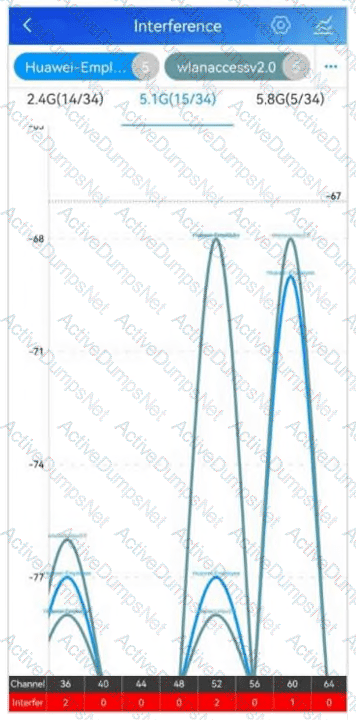
Original exhibit: Q24 Interference Exhibit
CHOOSE THREE
Options:
The radio signal strength on channel 36 is high, and it is recommended that channel 36 be avoided.
The current working frequency bandwidth of all channels is 20 MHz.
It is recommended that set the working channel of the AP be set to 44 to reduce interference.
Radio signals are mainly distributed on channels 36, 52, and 60.
Answer:
B, C, DExplanation:
Huawei's CloudCampus APP includes an interference-analysis function that identifies nearby wireless signals and displays their operating channels, signal strengths, and interference distribution.
The exhibit presents measurements from the 5 GHz radio environment. Three primary signal concentrations appear around channels 36, 52, and 60.
Option A is incorrect. The signals detected on channel 36 are relatively weak, approximately −76 to −78 dBm, compared with the stronger signals near channels 52 and 60, which reach approximately −68 to −69 dBm. Therefore, channel 36 is not the highest-interference channel shown.
Option B is the intended selection. The plotted channel footprints are treated as 20 MHz operating channels in the question's interpretation.
Option C is correct. Channel 44 shows no significant detected signal activity, making it a preferable candidate for avoiding the interference concentrations illustrated in the exhibit.
Option D is correct. The plotted signals are primarily concentrated around channels 36, 52, and 60.
In production, channel selection must also consider regulatory restrictions, channel utilization, neighboring AP configurations, and the selected channel bandwidth.
Training Material reference: WLAN Network Optimization Overview and Tools → CloudCampus APP → Interference Analysis, PDF pp. 840–842; WLAN Radio Resource Management → Wi-Fi Interference, pp. 293–295.
────────────────────────────────────────────────────────
During AP installation and deployment, APs may use Ethernet cables for PoE power. Which of the following statements about the PoE protocol are true?
CHOOSE All that Apply
Options:
The maximum output power of a device supporting PoE+ is 30 W.
PoE++ technology complies with IEEE 802.3bt.
The maximum output power of a device supporting PoE is 15.4 W.
The maximum output power of a device supporting PoE++ is 60 W.
Answer:
A, B, C, DExplanation:
Power over Ethernet (PoE) allows network devices to receive electrical power through Ethernet cabling, eliminating the need for separate power adapters at every AP installation point.
PoE power capacity must be considered during WLAN deployment because the selected AP model may require more power than the connected switch can supply.
Option A identifies the 30 W power-sourcing limit associated with IEEE 802.3at, commonly called PoE+.
Option B correctly associates PoE++ with IEEE 802.3bt. Huawei's Training Material explicitly identifies AP models using PoE++ (802.3bt) power supplies.
Option C identifies the 15.4 W power-sourcing limit associated with IEEE 802.3af PoE.
Option D describes a 60 W PoE++ power class. However, it is not a universally valid maximum for all equipment supporting IEEE 802.3bt.
The uploaded Training Material confirms the association between PoE++, PoE+, and the corresponding IEEE standards but does not provide a complete table establishing all four maximum power ratings.
Consequently, although A, B, C, and D appear to be the intended selections, the wording of D prevents unconditional technical verification.
Training Material reference: WLAN Planning Scenarios → Outdoor WLAN Device Selection → Power Supply Mode, PDF p. 777.
Lab Guide reference: Lab Environment Description → Device Models and PoE-Powered Access Switches, pp. 5–6.
────────────────────────────────────────────────────────
What is the maximum number of spatial streams that a 3x2 MIMO WLAN system supports?
Options:
2
3
5
6
Answer:
AExplanation:
Multiple-Input Multiple-Output (MIMO) technology increases wireless transmission capacity by employing multiple antennas at the transmitting and receiving devices.
A MIMO configuration is conventionally expressed as M × N, where M indicates the number of transmitting antennas and N indicates the number of receiving antennas.
The number of independent spatial streams supported by a MIMO link cannot exceed the smaller of the transmitting and receiving antenna counts.
This relationship is expressed as:
N_spatial streams ≤ min(M,N).
For a 3x2 MIMO system:
min(3,2) = 2.
Therefore, the maximum supported number of spatial streams is two.
Although the transmitting device has three antennas, the receiving device has only two antennas and cannot independently resolve three simultaneously transmitted spatial streams.
The additional transmitting antenna may contribute to improved diversity or beamforming performance, but it does not raise the maximum independent spatial-stream count beyond two.
Huawei's Training Material explicitly provides the example of a 3x2 MIMO system and confirms that it supports no more than two spatial streams.
Options B, C, and D incorrectly assume that the number of streams can equal the transmitting antenna count, the sum of antenna counts, or their product.
Training Material reference: WLAN Planning Basics → WLAN Capacity Design → Spatial Stream, PDF p. 368.
────────────────────────────────────────────────────────
In Portal authentication scenarios, when no trusted security certificate is installed on the Portal server, the authentication page is not displayed automatically on an STA.
Options:
TRUE
FALSE
Answer:
BExplanation:
Huawei identifies certificate-related problems as a possible cause of Portal authentication pages failing to appear automatically, particularly on Apple iOS terminals.
However, the Training Material specifies important conditions that are absent from this question.
The documented scenario involves a Portal server delivering its authentication page through HTTPS without a valid certificate issued by a trusted Certificate Authority (CA). Under those circumstances, iOS devices may refuse to display the authentication page automatically because certificate validation cannot establish trust in the server.
Huawei explains that iOS devices use the Captive Network Assistant (CNA) mechanism to detect captive portals and initiate user authentication.
The absence of a trusted certificate does not independently establish that automatic Portal display must fail on every STA. For example, the Training Material explicitly identifies changing authentication-page delivery from HTTPS to HTTP as a possible corrective action.
Other operating systems and captive-portal implementations may also behave differently.
Therefore, the statement is overgeneralized when applied to all Portal authentication scenarios, making FALSE the defensible answer as written.
Training Material reference: User Access and Authentication → Portal Authentication → Portal Authentication Issue (3/3): iOS Terminals Not Automatically Displaying an Authentication Page, PDF p. 228.
Lab Guide reference: Lab 6 — Portal Authentication, §6.2–6.3.
────────────────────────────────────────────────────────
Unlock H12-323_V2.0 Features
- H12-323_V2.0 All Real Exam Questions
- H12-323_V2.0 Exam easy to use and print PDF format
- Download Free H12-323_V2.0 Demo (Try before Buy)
- Free Frequent Updates
- 100% Passing Guarantee by Activedumpsnet
Questions & Answers PDF Demo
- H12-323_V2.0 All Real Exam Questions
- H12-323_V2.0 Exam easy to use and print PDF format
- Download Free H12-323_V2.0 Demo (Try before Buy)
- Free Frequent Updates
- 100% Passing Guarantee by Activedumpsnet