Summer Sale Limited Time Flat 70% Discount offer - Ends in 0d 00h 00m 00s - Coupon code: 70spcl

HashiCorp HCVA0-003 HashiCorp Certified: Vault Associate (003) Exam Exam Practice Test

Page: 1 / 32
Total 324 questions

HashiCorp Certified: Vault Associate (003) Exam Questions and Answers

Question 1

From the options below, select the auth methods that are better suited for machine-to-machine authentication (select five):

Options:

A.

Kubernetes

B.

GitHub

C.

TLS

D.

Token

E.

AppRole

F.

AWS

G.

LDAP

Question 2

    A Jenkins server is using the following token to access Vault. Based on the lookup shown below, what type of token is this? $ vault token lookup hvs.FGP1A77Hxa1Sp6Pkp1yURcZB


    Key Value

    --- -----

    accessor RnH8jtgrxBrYanizlyJ7Y8R

    creation_time 1604604512

    creation_ttl 24h

    display_name token

    entity_id n/a

    expire_time 2025-11-06T14:28:32.8891566-05:00

    explicit_max_ttl 0s

    id hvs.FGP1A77Hxa1Sp6KRau5eNB

    issue_time 2025-11-06T14:28:32.8891566-05:00

    meta < nil >

    num_uses 0

    orphan false

    path auth/token/create

    period 24h

    policies [admin default]

    renewable true

    ttl 23h59m50s

    type service

Options:

A.

Periodic token

B.

Batch token

C.

Orphaned token

D.

Secondary token

Question 3

After issuing the command to delete a secret, you run a vault kv list command, but the path to the secret still seems to exist. What command would permanently delete the path from Vault?

Question # 3

Options:

A.

vault kv delete -force kv/applications/app01

B.

vault kv destroy -versions=1 kv/applications/app01

C.

vault kv metadata delete kv/applications/app01

D.

vault kv delete -all kv/applications/app01

Question 4

What is the proper command to enable the AWS secrets engine at the default path?

Options:

A.

vault enable aws secrets engine

B.

vault secrets enable aws

C.

vault secrets aws enable

D.

vault enable secrets aws

Question 5

What API endpoint is used to manage secrets engines in Vault?

Options:

A.

/secret-engines/

B.

/sys/mounts

C.

/sys/capabilities

D.

/sys/kv

Question 6

Which of the following policies would permit a user to generate dynamic credentials on a database?

Options:

A.

path " database/creds/read_only_role " { capabilities = [ " generate " ] }

B.

path " database/creds/read_only_role " { capabilities = [ " update " ] }

C.

path " database/creds/read_only_role " { capabilities = [ " list " ] }

D.

path " database/creds/read_only_role " { capabilities = [ " read " ] }

Question 7

Which of the following are accurate statements regarding the use of a KV v2 secrets engine (select three)?

Options:

A.

Issuing a vault kv destroy command permanently deletes the current version of the secret

B.

Issuing a vault kv destroy command deletes all versions of a secret

C.

Issuing a vault kv delete command performs a soft delete of the current version

D.

Issuing a vault kv metadata delete command permanently deletes the secret

Question 8

True or False? Once you create a KV v1 secrets engine and place data in it, there is no way to modify the mount to include the features of a KV v2 secrets engine.

Options:

A.

True

B.

False

Question 9

Select the policies below that permit you to create a new entry of environment=prod at the path /secrets/apps/my_secret (select three).

Options:

A.

path " secrets/+/my_secret " { capabilities = [ " create " ] allowed_parameters = { " * " = [] } }

B.

path " secrets/apps/my_secret " { capabilities = [ " update " ] }

C.

path " secrets/apps/my_secret " { capabilities = [ " create " ] allowed_parameters = { " environment " = [] } }

D.

path " secrets/apps/* " { capabilities = [ " create " ] allowed_parameters = { " environment " = [ " dev " , " test " , " qa " , " prod " ] } }

Question 10

Below is a list of parent and child tokens and their associated TTL. Which token(s) will be revoked first?

Options:

A.

├───hvs.y4fUERqCtUV0xsQjWLJar5qX - TTL: 4 hours

B.

├───hvs.FNiIFU14RUxxUYAl4ErLfPVR - TTL: 6 hours

C.

├───hvs.Jw9LMpu7oCQgxiKbjfyzyg75 - TTL: 4 hours (child of B)

D.

├───hvs.3IrlhEvcerEGbae11YQf9FvI - TTL: 3 hours

E.

├───hvs.hOpweMVFvqfvoVnNgvZq8jLS - TTL: 5 hours (child of D)

Question 11

How does the Vault Secrets Operator (VSO) assist in integrating Kubernetes-based workloads with Vault?

Options:

A.

By enabling a local API endpoint to allow the workload to make requests directly from the VSO

B.

By using client-side caching for KVv1 and KVv2 secrets engines

C.

By injecting a Vault Agent directly into the pod requesting secrets from Vault

D.

By watching for changes to its supported set of Custom Resource Definitions (CRD)

Question 12

From the options below, select the benefits of using a batch token over a service token (select four).

Options:

A.

Often used for ephemeral, high-performance workloads

B.

Can be a root token

C.

Can be used on performance replication clusters (if orphan)

D.

Has accessors

E.

Lightweight and scalable

F.

No storage cost for token creation

Question 13

How long does the Transit secrets engine store the resulting ciphertext by default?

Options:

A.

24 hours

B.

30 days

C.

32 days

D.

Transit does not store data

Question 14

Which scenario most strongly indicates a need to run a self-hosted Vault cluster instead of using HCP Vault Dedicated?

Options:

A.

Your organization doesn’t require any custom security policies or intricate network topologies

B.

You want to offload all operational tasks and rely on HashiCorp to manage patching, upgrades, and infrastructure

C.

You prefer a fully managed environment that is readily scalable with minimal configuration overhead

D.

You must maintain specific compliance or custom integration requirements that demand full control over the Vault environment, including infrastructure provisioning and plugin development

Question 15

By default, what TCP port does Vault replication use?

Options:

A.

tcp/8200

B.

tcp/8300

C.

tcp/8201

D.

tcp/8301

Question 16

You are using an orchestrator to deploy a new application. Even though the orchestrator creates a new AppRole secret ID, security requires that only the new application has the combination of the role ID and secret ID. What feature can you use to meet these requirements?

Options:

A.

Have the application authenticate with the role ID to retrieve the secret ID

B.

Use response wrapping and provide the application server with the unwrapping token instead

C.

Use a batch token instead of a traditional service token

D.

Secure the communication between the orchestrator and Vault using TLS

Question 17

True or False? The Vault Secrets Operator does NOT encrypt client cache, such as Vault tokens and leases, by default in Kubernetes Secrets.

Options:

A.

True

B.

False

Question 18

During a service outage, you must ensure all current tokens and leases are copied to another Vault cluster for failover so applications don’t need to authenticate. How can you accomplish this?

Options:

A.

Have Vault write all the tokens and leases to a file so you have a second copy of them

B.

Configure all applications to use the auto-auth feature of the Vault Agent

C.

Configure Disaster Recovery replication and promote the secondary cluster during an outage

D.

Replicate to another cluster using Performance Replication and promote the secondary cluster during an outage

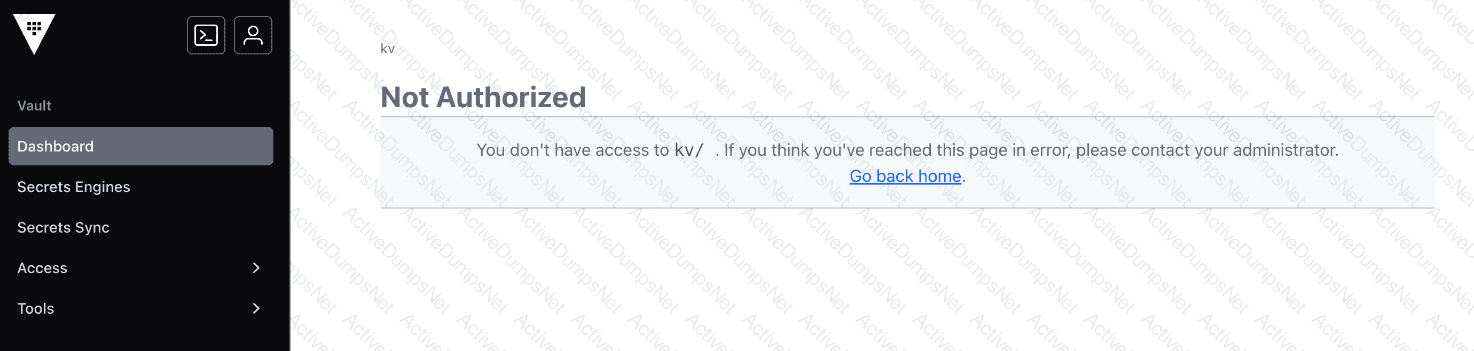
Question 19

A user is assigned the following policy, and they can successfully retrieve secrets using the CLI. However, the user reports receiving an error message in the UI. Why can’t the user access the secret in the Vault UI?

path " kv/apps/app01 " { capabilities = [ " read " ] }

Successful retrieval using the CLI
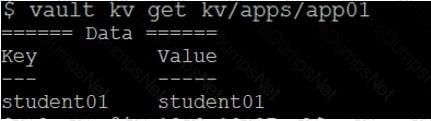
Question # 19

(Error: Permission denied in UI)

Question # 19

Options:

A.

The user doesn’t know what they’re doing

B.

The user doesn’t have permissions to retrieve the data from the UI, only the CLI

C.

The user needs list permissions to browse the UI

D.

The user’s token is invalid

Question 20

From the unseal options listed below, select the options you can use if you ' re deploying Vault on-premises (select four).

Options:

A.

Certificates

B.

Transit

C.

AWS KMS

D.

HSM PKCS11

E.

Key shards

Question 21

Julie is a developer who needs to ensure an application can properly renew its lease for AWS credentials it uses to access data in an S3 bucket. Although the application would generally use the API, what is the equivalent CLI command to perform this action?

Options:

A.

vault renew aws/roles/s3-read-only/39e6b9a2-296-83d9-2fe0-c11e846bdc99

B.

vault lease renew aws/creds/s3-read-only/39e6b9a2-296-83d9-2fe0-c11e846bdc99

C.

vault lease renew aws/roles/s3-read-only/39e6b9a2-296-83d9-2fe0-c11e846bdc99

D.

vault lease renew aws/creds/s3-read-only

Question 22

Which of the following features in Vault will replicate service tokens between clusters?

Options:

A.

Disaster Recovery Replication

B.

Performance Replication

C.

Vault Agent

D.

Integrated Storage

Question 23

Which of the following tokens are representative of a batch token? (Select two)

Options:

A.

hvr.AAAAAQL_tyer_gNuQqvQYPVQgsNxjap_YW1NB2m4CDHHadQo7rF2XLFGdwNJplAZNKbfloOvifrbpRCGdgG1taTqmC7Da_qftN64zeL10SmNwEoDTiPzC_1aS1KExbtVftU3Sx16cBVqaynwsYRDfVnfTAffE

B.

hvb.CAESIKOOSODDNGUJQe3EmsS8EQthulLjxRDhan_Axte2OrmPGiAKHGh2cy5KVnNhM25JdG82cDB0a1ZDbWhPTlAyekMQHg

C.

hvb.AAAAAQJnAGuRT_z8FD_jOwP26zYaNzJ456_SVqse0oXtaqrpaLUC3LlHrUoJhQPylGX7A6K_dcS0shiql6g5-BVpz0QIkCm7ePFQVjDT2HcIf8C6FNgkW313vYgBGP8lzQHebtspC0pqK64cfyU_qPKIka2u4ng-jsoy

D.

hvs.493n55sZp2lX2zyQfpkHTkL4

Question 24

When a lease is created, what actions can be performed by using only the lease ID? (Choose two)

Options:

A.

Renew the lease

B.

Revoke the lease

C.

Extend the max TTL for the lease

D.

Authenticate using the lease ID

Question 25

Tanner manages a data processing application and needs to be sure the data being processed is encrypted so it is securely stored post-processing. Which secrets engines can encrypt data? (Select three)

Options:

A.

transit

B.

KMIP

C.

SSH

D.

transform

Question 26

In Vault, there are two main types of tokens, batch and service. Which of the following is true about the renewable capabilities of each?

Options:

A.

Batch tokens cannot be renewed, but service can be renewed up to the max TTL

B.

Tokens cannot be renewed without reauthenticating to Vault

C.

Service tokens cannot be renewed, but batch can be renewed up to the max TTL

D.

Both batch and service tokens can be renewed up to the max TTL

Question 27

You need a simple and self-contained HashiCorp Vault cluster deployment with minimal dependencies. Which storage backend is best suited for this use case, providing all configuration within Vault and avoiding external services?

Options:

A.

Local File Storage Backend

B.

Integrated Storage (raft) Backend

C.

Consul Backend

D.

In-Memory Backend

Question 28

Which of the following secrets engines can store static secrets in Vault for future retrieval?

Options:

A.

KV

B.

PKI (certificates)

C.

Database

D.

Transit

Question 29

True or False? The following policy permits a user to read secrets contained in the path secrets/cloud/apps/jenkins?

text

CollapseWrapCopy

path " secrets/cloud/apps/jenkins/* " {

capabilities = [ " create " , " read " , " update " , " delete " , " list " ]

}

Options:

A.

True

B.

False

Question 30

What is the default value of the VAULT_ADDR environment variable?

Options:

A.

http://127.0.0.1:8200

B.

https://vault.example.com:8200

C.

https://127.0.0.1:8200

D.

http://vault.example.com:8200

Question 31

True or False? The root and default policies can be deleted if they are not needed or being used.

Options:

A.

True

B.

False

Question 32

You need to create a limited-privileged token that isn’t impacted by the TTL of its parent. What type of token should you create?

Options:

A.

Service token with a use limit

B.

Orphan token

C.

Periodic token

D.

Root token

Question 33

What header must be included in an API request in order to provide authentication validation?

Options:

A.

X-Token-Vault

B.

X-Vault-Token

C.

X-Token-Creds

D.

X-Vault-Creds

Question 34

Which of the following actions can be performed if you only had access to a token’s accessor? (Select four)

Options:

A.

Look up a token’s properties

B.

Renew the token

C.

Retrieve the actual token ID

D.

Revoke the token

E.

Look up a token’s capabilities on a path

Question 35

Suzy is a Vault user that needs to create and replace values at the path secrets/automation/apps/chef. Does the following policy permit her the permissions to do so?

text

CollapseWrapCopy

path " secrets/automation/apps/chef " {

capabilities = [ " create " , " read " , " list " ]

}

Options:

A.

No, the policy would deny Suzy from performing certain actions

B.

Yes, the policy has appropriate permissions

Question 36

Which of the following best describes response wrapping?

Options:

A.

The response is Base64 encoded, and the user must decode the response to retrieve the cleartext data

B.

Rather than provide a direct response, Vault returns a token and an accessor

C.

Vault responds with an encrypted version of the response, decrypted via transit

D.

Vault inserts the response into a single-use token’s cubbyhole

Question 37

True or False? You can create and update Vault policies using the UI.

Options:

A.

True

B.

False

Question 38

True or False? Although AppRole is designed for machines, humans can use it to authenticate to Vault if you wish.

Options:

A.

True

B.

False

Question 39

True or False? Once you authenticate to Vault using the API, subsequent requests will automatically be permitted without further interaction.

Options:

A.

True

B.

False

Question 40

Kyle enabled the database secrets engine for dynamic credentials. Amy, the senior DBA, accidentally deleted the database users created by Vault, disrupting client applications. How can Kyle manually remove the leases in Vault?

Options:

A.

No action is required since the leases will eventually expire and be revoked

B.

Obtain the individual lease IDs from the application logs and remove them using the vault lease revoke command

C.

Use the command vault lease revoke -force flag to delete the leases

D.

Revoke all of the leases associated with the entire database secrets engine to be sure they are all removed

Question 41

True or False? Performing a rekey operation using the vault operator rekey command creates new unseal/recovery keys as well as a new root key?

Options:

A.

True

B.

False

Question 42

To secure your applications, your organization uses certificates generated by a public CA. However, this strategy has proven expensive and you have to revoke certificates even though they have additional time left. What Vault plugin can be used to quickly generate X.509 certificates to secure your internal applications?

Options:

A.

Identity secrets engine

B.

PKI secrets engine

C.

SSH secrets engine

D.

Transit secrets engine

Question 43

By default, what methods of authentication does Vault support? (Select four)

Options:

A.

SSH

B.

Kubernetes

C.

VMware

D.

LDAP

E.

AppRole

F.

JWT

Question 44

True or False? After rotating a transit encryption key, all data encrypted with the previous version must be rewrapped or re-encrypted with the new key.

Options:

A.

True

B.

False

Question 45

There are a few ways in Vault that can be used to obtain a root token. Select the valid methods from the answers below. (Select three)

Options:

A.

Generating a root token using a quorum of recovery keys when using Vault auto unseal

B.

Initializing Vault when first creating the cluster by using vault operator init

C.

Using a batch DR operation token to create a new root token in the event of an emergency

D.

Running the command vault token create when using a valid root token

Question 46

Your organization runs workloads on both AWS and Azure for production applications. The security team has requested that a single Vault authentication mechanism be enabled to support applications on both public cloud platforms. Which of the following would be a valid auth method you can use?

Options:

A.

AWS

B.

GitHub

C.

AppRole

D.

Azure

Question 47

You have logged into the Vault UI and see this screen. What Vault component is being enabled in the screenshot below?
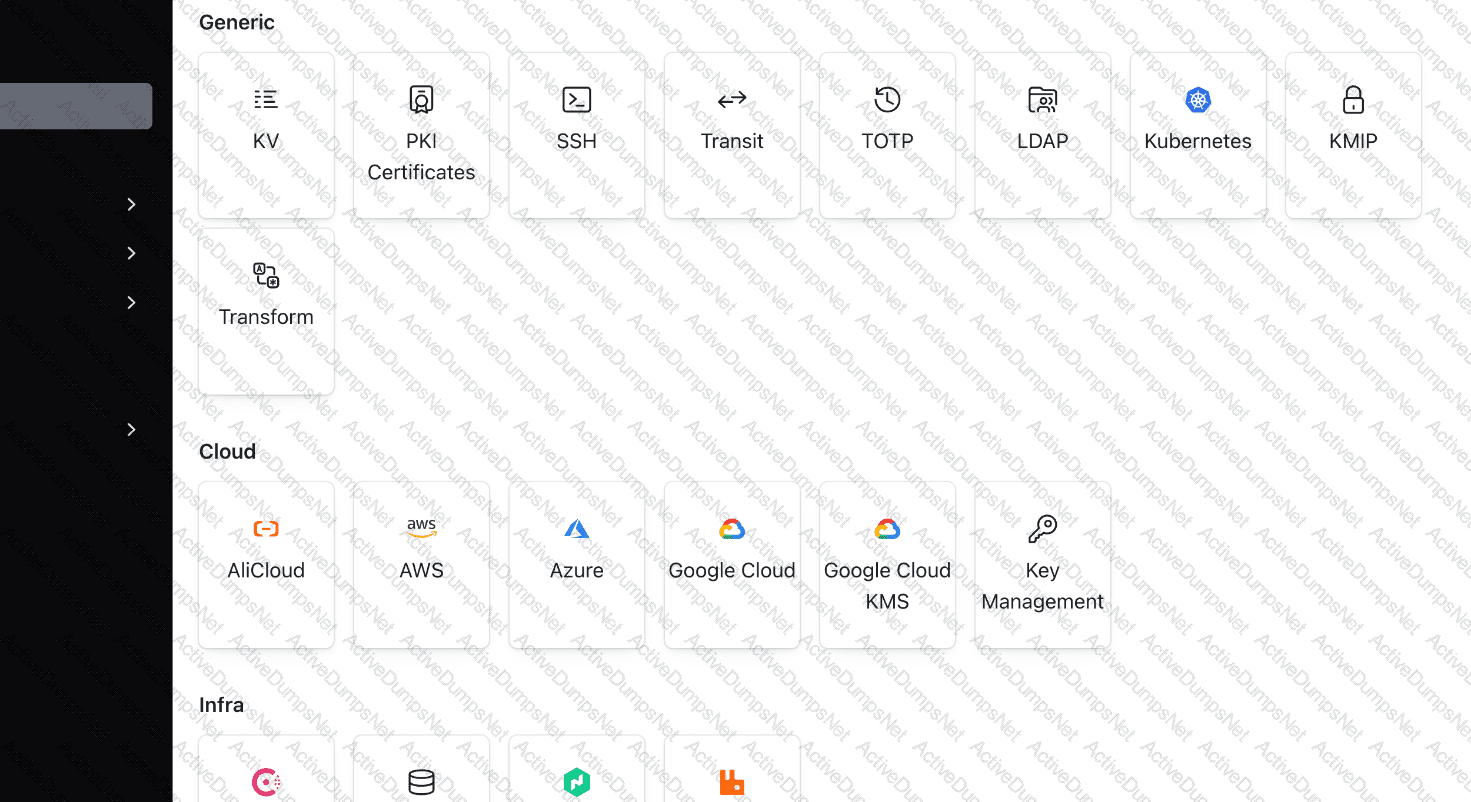
Question # 47

Options:

A.

Storage Backends

B.

Secrets Engine

C.

Auth Methods

D.

Audit Devices

Question 48

All Vault instances, or clusters, include two built-in policies that are created automatically. Choose the two policies below and the correct information regarding each policy. (Select two)

Options:

A.

The root policy is created automatically. This policy provides superuser privileges and cannot be deleted

B.

The admin policy is created automatically. It provides administrative permissions but can be deleted if needed

C.

The default policy is created automatically. This policy can be modified but not deleted

D.

The default policy is created automatically. This policy cannot be modified but it can be deleted

Question 49

You have enabled the Transit secrets engine on your Vault cluster to provide an " encryption as a service " service as your team develops new applications. What is a prime use case for the Transit secrets engine?

Options:

A.

Encrypting data before being written to an Amazon S3 bucket

B.

Storing the encrypted data in Vault for easy retrieval

C.

Generating dynamic SSH credentials for access to local systems

D.

Creating X.509 certificates for a new fleet of containers

Question 50

Your Azure Subscription ID is stored in Vault and you need to retrieve it via Vault API for an automated job. The Subscription ID is stored at secret/cloud/azure/subscription. The secret is stored on a KV Version 2 secrets engine. What curl command below would successfully retrieve the latest version of the secret?

Options:

A.

curl https://vault.krausen.com:8200/v1/secret/data/cloud/azure/subscription

B.

curl --header " X-Vault-Token: hvs.CbzCNJCVWt63jyzyaJakgDwz " https://vault.krausen.com:8200/v1/secret/cloud/azure/subscription

C.

curl --header " X-Vault-Token: hvs.CbzCNJCVWt63jyzyaJakgDwz " https://vault.krausen.com:8200/v1/secret/data/cloud/azure/subscription

D.

curl --header " X-Vault-Token: hvs.CbzCNJCVWt63jyzyaJakgDwz " https://vault.krausen.com:8200/secret/data/cloud/azure/subscription/latest

Question 51

You have a new team member on the Vault operations team. Their first task is to rotate the encryption key in Vault as part of the organization’s security policy. However, when they log in, they get an access denied error when attempting to rotate the key. The policy being used is below. Why can’t the user rotate the encryption key?

path " auth/* " {

capabilities = [ " create " , " read " , " update " , " delete " , " list " ]

}

path " sys/rotate " {

capabilities = [ " read " , " update " ]

}

Options:

A.

The policy requires sudo privileges since it is a root-protected path

B.

The policy doesn’t include create privileges so a new encryption key can’t be created

C.

The policy should include sys/rotate/ < name of key > as part of the path

D.

The encryption key has a minimum TTL, therefore the key cannot be rotated until that time expires

Question 52

How does the instance updates feature work when using the Vault Secrets Operator?

Options:

A.

By monitoring the Vault audit logs to watch for changes to the target path

B.

By constantly validating the current secret stored in Vault

C.

By continuously launching an init container to check for updates

D.

By subscribing to event notifications from Vault

Question 53

Your team uses the Transit secrets engine to encrypt all data before writing it to a MySQL database server. During testing, you manually retrieve ciphertext from the database and decrypt it to ensure the data can be read. After decrypting the data, you are worried something is wrong because the plaintext data isn’t legible. Why can you not read the original plaintext data after decrypting the ciphertext?

    $ vault write transit/decrypt/krausen-key ciphertext=vault:v1:8SDd3WHDOjf7mq69C.....

    Key Value

    --- -----

    plaintext Zml2ZSBzdGFyIHByYWN0aWNlIGV4YW1zIGJ5IGJyeWFuIGtyYXVzZW4=

Options:

A.

The incorrect key was selected when decrypting the ciphertext. Use the correct key to successfully read the data

B.

The incorrect key version was used to decrypt the data. Update the ciphertext and change the v1 to v3 to use the latest key version

C.

The plaintext is Base64 encoded. Decode the plaintext to see the original data

D.

The data was also encrypted on the database. Therefore Vault cannot decrypt the original data

Question 54

Your organization uses a CI/CD pipeline to deploy its applications on Azure. During testing, you generate new credentials to validate Vault can create new credentials. The result of this command is below:

text

CollapseWrapCopy

$ vault read azure/creds/bryan-krausen

Key Value

--- -----

lease_id azure/creds/bryan-krausen/9eed0373-ca92-99b6-b914-779b7bb0e1d9

lease_duration 60m

lease_renewable true

client_id 532bf678-ee4e-6be1-116b-4e4221e445dd

client_secret be60395b-4e6b-2b7e-a4b3-c449a5c00973

What commands can be used to revoke this secret after you have finished testing? (Select three)

Options:

A.

vault lease revoke azure/

B.

vault lease revoke -prefix azure/

C.

vault lease revoke azure/creds/bryan-krausen/9eed0373-ca92-99b6-b914-779b7bb0e1d9

D.

vault lease revoke azure/creds/bryan-krausen

E.

vault lease revoke -prefix azure/creds/bryan-krausen

Question 55

An Active Directory admin created a service account for an internal application. You want to store these credentials in Vault, allowing a CI/CD pipeline to read and configure the application with them during provisioning. Vault should maintain the last 3 versions of this secret. Which Vault secrets engine should you use?

Options:

A.

The KV secrets engine

B.

The LDAP secrets engine

C.

The Identity secrets engine

D.

The KV v2 secrets engine

Question 56

A new application is being provisioned in your environment. The application requires the generation of dynamic credentials against the Oracle database in order to read reporting data. Which is the best auth method to use to permit the application to authenticate to Vault?

Options:

A.

OIDC

B.

GitHub

C.

Userpass

D.

AppRole

Question 57

You have multiple Vault clusters in your environment, one for test and one for production. You have the CLI installed on your local machine and need to target the production cluster to make configuration changes. What environment variable can you set to target the production cluster?

Options:

A.

VAULT_REDIRECT_ADDR

B.

VAULT_CLUSTER_ADDR

C.

VAULT_ADDR

D.

VAULT_CAPATH

Question 58

You are using Vault CLI and enable the database secrets engine on the default path of database/. However, the DevOps team wants to enable another database secrets engine for testing but receives an error stating the path is already in use. How can you enable a second database secrets engine using the CLI?

Options:

A.

vault secrets enable database database2/

B.

vault secrets enable -force database

C.

vault secrets enable -path=database2 database

D.

vault secrets enable database2/

Question 59

Before data is written to the storage backend, the data is encrypted by which Vault feature?

Options:

A.

TLS certificate

B.

Cryptographic barrier

C.

Unseal keys

D.

Transit secrets engine

Question 60

Which of the following capabilities can be used when writing a Vault policy? (Select four)

Options:

A.

list

B.

deny

C.

apply

D.

root

E.

create

F.

write

Question 61

Which two interfaces automatically assume the token for subsequent requests after successfully authenticating? (Select two)

Options:

A.

CLI

B.

API

C.

UI

Question 62

By default, what happens to child tokens when a parent token is revoked?

Options:

A.

The child tokens are revoked

B.

The child tokens are renewed

C.

The child tokens are converted to parent tokens

D.

The child tokens create their own child tokens to be used

Question 63

You have deployed an application that needs to encrypt data before writing to a database. What secrets engine should you use?

Options:

A.

Transit

B.

SSH

C.

PKI

D.

TOTP

Question 64

An application is trying to use a dynamic secret in which the lease has expired. What can be done in order for the application to successfully request data from Vault?

Options:

A.

Try the expired secret in hopes it hasn’t been deleted yet

B.

Perform a lease renewal

C.

Request a new secret and associated lease

D.

Request the TTL be extended for the secret lease

Question 65

Which of the following unseal options can automatically unseal Vault upon the start of the Vault service? (Select four)

Options:

A.

HSM

B.

Azure KMS

C.

AWS KMS

D.

Transit

E.

Key Shards

Question 66

True or False? To prepare for day-to-day operations, the root token should be safely saved outside of Vault in order to administer Vault.

Options:

A.

True

B.

False

Question 67

True or False? After initializing Vault or restarting the Vault service, each individual node in the cluster needs to be unsealed.

Options:

A.

True

B.

False

Question 68

Holly has discovered that a highly privileged dynamic credential with a very long lease time was created, which could negatively impact the organization’s security. What command can Holly use to invalidate the credential so it can’t be used without affecting other credentials?

Options:

A.

vault lease revoke aws/creds/admin/27e1b9a1-27b8-83d9-9fe0-d99d786bdc83

B.

Holly would need to delete the credential on the cloud platform directly

C.

vault lease revoke -all

D.

vault lease revoke aws/creds/admin/*

Question 69

Which of the following features are not available in the Vault Community version?

Options:

A.

Cloud KMS auto-unseal

B.

Single sign-on support

C.

Event notifications and filtering

D.

Multi-factor authentication (auth)

E.

Dynamic secrets engines

F.

HSM auto-unseal

Question 70

Which of the following statements best describes the difference between static and dynamic credentials in a secrets management system?

Options:

A.

They are functionally identical—the only difference is what secrets engine creates them.

B.

Static credentials only apply to specific use cases, while dynamic credentials can be used everywhere.

C.

Static credentials often remain persistent for long periods of time, while dynamic are short-lived and auto-rotated.

D.

Static credentials are ephemeral and rotated frequently, while dynamic credentials remain unchanged indefinitely.

Question 71

Which auth method is ideal for machine-to-machine authentication?

Options:

A.

Okta

B.

UserPass

C.

GitHub

D.

AppRole

Question 72

After a client has authenticated to Vault, what security feature is used to make all subsequent calls?

Options:

A.

ldap

B.

pgp

C.

path

D.

key shard

E.

listener

F.

token

Question 73

What is the default method of authentication after first initializing Vault?

Options:

A.

TLS certificates

B.

GitHub

C.

Admin account

D.

Tokens

E.

AppRole

F.

Userpass

Question 74

The Vault Agent provides which of the following benefits? (Select three)

Options:

A.

Token renewal

B.

Authentication to Vault

C.

Client-side caching of responses

D.

Automatically creates secrets in the desired storage backend

Question 75

You are using Azure Key Vault for the auto-unseal configuration on your cluster. After the Vault service restarts, what command must you run to unseal Vault?

Options:

A.

You don’t need to run a command when using auto-unseal

B.

vault operator members

C.

vault operator unseal

D.

vault operator init

Question 76

Which statement most accurately describes how the response wrapping feature functions in Vault?

Options:

A.

Vault takes the response it would have sent to an HTTP client and instead inserts it into the cubbyhole of a single-use token, returning that single-use token instead.

B.

Vault encrypts the response with a dedicated key and sends it directly to the client, never storing it on the server or using single-use tokens for additional security.

C.

Vault divides the response into separate parts and stores each part in different tokens, requiring all tokens to be combined before disclosing the secret to the requesting client.

D.

Vault duplicates the response within a persistent token and allows multiple unwraps, ensuring that any user with the correct token can retrieve the secret repeatedly without time restrictions.

Question 77

What is the correct order that Vault uses to protect data?

Options:

A.

root key -- > encryption key -- > data

B.

unseal keys -- > root key -- > data

C.

root key -- > data

D.

encryption key -- > root key -- > data

Question 78

Which of the following best describes the function of the Vault Secrets Operator in a Kubernetes environment?

Options:

A.

It replaces the Kubernetes secrets API entirely and operates purely as a certificate authority for all workloads.

B.

It is a standalone Vault server that automatically applies security policies and rotates root tokens.

C.

It continuously reconciles and synchronizes secrets from Vault to Kubernetes, ensuring secrets are always updated

D.

It provides an interface to dynamically provision Kubernetes clusters through Vault’s infrastructure secrets.

Question 79

An application has authenticated to Vault and has obtained dynamic database credentials with a lease of 4 hours. Four hours later, the credentials expire, and the application can no longer communicate with the backend database, so the application goes down. What should the developers instruct the application to do to prevent this from happening again while maintaining the same level of security?

Options:

A.

Go back to using static credentials

B.

Renew the lease before expiration

C.

Revoke the lease before expiration

D.

Use a different auth method

Question 80

Which is not a capability that can be used when writing a Vault policy?

Options:

A.

delete

B.

modify

C.

create

D.

list

E.

read

F.

update

Question 81

Which of the following vault lease operations uses a lease _ id as an argument? Choose two correct answers.

Options:

A.

renew

B.

revoke -prefix

C.

create

D.

describe

E.

revoke

Question 82

Which of the following describes the Vault ' s auth method component?

Options:

A.

It verifies a client against an internal or external system, and generates a token with the appropriate policies attached

B.

It verifies a client against an internal or external system, and generates a token with root policy

C.

It is responsible for durable storage of client tokens

D.

It dynamically generates a unique set of secrets with appropriate permissions attached

Question 83

You have enabled the database secrets engine at the database/ path and created the readonly role. You run vault read, and the output shown in the exhibit is returned.

Which command renews the given lease?

Exhibit:

$ vault read database/creds/readonly

lease_id database/creds/readonly/fyF5xDomnKeCHNZNQgStwBKD

lease_duration 1h

lease_renewable true

password Ala-ckirtymYaXACplHn

username v-token-readonly-6iRIcGv8tLpu816oblPY-1556567086

Options:

A.

vault lease renew database/creds/readonly/fyF5xDomnKeCHNZNQgStwBKD

B.

Leases with the parameter lease_renewable set to true are renewed automatically.

C.

vault lease renew database/creds/readonly/

D.

vault lease renew

Question 84

What environment variable overrides the CLI ' s default Vault server address?

Options:

A.

VAULT_ADDR

B.

VAULT_HTTP_ADORESS

C.

VAULT_ADDRESS

D.

VAULT _HTTPS_ ADDRESS

Question 85

A developer mistakenly committed code that contained AWS S3 credentials into a public repository. You have been tasked with revoking the AWS S3 credential that was in the code. This credential was created using Vault ' s AWS secrets engine and the developer received the following output when requesting a credential from Vault.
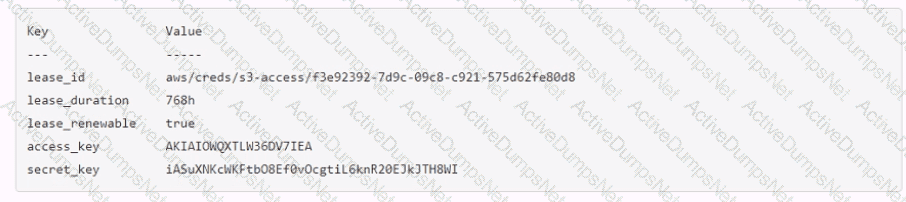
Question # 85

Which Vault command will revoke the lease and remove the credential from AWS?

Options:

A.

vault lease revoke aws/creds/s3-access/f3e92392-7d9c-99c8-c921-57Sd62fe89d8

B.

vault lease revoke AKIAI0WQXTLW36DV7IEA

C.

vault lease revoke f3e92392-7d9c-O9c8-c921-575d62fe80d8

D.

vault lease revoke access_key-AKIAI0WQXTLW36DV7IEA

Question 86

Which of the following is a reason to rekey a Vault cluster?

Pick the 2 correct responses below.

Options:

A.

A keyholder joins or leaves the organization.

B.

A compliance policy mandates rotating the root key at a regular interval.

C.

Additional Vault nodes are added to a cluster.

D.

Upgrading Vault Community Edition to Vault Enterprise.

E.

The root token is lost.

Question 87

What is a dynamic secret in HashiCorp Vault?

Options:

A.

A secret permanently stored in Vault’s Key/Value storage with multiple versions made available.

B.

A secret you can generate on-demand that is automatically revoked when its time to live expires.

C.

A user password for Vault that each user must rotate every 90 days by default.

D.

A secret that can periodically update its underlying encryption algorithm.

Question 88

You want to generate a token with a TTL of 24 hours which can be renewed indefinitely.

Which flag would you use on the following command?

vault token create

Options:

A.

-explicit-max-ttl=0

B.

-ttl=24h

C.

-period=24h

D.

-orphan

Question 89

Which of the following are true about Vault policies?

Pick the 2 correct responses below.

Options:

A.

A Vault policy must be created for every secret that will be accessed.

B.

Vault supports an extensible permission structure that allows new permission types to be added as plugins.

C.

Vault policies support wildcards anywhere in the path.

D.

Vault policies support regular expressions.

E.

Vault policies support globbing wildcards using the * symbol only at the end of the path.

F.

Vault policies are path-based.

Question 90

Which of the following statements are true about Vault policies? Choose two correct answers.

Options:

A.

The default policy can not be modified

B.

You must use YAML to define policies

C.

Policies provide a declarative way to grant or forbid access to certain paths and operations in Vault

D.

Vault must be restarted in order for a policy change to take an effect

E.

Policies deny by default (empty policy grants no permission)

Question 91

What is a benefit of response wrapping?

Options:

A.

Log every use of a secret

B.

Load balanc secret generation across a Vault cluster

C.

Provide error recovery to a secret so it is not corrupted in transit

D.

Ensure that only a single party can ever unwrap the token and see what ' s inside

Question 92

Which of the following cannot define the maximum time-to-live (TTL) for a token?

Options:

A.

By the authentication method t natively provide a method of expiring credentials

B.

By the client system f credentials leaking

C.

By the mount endpoint configuration very password used

D.

A parent token TTL e password rotation tools and practices

E.

System max TTL

Question 93

A web application uses Vault ' s transit secrets engine to encrypt data in-transit. If an attacker intercepts the data in transit which of the following statements are true? Choose two correct answers.

Options:

A.

You can rotate the encryption key so that the attacker won’t be able to decrypt the data

B.

The keys can be rotated and min_decryption_version moved forward to ensure this data cannot be decrypted

C.

The Vault administrator would need to seal the Vault server immediately

D.

Even if the attacker was able to access the raw data, they would only have encrypted bits (TLS in transit)

Question 94

You can use the token accessor to look up the actual token ID.

Options:

A.

True

B.

False

Question 95

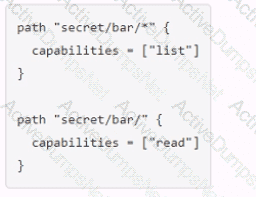
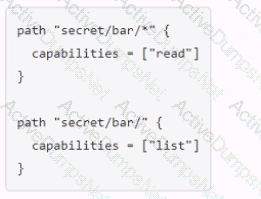
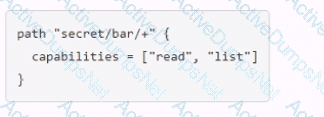
You have been tasked with writing a policy that will allow read permissions for all secrets at path secret/bar. The users that are assigned this policy should also be able to list the secrets. What should this policy look like?

Options:
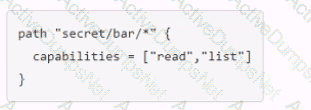
A.

Option A95

B.

Option B95

C.

Option C95

D.

Option D95

Question 96

The following three policies exist in Vault. What do these policies allow an organization to do?
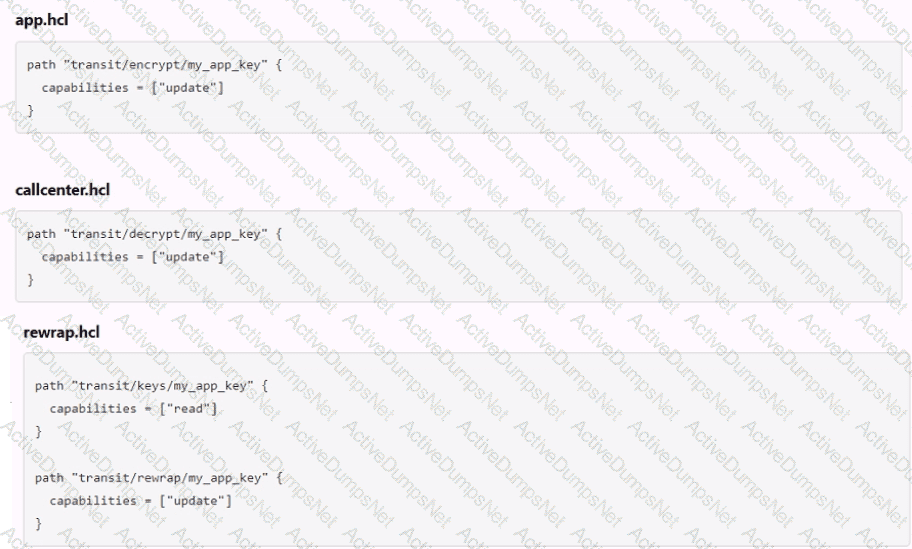
Question # 96

Options:

A.

Separates permissions allowed on actions associated with the transit secret engine

B.

Nothing, as the minimum permissions to perform useful tasks are not present

C.

Encrypt, decrypt, and rewrap data using the transit engine all in one policy

D.

Create a transit encryption key for encrypting, decrypting, and rewrapping encrypted data

Question 97

The key/value v2 secrets engine is enabled at secret/ See the following policy:
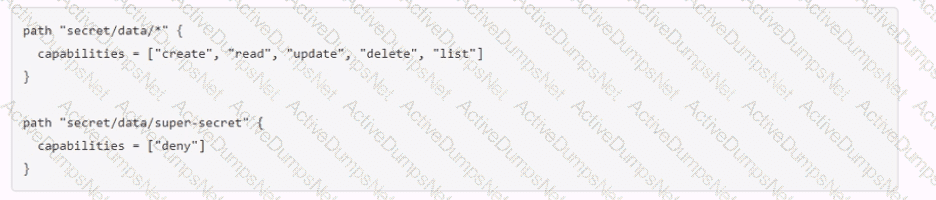
Question # 97

Which of the following operations are permitted by this policy? Choose two correct answers.

Options:

A.

vault kv get secret/webapp1

B.

vault kv put secret/webapp1 apikey- " ABCDEFGHI] K123M "

C.

vault kv metadata get secret/webapp1

D.

vault kv delete secret/super-secret

E.

vault kv list secret/super-secret

Page: 1 / 32
Total 324 questions