
- Home
- HRCI
- HRCI certification
- SPHR
- SPHR - Senior Professional in Human Resources
HRCI SPHR Senior Professional in Human Resources Exam Practice Test
Senior Professional in Human Resources Questions and Answers
The type of market characterized by identifying and designing products or services for a small profitable marketplace segment is:
Options:
Independent
Differentiated
Niche
Demographic
Answer:
CExplanation:
Comprehensive and Detailed Explanation:
A niche market is a targeted segment with unique needs. Strategy focuses on specialization , not mass appeal.
SPHR business acumen requires understanding market types — “niche strategies offer high margins, tailored offerings, and loyal customer bases, often requiring specialized workforce capabilities.”
In order to measure the return on investment (ROI) of a project, an organization must:
Options:
establish clear objectives.
utilize qualitative data.
develop performance standards.
identify project ownership.
Answer:
AExplanation:
To measure the ROI of a project , an organization must first establish clear objectives (A) . At the SPHR level, ROI is a financial metric that compares the value of outcomes achieved against the cost of resources invested. Without clearly defined objectives, it is impossible to determine whether desired results were achieved or to quantify benefits.
Clear objectives specify what success looks like and define measurable outcomes such as cost reduction, productivity improvement, revenue growth, quality enhancement, or risk mitigation. These outcomes form the basis for identifying benefits that can be translated into financial value, which is essential for ROI calculation.
Qualitative data (B) can supplement analysis but cannot, on its own, support ROI measurement. Performance standards (C) guide expectations but do not define the business results needed for ROI. Project ownership (D) supports accountability but does not enable measurement.
SPHR exam content emphasizes that ROI analysis requires clear, measurable objectives tied to business outcomes , allowing HR and leadership to evaluate whether investments deliver value and support strategic decision-making.
References :
HRCI SPHR Exam Content Outline — Functional Area: Leadership and Strategy (ROI analysis; program evaluation).
HRCI SPHR Study Guide — Measuring return on investment for HR initiatives.
==============
The balanced scorecard approach to measuring an organization’s performance:
Options:
Is reviewed on an annual basis
Assesses organizational challenges
Clarifies an organization’s vision and mission
Links the organization’s strategy to its actions
Answer:
DExplanation:
The Balanced Scorecard translates vision into strategy by aligning objectives, metrics, and initiatives across four areas: financial, customer, internal process, and learning and growth . It connects strategic planning to day-to-day activities .
Extract from HRCI-aligned HR knowledge (Leadership and Strategy):
SPHR professionals use tools like the Balanced Scorecard to “align HR and business metrics to strategic outcomes.” This approach reinforces organizational focus and strategic accountability .
Which of the following are the primary factors that would contribute to a hiring manager’s decision to extend an offer above the midpoint of a salary range? (Select TWO options.)
Options:
The candidate has the needed level of experience for the position
The candidate has a strong skill set including specialized certifications
The position is of average complexity and competition is high for talent
The position has some complexity and competition is moderate for talent
The candidate currently works in a similar position with a direct competitor
Answer:
B, EExplanation:
When extending offers above the midpoint , HR must justify that decision based on critical qualifications or competitive risks .
Option B refers to a candidate with specialized certifications and a strong skill set , which adds strategic value and warrants a premium.
Option E reflects competitive poaching ; to attract talent from a direct competitor , especially with transferable experience, HR may offer a compensatory advantage .
Extract from HRCI-aligned HR knowledge (Total Rewards domain):
“Total Rewards strategies must account for market competitiveness, internal equity, and candidate-specific value propositions.” Offering above midpoint should be based on “experience above minimum qualifications, hard-to-find certifications, or risk of losing talent to a competitor.” The SPHR model requires that offers be aligned with compensation strategy , which accounts for market data and internal compensation structure.
When planning the expansion of a department, HR should begin with:
Options:
analyzing competitor market trends.
evaluating the skills of the employees.
benchmarking against industry standards.
determining training needs of current employees.
Answer:
BExplanation:
When planning the expansion of a department, HR should begin by evaluating the skills of current employees (B) . At the SPHR level, expansion planning starts with understanding internal capability and capacity before seeking external solutions.
Evaluating existing skills helps HR determine whether expansion needs can be met through internal redeployment, upskilling, or promotion—often faster and more cost-effective than external hiring. This assessment also identifies gaps that inform future hiring or training strategies.
Competitor analysis (A) and industry benchmarking (C) provide context but do not assess internal readiness. Training needs analysis (D) follows once skill gaps are identified.
SPHR exam content emphasizes that strategic growth planning begins with internal talent assessment , ensuring optimal use of existing human capital.
References :
HRCI SPHR Exam Content Outline — Functional Area: Leadership and Strategy (workforce expansion; talent assessment).
HRCI SPHR Study Guide — Internal capability analysis for organizational growth.
The most important component in an effective crisis management plan is that it be designed for:
Options:
flexible decision-making.
remote access to organization data.
extended leaves of absence.
bottom-up communication.
Answer:
AExplanation:
The most important component of an effective crisis management plan is that it be designed for flexible decision-making (A) . At the SPHR level, crisis management is understood as a dynamic process that must adapt rapidly to evolving conditions, incomplete information, and unexpected consequences.
Crises—whether operational, reputational, financial, or safety-related—rarely unfold exactly as anticipated. Therefore, rigid, prescriptive plans can hinder effective response. Flexible decision-making allows leaders and managers to adjust actions, reallocate resources, and respond appropriately as circumstances change. This adaptability is critical to minimizing harm, maintaining continuity, and protecting employees and organizational assets.
Remote access to data (B) supports continuity but is a tactical capability, not the core design principle. Extended leaves of absence (C) may be a response option in some crises but does not define plan effectiveness. Bottom-up communication (D) is valuable for information flow, yet crisis plans typically require clear authority, rapid escalation, and decisive leadership rather than reliance on grassroots communication.
SPHR exam content emphasizes that effective crisis plans establish decision rights, escalation paths, and guiding principles , enabling leaders to act decisively while remaining adaptable. HR’s role includes ensuring leaders are trained to exercise judgment and flexibility under pressure.
References :
HRCI SPHR Exam Content Outline — Functional Area: Leadership and Strategy (risk management; crisis response).
HRCI SPHR Study Guide — Designing adaptive and effective crisis management plans.
==============
When organizations offer employees time-restricted stock options, the:
Options:
vesting occurs on an employee ' s anniversary date.
vesting occurs only after some time has elapsed.
employees have the right to buy shares during open enrollment.
employees are granted shares of stock when they retire.
Answer:
BExplanation:
With time-restricted stock options , vesting occurs only after some time has elapsed (B) . At the SPHR level, vesting schedules are understood as retention and long-term incentive mechanisms .
Time-based vesting requires employees to remain employed for a specified period before gaining the right to exercise stock options. This encourages retention and aligns employee interests with the organization’s long-term performance.
Anniversary-date vesting (A) may occur in some plans but is not the defining feature. Open enrollment (C) applies to benefits, not stock options. Granting shares at retirement (D) describes different equity plans, not time-restricted options.
SPHR exam content highlights equity compensation as a strategic reward tool that supports retention, ownership mindset, and alignment with shareholder interests .
References :
HRCI SPHR Exam Content Outline — Functional Area: Total Rewards (equity compensation).
HRCI SPHR Study Guide — Stock options and vesting structures.
==============
Coaching plans are most successful when they are:
Options:
designed for high performers.
linked to a competency model.
required to improve skill gaps.
created by human resources.
Answer:
BExplanation:
Coaching plans are most successful when they are linked to a competency model (B) . At the SPHR level, coaching is positioned as a strategic development intervention , not a remedial or ad hoc activity.
Competency models define the knowledge, skills, abilities, and behaviors required for success in specific roles or leadership levels. When coaching is aligned to these competencies, it becomes targeted, measurable, and directly connected to organizational expectations. This alignment ensures that coaching supports both individual development and broader talent and leadership strategies.
Designing coaching only for high performers (A) limits its strategic value; coaching can benefit high potentials, transitioning leaders, and individuals developing future capabilities. Requiring coaching solely to fix skill gaps (C) frames coaching as corrective rather than developmental, which can reduce engagement and effectiveness. HR-created coaching plans (D) may provide structure, but coaching is most effective when co-created with the individual and aligned to role-based competencies.
SPHR exam content emphasizes that development interventions—including coaching—must be integrated with competency frameworks, succession planning, and leadership development systems to deliver sustainable impact.
References :
HRCI SPHR Exam Content Outline — Functional Area: Learning and Development (coaching; competency models).
HRCI SPHR Study Guide — Designing effective coaching and development programs.
==============
What is the most effective way to attract and retain the best talent?
Options:
Establish a positive employer brand.
Eliminate sourcing errors.
Utilize a panel interview process.
Identify talent gaps and challenges.
Answer:
AExplanation:
A. Establish a positive employer brand is the best answer because employer branding affects how both prospective and current employees perceive the organization as a place to work. A credible, attractive employer brand communicates the organization ' s culture, values, employee experience, career opportunities, work environment, and overall employee value proposition. This directly supports both talent attraction and retention.
HRCI places this concept squarely within Talent Planning and Acquisition . The SPHR outline requires HR to develop, monitor, and assess recruitment strategies and explicitly includes “sourcing and branding strategy.” HRCI also lists “employer marketing and branding techniques” as required knowledge. These references make employer branding particularly strong when an examination question asks about simultaneously attracting and retaining talent.
HRCI guidance on talent acquisition emphasizes that organizations need a compelling talent or employer brand to win candidates ' attention and communicate what differentiates the employment experience. CIPD likewise defines employer brand as the mechanism through which organizations differentiate themselves in the labor market and states that it enables organizations to attract, recruit, retain, and engage the right people.
B. Eliminate sourcing errors can improve recruiting effectiveness, but sourcing accuracy addresses only part of the attraction process and says little about retention after employees are hired.
C. Utilize a panel interview process is a selection technique. When designed correctly, panels can improve consistency and provide multiple perspectives, but they do not create the broad organizational appeal required to attract and retain high-quality talent.
D. Identify talent gaps and challenges is essential to workforce planning because HR must understand future capability requirements. However, identifying a gap does not itself persuade candidates to join or employees to remain.
A is broader and more strategic. A strong employer brand affects the entire employment lifecycle—from initial awareness and candidate attraction through engagement and retention—and helps distinguish the organization from competing employers.
Therefore, A is the strongest SPHR answer.
Key factors that contribute to a successful restructuring of the HR function include:
Options:
Cost control and accountability
Business focus and benchmarking
Process design and customer focus
Service improvement and communication
Answer:
DExplanation:
Successful HR restructuring emphasizes not just efficiency but also enhancing service delivery and strengthening internal stakeholder communication . These ensure HR remains relevant, responsive, and aligned with business demands.
Extract from HRCI-aligned HR knowledge (HR Operations):
SPHR content highlights that restructuring should prioritize “HR service delivery effectiveness, user satisfaction, and alignment with organizational priorities.” Communication ensures stakeholder buy-in , and service improvement reflects strategic value delivery.
Which of the following is the most significant challenge for HR regarding mergers and acquisitions?
Options:
Cultural integration
Effective due diligence
Workforce management
Strategic alignment
Answer:
AExplanation:
During mergers and acquisitions (MandA), while due diligence and workforce management are important, the greatest challenge lies in integrating differing organizational cultures . Misaligned cultures can lead to resistance, low morale, and loss of talent.
Extract from HRCI-aligned HR knowledge (Leadership and Strategy):
SPHR-level HR is responsible for “assessing and mitigating organizational culture clashes in post-merger environments.” Effective cultural integration is key to maintaining productivity, engagement, and retention after an MandA event.
What are the most important benefits of incorporating succession management into an organization’s culture? (Select TWO options)
Options:
Develops bench strength
Decreases involuntary turnover
Reduces external recruiter expenses
Accelerates time to fill critical positions
Infuses new talent with fresh perspectives
Answer:
A, DExplanation:
Succession management creates a pipeline of talent ready to step into critical roles, ensuring business continuity . It strengthens internal bench strength (A) and reduces time-to-fill (D) since qualified internal candidates are readily available.
Extract from HRCI-aligned HR knowledge : Under Talent Planning and Acquisition , the SPHR framework encourages creating “succession planning systems that reduce talent gaps and support long-term workforce strategy,” emphasizing readiness, leadership continuity , and speed of internal promotion .
Higher levels of employee engagement lead to:
Options:
fewer workplace injuries and accidents.
increased training participation.
lower absenteeism and higher profits.
more interest in career development plans.
Answer:
CExplanation:
Higher levels of employee engagement are most strongly associated with lower absenteeism and higher profits (C) . At the SPHR level, engagement is treated as a business performance driver , not merely a satisfaction metric.
Engaged employees demonstrate greater commitment, discretionary effort, and accountability. This leads to reduced absenteeism because employees are more motivated to be present and contribute. Engagement also correlates with higher productivity, better customer outcomes, and improved financial performance, which together drive profitability.
While fewer accidents (A) and greater interest in development (D) may occur, these are indirect outcomes. Training participation (B) may increase, but it is not the most significant or consistent organizational result.
SPHR exam content consistently links engagement to measurable business outcomes , particularly financial performance and operational efficiency. This makes absenteeism reduction and profit improvement the most compelling outcomes.
References :
HRCI SPHR Exam Content Outline — Functional Area: Employee Relations and Engagement (engagement outcomes; organizational performance).
HRCI SPHR Study Guide — Business impact of employee engagement.
An HR director decided not to interview a qualified applicant because of personal knowledge that the applicant ' s family has a history of cancer. The director ' s decision created an alternative risk of:
Options:
Genetic discrimination
FMLA violation
Negligent hiring
Adverse impact
Answer:
AExplanation:
This scenario falls squarely under genetic discrimination , which is prohibited by GINA (Genetic Information Nondiscrimination Act) . GINA forbids employers from using genetic information, including family medical history , in hiring, firing, or promotion decisions.
Extract from HRCI-aligned HR knowledge : The Employee Relations and Engagement domain includes “ensuring compliance with employment law including GINA, ADA, and FMLA.” HR must never use genetic data (including family health history) in employment decisions, as this poses a federal liability risk .
Experience rating in the employee benefits area refers to:
Options:
qualifications of the employee benefit contract administrators.
claim history of a medical/dental plan for the preceding plan year.
cumulative history of a firm’s plan since inception.
cumulative history of a region’s healthcare plan since inception.
Answer:
BExplanation:
In employee benefits, experience rating refers to the claim history of a medical or dental plan for the preceding plan year (B) . At the SPHR level, experience rating is a core concept in understanding how insurance premiums are calculated for employer-sponsored benefit plans.
Under experience-rated plans, the employer’s actual claims experience is used to determine future premium rates. Higher-than-expected claims typically result in increased premiums, while favorable claims experience may reduce costs. This approach contrasts with community-rated or adjusted community-rated plans, where rates are based on broader population risk rather than individual employer experience.
Qualifications of administrators (A) are unrelated to experience rating. Cumulative history since inception (C) is not typically used; insurers rely on recent claims data to reflect current risk. Regional healthcare history (D) applies to community rating, not experience rating.
SPHR exam content stresses that HR leaders must understand how benefit funding and rating methodologies affect cost control, plan design, and risk exposure , particularly when evaluating fully insured versus self-funded plans.
References :
HRCI SPHR Exam Content Outline — Functional Area: Total Rewards (benefits funding; insurance rating).
HRCI SPHR Study Guide — Experience-rated versus community-rated benefit plans.
==============
To reduce individual resistance to organizational change, it is most critical to first communicate the:
Options:
Business reason for the change.
Impact of the change on the employee.
Organizational structure changes.
Change timeline and expectations.
Answer:
AExplanation:
A. Business reason for the change is the best answer because individuals are more likely to resist organizational change when they do not understand why the change is necessary. Before employees can meaningfully consider implementation details, timelines, or even personal consequences, they need awareness of the rationale for changing the current state.
HRCI places this issue directly within Leadership and Strategy . The SPHR blueprint requires senior HR professionals to “design and manage effective change strategies” and lists “change management processes and techniques” as required knowledge. Effective change leadership therefore involves establishing understanding and commitment, not merely announcing implementation steps.
Established change-management research strongly supports this sequence. Prosci identifies lack of awareness about the reason for change as a leading cause of employee resistance. Its communication guidance states that the first communications should focus on why the change is happening, why it is happening now, and the risk of failing to change.
B. Impact of the change on the employee is extremely important and should follow quickly. Employees naturally ask how their role, workload, security, responsibilities, and opportunities will be affected. However, understanding personal impact addresses the employee ' s desire and willingness to participate after awareness of the basic reason for the change is established.
C. Organizational structure changes describe part of what may change, not why the change is needed. Communicating structure without context can actually increase uncertainty.
D. Change timeline and expectations are necessary implementation details, but they are most useful after employees understand the rationale and purpose.
The key examination word is “first.” In a structured change-management sequence, HR and leadership initially establish awareness by explaining the business case and the risks of maintaining the status quo. Once that foundation exists, managers can address individual impacts, implementation expectations, training, and timelines.
Therefore, A is the strongest SPHR answer.
Employee stock ownership plans (ESOPs) are most likely to encourage employees to:
Options:
invest more of their personal earnings
refer others to the organization
accept less personal financial risk
engage in organizational performance
Answer:
DExplanation:
By giving employees a stake in the company’s success , ESOPs foster ownership thinking and align employee interests with business outcomes — promoting higher engagement and productivity .
SPHR compensation planning includes understanding ownership-based incentives as motivational tools for alignment and loyalty.
An organizational policy designed to limit employee access to certain websites helps to:
Options:
Safeguard the interests of the organization
Enhance existing social responsibility programs
Manage the bandwidth of existing communications
Address concerns about protecting employee information
Answer:
AExplanation:
Restricting access to non-business sites is a preventive control that protects organizational security, limits exposure to cyber threats, and ensures productivity standards are upheld.
Extract from HRCI-aligned HR knowledge (Risk Management):
SPHR’s risk framework includes “proactive policy development to protect corporate assets and productivity.” Web restrictions are part of a larger IT security and compliance strategy, especially in data-sensitive industries.
Which of the following is the most compelling reason to use noncash rewards?
Options:
The process for giving noncash rewards is easier.
Other types of incentives are often more cost-effective.
Cash is not always seen by employees as the most powerful motivator.
Cash bonuses can come to be viewed by employees as an entitlement.
Answer:
CExplanation:
The most compelling reason to use noncash rewards is that cash is not always perceived by employees as the most powerful motivator (C) . At the SPHR level, reward effectiveness is driven by meaning, recognition, and emotional impact , not just monetary value.
Noncash rewards—such as recognition programs, experiences, development opportunities, and symbolic awards—can be more memorable and personally meaningful than cash. They reinforce desired behaviors, strengthen emotional connection to the organization, and support intrinsic motivation.
While cash bonuses becoming entitlements (D) is a valid concern, it is a secondary consideration. Ease of administration (A) and cost-effectiveness (B) are not primary motivators for using noncash rewards.
SPHR exam content emphasizes that total rewards strategies should be holistic , leveraging both financial and nonfinancial incentives to drive engagement and performance.
References :
HRCI SPHR Exam Content Outline — Functional Area: Total Rewards (reward strategy; motivation).
HRCI SPHR Study Guide — Noncash rewards and employee motivation.
==============
The success of an employee engagement strategy is best measured by its correlation to:
Options:
employer evaluations.
sustained retention.
safety violations.
unethical behavior.
Answer:
BExplanation:
The success of an employee engagement strategy is best measured by its correlation to sustained retention (B) . At the SPHR level, engagement is viewed as a leading indicator of long-term workforce stability and organizational performance .
Highly engaged employees are more likely to remain with the organization because they feel connected to its mission, supported by leadership, and satisfied with their work experience. Sustained retention demonstrates that engagement efforts are not producing short-lived enthusiasm but are influencing long-term employment decisions.
While engagement may also influence safety outcomes (C) and ethical behavior (D) , these are indirect or situational indicators. Employer evaluations (A) reflect perception but do not capture behavioral outcomes. Retention, by contrast, is a clear, measurable, and strategically significant result that links engagement to cost reduction, productivity, and knowledge continuity.
SPHR exam content consistently ties engagement strategies to voluntary turnover reduction as a primary measure of success. Organizations that invest effectively in engagement typically experience lower attrition, reduced replacement costs, and stronger workforce continuity.
References :
HRCI SPHR Exam Content Outline — Functional Area: Employee Relations and Engagement (engagement metrics; retention).
HRCI SPHR Study Guide — Measuring engagement effectiveness.
==============
A Vice President of HR has been directed to transform HR from a traditional staff function into a strategic business partner. Resistance is anticipated in the HR department because of changing roles and responsibilities.
The best way for the Vice President to overcome this resistance is to:
Options:
create a zero-based staffing plan.
involve staff in the redesign of the department.
provide new job descriptions and salary schedules.
discuss significant concerns with staff members.
Answer:
BExplanation:
The most effective way to overcome resistance during HR’s transformation into a strategic business partner is to involve staff in the redesign of the department (B) . At the SPHR level, organizational change is most successful when employees participate in shaping the change that affects their roles and identities.
Involving HR staff in redesign builds ownership, reduces fear, and increases commitment to new expectations. Participation allows employees to better understand the strategic rationale for the shift, contribute insights from their operational experience, and see how their skills will be applied in higher-value work. This approach also aligns with change management best practices that emphasize engagement over top-down mandates.
While discussing concerns (D) is important, it is insufficient on its own without meaningful involvement. New job descriptions and salary schedules (C) address structural elements but do not resolve emotional or behavioral resistance. Zero-based staffing (A) may increase anxiety and is inappropriate as a primary change strategy.
SPHR exam content emphasizes that transforming HR into a strategic partner requires culture change, capability development, and stakeholder engagement , starting within the HR function itself.
References :
HRCI SPHR Exam Content Outline — Functional Area: Leadership and Strategy (change management; HR transformation).
HRCI SPHR Study Guide — Overcoming resistance in organizational change initiatives.
==============
A reward system is most effective when it:
Options:
creates innovative programs and responds directly to employee needs.
is aligned with business strategy and the organizational structure and culture.
supports administrative efficiency, organizational effectiveness, and a dynamic external environment.
includes measures and levels, a communication strategy, and an implementation plan.
Answer:
BExplanation:
A reward system is most effective when it is aligned with business strategy and organizational structure and culture (B) . At the SPHR level, total rewards are designed to drive behaviors and outcomes that support strategic objectives .
Alignment ensures that pay, incentives, and recognition reinforce what the organization values most—whether innovation, efficiency, customer focus, or growth. Misaligned reward systems can unintentionally encourage counterproductive behaviors.
Options A , C , and D describe important components or outcomes of a reward system but do not represent the primary effectiveness driver . Innovation and responsiveness, administrative efficiency, and solid implementation are all secondary to strategic alignment.
SPHR exam content consistently prioritizes strategy-driven reward design as the cornerstone of effective total rewards systems.
References :
HRCI SPHR Exam Content Outline — Functional Area: Total Rewards (reward strategy alignment).
HRCI SPHR Study Guide — Strategic integration of total rewards.
==============
Successful adoption of a new performance management system requires leadership to:
Options:
Communicate organizational needs and program benefits.
Ensure the confidentiality of proprietary information.
Develop marketing materials to promote usage.
Create a policy outlining the process.
Answer:
AExplanation:
A. Communicate organizational needs and program benefits is the best answer because successful implementation of a new performance management system is fundamentally a change-management and stakeholder-adoption issue . A technically sound system will not produce the intended results unless leaders explain why the change is necessary, how it supports organizational objectives, and how managers and employees will benefit from using it.
The HRCI SPHR Exam Content Outline places change leadership directly within Leadership and Strategy . One exact HRCI extract requires senior HR professionals to “design and manage effective change strategies” aligned with organizational goals. HRCI also identifies “change management processes and techniques” and technology supporting HR activities as required knowledge.
HRCI ' s performance-management implementation guidance reinforces this principle. It states that manager buy-in is imperative when implementing new performance management tools and that organizations should communicate how new systems can create more effective work environments while connecting the change to the larger organizational picture.
B is incorrect because confidentiality is important to any HR system containing sensitive data, but confidentiality alone does not create adoption. Employees may trust the system yet still resist or fail to use it appropriately if they do not understand its purpose.
C is incorrect because marketing materials are merely a communication vehicle. Promotional materials cannot substitute for credible leadership communication explaining business need, value, expectations, and benefits.
D is important but insufficient. A policy can define procedures, responsibilities, and requirements, but issuing a policy does not necessarily create commitment or behavioral adoption.
The SPHR-level distinction is between administrative implementation and organizational adoption . Leadership must create understanding and buy-in before expecting sustained behavior change. Accordingly, communicating both the organizational need and the benefits of the new performance management system is the strongest answer.
The best long-term strategy to retain employees during periods of high turnover is to provide a(n):
Options:
retention bonus.
service credit award.
flexible work environment.
Employee Assistance Program (EAP).
Answer:
CExplanation:
The best long-term strategy to retain employees during periods of high turnover is to provide a flexible work environment (C) . At the SPHR level, retention is driven by work design, autonomy, and work–life integration , not short-term financial incentives.
Flexible work environments—including flexible schedules, remote or hybrid work, and autonomy over how work is performed—address core drivers of voluntary turnover such as burnout, work–life conflict, and lack of control. These arrangements improve engagement, satisfaction, and loyalty across diverse employee populations.
Retention bonuses (A) are short-term fixes that do not address underlying issues and may encourage “bonus chasing.” Service awards (B) recognize tenure but do not influence ongoing retention drivers. EAPs (D) support employee well-being but are reactive and insufficient as a standalone retention strategy.
SPHR exam content emphasizes that sustainable retention strategies focus on job design and organizational culture rather than episodic incentives.
References :
HRCI SPHR Exam Content Outline — Functional Area: Employee Relations and Engagement (retention strategies).
HRCI SPHR Study Guide — Long-term drivers of employee retention.
==============
The analysis phase of instructional design is used to determine:
Options:
Training delivery methods
Which evaluation system to use
The budget for the project
What skills need to be taught
Answer:
DExplanation:
The ADDIE model starts with Analysis , where training needs are diagnosed, gaps identified, and specific skills to be addressed are determined. This is the foundation of effective instructional design.
Extract from HRCI-aligned HR knowledge (Learning and Development):
SPHR candidates must understand ADDIE: “The analysis phase identifies the business problem, learning goals, and knowledge gaps.” It is essential for building relevant and results-driven training programs .
Which of the following is the first action for HR to take when assessing the value of adding a formal relocation program to the overall talent acquisition strategy?
Options:
Consult with relocation service providers and benchmark current trends.
Work with finance to develop a relocation policy and budget.
Post positions outside the region to determine interest in relocation.
Perform an opportunity assessment to understand current reality and business alignment.
Answer:
DExplanation:
The first action HR should take is to perform an opportunity assessment to understand current reality and business alignment (D) . At the SPHR level, new program decisions begin with strategic need analysis , not solution design.
An opportunity assessment evaluates factors such as talent availability, hard-to-fill roles, geographic constraints, growth strategy, and competitive pressures. This ensures that a relocation program directly supports business objectives and addresses real workforce challenges rather than adding unnecessary cost or complexity.
Consulting vendors (A) , developing policies and budgets (B) , and posting jobs externally (C) are implementation steps that should occur only after strategic alignment and business justification are established.
SPHR exam content emphasizes that HR initiatives must be business-driven , beginning with diagnosis and alignment before operational planning.
References :
HRCI SPHR Exam Content Outline — Functional Area: Talent Planning and Acquisition (strategic staffing decisions).
HRCI SPHR Study Guide — Assessing talent acquisition program viability.
==============
The primary consideration when developing an employee recognition program is:
Options:
Rewarding behaviors that support core values
Establishing an appropriate program budget
Getting support from team champions
Linking with referral bonus programs
Answer:
AExplanation:
Effective recognition ties directly to behavioral reinforcement. Recognizing behaviors that exemplify core organizational values ensures alignment between culture and performance.
Extract from HRCI-aligned HR knowledge (Total Rewards):
SPHR candidates must link rewards to strategic outcomes: “Recognition should reinforce desired behaviors and values that contribute to culture and organizational success.” Budget and champions matter, but the behavioral alignment is central.
Characteristics that best define successful mentors include:
Options:
excellent communication and interpersonal skills.
previous service in a senior position in the organization.
a willingness to help others learn, achieve, and advance.
job proficiency, adaptability, and flexibility.
Answer:
CExplanation:
The defining characteristic of successful mentors is a willingness to help others learn, achieve, and advance (C) . At the SPHR level, mentoring is viewed as a developmental relationship , not a hierarchical or technical role.
Effective mentors are genuinely committed to the growth of others. This intrinsic motivation drives behaviors such as sharing experiences, offering guidance, providing encouragement, and advocating for mentees. Without this willingness, other attributes—such as seniority, communication skills, or technical expertise—are insufficient.
While communication skills (A) and job proficiency (D) are valuable, they support mentoring effectiveness rather than define it. Prior senior leadership experience (B) is not required and may even limit mentoring diversity.
SPHR exam content emphasizes mentoring as a voluntary, relationship-based development tool rooted in intent and commitment to others’ success.
References :
HRCI SPHR Exam Content Outline — Functional Area: Learning and Development (mentoring; leadership development).
HRCI SPHR Study Guide — Characteristics of effective mentors.
==============
The balanced scorecard is designed to facilitate organizational change by:
Options:
Analyzing both internal processes and financial results
Comparing performance measures to productivity ratios
Contrasting total quality initiatives with customer feedback
Measuring customer satisfaction before and after the change
Answer:
AExplanation:
The Balanced Scorecard (BSC) is a strategic tool used to measure organizational performance from multiple perspectives: financial , customer , internal business processes , and learning and growth . It is used to align performance to vision and strategy , particularly during change initiatives.
Extract from HRCI-aligned HR knowledge (Leadership and Strategy domain):
The SPHR strategic planning content references BSC as a method to “integrate financial and non-financial performance indicators” to monitor transformation effectiveness. The BSC helps ensure HR’s role is tied to operational outcomes and business value delivery.
HR can contribute to reducing potential risk by:
Options:
assessing employment practices.
completing a comprehensive legal review.
conducting a cost-benefit analysis.
addressing employee turnover.
Answer:
AExplanation:
HR contributes most directly to reducing potential organizational risk by assessing employment practices (A) . At the SPHR level, risk management includes identifying and mitigating people-related risks such as discrimination, wage and hour violations, inconsistent policy application, and inadequate documentation.
Assessing employment practices allows HR to proactively identify gaps in compliance, fairness, and consistency before they result in claims, penalties, or reputational damage. This includes reviewing hiring, promotion, discipline, termination, and compensation practices.
Comprehensive legal reviews (B) are typically led by legal counsel, though HR may support them. Cost-benefit analysis (C) supports financial decision-making, not risk reduction. Addressing turnover (D) is important but does not directly mitigate legal or compliance risk.
SPHR exam content highlights HR’s role in preventive risk management through policy review, training, and practice audits.
References :
HRCI SPHR Exam Content Outline — Functional Area: Leadership and Strategy (risk management; compliance).
HRCI SPHR Study Guide — HR-led risk assessment practices.
==============
Which of the following is the best way for HR to gain credibility?
Options:
Assess organizational structures for potential improvements.
Redesign the HR department ' s compliance management process.
Analyze and interpret the implications of risk-aversion decisions.
Measure the cost and effectiveness of its products and services.
Answer:
DExplanation:
The most effective way for HR to gain credibility is to measure the cost and effectiveness of its products and services (D) . At the SPHR level, credibility is earned when HR demonstrates measurable value and impact on organizational performance.
Senior leaders expect HR to operate with the same rigor as other business functions—using data to evaluate efficiency, effectiveness, and return on investment. By measuring outcomes such as cost per hire, turnover cost, training effectiveness, time-to-productivity, and engagement impact, HR shows accountability and business acumen.
While assessing structures (A) , redesigning compliance processes (B) , and analyzing risk decisions (C) are valuable activities, they do not inherently build credibility unless their outcomes are quantified and tied to results. Measurement enables HR to speak the language of business and influence strategic decisions.
SPHR exam content emphasizes that HR credibility is grounded in evidence-based practice, analytics, and outcome measurement , positioning HR as a strategic partner rather than a support function.
References :
HRCI SPHR Exam Content Outline — Functional Area: Leadership and Strategy (HR analytics; business acumen).
HRCI SPHR Study Guide — Building HR credibility through measurement and metrics.
==============
Which of the following is the best initial step to ensure internal pay equity when changing an organization ' s compensation structure?
Options:
Create or update job descriptions for each position
Develop a salary structure based on current salaries and positions
Conduct a job analysis to gain a full understanding of each position
Benchmark current salaries against similar positions in other organizations
Answer:
CExplanation:
Job analysis comes first—it provides objective data about the duties, responsibilities, and required qualifications for each role. This forms the basis for accurate evaluation, comparison, and equity in pay decisions.
Extract from HRCI-aligned HR knowledge (Total Rewards):
SPHR-level compensation design begins with “valid job analysis to establish internal consistency and legal defensibility.” Without this, pay decisions risk discrimination claims and internal misalignment.
Which of the following is the most effective way to motivate managers to conduct performance reviews?
Options:
Communicate clear expectations of required tasks.
Discipline managers for failure to meet goals.
Connect pay raises to completion.
Answer:
AExplanation:
A. Communicate clear expectations of required tasks is the best answer because managers are more likely to complete performance-management responsibilities when HR establishes clear accountability, processes, timelines, standards, roles, and expectations. Effective performance management should be integrated into normal managerial responsibilities rather than driven primarily by punishment or an artificial financial consequence.
The HRCI SPHR Exam Content Outline addresses this subject under Functional Area 05: Employee Relations and Engagement and specifically requires knowledge of “performance management strategies.” HRCI ' s responsibility statement also includes performance evaluation, corrective action, and coaching within strategies affecting employee satisfaction and performance.
HRCI performance-management guidance reinforces the importance of clear processes. It explains that HR should provide managers with a clear framework of expectations and appropriate training so they can successfully apply performance-management tools and processes. This reflects a fundamental management principle: before holding managers accountable, the organization should make responsibilities, standards, timing, procedures, and intended outcomes clear.
B. Discipline managers for failure to meet goals is not the best initial motivational strategy. Corrective action may eventually be appropriate for repeated failure to perform an established managerial responsibility, but punishment without first establishing clear expectations and providing necessary support is reactive rather than strategically effective.
C. Connect pay raises to completion is also inferior. Linking managerial salary increases simply to completing reviews can encourage a compliance mentality in which managers rush through evaluations to obtain their own financial reward. Completion alone does not ensure fair, accurate, timely, or useful performance management.
A strong SPHR answer favors clarity, accountability, and managerial capability before punitive or transactional measures . HR should define responsibilities, establish a usable process, communicate deadlines, equip managers, and monitor completion and quality.
Therefore, A is the best available answer.
Verification note: The question as supplied contains only three answer choices (A–C) . I have not created an unsupported Option D.
One way to ensure the proper assignment of points to compensable factors is to:
Options:
weigh all factor groups equally.
see what other companies do.
provide descriptive statements for each degree level.
use outside consultants in the job evaluation process.
Answer:
CExplanation:
A key way to ensure the proper assignment of points to compensable factors is to provide descriptive statements for each degree level (C) . At the SPHR level, this reflects best practice in point-factor job evaluation systems .
Descriptive statements clearly define what each degree of a compensable factor represents (for example, levels of skill, responsibility, effort, or working conditions). These definitions reduce subjectivity, promote consistency, and improve evaluator agreement when assigning points to jobs. This is essential for internal equity and defensibility of the compensation structure.
Weighing all factor groups equally (A) ignores strategic priorities and job differences. Benchmarking other companies (B) may inform factor selection but does not ensure accurate point assignment. Using consultants (D) can add expertise, but clarity in degree definitions is still required for sound evaluation.
SPHR exam content emphasizes that well-designed job evaluation systems rely on clear, job-related criteria and documentation to support equitable and transparent compensation decisions.
References :
HRCI SPHR Exam Content Outline — Functional Area: Total Rewards (job evaluation; internal equity).
HRCI SPHR Study Guide — Point-factor job evaluation methods and controls.
Which of the following formulas is used to calculate the number of sales positions required to achieve desired sales goals?


Options:
Option A
Option B
Option C
Option D
Answer:
BExplanation:
The correct answer is Option B , which reflects the appropriate workforce planning formula used to calculate the number of sales positions required to meet a desired sales goal, taking into account existing staff.
At the SPHR level, this question tests quantitative workforce planning and demand forecasting , a critical competency in Talent Planning and Acquisition. The goal is to determine how many sales representatives are required based on productivity assumptions and then adjust for current headcount.
From the data provided:
Desired sales goal: $6,000 per month
Orders per representative: 200 per month
Price per order: $3.00
Current sales representatives: 4
First, calculate the monthly revenue generated by one sales representative :
200 orders × $3.00 = $600 per representative per month
Next, calculate the total number of representatives required to meet the sales goal:
$6,000 ÷ $600 = 10 total representatives required
Because the organization already has 4 current sales representatives , the formula must subtract the existing headcount to determine additional positions needed :
10 − 4 = 6 additional sales representatives
Option B correctly represents this logic mathematically:
6,000 ÷ (200 × 3) − 4
The other options incorrectly reverse the formula or subtract values in a way that does not align with workforce demand logic, resulting in invalid staffing conclusions.
The SPHR Exam Content Outline emphasizes that effective workforce planning must:
Translate business goals into productivity assumptions
Use mathematically sound formulas
Account for current workforce supply
Option B is the only choice that satisfies all three requirements.
==============
An individual who is authorized to make decisions about pension plan investments is known as a:
Options:
director.
fiduciary.
trust executor.
valuation expert.
Answer:
BExplanation:
An individual authorized to make decisions regarding pension plan investments is a fiduciary (B) . Under ERISA principles, a fiduciary is anyone who exercises discretionary authority or control over plan management, assets, or administration. This designation is functional, meaning it is based on actions taken—not job title.
Fiduciaries are legally obligated to act solely in the interest of plan participants and beneficiaries , with duties of loyalty, prudence, diversification, and adherence to plan documents. Investment decisions—such as selecting funds, monitoring performance, or hiring investment managers—are core fiduciary responsibilities.
Directors (A) may or may not be fiduciaries, depending on their role. A trust executor (C) administers estates, not retirement plans. A valuation expert (D) provides technical analysis but does not make discretionary decisions.
SPHR exam content emphasizes fiduciary accountability and personal liability exposure for breaches. HR leaders must understand who is a fiduciary and ensure proper training, documentation, and governance to reduce risk.
References :
HRCI SPHR Exam Content Outline — Functional Area: Total Rewards (retirement plans; fiduciary responsibility).
HRCI SPHR Study Guide — ERISA fiduciary standards and obligations.
==============
To identify employees who are best able to assume leadership roles over time, HR must utilize:
Options:
Peer networks.
Succession planning.
Stakeholder feedback.
Job task analysis.
Answer:
BExplanation:
B. Succession planning is the correct answer because succession planning is the systematic process organizations use to identify critical positions, assess employees with future potential, evaluate readiness, and develop individuals who may eventually assume key leadership or other strategically important roles.
HRCI’s SPHR framework places this concept directly within Learning and Development. The outline requires HR to analyze organizational needs and develop a “succession plan for key roles” , including activities such as “identify talent” , career progression, coaching, and development. This language closely matches the question’s emphasis on identifying employees who can assume leadership responsibilities over time . The current SPHR outline retains essentially the same responsibility within Talent Management and explicitly connects succession planning with identifying talent, career progression, coaching, development, business continuity, and leadership development.
Effective succession planning normally involves identifying critical positions, defining future competency requirements, assessing internal talent, evaluating potential and readiness, identifying development gaps, and establishing development actions. It is future-oriented rather than simply evaluating how well an employee performs in the employee’s present job.
A. Peer networks may contribute information about employee reputation, influence, collaboration, and informal leadership, but peer networks are not a formal process for building leadership continuity.
C. Stakeholder feedback can be useful as one source of assessment data, particularly in performance reviews, 360-degree feedback, and leadership-development programs. However, feedback alone does not constitute the systematic process for preparing replacements for critical positions.
D. Job task analysis identifies the duties, responsibilities, knowledge, skills, and requirements associated with a particular job. Although such information can support workforce planning, it does not identify which employees should be developed as future leaders.
The phrase “assume leadership roles over time” is the strongest clue. SPHR questions involving long-term leadership continuity, internal leadership pipelines, potential successors, and readiness for critical positions normally point to succession planning .
What is a primary responsibility of HR in maintaining a positive organizational culture?
Options:
Creating behavior guidelines
Conducting market research
Collecting employee feedback
Increasing leadership training
Answer:
AExplanation:
A. Creating behavior guidelines is the best answer because maintaining organizational culture requires HR to translate the organization’s mission, vision, values, ethics, and expected standards of conduct into workplace practices that guide employee behavior. The current HRCI SPHR Exam Content Outline places this responsibility directly within Functional Area 01: Leadership and Strategy . Specifically, Responsibility 1.6 requires senior HR professionals to develop and manage workplace practices aligned with organizational values and ethics in order “to shape and reinforce organizational culture.”
Behavior guidelines—including standards of conduct, workplace expectations, ethical practices, and value-based behavioral norms—help employees understand what behaviors are encouraged, expected, or unacceptable. When such expectations are consistently communicated and supported by management practices, they reinforce the desired culture. This makes option A the closest match to the strategic HR responsibility identified in the SPHR blueprint.
Option B is incorrect because conducting market research primarily supports external business analysis, workforce planning, compensation benchmarking, recruitment, or strategic decision-making; it is not the most direct mechanism for maintaining organizational culture.
Option C is important but not the best answer. Collecting employee feedback can help HR assess attitudes, engagement, satisfaction, and perceptions of the workplace. Under the earlier SPHR outline, HRCI specifically identified “methods for assessing employee attitudes, opinions, and satisfaction” within Employee Relations and Engagement. However, feedback primarily diagnoses or measures culture; it does not by itself establish the behavioral standards that reinforce it.
Option D is also supportive rather than primary. Leadership training may strengthen desired behaviors, but training is one intervention. The broader strategic responsibility is establishing and managing workplace practices consistent with organizational values.
HR can best facilitate a successful change initiative by (Select TWO options):
Options:
Developing plans for organizational restructure
Ensuring clear and thorough communication
Establishing a sense of urgency
Mitigating resistance to change
Identifying a clear vision
Answer:
B, EExplanation:
B : Communication builds trust, reduces anxiety, and promotes transparency.
E : A compelling vision gives people direction and purpose during ambiguity.
Extract from HRCI-aligned HR knowledge (Leadership and Strategy):
SPHR-level HR is responsible for “managing communication and vision clarity throughout transformation.” Both are listed in Kotter’s Change Model (Steps 4 and 3), foundational for effective change leadership.
Which of the following measures do high-performing organizations use to determine the success of talent investment? (Select TWO options.)
Options:
Financial performance
Benefits utilization
Employee engagement
Compa-ratio
Number of referrals
Answer:
A, CExplanation:
Comprehensive and Detailed Explanation:
A: Financial performance links investment in people to business outcomes.
C: Engagement reflects how well talent strategies are meeting emotional and performance needs.
SPHR frameworks use metrics such as ROI, engagement surveys, and productivity indicators to assess talent ROI.
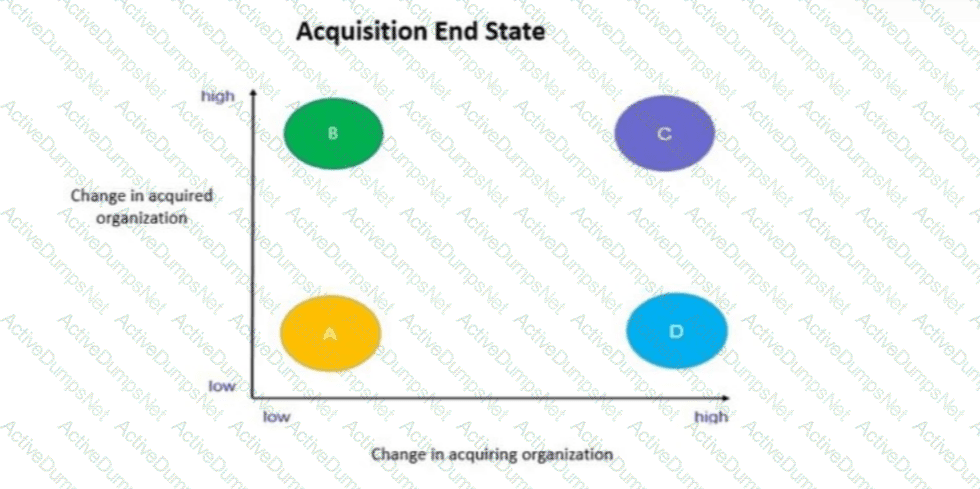
Which of the following options represents a state of complete transformation by both the acquiring and the acquired organization?
Options:
A
B
C
D
Answer:
CExplanation:
The correct answer is C , which represents a state of complete transformation for both the acquiring and the acquired organization .
This question is based on a well-established merger and acquisition (MandA) integration framework frequently referenced in SPHR exam preparation and HRCI-aligned strategy materials. The framework evaluates post-acquisition end states along two dimensions:
Degree of change in the acquired organization (vertical axis)
Degree of change in the acquiring organization (horizontal axis)
Each quadrant represents a different integration strategy and organizational outcome.
Option A (low change / low change) reflects preservation, where both organizations maintain their existing structures and cultures with minimal integration.
Option B (high change in acquired / low change in acquiring) reflects absorption, where the acquired organization undergoes significant transformation to conform to the acquiring organization.
Option D (low change in acquired / high change in acquiring) reflects reverse integration, where the acquiring organization adapts to the acquired entity.
Option C (high change / high change) reflects transformation , where both organizations significantly change structures, processes, systems, and culture to create a new, integrated operating model.
From an SPHR perspective, Option C is the most complex and highest-risk integration strategy , but it also offers the greatest potential for value creation. It is typically used when neither organization alone possesses the optimal model for future success and when synergy depends on creating a fundamentally new organization.
The SPHR Exam Content Outline emphasizes that in transformational integrations, HR plays a critical role in culture integration, leadership alignment, talent retention, organizational redesign, and change management . This end state requires significant investment in communication, capability building, and employee engagement to succeed.
HRCI SPHR Exam Content Outline — Functional Area: Leadership and Strategy (mergers and acquisitions; organizational transformation).
HRCI SPHR Study Guide — Acquisition integration models and end-state strategies.
==============
The most critical security factor HR should consider before posting an organizational chart on its intranet is the:
Options:
Privacy of employees who prefer less exposure
Ability to keep the information current and accurate
Morale of employees on the bottom of the chart
Ability to protect the information from unauthorized sources
Answer:
DExplanation:
Organizational charts often include names, titles, and reporting lines — a goldmine for bad actors. The security concern is unauthorized access, especially if the chart reveals sensitive structural information (e.g., leadership hierarchies).
Extract from HRCI-aligned HR knowledge (HR Operations):
The SPHR-level focus on data security includes protecting sensitive employee and structural data. Posting org charts online requires implementing access controls and encryption protocols to safeguard internal systems.
Which of the following strategies is used to connect executive performance to organization objectives?
Options:
Stock options
Signing bonuses
Golden parachute
Customized benefits
Answer:
AExplanation:
Stock options are a long-term incentive tool that aligns executive interest with shareholder value and overall corporate performance . Executives are motivated to improve financial performance because their personal gains are tied to stock price growth.
Extract from HRCI-aligned HR knowledge (Total Rewards domain):
The SPHR emphasizes “executive compensation structures such as long-term incentives that link financial results to reward.” Stock options, restricted stock units (RSUs), and performance shares are common strategic tools to link organizational success directly to leadership accountability.
HR leadership is tasked with addressing the need for new technology skills in the organization. HR should first:
Options:
invest in new systems and software
identify critical competencies
scan the labor market for needed skills
develop training to support new skills
Answer:
BExplanation:
Before buying tools or developing training, HR must identify which competencies are critical. This ensures alignment with business needs and avoids wasted investment.
SPHR learning strategies prioritize competency frameworks to guide skills development and workforce readiness planning.
When diagnosing how tasks get done during a merger or acquisition, it is important to evaluate which of the following? (Select TWO options.)
Options:
Previous needs assessments
Performance review processes
Management practices
Training opportunities
Working norms
Answer:
C, EExplanation:
When diagnosing how tasks get done during a merger or acquisition, it is most important to evaluate management practices (C) and working norms (E) . These elements define how decisions are made, how authority is exercised, and how work actually flows —often more powerfully than formal structures or processes.
Management practices influence accountability, communication, speed, and decision-making consistency. Differences in leadership style between merging organizations frequently create friction, confusion, and execution delays. Working norms —such as expectations around collaboration, risk-taking, hierarchy, and conflict—shape daily behavior and are critical to operational integration.
Previous needs assessments (A) and training opportunities (D) provide background information but do not explain real-time task execution. Performance review processes (B) may indicate priorities but are less immediate than norms and management behaviors.
SPHR exam content highlights that successful MandA integration depends on understanding informal systems , not just formal policies. HR’s diagnostic role during integration focuses on uncovering behavioral and cultural differences that affect how work gets done.
References :
HRCI SPHR Exam Content Outline — Functional Area: Leadership and Strategy (MandA integration; organizational diagnostics).
HRCI SPHR Study Guide — Cultural and operational assessment during mergers and acquisitions.
An unfair labor practice (ULP) complaint has been filed alleging that management interrogated, threatened, and dismissed employees to eliminate union supporters.
Which of the following is the first step the organization should take?
Options:
Release a statement in support of the union.
Discipline management for violating policy.
Interview all the terminated housekeepers.
Consult with counsel trained in labor relations.
Answer:
DExplanation:
When an unfair labor practice complaint is filed, the first step the organization should take is to consult with counsel trained in labor relations (D) . At the SPHR level, ULP allegations carry significant legal risk, including reinstatement orders, back pay, and reputational damage.
Labor counsel provides guidance on responding appropriately to the National Labor Relations Board (NLRB), preserving evidence, preparing statements, and ensuring that management actions do not worsen the situation. Early legal involvement helps protect the organization’s rights while ensuring compliance with labor law.
Releasing a statement (A) may be premature and risky. Disciplining management (B) before completing a legal review may undermine due process. Interviewing terminated employees (C) without legal guidance could expose the organization to additional liability.
SPHR exam content stresses that legal strategy and risk management take precedence immediately following formal labor charges.
References :
HRCI SPHR Exam Content Outline — Functional Area: Employee Relations and Engagement (labor relations; unfair labor practices).
HRCI SPHR Study Guide — Employer response to NLRB charges.
==============
An employee can be terminated for declining to join a union if:
Options:
Section 8(a) of the NLRB has been violated
The employee’s probationary period has been extended
The organization is a union shop
The union dues are reasonable
Answer:
CExplanation:
In a union shop (a type of union security agreement), employees may be required to join the union within a certain period after being hired. Refusal may lead to termination, provided it aligns with the collective bargaining agreement (CBA) and state labor laws .
Extract from HRCI-aligned HR knowledge (Employee and Labor Relations domain):
SPHR coverage of labor law and union practices includes union security clauses like union shop, agency shop, and closed shop . In a legal union shop, termination is permitted if an employee refuses union membership, assuming the terms are consistent with the NLRA and applicable CBAs .
A successful talent management program begins with a(n):
Options:
evaluation of annual performance.
internal promotion strategy.
assessment of employee potential.
forecast of human capital needs.
Answer:
DExplanation:
A successful talent management program begins with a forecast of human capital needs (D) . At the SPHR level, talent management is a strategic system , not a collection of disconnected HR practices.
Forecasting human capital needs aligns talent strategies with business direction, growth plans, retirements, and capability requirements. This forecast determines what skills, roles, and leadership capacity will be needed in the future, guiding recruitment, development, succession planning, and workforce investments.
Assessing potential (C) and evaluating performance (A) are critical components, but they are meaningful only after future demand is understood. Internal promotion strategies (B) are solutions that flow from workforce forecasts, not starting points.
SPHR exam content consistently reinforces that strategy precedes talent processes , making demand forecasting the foundation of effective talent management.
References :
HRCI SPHR Exam Content Outline — Functional Area: Talent Planning and Acquisition (talent management; workforce forecasting).
HRCI SPHR Study Guide — Strategic talent management frameworks.
==============
An employer ' s best legal protection with regard to electronic surveillance of employees is to:
Options:
Require workers’ written consent for surveillance
Establish criteria for monitoring personal devices
Review monitoring data quarterly
Prohibit surveillance in certain areas
Answer:
AExplanation:
Consent is a cornerstone of lawful workplace monitoring . Employers must obtain written acknowledgment from employees if surveillance (e.g., cameras, keystroke logging, emails) is used, particularly in jurisdictions with stricter privacy laws.
Extract from HRCI-aligned HR knowledge (Risk Management):
SPHR-level compliance frameworks require that “employee surveillance policies be transparent and consent-based.” This minimizes liability under privacy and wiretap laws, especially in multistate or international operations.
Employees experience catastrophic damage to their homes after a hurricane causes massive flooding. In addition, a mandatory evacuation order closes the local office for three days.
Which of the following are the advantages to an employer providing relief payments to employees affected by a disaster? (Select TWO options.)
Options:
The employer can claim the payments as deductible business expenses.
Employee contributions can supplement the company ' s donation.
A third-party aggregator can disperse the funds quickly based on need.
Affected workers can receive cash payments quickly.
Paid time off (PTO) can be included through a leave-sharing program.
Answer:
C, DExplanation:
The primary advantages of employer-provided disaster relief payments are that affected workers can receive cash payments quickly (D) and that a third-party aggregator can disperse funds efficiently based on need (C) .
From an SPHR perspective, disaster relief programs are designed to address immediate employee hardship , not long-term compensation or tax strategy. Speed and fairness are the most critical factors. Employees impacted by disasters often face urgent needs—temporary housing, food, transportation, and repairs—making quick access to funds essential for stability and recovery.
Using a third-party aggregator or disaster relief foundation allows employers to distribute funds rapidly while ensuring objective, needs-based allocation. This approach also supports confidentiality and consistency, reducing administrative burden on HR during a crisis.
Tax deductibility (A) may apply in some cases but is not the primary advantage from an HR or employee-impact perspective. Employee contributions (B) and leave-sharing programs (E) are separate relief mechanisms and do not directly describe advantages of employer cash relief payments.
SPHR exam content emphasizes that disaster response initiatives should prioritize speed, equity, and employee well-being , reinforcing trust and engagement during critical events.
References :
HRCI SPHR Exam Content Outline — Functional Area: Employee Relations and Engagement (employee well-being; emergency response).
HRCI SPHR Study Guide — Employer-sponsored disaster relief programs.
==============
Which of the following should be considered when aligning HR strategy to an organization ' s objectives?
Options:
Employee survey results
Market compensation data
Talent management process
Corporate social responsibility
Answer:
CExplanation:
The talent management process (C) is central to aligning HR strategy with business goals. This includes workforce planning, recruitment, development, performance, and succession — all of which must support organizational objectives .
Extract from HRCI-aligned HR knowledge : The Leadership and Strategy domain states that strategic HR requires aligning talent management infrastructure with business drivers , ensuring that HR practices are not isolated , but integrated with core organizational strategy .
An organization developing an OSHA emergency response plan for a site located more than 50 miles from a healthcare facility should be primarily concerned with:
Options:
Ensuring that the resources for adequate medical response are available
Integrating the response into an overall community plan
Ensuring that personal protective equipment is readily available
Identifying the nearest emergency facility
Answer:
AExplanation:
OSHA regulations require that organizations, particularly those in remote locations , ensure that medical services and first aid are available in a timely manner. The greater the distance from a medical facility, the more critical it becomes to have trained personnel and first-aid resources onsite .
Extract from HRCI-aligned HR knowledge : In the Employee Relations and Engagement / Risk Management domain, SPHR identifies the need to “develop emergency preparedness plans to mitigate workplace risks, especially in isolated environments,” with OSHA guidelines requiring onsite emergency readiness when off-site help is delayed.
The success of employee wellness programs in decreasing healthcare costs is most dependent on:
Options:
the participation of high-risk employees
follow-up case management
consistent employee satisfaction
frequent communication of risk factors
Answer:
AExplanation:
Comprehensive and Detailed Explanation:
High-risk employees (e.g., those with chronic conditions or unhealthy lifestyles) drive the majority of healthcare costs . Engaging them leads to the biggest cost reductions and improved long-term health outcomes.
SPHR-aligned engagement strategies support targeted wellness participation and incentives for at-risk populations as key ROI drivers in cost management programs.
The primary purpose of an employee stock ownership plan (ESOP) is to:
Options:
tie employee rewards to employee performance.
improve awareness of profit objectives.
align employee and shareholder interests.
promote employee participation.
Answer:
CExplanation:
The primary purpose of an employee stock ownership plan (ESOP) is to align employee and shareholder interests (C) . At the SPHR level, ESOPs are viewed as long-term ownership and alignment mechanisms rather than short-term incentive tools.
By granting employees ownership stakes in the organization, ESOPs encourage employees to think and act like owners. This alignment fosters commitment to organizational success, long-term value creation, and sustainable performance. Employees benefit financially when the organization performs well, directly linking their interests to shareholder outcomes.
Tying rewards to individual performance (A) is the function of incentive or merit pay, not ESOPs. Improving profit awareness (B) and encouraging participation (D) may be secondary benefits but are not the plan’s primary objective.
SPHR exam content highlights ESOPs as part of strategic total rewards and ownership culture , emphasizing alignment, retention, and long-term engagement rather than immediate performance motivation.
References :
HRCI SPHR Exam Content Outline — Functional Area: Total Rewards (equity-based compensation; ESOPs).
HRCI SPHR Study Guide — Purpose and design of employee ownership programs.
The best action for HR to take when addressing disparities found in a pay equity audit is:
Options:
Promote underrepresented employees
Establish compensation benchmarks
Take immediate steps to close gaps
Increase the use of diverse hiring sources
Answer:
CExplanation:
Comprehensive and Detailed Explanation:
Upon discovering pay disparities, SPHR-level best practice is not to wait , but to correct unjustifiable gaps immediately. Delay risks liability and undermines trust.
According to SPHR Total Rewards guidance, equity audits must lead to corrective action — “taking steps to remedy imbalances is critical to compliance and ethical compensation practices.” Establishing benchmarks (B) is preventative, but (C) addresses existing risk.
Which of the following presents the greatest difficulty in using a profit-sharing plan as a means of rewarding employees?
Options:
Payout levels can be supported effectively only at large organizations
Employees may feel disconnected from factors that contribute to organizational success
Compensation managers may have difficulty determining criteria for the plan
Rewards for financial success are most effective for executive-level employees
Answer:
BExplanation:
Profit-sharing plans distribute rewards based on company-wide financial performance , which often feels abstract or uncontrollable to front-line or non-executive employees. If they cannot see a clear connection between their daily work and the bottom line, motivation and engagement may suffer.
Extract from HRCI-aligned HR knowledge (Total Rewards domain):
Strategic compensation models highlight that for variable pay to be effective, “employees must understand the connection between performance and reward.” SPHR guidance warns that profit-sharing can be demotivating if employees feel too far removed from the metrics or don’t perceive personal impact on results.
The primary advantage of using a balanced scorecard approach to variable pay is that it:
Options:
promotes productivity.
provides tax deferrals to employees.
enhances team-based compensation.
communicates organizational priorities.
Answer:
DExplanation:
The primary advantage of a balanced scorecard approach to variable pay is that it communicates organizational priorities (D) . At the SPHR level, compensation systems are used as strategic tools to signal what matters most to the organization.
A balanced scorecard links variable pay to multiple dimensions of performance—financial results, customer outcomes, internal processes, and learning or growth. By tying incentives to these measures, organizations clearly communicate desired behaviors and outcomes across the enterprise. Employees understand not only what is rewarded, but why .
Promoting productivity (A) may occur, but it is not the defining advantage. Tax deferrals (B) are unrelated to balanced scorecards. Enhancing team-based compensation (C) may be a design feature, but the strategic strength of the scorecard lies in alignment and communication.
SPHR exam content emphasizes that variable pay should reinforce strategy execution , and balanced scorecards ensure incentives do not drive narrow or short-term behavior at the expense of broader organizational goals.
References :
HRCI SPHR Exam Content Outline — Functional Area: Total Rewards (incentive design; performance alignment).
HRCI SPHR Study Guide — Balanced scorecard applications in compensation.
==============
When developing an offboarding strategy, it is most critical to:
Options:
gather team feedback.
provide management training.
conduct a turnover analysis.
accommodate different situations.
Answer:
DExplanation:
When developing an offboarding strategy, the most critical consideration is to accommodate different situations (D) . At the SPHR level, offboarding is recognized as a risk-sensitive and relationship-sensitive process , not a one-size-fits-all procedure.
Employees leave organizations for many reasons—retirement, voluntary resignation, layoffs, performance terminations, or misconduct. Each scenario presents different legal, emotional, operational, and reputational risks. Effective offboarding strategies are flexible enough to address these varying circumstances while maintaining consistency, fairness, and compliance.
Turnover analysis (C) is valuable for diagnosing patterns but does not guide execution. Team feedback (A) and management training (B) may support improvement but are secondary to ensuring the process adapts appropriately to the nature of the separation.
SPHR exam content emphasizes that offboarding must protect organizational assets, employer brand, legal compliance, and employee dignity , all of which require situational flexibility.
References :
HRCI SPHR Exam Content Outline — Functional Area: Employee Relations and Engagement (separation management; risk mitigation).
HRCI SPHR Study Guide — Best practices in employee offboarding.
==============
Which of the following pension options best serves an organization that has a practice of hiring mid-career workers with high mobility?
Options:
Traditional IRA
Defined benefit
Defined contribution
Rabbi trust
Answer:
CExplanation:
A defined contribution plan (C) best serves organizations that hire mid-career workers with high mobility . At the SPHR level, benefit plan design must align with workforce demographics and employment patterns.
Defined contribution plans—such as 401(k) plans—are portable, allowing employees to retain and transfer accumulated retirement savings as they move between employers. This portability is highly attractive to mobile, mid-career professionals who do not expect long-term tenure with a single organization.
Defined benefit plans (B) reward long service and are less valuable to employees who change employers frequently. Traditional IRAs (A) are individually established and not employer-sponsored pension plans. Rabbi trusts (D) are used for nonqualified deferred compensation for executives, not broad employee retirement coverage.
SPHR exam content stresses that effective total rewards strategies consider workforce mobility, retention patterns, and employee preferences , making defined contribution plans the most appropriate option in this scenario.
References :
HRCI SPHR Exam Content Outline — Functional Area: Total Rewards (retirement plans).
HRCI SPHR Study Guide — Matching retirement plan design to workforce demographics.
==============
In the analysis stage of benefit plan benchmarking, the first step is to:
Options:
develop action plans to address key findings.
determine gaps between competitive practices.
communicate findings to the organization.
identify improvements and timetables.
Answer:
BExplanation:
In the analysis stage of benefit plan benchmarking , the first step is to determine gaps between competitive practices (B) . At the SPHR level, benchmarking is a structured process used to evaluate how an organization’s benefits compare to relevant labor market competitors.
Once benchmark data is collected, analysis begins by identifying where the organization’s offerings exceed, match, or fall below market norms. These gaps provide the factual basis for decision-making and help HR prioritize which benefits may require adjustment to remain competitive, compliant, and cost-effective.
Developing action plans (A) , identifying improvements and timelines (D) , and communicating findings (C) all occur after gaps are clearly understood. Taking action without first identifying gaps risks misaligned investments or unintended consequences.
SPHR exam content highlights that effective benchmarking relies on objective comparison and disciplined analysis , not immediate action. HR’s credibility depends on demonstrating a clear link between data, gaps, and recommended changes.
References :
HRCI SPHR Exam Content Outline — Functional Area: Total Rewards (benefits benchmarking; competitive analysis).
HRCI SPHR Study Guide — Benchmarking methodology for benefit plans.
==============
What can an employer legally do when a union approaches employees about forming a bargaining unit?
Options:
Promise a pay increase
Ask employees how they will vote
Tell employees the cost of union dues
Speak with employees at their homes
Answer:
CExplanation:
According to the National Labor Relations Act (NLRA) and best practices in union-related employee relations, employers may share factual information such as the cost of union dues , but cannot threaten , interrogate , promise benefits , or spy on employees (the “TIPS” rule). Option C is legal because it is a fact-based communication. The other options involve coercive or invasive actions. This aligns with SPHR knowledge under Employee and Labor Relations in the Employee Relations and Engagement domain.
What is the best strategy for an organization with a high percentage of retirement-eligible leaders?
Options:
Rehire leaders as contractors or consultants.
Develop internal leadership capabilities.
Build executive retention packages.
Hire externally for leadership roles.
Answer:
BExplanation:
The best strategy for an organization facing a high percentage of retirement-eligible leaders is to develop internal leadership capabilities (B) . At the SPHR level, this scenario represents a succession risk that must be addressed proactively to ensure continuity, stability, and long-term performance.
Developing internal leadership capability allows organizations to create a sustainable leadership pipeline , preserve institutional knowledge, and ensure cultural continuity. Leadership development, succession planning, and targeted development assignments prepare high-potential employees to assume leadership roles as vacancies occur.
Rehiring retirees as consultants (A) may provide short-term continuity but does not address long-term leadership needs. Executive retention packages (C) may delay retirements but are costly and only temporary solutions. Hiring externally (D) can fill gaps but increases risk, cost, and cultural disruption if overused.
SPHR exam content emphasizes that organizations must anticipate leadership transitions and invest in internal talent development as the most effective and strategic response to demographic risk.
References :
HRCI SPHR Exam Content Outline — Functional Area: Leadership and Strategy (succession planning; leadership development).
HRCI SPHR Study Guide — Managing leadership continuity and retirement risk.
==============
What is the first step of the strategic planning process?
Options:
Defining vision and values
Designing communication plans
Conducting an environmental scan
Formulating implementation goals
Answer:
CExplanation:
C. Conducting an environmental scan is the best SPHR-oriented answer. In the strategic-planning framework commonly tested in senior-level HR, leaders first need an accurate understanding of the organization ' s current internal and external environment before they can make well-supported strategic choices.
The HRCI SPHR Exam Content Outline specifically requires knowledge of the “strategic planning process” and methods for gathering strategic-planning information, including SWOT and PEST analysis. SWOT examines strengths, weaknesses, opportunities, and threats, while PEST evaluates important political, economic, social, and technological influences. The current HRCI outline further requires senior HR professionals to “analyze and assess internal and external factors” affecting organizational operations and explicitly references environmental scanning.
An environmental scan establishes where the organization currently stands . It evaluates internal capabilities and limitations together with external opportunities, threats, competitive conditions, economic developments, technology, labor-market conditions, demographic trends, regulation, and other forces. This information provides the foundation for strategic formulation.
A. Defining vision and values is essential to strategic planning, but in the examination model represented by these choices, vision, mission, values, and strategic direction are formulated or refined after sufficient information about the environment has been gathered. HRCI recognizes vision, mission, and values as core elements of organizational strategy, but that does not make them the earliest analytical activity in this question.
B. Designing communication plans occurs later, when the organization needs to communicate and support implementation of the strategy.
D. Formulating implementation goals also follows analysis and strategy formulation. Implementation goals translate strategic direction into measurable action.
The key distinction is analysis before action . Strategic decisions should be grounded in evidence concerning current internal and external conditions. Therefore, among the four choices, conducting an environmental scan is the first step and the strongest SPHR exam answer.
A recruiting department strives to be more service-oriented with its business partners. Which of the following training areas best support that objective? (Select TWO options.)
Options:
Blended learning
Problem solving
Risk management
Defining vision
Building alliances
Answer:
B, EExplanation:
A service-oriented recruiting function operates as a strategic partner , not merely an administrative or transactional service. To effectively support business partners such as hiring managers and leadership teams, recruiters must be equipped with competencies that enable collaboration, responsiveness, and value-added decision-making. The two training areas that best support this objective are problem solving (B) and building alliances (E) .
Problem-solving skills are essential for recruiters working closely with business partners. Recruiters must navigate talent shortages, competing priorities, time-to-fill pressures, and evolving workforce needs. Training in problem solving enables recruiters to diagnose hiring challenges, evaluate alternatives, anticipate constraints, and recommend solutions aligned with business goals. This shifts the recruiter’s role from order-taker to trusted advisor—an expectation emphasized in SPHR-level talent strategy.
Building alliances directly supports a service-oriented approach by strengthening relationships with internal stakeholders. Alliance-building training enhances communication, trust, influence, and partnership effectiveness. Recruiters who can build strong alliances better understand business unit needs, align recruiting strategies with operational realities, and manage expectations proactively. This competency is foundational to strategic workforce planning and consultative recruiting models.
The remaining options are less directly aligned. Blended learning (A) is a delivery method, not a competency area. Risk management (C) , while important in HR broadly, is not central to becoming more service-oriented in recruiting partnerships. Defining vision (D) is typically a senior leadership competency and does not directly address day-to-day service interactions with business partners.
From an SPHR perspective, developing recruiters’ consultative capabilities—especially problem solving and relationship management—is critical to elevating recruiting from a functional role to a strategic, service-oriented partner.
References :
HRCI SPHR Exam Content Outline — Functional Area: Talent Planning and Acquisition (strategic workforce planning; stakeholder partnership; consultative HR roles).
HRCI SPHR Study Guide — Emphasis on relationship management and problem-solving competencies in strategic talent acquisition.
What is the target demographic of an organization with a total rewards package that includes at-market pay and a high professional development budget?
Options:
Highly skilled individuals
New college graduates
Executive leadership
Middle management
Answer:
AExplanation:
Skilled professionals are attracted by competitive base pay and opportunities for growth — two major motivators for high-demand, high-talent individuals.
SPHR-aligned rewards strategies recommend tailoring packages to “match the priorities of specialized talent segments, including career advancement and competitive base compensation”.
HR can best prepare organizations to adjust to an aging workforce by:
Options:
Developing plans for potential skill gaps
Analyzing information about turnover and recruitment
Considering outsourcing and alternative staffing models
Ensuring retirement-eligible workers understand retirement options
Answer:
AExplanation:
An aging workforce introduces a risk of knowledge and skill loss . Proactive HR must assess what skills are at risk of retiring and develop plans to ensure succession, upskilling, or knowledge transfer.
Extract from HRCI-aligned HR knowledge (Talent Planning and Acquisition):
SPHR competencies emphasize “workforce analytics and demographic analysis to predict future talent needs.” Addressing the aging workforce begins with skills gap analysis and strategic planning to support business continuity and resilience in talent pipelines .
Following an investigation of sexual harassment, the accused employee is given disciplinary counseling. The employee refuses to sign the counseling and discloses that the inappropriate behavior was caused by medication taken for a mental disability.
If the organization decides to retain the employee, which of the following is the best course of action to reintroduce the employee to the work site?
Options:
Transfer the complainant to another department to distance them from the offender.
Require the employee to disclose any changes in medication to the employer.
Reassure the victim, communicate the plan, and address any concerns.
Provide enough details to the employee ' s supervisor to mitigate future occurrences.
Answer:
CExplanation:
If the organization decides to retain the employee, the best course of action is to reassure the victim, communicate the plan, and address any concerns (C) . At the SPHR level, the priority following a substantiated harassment investigation is to restore a safe, respectful, and non-retaliatory workplace , while ensuring legal compliance.
Reassuring the complainant that the behavior has been addressed, explaining safeguards in place, and allowing the complainant to express concerns helps rebuild trust and reduces the risk of retaliation or hostile work environment claims. Communication should be appropriate, limited to necessary information, and focused on safety and prevention—not disciplinary specifics.
Transferring the complainant (A) may be perceived as retaliation unless requested by the complainant. Requiring disclosure of medication changes (B) violates ADA confidentiality and exceeds the employer’s authority. Sharing detailed information with a supervisor (D) risks breaching confidentiality and privacy standards.
SPHR exam content emphasizes balancing victim protection, confidentiality, ADA obligations, and misconduct accountability . Effective reintegration centers on safety, communication, and prevention—not punishment or disclosure.
References :
HRCI SPHR Exam Content Outline — Functional Area: Employee Relations and Engagement (workplace investigations; harassment response).
HRCI SPHR Study Guide — Managing post-investigation outcomes and reintegration.
==============
The alleged management actions—interrogating, threatening, and dismissing employees for union support—violate:
Options:
the collective bargaining agreement.
employees’ Weingarten Rights.
protected concerted activity.
good faith employee relations.
Answer:
CExplanation:
The alleged actions violate employees’ rights to protected concerted activity (C) under the National Labor Relations Act (NLRA). At the SPHR level, protected concerted activity includes employees’ rights to organize, join, or support a union without employer interference, restraint, or coercion.
Interrogating employees about union activity, threatening adverse consequences, or terminating employees due to union support are classic unfair labor practices that directly interfere with these protected rights.
Weingarten Rights (B) apply to union-represented employees’ right to representation during investigatory interviews and are not relevant here. Collective bargaining agreements (A) apply only after a union is certified. Good faith employee relations (D) is not a legal standard under the NLRA.
SPHR exam questions frequently test recognition of protected concerted activity violations , making this a high-probability concept.
References :
HRCI SPHR Exam Content Outline — Functional Area: Employee Relations and Engagement (NLRA; protected activity).
HRCI SPHR Study Guide — Employer interference and unfair labor practices.
==============
Developing the HR department ' s budget through the incremental budgeting method requires:
Options:
justifying every line item before including it in the budget.
identifying new sources of revenue to offset included costs.
labeling each expense line item as fixed or variable.
making adjustments to items included in the current budget.
Answer:
DExplanation:
Incremental budgeting requires making adjustments to items included in the current budget (D) . At the SPHR level, understanding budgeting methodologies is essential for effective resource planning and financial stewardship.
Incremental budgeting begins with the current (or prior-year) budget as a baseline and adjusts for anticipated changes such as inflation, headcount shifts, new initiatives, or cost reductions. It assumes that existing programs and expenses are generally valid, focusing attention on marginal changes rather than full re-justification.
Justifying every line item (A) describes zero-based budgeting, not incremental budgeting. Identifying new revenue sources (B) is not a core budgeting requirement for HR. Labeling fixed versus variable costs (C) is useful for financial analysis but not defining of incremental budgeting.
SPHR exam content distinguishes budgeting methods and emphasizes selecting the appropriate approach based on organizational stability, growth, and governance expectations.
References :
HRCI SPHR Exam Content Outline — Functional Area: Leadership and Strategy (financial management; budgeting).
HRCI SPHR Study Guide — Incremental vs. zero-based budgeting methods.
==============
What percent of the employees must sign authorization cards before the union can file a petition for an election with the NLRB?
Options:
10%
30%
50%
70%
Answer:
BExplanation:
Comprehensive and Detailed Explanation:
Per National Labor Relations Act regulations, a union must obtain authorization from at least 30% of the proposed bargaining unit to file a petition for an election with the NLRB.
SPHR professionals must have detailed knowledge of labor law thresholds. This is foundational in labor relations and union avoidance education under Employee Relations competencies.
In the absence of ethics programs, employees are most likely to make decisions based on:
Options:
Their history with the organization
Pressure from customers and clients
The negative consequences of non-compliance
Observing how peers and superiors behave
Answer:
DExplanation:
People model behavior they see , not what is written in a handbook. Without formal training, most employees take cues from leadership behavior and peer norms — for better or worse.
Extract from HRCI-aligned HR knowledge (Risk Management):
SPHR frameworks for ethics include “leadership modeling as a key influence on ethical behavior.” In the absence of structure, culture becomes the teacher , emphasizing the importance of tone at the top.
An advantage of using cross-functional teams in a global environment is that:
Options:
solidarity is strengthened.
groupthink is prevented.
payroll costs are reduced.
natural leaders emerge.
Answer:
BExplanation:
A key advantage of using cross-functional teams in a global environment is that groupthink is prevented (B) . Cross-functional teams bring together individuals from different functions, cultures, geographies, and perspectives, which enhances diversity of thought and decision-making quality.
In global organizations, complex challenges require multiple viewpoints to identify risks, opportunities, and innovative solutions. Cross-functional collaboration reduces the likelihood that decisions will be dominated by a single functional or cultural lens. This diversity helps challenge assumptions and avoid the conformity associated with groupthink.
Strengthening solidarity (A) may occur, but it is not the primary advantage. Reducing payroll costs (C) is unrelated to team structure. Natural leaders emerging (D) may happen, but it is not a defining benefit.
SPHR exam content emphasizes that cross-functional teams support innovation, adaptability, and global integration by leveraging varied expertise and perspectives.
References :
HRCI SPHR Exam Content Outline — Functional Area: Leadership and Strategy (team effectiveness; global collaboration).
HRCI SPHR Study Guide — Benefits of cross-functional teams.
==============
An organization ' s employment brand is primarily driven by:
Options:
External influences
Client satisfaction
Internal factors
Financial benchmarks
Answer:
CExplanation:
Internal factors —such as culture, leadership behavior, employee engagement, and development opportunities— shape how the organization is perceived by current and potential employees. External reputation often starts inside the company .
Extract from HRCI-aligned HR knowledge (Talent Planning and Acquisition):
SPHR-level strategy encourages organizations to “cultivate internal environments that reflect the employment brand promise.” What employees experience daily becomes the external message job candidates receive.
Learning is best linked to performance when:
Options:
Post-training skills transfer to the job
Managers say they will use program tools
Trainees show increased levels of knowledge
Trainees report high satisfaction with the program
Answer:
AExplanation:
The goal of any training is application . Learning only adds value when the new skills and knowledge are used on the job , improving performance. This is what makes training a strategic business investment .
Extract from HRCI-aligned HR knowledge (Learning and Development):
SPHR strategy emphasizes that “learning must lead to behavior change and performance improvement.” This is directly connected to Kirkpatrick Level 3 (Behavior) and Level 4 (Results), which evaluate real workplace impact.
Organizational climate is most directly impacted by a leader ' s:
Options:
Business acumen
Work experience
Educational level
Emotional intelligence
Answer:
DExplanation:
Emotional intelligence (EI) — the ability to perceive, regulate, and manage emotions — plays a central role in shaping team morale, communication, and psychological safety. Leaders with high EI foster positive climates and inclusive behaviors .
Extract from HRCI-aligned HR knowledge (Leadership and Strategy):
SPHR frameworks for leadership development include “emotional intelligence as a key leadership competency that drives trust, transparency, and engagement.” EI directly influences team dynamics, motivation, and workplace climate.
The best reason for an employer to self-fund its healthcare benefit program is to:
Options:
reward employees ' well-being.
maximize cost savings.
minimize administrative burdens.
reduce internal staffing levels.
Answer:
BExplanation:
The primary reason employers choose to self-fund healthcare benefits is to maximize cost savings (B) . At the SPHR level, self-funding is a strategic financial decision rather than a wellness initiative.
Self-funded plans allow employers to pay actual claims incurred rather than fixed insurance premiums, avoiding carrier profit margins and certain state insurance taxes. Employers also gain access to detailed claims data, enabling better cost management, plan design, and vendor negotiation.
Employee well-being (A) is supported through plan design but is not the primary driver. Administrative burden (C) typically increases with self-funding. Reducing staffing (D) is unrelated.
SPHR exam content emphasizes understanding financial trade-offs and risk tolerance when evaluating benefit funding strategies.
References :
HRCI SPHR Exam Content Outline — Functional Area: Total Rewards (healthcare benefits; funding strategies).
HRCI SPHR Study Guide — Self-funded versus fully insured health plans.
==============
As a result of the filing, which of the following is one of the first actions the National Labor Relations Board (NLRB) will take?
Options:
Conduct an on-site investigation.
Gather evidence related to the complaint.
File criminal charges against the organization.
Impose alternative dispute resolution.
Answer:
BExplanation:
One of the first actions the NLRB will take after receiving an unfair labor practice complaint is to gather evidence related to the complaint (B) . At the SPHR level, understanding NLRB procedures is critical for effective labor relations risk management.
The NLRB’s regional office investigates ULP charges by collecting documents, interviewing witnesses, and reviewing employer policies and practices. This evidence-gathering phase determines whether there is merit to the allegations and whether the case proceeds to a formal complaint.
On-site investigations (A) may occur later but are not always immediate. The NLRB does not file criminal charges (C) , as labor violations are civil matters. Alternative dispute resolution (D) may be offered later but is not an initial action.
SPHR exam content emphasizes familiarity with NLRB enforcement processes , particularly the investigation and evidence review stages following a ULP filing.
References :
HRCI SPHR Exam Content Outline — Functional Area: Employee Relations and Engagement (NLRB procedures; ULP enforcement).
HRCI SPHR Study Guide — Steps in handling unfair labor practice charges.
The police arrest an employee at the workplace for failing to register as a sexual offender. The employer did not request conviction information prior to hire.
What should HR do first ?
Options:
Arrange to talk to the employee to understand the nature of the crime.
Terminate the employee for failing to disclose the information.
Place the employee on suspension until co-worker concerns have been addressed.
Take no action to protect the employee ' s privacy rights.
Answer:
AExplanation:
The first action HR should take is to arrange to speak with the employee to understand the nature of the crime (A) . At the SPHR level, handling arrests and criminal matters requires fact-finding, due process, and risk assessment .
An arrest alone does not establish guilt, and employment decisions should not be made without understanding the circumstances, job relevance, and potential risk. HR must gather information to determine whether the situation affects workplace safety, job duties, or legal compliance.
Immediate termination (B) without investigation may expose the organization to wrongful termination claims. Suspension (C) may be appropriate later but should follow initial assessment. Taking no action (D) ignores potential safety and reputational risks.
SPHR exam content emphasizes that HR must balance employee rights, workplace safety, and organizational liability through careful, consistent investigation.
References :
HRCI SPHR Exam Content Outline — Functional Area: Employee Relations and Engagement (employee discipline; workplace safety).
HRCI SPHR Study Guide — Managing arrests and criminal conduct in the workplace.
In compensation system development, internal equity conflicts directly with which other element?
Options:
Recruitment efforts
Employee satisfaction
Market competitiveness
Procedural fairness
Answer:
CExplanation:
Internal equity ensures fairness among current employees, while market competitiveness is about offering externally attractive pay. These can conflict when market rates exceed internal benchmarks, creating compression or morale issues.
Extract from HRCI-aligned HR knowledge (Total Rewards):
SPHR guidance includes “balancing internal consistency with external competitiveness in pay structures.” HR leaders must mitigate conflicts through pay bands, variable pay, or phased market adjustments.
What is the best way for HR to successfully reintegrate employees after an extended leave?
Options:
Communicate clear expectations.
Reduce workload demands.
Conduct fitness-for-duty tests.
Establish a 60-day check-in plan.
Answer:
AExplanation:
A. Communicate clear expectations is the best answer because successful return-to-work reintegration depends on employees and managers understanding the employee ' s role, responsibilities, schedule, workplace changes, available support, applicable restrictions or accommodations, and the expectations associated with the return.
Within the requested HRCI framework, this question fits most closely with Employee Relations and Engagement , which requires knowledge of positive employee-relations strategies, human-relations concepts, performance management, employee satisfaction, and effective workplace practices. Clear communication supports each of these areas by reducing uncertainty and helping the returning employee and supervisor coordinate an effective transition.
Return-to-work guidance from the U.S. Department of Labor emphasizes clearly identifying and communicating the roles and responsibilities of employees, supervisors, HR or return-to-work coordinators, and other involved parties. Its guidance specifically explains that clarifying responsibilities establishes accountability and supports successful return-to-work outcomes.
B. Reduce workload demands is not automatically appropriate. Some returning employees may require temporary adjustments or reasonable accommodations, but HR should not assume that every individual returning from extended leave needs reduced responsibilities. Adjustments should be based on the circumstances and, where relevant, an individualized accommodation process.
C. Conduct fitness-for-duty tests is too broad. Depending on the leave and applicable requirements, an employer may sometimes require appropriate return-to-work or fitness-for-duty documentation. However, this is not a universal reintegration strategy, and medical inquiries or examinations must be handled carefully under applicable requirements.
D. Establish a 60-day check-in plan can be useful as one follow-up mechanism, but an arbitrary 60-day interval is not the most important first practice. Effective reintegration requires communication before and at the point of return, with follow-up adjusted to individual needs.
The SPHR-level principle is to establish clarity rather than make assumptions. HR should coordinate expectations, responsibilities, support, and communication so that the employee can resume work effectively. Thus, A is the strongest answer.
The most effective way an organization can optimize Sarbanes-Oxley Act (SOX) controls is to:
Options:
Manually track compliance to avoid data reliability issues
Ensure that procedures are in place to prevent policy deviations
Require vendors to maintain distinct compliance processes
Direct all feedback through a single channel to ensure awareness
Answer:
BExplanation:
Comprehensive and Detailed Explanation:
Preventive controls , such as strong internal procedures, are essential to SOX compliance. They reduce risk by ensuring that deviations are identified or avoided early.
SPHR risk and compliance strategies involve “establishing clear, enforceable internal control frameworks aligned with SOX expectations.”
An HR director has been hired by a high-technology business that has been growing at a rapid rate. There are 300 professional employees in manufacturing and 80 in clerical and laboratory support. There has been no formal human resource function in the past, with each department head controlling the hiring, salary adjustments, and other details. The president wants the new director to identify the key areas of importance. Which of the following is the new director ' s first obligation?
Options:
Conduct an internal salary equity study to ensure fairness
Conduct an attitude survey to gauge employee perceptions
Determine the highest-priority human resource issues and write policies to cover them
Identify the highest-priority human resource issues that support the organization ' s strategy
Answer:
DExplanation:
In an emerging HR function, the first strategic priority is to align HR practices with the organization’s overall goals and growth trajectory . Rather than jumping into tactical fixes (e.g., surveys, pay studies), SPHR-level professionals start with strategic assessment : What HR issues most directly impact the company’s ability to scale, compete, and deliver?
Extract from HRCI-aligned HR knowledge (Leadership and Strategy domain):
SPHR-level HR leaders must “analyze business strategy and align HR programs accordingly.” The key to success in newly formed or growing organizations is to identify HR priorities that support the business plan , such as talent gaps, leadership development, compliance infrastructure, or scalable compensation systems.
Which of the following are the most critical factors that indicate an internal promotion policy is needed? (Select TWO options.)
Options:
Cost per hire
Benefit costs
Low unemployment
Fluctuating overtime
Job proficiency rates
Answer:
C, EExplanation:
The most critical indicators that an internal promotion policy is needed are low unemployment (C) and job proficiency rates (E) .
Low unemployment signals a tight labor market where external recruiting is more difficult, time-consuming, and costly. In such conditions, organizations must rely more heavily on internal talent pipelines to fill key roles. An internal promotion policy formalizes development, readiness, and advancement pathways to ensure continuity.
Job proficiency rates indicate whether employees are developing the skills and capabilities required for higher-level roles. Strong proficiency rates suggest internal candidates can successfully assume greater responsibility, making internal promotion both viable and desirable.
Cost per hire (A) and benefit costs (B) are important staffing metrics but do not directly indicate the need for an internal promotion policy. Fluctuating overtime (D) may reflect workload issues but does not address long-term talent mobility.
SPHR exam content emphasizes that internal promotion policies are strategic tools for talent development, succession planning, and workforce agility , especially in constrained labor markets.
References :
HRCI SPHR Exam Content Outline — Functional Area: Talent Planning and Acquisition (internal mobility; labor market analysis).
HRCI SPHR Study Guide — Indicators for internal promotion and succession readiness.
==============
Which of the following is the best way to leverage organizational culture to build a strong employer brand?
Options:
Develop an employee value proposition (EVP)
Benchmark against competitor achievements
Design a corporate social responsibility (CSR) program
Publicize employee success stories
Answer:
AExplanation:
An Employee Value Proposition (EVP) communicates what makes your workplace unique and why it’s attractive. It aligns internal culture with external messaging, positioning your company competitively in the talent market.
Extract from HRCI-aligned HR knowledge (Talent Planning and Acquisition):
SPHR-level HR should “design and communicate a compelling EVP that reflects organizational culture, mission, and employee experience.” A strong EVP supports both talent attraction and retention strategies .
The most important reason for HR to support social responsibility activities is to:
Options:
Identify organizational philanthropic endeavors
Create a positive organizational brand
Influence legislation
Ensure governmental compliance
Answer:
BExplanation:
A strategic CSR program improves the organization ' s reputation as an ethical employer , strengthens brand equity , and attracts values-aligned talent . This is especially impactful in competitive labor markets.
Extract from HRCI-aligned HR knowledge (Leadership and Strategy):
SPHR-level guidance includes “integrating CSR with employer branding and talent strategy.” CSR builds employer reputation , aligns with stakeholder values, and is a competitive advantage in global talent acquisition.
Which of the following scenarios are considered Fair Labor Standards Act (FLSA) violations? (Select TWO options.)
Options:
Automatic wage deductions from an exempt employee’s salary for half-day absence
Paying two times the employee’s regular wage for overtime hours worked
Not paying overtime to an office clerk who clocked out but continued to work through lunch
An employee is not paid for arriving 10 minutes early to be ready for shift change
Not paying a new manager for two days’ absence due to a personal emergency
Answer:
A, CExplanation:
A : Deductions from exempt employees for partial-day absences violate FLSA, which requires salaried exempt employees be paid their full salary regardless of hours worked, with few exceptions.
C : Employers must pay for all hours worked , even if the employee stays late or skips a break unapproved— “suffered or permitted to work” under FLSA.
Extract from HRCI-aligned HR knowledge (Risk Management):
SPHR-level compliance includes “applying wage and hour laws to ensure proper classification, compensation, and time tracking.” FLSA violations often stem from misinterpreting exempt rules or meal period work time.
In order to achieve the desired results following an acquisition, the management team needs to ensure that:
Options:
due diligence risks are resolved.
legal expertise is available.
third-party financial investment is maintained.
the strengths of the combined organizations are realized.
Answer:
DExplanation:
To achieve desired results after an acquisition, management must ensure that the strengths of the combined organizations are realized (D) . At the SPHR level, post-acquisition success depends on integration effectiveness , not just transaction execution.
While due diligence (A) and legal expertise (B) are critical before and during the deal, they do not guarantee value creation. Realizing combined strengths—such as complementary capabilities, talent, market access, and operational synergies—is what ultimately delivers strategic benefit.
Third-party investment (C) may support financing but does not drive integration success.
SPHR exam content emphasizes that HR plays a key role in identifying, retaining, and integrating talent to ensure that the human capital synergies envisioned in the acquisition are actually achieved.
References :
HRCI SPHR Exam Content Outline — Functional Area: Leadership and Strategy (MandA integration).
HRCI SPHR Study Guide — Post-acquisition value realization.
Which of the following is a goal of career development programs?
Options:
Team building
Attitude change
Emotional growth
Increased responsibility
Answer:
DExplanation:
A primary goal of career development programs is increased responsibility (D) as employees progress in capability, scope, and contribution over time. Career development focuses on preparing employees for future roles, expanded duties, and leadership opportunities , aligning individual growth with organizational needs.
At the SPHR level, career development is distinguished from training by its long-term, forward-looking orientation . Effective programs build skills, knowledge, and experiences that enable employees to assume greater responsibility, complexity, and decision-making authority.
Team building (A) and attitude change (B) are typically objectives of organizational development or training interventions, not career development. Emotional growth (C) , while beneficial, is not a primary organizational goal of formal career development programs.
SPHR frameworks emphasize career development as a retention, succession, and engagement strategy , ensuring a pipeline of capable talent ready to meet future business demands.
References :
HRCI SPHR Exam Content Outline — Functional Area: Learning and Development (career development; succession planning).
HRCI SPHR Study Guide — Objectives and outcomes of career development initiatives.
==============
An HR director has been hired by a high-technology business that has been growing at a rapid rate. There are 300 professional employees in manufacturing and 80 in clerical and laboratory support. There has been no formal human resource function in the past, with each department head controlling the hiring, salary adjustments, and other details of that department. There are no established working hours except for non-exempt employees and the work environment is very informal in dress and supervisory relationships. The president wants the new director to identify the key areas of importance. To plan for future staffing needs, the first step should be to:
Options:
Design new compensation systems
Develop an employee skills inventory
Redesign the employee activities committee
Evaluate the current succession planning system
Answer:
BExplanation:
To build a sustainable staffing plan, HR must start by identifying existing skills and capabilities . A skills inventory is a comprehensive internal scan that identifies gaps, strengths, and development needs , enabling the organization to prepare for growth, succession, and future workforce demands.
Extract from HRCI-aligned HR knowledge (Talent Planning and Acquisition domain):
SPHR-level HR strategy includes “conducting internal talent assessments to anticipate future organizational needs.” Developing an employee skills inventory is the first step in strategic workforce planning , forming the basis for recruitment, development, and succession actions.
When arbitrators review issues in a labor dispute, careful consideration is given to:
Options:
conditional offers previously rejected
past grievances and resolutions
written agreements and past practice
written transcripts of negotiation sessions
Answer:
CExplanation:
Comprehensive and Detailed Explanation:
Arbitrators heavily weigh the collective bargaining agreement and the organization ' s established past practices, which may have the force of contract if consistent and long-standing.
SPHR-level union relations competencies stress that arbitrators seek contractual clarity and behavioral consistency when ruling on grievances.
What is the most important component of an effective sourcing strategy?
Options:
Focused benchmarking
Environmental scanning
Defined staffing needs
Cost-benefit analysis
Answer:
CExplanation:
C. Defined staffing needs is the best answer because an organization cannot develop an effective sourcing strategy until it knows what talent it needs to obtain. Sourcing decisions—including where to search, which candidate populations to target, what employment message to communicate, which channels to use, and how much recruiting capacity is necessary—must be based on clearly identified workforce requirements.
The HRCI SPHR Exam Content Outline places this question within Functional Area 02: Talent Planning and Acquisition . It first requires HR to evaluate and forecast organizational needs to develop workforce plans and then requires the development of recruitment strategies, including “sourcing and branding strategy.” This sequence is important: workforce demand informs sourcing.
Defined staffing needs typically address the number of employees required, job or capability requirements, critical skills, timing, geographical requirements, employment arrangements, and expected future demand. CIPD workforce-planning guidance likewise describes workforce planning as determining future workforce needs and identifying gaps between current supply and future demand. Recruitment guidance similarly emphasizes understanding the skills required for current and future organizational performance before recruiting.
A. Focused benchmarking can provide useful comparative information about competitors, labor markets, recruiting practices, or staffing metrics, but benchmarking is an input rather than the foundation of the sourcing strategy.
B. Environmental scanning helps HR understand external conditions such as labor availability, economic conditions, demographic changes, competitors, and technological trends. It can shape a sourcing strategy but does not define exactly what talent the organization needs.
D. Cost-benefit analysis helps compare recruiting channels or evaluate whether particular sourcing investments are worthwhile. However, HR cannot effectively evaluate costs and benefits until staffing requirements have been established.
The logical SPHR sequence is determine workforce demand first, then select sourcing methods capable of meeting that demand . Without defined staffing needs, recruiting activity may generate many applicants while failing to produce the particular capabilities required by the business.
Therefore, C is the strongest answer.
Paying people for what they are capable of doing rather than the tasks they are specifically assigned is a characteristic of which type of pay program?
Options:
Merit
Seniority
Skill-based
Job content based
Answer:
CExplanation:
Paying employees based on what they are capable of doing , rather than specific job tasks, is characteristic of skill-based pay (C) . At the SPHR level, skill-based pay systems support flexibility, cross-training, and continuous learning .
In skill-based systems, employees earn higher pay as they acquire additional skills, certifications, or competencies that can be applied across roles or tasks. This encourages workforce agility, reduces dependency on narrowly defined job roles, and supports operational resilience.
Merit pay (A) rewards performance, not capability breadth. Seniority pay (B) rewards tenure. Job content–based pay (D) compensates based on the duties of a specific position, not the individual’s skill portfolio.
SPHR exam content emphasizes that skill-based pay aligns with lean operations, team-based work, and dynamic job design .
References :
HRCI SPHR Exam Content Outline — Functional Area: Total Rewards (alternative pay systems).
HRCI SPHR Study Guide — Skill-based and competency-based pay programs.
==============
Unlock SPHR Features
- SPHR All Real Exam Questions
- SPHR Exam easy to use and print PDF format
- Download Free SPHR Demo (Try before Buy)
- Free Frequent Updates
- 100% Passing Guarantee by Activedumpsnet
Questions & Answers PDF Demo
- SPHR All Real Exam Questions
- SPHR Exam easy to use and print PDF format
- Download Free SPHR Demo (Try before Buy)
- Free Frequent Updates
- 100% Passing Guarantee by Activedumpsnet