
Weekend Special - 75% Discount Offer - Ends in 0d 00h 00m 00s - Coupon code: discactive

HP HPE7-S02 Advanced HPE Compute Integrator Solutions Written Exam Exam Practice Test

Page: 1 / 4
Total 40 questions

Advanced HPE Compute Integrator Solutions Written Exam Questions and Answers

Question 1

Which correctly describes an aspect of the AI software stack for HPE Cray XD systems?

Options:

A.

The systems use HPE GreenLake cloud for multi-systems management.

B.

The systems use HPE Performance Cluster Manager for the AI development environment.

C.

The systems use a combined firmware and OS, developed by HPE.

D.

The systems use Redfish-based firmware and a Linux OS.

Question 2

An HPE Private Cloud AI customer wants to eliminate the certificate errors that show when users access HPE AI Essentials. The customer has created a certificate signed by their CA to replace the current certificate. The customer has given you the certificate file, private key file, and CA certificate file.

How should you install this certificate?

Options:

A.

Use the HPE Private Cloud AI interface to access the VM that hosts the HPE AI Essentials UI. Install the certificate, private key, and CA certificate on that VM.

B.

Create a CertificateIssuer that references the CA certificate in the HPE AI Essential cert-manager namespace. Then create an ingress-cert certificate based on the provided certificate and private key in the istio-system namespace.

C.

Log into the Keycloak interface using the credentials stored in the HPE AI Essentials ezaddon-system namespace. Upload the certificate, private key, and CA certificate files in the “ua” realm.

D.

Delete the current “ingress-cert” certificate and secret in the HPE AI Essentials istio-system namespace. Add a new “ingress-cert” secret in this namespace referencing the provided files.

Question 3

How do workloads running within HPE AI Essentials authenticate each other?

Options:

A.

Using certificates issued by the Istio ingress gateway built into HPE AI Essentials

B.

Using SVIDs that an Istio proxy helps them obtain from a built-in SPIRE server

C.

Using Kubernetes secrets auto-generated by Kyverno mutating admission controllers when workloads spin up

D.

Using self-signed certificates generated when HPE installs the solution

Question 4

What is one way that NVIDIA Spectrum-X meets the needs for AI networks?

Options:

A.

It replaces IP ECN with PFC to provide more sophisticated congestion control for large AI flows.

B.

It uses ECMP to provide fine-grained load balancing and to saturate redundant links.

C.

It uses dedicated per-port buffers to ensure losslessness for RDMA traffic.

D.

It uses targeted Flow Metering to manage congestion for bursty AI traffic.

Question 5

You have imported a VMware vSphere ESXi cluster into HPE OneView for VMware vCenter (OV4VC). You now want to grow the cluster, adding an HPE ProLiant DL server as a host.

What is one requirement?

Options:

A.

The server is assigned a static IP address with connectivity to OV4VC.

B.

The cluster’s server profile assigns NIC0 to a network with connectivity to the provisioning server.

C.

The server has HPE drivers and HPE Agentless Management Software (AMS) pre-provisioned on it.

D.

The server has UEFI optimized mode with Secure Boot enabled on it.

Question 6

An HPE Private Cloud AI customer wants to implement access controls on Airflow DAGs such that only HPE Private Cloud AI Administrators can trigger the DAGs.

What should you recommend?

Options:

A.

From within the HPE GreenLake cloud User management page, assign the Airflow Admin role to HPE Private Cloud AI Administrators.

B.

Configure the Airflow framework and change the value for the access_control line to “Admin.”

C.

Within the Airflow UI, go to the Security > List Roles page and assign the “trigger” permission to the Admin role.

D.

Add an access control line to the DAG code that permits “Admin” the “can_edit” privilege.

Question 7

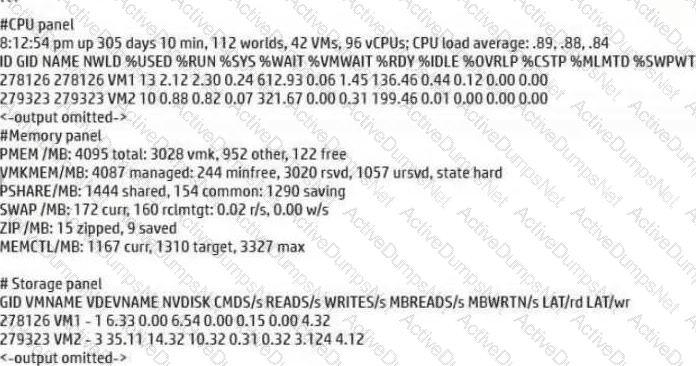
You are helping a customer troubleshoot performance issues on an HPE ProLiant DL server acting as a VMware ESXi host.

You have used the esxtop command, and the output is shown below. (In this output, the details for many VMs have been omitted; however, other VMs have similar stats to the ones that are shown.)
Question # 7

Based on this output, what should you explain?

Options:

A.

The host needs more memory, or some VMs need to be moved to other hosts.

B.

The performance issues derive from the storage backend, which might require a controller upgrade.

C.

The host needs processors with more cores, or some VMs need to be moved to other hosts.

D.

The performance issues derive from the storage network, which needs higher bandwidth.

Question 8

What is one benefit of HPE Slingshot for HPC workloads?

Options:

A.

It uses InfiniBand NDR to reduce the average end-to-end latency for MPI communications.

B.

It uses bandwidth efficiently with packet-by-packet adaptive routing for MPI and Lustre.

C.

It provides advanced congestion management based on DiffServ.

D.

It provides the end-to-end non-blocking architecture required for typical HPC applications.

Question 9

An HPE Private Cloud AI customer has a model deployed with HPE Machine Learning Inference Software (MLIS). You have helped the customer further fine-tune that model. Now the customer would like to test the new model by directing 10% of traffic to it.

What should you do?

Options:

A.

Add a new version of the model to the existing deployment as a canary rollout, setting the desired percentages per version.

B.

Create a second deployment with the new model in MLIS. Use HPE Private Cloud AI’s Canal service to set up routing rules to each deployment.

C.

Migrate the deployment to KServe and use autoscaling to set the 10% value for the new model.

D.

Edit the existing deployment and use the advanced options to set up routing rules to the two model versions.

Question 10

A hospital wants to fine-tune an LLM on their own dataset. However, the data needs to have sensitive information redacted.

Duplicate records also need to be cleaned up.

What can the customer use to achieve this goal?

Options:

A.

MLflow

B.

NeMo Customizer

C.

Katib

D.

NeMo Curator

Question 11

You are demonstrating HPE AI Essentials to a customer. You want to show running a DAG (workflow).

Which framework or page should you access?

Options:

A.

NVIDIA AI Enterprise

B.

MLflow

C.

Ray

D.

Airflow

Question 12

Which benefit does HPE Rear Door Heat Exchanger (RDHX) provide?

Options:

A.

Decreasing energy costs through the use of liquid-to-air cooling

B.

Allowing server chassis to tolerate higher temperatures than those for which they are rated

C.

Providing the efficiencies of liquid cooling to facilities without water available at the rack

D.

Reducing costs by removing the need for heat sinks and fans within servers

Page: 1 / 4
Total 40 questions