
HP HPE7-A10 HPE Network Security Expert Written Exam Exam Practice Test
HPE Network Security Expert Written Exam Questions and Answers
Introduction to the customer
You are assisting a company with adding HPE Aruba Networking ClearPass to its network, which uses HPE Aruba Networking infrastructure devices.
The company already has a Windows domain and Windows CA. The Windows CA issues certificates to domain computers, domain users, and servers such as domain controllers.
ClearPass cluster IP addressing and hostnames
A customer's ClearPass cluster uses these IP addresses:
Publisher = 10.47.47.5
Subscriber 1 = 10.47.47.6
Subscriber 2 = 10.47.47.7
Virtual IP with Subscriber 1 and Subscriber 2 = 10.47.47.8
The customer's DNS server contains these entries:
cp.acnsxtest.com = 10.47.47.5
cps1.acnsxtest.com = 10.47.47.6
cps2.acnsxtest.com = 10.47.47.7
radius.acnsxtest.com = 10.47.47.8
onboard.acnsxtest.com = 10.47.47.8
Refer to the scenario.
The Onboard CA uses the settings shown in the exhibits below.
* CA Name: Onboard CA, CA ID: 2
* Common Name: ClearPass Intune Certificate Authority
Microsoft Entra ID (Azure AD) administrators need assistance configuring the app registration for integration with ClearPass Onboard.
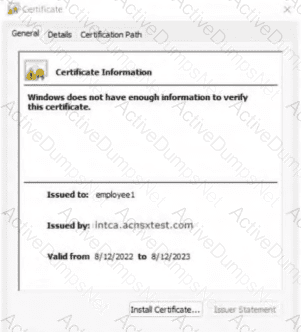
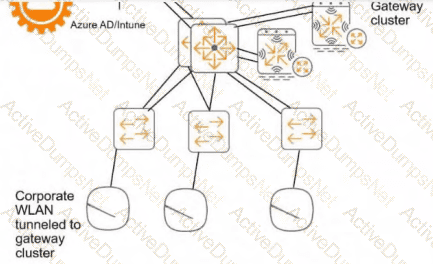
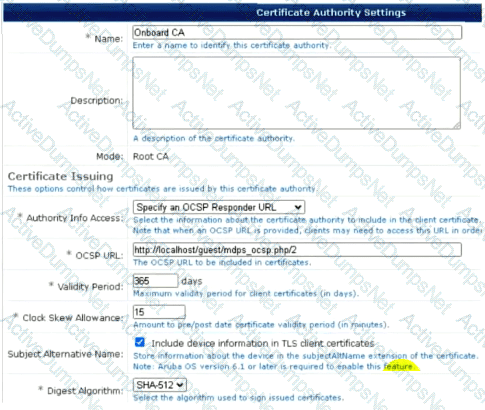
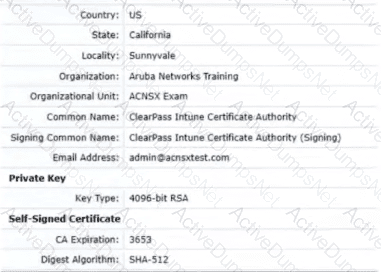
Which URL should you tell them to use?
The customer needs a secure wireless solution that lets users onboard new wireless clients. You are recommending a new WLAN that will give users limited access for this process.
Which WLAN security should you recommend, assuming users have a mixture of WPA2- and WPA3-capable devices?
Introduction to the customer
You are assisting a company with adding HPE Aruba Networking ClearPass to its network, which uses HPE Aruba Networking network-infrastructure devices.
The company already has a Windows domain and Windows CA. The Windows CA issues certificates to domain computers, domain users, and servers such as domain controllers.
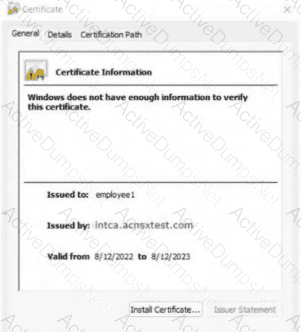
ClearPass cluster IP addressing and hostnames
Publisher = 10.47.47.5
Subscriber 1 = 10.47.47.6
Subscriber 2 = 10.47.47.7
Virtual IP with Subscriber 1 and Subscriber 2 = 10.47.47.8
Refer to the scenario.
You imported the root certificate for the Windows CA into the ClearPass CA Trust list. Based on the scenario requirements, which usages should be added to it?
You are entering the following command on an AOS-CX switch:
radius-server host clearpass.example.com tls clearpass-username clearpass-password plaintext
Which credentials should you enter for clearpass-username and clearpass-password?
Introduction to the customer
You are assisting a company with adding HPE Aruba Networking ClearPass to its network, which uses HPE Aruba Networking network-infrastructure devices.
The company already has a Windows domain and Windows CA. The Windows CA issues certificates to domain computers, domain users, and servers such as domain controllers.
ClearPass cluster IP addressing and hostnames
Publisher = 10.47.47.5
Subscriber 1 = 10.47.47.6
Subscriber 2 = 10.47.47.7
Virtual IP with Subscriber 1 and Subscriber 2 = 10.47.47.8
Refer to the scenario.
You created a role-mapping policy as displayed in the exhibits below.
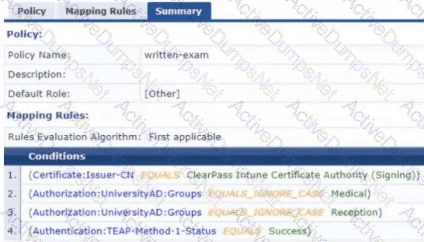
Policy Name: written-exam
Rules Evaluation Algorithm: First applicable
Conditions:
1. (Certificate:Issuer-CN EQUALS ClearPass Intune Certificate Authority (Signing))
2. (Authorization:UniversityAD:Groups EQUALS_IGNORE_CASE Medical)
3. (Authorization:UniversityAD:Groups EQUALS_IGNORE_CASE Reception)
4. (Authentication:TEAP-Method-1-Status EQUALS Success)
What one change must you make to this policy?
An organization wants an AOS-CX switch to generate an alert when its RADIUS server (cp.acnsxtest.local) rejects an abnormal number of client authentication requests each hour. After discussing this with other HPE Aruba Networking administrators, you still do not know how many rejections should be considered normal or abnormal. You expect this value may vary for every switch.
You are assisting the developer with developing an NAE script for this use case.
Refer to the scenario.
You are helping a customer define an NAE script for AOS-CX switches. The script will monitor statistics from a RADIUS server configured on the switch. To future-proof the script, you want administrators to be able to choose a different hostname or IP address for the monitored RADIUS server when they create an agent from the script.
What should you recommend?
A customer has an HPE Aruba Networking ClearPass cluster. The customer uses AOS-CX switches that perform 802.1X authentication through HPE Aruba Networking ClearPass Policy Manager (CPPM). The switches use local port-access policies.
The customer wants to begin tunneling wired clients that pass user authentication only to an HPE Aruba Networking gateway cluster. The gateway cluster must place these clients in the eth-internet role. The gateway must also assign the clients to VLAN 20.
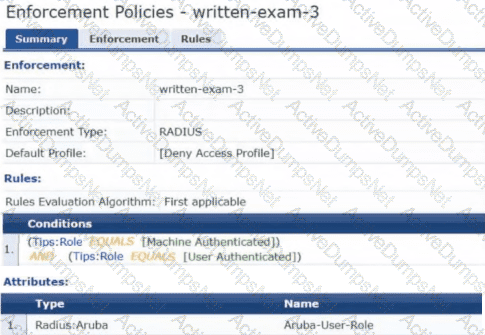
The proposed enforcement policy and profiles are shown below:
* Policy: `written-exam-3`
* Profile: `written-exam-b`
The gateway cluster contains two gateways with the following IP addresses:
Gateway 1: VLAN 4085 (system IP) = 10.20.4.21 | VLAN 20 (users) = 10.20.20.1 | VLAN 4094 (WAN) = 198.51.100.14
Gateway 2: VLAN 4085 (system IP) = 10.20.4.22 | VLAN 20 (users) = 10.20.20.2 | VLAN 4094 (WAN) = 198.51.100.12 | VRRP on VLAN 20 = 10.20.20.254
The customer needs high availability for tunnels between the switches and the gateway cluster. If one gateway fails, the other gateway must take over its tunnels. The switch must also be able to discover the gateway cluster whether either gateway is present in the cluster.
Refer to the scenario.
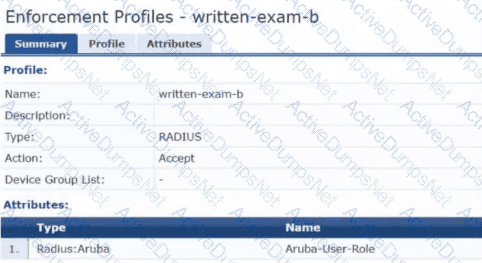
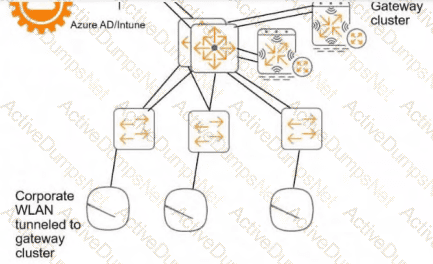
You are configuring the UBT zone on an AOS-CX switch. Which IP addresses should you configure in the zone?
Refer to the exhibit.
An administrator has configured a remote mirror between an AOS-CX switch and a station running a protocol analyzer. The exhibit displays a sample of the packet capture.
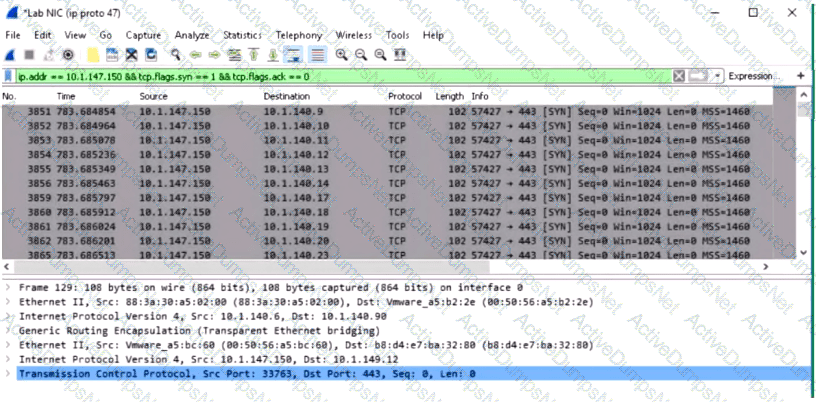
Packet trace details:
Source: 10.1.147.150 - > Destination: 10.1.140.9 TCP 57427 - > 443 [SYN] Seq=0 Len=0
Source: 10.1.147.150 - > Destination: 10.1.140.10 TCP 57427 - > 443 [SYN] Seq=0 Len=0
Source: 10.1.147.150 - > Destination: 10.1.140.11 TCP 57427 - > 443 [SYN] Seq=0 Len=0
Source: 10.1.147.150 - > Destination: 10.1.140.12 TCP 57427 - > 443 [SYN] Seq=0 Len=0
Source: 10.1.147.150 - > Destination: 10.1.140.13 TCP 57427 - > 443 [SYN] Seq=0 Len=0
Packet encapsulation tree shows Generic Routing Encapsulation (Transparent Ethernet bridging).
Which characteristic is suspicious?
A hospital has an AOS-10 architecture managed by HPE Aruba Networking Central. The customer has deployed a pair of HPE Aruba Networking 9000 Series gateways with Security licenses at each clinic. The gateways implement IDS/IPS in IDS mode.
The Security Dashboard shows several recent events with the same signature, as shown below:
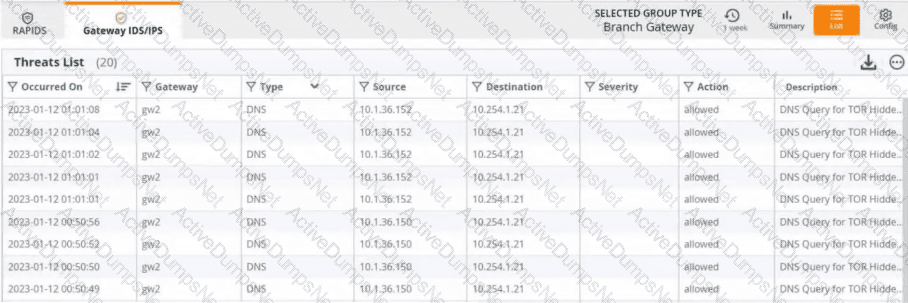
Occurred On: 2023-01-12 | Gateway: gw2 | Type: DNS | Source: 10.1.36.152 | Destination: 10.254.1.21 | Action: allowed | Description: DNS Query for TOR Hidden...
Refer to the scenario.
You have learned that nurse call stations are the source of the events. What can you conclude?
Refer to the exhibit.
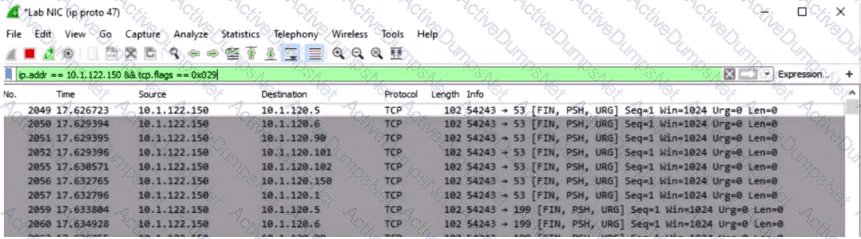
Packet trace display:
Source: 10.1.122.150 - > Destination: 10.1.120.5 TCP 54243 - > 53 [FIN, PSH, URG] Seq=1 Win=1024 Urg=0 Len=0
Source: 10.1.122.150 - > Destination: 10.1.120.6 TCP 54243 - > 53 [FIN, PSH, URG] Seq=1 Win=1024 Urg=0 Len=0
Source: 10.1.122.150 - > Destination: 10.1.120.90 TCP 54243 - > 53 [FIN, PSH, URG] Seq=1 Win=1024 Urg=0 Len=0
Source: 10.1.122.150 - > Destination: 10.1.120.101 TCP 54243 - > 53 [FIN, PSH, URG] Seq=1 Win= 1024 Urg=0 Len=0
Source: 10.1.122.150 - > Destination: 10.1.120.5 TCP 54243 - > 199 [FIN, PSH, URG] Seq=1 Win=1024 Urg=0 Len=0
What does this indicate?
A customer operates an HPE Aruba Networking ClearPass cluster. The customer has AOS-CX switches that use 802.1X authentication with HPE Aruba Networking ClearPass Policy Manager (CPPM).
The switches use local port-access policies. The customer wants to begin tunneling wired clients that pass only user authentication to an HPE Aruba Networking gateway cluster. The gateway cluster must assign these clients the eth-internet role. The gateway must also assign the clients to VLAN 20.
The intended enforcement policy and profiles are shown below:
* Policy: `written-exam-3`
* Profile: `written-exam-b`
The gateway cluster contains two gateways with the following IP addresses:
Gateway 1: VLAN 4085 (system IP) = 10.20.4.21 | VLAN 20 (users) = 10.20.20.1 | VLAN 4094 (WAN) = 198.51.100.14
Gateway 2: VLAN 4085 (system IP) = 10.20.4.22 | VLAN 20 (users) = 10.20.20.2 | VLAN 4094 (WAN) = 198.51.100.12 | VRRP on VLAN 20 = 10.20.20.254
The customer needs high availability for tunnels between the switches and the gateway cluster. If one gateway fails, the other gateway must take over its tunnels. The switch must also be able to discover the gateway cluster even if one gateway in the cluster is unavailable.
Refer to the scenario. Assume that `myzone` is the name used for the UBT zone.
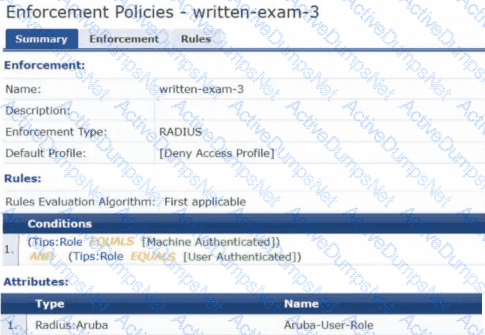
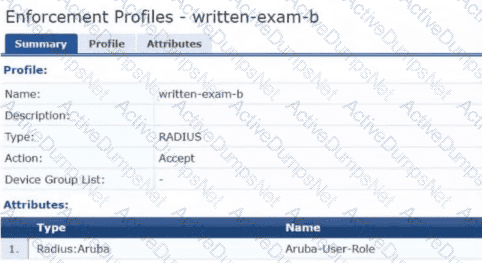
Which option is a valid minimal configuration for the AOS-CX port-access roles?
Refer to the exhibit.
Device Insight Integration:
* Device Insight Integration: Enable
* Registration Token: 4ROAMDMNKLG
* Registration Status: Registered
* Master ClearPass Server: cp1.acnsxtest.com (10.38.1.113)
* Polling Interval: 15 minutes
Device Tag Updates Action:
* Tags Update Action: Apply action for selected Tag updates only
* Selected Tags for Action: `suspicious`
* RADIUS Action: `[AOS-CX - Disconnect]`
HPE Aruba Networking ClearPass Policy Manager (CPPM) uses the settings displayed in the exhibit. You use the tag shown in the exhibit in enforcement policies associated with several NAS types, including HPE Aruba Networking APs, HPE Aruba Networking gateways, and AOS-CX switches.
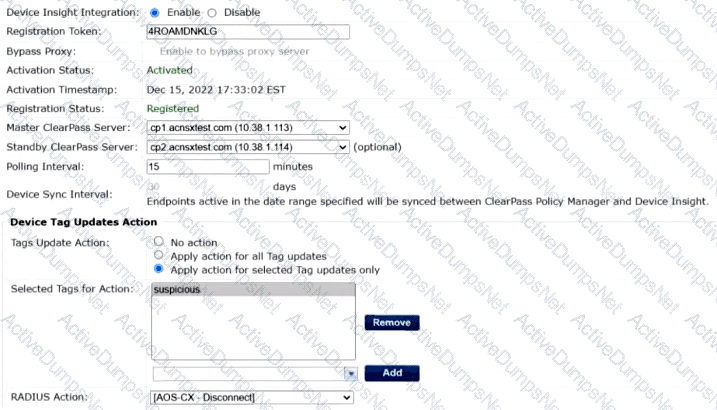
What should you do to ensure clients are reclassified and receive the proper treatment based on the tag?
A customer requires you to configure Aruba ClearPass Policy Manager (CPPM) to authenticate domain users on domain computers. Domain users, domain computers, and domain controllers obtain certificates from a Windows CA. CPPM must validate these certificates and confirm that the users and computers have accounts in Windows AD. The customer requires encrypted communication for all traffic between CPPM and the domain controllers.
You have imported the Windows CA root certificate into the ClearPass CA Trust list.
Based on these requirements, which usages should be added to it?
How does HPE Aruba Networking Central secure site-to-site connections between AOS-10 gateways?
A customer has an HPE Aruba Networking ClearPass cluster. The customer has AOS-CX switches that use 802.1X authentication with HPE Aruba Networking ClearPass Policy Manager (CPPM).
The switches use local port-access policies. The customer wants to begin tunneling wired clients that pass user authentication only to an HPE Aruba Networking gateway cluster. The gateway cluster must assign these clients the eth-internet role. The gateway must also assign the clients to VLAN 20.
The planned enforcement policy and profiles are shown below:
* Policy: `written-exam-3`
* Profile: `written-exam-b`
The gateway cluster contains two gateways with these IP addresses:
Gateway 1: VLAN 4085 (system IP) = 10.20.4.21 | VLAN 20 (users) = 10.20.20.1 | VLAN 4094 (WAN) = 198.51.100.14
Gateway 2: VLAN 4085 (system IP) = 10.20.4.22 | VLAN 20 (users) = 10.20.20.2 | VLAN 4094 (WAN) = 198.51.100.12 | VRRP on VLAN 20 = 10.20.20.254
The customer requires high availability for tunnels between the switches and the gateway cluster. If one gateway fails, the other gateway must take over its tunnels. The switch must also be able to discover the gateway cluster whether either gateway is in the cluster.
Refer to the scenario.
What is one change that should be made to the solution?
A customer has an AOS-10 architecture managed by HPE Aruba Networking Central. HPE Aruba Networking infrastructure devices authenticate clients through an HPE Aruba Networking ClearPass cluster.
In HPE Aruba Networking Central, you are reviewing network traffic flows for a wireless IoT device categorized as a “Raspberry Pi” client. You observe SSH traffic. You then inspect several additional wireless IoT clients and find that they are also sending SSH traffic.
Refer to the scenario.
You are assisting the customer in evaluating ways to mitigate the potential threat detected. One possible option has been identified: add a rule to the clients’ AOS user role that matches SSH traffic and applies denylisting.
What is one benefit of this option?
A customer wants to avoid using RadSec between AOS-CX switches and ClearPass Policy Manager (CPPM) in order to reduce the need to manage switch certificates. Given this condition, what can you recommend to enhance security?
Refer to the scenario.
A customer uses an AOS-10 architecture managed by HPE Aruba Networking Central. HPE Aruba Networking infrastructure devices authenticate clients to an HPE Aruba Networking ClearPass cluster.
In HPE Aruba Networking Central, you are reviewing network traffic flows for a wireless IoT device categorized as a “Raspberry Pi” client. You observe SSH traffic. You then examine several additional wireless IoT clients and find that they are also sending SSH.
You want a relatively easy way to communicate to HPE Aruba Networking CPPM that an IoT client has used SSH.
What is one prerequisite?
You must install a certificate on a standalone HPE Aruba Networking Mobility Controller (MC). The MC must use the certificate for the Web UI and to implement RadSec with HPE Aruba Networking ClearPass Policy Manager. You have received a certificate with these settings:
Subject: CN=mc49.site30.example.com
No SANs
Issuer: CN=ca89.example.com
EKUs: Server Authentication, Client Authentication
What problem does this certificate have for its intended uses?
A customer has an AOS-10 architecture managed by HPE Aruba Networking Central. HPE Aruba Networking infrastructure devices authenticate clients against an HPE Aruba Networking ClearPass cluster.
In HPE Aruba Networking Central, you are reviewing network traffic flows for a wireless IoT device categorized as a “Raspberry Pi” client. You observe SSH traffic. You then review several additional wireless IoT clients and find that they are also sending SSH.
Refer to the scenario.
You are assisting the customer in assessing ways to mitigate the potential threat detected. For the foreseeable future, until the security team has addressed the threat, the company wants to block most traffic from any IoT client detected sending SSH traffic. The company does want to allow limited access for these clients so that administrators can remediate them remotely.
What action should you take?
A customer has an AOS-10 architecture consisting of HPE Aruba Networking APs and AOS-CX switches, managed through HPE Aruba Networking Central. The customer wants information about clients, including their general category and OS.
What should you explain?
Refer to the exhibit, which depicts the topology for an HPE Aruba Networking network.
* Gateways: GW1 (10.1.30.2 / 10.1.36.2), GW2 (10.1.30.3 / 10.1.36.3), VRRP: 10.1.36.1
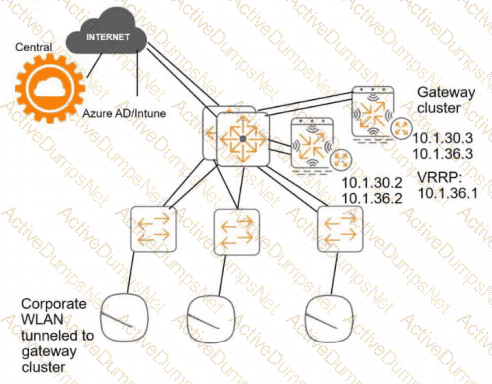
The gateways have sent the following logs to your Syslog server:
```text
< 142 > Jan 9 18:01:15 GW1 authmgr[6118]: < 124039 > < 6118 > Time-range night-hours activated
< 142 > Jan 9 18:01:15 GW1 authmgr[6118]: < 124040 > < 6118 > Time-range working-hours deactivated
< 142 > Jan 9 18:13:07 GW2 authmgr[6159] : < 124709 > < 6159 > Drop ARP-packet with unknown-IP: smac:a0:e7:7b:97:a2:98 sender-mac: a0:e7:7b:97:a2:98 sender-ip:10.1.30.2
< 142 > Jan 9 18:13:38 GW2 authmgr[6159]: < 124709 > < 6159 > Drop ARP-packet with unknown-IP: smac: a0:e7:7b:97:a2:98 sender-mac: a0:e7:7b:97:a2:98 sender-ip:10.1.30.2
< 142 > Jan 9 18:21:24 GW2 isakmpd[6132]: < 103076 > < 6132 > IKEv2 IPSEC Tunnel created for peer 10.1.30.2:500
< 142 > Jan 9 18:21:24 GW2 isakmpd[6132]: < 103101 > < 6132 > IPSEC SA deleted for peer 10.1.30.2
< 142 > Jan 9 18:21:24 GW2 isakmpd[6132]: < 103078 > < 6132 > IKEv2 CHILDSA successful for peer 10.1.30.2:500
< 142 > Jan 9 18:21:26 GW1 isakmpd[6091]: < 103076 > < 6091 > IKEv2 IPSEC Tunnel created for peer 10.1.30.3:500
< 142 > Jan 9 18:21:26 GW1 isakmpd[6091]: < 103101 > < 6091 > IPSEC SA deleted for peer 10.1.30.3
< 142 > Jan 9 18:21:26 GW1 isakmpd[6091]: < 103078 > < 6091 > IKEv2 CHILDSA successful for peer 10.1.30.3:500
```
What potential security issue can be identified from these logs?