Big Cyber Monday Sale Limited Time Flat 70% Discount offer - Ends in 0d 00h 00m 00s - Coupon code: 70spcl

HP HPE7-A02 Aruba Certified Network Security Professional Exam Exam Practice Test

Page: 1 / 14
Total 135 questions

Aruba Certified Network Security Professional Exam Questions and Answers

Question 1

A company wants to apply a standard configuration to all AOS-CX switch ports and have the ports dynamically adjust their configuration based on the identity of

the user or device that connects. They want to centralize configuration of the identity-based settings as much as possible.

What should you recommend?

Options:

A.

Having HPE Aruba Networking ClearPass Policy Manager (CPPM) send standard RADIUS AVPs to customize port settings

B.

Having switches pull port configurations dynamically from HPE Aruba Networking Activate

C.

Having switches download user-roles from HPE Aruba Networking gateways

D.

Having switches download user-roles from HPE Aruba Networking ClearPass Policy Manager (CPPM)

Question 2

You are establishing a cluster of HPE Aruba Networking ClearPass servers. (Assume that they are running version 6.9.).

For which type of certificate it is recommended to install a CA-signed certificate on the Subscriber before it joins the cluster?

Options:

A.

Database

B.

HTTPS

C.

RADIUS/EAP

D.

RadSec

Question 3

You are establishing a cluster of HPE Aruba Networking ClearPass servers. (Assume that they are running version 6.9.).

For which type of certificate is it recommended to install a CA-signed certificate on the Subscriber before it joins the cluster?

Options:

A.

HTTPS

B.

Database

C.

RADIUS/EAP

D.

RadSec

Question 4

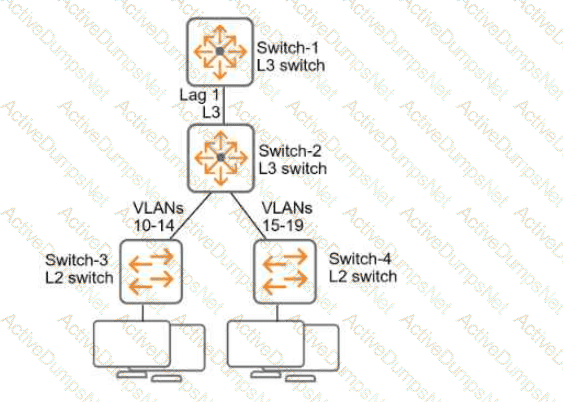
Refer to Exhibit:

Question # 4

All of the switches in the exhibit are AOS-CX switches.

What is the preferred configuration on Switch-2 for preventing rogue OSPF routers in this network?

Options:

A.

Configure OSPF authentication on VLANs 10-19 in password mode.

B.

Configure OSPF authentication on Lag 1 in MD5 mode.

C.

Disable OSPF entirely on VLANs 10-19.

D.

Configure passive-interface as the OSPF default and disable OSPF passive on Lag 1.

Question 5

A company wants HPE Aruba Networking ClearPass Policy Manager (CPPM) to periodically poll Microsoft Endpoint Manager (formerly Intune) for attributes about its managed clients.

What should you do on ClearPass to permit this integration?

Options:

A.

Install the Intune extension from ClearPass Guest

B.

Import the Intune dictionary into the ClearPass dictionaries

C.

Create an Intune authentication source on CPPM

D.

Configure Endpoint Manager (Intune) as an event source on CPPM

Question 6

Refer to Exhibit.

Question # 6

A company is using HPE Aruba Networking ClearPass Device Insight (CPDI) (the standalone application). In the CPDI interface, you go to the Generic Devices

page and see the view shown in the exhibit.

What correctly describes what you see?

Options:

A.

Each cluster is a group of unclassified devices that CPDI's machine learning has discovered to have similar attributes.

B.

Each cluster is a group of devices that match one of the tags configured by admins.

C.

Each cluster is all the devices that have been assigned to the same category by one of CPDI's built-in system rules.

D.

Each cluster is a group of devices that have been classified with user rules, but for which CPDI offers different recommendations.

Question 7

You have created this rule in an HPE Aruba Networking ClearPass Policy Manager (CPPM) service's enforcement policy: IF Authorization [Endpoints Repository]

Conflict EQUALS true THEN apply "quarantine_profile"

What information can help you determine whether you need to configure cluster-wide profiler parameters to ignore some conflicts?

Options:

A.

Whether the company has rare Internet of Things (loT) devices

B.

Whether some devices are incapable of captive portal or 802.1X authentication

C.

Whether the company has devices that use PXE boot

D.

Whether some devices are running legacy operating systems

Question 8

A company assigns a different block of VLAN IDs to each of its access layer AOS-CX switches. The switches run version 10.07. The IDs are used for standard

purposes, such as for employees, VolP phones, and cameras. The company wants to apply 802.1X authentication to HPE Aruba Networking ClearPass Policy

Manager (CPPM) and then steer clients to the correct VLANs for local forwarding.

What can you do to simplify setting up this solution?
Options:

A.

Assign consistent names to VLANs of the same type across the AOS-CX switches and have user-roles reference names.

B.

Use the trunk allowed VLAN setting to assign multiple VLAN IDs to the same role.

C.

Change the VLAN IDs across the AOS-CX switches so that they are consistent.

D.

Avoid configuring the VLAN in the role; use trunk VLANs to assign multiple VLANs to the port instead.

Question 9

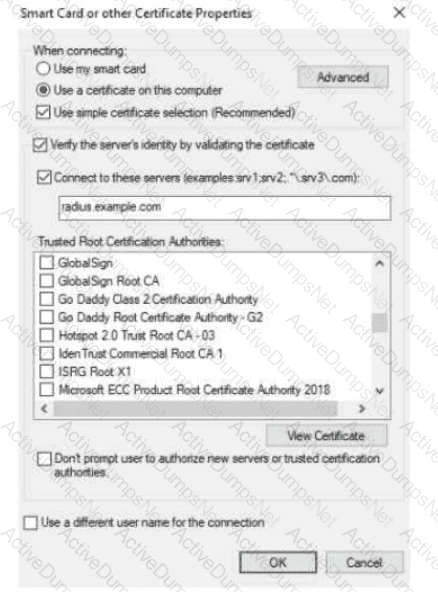
Question # 9

The exhibit shows the 802.1X-related settings for Windows domain clients. What should admins change to make the settings follow best security practices?

Options:

A.

Specify at least two server names under the "Connect to these servers" field.

B.

Select the desired Trusted Root Certificate Authority and select the check box next to "Don't prompt users."

C.

Under the "Connect to these servers" field, use a wildcard in the server name.

D.

Clear the check box for using simple certificate selection and select the desired certificate manually.

Question 10

An AOS-CX switch has this admin user account configured on it:

netadmin in the operators group.

You have configured these commands on an AOS-CX switch:

tacacs-server host cp.example.com key plaintext &12xl,powmay7855

aaa authentication login ssh group tacacs local

aaa authentication allow-fail-through

A user accesses the switch with SSH and logs in as netadmin with the correct password. When the switch sends a TACACS+ request to the ClearPass server at cp.example.com, the server does not send a response. Authentication times out.

What happens?

Options:

A.

The user is logged in and granted operator access.

B.

The user is logged in and allowed to enter auditor commands only.

C.

The user is logged in and granted administrators access.

D.

The user is not allowed to log in.

Question 11

A company uses HPE Aruba Networking ClearPass Policy Manager (CPPM) and HPE Aruba Networking ClearPass Device Insight (CPDI) and has integrated the

two. CPDI admins have created a tag. CPPM admins have created rules that use that tag in the wired 802.1X and wireless 802.1X services' enforcement policies.

The company requires CPPM to apply the tag-based rules to a client directly after it learns that the client has that tag.

What is one of the settings that you should verify on CPPM?

Options:

A.

The "Device Sync" setting is set to 1 in the ClearPass Device Insight Integration settings.

B.

Both 802.1X services have the "Profile Endpoints" option enabled and an appropriate CoA profile selected in the Profiler tab.

C.

Both 802.1X services have the "Use cached Role and Posture attributes from the previous sessions" setting.

D.

The "Polling Interval" is set to 1 in the ClearPass Device Insight Integration settings.

Question 12

HPE Aruba Networking switches are implementing MAC-Auth to HPE Aruba Networking ClearPass Policy Manager (CPPM) for a company's printers. The company wants to quarantine a client that spoofs a legitimate printer's MAC address. You plan to add a rule to the MAC-Auth service enforcement policy for this purpose. What condition should you include?

Options:

A.

Endpoint Compliance EQUALS false

B.

Endpoint Device Insight Tag EXISTS

C.

Authorization: [Endpoints Repository] Compromised EQUALS true

D.

Authorization: [Endpoints Repository] Conflict EQUALS true

Question 13

A company has AOS-CX switches and HPE Aruba Networking ClearPass Policy Manager (CPPM). The company wants switches to implement 802.1X

authentication to CPPM and download user roles.

What is one task that you must complete on the switches to support this use case?

Options:

A.

Specify CPPM as the RADIUS server with the exact CN in CPPM's HTTPS certificate.

B.

Install the root CA certificate for CPPM's RADIUS certificate in a TA profile on the switches.

C.

Configure empty user-roles with names that match enforcement profile names on CPPM.

D.

Specify a ClearPass username and password that match the name and RADIUS secret in a CPPM network device entry.

Question 14

You have set up a mirroring session between an AOS-CX switch and a management station, running Wireshark. You want to capture just the traffic sent in the

mirroring session, not the management station's other traffic.

What should you do?

Options:

A.

Apply this capture filter: ip proto 47

B.

Edit protocol preferences and enable ARUBA_ERM.

C.

Edit protocol preferences and enable HPE_ERM.

D.

Apply this capture filter: udp port 5555

Question 15

A company lacks visibility into the many different types of user and loT devices deployed in its internal network, making it hard for the security team to address

those devices.

Which HPE Aruba Networking solution should you recommend to resolve this issue?

Options:

A.

HPE Aruba Networking ClearPass Device Insight (CPDI)

B.

HPE Aruba Networking Network Analytics Engine (NAE)

C.

HPE Aruba Networking Mobility Conductor

D.

HPE Aruba Networking ClearPass OnBoard

Question 16

A company uses HPE Aruba Networking ClearPass Policy Manager (CPPM) as a TACACS+ server to authenticate managers on its AOS-CX switches. You want

to assign managers to groups on the AOS-CX switch by name.

How do you configure this setting in a CPPM TACACS+ enforcement profile?

Options:

A.

Add the Shell service and set autocmd to the group name.

B.

Add the Shell service and set priv-Ivl to the group name.

C.

Add the Aruba:Common service and set Aruba-Admin-Role to the group name.

D.

Add the Aruba:Common service and set Aruba-Priv-Admin-User to the group name.

Question 17

What is a use case for running periodic subnet scans on devices from HPE Aruba Networking ClearPass Policy Manager (CPPM)?

Options:

A.

Using DHCP fingerprints to determine a client's device category and OS

B.

Detecting devices that fail to comply with rules defined in CPPM posture policies

C.

Identifying issues with authenticating and authorizing clients

D.

Using WMI to collect additional information about Windows domain clients

Question 18

A company uses HPE Aruba Networking ClearPass Policy Manager (CPPM) as a TACACS+ server to authenticate managers on its AOS-CX switches. The company wants CPPM to control which commands managers are allowed to enter.

Which service must you add to the managers' TACACS+ enforcement profile?

Options:

A.

Cpass:HTTP

B.

Shell

C.

ARAP

D.

Aruba:Common

Question 19

You need to create a rule in an HPE Aruba Networking ClearPass Policy Manager (CPPM) role mapping policy that references a ClearPass Device Insight Tag. Which Type (namespace) should you specify for the rule?

Options:

A.

Endpoint

B.

TIPS

C.

Device

D.

Application

Question 20

Refer to the exhibit.

Question # 20

The exhibit shows a saved packet capture, which you have opened in Wireshark. You want to focus on the complete conversation between 10.1.70.90 and 10.1.79.11 that uses source port 5448.

What is a simple way to do this in Wireshark?

Options:

A.

Apply a capture filter that selects for both the 10.1.70.90 and 10.1.79.11 IP addresses.

B.

Click the Source column and then the Destination column to sort the packets into the desired order.

C.

Apply a capture filter that selects for TCP port 5448.

D.

Right-click one of the packets between those addresses and choose to follow the stream.

Question 21

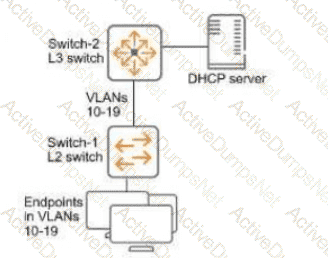
Refer to the exhibit.

Question # 21

You have verified that AOS-CX Switch-1 has constructed an IP-to-MAC binding table in VLANs 10-19. Now you need to enable ARP inspection for the endpoint connected to Switch-1. What must you do first to prevent traffic disruption?

Options:

A.

Configure ARP inspection on VLANs 10-19 on Switch-2.

B.

Configure DHCP snooping on VLANs 10-19 on Switch-2.

C.

Configure Switch-1 uplinks as trusted ARP inspection ports.

D.

Create a static IP-to-MAC binding on Switch-1 for the DHCP server.

Question 22

A company wants HPE Aruba Networking ClearPass Policy Manager (CPPM) to respond to Syslog messages from its Palo Alto Next Generation Firewall (NGFW)

by quarantining clients involved in security incidents.

Which step must you complete to enable CPPM to process the Syslogs properly?

Options:

A.

Configure the Palo Alto as a context server on CPPM.

B.

Install a Palo Alto Extension through ClearPass Guest.

C.

Enable Insight and ingress event processing on the CPPM server.

D.

Configure CPPM to trust the root CA certificate for the NGFW.

Question 23

You have enabled "rogue AP containment" in the Wireless IPS settings for a company’s HPE Aruba Networking APs. What form of containment does HPE Aruba Networking recommend?

Options:

A.

Wireless deauthentication only

B.

Wireless tarpit and wired containment

C.

Wireless tarpit only

D.

Wired containment

Question 24

Your company wants to implement Tunneled EAP (TEAP).

How can you set up HPE Aruba Networking ClearPass Policy Manager (CPPM) to enforce certificated-based authentication for clients using TEAP?

Options:

A.

For the service using TEAP, set the authentication source to an internal database.

B.

Select a service certificate when you specify TEAP as a service's authentication method.

C.

Create an authentication method named "TEAP" with the type set to EAP-TLS.

D.

Select an EAP-TLS-type authentication method for the TEAP method's inner method.

Question 25

You are using OpenSSL to obtain a certificate signed by a Certification Authority (CA). You have entered this command:

openssl req -new -out file1.pem -newkey rsa:3072 -keyout file2.pem

Enter PEM pass phrase: **********

Verifying - Enter PEM pass phrase: **********

Country Name (2 letter code) [AU]:US

State or Province Name (full name) [Some-State]:California

Locality Name (eg, city) []:Sunnyvale

Organization Name (eg, company) [Internet Widgits Pty Ltd]:example.com

Organizational Unit Name (eg, section) []:Infrastructure

Common Name (e.g. server FQDN or YOUR name) []:radius.example.com

What is one guideline for continuing to obtain a certificate?

Options:

A.

You should use a third-party tool to encrypt file2.pem before sending it and file1.pem to the CA.

B.

You should concatenate file1.pem and file2.pem into a single file, and submit that to the desired CA to sign.

C.

You should submit file1.pem, but not file2.pem, to the desired CA to sign.

D.

You should submit file2.pem, but not file1.pem, to the desired CA to sign.

Question 26

An AOS-CX switch has been configured to implement UBT to two HPE Aruba Networking gateways that implement VRRP on the users' VLAN. What correctly describes how the switch tunnels UBT users' traffic to those gateways?

Options:

A.

The switch always sends the users' traffic to the VRRP master.

B.

The switch always sends all users' traffic to the primary gateway configured in the UBT zone.

C.

The switch always load shares the users' traffic across both gateways.

D.

The switch always sends all users' traffic to the gateway assigned as the active device designed gateway.

Question 27

What correctly describes an HPE Aruba Networking AP's Device (TPM) certificate?

Options:

A.

It is signed by an HPE Aruba Networking CA and is trusted by many HPE Aruba Networking solutions.

B.

It works well as a captive portal certificate for guest SSIDs.

C.

It is a self-signed certificate that should not be used in production.

D.

It is installed on APs after they connect to and are provisioned by HPE Aruba Networking Central.

Question 28

You are using Wireshark to view packets captured from HPE Aruba Networking infrastructure, but you’re not sure that the packets are displaying correctly. In which circumstance does it make sense to configure Wireshark to ignore protection bits with the IV for the 802.11 protocol?

Options:

A.

When the traffic was captured on the data plane of an HPE Aruba Networking gateway and sent to a remote IP.

B.

When the traffic was mirrored from an AOS-CX switch port connected to an AP.

C.

When the traffic was captured from an AP with HPE Aruba Networking Central.

D.

When the traffic was captured on the control plane of an HPE Aruba Networking MC and sent to a remote IP.

Question 29

A company wants to turn on Wireless IDS/IPS infrastructure and client detection at the high level on HPE Aruba Networking APs. The company does not want to

enable any prevention settings.

What should you explain about HPE Aruba Networking recommendations?

Options:

A.

HPE Aruba Networking recommends turning on both wired and wireless prevention whenever you enable detection at high.

B.

HPE Aruba Networking recommends using hybrid AP mode, as opposed to Air Monitors (AMs), when implementing detection without prevention.

C.

HPE Aruba Networking recommends disabling client detection when you configure infrastructure detection at high, as infrastructure detection includes all the client checks and more.

D.

HPE Aruba Networking recommends configuring infrastructure and client detection at a custom level and disabling or tuning some of the settings that are likely to produce false positives.

Question 30

A company needs to enforce 802.1X authentication for its Windows domain computers to HPE Aruba Networking ClearPass Policy Manager (CPPM). The

company needs the computers to authenticate as both machines and users in the same session.

Which authentication method should you set up on CPPM?

Options:

A.

TEAP

B.

PEAP MSCHAPv2

C.

EAP-TTLS

D.

EAP-TLS

Question 31

What is one use case that companies can fulfill using HPE Aruba Networking ClearPass Policy Manager's (CPPM's) Device Profiler?

Options:

A.

OIdentifying device security vulnerabilities by CVE ID and receiving remediation recommendations

B.

Leveraging artificial intelligence to more accurately identify Internet of Things (loT) devices

C.

Quarantining devices that do not have the required antivirus software installed on them

D.

Assigning different AOS firewall roles to users on computers and the same users on smartphones

Question 32

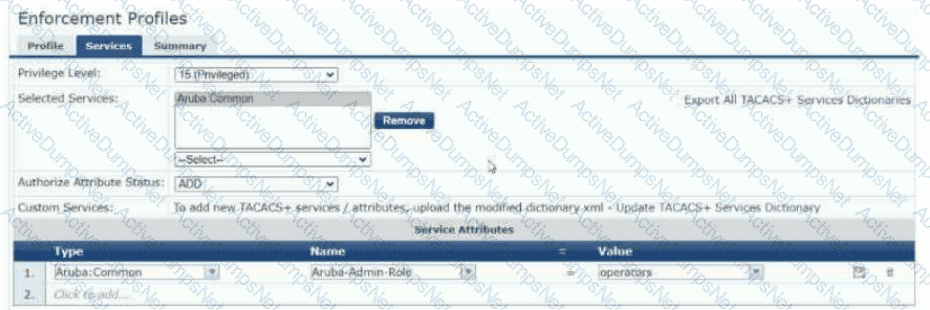
Refer to the exhibit:

Question # 32

The exhibit shows the TACACS+ enforcement profile that HPE Aruba Networking ClearPass Policy Manager (CPPM) assigns to a manager. When this manager logs into an AOS-CX switch, what does the switch do?

Options:

A.

Assigns the manager operator-level privileges

B.

Assigns the manager administrator-level privileges

C.

Rejects the manager with an error message

D.

Assigns the manager auditor-level privileges

Question 33

HPE Aruba Networking Central displays an alert about an Infrastructure Attack that was detected. You go to the Security > RAPIDS events and see that the attack was "Detect adhoc using Valid SSID." What is one possible next step?

Options:

A.

Make sure that you have tuned the threshold for that check as false positives are common for it.

B.

Make sure that clients have updated drivers, as faulty drivers are a common explanation for this attack type.

C.

Use HPE Aruba Networking Central floorplans or the detecting AP identities to locate the general area for the threat.

D.

Look for the IP address associated with the offender and then check for that IP address among HPE Aruba Networking Central clients.

Question 34

A company has HPE Aruba Networking APs, which authenticate users to HPE Aruba Networking ClearPass Policy Manager (CPPM).

What does HPE Aruba Networking recommend as the preferred method for assigning clients to a role on the AOS firewall?

Options:

A.

Configure CPPM to assign the role using a RADIUS enforcement profile with a RADIUS:IETF Username attribute.

B.

Configure CPPM to assign the role using a RADIUS enforcement profile with an Aruba-User-Role VSA.

C.

OCreate server rules on the APs to assign clients to roles based on RADIUS IETF attributes returned by CPPM.

D.

Create user rules on the APs to assign clients to roles based on a variety of criteria.

Question 35

A company has AOS-CX switches. The company wants to make it simpler and faster for admins to detect denial of service (DoS) attacks, such as ping or ARP floods, launched against the switches.

What can you do to support this use case?

Options:

A.

Deploy an NAE agent on the switches to monitor control plane policing (CoPP).

B.

Configure the switches to implement RADIUS accounting to HPE Aruba Networking ClearPass and enable HPE Aruba Networking ClearPass Insight.

C.

Implement ARP inspection on all VLANs that support end-user devices.

D.

Enabling debugging of security functions on the switches.

Question 36

You are configuring the HPE Aruba Networking ClearPass Device Insight Integration settings on ClearPass Policy Manager (CPPM). For which use case should you set the 'Tag Updates Action" to "apply for all tag updates"?

Options:

A.

When the Device Insight integration poll interval is set to a relatively long interval but you still want CPPM to be informed quickly about devices' new tags.

B.

When Device Insight tags are only used to identify dangerous devices, and you want to disconnect those devices without having to set up new rules in enforcement policies.

C.

When CPPM is gathering posture information for CPDI, and you want CPDI to always have access to the most up-to-date information.

D.

When you plan to have CPPM issue CoAs for clients with new tags, but do not want to have to list those specific tags in the Device Integration settings in advance.

Question 37

You have created a Web-based Health Check Service that references a posture policy. You want the service to trigger a RADIUS change of authorization (CoA) when a client receives a Healthy or Quarantine posture. Where do you configure those rules?

Options:

A.

In a RADIUS enforcement policy

B.

In the Agents and Software Updates > OnGuard Settings

C.

In the posture policy

D.

In a WEBAUTH enforcement policy

Question 38

A company has HPE Aruba Networking Central-managed APs. The company wants to block all clients connected through the APs from using YouTube.

Which steps should you take?

Options:

A.

Deploy gateways and have the APs tunnel traffic to the gateways. Then, enable the gateway IDS/IPS engine.

B.

Enable Client IPS at the "custom" level, and then specify the check for YouTube.

C.

Enable WebCC on all client firewall roles. Then, create WebCC category rules that deny suspicious URLs.

D.

Enable DPI. Then, create application rules to deny YouTube on the firewall roles.

Question 39

A company has AOS-CX switches at the access layer, managed by HPE Aruba Networking Central. You have identified suspicious activity on a wired client. You want to analyze the client's traffic with Wireshark, which you have on your management station.

What should you do?

Options:

A.

Access the client's switch's CLI from your management station. Access the switch shell and run a TCP dump on the client port.

B.

Go to the client's switch in HPE Aruba Networking Central. Use the "Security" page to run a packet capture.

C.

Set up a policy that implements a captive portal redirect to your management station. Apply that policy to the client's port.

D.

Set up a mirror session on the client's switch; set the client port as the source and your station IP address as the tunnel destination.

Question 40

HPE Aruba Networking Central displays an alert about an Infrastructure Attack that was detected. You go to the Security > RAPIDS events and see that the attack

was "Detect adhoc using Valid SSID."

What is one possible next step?

Options:

A.

Use HPE Aruba Networking Central floorplans or the detecting AP identities to locate the general area for the threat.

B.

Look for the IP address associated with the offender and then check for that IP address among HPE Aruba Networking Central clients.

C.

Make sure that you have tuned the threshold for that check, as false positives are common for it.

D.

Make sure that clients have updated drivers, as faulty drivers are a common explanation for this attack type.

Page: 1 / 14
Total 135 questions