Summer Sale Limited Time Flat 70% Discount offer - Ends in 0d 00h 00m 00s - Coupon code: 70spcl

Fortinet NSE5_FWB_AD-8.0 Fortinet NSE 5 - FortiWeb 8.0 Administrator Exam Practice Test

Fortinet NSE 5 - FortiWeb 8.0 Administrator Questions and Answers

Question 1

You are reviewing SSL-related issues on FortiWeb. An administrator reports that they receive a certificate warning when they access the FortiWeb GUI over HTTPS. Separately, your FortiWeb device also makes outbound HTTPS requests to a back-end API server.

In which two situations would FortiWeb use its own certificates to establish or secure the connection? (Choose two.)

Options:

A.

When a client browser initiates an SSL session and FortiWeb is in transparent inspection mode.

B.

When FortiWeb is routing an HTTPS connection to a FortiGate without decrypting it.

C.

When an administrator connects to the FortiWeb GUI using HTTPS in a browser.

D.

When FortiWeb connects to a back-end server over HTTPS as a client.

Question 2

Refer to the exhibit.

Question # 2

Question # 2

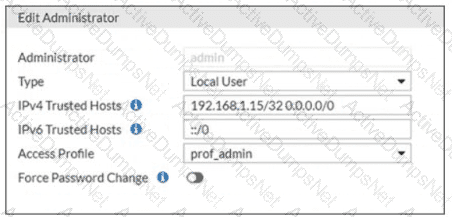
A FortiWeb administrator is trying to enable policy-based traffic logging on FortiWeb but doesn’t see the traffic log option available in the server policy settings.

What is the most likely reason this option is not visible?

Options:

A.

The FortiWeb administrator must first connect to FortiSIEM or FortiAnalyzer, and then enable policy logs from those devices.

B.

Server policy logging only becomes available when FortiWeb is deployed in reverse-proxy mode and transparent mode.

C.

The global traffic log setting must be enabled manually in the CLI for the option to appear.

D.

The FortiWeb administrator must get a license to use this feature with FortiAppSec Cloud.

Question 3

Refer to the exhibit.

Question # 3

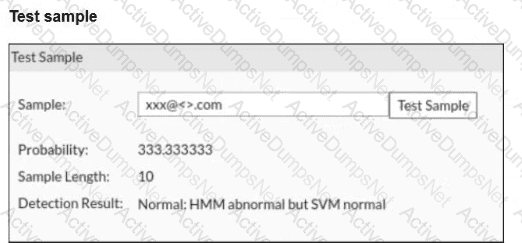
What does the exhibit show?

Options:

A.

The FortiGate UI interface in HTML.

B.

A sample response returned by the FortiGate API at https://fortigate.com/ui.

C.

The result of a show ui details command on a FortiWeb server.

D.

An API schema file.

Question 4

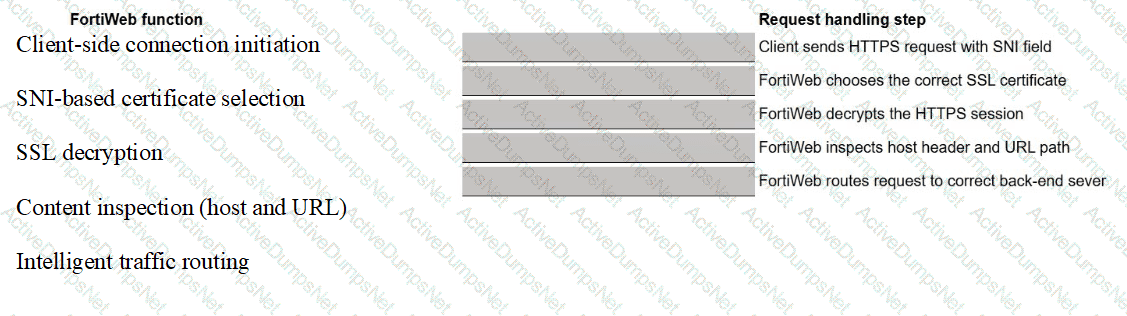
You are reviewing the FortiWeb integration with the Advanced Bot Protection (ABP) service.

Match each step in the ABP flow with its description.

Question # 4

Options:

Question 5

A FortiWeb administrator is deciding between using SAML SSO or HTML authentication. They want to minimize the number of credential prompts users receive across multiple Fortinet services.

Which statement accurately describes which option is best, and why?

Options:

A.

SAML SSO, because it supports identity authentication on Fortinet devices.

B.

SAML, because it blocks users from accessing anything not approved in FortiWeb policy.

C.

HTML form authentication, because it’s faster and doesn’t need external systems.

D.

HTML form, because it provides token-based access to remote services.

Question 6

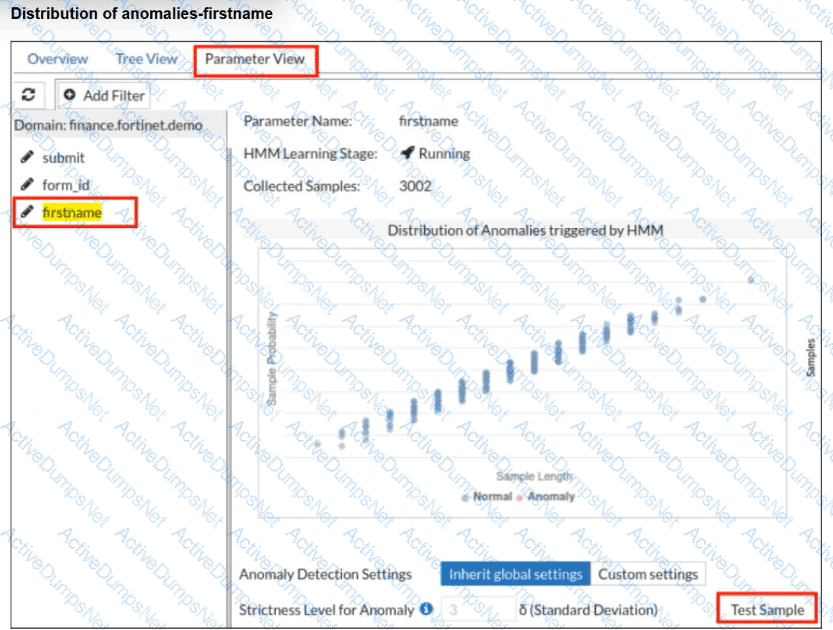
You have configured parameter validation, file security, and machine learning (ML) anomaly detection for a web form, but some server-side request forgery tests are still succeeding. You need to advise the team on what to prioritize next to improve SSRF protection without compromising other parts of the application.

Which recommendation would best strengthen FortiWeb’s ability to block remaining SSRF attempts?

Options:

A.

Disable ML anomaly detection and rely solely on parameter inspection.

B.

Review and refine input validation logic, as SSRF may be exploiting backend behavior or bypassing weak filters.

C.

Offload all server-side request forgery (SSRF) protection to FortiGate and remove FortiWeb from the API flow.

D.

Apply HTTPS inspection at the transport layer, which FortiWeb does not use to block SSRF.

Question 7

A large enterprise has an existing web infrastructure with complex routing rules and static IP address assignments. The network administrators cannot modify the current IP address scheme, but they need FortiWeb to inspect and block threats like SQL injection and cross-site scripting (XSS) without changing the client-server communication flow.

In this situation, which FortiWeb operation mode is the most suitable?

Options:

A.

Reverse proxy mode

B.

Web Cache Communication Protocol (WCCP) redirection mode

C.

True transparent proxy mode

D.

Decryption mirror mode

Question 8

A FortiWeb administrator is hardening a customer checkout website.

The site contains sensitive links such as Login, Payment, and Admin, which are embedded in the HTML content of several pages.

A vulnerability scan shows that automated bots can crawl the web pages and easily enumerate these links by parsing the HTML source, even though users access them normally, through the site navigation.

Which FortiWeb feature should the administrator enable to prevent automated scanners from discovering these links?

Options:

A.

Link cloaking

B.

URL rewriting

C.

URL encryption

D.

Deep packet inspection

Question 9

A FortiWeb administrator is reviewing issues found during a security audit. The audit lists shortcomings based on behavior, configuration, and data protection.

The administrator must break down the findings and match them with the correct FortiWeb feature.

Select each FortiWeb feature in the left column, hold and drag it to the blank space next to the OWASP issue in the column on the right. Once you match a FortiWeb

feature to the OWASP issue, you can move it again if you want to change your answer by clicking on the FortiWeb feature. You need to match five FortiWeb features to

the OWASP issue in the work area.

Question # 9

Options:

Question 10

You are setting up a FortiWeb policy to protect a customer login portal. Users connect to https://login.training.lab, and you want FortiWeb to forward those requests to a load-balanced pool of back-end servers.

Which three components must you configure to complete the server policy?

Options:

A.

Virtual server, server pool, and port settings (service).

B.

Web application firewall (WAF) profile, DoS policy, and server name indication (SNI)-based certificate.

C.

DNS resolver, URL rewrite rule, and HTTP health check.

D.

Real server, IPsec tunnel, and static route.