Weekend Special - 75% Discount Offer - Ends in 0d 00h 00m 00s - Coupon code: discactive

Fortinet NSE5_FSW_AD-7.6 Fortinet NSE 5 - FortiSwitch 7.6 Administrator Exam Practice Test

Fortinet NSE 5 - FortiSwitch 7.6 Administrator Questions and Answers

Question 1

Which statement about using MAC, IP, and protocol-based VLANs on FortiSwitch is true?

Options:

A.

lt is a scalable and secure solution in comparison to other Layer 2 security measures.

B.

FortiSwitch uses only the Ethernet type to assign traffic to VLANs.

C.

It provides benefits that can be obtained when using 802.1X authentication.

D.

Endpoints are required to use the same FortiSwitch port to remain members of the VLAN.

Question 2

Which two types of Layer 3 interfaces can participate in dynamic routing on FortiSwitch? (Choose two.)

Options:

A.

Detected management interfaces

B.

Loopback interfaces

C.

Switch virtual interfaces

D.

Physical interfaces

Question 3

Which statement about 802.1X security profiles using MAC-based authentication mode is true?

Options:

A.

FortiSwitch allows connectivity to all hosts connected to a port, if one host is authenticated.

B.

FortiSwitch can grant each device a different access level based on the credentials provided

C.

FortiSwitch performs faster when using this security mode on the ports.

D.

FortiSwitch must communicate with the RADIUS server to authenticate devices

Question 4

Which two statements about DHCP snooping enabled on a FortiSwitch VLAN are true? (Choose two.)

Options:

A.

Enabling DHCP snooping on a FortiSwitch VLAN ensures requests and replies are seen by all DHCP servers.

B.

switch-controller-dhcp-snooping-verify-mac verifies the destination MAC address to protect against DHCP exhaustion attacks.

C.

By default, all FortiSwitch ports are set to forward client DHCP requests to untrusted ports.

D.

Settings related to DHCP option 82 are only configurable through the CLI

Question 5

Which two are valid traffic processing actions that a FortiSwitch access control list (ACL) can apply to matching traffic? (Choose two answers)

Options:

A.

Redirect frames to another port.

B.

Assign traffic to a high-priority egress queue.

C.

Encrypt frames.

D.

Drop frames.

Question 6

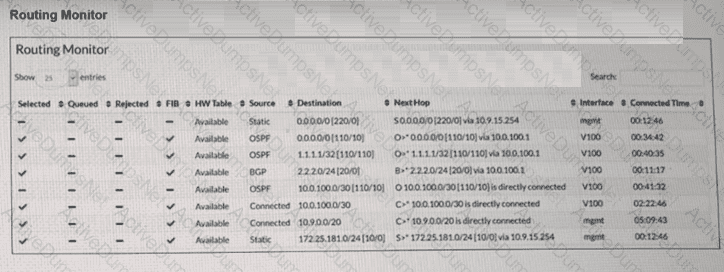
Refer to the exhibit.

Question # 6

Two routes in the routing monitor are marked as available but are not installed in the forwarding information base (FIB). Which statement correctly explains why the routes have this status? (Choose one answer)

Options:

A.

They are excluded from the FIB because a more preferred route exists for the same destination.

B.

They are unavailable due to invalid next-hop addresses.

C.

They are not included in the FIB due to route-policy filtering.

D.

They are installed in the FIB but cannot be offloaded to hardware.

Question 7

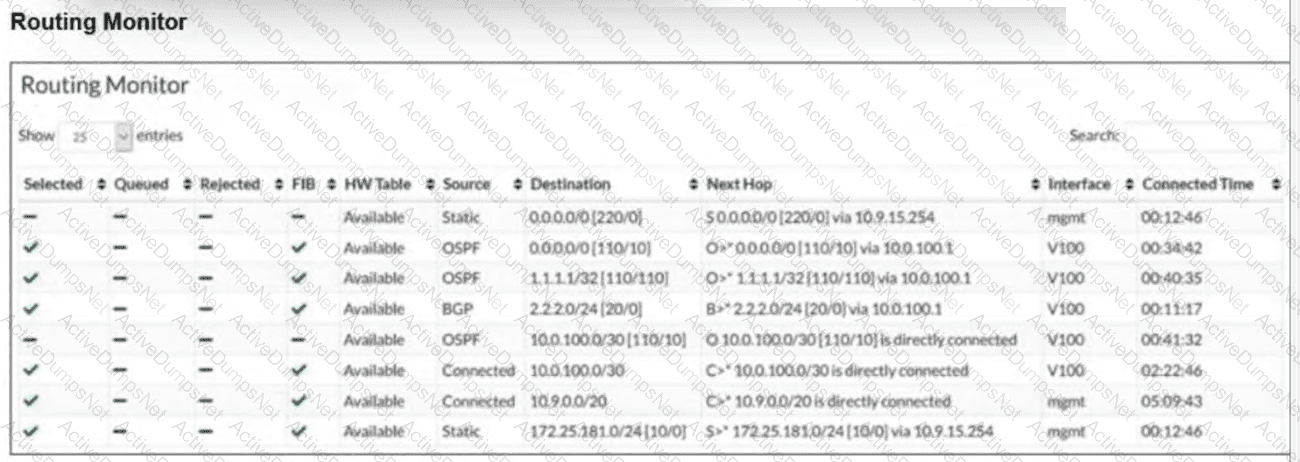
Refer to the exhibit.

Question # 7

and an OSPF route with destination 0.0.0.0/0 [110/10]. The OSPF route is marked with a checkmark in the FIB column, while the Static route has a dash.]

The routing monitor displays multiple route entries, but only some are installed in the forwarding information base (FIB). After analyzing the two route entries with the destination 0.0.0.0/0, which statement correctly describe why one of these routes is not installed in the FIB? (Choose one answer)

Options:

A.

The OSPF route has a higher metric, making it less preferred than the static route.

B.

The interface V100 for the OSPF route is down, preventing its installation.

C.

The OSPF route with a lower administrative distance is preferred over the static route.

D.

The two routes have identical destination prefixes, causing a conflict where only one is selected.

Question 8

Refer to the exhibit.

Question # 8

You have just authorized a new FortiSwitch on your FortiGate, and it appears online in the GUI. To verify that FortiLink connectivity is healthy, what should you check next? (Choose one answer)

Options:

A.

Check that the switch automatically disables all unused ports.

B.

Look for FortiLink heartbeat messages sent from FortiSwitch to FortiGate every few seconds and confirm FortiGate acknowledges them.

C.

Verify that FortiGate has pushed a new firmware image to FortiSwitch immediately.

D.

Ensure the FortiSwitch is automatically sending log events to FortiAnalyzer.

Question 9

When Dynamic Host Configuration Protocol (DHCP) snooping is enabled on a FortiSwitch VLAN, which two statements are true? (Choose two answers)

Options:

A.

DHCP replies are accepted only on trusted ports.

B.

DHCP snooping blocks all unicast traffic.

C.

Option 82 can be inserted into DHCP requests.

D.

DHCP requests are dropped if sent from trusted ports.

Question 10

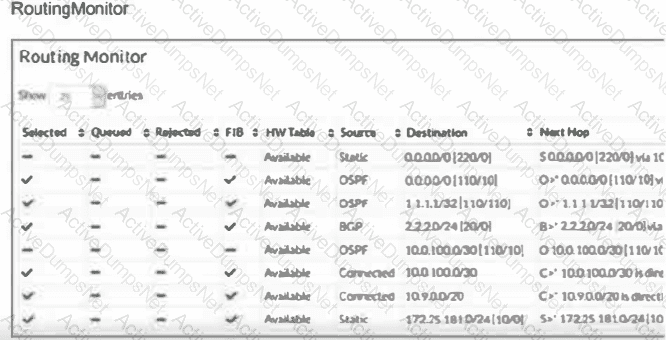
Exhibit.

Question # 10

Two routes are not installed in the forwarding information base (FIB) as shown in the exnibit. Which two statements about these two route entries are true? (Choose two.)

Options:

A.

These two routes have a higher administrative distance value available to the destination networks.

B.

These two routes will become primary, if the best routes are removed.

C.

These two routes will be used as load-balancing routes.

D.

These two routes are available in the hardware routing table.

Question 11

Which two rules used by MSTP are similar to rules used by other STP methods? (Choose two.)

Options:

A.

MSTP uses port role election, similar to rapid STP on the instances.

B.

MSTP uses alternate path and primary path, similar to regular STP.

C.

MSTP uses root bridge selection, similar to rapid STP

D.

MSTP uses timers for transitioning the ports, similar to regular STP.

Question 12

Refer to the exhibit.

Question # 12

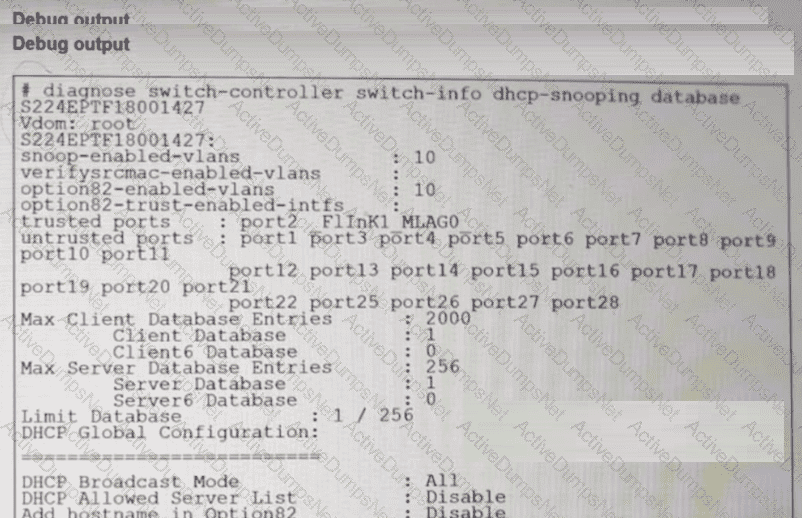
After reviewing the CLI command output, which two conclusions can you make about the Dynamic Host Configuration Protocol (DHCP) snooping configuration? (Choose two answers)

Options:

A.

DHCP snooping is disabled globally.

B.

All ports are untrusted, except port2.

C.

Option 82 is enabled on VLAN 10.

D.

DHCP broadcasts are not restricted.

Question 13

Refer to the exhibit.

Question # 13

The exhibit shows the current status of the ports on the managed FortiSwitch. Access-1.

Why would FortiGate display a serial number in the Native VLAN column associated with the port23 entry?

Options:

A.

port23 is configured as the dedicated management interface.

B.

Ports connected to adjacent FortiSwitch devices show their serial number as the native VLAN.

C.

port23 is a member of a trunk that uses the Access-1 FortiSwitch serial number as the name of the trunk.

D.

A standalone switch with the shown serial number is connected on port23.

Question 14

You are configuring FortiSwitch to perform layer 3 inter-VLAN routing while managed by FortiGate over FortiLink. On supported hardware models, FortiSwitch can offload routing decisions for better performance.1How does FortiSwitch perform routing between VLANs? (Choose one answer)

Options:

A.

By using a hardware forwarding table (FIB) programmed into ASIC.

B.

By supporting only dynamic routing protocols in hardware.

C.

By disabling routing when managed by FortiGate.

D.

By relying entirely on the CPU in software.

Question 15

(Full question statement start from here)

How does enabling an IGMP snooping proxy on FortiSwitch help reduce the number of IGMP reports processed by the IGMP querier? (Choose one answer)

Options:

A.

By converting IGMP reports into broadcast packets to reach all VLAN members

B.

By converting IGMP traffic to unicast

C.

By suppressing duplicate IGMP reports within the VLAN

D.

By forwarding IGMP reports only when the first member joins and the last member leaves

Question 16

Which LLDP-MED Type-Length-Values does FortiSwitch collect from endpoints to track network devices and determine their characteristics?

Options:

A.

Network policy

B.

Power management

C.

Location

D.

Inventory management

Question 17

What can an administrator do to maintain a FortiGate-compatible FortiSwitch configuration when changing the management mode from standalone to FortiLinK?

Options:

A.

Use a migration tool based on Python script to convert the configuration.

B.

Enable the FortiLink setting on FortiSwitch before the authorization process.

C.

FortiGate automatically saves the existing FortiSwitch configuration during the FortiLink management process.

D.

Register FortiSwitch to FortiSwitch Cloud to save a copy before managing with FortiGate.

Question 18

What is the role of a device that is simultaneously functioning as both the distribution and core in the hierarchy network model?

Options:

A.

POE with high density FortiSwitch

B.

FortiGate managing FortiSwitch

C.

FortiSwitch functioning as standalone

D.

HA backup FortiGate managing FortiSwitch

Question 19

(Full question statement start from here)

How does FortiSwitch determine the route for traffic traversing its interfaces? (Choose one answer)

Options:

A.

Hardware-based routing on FortiSwitch is handled by the CPU.

B.

ASIC hardware routing can handle only dynamic routing, if supported.

C.

FortiSwitch looks up the hardware routing table and then the forwarding information base (FIB).

D.

FortiSwitch forwards all traffic to FortiGate for routing decisions.

Question 20

Refer to the diagnostic output:

Question # 20

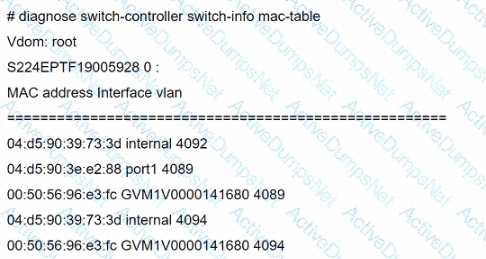
Two entries in the exhibit show that the same MAC address has been used in two different VLANs. Which MAC address is shown in the above output?

Options:

A.

It is a MAC address of FortiLink interface on FortiGate.

B.

It is a MAC address of a switch that accepts multiple VLANs.

C.

It is a MAC address of an upstream FortiSwitch.

D.

It is a MAC address of FortiGate in HA configuration.

Question 21

Refer to the exhibit.

Question # 21

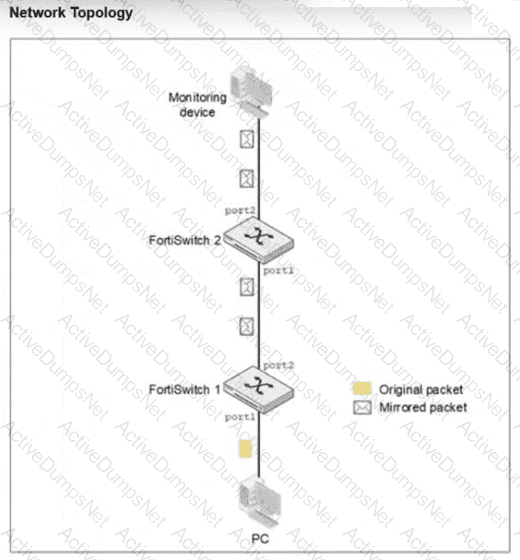
You configured Switched Port Analyzer (SPAN) to monitor traffic from a source port on FortiSwitch 1, but the monitoring device is connected to FortiSwitch 2. After port mirroring configuration on FortiSwitch 1, the monitoring device is not receiving any mirrored traffic.

What is the most likely reason the mirrored traffic is not reaching the monitoring device? (Choose one answer)

Options:

A.

SPAN does not support forwarding mirrored traffic across multiple switches.

B.

SPAN traffic must be filtered with an access control list (ACL).

C.

The SPAN session must be restarted after configuration.

D.

The monitoring device must use a management IP in the same subnet.

Question 22

Refer to the exhibits.

Question # 22

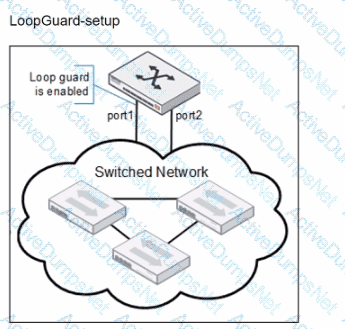
Port1 and port2 are the only ports configured with the same native VLAN 10.

What are two reasons that can trigger port1 to shut down? (Choose two.)

Options:

A.

port1 was shut down by loop guard protection.

B.

STP triggered a loop and applied loop guard protection on port1.

C.

An endpoint sent a BPDU on port1 that it received from another interface.

D.

Loop guard frame sourced from port 1 was received on port 1.

Question 23

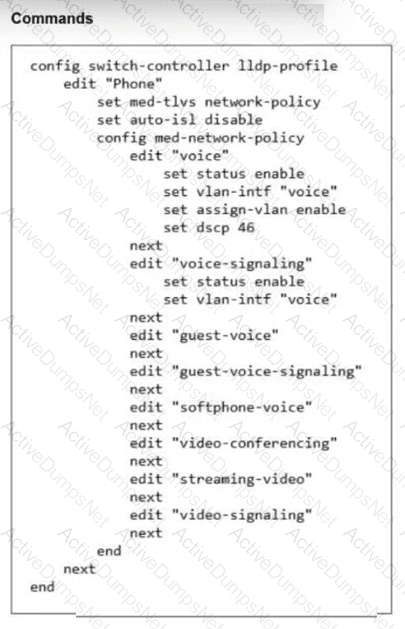
Refer to the exhibit.

Question # 23

The LLDP profile shown in the exhibit was configured to detect IP phones and automatically assign them to the appropriate VLAN. You apply this LLDP profile on a FortiSwitch port. Which configuration should you enable on the FortiSwitch profile to collect detailed information about all the connected IP phones? (Choose one answer)

Options:

A.

Create a new LLDP profile to handle different LLDP-MED TLVs.

B.

Configure a dedicated voice VLAN with DSCP 46.

C.

Enable LLDP-MED inventory management TLVs.

D.

Enable auto-isl.

Question 24

Which Ethernet frame can create Layer 2 flooding due to all bytes on the destination MAC address being set to all FF?

Options:

A.

The broadcast Ethernet frame

B.

The unicast Ethernet frame

C.

The multicast Ethernet frame

D.

The anycast Ethernet frame

Question 25

What are two reasons why time synchronization between FortiGate and its managed FortiSwitch is critical in switch management? (Choose two.)

Options:

A.

FortiSwitch does not retain its time after a reboot, which gets reset after each reboot.

B.

FortiSwitch will not be able to become an NTP server for downstream devices.

C.

FortiSwitch cannot complete the DTLS handshake used in the CAPWAP tunnel.

D.

FortiSwitch will not allow other FortiSwitch devices in the chain be discovered by FortiGate.

Question 26

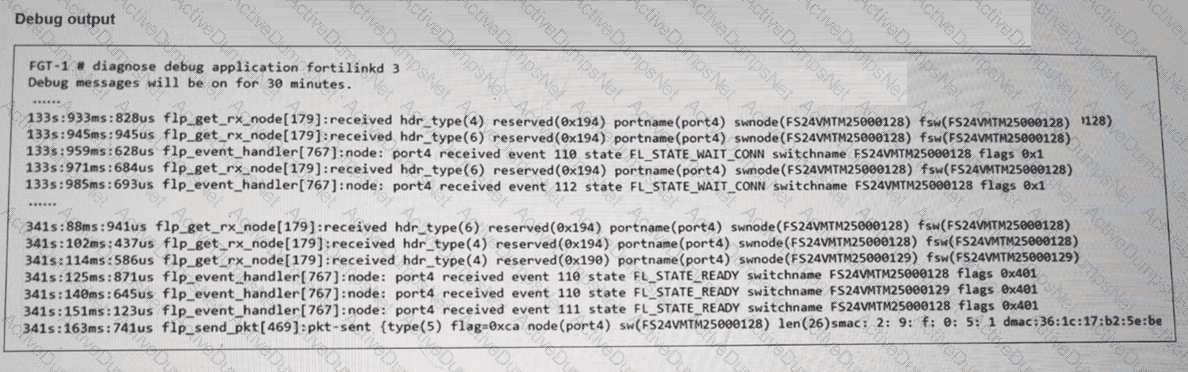
FortiGate is unable to establish a tunnel with the FortiSwitch device it is supposed to manage Based on the debug output shown in the exhibit, what is the reason for the failure?

Options:

A.

The handshake process timed out before FortiSwitch responded.

B.

DTLS client hello had the incorrect pre-shared key.

C.

The CAPWAP tunnel failed to come up due to a mismatch in time.

D.

FortiSwitch has disabled FortiLink and is only managed as a standalone.

Question 27

Exhibit.

port24 is the only uplink port connected to the network where access to FortiSwitch management services is possible. However, FortiSwitch is still not accessible on the management interface. Which two actions should you take to fix the issue and access FortiSwitch? (Choose two.)

Options:

A.

You must add port24 native VLAN as an allowed VLAN on internal.

B.

You must add VLAN ID 200 to the allowed VLANS on internal.

C.

You must allow VLAN ID 4094 on port24, if management traffic is tagged.

D.

You should use VLAN ID 4094 as the native VLAN on port24.

Question 28

(Full question statement start from here)

Refer to the exhibit.
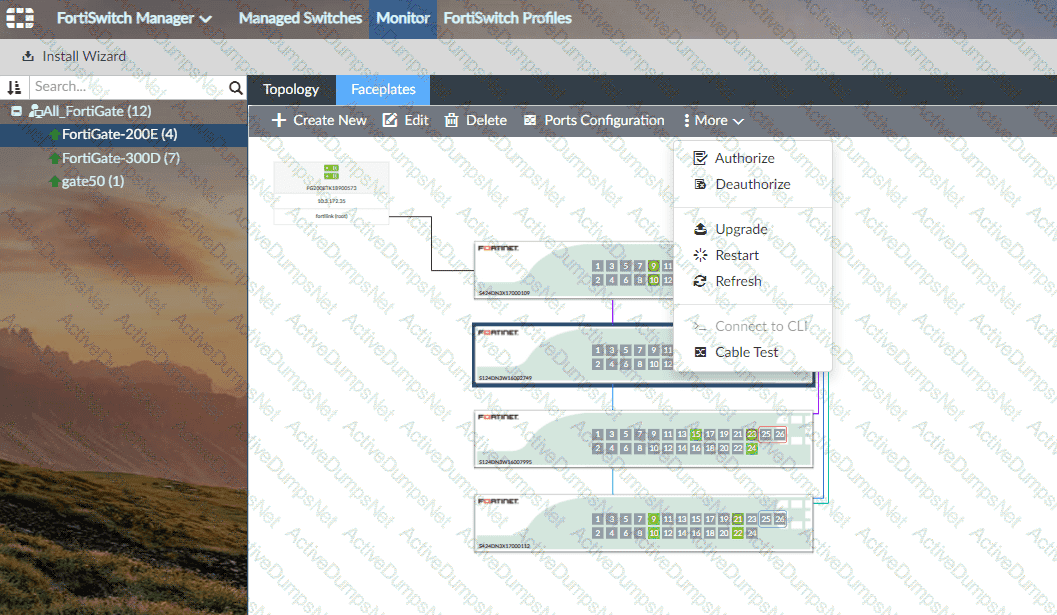
Question # 28

Question # 28

Question # 28

Which information does FortiGate use to generate the port details in the FortiSwitch Faceplates view? (Choose one answer)

Options:

A.

The FortiSwitch model

B.

The Cisco Discovery Protocol (CDP) advertisements from FortiSwitch

C.

The LLDP advertisements received from the FortiSwitch

D.

The FortiLink discovery frames sent by FortiSwitch

Question 29

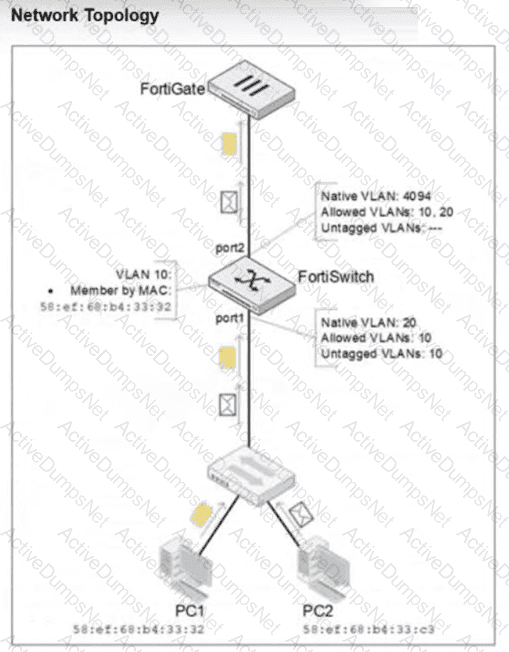
Refer to the exhibit.

Question # 29

PC1 and PC2 are connected to port1 on FortiSwitch. Which VLAN tags will FortiSwitch apply when forwarding PC1 and PC2 traffic out of port2? (Choose one answer)

Options:

A.

FortiSwitch will tag PC1 and PC2 frames with VLAN 20.

B.

FortiSwitch will tag both PC1 and PC2 frames with VLAN 10, due to MAC override.

C.

FortiSwitch will tag PC1 frames with VLAN 10 and PC2 frames with VLAN 20.

D.

FortiSwitch will leave PC1 frames untagged and will tag PC2 frames with VLAN 10.

Question 30

How are the ' by VLAN redirect MAC address quarantine ' mode and the ' by redirect MAC address quarantine ' mode on FortiGate similar?

Options:

A.

Both modes move quarantined devices to the quarantine VLAN.

B.

Both modes require firewall policies to block inter-VLAN traffic.

C.

Both modes add quarantined device MAC addresses to the blocked firewall address group.

D.

Both modes block intra-VLAN traffic by FortiGate automatically.

Question 31

Exhibit.

port1 and port2 are the only ports configured with the same native VLAN 10.

What are two reasons that can trigger port1 to shut down? (Choose two.)

Options:

A.

port1 was shut down by loop guard protection.

B.

STP triggered a loop and applied loop guard protection on port1.

C.

An endpoint sent a BPDU on port1 that it received from another interface.

D.

Loop guard frame sourced from port1 was received on port1.

Question 32

You are deploying a small office network with a single FortiGate and a single FortiSwitch. The office currently has moderate traffic, but the IT team expects the network to grow in the near future, adding more FortiSwitch devices and endpoints. Which FortiLink configuration should you deploy to provide the best combination of current performance and scalability for future growth? (Choose one answer)

Options:

A.

Configure FortiLink using hardware-based switch interfaces.1

B.

Configure FortiLink using software-based switch interfaces.

C.

Configure FortiLink as a link aggregation group (LAG) interface.

D.

Configure FortiLink as a multichassis LAG (MCLAG) interface.2

Question 33

Refer to the exhibit.

What two conclusions can be made regarding DHCP snooping configuration? (Choose two.)

Options:

A.

Maximum value to accept clients DHCP request is configured as per DHCP server range.

B.

FortiSwitch is configured to trust DHCP replies coming on FortiLink interface.

C.

DHCP clients that are trusted by DHCP snooping configured is only one.

D.

Global configuration for DHCP snooping is set to forward DHCP client requests on all ports in the VLAN.

Question 34

You are managing FortiSwitch ports from a FortiGate device with multiple VDOMs. Which two methods can you use to assign FortiSwitch ports to VDOMs? (Choose two answers)
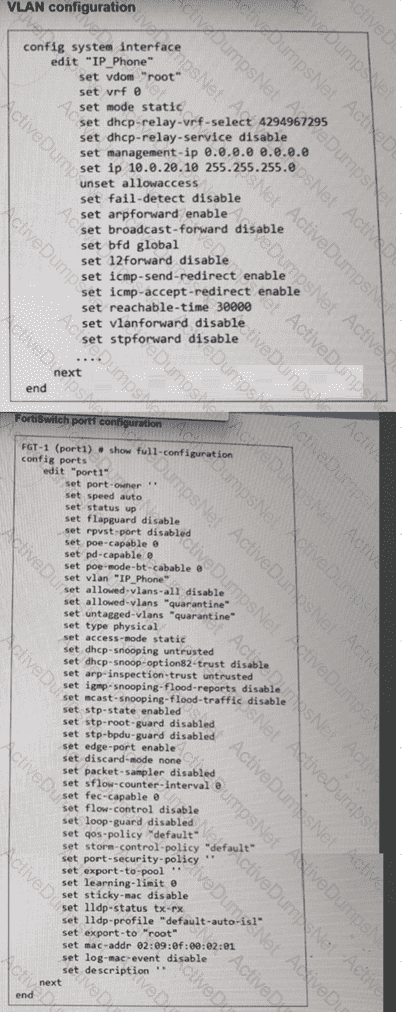
Options:

A.

Assigning the port directly to a specific VDOM for dedicated physical isolation

B.

Use FortiGate policies to control inter-VDOM traffic for FortiSwitch ports

C.

Use interface role mapping to dynamically assign FortiSwitch ports to VDOMs based on Dynamic Host Configuration Protocol (DHCP) scope

D.

Using a virtual port pool (VPP) to create virtualized ports that can be assigned to different VDOMs