
F5 F5CAB3 BIG-IP Administration Data Plane Configuration (F5CAB3) exam Exam Practice Test
BIG-IP Administration Data Plane Configuration (F5CAB3) exam Questions and Answers
A virtual server is configured to offload SSL from a pool of backend servers. When users connect to the virtual server, they successfully establish an SSL connection but no content is displayed. A packet trace performed on the server shows that the server receives and responds to the request. What should a BIG-IP Administrator do to resolve the problem? (Choose one answer)
Refer to the exhibit.
A BIG-IP Administrator needs to configure health monitors for a newly configured server pool named Pool_B. Which health monitor settings will ensure that all pool members will be accurately marked as available or unavailable?
During high-demand traffic events, the BIG-IP Administrator needs to limit new connections per second.
What should be applied?
A Standard Virtual Server for a web application is configured with Automap for the Source Address Translation option. The original source address of the client must be known by the backend servers. What should the BIG-IP Administrator configure to meet this requirement?
The BIG-IP Administrator needs to load balance a pool of web servers. Load balancing should consider the number of connections that are active on that pool member.
Which load balancing method meets this requirement? (Choose one answer)
An organization is reporting slow performance accessing their Intranet website. All employees use a single Proxy Server with a public IP.
What should the BIG-IP Administrator do to fix this issue?
During a high-demand event, the BIG-IP Administrator needs to limit the number of new connections per second to a Virtual Server.
What should be applied?
DNS queries from internal DNS servers fail when sent through a BIG-IP Virtual Server.
Which Virtual Server property should be changed?
All pool members are online. All other virtual server settings are at default.
What might alter the load balancing behavior? (Choose one answer)
The BIG-IP Administrator has to provide encrypted communication between the users and the virtual server they access. Multiple hostnames are configured in DNS with the same IP address. Which profile type and setting in the profile should be used? (Choose one answer)
In a pool there are 2 pool members out of the 5 members that are older servers. The number of connections these can handle is less than the other 3 pool members. Which load balancing method would allow more traffic to be directed to the newer servers? (Choose one answer)
To increase available bandwidth of an existing Trunk, the BIG-IP Administrator is adding additional interfaces. Which command should the BIG-IP Administrator run from within the bash shell?
A Standard Virtual Server for a web application is configured with Automap for Source Address Translation. The original client IP must be known by backend servers.
What should the BIG-IP Administrator configure?
A BIG-IP Administrator adds new pool members to a highly utilized pool. The application begins failing.
What pool-level setting should be checked?
Which type of Virtual Server requires the use of a FastL4 profile?
Refer to the exhibit.
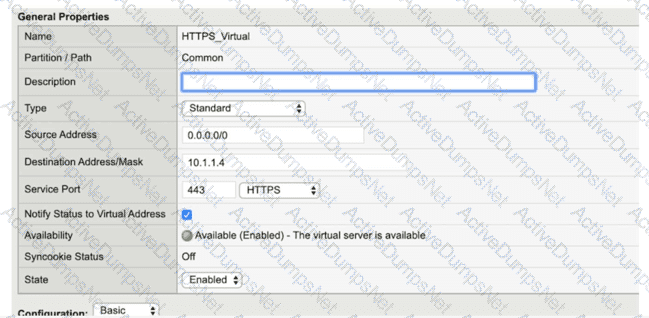
A BIG-IP Administrator configures a Virtual Server to handle HTTPS traffic. Users report that the application is NOT working. Which additional configuration is required to resolve this issue?
A BIG-IP Administrator adds new pool members into a highly utilized pool. Users report application failures.
Which pool-level setting should be checked?
A Standard Virtual Server for a web application is configured with SNAT Automap. The original client IP must be known by backend servers.
What should the BIG-IP Administrator configure?
Refer to the exhibit.
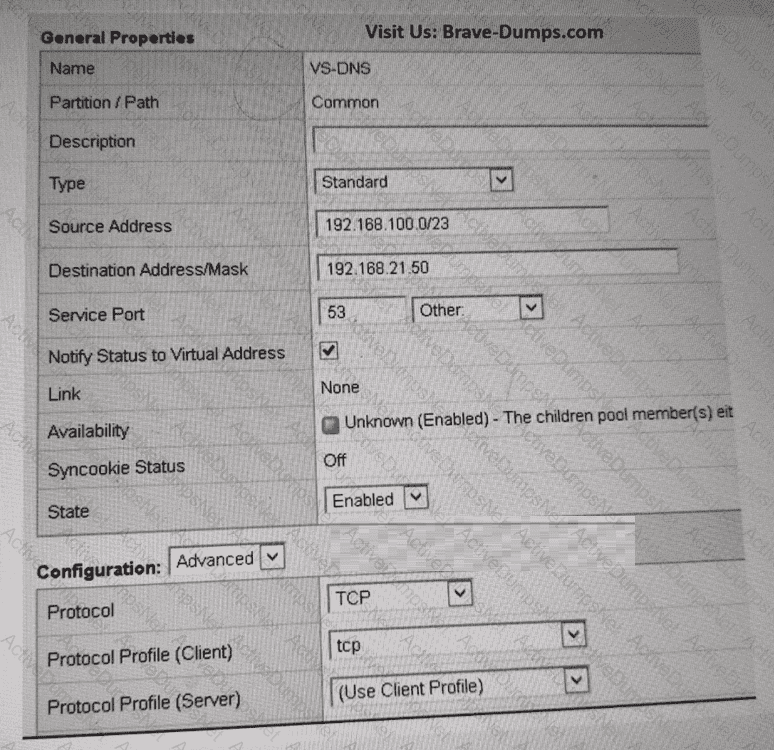
DNS queries from two internal DNS servers are being load-balanced to external DNS servers via a virtual server on a BIG-IP device. The DNS queries originate from:
192.168.10.100
192.168.10.200
and target:
192.168.2.150
All DNS queries destined for the external DNS servers fail.
Which property change should the BIG-IP Administrator make in the Virtual Server to resolve this issue? (Choose one answer)
The BIG-IP Administrator has to provide encrypted communication between the users and the virtual server they access. Multiple hostnames are configured in DNS with the same IP address. Which profile type and setting in the profile should be used?
A set of servers is used for an FTP application as well as an HTTP website via separate BIG-IP Pools. The server support team reports that some servers are receiving a lot more traffic than others. Which Load Balancing Method should the BIG-IP Administrator apply to even out the connection count?
In a pool there are 2 pool members out of the 5 members that are older servers. The number of connections these can handle is less than the other 3 pool members. Which load balancing method would allow more traffic to be directed to the newer servers?
A BIG-IP Administrator needs to apply persistence to a virtual server that is configured as a Performance (Layer 4) virtual server that allows access to a secure (TLS) e-commerce website.
What type of persistence profile can be used? (Choose one answer)
A virtual server is configured to offload SSL from a pool of backend servers. When users connect to the virtual server, they successfully establish an SSL connection but no content is displayed. A packet trace performed on the server shows that the server receives and responds to the request. What should a BIG-IP Administrator do to resolve the problem?