New Year Sale Limited Time Flat 70% Discount offer - Ends in 0d 00h 00m 00s - Coupon code: 70spcl

F5 F5CAB1 BIG-IP Administration Install, Initial Configuration, and Upgrade Exam Practice Test

Page: 1 / 5
Total 46 questions

BIG-IP Administration Install, Initial Configuration, and Upgrade Questions and Answers

Question 1

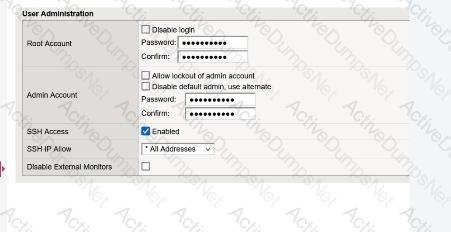
For security reasons, a BIG-IP Administrator needs to specify allowable IP ranges for access to the Configuration Utility (WebUI).

The exhibit shows the User Administration section of the Configuration Utility.
Question # 1

The administrator could not find any setting that explicitly restricts access to the Configuration Utility.

Which one of the following is a reason for that?

Options:

A.

Restricting access to the Configuration Utility can only be done from the Command Line Interface

B.

The administrator must restrict access by IP address for SSH, which will implicitly restrict access to the Configuration Utility

C.

To avoid locking out the administrator, recent versions of BIG-IP no longer allow restricting administrator access to the Configuration Utility by source IP address

D.

The administrator needs to switch to the “Advanced” view mode in order to display the relevant setting

Question 2

Which port is an exception to the Port Lockdown function of Self-IPs if a device-group synchronization cluster is configured?

Options:

A.

TCP 443

B.

TCP 4353

C.

UDP 53

Question 3

An F5 BIG-IP Administrator is asked to report which modules areprovisionedon the BIG-IP.

In which two ways can this be done?

(Choose two.)

Options:

A.

Via the GUI atSystem → Resource Provisioning → Module Allocation

B.

Via TMSH withshow /sys provision

C.

Via the GUI atStatistics → Module Statistics → System

D.

Via TMSH withlist /sys provision

Question 4

When logged into thebash shellof a BIG-IP system, which of the following commands will display themanagement-ip address?

(Choose two.)

Options:

A.

tmsh list /sys management-ip

B.

show mgmt ip

C.

ifconfig mgmt

D.

list / sys management-ip

Question 5

The Configuration Utility of a BIG-IP device is currently accessible via its management IP10.53.1.245from all VLANs.

The BIG-IP Administrator needs to restrict access so only hosts from the10.0.0.0/24subnet can access the Configuration Utility.

Which TMSH command accomplishes this?

Options:

A.

(tmos)# create /net acl MGMT.HTTP rule add { (permit tcp 10.0.0.0 0.0.0.255 host 10.53.1.245 http) }

B.

(tmos)# modify /ltm httpd allow replace-all-with {10.0.0.0/24}

C.

(tmos)# create /net acl MGMT.HTTP rule add { (permit tcp 10.0.0.0/24 10.53.1.245 http) (deny ip any any http) }

D.

(tmos)# modify /sys httpd allow replace-all-with {10.0.0.0/24}

Question 6

The device is currently onv15.1.2.1.

The BIG-IP Administrator needs to boot the device back tov13.1.0.6to gather data for troubleshooting.

The system shows:

Sys::Software Status

Volume Product Version Build Active Status Allowed

HD1.1 BIG-IP 15.1.2.1 0.0.10 yes complete yes

HD1.2 BIG-IP 13.1.0.6 0.0.3 no complete yes

Which is the correct command-line sequence to boot the device to version13.1.0.6?

Options:

A.

Use tmsh to select a new boot volume, tmsh reboot HD1.2

B.

switchboot -b HD1.2, then reboot

C.

switchboot -I HD1.2, then reboot

D.

Use tmsh to select a new boot volume, tmsh switchboot HD1.2

Question 7

What are the two options for securing a BIG-IP’s management interface?

(Choose two.)

Options:

A.

Limiting network access through the management interface to a trusted/secured network VLAN.

B.

Block all management-interface administrative HTTPS and SSH service ports to prevent access.

C.

Use the BIG-IP’s Self-IP addresses for administrative access rather than the management interface.

D.

Restrict administrative HTTPS and SSH access to specific IP addresses or IP ranges.

Question 8

The BIG-IP Administrator received a ticket that an authorized user is attempting to connect to the Configuration Utility from a jump host and is being denied.

The HTTPD allow list is configured as:

sys httpd {

allow { 172.28.31.0/255.255.255.0 172.28.65.0/255.255.255.0 }

}

The jump host IP is172.28.32.22.

What command should the BIG-IP Administrator use to allow HTTPD access for this jump host?

Options:

A.

modify /sys httpd allow replace-all-with { 172.28.32.22 }

B.

modify /sys httpd allow delete { 172.28.31.0/255.255.255.0 172.28.65.0/255.255.255.0 }

C.

modify /sys httpd allow add { 172.28.32.22 }

Question 9

A new logging solution is being implemented on the network. Policy requires keeping management traffic sent from the BIG-IPout of the management interface. After configuring the BIG-IP to forward messages to the new Syslog server, the BIG-IP Administrator notices that packets are being sentfrom a numbered data-plane Self IP.

What should the BIG-IP Administrator change to send the traffic out of thecorrect interface?

Options:

A.

Set the Management IP as the source address when configuring a Remote Syslog destination.

B.

Create a Management Route for the specific address/subnet of the syslog service via TMSH.

C.

Create a new Self IP in the same subnet as the management IP address using a route domain.

D.

Modify the port lockdown settings on the Self IP address to allow UDP port 514 traffic.

Question 10

The BIG-IP Administrator needs to update access to the Configuration Utility to include the172.28.31.0/24and172.28.65.0/24networks.

From the TMOS Shell (tmsh), which command should the BIG-IP Administrator use to complete this task?

Options:

A.

modify /sys httpd allow add { 172.28.31.0/255.255.255.0 172.28.65.0/255.255.255.0 }

B.

modify /sys httpd allow add { 172.28.31.0 172.28.65.0 }

C.

modify /sys httpd permit add { 172.28.31.0/255.255.255.0 172.28.65.0/255.255.255.0 }

Question 11

The BIG-IP Administrator uses Secure Copy Protocol (SCP) to upload a TMOS image to the/shared/images/directory in preparation for a TMOS upgrade.

After the upload is completed, what will the system dobeforethe image is shown in the GUI under:

System » Software Management » Image List?

Options:

A.

The system performs a reboot into a new partition

B.

The system verifies the internal checksum

C.

The system copies the image to /var/local/images/

Question 12

A BIG-IP Administrator upgrades the BIG-IP LTM to a newer software version. After the administrator reboots into the new volume, the configuration fails to load.

Why is the configuration failing to load?

Options:

A.

The upgrade was performed on the standby unit.

B.

The license needed to be reactivated before the upgrade.

C.

A minimum of at least two reboots is required.

D.

Connectivity to the DNS server failed to be established.

Question 13

For an upgrade of a standalone BIG-IP, a maintenance window is available in which brief interruptions are allowed.

Actions with no impact can be done outside the maintenance window.

When should a license reactivation be performed?

Options:

A.

During the maintenance window.

B.

Before the maintenance window.

C.

After the maintenance window.

Page: 1 / 5
Total 46 questions