
Databricks Databricks-Generative-AI-Engineer-Associate Databricks Certified Generative AI Engineer Associate Exam Practice Test
Total 90 questions
Databricks Certified Generative AI Engineer Associate Questions and Answers
A Generative AI Engineer at an automotive company would like to build a question-answering chatbot to help customers answer specific questions about their vehicles. They have:
A catalog with hundreds of thousands of cars manufactured since the 1960s
Historical searches with user queries and successful matches
Descriptions of their own cars in multiple languages
They have already selected an open-source LLM and created a test set of user queries. They need to discard techniques that will not help them build the chatbot. Which do they discard?
A Generative AI Engineer just deployed an LLM application at a digital marketing company that assists with answering customer service inquiries.
Which metric should they monitor for their customer service LLM application in production?
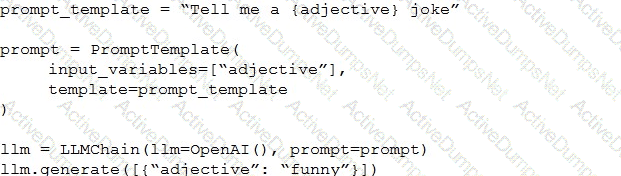
A Generative AI Engineer is testing a simple prompt template in LangChain using the code below, but is getting an error.
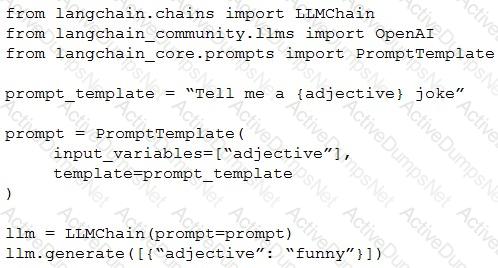
Assuming the API key was properly defined, what change does the Generative AI Engineer need to make to fix their chain?
A)
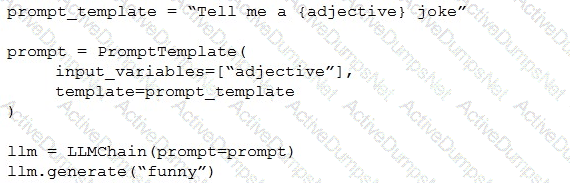
B)
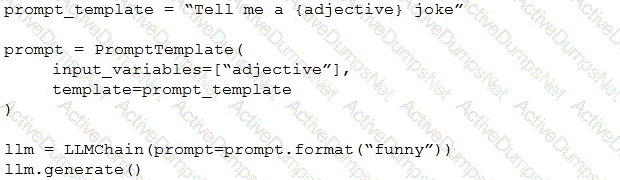
C)
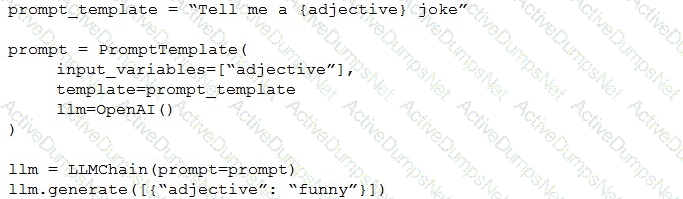
D)
A Generative AI Engineer is building a Generative AI system that suggests the best matched employee team member to newly scoped projects. The team member is selected from a very large team. The match should be based upon project date availability and how well their employee profile matches the project scope. Both the employee profile and project scope are unstructured text.
How should the Generative Al Engineer architect their system?
A Generative Al Engineer would like an LLM to generate formatted JSON from emails. This will require parsing and extracting the following information: order ID, date, and sender email. Here’s a sample email:
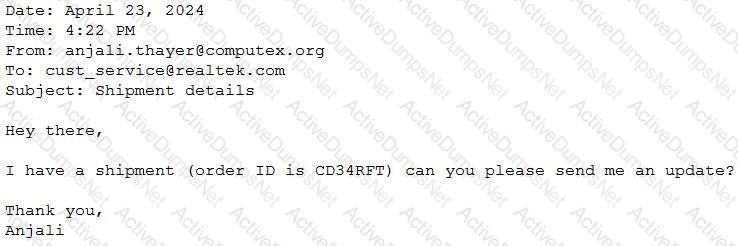
They will need to write a prompt that will extract the relevant information in JSON format with the highest level of output accuracy.
Which prompt will do that?
A Generative Al Engineer is working with a retail company that wants to enhance its customer experience by automatically handling common customer inquiries. They are working on an LLM-powered Al solution that should improve response times while maintaining a personalized interaction. They want to define the appropriate input and LLM task to do this.
Which input/output pair will do this?
A small and cost-conscious startup in the cancer research field wants to build a RAG application using Foundation Model APIs.
Which strategy would allow the startup to build a good-quality RAG application while being cost-conscious and able to cater to customer needs?
A Generative AI Engineer is developing a patient-facing healthcare-focused chatbot. If the patient’s question is not a medical emergency, the chatbot should solicit more information from the patient to pass to the doctor’s office and suggest a few relevant pre-approved medical articles for reading. If the patient’s question is urgent, direct the patient to calling their local emergency services.
Given the following user input:
“I have been experiencing severe headaches and dizziness for the past two days.”
Which response is most appropriate for the chatbot to generate?
Which TWO chain components are required for building a basic LLM-enabled chat application that includes conversational capabilities, knowledge retrieval, and contextual memory?
A Generative Al Engineer has developed an LLM application to answer questions about internal company policies. The Generative AI Engineer must ensure that the application doesn’t hallucinate or leak confidential data.
Which approach should NOT be used to mitigate hallucination or confidential data leakage?
A Generative Al Engineer is building a production-ready LLM system which replies directly to customers. The solution makes use of the Foundation Model API via provisioned throughput. They are concerned that the LLM could potentially respond in a toxic or otherwise unsafe way. They also wish to perform this with the least amount of effort.
Which approach will do this?
A Generative AI Engineer is deploying a customer-facing, fine-tuned LLM on their public website. Given the large investment the company put into fine-tuning this model, and the proprietary nature of the tuning data, they are concerned about model inversion attacks. Which of the following Databricks AI Security Framework (DASF) risk mitigation strategies are most relevant to this use case?
A Generative AI Engineer wants to build an LLM-based solution to help a restaurant improve its online customer experience with bookings by automatically handling common customer inquiries. The goal of the solution is to minimize escalations to human intervention and phone calls while maintaining a personalized interaction. To design the solution, the Generative AI Engineer needs to define the input data to the LLM and the task it should perform.
Which input/output pair will support their goal?
When developing an LLM application, it’s crucial to ensure that the data used for training the model complies with licensing requirements to avoid legal risks.
Which action is NOT appropriate to avoid legal risks?
An AI developer team wants to fine-tune an open-weight model to have exceptional performance on a code generation use case. They are trying to choose the best model to start with. They want to minimize model hosting costs and are using Hugging Face model cards and spaces to explore models. Which TWO model attributes and metrics should the team focus on to make their selection?
Which indicator should be considered to evaluate the safety of the LLM outputs when qualitatively assessing LLM responses for a translation use case?
A Generative Al Engineer is using an LLM to classify species of edible mushrooms based on text descriptions of certain features. The model is returning accurate responses in testing and the Generative Al Engineer is confident they have the correct list of possible labels, but the output frequently contains additional reasoning in the answer when the Generative Al Engineer only wants to return the label with no additional text.
Which action should they take to elicit the desired behavior from this LLM?
A Generative Al Engineer is creating an LLM system that will retrieve news articles from the year 1918 and related to a user ' s query and summarize them. The engineer has noticed that the summaries are generated well but often also include an explanation of how the summary was generated, which is undesirable.
Which change could the Generative Al Engineer perform to mitigate this issue?
A Generative AI Engineer is creating an agent-based LLM system for their favorite monster truck team. The system can answer text based questions about the monster truck team, lookup event dates via an API call, or query tables on the team’s latest standings.
How could the Generative AI Engineer best design these capabilities into their system?
A Generative Al Engineer has successfully ingested unstructured documents and chunked them by document sections. They would like to store the chunks in a Vector Search index. The current format of the dataframe has two columns: (i) original document file name (ii) an array of text chunks for each document.
What is the most performant way to store this dataframe?
A company selling gourmet mushroom-growing supplies has a script that runs once per day to scrape various social media platforms for posts that mention its name. The scraped text data is loaded into a Delta table each night for a downstream processing task that summarizes each post and its sentiment for internal use. Given the small size of the company, it only receives a couple hundred posts per day.
Which solution best optimizes for cost and ease of implementation?
A Generative AI Engineer is deploying a conversational agent that provides financial-analysis insights to internal analysts at a company. The company has standardized on Microsoft 365 for all internal communications and collaboration. The analysts are distributed across multiple time zones and primarily work within Microsoft Teams channels, where they already discuss financial data and share reports. The agent needs to integrate with the company’s existing Azure Active Directory for authentication and must respect the company’s data-governance policies. Users should be able to interact with the agent within their existing workflow without switching applications.
Which interface should the engineer implement for this agent deployment?
A Generative Al Engineer is tasked with developing an application that is based on an open source large language model (LLM). They need a foundation LLM with a large context window.
Which model fits this need?
A Generative AI Engineer has a provisioned throughput model serving endpoint as part of a RAG application and would like to monitor the serving endpoint’s incoming requests and outgoing responses. The current approach is to include a micro-service in between the endpoint and the user interface to write logs to a remote server.
Which Databricks feature should they use instead which will perform the same task?
A Generative Al Engineer is responsible for developing a chatbot to enable their company’s internal HelpDesk Call Center team to more quickly find related tickets and provide resolution. While creating the GenAI application work breakdown tasks for this project, they realize they need to start planning which data sources (either Unity Catalog volume or Delta table) they could choose for this application. They have collected several candidate data sources for consideration:
call_rep_history: a Delta table with primary keys representative_id, call_id. This table is maintained to calculate representatives’ call resolution from fields call_duration and call start_time.
transcript Volume: a Unity Catalog Volume of all recordings as a *.wav files, but also a text transcript as *.txt files.
call_cust_history: a Delta table with primary keys customer_id, cal1_id. This table is maintained to calculate how much internal customers use the HelpDesk to make sure that the charge back model is consistent with actual service use.
call_detail: a Delta table that includes a snapshot of all call details updated hourly. It includes root_cause and resolution fields, but those fields may be empty for calls that are still active.
maintenance_schedule – a Delta table that includes a listing of both HelpDesk application outages as well as planned upcoming maintenance downtimes.
They need sources that could add context to best identify ticket root cause and resolution.
Which TWO sources do that? (Choose two.)
A Generative AI Engineer developed an LLM application using the provisioned throughput Foundation Model API. Now that the application is ready to be deployed, they realize their volume of requests are not sufficiently high enough to create their own provisioned throughput endpoint. They want to choose a strategy that ensures the best cost-effectiveness for their application.
What strategy should the Generative AI Engineer use?
A Generative Al Engineer is creating an LLM-based application. The documents for its retriever have been chunked to a maximum of 512 tokens each. The Generative Al Engineer knows that cost and latency are more important than quality for this application. They have several context length levels to choose from.
Which will fulfill their need?
Total 90 questions