
Summer Sale Limited Time Flat 70% Discount offer - Ends in 0d 00h 00m 00s - Coupon code: 70spcl

Databricks Databricks-Certified-Data-Engineer-Associate Databricks Certified Data Engineer Associate Exam Exam Practice Test

Databricks Certified Data Engineer Associate Exam Questions and Answers

Question 1

Which of the following describes the relationship between Gold tables and Silver tables?

Options:

A.

Gold tables are more likely to contain aggregations than Silver tables.

B.

Gold tables are more likely to contain valuable data than Silver tables.

C.

Gold tables are more likely to contain a less refined view of data than Silver tables.

D.

Gold tables are more likely to contain more data than Silver tables.

E.

Gold tables are more likely to contain truthful data than Silver tables.

Question 2

A data engineer and data analyst are working together on a data pipeline. The data engineer is working on the raw, bronze, and silver layers of the pipeline using Python, and the data analyst is working on the gold layer of the pipeline using SQL. The raw source of the pipeline is a streaming input. They now want to migrate their pipeline to use Delta Live Tables.

Which of the following changes will need to be made to the pipeline when migrating to Delta Live Tables?

Options:

A.

None of these changes will need to be made

B.

The pipeline will need to stop using the medallion-based multi-hop architecture

C.

The pipeline will need to be written entirely in SQL

D.

The pipeline will need to use a batch source in place of a streaming source

E.

The pipeline will need to be written entirely in Python

Question 3

A data engineer has been using a Databricks SQL dashboard to monitor the cleanliness of the input data to an ELT job. The ELT job has its Databricks SQL query that returns the number of input records containing unexpected NULL values. The data engineer wants their entire team to be notified via a messaging webhook whenever this value reaches 100.

Which of the following approaches can the data engineer use to notify their entire team via a messaging webhook whenever the number of NULL values reaches 100?

Options:

A.

They can set up an Alert with a custom template.

B.

They can set up an Alert with a new email alert destination.

C.

They can set up an Alert with a new webhook alert destination.

D.

They can set up an Alert with one-time notifications.

E.

They can set up an Alert without notifications.

Question 4

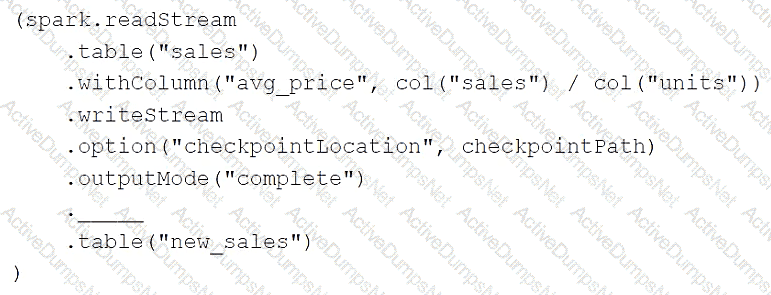
A data engineer has configured a Structured Streaming job to read from a table, manipulate the data, and then perform a streaming write into a new table.

The code block used by the data engineer is below:
Question # 4

If the data engineer only wants the query to process all of the available data in as many batches as required, which of the following lines of code should the data engineer use to fill in the blank?

Options:

A.

processingTime(1)

B.

trigger(availableNow=True)

C.

trigger(parallelBatch=True)

D.

trigger(processingTime= " once " )

E.

trigger(continuous= " once " )

Question 5

Identify the impact of ON VIOLATION DROP ROW and ON VIOLATION FAIL UPDATE for a constraint violation.

A data engineer has created an ETL pipeline using Delta Live table to manage their company travel reimbursement detail, they want to ensure that the if the location details has not been provided by the employee, the pipeline needs to be terminated.

How can the scenario be implemented?

Options:

A.

CONSTRAINT valid_location EXPECT (location = NULL)

B.

CONSTRAINT valid_location EXPECT (location != NULL) ON VIOLATION FAIL UPDATE

C.

CONSTRAINT valid_location EXPECT (location != NULL) ON DROP ROW

D.

CONSTRAINT valid_location EXPECT (location != NULL) ON VIOLATION FAIL

Question 6

Which Databricks SQL predicate correctly performs a null-safe equality comparison so that rows are matched when both sides are NULL or when both are equal non-NULL values?

Options:

A.

WHERE customer_id < = > :cid

B.

WHERE customer_id = :cid

C.

WHERE customer_id < > :cid OR customer_id IS NULL

D.

WHERE COALESCE(customer_id, ' ' ) = COALESCE(:cid, ' ' )

Question 7

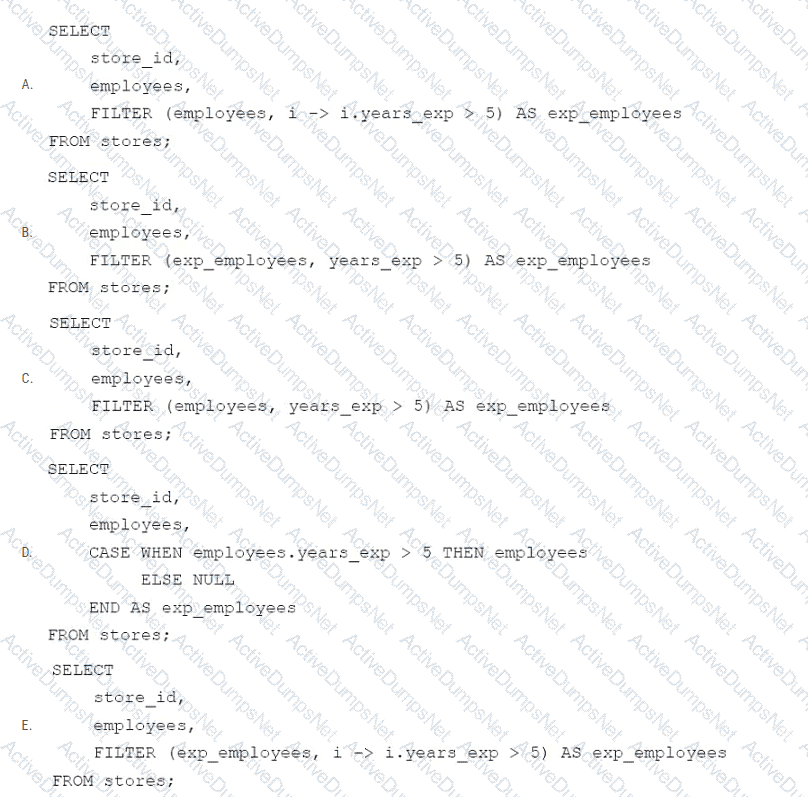
A data engineer needs to apply custom logic to identify employees with more than 5 years of experience in array column employees in table stores. The custom logic should create a new column exp_employees that is an array of all of the employees with more than 5 years of experience for each row. In order to apply this custom logic at scale, the data engineer wants to use the FILTER higher-order function.

Which of the following code blocks successfully completes this task?
Question # 7

Options:

A.

Option A

B.

Option B

C.

Option C

D.

Option D

E.

Option E

Question 8

Which of the following approaches should be used to send the Databricks Job owner an email in the case that the Job fails?

Options:

A.

Manually programming in an alert system in each cell of the Notebook

B.

Setting up an Alert in the Job page

C.

Setting up an Alert in the Notebook

D.

There is no way to notify the Job owner in the case of Job failure

E.

MLflow Model Registry Webhooks

Question 9

A data engineer is managing a data pipeline in Databricks, where multiple Delta tables are used for various transformations. The team wants to track how data flows through the pipeline, including identifying dependencies between Delta tables, notebooks, jobs, and dashboards. The data engineer is utilizing the Unity Catalog lineage feature to monitor this process.

How does Unity Catalog’s data lineage feature support the visualization of relationships between Delta tables, notebooks, jobs, and dashboards?

Options:

A.

Unity Catalog lineage visualizes dependencies between Delta tables, notebooks, and jobs, but does not provide column-level tracing or relationships with dashboards.

B.

Unity Catalog lineage only supports visualizing relationships at the table level and does not extend to notebooks, jobs, or dashboards.

C.

Unity Catalog lineage provides an interactive graph that tracks dependencies between tables and notebooks but excludes any job-related dependencies or dashboard visualizations.

D.

Unity Catalog provides an interactive graph that visualizes the dependencies between Delta tables, notebooks, jobs, and dashboards, while also supporting column-level tracking of data transformations.

Question 10

A departing platform owner currently holds ownership of multiple catalogs and controls storage credentials and external locations. The data engineer wants to ensure continuity: transfer catalog ownership to the platform team group, delegate ongoing privilege management, and retain the ability to receive and share data via Delta Sharing .

Which role must be in place to perform these actions across the metastore?

Options:

A.

Account Admin, because account admins can only create metastores but cannot change ownership of catalogs.

B.

Workspace Admin, because workspace admins can transfer ownership of any Unity Catalog object.

C.

Metastore Admin, because metastore admins can transfer ownership and manage privileges across all metastore objects, including shares and recipients.

D.

Catalog Owner, because catalog owners can transfer any object in any catalog in the metastore.

Question 11

An organization is looking for an optimized storage layer that supports ACID transactions and schema enforcement. Which technology should the organization use?

Options:

A.

Cloud File Storage

B.

Unity Catalog

C.

Data lake

D.

Delta Lake

Question 12

A data engineer is developing a small proof of concept in a notebook. When running the entire notebook, cluster usage spikes. The data engineer wants to keep the development experience and get real-time results.

Which cluster meets these requirements?

Options:

A.

All-Purpose Cluster with a large fixed memory size

B.

All-Purpose Cluster with autoscaling

C.

Job Cluster with autoscaling enabled

D.

Job Cluster with Photon enabled and autoscaling

Question 13

A data engineer needs access to a table new_uable, but they do not have the correct permissions. They can ask the table owner for permission, but they do not know who the table owner is.

Which approach can be used to identify the owner of new_table?

Options:

A.

There is no way to identify the owner of the table

B.

Review the Owner field in the table ' s page in the cloud storage solution

C.

Review the Permissions tab in the table ' s page in Data Explorer

D.

Review the Owner field in the table’s page in Data Explorer

Question 14

A data engineer triggers a scheduled job but finds that the new run was not executed. The run history shows that the run was skipped with a concurrency-related queue message.

Which configuration should the engineer investigate?

Options:

A.

The cluster spot-instance availability in the cloud provider

B.

The SQL warehouse permissions for the task

C.

The job-level max_concurrent_runs setting and whether queueing is enabled

D.

The task-level timeout_seconds configuration

Question 15

A data engineer is transforming a Bronze table containing API-response data into a Silver table. The Bronze table has a user_profile column of type STRING that contains JSON data. An example value is:

{ " user_id " : " 12345 " , " name " : " John Smith " , " age " :32, " email " : " john@example.com " }

The Silver table must make this data easily queryable for analytics without requiring JSON parsing in every downstream query.

Which approach standardizes this column for the Silver table?

Options:

A.

SELECT

from_json(

user_profile,

' user_id STRING, name STRING, age STRING, email STRING '

) AS parsed_profile

FROM bronze_table;

B.

SELECT

user_profile.user_id AS user_id,

user_profile.name AS name,

CAST(user_profile.age AS INT) AS age,

user_profile.email AS email

FROM bronze_table;

C.

SELECT

get_json_object(user_profile, ' $.user_id ' ) AS user_id,

get_json_object(user_profile, ' $.name ' ) AS name,

CAST(get_json_object(user_profile, ' $.age ' ) AS INT) AS age,

get_json_object(user_profile, ' $.email ' ) AS email

FROM bronze_table;

D.

SELECT

get_json_object(user_profile, ' user_id ' ) AS user_id,

get_json_object(user_profile, ' name ' ) AS name,

get_json_object(user_profile, ' age ' ) AS age,

get_json_object(user_profile, ' email ' ) AS email

FROM bronze_table;

Question 16

A new data engineering team has been assigned to work on a project. The team will need access to database customers in order to see what tables already exist. The team has its own group team.

Which of the following commands can be used to grant the necessary permission on the entire database to the new team?

Options:

A.

GRANT VIEW ON CATALOG customers TO team;

B.

GRANT CREATE ON DATABASE customers TO team;

C.

GRANT USAGE ON CATALOG team TO customers;

D.

GRANT CREATE ON DATABASE team TO customers;

E.

GRANT USAGE ON DATABASE customers TO team;

Question 17

A data engineer uploads a CSV file using the Create or modify a table using file upload option in Databricks. To avoid incorrect schema inference, the engineer disables Automatically detect column types before creating a Unity Catalog-managed table.

What is the outcome?

Options:

A.

All columns are created with the STRING data type.

B.

Numeric columns are inferred as numeric types, while all other columns use STRING.

C.

Table creation fails because column types are not specified.

D.

Previously inferred column types are preserved.

Question 18

A data engineer works for an organization that must meet a stringent Service Level Agreement (SLA) that demands minimal runtime errors and high availability for its data processing pipelines. The data engineer wants to avoid the operational overhead of managing and tuning clusters.

Which architectural solution will meet the requirements?

Options:

A.

Implement a hybrid approach with scheduled batch jobs on custom cloud VMs.

B.

Use an auto-scaling cluster configured and monitored by the user.

C.

Utilize Databricks serverless compute that automatically optimizes resources and abstracts cluster management.

D.

Deploy a dedicated, manually managed cluster optimized by in-house IT staff.

Question 19

Which single Databricks CLI command deploys local bundle assets to the target workspace specified in the bundle configuration file?

Options:

A.

databricks bundle validate

B.

databricks bundle plan & & databricks bundle run

C.

databricks bundle deploy

D.

databricks bundle init & & databricks bundle deployment

Question 20

A data engineer needs to enforce row-level security on main.secure.events(region STRING, event_id STRING). Members of the account group all_regions must see all rows. All other users must see only rows where region = ' EU ' .

Which SQL sequence satisfies the requirement?

Options:

A.

CREATE FUNCTION main.secure.region_filter(region STRING)

RETURN IF(is_account_group_member( ' all_regions ' ), true, region = ' EU ' );

ALTER TABLE main.secure.events

SET ROW FILTER main.secure.region_filter ON (region);

B.

CREATE FUNCTION main.secure.region_filter(region STRING)

RETURN IF(is_account_group_member( ' all_regions ' ), true, region = ' EU ' );

ALTER TABLE main.secure.events

ALTER COLUMN region

SET MASK main.secure.region_filter;

C.

CREATE FUNCTION main.secure.region_filter(region STRING)

RETURN IF(is_account_group_member( ' all_regions ' ), true, region = ' EU ' );

ALTER VIEW main.secure.events

SET ROW FILTER main.secure.region_filter ON (region);

D.

CREATE FUNCTION main.secure.region_filter(region STRING)

RETURN IF(is_account_group_member( ' all_regions ' ), true, region = ' EU ' );

ALTER TABLE main.secure.events

SET ROW FILTER main.secure.region_filter USING COLUMNS (region);

Question 21

A data engineer manages multiple external tables linked to various data sources. The data engineer wants to manage these external tables efficiently and ensure that only the necessary permissions are granted to users for accessing specific external tables.

How should the data engineer manage access to these external tables?

Options:

A.

Create a single user role with full access to all external tables and assign it to all users.

B.

Use Unity Catalog to manage access controls and permissions for each external table individually.

C.

Set up Azure Blob Storage permissions at the container level, allowing access to all external tables.

D.

Grant permissions on the Databricks workspace level, which will automatically apply to all external tables.

Question 22

A data engineer is setting up access control in Unity Catalog and needs to ensure that a group of data analysts can query tables but not modify data.

Which permission should the data engineer grant to the data analysts?

Options:

A.

SELECT

B.

INSERT

C.

MODIFY

D.

ALL PRIVILEGES

Question 23

Which tool is used by Auto Loader to process data incrementally?

Options:

A.

Spark Structured Streaming

B.

Unity Catalog

C.

Checkpointing

D.

Databricks SQL

Question 24

A data engineer needs to conduct Exploratory Data Analysis (EDA) on data residing in a database within the company’s custom-defined cloud network . The data engineer is using SQL for this task.

Which type of SQL Warehouse will enable the data engineer to process large numbers of queries quickly and cost-effectively?

Options:

A.

All-purpose compute cluster

B.

Pro SQL Warehouse

C.

SQL Serverless Warehouse

D.

Classic SQL Warehouse

Question 25

A data engineer is writing a script that is meant to ingest new data from cloud storage. In the event of the Schema change, the ingestion should fail. It should fail until the changes downstream source can be found and verified as intended changes.

Which command will meet the requirements?

Options:

A.

addNewColumns

B.

failOnNewColumns

C.

rescue

D.

none

Question 26

A data engineer is setting up a new Databricks pipeline that ingests clickstream events from Kafka and daily product catalogs from cloud object storage. To ensure auditability and easy reprocessing, the engineer wants to land all source data first. Later stages will handle cleaning, deduplication, and business modeling before the data is used in dashboards.

Which approach aligns with Medallion Architecture principles?

Options:

A.

Land both sources in Gold with denormalized star schemas to optimize BI while retaining full source fidelity

B.

Land streaming events from Kafka in Silver and the product catalog directly in Gold to minimize layers for batch data

C.

Land both sources in the Bronze layer append-only with minimal validation, then build Silver/Gold downstream for quality and analytics

D.

Land both sources directly into the Silver layer with schema enforcement and deduplication to reduce downstream complexity

Question 27

A data engineer needs to conduct Exploratory Analysis on data residing in a database that is within the company ' s custom-defined network in the cloud. The data engineer is using SQL for this task.

Which type of SQL Warehouse will enable the data engineer to process large numbers of queries quickly and cost-effectively?

Options:

A.

Serverless compute for notebooks

B.

Serverless SQL Warehouse

C.

Classic SQL Warehouse

D.

Pro SQL Warehouse

Question 28

A data engineer is building a nightly batch ETL pipeline that processes very large volumes of raw JSON logs from a data lake into Delta tables for reporting. The data arrives in bulk once per day, and the pipeline takes several hours to complete. Cost efficiency is important , but performance and reliable completion of the pipeline are the highest priorities.

Which type of Databricks cluster should the data engineer configure?

Options:

A.

A job cluster configured to autoscale across multiple workers during the pipeline run

B.

A lightweight single-node cluster with a low worker node count to reduce costs

C.

A high-concurrency cluster designed for interactive SQL workloads

D.

An all-purpose cluster that always runs to ensure low-latency job startup times

Question 29

A data engineer has multiple Unity Catalog-managed Delta tables that require regular maintenance. Currently, the engineer manually schedules OPTIMIZE and VACUUM jobs for each table, adjusting their frequency according to how often each table is queried and updated.

The engineer needs to eliminate this manual maintenance overhead and allow Databricks to determine automatically when and how to run these operations.

Which action should the engineer take?

Options:

A.

Enable predictive optimization at the account, catalog, or schema level so Databricks automatically identifies and runs maintenance operations on managed tables.

B.

Configure Auto Loader with schema evolution enabled so it automatically triggers OPTIMIZE and VACUUM after each ingestion batch.

C.

Enable liquid clustering with CLUSTER BY on each table so it automatically compacts files and removes stale files on a schedule.

D.

Set delta.autoOptimize.autoCompact and delta.autoOptimize.optimizeWrite table properties to trigger automatic VACUUM and file compaction.

Question 30

A data engineer is configuring Unity Catalog in Databricks and needs to assign a role to a user who should have the ability to grant and revoke privileges on various data objects within a specific schema but should not have read/write access over the schema or its objects.

Which role should the data engineer assign to this user?

Options:

A.

USE CATALOG / USE SCHEMA privilege on the schema

B.

Catalog Owner

C.

Table Owner

D.

Schema Owner

Question 31

A data engineer has developed a Python notebook in a Databricks workspace and configured it to run as a scheduled job to process daily sales data.

How are the storage and execution of this notebook managed within the Databricks architecture?

Options:

A.

The notebook is stored securely and encrypted in the compute plane, and the code executes in the control plane when the job runs.

B.

The notebook is stored securely and encrypted in Unity Catalog, and the code executes in Delta Lake when the job runs.

C.

The notebook is stored securely and encrypted in the control plane, and the code executes in the compute plane when the job runs.

D.

The notebook is stored unencrypted in the workspace storage bucket, and the code executes on the cluster driver node in the compute plane when the job runs.

Question 32

Which two components function in the DB platform architecture’s control plane? (Choose two.)

Options:

A.

Virtual Machines

B.

Compute Orchestration

C.

Serverless Compute

D.

Compute

E.

Unity Catalog

Question 33

A pipeline uses COPY INTO to ingest CSV files from cloud object storage into a Unity Catalog Delta table. Some files are occasionally re-uploaded with corrections using the same filename.

The engineer needs the corrected data to be ingested as soon as it becomes available.

What should the engineer do?

Options:

A.

Overwrite the target Delta table during every run.

B.

Load corrections as new files and apply updates to the target table.

C.

Recreate the target table before every run.

D.

Reload all files from the source path during every run.

Question 34

A data engineer wants to create a data entity from a couple of tables. The data entity must be used by other data engineers in other sessions. It also must be saved to a physical location.

Which of the following data entities should the data engineer create?

Options:

A.

Database

B.

Function

C.

View

D.

Temporary view

E.

Table

Question 35

A data engineer wants to delegate day-to-day permission management for the schema main.marketing to the mkt-admins group, without making them workspace admins. They should be able to grant and revoke privileges for other users on objects within that schema.

Which approach aligns with Unity Catalog’s ownership and privilege model?

Options:

A.

Transfer ownership of the schema main.marketing to mkt-admins ; owners can manage privileges on the schema and its contained objects.

B.

Grant MANAGE permissions on the metastore to mkt-admins , which allows managing privileges for all schemas and tables globally.

C.

Grant USE SCHEMA on main.marketing , and MODIFY on all tables to mkt-admins , which enables the management of grants within the schema.

D.

Make mkt-admins a workspace-level admins group, then assign SELECT on main.marketing to allow privilege delegation.

Question 36

A data engineer is preparing a Declarative Automation Bundle, formerly known as a Databricks Asset Bundle, to deploy a Lakeflow pipeline.

To ensure that the pipeline is deployed to the correct environment, where should workspace-specific configurations, such as the workspace host URL and root storage path, be defined within the bundle project?

Options:

A.

Inside the README.md file in the bundle’s root directory

B.

Within the Python source code of the Lakeflow pipeline

C.

In the targets section of the databricks.yml file

D.

In a global environment variable on the local development machine

Question 37

A data engineer needs to apply custom logic to string column city in table stores for a specific use case. In order to apply this custom logic at scale, the data engineer wants to create a SQL user-defined function (UDF).

Which of the following code blocks creates this SQL UDF?

Options:

A.

B.

C.

D.

E.

Question 38

A data engineer has realized that the data files associated with a Delta table are incredibly small. They want to compact the small files to form larger files to improve performance.

Which of the following keywords can be used to compact the small files?

Options:

A.

REDUCE

B.

OPTIMIZE

C.

COMPACTION

D.

REPARTITION

E.

VACUUM

Question 39

Which of the following tools is used by Auto Loader process data incrementally?

Options:

A.

Checkpointing

B.

Spark Structured Streaming

C.

Data Explorer

D.

Unity Catalog

E.

Databricks SQL

Question 40

Which of the following benefits is provided by the array functions from Spark SQL?

Options:

A.

An ability to work with data in a variety of types at once

B.

An ability to work with data within certain partitions and windows

C.

An ability to work with time-related data in specified intervals

D.

An ability to work with complex, nested data ingested from JSON files

E.

An ability to work with an array of tables for procedural automation

Question 41

A data engineer is reviewing the documentation on audit logs in Databricks for compliance purposes and needs to understand the format in which audit logs output events.

How are events formatted in Databricks audit logs?

Options:

A.

In Databricks, audit logs output events in a plain text format. In Databricks, audit logs output events in a JSON format.

B.

In Databricks, audit logs output events in an XML format.

C.

In Databricks, audit logs output events in a CSV format.

Question 42

A data engineer ingests semi-structured JSON logs into a Delta table using Auto Loader with schema evolution enabled. A new string field named userAgent appears in the JSON source data.

What happens to the new userAgent field?

Options:

A.

Ingestion fails with a schema-mismatch error until the table is manually altered.

B.

All existing data is backfilled with a default value for userAgent, and the column is made non-nullable.

C.

The userAgent field is added as a new nullable column in the Delta table and populated for new data.

D.

The userAgent field is silently ignored, and its data is dropped from all new files.

Question 43

A data engineer has a Job with multiple tasks that runs nightly. Each of the tasks runs slowly because the clusters take a long time to start.

Which of the following actions can the data engineer perform to improve the start up time for the clusters used for the Job?

Options:

A.

They can use endpoints available in Databricks SQL

B.

They can use jobs clusters instead of all-purpose clusters

C.

They can configure the clusters to be single-node

D.

They can use clusters that are from a cluster pool

E.

They can configure the clusters to autoscale for larger data sizes

Question 44

Which of the following is hosted completely in the control plane of the classic Databricks architecture?

Options:

A.

Worker node

B.

JDBC data source

C.

Databricks web application

D.

Databricks Filesystem

E.

Driver node

Question 45

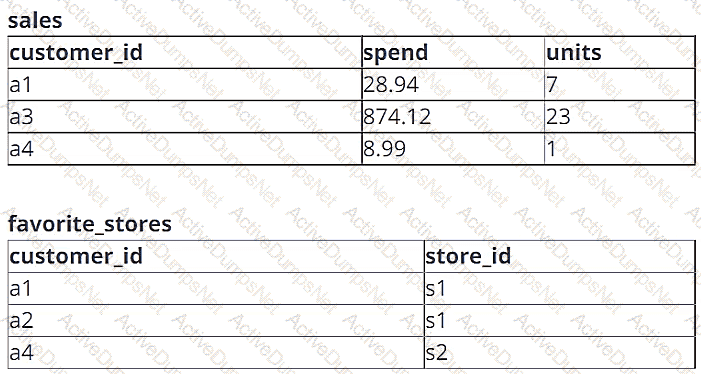
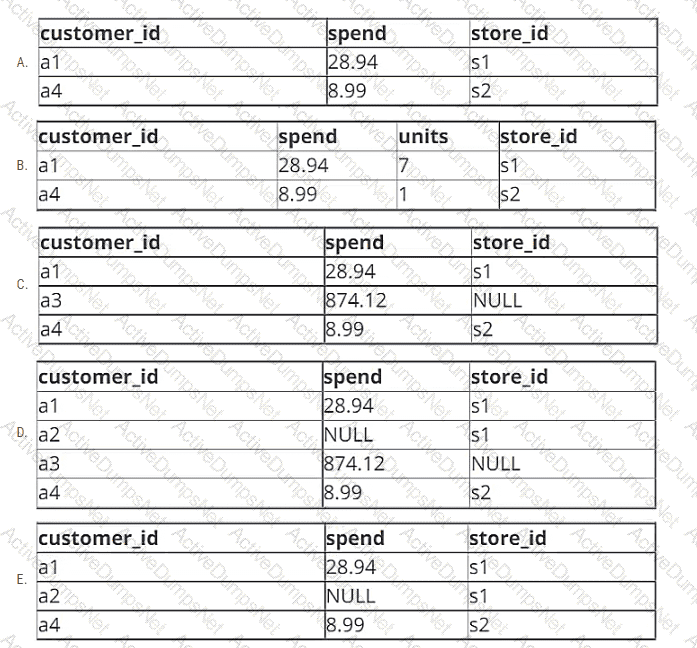
A data engineer is working with two tables. Each of these tables is displayed below in its entirety.
Question # 45

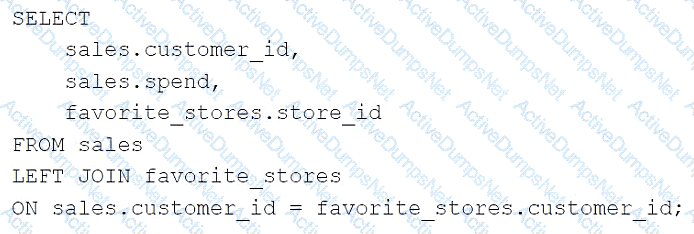
The data engineer runs the following query to join these tables together:
Question # 45

Which of the following will be returned by the above query?
Question # 45

Options:

A.

Option A

B.

Option B

C.

Option C

D.

Option D

E.

Option E

Question 46

A data engineer has manually created several Databricks jobs and dashboards using the workspace UI. The team now wants to manage these resources as code using Declarative Automation Bundles, formerly known as Databricks Asset Bundles, store the configuration in a Git repository, and deploy changes through CI/CD.

Which approach converts the existing resources into a bundle project?

Options:

A.

Run databricks bundle generate for each existing resource, then use databricks bundle deployment bind to link the generated configuration to the corresponding existing workspace resource, and commit the bundle project to Git for CI/CD deployment.

B.

Use the Databricks REST API to export each job’s JSON definition, save the JSON files into a Git repository, and configure CI/CD to import them using the REST API during each deployment.

C.

Clone an empty Git repository into a Git folder, manually recreate each job and dashboard configuration in YAML by referencing the workspace UI, and then deploy with databricks bundle deploy.

D.

Run databricks bundle init to create a new bundle project, and then use databricks bundle deploy to automatically detect and import all existing workspace resources.

Question 47

What is the functionality of AutoLoader in Databricks?

Options:

A.

Auto Loader automatically ingests and processes new files from cloud storage, handling batch data with support for schema evolution.

B.

Auto Loader automatically ingests and processes new files from cloud storage, handling only streaming data with no support for schema evolution.

C.

Auto Loader automatically ingests and processes new files from cloud storage, handling batch and streaming data with no support for schema evolution.

D.

Auto Loader automatically ingests and processes new files from cloud storage, handling both batch and streaming data with support for schema evolution.

Question 48

An organization plans to share a large dataset stored in a Databricks workspace on AWS with a partner organization whose Databricks workspace is hosted on Azure. The data engineer wants to minimize data transfer costs while ensuring secure and efficient data sharing.

Which strategy will reduce data egress costs associated with cross-cloud data sharing?

Options:

A.

Sharing data via pre-signed URLs without monitoring egress costs

B.

Migrating the dataset to Cloudflare R2 object storage before sharing

C.

Configure VPN connection between AWS and Azure for faster data sharing

D.

Using Delta Sharing without any additional configurations

Question 49

A data engineer needs to ingest JSON change data from Salesforce into Unity Catalog-governed Delta tables using a low-code, fully managed experience.

Which Databricks capability should the data engineer use?

Options:

A.

A Lakeflow Connect managed Salesforce connector that writes to Unity Catalog Delta tables.

B.

The Salesforce REST API in a PySpark notebook to query changed records and write them to Delta tables.

C.

Auto Loader with a file-arrival trigger monitoring DBFS.

D.

Auto Loader reading JSON files from an Amazon S3 bucket populated by a separate Salesforce export process.

Question 50

A data engineering team uses Declarative Automation Bundles, formerly known as Databricks Asset Bundles, to deploy the same codebase across development, test, and production environments. The team wants environment-specific behavior to be applied only through bundle configuration, without modifying notebooks, job definitions, or deployment logic during promotion.

Which approach applies environment-specific configuration while meeting this requirement?

Options:

A.

Deploy the same bundle once and edit job settings in the workspace UI for each environment after deployment.

B.

Define bundle variables and reference them from bundle resources, and then override the variable values for each environment using bundle targets.

C.

Use separate Git branches for each environment so each branch can contain environment-specific configuration values.

D.

Parameterize environment-specific values inside notebooks and set those parameters whenever each job run is triggered.

Question 51

A data engineer has a single-task Job that runs each morning before they begin working. After identifying an upstream data issue, they need to set up another task to run a new notebook prior to the original task.

Which of the following approaches can the data engineer use to set up the new task?

Options:

A.

They can clone the existing task in the existing Job and update it to run the new notebook.

B.

They can create a new task in the existing Job and then add it as a dependency of the original task.

C.

They can create a new task in the existing Job and then add the original task as a dependency of the new task.

D.

They can create a new job from scratch and add both tasks to run concurrently.

E.

They can clone the existing task to a new Job and then edit it to run the new notebook.

Question 52

Which TWO items are characteristics of the Gold Layer?

Choose 2 answers

Options:

A.

Read-optimized

B.

Normalised

C.

Raw Data

D.

Historical lineage

E.

De-normalised

Question 53

A dataset has been defined using Delta Live Tables and includes an expectations clause:

CONSTRAINT valid_timestamp EXPECT (timestamp > ' 2020-01-01 ' ) ON VIOLATION FAIL UPDATE

What is the expected behavior when a batch of data containing data that violates these constraints is processed?

Options:

A.

Records that violate the expectation cause the job to fail.

B.

Records that violate the expectation are added to the target dataset and flagged as invalid in a field added to the target dataset.

C.

Records that violate the expectation are dropped from the target dataset and recorded as invalid in the event log.

D.

Records that violate the expectation are added to the target dataset and recorded as invalid in the event log.

Question 54

Which of the following describes a benefit of creating an external table from Parquet rather than CSV when using a CREATE TABLE AS SELECT statement?

Options:

A.

Parquet files can be partitioned

B.

CREATE TABLE AS SELECT statements cannot be used on files

C.

Parquet files have a well-defined schema

D.

Parquet files have the ability to be optimized

E.

Parquet files will become Delta tables

Question 55

Which of the following describes the relationship between Bronze tables and raw data?

Options:

A.

Bronze tables contain less data than raw data files.

B.

Bronze tables contain more truthful data than raw data.

C.

Bronze tables contain aggregates while raw data is unaggregated.

D.

Bronze tables contain a less refined view of data than raw data.

E.

Bronze tables contain raw data with a schema applied.

Question 56

A data engineer has developed a data pipeline to ingest data from a JSON source using Auto Loader, but the engineer has not provided any type inference or schema hints in their pipeline. Upon reviewing the data, the data engineer has noticed that all of the columns in the target table are of the string type despite some of the fields only including float or boolean values.

Which of the following describes why Auto Loader inferred all of the columns to be of the string type?

Options:

A.

There was a type mismatch between the specific schema and the inferred schema

B.

JSON data is a text-based format

C.

Auto Loader only works with string data

D.

All of the fields had at least one null value

E.

Auto Loader cannot infer the schema of ingested data

Question 57

A data engineer has been given a new record of data:

id STRING = ' a1 '

rank INTEGER = 6

rating FLOAT = 9.4

Which of the following SQL commands can be used to append the new record to an existing Delta table my_table?

Options:

A.

INSERT INTO my_table VALUES ( ' a1 ' , 6, 9.4)

B.

my_table UNION VALUES ( ' a1 ' , 6, 9.4)

C.

INSERT VALUES ( ' a1 ' , 6, 9.4) INTO my_table

D.

UPDATE my_table VALUES ( ' a1 ' , 6, 9.4)

E.

UPDATE VALUES ( ' a1 ' , 6, 9.4) my_table

Question 58

An organization is building a data lakehouse and needs to ingest data from multiple sources into Unity Catalog-managed tables:

    Salesforce: More than 50 objects, frequent schema changes, and OAuth authentication

    An on-premises SQL Server database: More than 100 tables, CDC enabled, and private network connectivity required

    Daily JSON files landing in Azure Data Lake Storage Gen2

The organization wants all ingested data governed by Unity Catalog, minimal engineering effort for schema changes, and serverless processing wherever possible.

Which ingestion strategy meets these requirements?

Options:

A.

Use partner connectors such as Fivetran for all three sources through Partner Connect

B.

Use Auto Loader for all three sources, with custom Python code for Salesforce API calls and SQL Server CDC extraction

C.

Use Lakeflow Connect managed connectors for Salesforce and SQL Server, and Auto Loader for the ADLS files, within Lakeflow Spark Declarative Pipelines

D.

Use Lakeflow Connect managed connectors for all three sources

Question 59

A data engineer has a PySpark DataFrame named events_df with the following schema:

event_id STRING,

device STRUCT <

id: STRING,

model: STRING,

location: STRUCT <

latitude: DOUBLE,

longitude: DOUBLE

>

> ,

event_ts TIMESTAMP

The engineer needs to flatten all nested device fields into root-level columns while retaining the event identifier and timestamp.

Which PySpark expression achieves this requirement?

Options:

A.

events_df.withColumn( " device_id " , events_df[ " device.id " ]).withColumn( " device_model " , events_df[ " device.model " ]).withColumn( " location " , events_df[ " device.location " ])

B.

events_df.select( " event_id " , " event_ts " , " device.* " )

C.

events_df.select( " event_id " , " event_ts " , " device.id " , " device.model " , " device.location.latitude " , " device.location.longitude " )

D.

events_df.select( " event_id " , " device[id] " , " device[model] " , " device.location[latitude] " , " device.location[longitude] " , " event_ts " )

Question 60

A data engineer is inspecting an ETL pipeline based on a Pyspark job that consistently encounters performance bottlenecks. Based on developer feedback, the data engineer assumes the job is low on compute resources. To pinpoint the issue, the data engineer observes the Spark Ul and finds out the job has a high CPU time vs Task time.

Which course of action should the data engineer take?

Options:

A.

High CPU time vs Task time means an under-utilized cluster. The data engineer may need to repartition data to spread the jobs more evenly throughout the cluster.

B.

High CPU time vs Task time means efficient use of cluster and no change needed

C.

High CPU time vs Task time means over-utilized memory and the need to increase parallelism

D.

High CPU time vs Task time means a CPU over-utilized job. The data engineer may need to consider executor and core tuning or resizing the cluster

Question 61

A data engineer wants to create a relational object by pulling data from two tables. The relational object does not need to be used by other data engineers in other sessions. In order to save on storage costs, the data engineer wants to avoid copying and storing physical data.

Which of the following relational objects should the data engineer create?

Options:

A.

Spark SQL Table

B.

View

C.

Database

D.

Temporary view

E.

Delta Table

Question 62

A data engineer runs df.toPandas() on a wide DataFrame containing 50 million rows. The notebook cell fails with a java.lang.OutOfMemoryError on the driver.

Which memory configuration is directly associated with this failure?

Options:

A.

spark.sql.shuffle.partitions is too high.

B.

spark.memory.fraction is too low.

C.

spark.executor.memory is too low.

D.

spark.driver.memory is too low to hold the collected result.

Question 63

A data engineer is cleaning a Bronze table. The requirement is to eliminate rows where either the customer_email field or the customer_phone field is NULL. The cleaning must be performed in one operation using a single method call.

Which PySpark approach supports filtering multiple columns for NULL values in one call?

Options:

A.

df.dropna(subset=[ " customer_email " , " customer_phone " ])

B.

df.where( " customer_email IS NOT NULL " ).where( " customer_phone IS NOT NULL " )

C.

df.na.drop(how= " all " )

D.

df.filter(col( " customer_email " ).isNotNull() & col( " customer_phone " ).isNotNull())

Question 64

A data engineering team is designing the Gold layer in its Unity Catalog-governed lakehouse for downstream BI and analytics users. The team wants to expose business-ready metrics with fast query performance and consistent definitions while keeping the transformation logic in Spark notebooks.

Which type of Gold-layer object meets this requirement?

Options:

A.

A materialized view that precomputes aggregations from Silver tables on a schedule and is queried by BI tools for faster, consistent analytics

B.

A view that directly references raw Bronze tables so BI tools can define their own joins and aggregations

C.

A streaming table that continuously ingests raw events from source systems and exposes them directly to BI users

D.

A collection of CSV files stored in cloud object storage that BI users parse to query the Gold-layer data

Question 65

A data engineer is attempting to write Python and SQL in the same command cell and is running into an error The engineer thought that it was possible to use a Python variable in a select statement.

Why does the command fail?

Options:

A.

Databricks supports multiple languages but only one per notebook.

B.

Databricks supports language interoperability in the same cell but only between Scala and SQL

C.

Databricks supports language interoperability but only if a special character is used.

D.

Databricks supports one language per cell.

Question 66

Which SQL keyword can be used to convert a table from a long format to a wide format?

Options:

A.

TRANSFORM

B.

PIVOT

C.

SUM

D.

CONVERT

Question 67

What Databricks feature can be used to check the data sources and tables used in a workspace?

Options:

A.

Do not use the lineage feature as it only tracks activity from the last 3 months and will not provide full details on dependencies.

B.

Use the lineage feature to visualize a graph that highlights where the table is used only in notebooks,

C.

Use the lineage feature to visualize a graph that highlights where the table is used only in reports.

D.

Use the lineage feature to visualize a graph that shows all dependencies, including where the table is used in notebooks, other tables, and reports.

Question 68

A data engineer has a Job that has a complex run schedule, and they want to transfer that schedule to other Jobs.

Rather than manually selecting each value in the scheduling form in Databricks, which of the following tools can the data engineer use to represent and submit the schedule programmatically?

Options:

A.

pyspark.sql.types.DateType

B.

datetime

C.

pyspark.sql.types.TimestampType

D.

Cron syntax

E.

There is no way to represent and submit this information programmatically

Question 69

Which of the following must be specified when creating a new Delta Live Tables pipeline?

Options:

A.

A key-value pair configuration

B.

The preferred DBU/hour cost

C.

A path to cloud storage location for the written data

D.

A location of a target database for the written data

E.

At least one notebook library to be executed