Redeem Your Black Friday Code: 75% Off All Exam Bundles! Use coupon code below! - Ends in 0d 00h 00m 00s - Coupon code: discactive

CyberArk GUARD CyberArk Guardian Exam Exam Practice Test

Page: 1 / 6
Total 60 questions

CyberArk Guardian Exam Questions and Answers

Question 1

In which circumstances is it permissible to install third-party clients on a Vault server?

Options:

A.

It is never acceptable to install 3rd-party clients on a Vault.

B.

Device drivers whenever a Vault requires integration with SAN, HSM, or NIC.

C.

Whenever regulations require anti-virus on all Windows systems.

D.

When conforming to organizational policies.

Question 2

ClientABC is building a PSM farm with 2 servers. They plan to use a physical load balancer configured for least connections.

What else is required as part of this configuration?

Options:

A.

Deploy the PSM Healthcheck integration on 1 of the 2 PSM servers. This acts as a centralized healthcheck for both servers.

B.

Deploy the PSM Healthcheck integration on both of the 2 PSM servers. Ensure the load balancer uses this URL.

C.

This is not a supported configuration, PSM only supports round robin load balancing.

D.

Deploy the PSM Healthcheck, however without the load balancer, CyberArk is able to load balance the PSMs internally.

Question 3

The customer currently has a Primary and DR vault. They have heard that another DR vault can be deployed for additional redundancy, so they order a physical server and rack and stack it in a Co-Iocation.

However, when installing the DR module on the new vault, the installation fails. What is the most likely cause?

Options:

A.

None of the PVWAs can communicate with the new vault.

B.

The customer does not have enough DR licenses.

C.

The vault has not been hardened correctly.

D.

Unless the configuration is using the Distributed Vault architecture, you can only have 2 total vault servers.

Question 4

Which Secrets Manager component is recommended to be placed behind a load balancer for availability and redundancy?

Options:

A.

Application Server Credential Provider

B.

Credential Provider

C.

Central Credential Provider

D.

Conjur Synchronizer

Question 5

A financial institution uses CyberArk Privileged Session Manager (PSM) to monitor privileged access to production servers.

The security team requires authorized auditors to terminate suspicious privileged sessions immediately when potentially malicious administrative activity is detected.

An auditor can view active sessions in PVWA but cannot terminate them. The administrator confirms that session monitoring is enabled and the PSM infrastructure is functioning correctly.

What configuration should be implemented to allow the auditor to terminate active privileged sessions?

Options:

A.

Add the auditor to the Vault Administrators group and grant full administrative access to all Recording Safes.

B.

Enable the Require Dual Control Password Access Approval rule in the Master Policy and assign the auditor as an approver.

C.

Add the auditor to the PSMLiveSessionTerminators group and ensure that this group has the required membership in the Safes containing the managed accounts.

D.

Assign the auditor the Retrieve Accounts permission on the relevant Safes and enable automatic password reconciliation.

Question 6

Which option listed below is an advanced Master Policy rule?

Options:

A.

Allow users to select a reason for access.

B.

Allow Manual Change.

C.

Allow Users to View Passwords.

D.

Only Administrators can approve password access.

Question 7

Communication is an integral component of any PAM program and includes these two elements.

Choose two

Options:

A.

Getting buy-in from leadership and communicating this from the first stakeholder meeting.

B.

Allowing each level to develop their own messaging so that we can build a specific message catered to each group's goals: leadership, management, different organizations, IT Administrators, etc..

C.

Developing a PAM sponsor to evangelize the project goals with the CTO and the entire technology organization.

D.

"One and Done" communication so we don't overwhelm users.

E.

Developing all training materials in Stage 2 of the program so that we can include 'lessons learned'.

Question 8

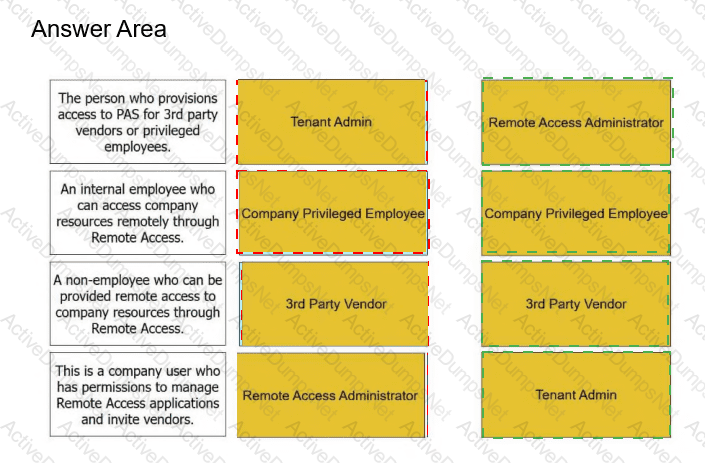
In CyberArk Remote Access, match each persona to its job role:
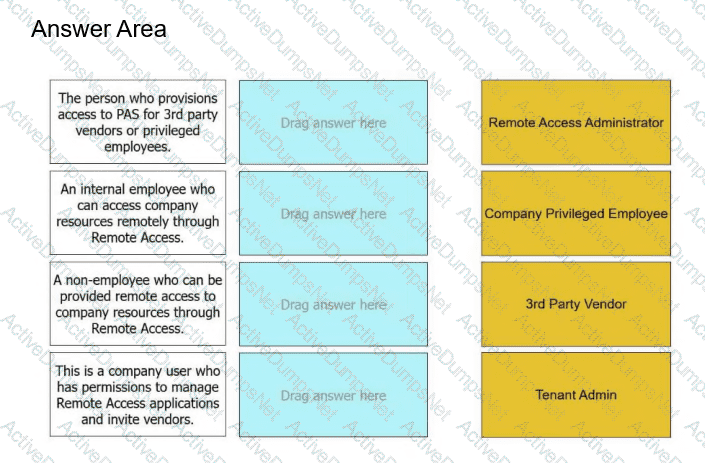
Question # 8

Options:

Question 9

A customer has a large deployment that comprises 4 VAULTs, 6 PVWAs, 5 CPMs, and 6 PSMs. The support team has asked you to submit logs and configuration files for each component.

How would you obtain the files in the most efficient way?

Options:

A.

Use PAS Reporter to gather the logs and configuration files. Upload the PAS reporter database to the support ticket.

B.

Use CyberArk xRay.

C.

Use CyberArk zBang.

D.

Gather the logs and configuration files from each server manually.

Question 10

A customer has asked you to onboard more than 1,000 Local Admin accounts. All of the accounts are used by the same team and are in a control zone.

Which CyberArk feature provides an automated way to accomplish this task?

Options:

A.

Password Upload Utility

B.

Auto-Detection

C.

Auto-Reconcile

D.

Remote Control Agent

Question 11

ClientABC is moving into the DevOps space. They currently use CCP and are considering Conjur. They have noticed there is considerable overlap.

How would you explain the difference between the two?

Choose two

Options:

A.

Conjur is well suited for the velocity of the CI/CD pipeline because it includes native authentication such as API keys, 1AM, and OAuth. You store the secret at the project folder level.

B.

CCP is a good choice if you're using client certificate authentication. With CCP you need to authenticate and pass an application ID and your query for your secret.

C.

Conjur is best suited for static secrets. You only need to pass an API key to make the call. This is suited well for the velocity of the CI/CD pipeline because it integrates seamlessly with containers.

D.

CCP is best used for ad-hoc scripts. It's a great choice because you're able to use enhanced authentication mechanisms such as 'Path' and 'Hash'.

E.

When trying to decide between the two, you should generally choose CCP, as Conjur cannot be integrated with the same vault that is used for CyberArk PAM.

Question 12

What are the three Guiding Principles of the CyberArk Blueprint?

Options:

A.

Credential Theft, Lateral and Vertical Movement, Privilege Escalation and Abuse.

B.

Identity Security, Credential Theft, Lateral and Vertical Movement.

C.

Attack and Defend capability, Credential Theft, Least Privilege.

D.

Quick return on investment, Password Management, Credential Theft.

Question 13

You are deploying PAM for a globally distributed organization with locations in England (UK), Boston (USA), and Hong Kong (ROC).

Each location has two physically separated data centers for disaster mitigation. England DC 1 has been designated as the Primary DC. Components will be scaled horizontally where needed in later phases, and all DCs can communicate with one another.

The solution must provide:

• Resilient access to target systems

• A highly resilient primary location

• Recovery from all locations

• Global resilience to outages

• A single Master Policy governing the solution

Load balancing is possible between DCs in the same region.

What is the minimum required to meet these requirements?

Options:

A.

UK DC 1 :- Vault, PVWA, PSM, CPM, PTA

UK DC 2 :- DR Vault, PVWA, PSM, DR PTA

US DC 1 :- DR Vault, PVWA, PSM, CPM

US DC 2 :- PVWA, PSM

ROC DC 1 :- DR Vault, PVWA, PSM, CPM

ROC DC 2 :- PVWA, PSM

B.

UK DC 1 :- Vault, PVWA, PSM, CPM, PTA

UK DC 2 :- PVWA, PSM, DR PTA

US DC 1 :- DR Vault, PVWA, PSM, CPM

US DC 2 :- PVWA, PSM

ROC DC 1 :- DR Vault, PVWA, PSM, CPM

ROC DC 2 :- PVWA, PSM

C.

UK DC 1 :- Vault, PVWA, PSM, CPM, PTA

UK DC 2 :- DR Vault, PVWA, PSM, CPM, PTA

US DC 1 :- Vault, PVWA, PSM, CPM, PTA

US DC 2 :- DR Vault, PVWA, PSM, CPM, PTA

ROC DC 1 :- Vault, PVWA, PSM, CPM, PTA

ROC DC 2 :- DR Vault, PVWA, PSM, CPM, PTA

D.

UK DC 1 :- Vault, PVWA, PSM, CPM, PTA

UK DC 2 :- DR Vault, PVWA, PSM, CPM, DR PTA

US DC 1 :- DR Vault, PVWA, PSM, CPM

US DC 2 :- DR Vault, PVWA, PSM, CPM

ROC DC 1 :- DR Vault, PVWA, PSM, CPM

ROC DC 2 :- DR Vault, PVWA, PSM, CPM

Question 14

How can a single platform manage passwords for multiple Unix flavors?

Options:

A.

The Policies and Prompts files can be customized to handle different workflows for different Unix flavors.

B.

You are not able to have more than one unix system type in a single platform.

C.

You can change the platform settings to set up different Unix change commands through the Additional Policies section.

D.

An account can be set up with an additional fields which includes the change and reconcile commands required.

Question 15

You deployed your Primary Vault on a CyberArk-supported cloud platform by using a CyberArk-provided image, and deployed a DR Vault in a privately owned data center.

What is the best method for securing the Server Key on the DR Vault?

Options:

A.

Use KMS.

B.

Use HSM.

C.

Mount Operator CD every time Vault is started.

D.

Use Azure Key Vault.

Question 16

A customer has a hybrid infrastructure that spans multiple cloud vendors and privately owned data centers. They deployed CyberArk PAM in AWS by using CyberArk-provided scripts. Eighty percent of the customer’s infrastructure is located in privately owned data centers. The customer is concerned about availability between the cloud provider and the data center. They are cloud-first and are gradually migrating their servers to the cloud.

Active Master Policy settings:

• Require dual-control approval for password access

• Enforce exclusive check-in/check-out access

• Require password changes every 25 days

• Require password verification every 7 days

What is the most appropriate recommendation for the customer?

Options:

A.

Keep the deployment as is in AWS.

B.

Deploy an active CPM to the privately owned Data Center.

C.

Deploy a separate infrastructure in another cloud vendor.

D.

Migrate the CPM to the privately owned Data Center.

Question 17

The Active Directory manager asks you to temporarily enable Object Level Access Control (OLAC) on a Safe they own so they can control which users may use a particular Domain Admin account.

What OLAC limitation should you explain to them?

Options:

A.

OLAC does not enable granular control of which users can use a specific object.

B.

Once enabled, object level access control cannot be disabled.

C.

With object level access control enabled, PSM operations on the managed accounts are not supported.

D.

New accounts cannot be added to the safe, once OLAC is enabled.

Question 18

In the customer’s current environment, Administrators use shared Admin accounts. The account passwords are configured never to expire and are stored in an Excel sheet that each Administrator keeps locally on their system.

How can the customer use CyberArk to secure the shared Admin accounts?

Options:

A.

Vault the shared accounts and allow the Administrators access to the accounts via CyberArk and enable one-time passwords and exclusive accounts.

B.

Vault the shared accounts in CyberArk and enable one-time passwords and exclusive accounts. Create new shared accounts for the Administrators to use outside of CyberArk.

C.

Vault the shared accounts and do not allow the Administrators to use the accounts in CyberArk.

D.

Vault the shared accounts and allow the Administrators access to the accounts via CyberArk and enable manual password change.

Page: 1 / 6
Total 60 questions