
Summer Sale Limited Time Flat 70% Discount offer - Ends in 0d 00h 00m 00s - Coupon code: 70spcl

Cisco 500-420 Cisco AppDynamics Associate Performance Analyst (CAAPA) Exam Practice Test

Page: 1 / 12
Total 124 questions

Cisco AppDynamics Associate Performance Analyst (CAAPA) Questions and Answers

Question 1

Question # 1

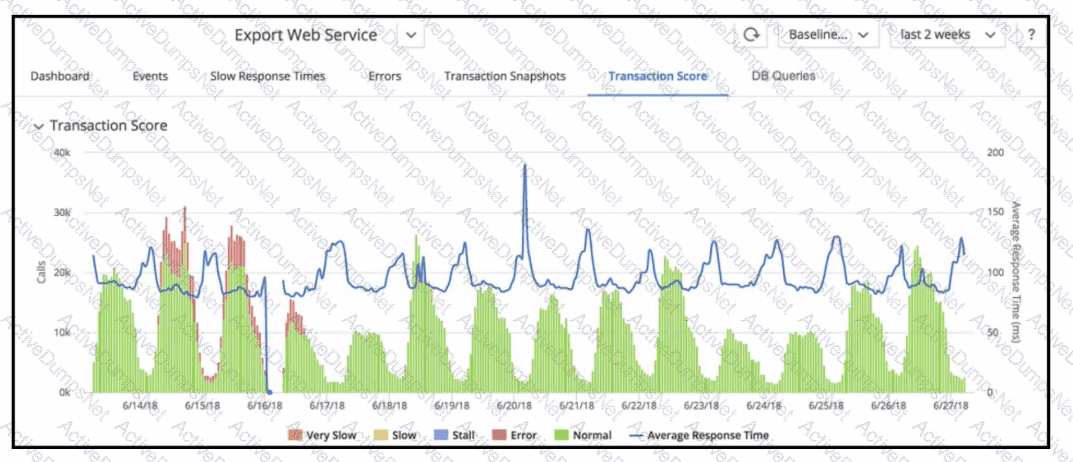
Refer to the exhibit. The transaction score in the graphic displays an interesting performance pattern outside of business hours on 6/16/18. Which additional performance anomaly should be of most interest to a Performance Analyst?

Options:

A.

Elevated Response Time at 6/19/18

B.

Elevated Response Time at 6/25/18

C.

Lower than usual volume at 6/17/18

D.

Low volume at 6/15/18

Question 2

When a manual diagnostic session is triggered, what snapshots are captured?

Options:

A.

Snapshots for all nodes that contributed to slow, very slow, or error business transactions

B.

Snapshots for all nodes through which a business transaction passes

C.

Snapshots for all slow, very slow, or error business transactions regardless of node

D.

Snapshots on the triggering nodes at the start of the business transaction

Question 3

Which statement is correct regarding controller-level and tier/node-level dashboards?

Options:

A.

The Performance Analyst can associate a controller-level dashboard with a tier or node through the My Dashboards tab

B.

From the controller-level dashboards list the Performance Analyst can access any tier/node-level dashboards outside the application in which they were created.

C.

Controller-level and tier/node-level dashboards are two separate sets. The Performance Analyst cannot cross-reference between these dashboards.

D.

Controller-level and tier/node-level dashboards are not scoped to be separate entities.

Question 4

A Performance Analyst is reviewing Business Transactions with an Application team. The Application team would like to increase the Application Business Transaction limit because they need to have visibility into all the different transactions. What should the Performance Analyst do?

Options:

A.

Do nothing since the limit is not important during configuration

B.

Increase the limit to the requested value

C.

Increase the limit half way between the current level and the requested value

D.

Focus on the Business Transactions exceeding the limit and why

Question 5

Which three things should a Performance Analyst verify to validate a Java Agent’s configuration? (Choose three.)

Options:

A.

/etc/sysctl.conf

B.

controller-info.yaml

C.

Startup script

D.

controller-info.xml

E.

Environment variables

Question 6

If a user request results in the discovery of an entry point, what is the one key item that must be defined as one or more asynchronous activities are spawned?

Options:

A.

Business Transaction

B.

Custom Endpoint

C.

Asynchronous Metric

D.

Endpoint Metrics

Question 7

Business Transaction Discovery Sessions work with which two code languages? (Choose two.)

Options:

A.

.NET

B.

C++

C.

PHP

D.

Java

E.

Node.js

Question 8

Within the configuration setting for Slow Transactions, under the " Configure Diagnostic Session Duration and Collection Rate " option, what is the default value pair for the setting " Collect up to ____snapshots per minute for _____ minutes " ?

Options:

A.

2,2

B.

5,5

C.

10, 10

D.

4,4

Question 9

Which statement is true for shared AppDynamics Dashboards?

Options:

A.

Users are required to log in to their AppDynamics account and be inside the organization network.

B.

Users are required to have administrator access to the Controller.

C.

Users are not required to be logged in to their AppDynamics account.

D.

Users are required to log in to their AppDynamics account.

Question 10

When instrumenting and configuring Transaction Detection Rules, when should Scope be used?

Options:

A.

To apply Transaction Detection Rules to specific nodes that have the same function

B.

To apply Transaction Detection Rules to certain backends that have the same function

C.

To apply Transaction Detection Rules to certain tiers that have the same function

D.

To apply Transaction Detection Rules to multiple applications

Question 11

How can a Business Transaction be permanently deleted?

Options:

A.

Use Business Transaction Automatic Cleanup

B.

Modify the detection rule and delete the Business Transaction

C.

Exclude the transaction from the Business Transaction list and delete the Business Transaction

D.

Delete the transaction from the Business Transaction list

Question 12

What are two default Business Transaction limits at the Application and Node levels? (Choose two.)

Options:

A.

Application 100

B.

Application 200

C.

Application 300

D.

Node 50

E.

Node 75

F.

Node 200

Question 13

Using the Business Transaction Discovery Sessions tools, which two items can a Performance Analyst browse? (Choose two.)

Options:

A.

Classes

B.

Methods

C.

Database Calls

D.

JMX MBeans

E.

Memory Objects

Question 14

Which two health rules are provided out-of-the-box for proactive monitoring? (Choose two.)

Options:

A.

Business Transaction response time is much higher than normal

B.

Node Web Container Threads is much higher than normal

C.

Business Transaction error rate is much higher than normal

D.

Business Transaction thread stalls are much higher than normal

E.

Application Transaction rate is much lower than normal

Question 15

Which two tabs in the Transaction Snapshot window point the developer to a class, method, and line number in the code? (Choose two.)

Options:

A.

More

B.

Data Collectors

C.

DB and Remote Services Calls

D.

Call Graph

E.

Slow Calls & Errors > Hot Spots

F.

Servers

Question 16

Which view presents a calculated percentage of the slow, very slow, and stalled Business Transactions?

Options:

A.

Transaction Score

B.

Slow Responses under Troubleshoot

C.

Business Transactions

D.

Metric Browser

Question 17

When using the REST interface, where would a Performance Analyst go to see all captured endpoints by service?

Options:

A.

Navigate to the Metric Browser, locate a specific metric, copy its REST URL, and use a wildcard query to retrieve metrics for the other Service Endpoints.

B.

Access the MySQL database, locate all endpoints in an application, drill down to the tiers and transactions, and select the REST feature enabled by the Service Endpoint.

C.

Navigate to the Applications browser, drill down to the requested endpoint, select the available dashboard and metric indicators, and then select the desired metric.

D.

Navigate to the Metric Browser, open the Consumed Endpoints location, and drill down into a specific endpoint to identify its services.

Question 18

A Performance Analyst is evaluating the performance of a shopping application from a customer perspective. Which three Key Performance Indicators (KPIs) are quantifiable measurements used to determine user experience? (Choose three.)
Options:

A.

Network Incoming Errors

B.

Business Transactions 94th Percentile Response Time

C.

Machine Agent Availability

D.

End User Response Time

E.

Infrastructure Average CPU Used

F.

Business Transactions Errors per Minute

Question 19

Question # 19

Refer to the exhibit. When looking at the Transaction Score for a specific transaction, how are errors in the transaction identified?

Options:

A.

Set the time range and drill down into the snapshots in the Error tab.

B.

Set the time range and examine the Slow Response Times tab.

C.

Set the time range and examine the dashboard for errors.

D.

Set the time range and drill down into the snapshots in the Events tab.

Question 20

A Performance Analyst is reviewing Business Transactions with an application team. The application team wants to increase the Application Business Transaction limit because it needs visibility into all the different transactions. What should the Performance Analyst do?

Options:

A.

Do nothing because the limit is not important during configuration

B.

Increase the limit to the requested value

C.

Focus on the Business Transactions exceeding the limit and determine why

D.

Increase the limit halfway between the current level and the requested value

Question 21

A Performance Analyst has noticed a significant decrease in an application ' s workload, measured in calls per minute, and is trying to identify the root cause. Which option will give the Performance Analyst insight into the behavior of the affected Business Transactions?

Options:

A.

Review Top Business Transactions by Load in the Application Dashboard

B.

Review all elements in the Application Flow Map and identify variations in load

C.

In Metric Browser, plot Calls/min for the Application

D.

Review Business Transactions and enable Show Trends

E.

Review the Transaction Score for the Application

Question 22

Under the Troubleshooting menu, which option allows viewing of transaction snapshots?

Options:

A.

Health Rule Violations

B.

Slow Response Times

C.

Slow and Error Transactions

D.

War Rooms

Question 23

Which two statements are correct about creating Information Points? (Choose two.)

Options:

A.

A wildcard can be used to select multiple methods for an Information Point.

B.

A wildcard can be used to select multiple classes for an Information Point.

C.

An Information Point can be created on the same class and method as a Custom Exit Point.

D.

An Information Point can be created on a class and method that is executed before the Business Transaction entry point.

Question 24

What are three effects of Development Level Monitoring? (Choose three.)

Options:

A.

The agent captures a combination of full and partial call graphs in development mode.

B.

The agent captures full call graphs in development mode.

C.

The agent attempts to take a snapshot for every transaction.

D.

The agent ignores the “dev-mode-suspend-cpm” property.

E.

AppDynamics increases information collected for exit calls to backend systems.

F.

The agent guarantees a snapshot for every transaction.

Question 25

An E-commerce application is built using microservices architecture design with several components. In AppDynamics, how should the Transaction Detection rules be grouped logically?

Options:

A.

Use Automatic Discovery

B.

Use Scope

C.

Use Transaction Group

D.

Use Backend Detection

Question 26

Within the Application Dashboard, which two methods could a Performance Analyst use to quickly demonstrate that a slow backend is contributing to an application slowdown? (Choose two.)

Options:

A.

Select Top Business Transactions, choose By Response Time, and compare the backend’s response time for the available timeframes.

B.

Select Application Flow – Grid View, locate and select the slow backend, and compare response time for the available timeframes.

C.

Select Transaction Snapshots, review Slow and Error Transactions, and compare the backend’s response time for the available timeframes.

D.

Select Application Flow Map, locate and select the backend, and compare response time for the available timeframes.

Question 27

Which option should a Performance Analyst use in an environment where virtual machines are routinely created and destroyed?

Options:

A.

Dappdynamics.agent.auto.node.prefix and -Dappdynamics.cron.vm

B.

Dappdynamics.agent.reuse.nodeName and - Dappdynamics.agent.reuse.nodeName.prefix

C.

Dappdynamics.http.proxyHost and -Dappdynamcs.http. proxy User

D.

Dappdynamics.agent.node.metainfo and -Dappdynamics.agent.nodeName

Question 28

Which dashboard can be used to identify potential Business Transactions contributing to an increase in Error Counts?

Options:

A.

Transaction Score – Snapshots

B.

Top Business Transactions – by Errors

C.

Transaction Snapshots – All Snapshots

D.

Application Flow – Grid View

Question 29

Which two match conditions can be added when you configure an Information Point? (Choose two.)

Options:

A.

Match based on a regex applied to the method

B.

Match based on the invoked object

C.

Match based on the Business Transaction

D.

Match based on the return value

Question 30

An AppDynamics deployment has Business Transaction Lock Down turned on. The company has just added an important service to its application and wants to track this service as a unique Business Transaction. What action is needed to achieve this?

Options:

A.

Modify the Automatic Transaction Discovery rule to include the Web Service Name and Operation Name

B.

Create a Custom Transaction Match Rule based on the Web Service Name and Operation Name

C.

Use Live Preview to identify the Business Transaction and register it from there

D.

Use the Business Transaction Dashboard for the tier-specific All Other Traffic to register the Business Transaction

Question 31

Which tab within the Application Dashboard displays performance trends for each of Snapshots, Average Response Time, and Events within one central view?

Options:

A.

Application Flow Map

B.

Dashboard

C.

Events

D.

Transaction Score

E.

Network Dashboard

Question 32

Which two things should a Performance Analyst check if an agent has failed to register with the Controller after several minutes? (Choose two.)

Options:

A.

total free RAM

B.

network/firewall rules

C.

current CPU load average

D.

free license count

Question 33

Which two rule types are available when creating new transaction detection rules? (Choose two.)

Options:

A.

Exclude Rule

B.

Automatic Discovery Rule

C.

Custom Match Rule

D.

Health Rule

E.

Include Rule

Question 34

Developers and operations personnel complain the Controller tracks many irrelevant Java classes and methods. How does a Performance Analyst exclude this unhelpful information?

Options:

A.

Configuration > Baselines and create a new dynamic baseline

B.

Edit the mbeans-server.xml file to delete the irrelevant methods

C.

Configuration > Instrumentation > Call Graph Settings and exclude irrelevant packages

D.

Edit the controller-info.xml file to exclude irrelevant methods

Question 35

Which two options are forms of data collectors? (Choose two.)

Options:

A.

URN data collectors capture the URN, persistent values, metadata strings, and GET data of HTTP messages exchanged in a Business Transaction.

B.

HTTP data collectors capture URLs, parameter values, headers, and cookies from HTTP messages exchanged in a Business Transaction.

C.

SNMP data collectors capture device data, proxy details, forwards, and GetNext agent data for a network-management framework.

D.

URI data collectors capture URIs, parameter values, metadata, and POST data from HTTP messages exchanged in a Business Transaction.

E.

Method invocation data collectors capture code-level data such as method arguments, variables, and return values.

Question 36

When a team of developers refactored their code, resulting in class-name changes, Business iQ users reported that metrics had disappeared. Where should a Performance Analyst look to troubleshoot this problem?

Options:

A.

Applications > Troubleshoot > Errors

B.

Configuration > Slow Transaction Thresholds

C.

Configuration > Instrumentation > Data Collectors

D.

Databases > Configuration > Collectors

Question 37

A team of developers deploys new Java servlet code that should create new business transactions in AppDynamics. After applying load on the new code function, there are no new Business Transactions on the Business Transaction Dashboard. Which two options should the developers check in AppDynamics to make sure the Business Transactions can be discovered?

[Choose two.)

Options:

A.

The metric browser to see if the new transactions appear under Business Transaction Performance.

B.

The tier with the new code does not have any rules excluding it.

C.

Auto discovery for service endpoints is turned on.

D.

There is a health rule created to check for transaction performance.

E.

Auto Discovery for servlet is turned on for Java agents.

Page: 1 / 12
Total 124 questions