New Year Sale Limited Time Flat 70% Discount offer - Ends in 0d 00h 00m 00s - Coupon code: 70spcl

Cisco 350-501 Implementing and Operating Cisco Service Provider Network Core Technologies (350-501 SPCOR) Exam Practice Test

Page: 1 / 55
Total 547 questions

Implementing and Operating Cisco Service Provider Network Core Technologies (350-501 SPCOR) Questions and Answers

Question 1

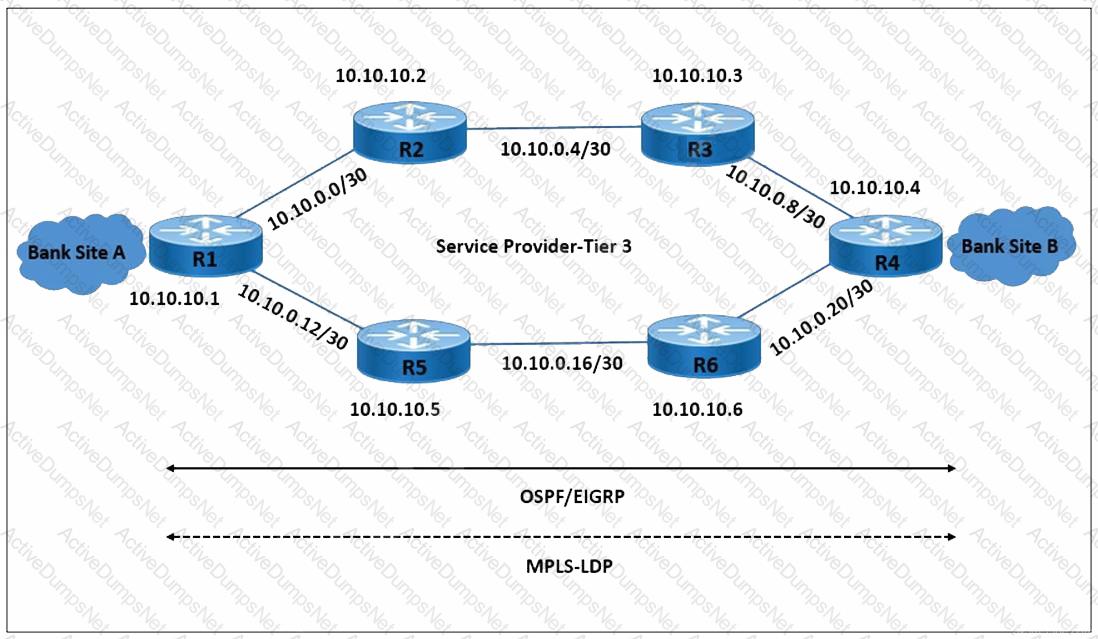
Refer the exhibit.

Question # 1

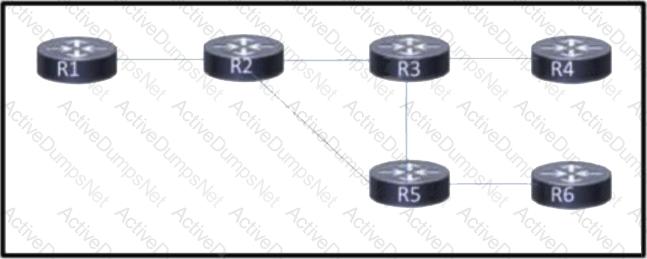
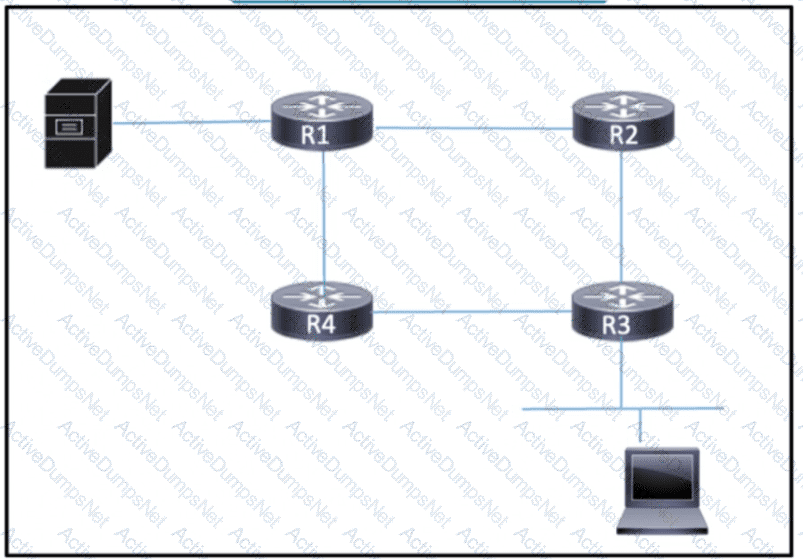
Users on a network connected to router R3 report slow speeds when they connect to the server connected to R2. After analyzing traffic on the network, a network engineer identified congestion on the link between R2 and R3 as the cause. Which QoS service must the engineer implement to drop traffic on the link when it exceeds a configured threshold?

Options:

A.

first-in, first-out

B.

traffic shaping

C.

class-based weighted fair queueing

D.

traffic policing

Question 2

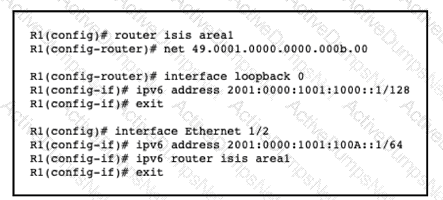
Refer to the exhibit.

Question # 2

An engineer applied a gRPC dial-in configuration on customer's router to provide connection multiplexing and two-way streaming. What does this configuration accomplish in a gRPC?

Options:

A.

It is the encoding requested by the gRPC server.

B.

IT is the encoding that is used for dial-in and dial-out.

C.

It is used for encoding with the default protocol buffers

D.

It is the encoding requested by the gRPC client.

Question 3

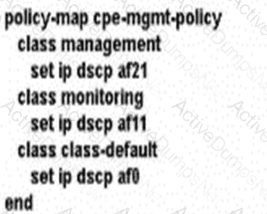
A network engineer Is implementing a QoS policy for outbound management traffic classification and marking on a CPE device with these requirements:

• Management protocols must be marked with DSCP AF class 2 w4h low drop probability.

• Monitoring protocols must be marked with DSCP AF class 1 with low drop probability.

• All remaining traffic must be marked with a DSCP value of 0.

Which configuration must the engineer implement to satisfy the requirements?

A)
Question # 3

B)

Question # 3

C)

Question # 3

D)

Question # 3

Options:

A.

Option A

B.

Option B

C.

Option C

D.

Option D

Question 4

Question # 4

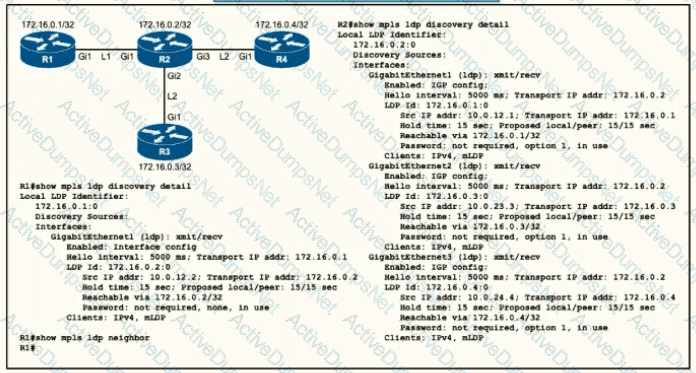
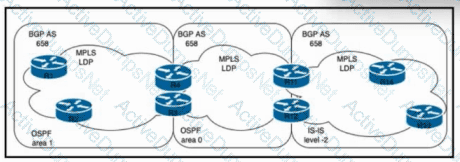
Refer to the exhibit. Customers report occasional forwarding issues from hosts connected to R6 to hosts connected to R1. A network engineer has just updated the MPLS configuration on the network, and a targeted LDP session has been established between R1 and R5. Which additional task must the engineer perform so that the team can identify the path from R6 to R1 in case the forwarding issues continue?

Options:

A.

Configure an MPLS TE from R4 to R1 that routes through R5.

B.

Implement MPLS OAM within the network.

C.

Implement MPLS VPLS within the network.

D.

Configure MPLS LDP Sync on each router.

Question 5

Simulation 3

Question # 5

Question # 5

Options:

Question 6

Question # 6

Refer to the exhibit. Routers R1 and R2 support traffic between multiple departments at a company's remote office and exchange routes using OSPF. The link between R1 and R2 has been providing inconsistent performance, particularly during times of peak usage. To help identify the cause, an engineer was asked to implement BFD to detect failures on the link. Which task must the engineer perform?

Options:

A.

Configure the session parameters individually on each interface.

B.

Configure IS-IS to share routes between the routers.

C.

Change the network between R1 and R2 to a /30 prefix.

D.

Configure echo mode on both devices to support asymmetry.

Question 7

Why do packet loops occur during the configuration of BlDlR-PIM?

Options:

A.

The network does not support BIDIR-PIM

B.

The network is partially upgraded to support BIDlR-PIM

C.

No interface for carrying traffic for multicast groups has been configured

D.

The router has not been configured to advertise itself

Question 8

What causes multicast traffic to permanently stay on the shared tree and not switch to the source tree?

Options:

A.

The SPT threshold is set to infinity.

B.

The RP IP address is configured incorrectly.

C.

The RP announcements are being filtered.

D.

SSM range is being used.

Question 9

An engineer must apply an 802.1ad-compliant configuration to a new switchport with these requirements:

The switchport must tag all traffic when it enters the port.

The switchport is expected to provide the same level of service to traffic from any customer VLAN.

Which configuration must the engineer use?

Options:

A.

interface GigabitEthernet1/0/1

switchport mode trunk

switchport trunk encapsulation dot1q

encapsulation ISL

bridge-domain 12

B.

interface GigabitEthernet1/0/1

ethernet dot1ad uni c-port

service instance 12

encapsulation dot1q

rewrite ingress tag push dot1ad 21 symmetric

bridge-domain 12

C.

interface GigabitEthernet1/0/1

ethernet dot1ad uni s-port

service instance 12

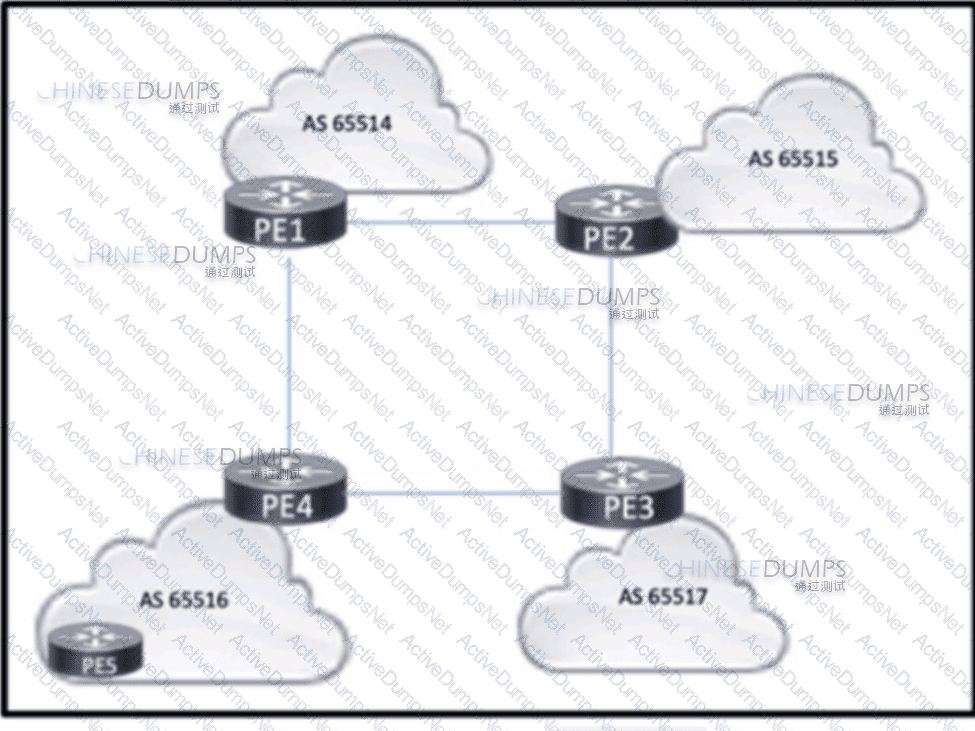
encapsulation default

rewrite ingress tag push dot1ad 21 symmetric

bridge-domain 12

D.

interface GigabitEthernet1/0/1

ethernet dot1ad nni

service instance 12

encapsulation dot1ad

bridge-domain 12

Question 10

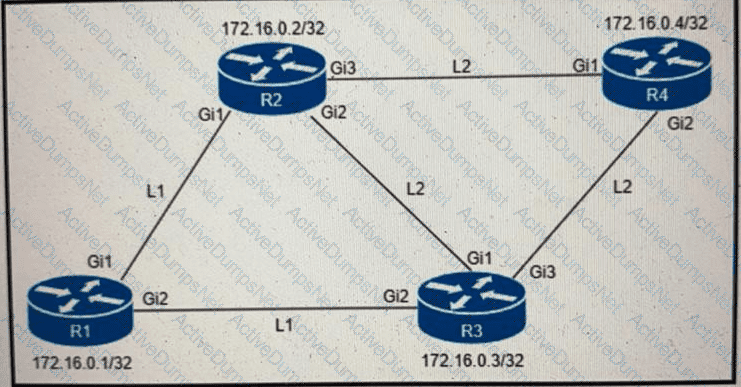
Refer to the exhibit.

Question # 10

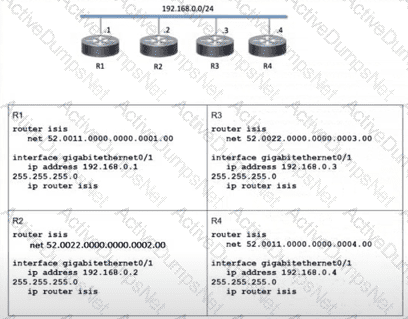
Which two topology changes happen to the IS-IS routers? (Choose two.)

Options:

A.

All four routers are operating as Level 1 routers only.

B.

All four routers are operating as Level 2 routers only.

C.

R1 and R4 are Level 2 neighbours.

D.

R1 and R2 are Level 2 neighbours.

E.

All four routers are operating as Level 1-2 routers.

Question 11

What is the primary role of a BR router in a 6rd environment?

Options:

A.

It provides connectivity between end devices and the IPv4 network.

B.

It embeds the IPv4 address in the 2002::/16 prefix.

C.

It connects the CE routers with the IPv6 network.

D.

It provides IPv4-in-IPv6 encapsulation

Question 12

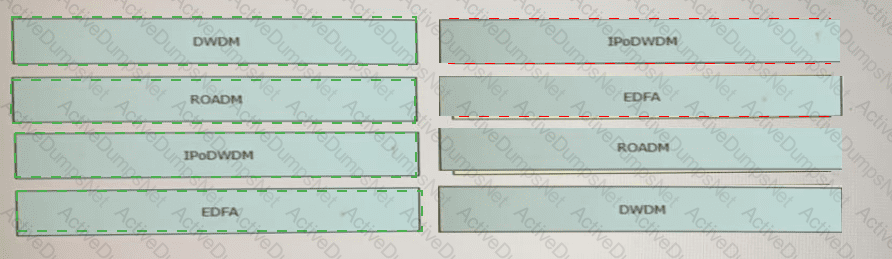
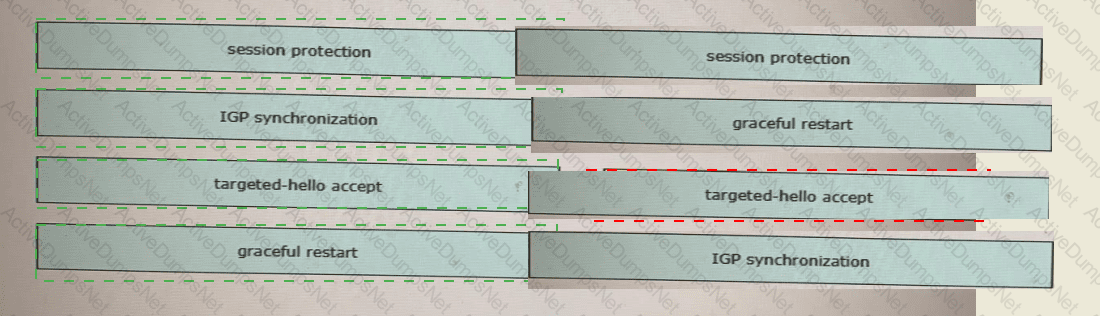
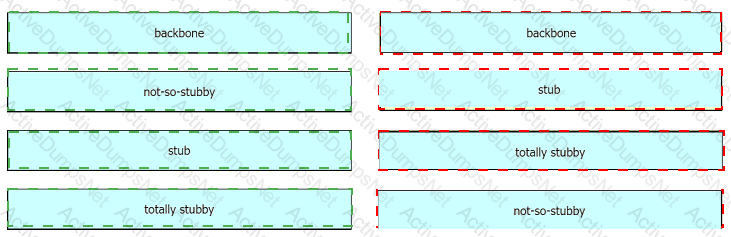
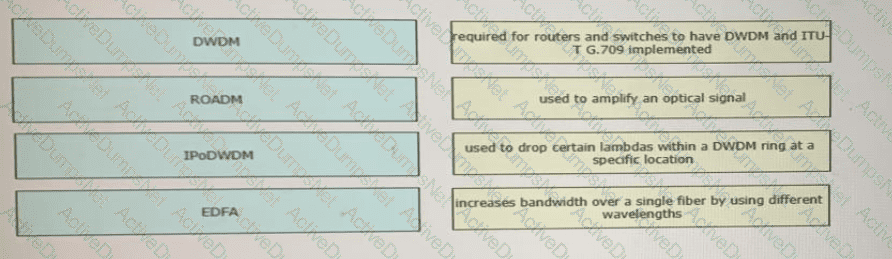
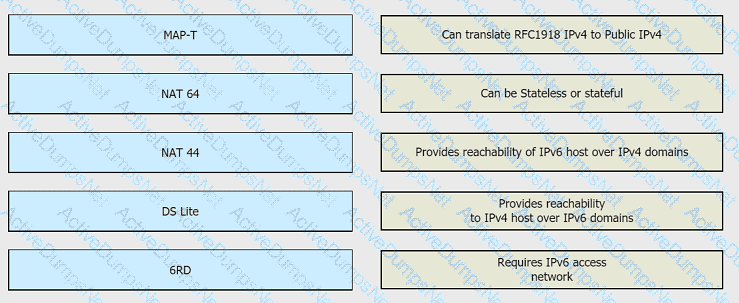
Drag and drop the technologies from the left onto the correct definitions on the right.
Question # 12

Options:

Question 13

Question # 13

Refer to the exhibit. An engineer is scripting ACLs to handle traffic on the given network. The engineer must block users on the network between R1 and R2 from leaving the network through R5. but these users must still be able to access all resources within the administrative domain. How must the engineer implement the ACL configuration?

Options:

A.

Configure an ACL that permits traffic to any internal address, and apply it to the R5 interfaces to R3 and R4 in the egress direction

B.

Configure a permit any ACL on the R1 interface to R2 in the egress direction, and a deny any ACL on the interface in the ingress direction

C.

Configure an ACL that permits traffic to all internal networks and denies traffic to any external address, and apply it to the R2 interface to R1 in the ingress direction.

D.

Configure an ACL that denies traffic to any internal address and denies traffic to any external address, and apply it to the R5 interfaces to R3 and R4 in the ingress direction

Question 14

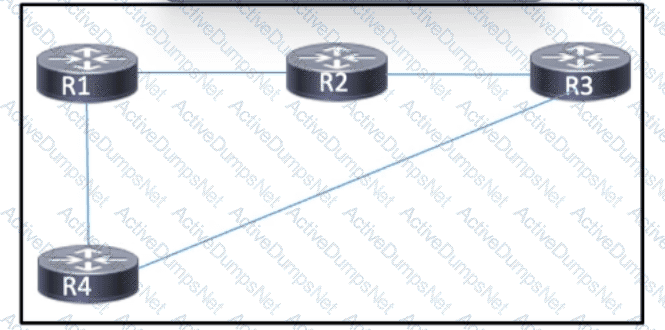
How do PE routers operate with the MDT in a multicast VPN?
Options:

A.

When the sending PE router recognizes that multicast data has exceeded the bandwidth threshold, it creates a data MDT and sends a UDP message to all routers using the default MDT.

B.

After the default MDT and BGP VPNv4 neighbor is configured, a different PE neighbor in the IPv6 MDT address family is configured automatically for migrating to MDT SAFI.

C.

When the source PE router establishes adjacency using PIM SM mode in the default MDT, the receiving PE requests information about the source PE for BGP advertisement.

D.

The default MDT uses PIM sparse mode and PIM establishes adjacency over the shortest path tree toward the destination PE router.

Question 15

Question # 15

Refer to the exhibit. MPLS is configured within the network. The routers use OSPF to exchange routing information. Hosts that are connected to routers R1 and R3 use routers R2 and R4 to access servers that run a variety of intranet applications. A network engineer must ensure that R1 and R3 maintain an LDP session between them to support the flow of traffic between hosts and servers in case of failure on the path between R1 and R3. Which task should the engineer perform to provide LDP bindings in case of failure on the path between R1 and R3?

Options:

A.

Implement session protection to send targeted hellos between R1 and R3.

B.

Implement multicast in the network to share data between hosts and servers without targeted routing.

C.

Implement LDP sync on the four devices to give MPLS and OSPF the ability to maintain continuous uptime.

D.

Implement BFD to monitor and detect link failures between R1 and R3.

Question 16

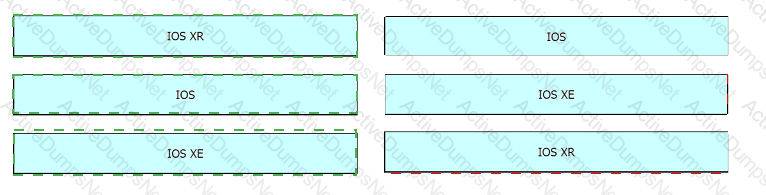
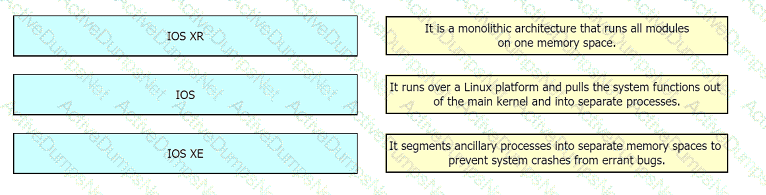
Drag and drop the OSs from the left onto the correct deceptions on the right.
Question # 16

Options:

Question 17

Refer to me exhibit.

Question # 17

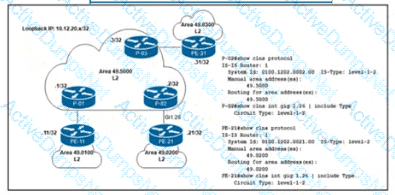
Refer to the exhibit. A network engineer notices PE-21 convergence degradation due to the growing LSDB size of Level 2 areas in the network. The engineer decides to migrate router PE-21 from an inter-area design to an intra-area implementation. Inter-area routing must be accomplished via an ATT-bit set by the Level 1/Level 2 router. Which configuration must the engineer implement on PE-21 to complete the migration?

Options:

A.

configure terminal

router isis 1

no net 49.0200

net 49.5000

is-type level-1-2

end

B.

configure terminal

router isis 1

net 49.5000.0100.1202.0021.00

is-type level-1-2

end

C.

configure terminal

router isis 1

net 49.5000.0100.1222.0022.00

is-type level-1

end

D.

configure terminal

router isis 1

no net 49.0200.0100.1202.0021.00

net 49.5000.0100.1202.0021.00

is-type level-1

end

Question 18

Drag and drop the functionalities from the left onto the correct target fields on the right.
Question # 18

Options:

Question 19

Question # 19

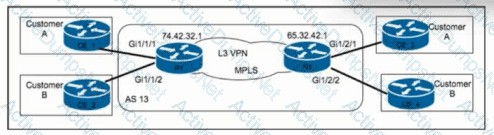
Refer to the exhibit. A Tier-2 ISP provides MPLS Layer 3 VPNs to customers throughout the region. BGP and OSPF are used as routing protocols in the backbone, and all routers are running Cisco IOS-XE software. Customer A has requested a private connection between two of its offices. The company has plans to interconnect more offices across the country soon, so the solution should allow for the addition of new sites without reconfiguring the existing sites. The customer is using an IPv6 addressing scheme. R1 has been preconfigured with vrf definition Customer_A and assigned rd 1441:3421.

Which two tasks should the engineer perform on R1 to configure the private connection? (Choose two.)

Options:

A.

Configure address-family unicast ipv6 Customer_A under the BGP configuration.

B.

Configure export route-target 1441:3421 under the VRF configuration.

C.

Configure address-family ipv6 unicast under the VRF configuration.

D.

Configure route-target both 1441:3421 under the address family configuration.

E.

Configure address-family unicast ipv6 vrf Customer_A under the OSPF configuration.

Question 20

Refer to the exhibit.

Question # 20

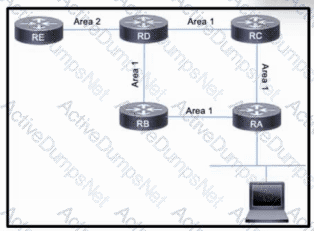
If RC is a stub router, which entry must be injected so that it will send traffic outside the OSPF domain?

Options:

A.

virtual link between RB and RC

B.

sham link

C.

more specific route

D.

default route

Question 21

Why is the keyword none needed when implementing management plane security using TACACS?

Options:

A.

It aItovSWMB6ter to query a RADIUS server when the TACACS+ server is unreachable.

B.

It allows the local database to authenticate when the TACACS^ server is unreachable.

C.

It allows authentication to succeed when the TACACS+ server is unreachable.

D.

It prevents all users from accessing router 1 unless the TACACS+ server is reachable,

Question 22

After a possible security breach, the network administrator of an ISP must verify the times that several different users logged into the network. Which command must the administrator enter to display the login time of each user that activated a session?
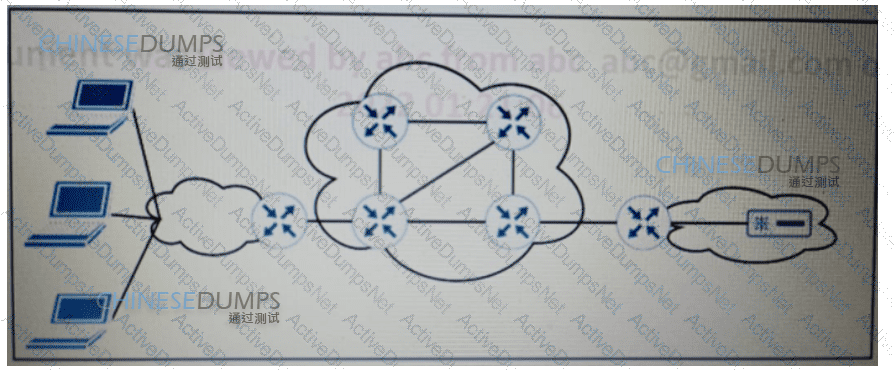
Options:

A.

show netconf-yang sessions detail

B.

show netconf-yang datastores

C.

show platform software yang-management process

D.

show netconf-yang sessions

Question 23

Question # 23

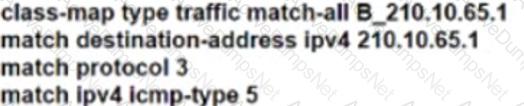
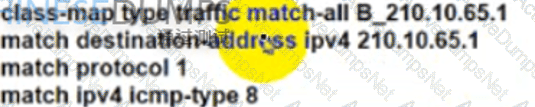
Refer to the exhibit. ISP A provides VPLS services and DDoS protection to Company XYZ to connect their branches across the North America and Europe regions. The uplink from the data center to the ISP is Mbps. The company XYZ security team asked the ISP to redirect ICMP requests which are currently going to the web server to a new local security appliance which configuration must an ISPP engineer apply to router R2 to redirect the ICMP traffic?

A)
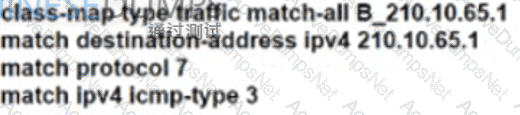
Question # 23

B)

Question # 23

C)

Question # 23

D)

Question # 23

Options:

A.

Option A

B.

Option B

C.

Option C

D.

Option D

Question 24

Question # 24

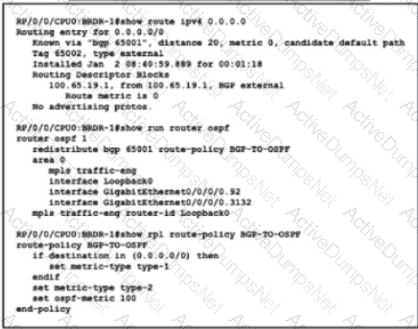
Refer to the exhibit. Router BRDR-1 is configured to receive the 0.0.0.0/0 and 172.17.1.0/24 network via BGP and advertise then into OSPF area 0. An engineer has noticed that the OSPF domain is receiving only the 172.17.1.0/24 route and default router 0.0.0.0/0 is still missing. Which configuration must an engineer apply to resolve this problem?

Question # 24

      Option A

      Option B

      Option C

Options:

A.

Option D

Question 25

When implementing a REST API, how does an engineer mitigate security risks?

Options:

A.

by configuring the system to authenticate the client's identity and avoid broken authentication

B.

by configuring object properties to protect data

C.

by configuring separate authorization schemes to securely compartmentalize different areas of the business

D.

by configuring rate limiting to reduce the risk of DOS and DDOS attacks against the system

Question 26

An ISP Is Implementing end-to-end fault monitoring for a customer based on the IEEE 802.3ah standard. The solution must detect when 15 or more corrupted Ethernet packets arrive within 10 ms and stop propagating traffic through the ISP backbone network or to the customer side. Which configuration must the ISP engineer apply?

Options:

A.

ethernet oam link-monitoring enable

ethernet oam link-monitor crc-errors ingress time-window 10

ethernet oam link-monitor crc-errors ingress threshold high 15 ethernet oam link-monitor crc-errors egress time-window 10 ethernet oam link-monitor crc-errors egress threshold high 15 ethernet oam link-monitor high-threshold action shutdown-interface

B.

ethernet oam link-monitoring

ethernet oam link-monitor receive-crc window 15

ethernet oam link-monitor receive-crc threshold high 10

ethernet oam link-monitor high-threshold action disable-interface

C.

ethernet oam

ethernet oam link-monitor receive-crc window 10

ethernet oam link-monitor receive-crc threshold high 15

ethernet oam link-monitor transmit-crc window 10

ethernet oam link-monitor transmit-crc threshold high 15

ethernet oam link-monitor high-threshold action errordisable-interface

D.

ethernet oam link-monitoring global enable

ethernet oam link-monitor receive crc-errors period 15

ethernet oam link-monitor receive crc-errors limit 15

ethernet oam link-monitor transmit crc-errors period 10

ethernet oam link-monitor transmit crc-errors limit 15

ethernet oam link-monitor limit action error-disable interface

Question 27

Refer to the exhibit.

Question # 27

An engineer is securing a customer's network. Which command completes this configuration and the engineer must use to prevent a DoS attack?

Options:

A.

neighbor ebgp-multihop

B.

ebgp-multihop

C.

ttl-security

D.

neighbor-ttl-security

Question 28

While an engineer deploys a new Cisco device to redistribute routes from OSPF to BGP, they notice that not all OSPF routes are getting advertised into BGP. Which action must the engineer perform so that the device allows O, OIA, OE1, and OE2 OSPF routes into other protocols?

Options:

A.

Configure the device to pass only O and E2 routes through it.

B.

Configure the synchronization keyword in the global BGP configuration.

C.

Configure the keyword nssa in the redistribution entry.

D.

Configure the keywords internal and external in the redistribution entry.

Question 29

Drag and drop the functions from the left onto the Path Computation Element Protocol roles on the right.
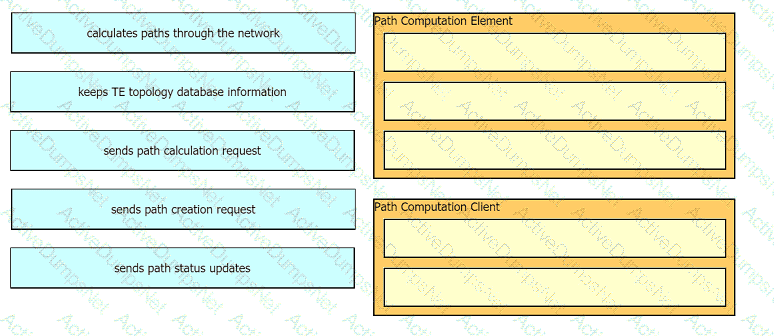
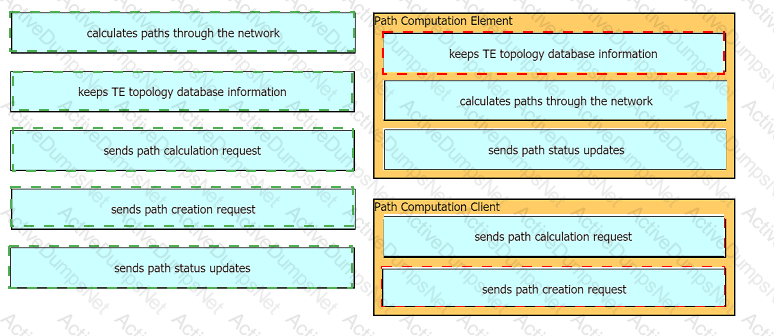
Question # 29

Options:

Question 30

Which function does orchestrated fulfillment perform under the Cisco Network Services Orchestrator model?
Options:

A.

It maintains the service topology in an inventory system to enable accurate assessment of service impact and support root-cause analysis.

B.

It translates the networking service high-level intent into device configurations, and pushes the configurations to physical and virtual devices.

C.

It leverages open-source NFV components such as OpenStack virtual infrastructure manager and Open vSwitch to create necessary service chains among VNFs.

D.

It instantiates virtual test probes to perform activation testing and provide ongoing measurement of service KPIs against defined SLAs.

Question 31

Question # 31

Question # 31

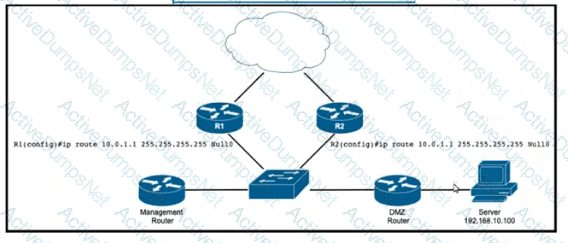
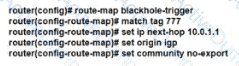
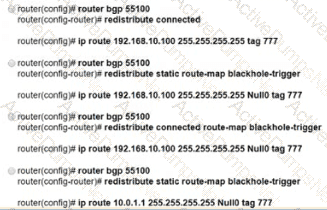
Refer to the exhibit. EIGRP a running across the core lo exchange Internal routes, and each router maintains 6GP adjacency with the other routers on the network. An operator has configured static routes on the edge routers R1 and R2 for IP address 10.0.1.1. which is used as a black hole route as shown. Which configuration should the operator Implement to me management rouler to create a route map that will redistribute lagged static routes into BGP and create a static route to blackhole traffic with tag 777 that Is destined to server at 192.168.10.100?
Question # 31

Options:

A.

Option A

B.

Option B

C.

Option C

D.

Option D

Question 32

A network engineer must enable multicast on the network to support a new series of webcasts. The PIM protocol has been enabled on the LAN side, with PIM and MSDP capabilities on edge router R1. The multicast source has been configured with IP address FF3A:121, and IP protocol 58 has been enabled and successfully tested in the network. Due to the limitations of some devices on the network, the data flow should take the most efficient path.

Which task must the engineer perform to achieve the goal?

Options:

A.

Enable PIM BSR on R1.

B.

Implement Anycast RP on R1.

C.

Implement PIM-SM in the LAN.

D.

Enable PIM-SSM across the network.

Question 33

A network engineer must implement an ACL-based solution to mitigate availability issues on a web service that is hosted on a server at IP address 172.16.15.18/23. Access to the web server should be allowed over HTTP from RFC 1918 addresses only. The network architect has already enabled PMTUD in the network. Which ACL configuration must the engineer implement to complete the task?

Options:

A.

access-list 198 deny ip any host 172.16.15.18 fragments

access-list 198 permit 6 10.0.0.0 0.255.255.255 172.16.15.18 0.0.1.255 eq 80

access-list 198 permit 6 172.16.0.0 0.0.255.255 172.16.15.18 0.0.1.255 eq 80

access-list 198 permit 6 192.168.0.0 0.0.0.255 172.16.15.18 0.0.1.255 eq 80

access-list 198 deny ip any any

B.

access-list 198 deny ip any host 172.16.15.18 ip-fragments

access-list 198 permit 18 10.10.0.0 0.0.255.0 172.16.15.18 255.255.254.0

access-list 198 permit 18 172.16.0.0 255.255.0 172.16.15.18 255.255.254.0

access-list 198 permit 18 192.168.0.0 255.255.0 172.16.15.18 255.255.254.0

access-list 198 deny tcp any any

C.

access-list 199 deny ip any host 172.16.15.18 tcp-fragments

access-list 199 permit tcp 10.0.0.0 0.0.255.255 172.16.15.18 0.0.254.255 eq 80

access-list 199 permit tcp 172.16.0.0 0.0.0.255 172.16.15.18 0.0.254.255 eq 80

access-list 199 permit tcp 192.168.0.0 0.0.0.255 172.16.15.18 0.0.254.255 eq 80

access-list 199 deny ip any any

D.

access-list 199 deny tcp any host 172.16.15.18 http-fragments

access-list 199 permit 16 10.10.0.0 0.255.255.255 172.16.15.18 0.0.2.253 eq 80

access-list 199 permit 16 172.16.0.0 0.0.255.255 172.16.15.18 0.0.2.253 eq 80

access-list 199 permit 16 192.168.0.0 0.0.255 172.16.15.18 0.0.2.253 eq 80

access-list 199 deny tcp any any

Question 34

What are two features of 6RD IPv6 transition mechanism? (Choose two.)
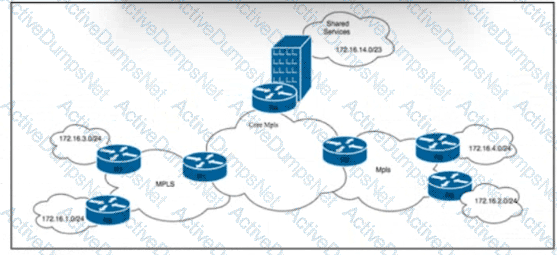
Options:

A.

It inserts IPv4 bits into an IPv6 delegated prefix.

B.

It uses a native IPv6-routed network between CE routers and the BR router.

C.

It allows dynamic 1:N translation of IPv6 address.

D.

It uses stateful automatic 6to4 tunnels between CE routers and the BR router.

E.

It uses stateless automatic 6to4 tunnels between CE routers and the BR router.

Question 35

Question # 35

Refer to the exhibit. The ISP is implementing a new hosting-as-a-service solution for its business customers. Service accessibility must be unique and separate for each customer. The network architect must ensure that multiple paths toward the hosting-as-a-service solution are always available. Basic protection against traffic black-holing on the MPLS network is required in case of link failure. Which two actions must the engineering team perform to meet the requirements? (Choose two.)

Options:

A.

Create the hosting-as-a-service VRF on router R4 and configure It with the route target both 65123:88 command.

B.

Configure the fast-reroute per-prefix command for the IS-IS protocol in the MPLS network and enable the BGP route-reflector feature on R2.

C.

Enable the VRF-Lite feature on router R4 and enable BGP address-family VPNv4.

D.

Configure the mpls Idp sync command in the MPLS network with the BGP additional-paths receive and additional-paths send options.

E.

Configure the fast-hello command under the IS-IS routing protocol with the BGP multipath 2 option enabled.

Question 36

Refer to the exhibit.

Question # 36

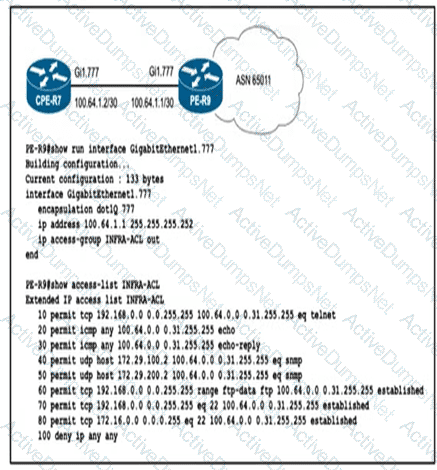
To protect in-band management access to CPE-R7, an engineer wants to allow only SSH management and provisioning traffic from management network 192.168.0.0/16. Which infrastructure ACL change must be applied to router PE-R9 to complete this task?

A)

Question # 36

B)

Question # 36

C)

Question # 36

D)

Question # 36

Options:

A.

Option A

B.

Option B

C.

Option C

D.

Option D

Question 37

Refer to the exhibit.

Question # 37

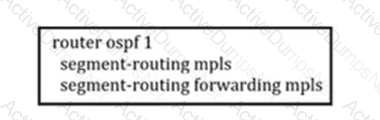
AN engineer is configuring segment routing on an ISP to simplify traffic engineering and management across network domains. What should the engineer do to complete the implementation of segment routing?

Options:

A.

OSPF must be configured with wide area metrics to support routing.

B.

The segment will run without any further configuration.

C.

Area authentication must be enable before segment routing will run.

D.

Area Authentication must be enable before segment routing will run.

Question 38

Which function does RSVP perform in a Cisco MPLS TE environment?

Options:

A.

It establishes targeted LDP sessions between neighbors that are directly connected.

B.

It signals to LDP protocol along the path that a Cisco MPLS TE will be configured.

C.

It reserves bandwidth for LDP sessions between routers participating in a Cisco MPLS TE.

D.

It reserves the bandwidth along the path between the head-end and tail-end router.

Question 39

R1 serves as a route reflector on a BGP-enabled network and has dual RPs installed. To ensure that all routes have been processed when an RP fails over, R1 must send the router request to all peers configured with NSR to refresh the route database. Which action completes the implementation?

Options:

A.

Implement bgp fast-external-failover under the BGP IPv4 address-family configuration.

B.

Enable bgp jett rp route-update in the global router configuration.

C.

Enable bgp sso route-refresh-enable in the global BGP configuration.

D.

Implement bgp consistency-checker auto-repair under the Cisco Express Forwarding configuration.

Question 40

Refer to the exhibit.

Question # 40

What does the number 2 mean in the configuration?

Options:

A.

It dictates the number of sessions that will be open with the SNMP manager

B.

It represents the version of SNMP running.

C.

It indicates two SNMP managers are able to read and write with the agent using community string ciscotest.

D.

It is the numeric name of the ACL that contains the list of SNMP managers with access to the agent.

Question 41

The network team is planning to implement IPv6 on the company’s existing IPv4 network infrastructure. The network currently uses IS-IS to share routes between peers. Which task must the team perform so that IS-IS will run in multitopology mode on the updated IPv6 network?

Options:

A.

Configure the links between the network routers as point-to-point.

B.

Configure the network routers to use metric-style wide.

C.

Configure the network routers as Level 2 routers.

D.

Configure the IS-IS IPv6 metric on the dual-stack links.

Question 42

Question # 42

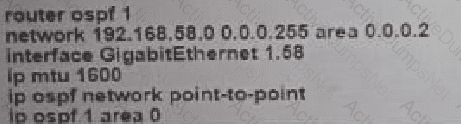
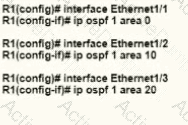
Refer to the exhibit. An engineer started to configure a router for OSPF. Which configuration must the engineer perform on the router without changing any interface configuration so that the router establishes an OSPF neighbor relationship with its peer?

Options:

A.

router(config)# router ospf 11router(config-if)# no passive-interface ethernet 1/1

B.

router(config)# interface ethernet 1/1router(config-if)# no shutdown

C.

router(config)# interface ethernet 1/1router(config-if)# ip ospf hello-interval

D.

router(config)# interface ethernet 1/1router(config-if)# ip ospf priority 0

Question 43

Which is the benefit of implementing model-driven telemetry in a service provider environment?

Options:

A.

It reduces the number of network monitoring tools that are necessary to verify device statistics.

B.

It increases the efficiency of SNMP by pulling system data to requesting servers.

C.

It reduces or eliminates the need to monitor Layer 2 traffic between switches.

D.

It uses reliable transport to push Information to network monitoring tools

Question 44

Drag and drop the OSPF and IS-IS Cisco MPLS TE extensions from the left to their functional descriptions on the right.
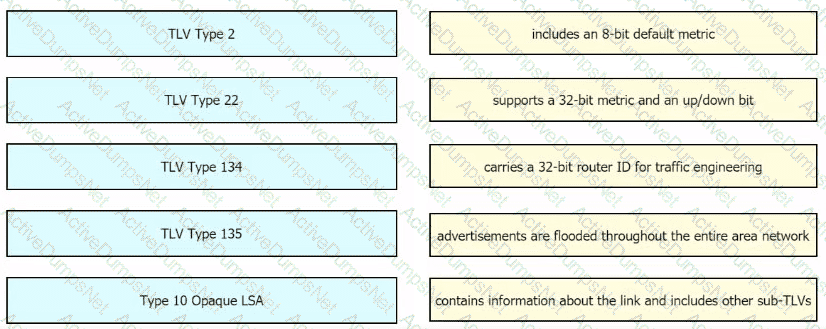
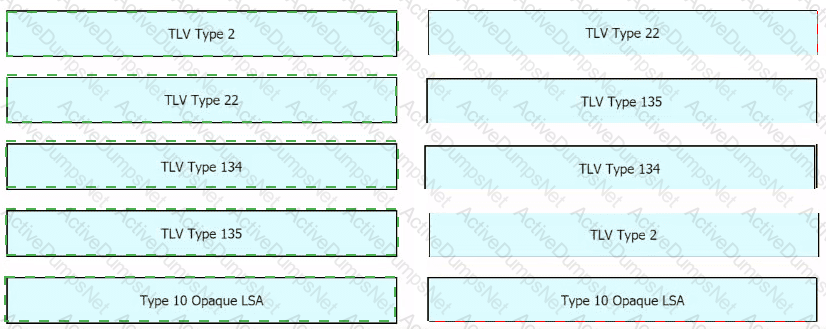
Question # 44

Options:

Question 45

Simulation 8

Question # 45Question # 45

Question # 45

Options:

Question 46

Question # 46

Question # 46

Refer to the exhibit. LDP peering between routers R1 and R2 is dropped when the link between R1 and R2 is taken offline. However, LDP peering between R2 and R3 stays up when the link between R2 and R3 is taken offline. Which action allows MPLS traffic forwarding to continue normally if the link between R1 and R2 goes down?

Options:

A.

Enable IGP and LDP Synchronization on R1.

B.

Implement LDP Session Protection on R1.

C.

Enable IGP and LDP Synchronization on R2.

D.

Implement LDP Session Protection on R2.

Question 47

The engineering team at a large ISP has been alerted a customer network is experiencing high traffic congestion. After a discussion between the ISP and technical personnel at the customer site, the team agrees that traffic to the customer network that exceeds a specific threshold will be dropped. Which task must the engineer perform on the network to implement traffic policing changes?

Options:

A.

Configure RSVP to reserve bandwidth on all interfaces when a path is congested.

B.

Enable Cisco Discovery Protocol on the interface sending the packets.

C.

Enable Cisco Express Forwarding on the interfaces sending and receiving the packets.

D.

Set IP precedence values to take effect when traffic exceeds a given threshold.

Question 48

You are creating new Cisco MPLS TE tunnels. Which type of RSVP message does the headend router send to reserve bandwidth on the path to the tunnel’s router?

Options:

A.

error

B.

reservation

C.

path

D.

tear

Question 49

How is a telemetry session established for data analytics?
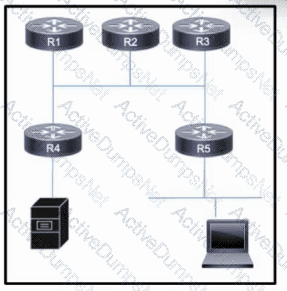
Options:

A.

A router initiates a session using the dial-out to a destination.

B.

A destination initiate a session to a router.

C.

The destination initiate a session using the dial-out more to the router.

D.

A router requests the data using Teinet.

Question 50

Question # 50

Refer to the exhibit. A large enterprise streams training videos from a server connected to R4 to hosts connected to R5. PIM-SM is configured in the network using IGMPv2, with R2 serving as the RP. OSPF is configured in the network to support IGP routing, and the network uses BGP to access the internet through R3. The network engineering team must migrate the network to SSM.

Which action must the team take to begin the migration?

Options:

A.

Enable the MDT address family in BGP.

B.

Change the PIM version from PIM-SM to PIM-DM.

C.

Upgrade IGMPv2 to IGMPv3.

D.

Update the device configurations so that R5 will serve as the RP.

Question 51

Refer to the exhibit.

Question # 51

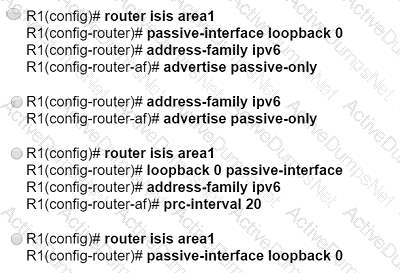
A network engineer with an employee id: 3812:12:993 has started to configure router R1 for IS-IS as shown. Which additional configuration must be applied to configure the IS-IS instance to advertise only network prefixes associated to passive interfaces?
Question # 51

Options:

A.

Option A

B.

Option B

C.

Option C

D.

Option D

Question 52

Refer to the exhibit.

Question # 52

An engineer must configure router R2 as the new P router in the network. Which configuration must be applied to R2 to enable LDP-IGP Sync on its L2 IS-IS adjacencies?

Question # 52

Options:

A.

Option A

B.

Option B

C.

Option C

D.

Option D

Question 53

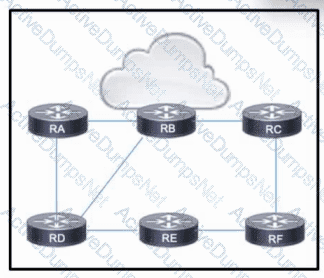
Which MPLS design attribute can you use to provide Internet access to a major customer through a separate dedicated VPN?
Options:

A.

The customer that needs the Internet access service is assigned to the same RTs as the Internet gateway

B.

The Internet gateway inserts the full Internet BGP routing table into the Internet access VPN

C.

The Internet gateway router is connected as a PE router to the MPLS backbone.

D.

The CE router supports VRF-Ute and the full BGP routing table.

Question 54

Question # 54

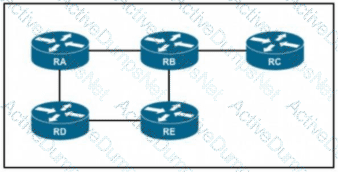
Refer to the exhibit. The network is running OSPF, and access to the internet is provided through router RB. Router RA connects to several servers that provide services to users connected to RC and RF. User traffic is growing, and the engineering team wants to mitigate the future potential for congestion when the servers are experiencing heavy use.

Which action must the team take to maintain better network performance?

Options:

A.

Implement MPLS and install a Cisco MPLS TE tunnel to route high-priority traffic via a preferred path.

B.

Implement ACLs to manage traffic flowing over individual links.

C.

Implement class maps to categorize traffic and apply them to policies to manage traffic flow.

D.

Implement OSPF point-to-point links to eliminate the need for DR election and the associated traffic.

Question 55

What is the purpose of microsegments in the SRv6 architecture?

Options:

A.

They ensure that routers in the path sufficiently examine the indexed mapping tables.

B.

They support a scalable control plane.

C.

They reduce fragmentation as packets traverse the network.

D.

They allow for configuration changes in the SRv6 data plane without requiring the device to reboot.

Question 56

An engineer Is implementing NSR with OSPF on a large campus that requires high availability. Which task must an engineer perform to complete the process with minimal disruption to traffic?

Options:

A.

Reset OSPF neighbor sessions to maintain state Information during router switchover

B.

Configure the device to repopulate state information using routing updates received from the BDR

C.

increase the keepalive interval on the OSPF neighbors so that traffic continues to pass during the switchover.

D.

Ensure that the dual RP has synchronized their state information before performing the switchover operation.

Question 57

Which two tasks must an engineer perform when implementing LDP NSF on the network? (Choose two.)

Options:

A.

Disable Cisco Express Forwarding.

B.

Enable NSF for EIGRP.

C.

Enable NSF for the link-state routing protocol that is in use on the network.

D.

Implement direct connections for LDP peers.

E.

Enable NSF for BGP.

Question 58

Refer to the exhibit.

Question # 58

A network engineer is configuring customer edge routers to finalize a L2VPN over MPLS deployment Assume that the AToM L2VPN service that connects the two CEs is configured correctly on the service provider network Which action causes the solution to fail?

Options:

A.

A loopback with a /32 IP address has not been used

B.

OSPF does not work with L2VPN services

C.

The xconnect statement has not been defined

D.

The routing protocol network types are not compatible

Question 59

Simulation2

TOPOLOGY

Question # 59

Question # 59

Question # 59

Options:

Question 60

Refer to the exhibit:

Question # 60

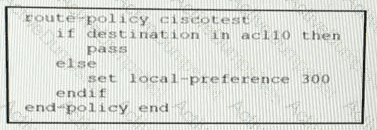
A network administrator wants to enhance the security for SNMP for this configuration.

Which action can the network administrator implement?

Options:

A.

Re-configure to use SNMPv2 with MD5 authentication

B.

Add a community string to the existing entry

C.

Re-configure to use SNMPv3.

D.

Maintain the configuration but switch to an encrypted password for device access through SSH

Question 61

When configuring traffic engineering tunnels in Cisco MPLS core network, you see the traffic is not taking the expected path in the core.

Which command do you use to quickly check path of a TE tunnel?

Options:

A.

Traceroute mpls ipv4 -tunnel destination

B.

Ping

C.

show mpls traffic-engineering tunnels

D.

traceroute

Question 62

Refer to the exhibit.

Question # 62

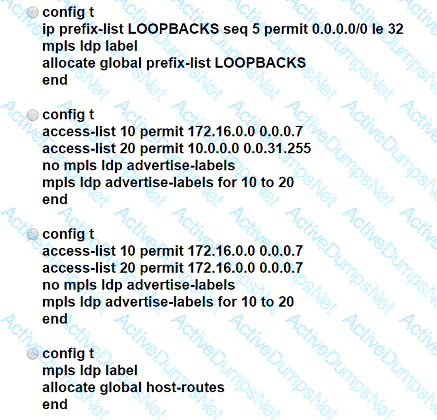
Which configuration must be applied to each of the four routers on the network to reduce LDP LIB size and advertise label bindings for the /32 loopback IP space only?
Question # 62

Options:

A.

Option A

B.

Option B

C.

Option C

D.

Option D

Question 63

Refer to the exhibit.

Question # 63

Which configuration must be implemented on router R8 so that it will establish OSPF adjacency with R5?

A)

Question # 63

B)

Question # 63

C)

Question # 63

D)

Question # 63

Options:

A.

Option A

B.

Option B

C.

Option C

D.

Option D

Question 64

Question # 64

Refer to the exhibit. A host connected to R3 must connect with a server on R1 that provides critical, time-sensitive data. Traffic between the host and server must always be given bandwidth to traverse the links when they are congested, with other traffic being dropped. How must the network engineer implement a QoS strategy with classification to ensure that the traffic is given the appropriate bandwidth?

Options:

A.

Implement FIFO to guarantee that the server traffic is sent first while other traffic is queued.

B.

Implement policing to rate-limit noncritical traffic that exceeds designated thresholds.

C.

Implement traffic shaping to delay noncritical traffic when the link is congested.

D.

Implement strict priority to guarantee bandwidth for the server traffic.

Question 65

What is the role of NFVI?

Options:

A.

domain name service

B.

intrusion detection

C.

monitor

D.

network address translation

Question 66

Question # 66

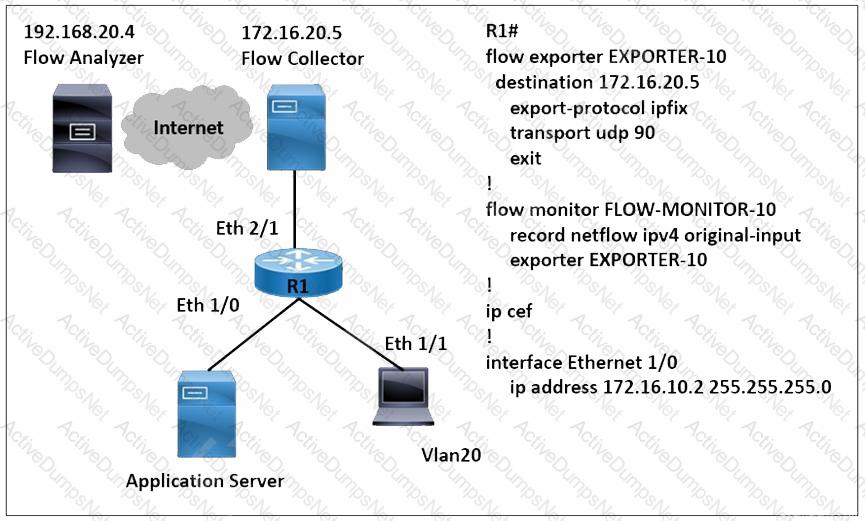
Refer to the exhibit. A network engineer wants to monitor traffic from the application server and send the output to the external monitoring device at 172.16.20.5. Application server traffic should pass through the R1 Eth2/1 interface for further analysis after it is monitored. Which configuration must be applied on the R1 router?

Options:

A.

Configure the FLOW-MONITOR-20 command.

B.

Configure the flow exporter EXPORTER-10 destination 192.168.20.4 command.

C.

Configure the ip flow monitor FLOW-MONITOR-10 input command on the Ethernet1/0 interface.

D.

Configure the ip flow monitor FLOW-MONITOR-10 output command on the Ethernet 2/1 interface.

Question 67

A network engineer is configuring a router to send multicast traffic for the 239.10.10.10 group. Which configuration must an .... forward the traffic?

Options:

A.

Cisco(config)# interface ethernet 1/0 Cisco(config-if)# ip igmp max-groups action replace

B.

Cisco(config)# interface ethernet 1/0 Cisco(config-if)# ip igmp filter

C.

Cisco(config)# interface ethernet 1/0 Cisco(config-if)# ip igmp access-group 239.10.10.10

D.

Cisco(config)# interface ethernet 1/0 Cisco(config-if)# ip igmp join-group 239.10.10.10

Question 68

Refer to the exhibit.

Question # 68

An engineer implemented OSPF neighbor relationship on an IOS device. Which configuration must be applied to get the OR/BOR election removed from interfaces running OSPF?

Options:

A.

ip ospf network broadcast on interfaces running OSPF

B.

ip ospf network point-to-point on interfaces running OSPF

C.

ip ospf network multipoint-point on interfaces running OSPF

D.

ip ospf network non-broadcast on n:erfaces running OSPF

Question 69

Question # 69

Refer to the exhibit. A large enterprise is migrating its network to use MPLS VPNs between different business divisions. Within the core, routes are shared between the routers using OSPF, and each connected link maintains an MPLS neighbor relationship.

Which action must the migration team take so that LDP neighbor relationships are maintained if a directly-connected link goes down?

Options:

A.

Implement targeted LDP sessions between directly connected routers and between routers that are one hop away.

B.

Implement LDP session protection between each directly connected LDP neighbor.

C.

Implement LDP sync between routers that are directly connected to each business division.

D.

Implement targeted LDP sessions between routers that are directly connected to each business division.

Question 70

Refer to the exhibit: Question # 70

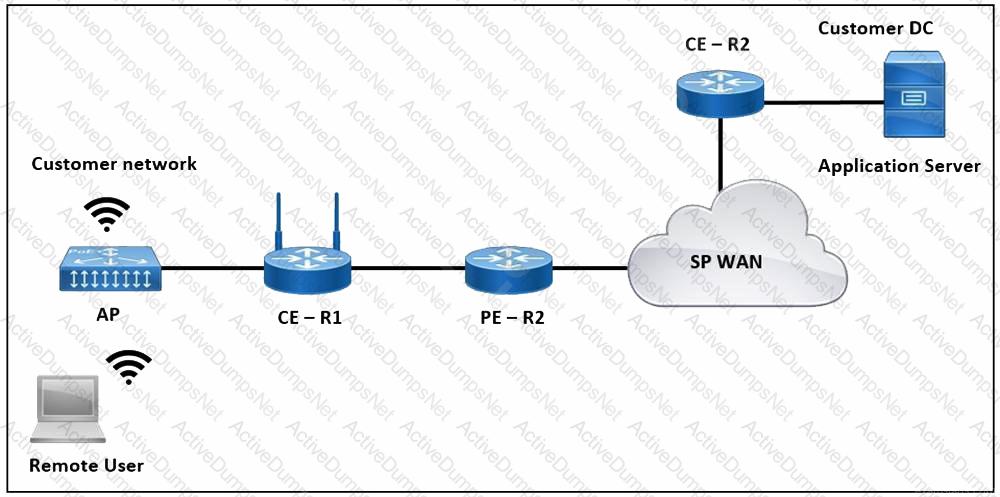
BGPsec is implemented on R1. R2. R3. and R4 BGP peering is established between neighboring autonomous systems Which statement about implementation is true?
Options:

A.

BGP updates from the eBGP peers are appended with an additional AS path value that is statically set by the domain administrator

B.

BGP updates from the iBGP peers are appended with a community of local-as

C.

BGP updates from the all BGP peers are appended with a community of no export

D.

BGP updates from the eBGP peers are appended with a BGPsec attribute sequence that includes a public key hash and digital signature

Question 71

Question # 71

Refer to the exhibit. The application server in the data center hosts voice, video, and data applications over the internet. The data applications run more slowly than the voice and video applications. To ensure that all applications run smoothly, the service provider decided to implement a QoS policy on router PER 2 to apply traffic shaping. Which two actions must an engineer take to implement the task? (Choose two.)

Options:

A.

Configure the scheduling function to handle delayed packets.

B.

Enable packet remarking for priority traffic.

C.

Configure a queue to buffer excess traffic.

D.

Set the token value for secondary traffic.

E.

Set a threshold to discard excess traffic.

Question 72

A customer of an ISP requests support to setup a BGP routing policy. Which BGP attribute should be configured to choose specific BGP speakers as preferred exit

points for the customer AS?

Options:

A.

highest local preference outbound

B.

lowest local preference inbound

C.

highest local preference inbound

D.

lowest multi-exit discriminator

Question 73

Refer to the exhibit.

Question # 73

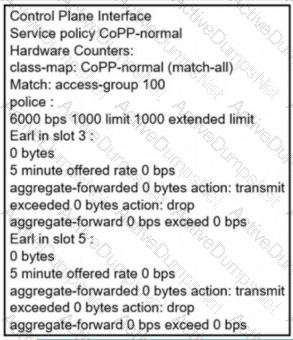
Which show command shows statistics for the control plane policy and is used to troubleshoot?
Options:

A.

show control-plane CoPP

B.

show control-plane

C.

show policy-map control-plane

D.

show policy control-plane

Question 74

Question # 74

Refer to the exhibit. ISP_A is a Tier-1 ISP that provides private Layer 2 and Layer 3 VPN services across the globe using an MPLS-enabled backbone network. Routers R1, R2, R13, and R14 are PE devices. ASRs R3 and R4 and ASBRs R11 and R12 are acting as route reflectors with preconfigured next-hop-self for all BGP neighbors. After the network experienced IGP RIB overflow with multiple routes, a network engineer is working on a more scalable network design to minimize the impact on local RIBs. The solution should be based on RFC 3107 and maintain existing QoS capabilities.

Which task must the engineer perform to achieve the goal?

Options:

A.

Implement Seamless Segment Routing on the ABR routers.

B.

Implement MPLS Traffic Engineering on PE routes only.

C.

Implement Hierarchical MPLS VPLS across all LDP-enabled routers.

D.

Implement Unified MPLS on all MPLS-enabled routers.

Question 75

A company uses PIM-SM multicast with IGMPv2 to stream training videos from a server in one network to hosts in a different network. As the company has grown, the networking team decided to implement SSM to improve efficiency for multicast within Layer 2. Which action must the team take to begin the process?

Options:

A.

Configure an IGMP querier and implement Cisco Express Forwarding across the network.

B.

Implement PIM-DM to enable the routers on the LAN to identify SSM-capable multicast hosts.

C.

Implement IGMPv3 and deprecate IGMPv2.

D.

Implement IGMPv3 simultaneously with IGMPv2 on the individual links that must support SSM and PIM-DM.

Question 76

Drag and drop the LDP features from the left onto the correct usages on the right.
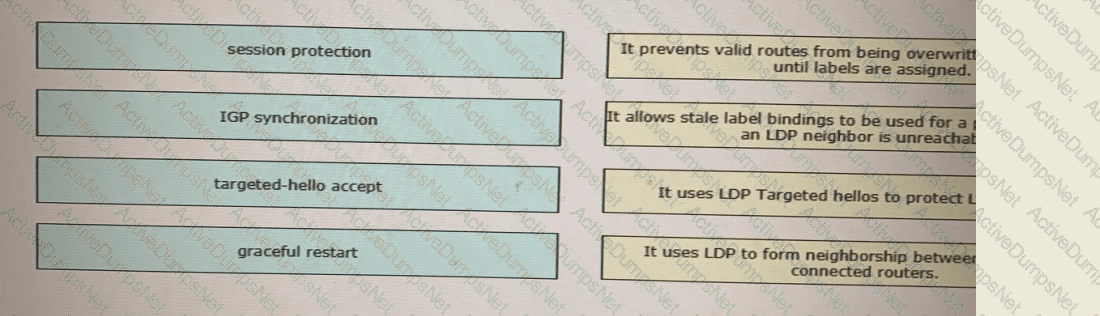
Question # 76

Options:

Question 77

What does DWDM use to combine multiple optical signals?

Options:

A.

frequency

B.

IP protocols

C.

time slots

D.

wavelength

Question 78

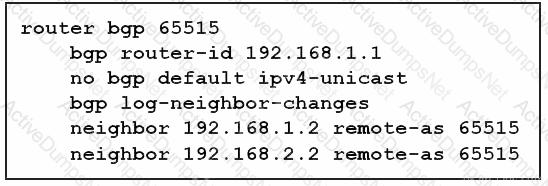
Which OoS model allows hosts to report their QoS needs to the network?
Options:

A.

DiffServ

B.

CB-WFQ

C.

IntServ

D.

MQC

Question 79

Question # 79

Refer to the exhibit. A network engineer is configuring a new router for iBGP to improve the capacity of a growing network. The router must establish an iBGP peer relationship with its neighbor. The underlay network is already configured with the correct IP addresses. Which step should the engineer apply to complete this task?

Options:

A.

Implement multicast routing on the router to support BGP hellos.

B.

Configure the AS number for the router to share with its iBGP peers.

C.

Configure the new router as an iBGP route reflector to support multiple iBGP peers.

D.

Activate the BGP peers under the correct address family on the router.

Question 80

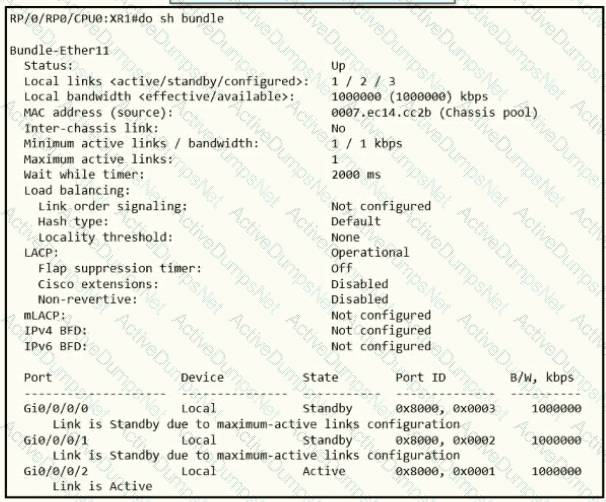
Refer to the exhibit.

Question # 80

A network operator needs to shut down interface Gi0/0/0/2 for maintenance. What occurs to the interface states of Gi0/0/0/0 and Gi0/0/0/1?
Options:

A.

Gi0/0/0/1 and Gi0/0/0/0 become active

B.

Gi0/0/0/1 and Gi0//0/0 remains standby

C.

Gi0/0/0/0 becomes active. Gi0/00/1 remains standby

D.

Gi0/0/0/1 becomes active Gi0/0/0/0 remains standby

Question 81

Question # 81

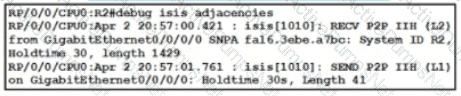
Refer to the exhibit. A network operator is attempting to configure an IS-IS adjacency between two routers, but the adjacency cannot be established. To troubleshoot the problem, the operator collects this debugging output. Which interface are misconfigured on these routers?
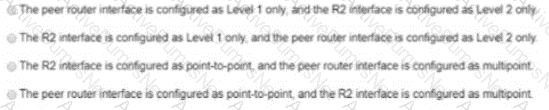
Question # 81

Options:

A.

Option A

B.

Option B

C.

Option C

D.

Option D

Question 82

Refer to the exhibit.

Question # 82

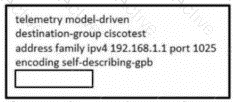
A Cisco engineer is implementing gRPC dial-out on an ASR. Receiver 192.168 1.1 will be assigned one of the subscriptions, and it will manage the ASR. Which command is needed to complete the router configuration?

Options:

A.

protocol grpc

B.

protocol all

C.

protocol tcp

D.

protocol any

Question 83

Question # 83

Refer to the exhibit. Router 1 and Router 2 were installed in the data center. Router 1 is the core router in the network, but it fails to establish an OSPF peering with Router 2. and customer traffic is unable to pass. Router 1 also reports an increase in CPU and memory usage. However, the CPU for R2 is stable. Which action resolves this issue?

Options:

A.

Disable Cisco Express Forwarding on Router 2.

B.

Change the transport mode to WAN on Router 1.

C.

Change the MTU to 1524 on Router 1.

D.

Enable MPLS on Router 2.

Question 84

What is the purpose of RSVP tear messages?
Options:

A.

to notify the tail-end router of resource unavailability on the transit router

B.

to inform the headend router of LSP issues

C.

to reuse router resources for other reservation requests

D.

to confirm successful end-to-end resource allocation

Question 85

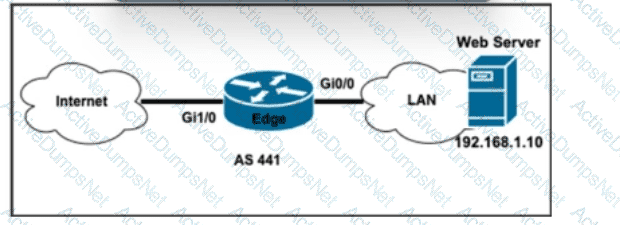
Question # 85

Refer to the exhibit. The network manager asked a network engineer to increase data-plane security on an Edge router connected to the internet with these requirements:

*Allow incoming HTTP traffic from any source to the Web server with IP address 192.168.1.10.

*Allow incoming SSH traffic from the management host with IP address 10.0.0.10.

*Block incoming Telnet traffic from all sources.

Which action must the engineer take to meet the requirements?

Options:

A.

Implement port security under the Gi0/0 interface.

B.

Implement uRPF under the Gi1/0 interface.

C.

Implement an access control list under the Gi1/0 interface.

D.

Implement Network Address Translation under the Gi0/0 interface.

Question 86

Refer to the exhibit.

Question # 86

An engineer began to configure LDP between R1 and R2, but R1 and R2 cannot yet establish an LDP TCP connection. Which additional task must be completed to finish the implementation?
Options:

A.

Configure the mpls Idp neighbor 172.16.0.1 password command on R1

B.

Configure the mpls Idp neighbor 10.0.12.1 password command on R1

C.

Configure the no mpls Idp password option 1 command on R2

D.

Configure the no mpls Idp password option 1 command on R1

Question 87

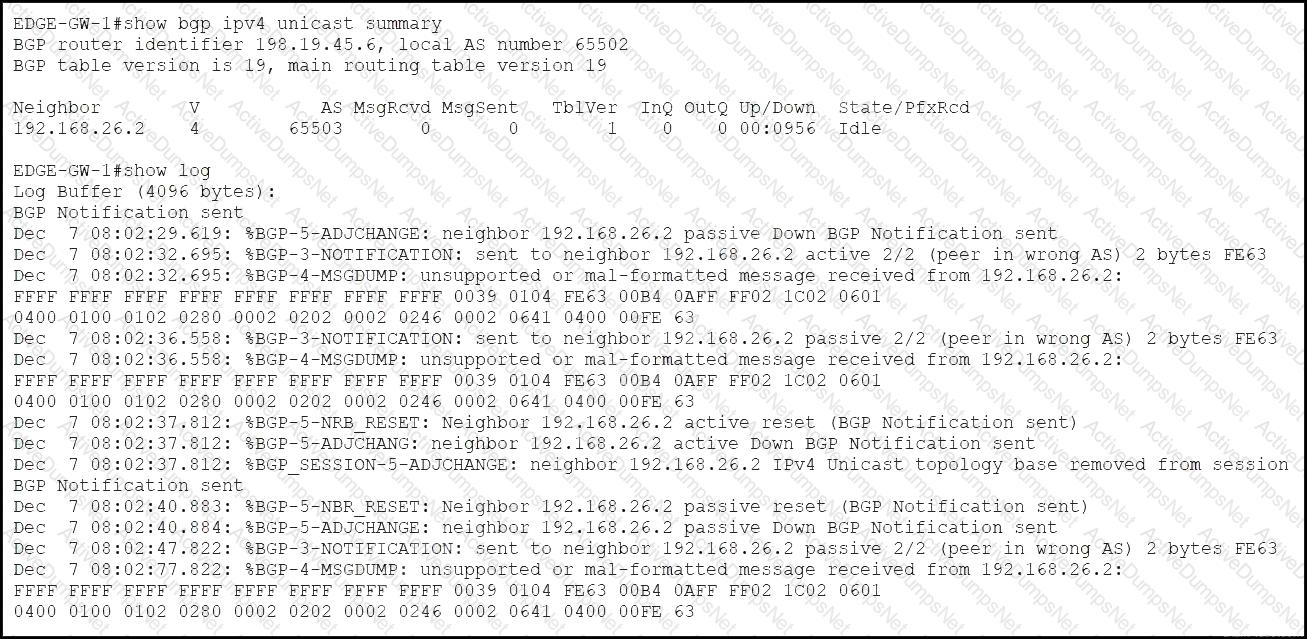
Question # 87

Refer to the exhibit. A network support engineer for ASN 65502 receives a technical support ticket from a customer in ASN 65503 who reports that an eBGP session is down. The engineer determines that the peering failed after a recent change to the device at 192.168.26.2. EDGE-GW-1 must establish an eBGP session with the peering router 192.168.26.2. Which configuration establishes this session?
Options:

A.

configure terminal

no router bgp 65502

router bgp 65503

neighbor 192.168.26.2 remote-as 65503

address-family ipv4

neighbor 192.168.26.2 activate

end

B.

configure terminal

router bgp 65502

address-family ipv4

neighbor 192.168.26.2 activate

end

C.

configure terminal

no router bgp 65502

router bgp 65503

neighbor 192.168.26.2 remote-as 65123

address-family ipv4

neighbor 192.168.26.2 activate

end

D.

configure terminal

router bgp 65502

no neighbor 192.168.26.2 remote-as 65503

neighbor 192.168.26.2 remote-as 65123

address-family ipv4

neighbor 192.168.26.2 activate

end

Question 88

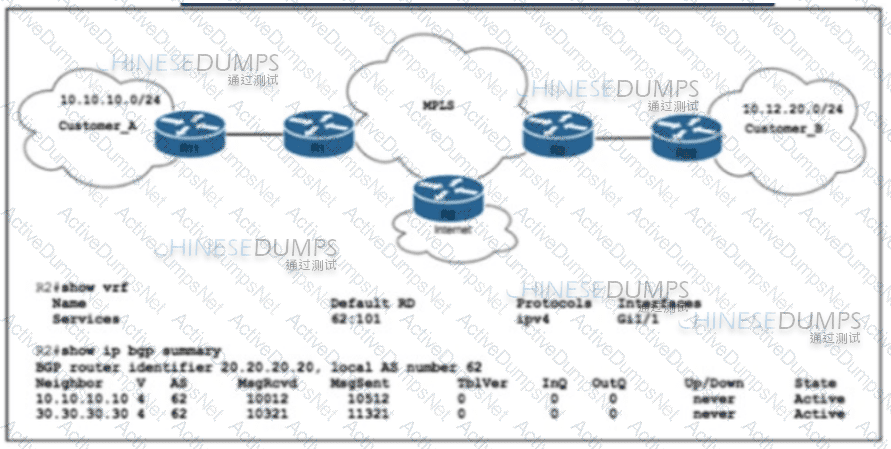
Question # 88

Refer to the exhibit. ISP_A is about to launch a new internet service. ISP_A is already providing MPLS VPN Layer 3 services to Customer_A and Customer_B, which are connected to ISP_A via OSPF. A network engineer completed the BGP and VRF configurations on R2 to support the new internet service. Which additional action completed the launch?
Options:

A.

Implement the BGP routing protocol in the customer VRFs on R1 and R2

B.

Import route-target 62:101 into the customer VRFs on R1 and R3.

C.

Enable the route-replicate command under the customer VRFs on R1 and R2

D.

Activate NAT CE in the customer VRFs on R1. R2. and R3.

Question 89

Question # 89

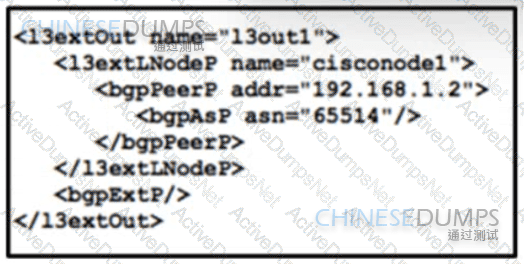
Refer to the exhibit. A global company plans to implement BGP at its newest location to provide connectivity to other offices. The global infrastructure of the company is a multivendor environment. An engineer must review the BGP core configurations at headquarters to determine if they can be repurposed at the new location. The engineer copied this JSON script for review. What is the effect of the script?

Options:

A.

It configures BGP with neighbor 192.168.1.2 residing in AS 65514.

B.

It sets the BGP router-ID to 192.168.1.2 and sets the AS of the router to 65514.

C.

It configures BGP on the device and inserts 192.168.1.0/24 into the BGP table using the origin AS 65514.

D.

It configures a VRF named cisconode1 and a BGP instance using the VPNv4 address family.

Question 90

Exhibit:

Question # 90

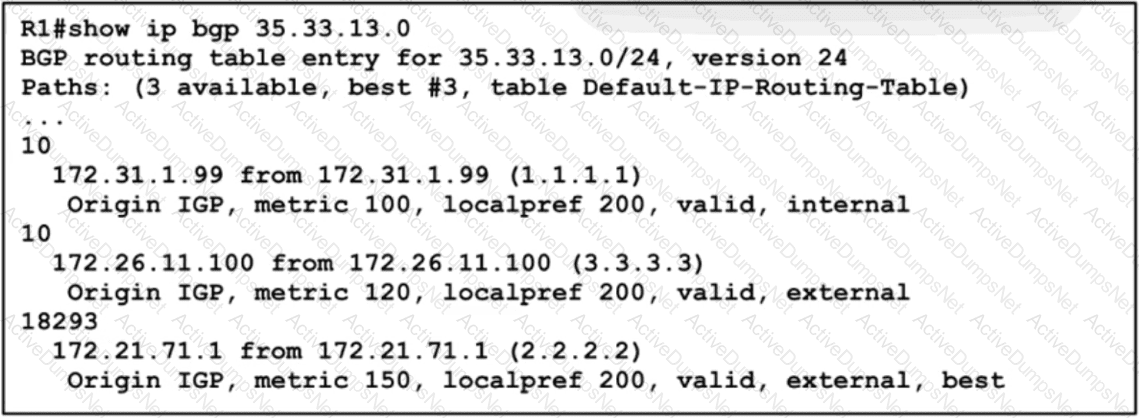
A network engineer must update the routing toward the web server with IP address 35.22.13.1. The primary path must be configured via the neighbor router with ID 1.1.1.1. However, local-preference configuration is not permitted on R1. Which task must the engineer perform on R1 to complete the implementation?

Options:

A.

Configure the device to choose the best MED from the same AS.

B.

Set the device to ignore the conditional MED if the route originated in a different autonomous system.

C.

Enable MED comparison between routes from neighbors in different AS.

D.

Implement deterministic MED to choose the best route from the different AS.

Question 91

The service provider is serving hosts with two different multicast streams from source X and source Y. Source X is multicast group 224.0.0.0/8, and source Y is multicast group 226.0.0.0/8. Multicast source X should send its stream through bidirectional RP address 10.20.1.1, and multicast source Y should send its stream through RP address 10.20.2.1. Which configuration meets these requirements?

Options:

A.

Enable ip pim ssm default on RA and RB.

B.

Add ip pim bidir-enable in global mode on RB.

C.

Permit the source X and source Y IP addresses in the access list on RB.

D.

Set PIM sparse mode with a static RP address of 10.20.2.1 on RA and RC.

Question 92

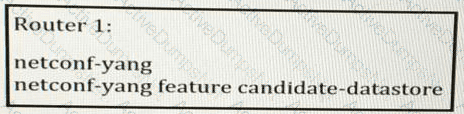
Refer to the exhibit:

Question # 92

Which statement describes this configuration?

Options:

A.

Router 1 has its running configuration locked so changes can be made only when the administrator issues a kill session

B.

Router 1 can be remotely managed by the CLI using Telnet

C.

Router 1 has a new data store to collect SNMP information, but configuration must still be done at the CLI only

D.

Router 1 has a temporary data store where a copy of the running configuration can be manipulated and verified before committing the configuration

Question 93

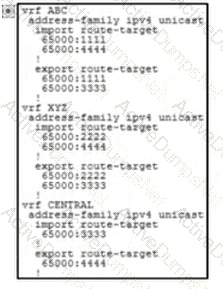
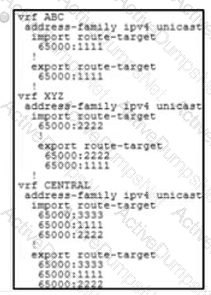
An engineer is setting up overlapping VPNs to allow VRF ABC and XYZ to communicate with VRF CENTRAL but wants to make sure that VRF ABC and XYZ cannot communicate. Which configuration accomplishes these objectives?

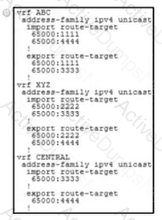
Question # 93

Question # 93

Question # 93

Question # 93

Options:

A.

Option A

B.

Option B

C.

Option C

D.

Option D

Question 94

Which configuration enables BGP FlowSpec client function and installation of policies on all local interfaces?

A)

Question # 94

B)

Question # 94

C)

Question # 94

D)

Question # 94

Options:

A.

Option A

B.

Option B

C.

Option C

D.

Option D

Question 95

A network architect décides to expand the scope of the multicast deployment within the company network the network is already using PlM-SM with a static RP that supports a high-bandwidth. video-based training application that s heavily used by the employees, but excessive bandwidth usage is a concern How must the engineer update the network to provide a more efficient multicast implementation'?
Options:

A.

Configure IGMP to manage the multicast hosts on each LAN

B.

implement BSR to support dynamic RP notification.

C.

Deploy ICMP to Improve multicast reachability across the network using static RP.

D.

Implement STP to improve switching performance for multicast data.

Question 96

Question # 96

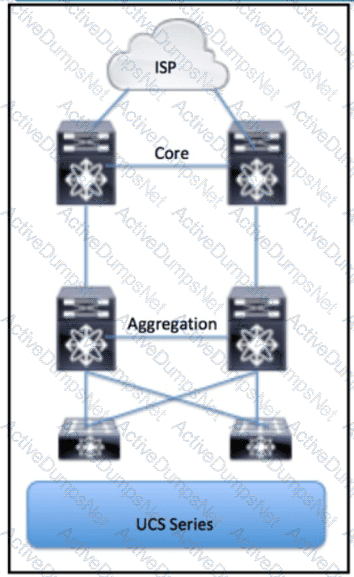
Refer to the exhibit. Which part of the diagram will host OpenStack components?

Options:

A.

Aggregation

B.

UCS Series

C.

Access

D.

Core

Question 97

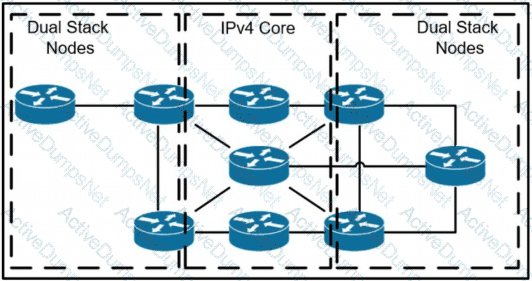
Refer to the exhibit.

Question # 97

A network operator has two IPv4 and IPv6 dual-stacked network on each side of the IPv4 core network. The operator must be able to provide connectivity between them while using specific assigned IPv6 space provided from the company IP administrator team. Which technology should the network operator use to accomplish this goal?

Options:

A.

6rd

B.

NAT46

C.

DS-Lite

D.

NAT44

Question 98

After a series of unexpected device failures on the network. a Cisco engineer is deploying NSF on the network devices so that packets continue to be forwarded during switchovers The network devices reside in the same holding, but they are physically separated into two different data centers Which task must the engineer perform as part of the deployment?
Options:

A.

implement OSPF to maintain the link-state database during failover.

B.

implement VRFs and specify the forwarding instances that must remain active during failover.

C.

implement an L2VPN with the failover peer to share state Information between the active and standby devices.

D.

implement Cisco Express Forwarding to provide forwarding during failover

Question 99

Question # 99

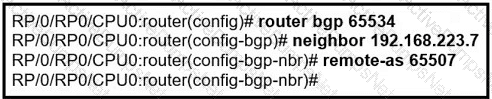
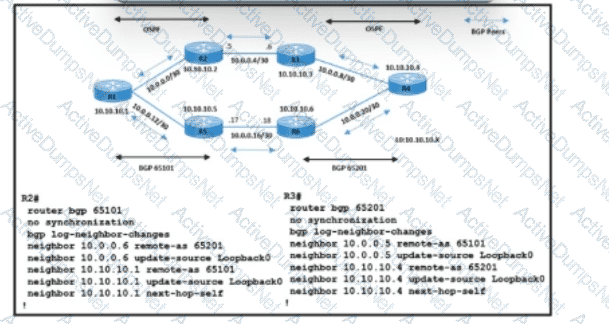
Refer to the exhibit. A network operations team is implementing eBGP on the service provider network. Data traffic between routers R1 and R4 must use the R2-R3 link, which connects AS 65101 and AS65201. iBGP sessions with adjacent routers are up on 10.10.10.1 and 10.10.10.4. The team is now updating the configuration for eBGP peers on routers R2 and R3. Which action must be taken to meet the requirements?

Options:

A.

Add the soft-reconfiguration command.

B.

Add the ebgp-multihop command.

C.

Remove the update-source command.

D.

Remove the next-hop-self command.

Question 100

Simulation1

Question # 100

Question # 100

Question # 100

Options:

Question 101

Question # 101

Refer to the exhibit. A network operator working for a private telecommunication company with an employee id: 7138: 13:414 just added new users to the network, which resides in VLANs connected to routers R1 and R4. The engineer now must configure the network so that routers R1 and R4 share routes to the VLANs, but routers R2 and R3 are prevented from including the routes in their routing tables. Which configuration must the engineer apply to R4 to begin implementing the request?
Options:

A.

pseudowire -class ciscotest

encapsulation mpls

interface gigabitethernet 1/0/1

connect neighbor 192.168.1.1 101 pw-class cisco

B.

pseudowire -class ciscotest

encapsulation mpls

interface gigabitethernet 1/0/1

xconnect 192.168.1.1 101 pw-class ciscotest

C.

pseudowire-class ciscotest

encapsulation mpls

service-policy output ciscotest

D.

interface serial 2/0/0

frame-relay encapsulation

ip address 192.168.1.4 255.255.255.0

service-policy output ciscotest

Question 102

Question # 102

Refer to the exhibit. Company A's network architect is implementing the capabilities that are described in RFC 4379 to provide new options for troubleshooting the company's MPLS network. MPLS LSPs are signaled via the BGP routing protocol with IPv4 unicast prefix FECs. Due to company security policies, access is controlled on the control plane and management plane. Which two tasks must the architect perform to achieve the goal? (Choose two.)

Options:

A.

Open UDP port 3503.

B.

Open MCP port 3505.

C.

Implement OAM on all MPLS-enabled routers.

D.

Implement LSP Ping on PE routers only.

E.

Implement VCCV on core routers only.

Question 103

According to RFC5305 on IS-IS extensions for traffic engineering, what is the 4-octet sub-TLV type 10 of extended IS-IS reachability TLV type 22?

Options:

A.

TE default metric

B.

maximum reservable link bandwidth

C.

administrative group (color)

D.

IPv4 neighbor address

Question 104

Refer to the exhibit:

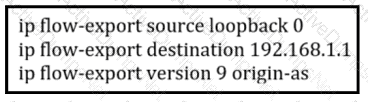
Question # 104

Export statistics received do not include the BGP next hop.

Which statement about the NetFlow export statistics is true?

Options:

A.

Only the origin AS of the source router will be included in the export statistics.

B.

Loopback 0 must be participating in BGP for it to be included in the export statistics.

C.

The origin AS and the peer-as will be included in the export statistics.

D.

To include the BGP next hop in the export statistics, those keywords must be included with the version 9 entry.

Question 105

What is the purpose of DS-Lite technology?

Options:

A.

It enables networks to pass encapsulated IPv4-in-IPv6 traffic over the ISP backbone.

B.

It allows network administrators to implement shared IPv4 addresses between the ISP and its customers.

C.

It allows an ISP to service IPv6 networks over an IPv4-enabled ISP backbone.

D.

It allows network administrators to transition a network to IPv6 while maintaining IPv4 support.

Question 106

An engineer working for a private service provider with employee id: 3994 37 650 is configuring a Cisco device to redistribute OSPF into BGP. Which task enables the device to filter routes?

Options:

A.

Configure a distribute list and associate it to the BGP peer interface

B.

Configure a prefix list and associate it to the BGP peer interface

C.

Configure a route map and reference it with the redistribute command

D.

Configure an access list and reference it with the redistribute command

Question 107

A network engineer implements OSPF on the network and then notices frequent faults in traffic between two routers, particularly on interface TenGigE 0/0/1. The engineer decides to configure NetFlow to monitor the issue. Which configuration must the engineer apply to the router?

Options:

A.

interface tenGigE 0/0/1

ip flow egress

snmp-server community public

snmp-server enable traps lsdn

snmp-server host 192.168.1.27 version 2c public

B.

interface tenGigE 0/0/1

ip flow ingress

ip flow-export version 9

ip flow-cache timeout active 1

C.

ip flow-export destination 192.168.2.1 2055

ip flow-export source loopback0

ip flow-export version 9

ip flow-cache timeout active 1

ip flow-cache timeout inactive 15

snmp-server ifindex persist

D.

ip flow-export destination 192.168.2.1 2055

ip flow-export source loopback0

ip flow-export version 9

ip flow-cache timeout active 1

ip flow-cache timeout inactive 15

snmp-server ifindex persist

interface tenGigE 0/0/1

ip flow ingress

Question 108

Refer to the exhibit.

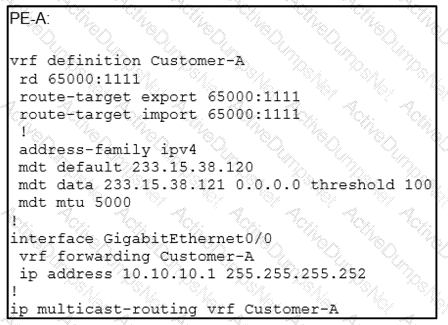
Question # 108

An engineer is implementing Auto-RP and reviewing the configuration of the PE-A. Which configuration permits Auto-RP messages to be forwarded over this interface?

Options:

A.

PE-A(config-if)#ip pim sparse-mode

B.

PE-A(config-if)#no ip pim bsr-border

C.

PE-A(config-if)#ip igmp version 3

D.

PE-A(config-if)#ip pim sparse-dense-mode

Question 109

A network engineer must collect traffic statistics for an internal LAN toward the internet The sample must include the source and destination IP addresses, the destination ports, the total number of bytes from each flow using a 64-bit counter, and all transport flag information. Because of CPU limits, the flow collector processes samples that are a maximum of 20 seconds long. Which two configurations must the network engineer apply to the router? (Choose two.)
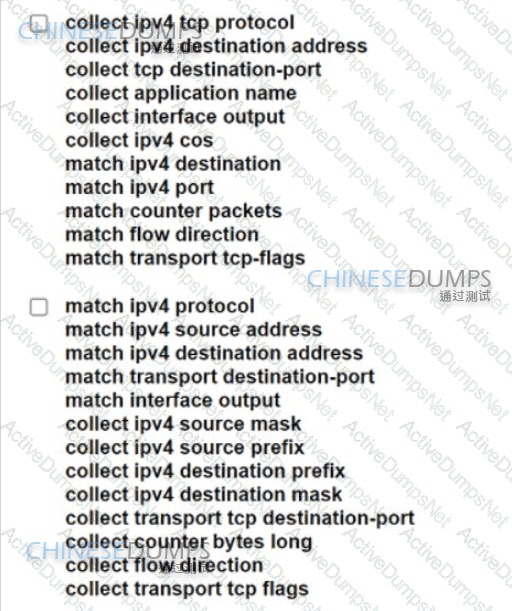
Question # 109

Question # 109

Options:

A.

Option A

B.

Option B

C.

Option C

D.

Option D

E.

Option E

Question 110

A network engineer is implementing BFD configuration changes on a customer's equipment. How is the bfd interval configuration on the interface disconnected?
Options:

A.

The status of the interface changes.

B.

The IPv4 or IPv6 address configuration on the interface changes.

C.

It is automatically disconnected when the BFD-configured subinterface is removed.

D.

It is automatically disconnected when the BFD main interface is removed.

Question 111

Question # 111

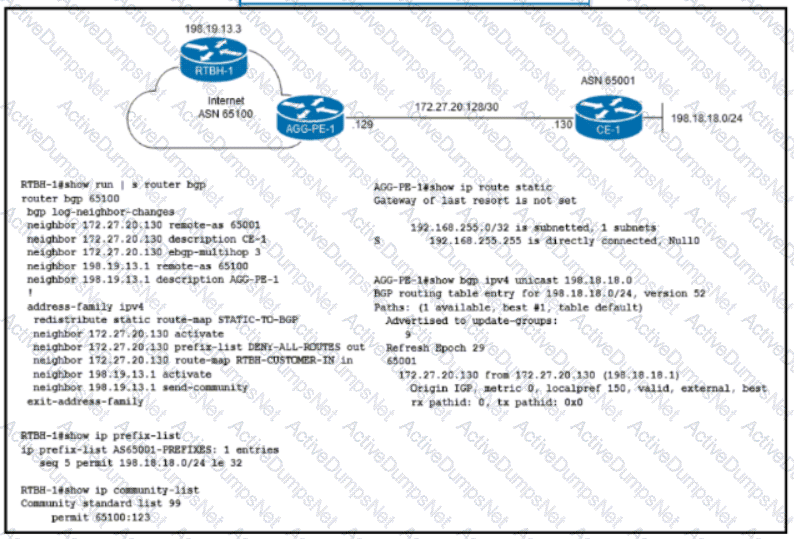
Refer to the exhibit. ISP ASN 65100 provides Internet services to router CE-1 and receives customer prefix 198.18.18.0/24 via eBGP. An administrator for the ISP is now provisioning RTBH services to provide on-demand data-plane security for the customer’s IP space. Which route-map configuration must the administrator apply to router RTBH-1 to complete the implementation of RTBH services to CE-1?

Options:

A.

route-map RTBH-CUSTOMER-IN permit 10

description AS65001

match ip address prefix-list AS65001-PREFIXES

match community 99

set local-preference 200

set community no-export additive

set ip next-hop 192.168.255.255

route-map RTBH-CUSTOMER-IN deny 65535

description DEFAULT DENY

B.

route-map RTBH-CUSTOMER-IN permit 10

description AS65001

match ip address prefix-list AS65001-PREFIXES

match community 99

set local-preference 200

set community local-as additive

set ip next-hop 192.168.255.255

route-map RTBH-CUSTOMER-IN deny 65535

description DEFAULT DENY

C.

route-map RTBH-CUSTOMER-IN permit 10

description AS65001

match ip address prefixlist AS65001-PREFIXES

match community 99

set local-preference 200

set community no-advertise additive

set ip next-hop local-address

route-map RTBH-CUSTOMER-IN deny 65535

description DEFAULT DENY

D.

route-map RTBH-CUSTOMER-IN permit 10

description AS65001

match ip address prefix-list AS65001-PREFIXES

match community 99

set local-preference 200

set community no-advertise additive

set ip next-hop 192.168.255.255

route-map RTBH-CUSTOMER-IN deny 65535

description DEFAULT DENY

Question 112

Refer to the exhibit.

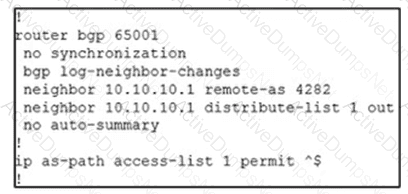
Question # 112

An engineer is reviewing the BGP configuration. Which routes must be advertised to 10.10.10.1

Options:

A.

Local routes are permitted, and routes from other ASNs are denied.

B.

All routes whether local or from other ASNs are denied.

C.

Local routes are denied, and routes from other ASNs are permitted.

D.

All routes whether local or from other ASNs are permitted.

Question 113

Which utility must be used to locate MPLS faults?

Options:

A.

QoS

B.

MPLS LSP ping

C.

MPLStraceroute

D.

EEM

Question 114

Which utility can you use to locate MPLS faults?

Options:

A.

MPLS traceroute

B.

EEM

C.

MPLS LSP ping

D.

QoS

Question 115

Simulation 6

Question # 115

Question # 115

Options:

Question 116

Refer to the exhibit.

Question # 116

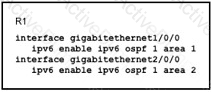
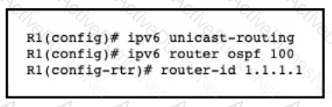
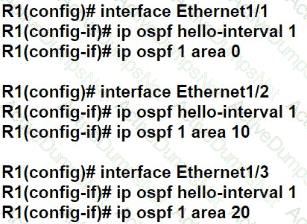
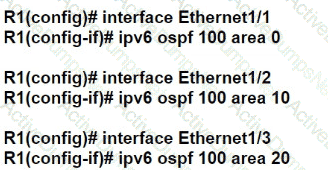
An engineer is configuring router R1 for OSPFv3 as shown. Which additional configuration must be performed so that the three active interfaces on the router will advertise routes and participate in OSPF IPv6 processes?

A)
Question # 116

B)

Question # 116

C)

Question # 116

Options:

A.

Option A

B.

Option B

C.

Option C

Question 117

A regional MPLS VPN provider operates m two regions and wants to provide MPLS L 3VPN service for a customer with two sites in these separate locations. The VPN provider approaches another organization to provide backbone carrier services so that the provider can connect to these two locations.

Which statement about this scenario is true?

Options:

A.

When edge routers at different regional sites are connected over the global carrier backbone, MP-eBGP must run between the routers to exchange the customer VPNv4 routes

B.

When eBGP is used for label exchange using the send label option, MPLS-BGP forwarding is configured under the global ABC CSC PE-to CE interface

C.

When IGP is used for route exchange and LDP for label exchange, MPLS is enabled only on the VRF interface on the backbone-earner PE side.

D.

When BGP is used for both route and label exchange, the neighbor a.b.c.d send-lable command is used under the address family VPNv4 command mode.

Question 118

Refer to the exhibit:

Question # 118

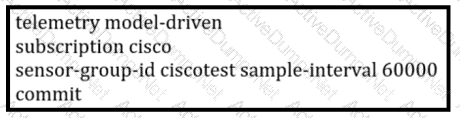
This configuration is being applied on an IOS XR router.

Which statement about this configuration is true?

Options:

A.

It is used to set up configuration to poll network data

B.

It is used to enable gRPC

C.

It is used to create a streaming subscription with a 60-second interval

D.

It is used to create a streaming subscription with a 600-second interval

Question 119

Refer to the exhibit.

Question # 119

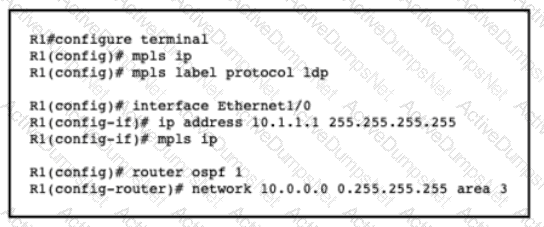
A network engineer is configuring MPLS LDP synchronization on router R1. Which additional configuration must an engineer apply to R1 so that it will synchronize to OSPF process 1?
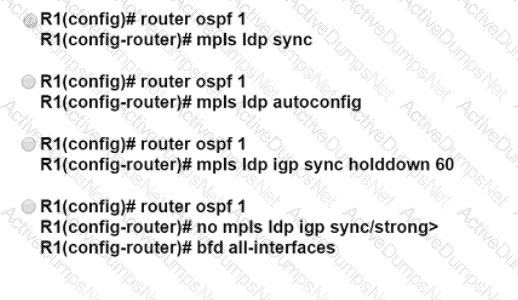
Question # 119

Options:

A.

Option A

B.

Option B

C.

Option C

D.

Option D

Question 120

Question # 120

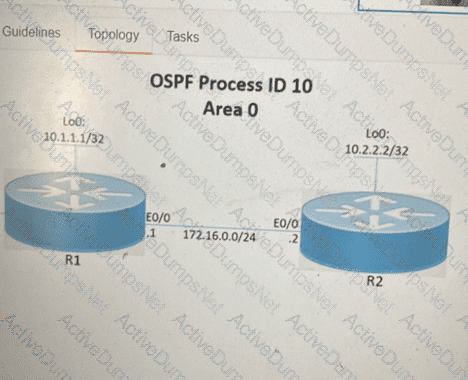
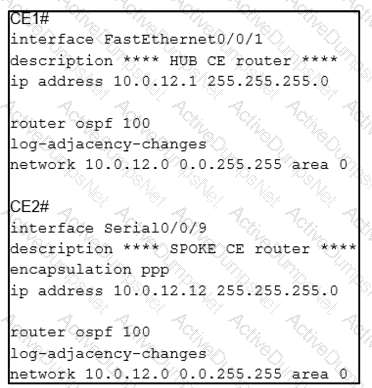
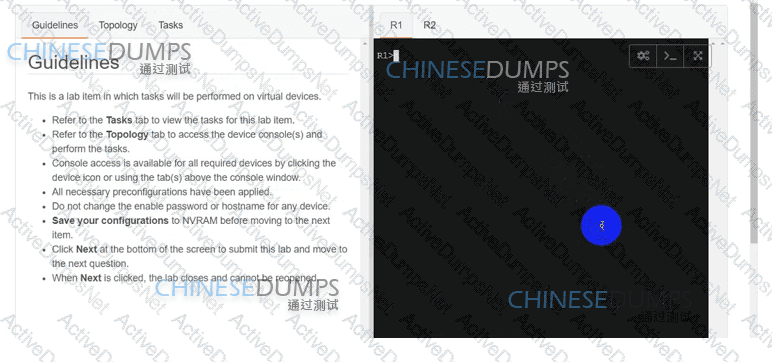
Guidelines

-

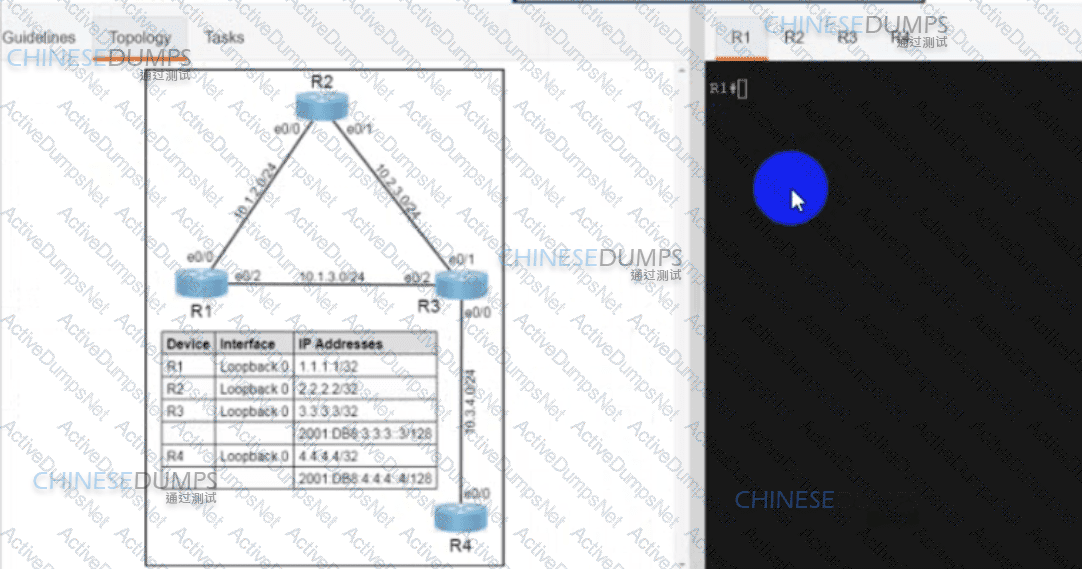
This is a lab item in which tasks will be performed on virtual devices.

• Refer to the Tasks tab to view the tasks for this lab item.

• Refer to the Topology tab to access the device console(s) and perform the tasks.

• Console access is available for all required devices by clicking the device icon or using the tab(s) above the console window.

• All necessary preconfigurations have been applied.

• Do not change the enable password or hostname for any device.

• Save your configurations to NVRAM before moving to the next item.

• Click Next at the bottom of the screen to submit this lab and move to the next question.

• When Next is clicked, the lab closes and cannot be reopened.

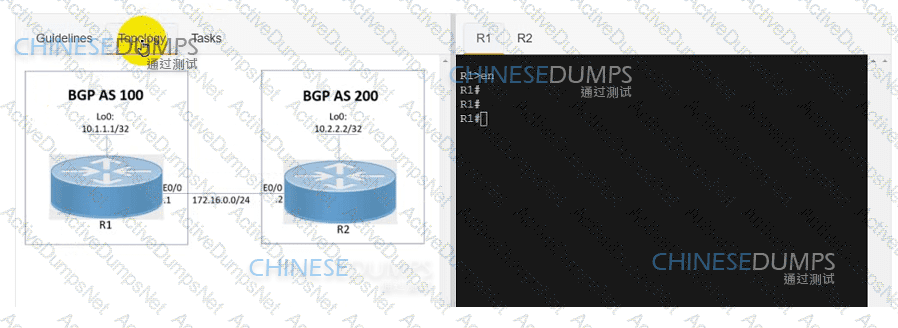
Topology

Question # 120

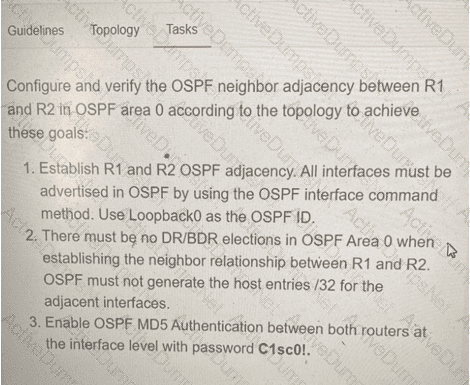
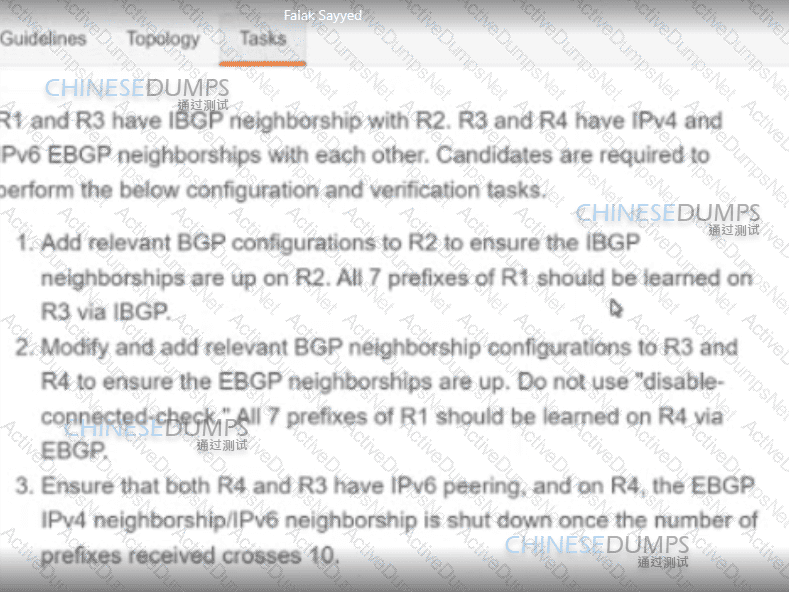
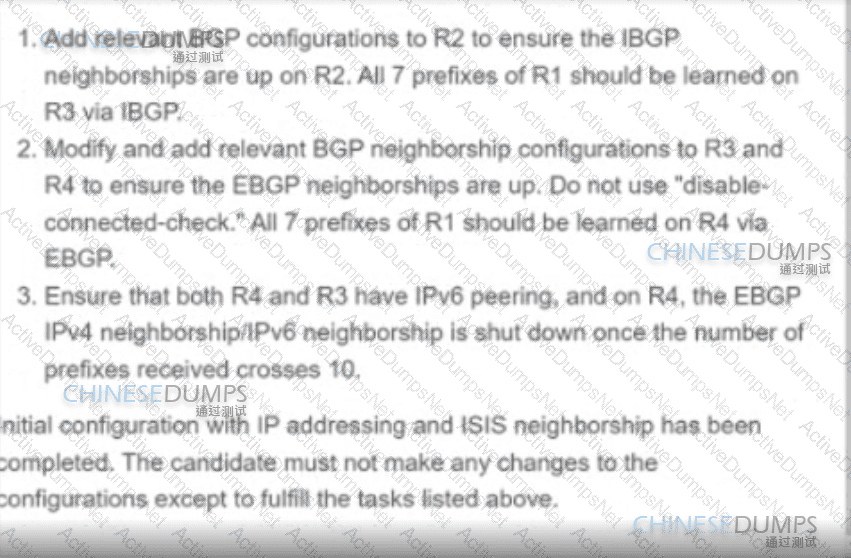
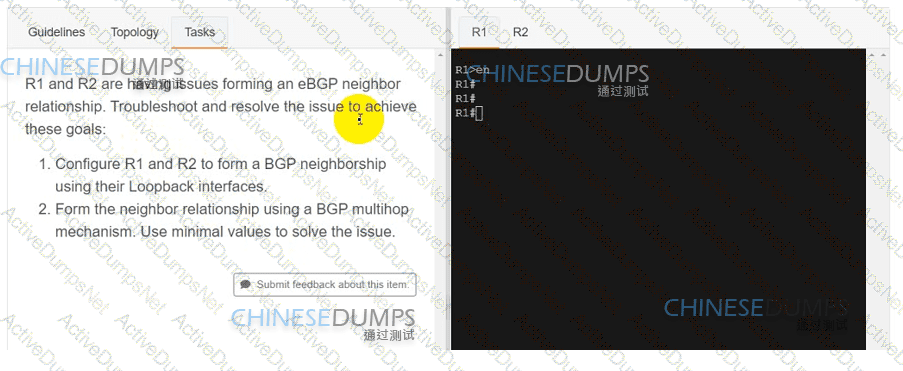
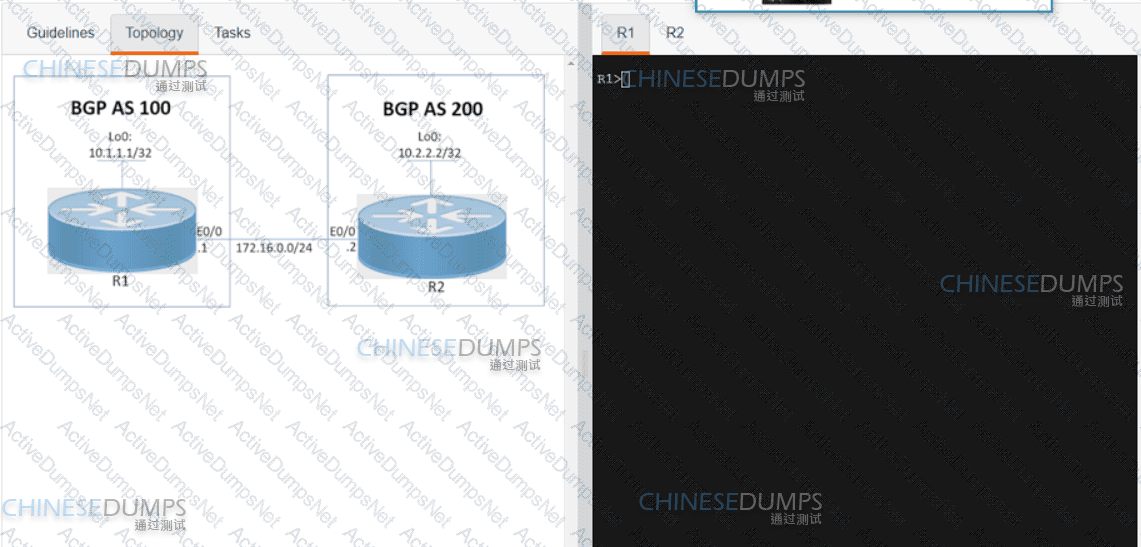
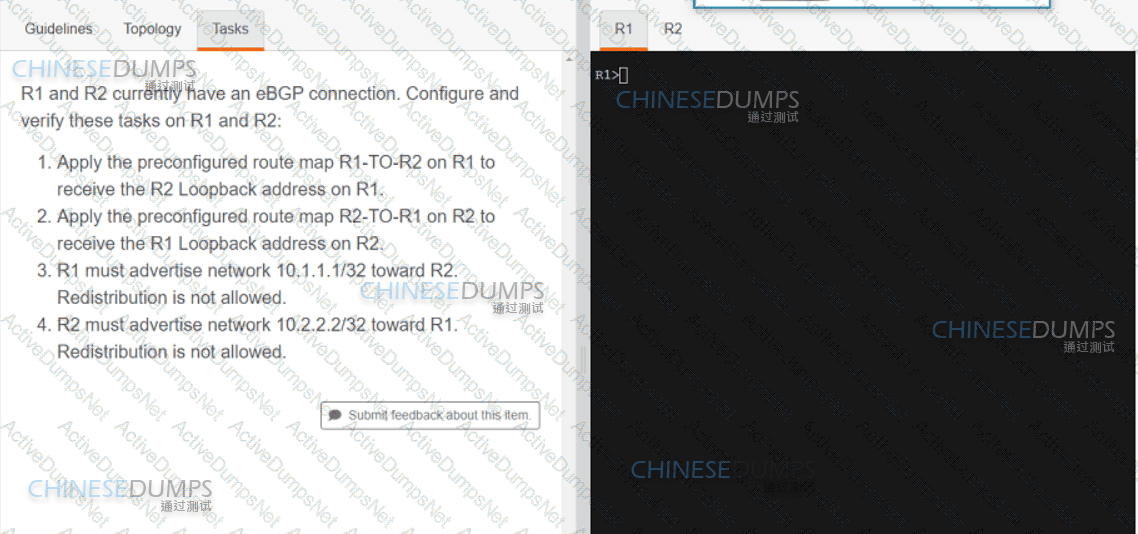
Tasks

-

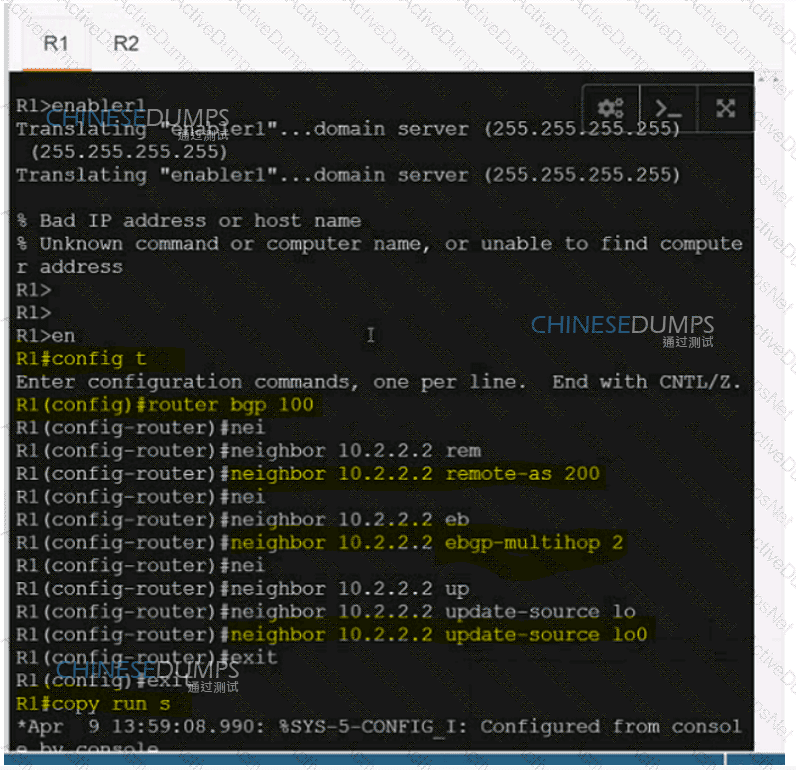
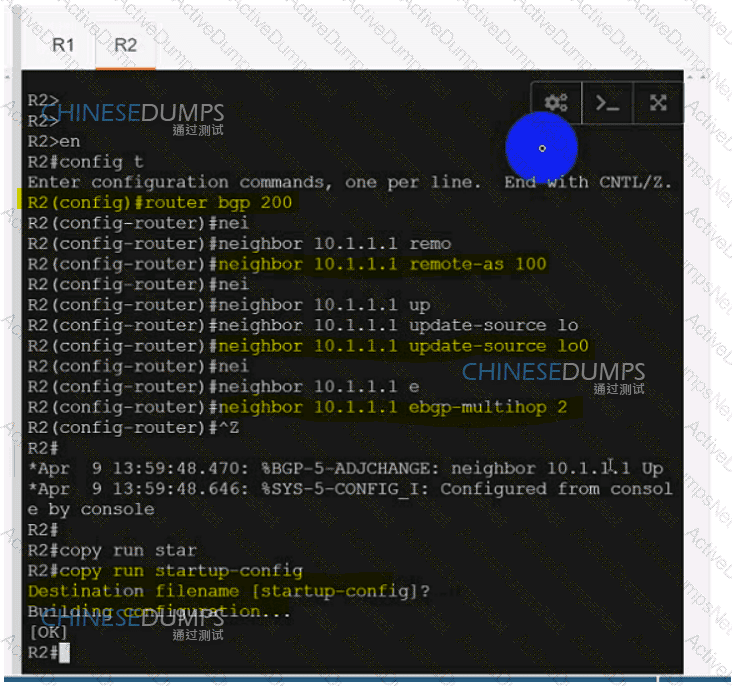
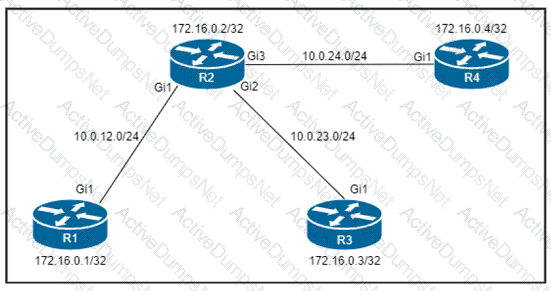
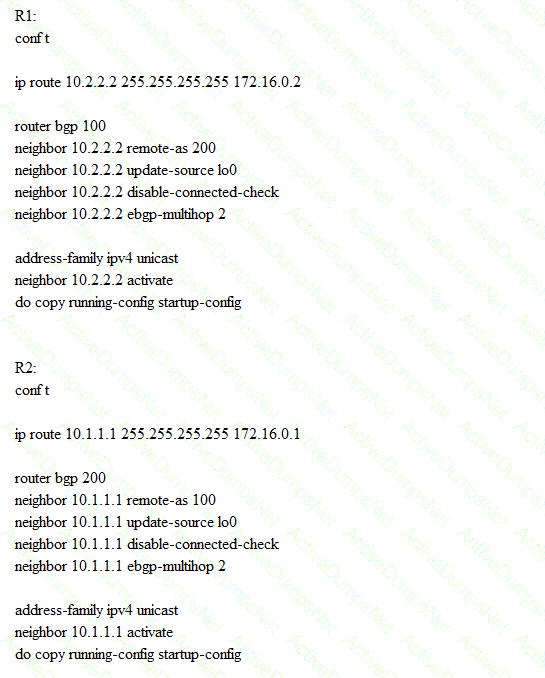
R1 and R2 are having issues forming an eBGP neighbor relationship. Troubleshoot and resolve the issue to achieve these goals:

1. Configure R1 and R2 to form a BGP neighborship using their Loopback interfaces.

2. Form the neighbor relationship using a BGP multihop mechanism. Use minimal values to solve the issue.
Options:

Question 121

An engineer must implement QoS to prioritize traffic that requires better service throughout the network. The engineer started by configuring a class map to identify the high-priority traffic. Which additional tasks must the engineer perform to implement the new QoS policy?

Options:

A.

Attach the class map to a policy map that sets the minimum bandwidth allocated to the classified traffic and designates the action to be taken on the traffic.

B.

Attach the class map to a policy map that designates the action to be taken on the classified traffic and then attach the policy map to an interface using a service policy.

C.

Attach the class map to a policy map within a VRF to segregate the high-priority traffic and then attach the policy map to an interface in another VRF.

D.

Create a route map to manipulate the routes that are entered into the routing table and then attach the route map to an interface using a service policy.

Question 122

Which capability does the MPLS TE FRR facility backup protection method provide?

Options:

A.

defining the set of characteristics for the backup TE LSP

B.

leveraging label stacking to protect selected TE LSPs using a single backup TE LSP

C.

creating a bypass LSP for each protected LSP at each point of local repair

D.

assigning a backup TE LSP tunnel to the protected node at the headend of the protected TE LSP

Question 123

Refer to the exhibit.

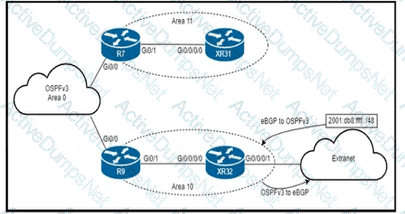
Question # 123

An engineer is updating this network to meet these conditions:

• Area 10 will receive inter-area routes and support mutual redistribution of external routes with the extranet.

• The ::/0 route is prohibited in Area 10.

• Area 11 will receive only the ::/0 route from the ABR.

• External route redistribution is not supported in Area 11.

• The ABR in Area 11 will advertise no interarea routes.

Which two configurations must be performed to meet the requirements? (Choose two.)

Options:

A.

Configure area 11 as nssa no-summary on R7 and as nssa on XR31.

B.

Configure area 10 as stub on R9 and XR32.

C.

Configure area 11 as stub no-summary on R7 and as stub on XR31.

D.

Configure area 11 as nssa default-information-originate on R7 and as nssa on XR31.

E.

Configure area 10 as nssa on R9 and XR32.

Question 124

What is a characteristic of data modeling language?

Options:

A.

It provides an interface for state data.

B.

It separates configuration and state data.

C.

It ensures devices are individually configured.

D.

It replaces SNMP.

Question 125

Company A is implementing VoIP services across the company. The network architect designed a QoS policy to allow only specific IP subnets and mark the signaling flow with DSCP 36. The solution should be as secure as possible. Phones receive their IP addresses from the 172.184.12.0/24 pool and are assigned by the RADIUS server to VLAN 1021. Skinny Client Control Protocol is used as a signaling protocol in the network. For security reasons, switchport port-security maximum 1 vlan voice has been preconfigured on the switch side. Which two tasks must an engineer perform on SW_1 to achieve this goal? (Choose two.)

Options:

A.

Implement a class map with the set dscp af42 command.

B.

Implement a class map with the set dscp af43 command.

C.

Implement an ACL with the set dscp af41 command.

D.

Implement an ACL with the permit udp 172.184.12.0 0.0.0.255 any range 2000 2002 command.

E.

Implement an ACL with the permit tcp 10.124.121.0 0.0.0.255 range 16384 32767 command.

Question 126

Question # 126

Refer to the exhibit. An engineer configured several network devices to run REST APIs. After testing, the organization plans to use REST APIs throughout the network to manage the network more efficiently. What is the effect if this script?
Options:

A.

It returns an AAA users with the last name CiscoTest.

B.

It creates a class map named aaauser with traffic tagged from AAA.

C.

It queries the local database to find a user named aaaUser.Json

D.

It adds the user CiscoTest to the AAA database located at 192.168.201.10.

Question 127

Question # 127

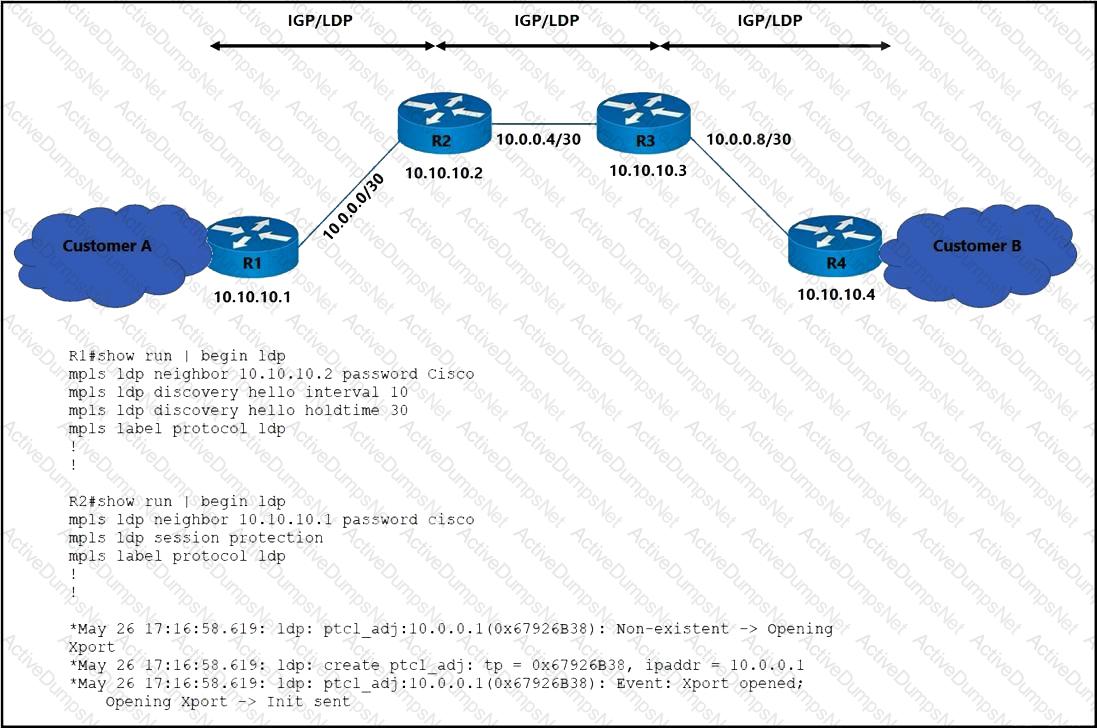
Refer to the exhibit. The operations team is implementing an LDP-based configuration in the service provider core network with these requirements:

R1 must establish LDP peering with the loopback IP address as its Router-ID.

Session protection must be enabled on R2.

How must the team update the network configuration to successfully enable LDP peering between R1 and R2?
Options:

A.

Change the LDP password on R2 to Cisco.

B.

Configure mpls ldp router-id loopback0 on R1 and R2.

C.

Configure LDP session protection on R1.

D.

Change the discover hello hold time and interval to their default values.

Question 128

Question # 128

Refer to the exhibit. Four midsize service providers provide access to different customers that use Layer 3 VPN services to enable communication across geographic regions. The service providers are connected as shown in the exhibit, and the PEs have established eBGP relationships. PE4 has an IBGP relationship with PE5. The routes that PE4 learns from PE5 must reach the other PE routers, but they are absent from the routing tables on the other PES. Which action should the engineers take to correct the problem?

Options:

A.

Configure a peering between all five Pes.

B.

Disable BGP synchronization on PE4.

C.

Enable BOP IPv4 unicast on PE4 and PE5

D.

Advertise the route targets for PE5 to the other PEs

Question 129

Which action does the ingress VTEP perform on traffic between EVPN VXLAN overlays?

Options:

A.

routing and tunneling when doing symmetric IRB

B.

routing when doing asymmetric IRB

C.

routing and bridging when doing asymmetric IRB

D.

bridging when doing symmetric IRB

Question 130

Which action occurs during the traceback phase of the six-phase approach to service provider security?

Options:

A.

Trace action occur flows from the stacked sections of the network toward the network edges

B.

Detect unusual activity or behavior and activate appropriate measures after an alert is raised.

C.

Review the whole attack-handling process

D.

Mitigate the attack that flows using various mechanisms.

Question 131

What is the function of the FEC field within the OTN signal structure?

Options:

A.

It allows the sending devices to apply QoS within the OTN forwarding structure.

B.

It allows source nodes to discard payload errors before transmitting data on the network.

C.

It allows receivers to correct errors upon data arrival.

D.

It allows deep inspection of data payload fields.

Question 132

Which statement about Network Services Orchestrator (NSO) is true?

Options:

A.

It is used only in service provider environments

B.

It can be used only with XML coding

C.

It uses YANG modeling language to automate devices

D.

It must use SDN as an overlay for addressing

Question 133

A network architect plans to implement MPLS OAM to provide additional troubleshooting functionality for the NOC team. After analyzing the configuration on the MPLS P/PE nodes, the architect decides to revise the CoPP policies. Which two actions ensure that the new solution is secure? (Choose two.)

Options:

A.

Allow port 3505 in the outbound direction only.

B.

Allow the ICMP protocol only.

C.

Allow the TCP and UDP protocols.

D.

Allow the UDP protocol only.

E.

Allow port 3503 in the inbound direction only.

Question 134

Refer to the exhibit:

Question # 134

Based on the show/ command output, which result m true after BGP session is established?

Options:

A.

The IOS XR router advertises all routes to the neighbor 192.168.2.2, but it does not accept any routes from 192.168.2.2

B.

The IOS XR router advertises and accepts all routes to and from eBGP neighbor 192.168.2.2 C. No routes are accepted from the neighbor 192.168.2.2, nor are any routes advertised to it

C.

The IOS XR router does not advertise any routes to the neighbor 192.168.2.2,but it accepts all routes from 192.168.2.2.

Question 135

Refer to the exhibit:

Question # 135

Which statement describes the effect of this configuration?

Options:

A.

It applies a service policy to all interfaces remarking HTTP traffic

B.

It creates an ACL named WEB that filters HTTP traffic.

C.

It matches HTTP traffic for use in a policy map

D.

It modifies the default policy map to allow all HTTP traffic through the router

Question 136

Which characteristic describes prefix segment identifier?

Options:

A.

It contains the interface address of the device per each link.

B.

It Is globally unique.

C.

It is locally unique.

D.

It contains a router to a neighbor.

Question 137

Which control plane protocol is used between Cisco SD-WAN routers and vSmart controllers?

Options:

A.

OTCP

B.

OMP

C.

UDP

D.

BGP

Question 138

Refer to the exhibit.

Question # 138

A network engineer Is implementing OSPF multiarea. Which command on interface G0/1 resolves adjacency Issues in the new area?
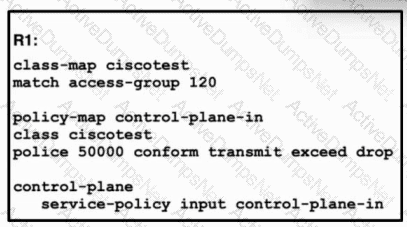
Options:

A.

Ip ospf network broadcast

B.

Ip ospf network non-broadcast

C.

Ip ospf network polnt-to-multlpoint

D.

Ip ospf network point-to-point

Question 139

Question # 139

Refer to the exhibit. A network engineer installed router R1 as the new core router and must secure the control plane. The configuration has been applied, and now the engineer is creating ACL 120. Only hosts 192.168.1.1 and 192.168.2.2 should be allowed to access the router using Telnet. All other hosts should be rate-limited, with excess traffic dropped. Which configuration accomplishes this goal?

Options:

A.

access-list 120 deny tcp any any eq telnet

access-list 120 permit tcp host 192.168.1.1 any eq telnet

access-list 120 permit tcp host 192.168.1.2 any eq telnet

B.

access-list 120 deny tcp host 192.168.1.1 any eq telnet

access-list 120 deny tcp host 192.168.1.2 any eq telnet

access-list 120 permit tcp any any eq telnet

C.

access-list 120 permit tcp host 192.168.1.1 any eq telnet

access-list 120 permit tcp host 192.168.2.2 any eq telnet

access-list 120 deny tcp any any eq telnet

D.

access-list 120 permit tcp any any eq telnet

access-list 120 deny tcp host 192.168.1.1 any eq telnet

access-list 120 deny tcp host 192.168.1.2 any eq telnet

Question 140

How does SR policy operate in Segment Routing Traffic Engineering?
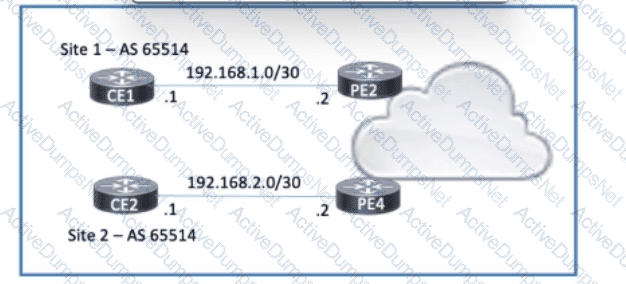
Options:

A.

An SR policy for color and endpoint is deactivated at the headend as soon as the headend learns a valid candidate path for the policy.

B.

When "invalidation drop" behavior occurs, the SR policy forwarding entry is removed and the router drops all traffic that is steered into the SR policy.

C.

When a set of SID lists is associated with the SR policy designated path, traffic steering is ECMP-based according to the qualified cost of each SID-list.

D.

An active SR policy installs a BSID-keyed entry in the forwarding table to steer the packets that match the entry to the SR policy SID-list.

Question 141

Question # 141

Refer to the exhibit. Company A has two offices that communicate via a service provider in AS 65516. CE1 and CE2 provide connections to the service provider from site 1 and site 2 respectively. Both customer sites use BGP as the PE-CE routing protocol. Which configuration must the engineer apply to ensure that traffic passes between the two sites?

Options:

A.

CE2(config)#router bgp 65514

CE2(config-router)#neighbor 192.168.1.1 as-override

B.

CE1(config)#router bgp 65514

CE1(config-router)#neighbor 192.168.1.2 allowas-in

C.

PE2(config)#router bgp 65516

PE2(config-router)#neighbor 192.168.1.1 next-hop-self

PE4(config)#router bgp 65516

PE4(config-router)#neighbor 192.168.2.1 next-hop-self

D.

CE1(config)#router bgp 65514

CE1(config-router)#neighbor 192.168.1.2 next-hop-self

CE2(config)#router bgp 65514

CE2(config-router)#neighbor 192.168.2.2 next-hop-self

Question 142

Drag and drop the descriptions from the left onto the corresponding OS types on the right.
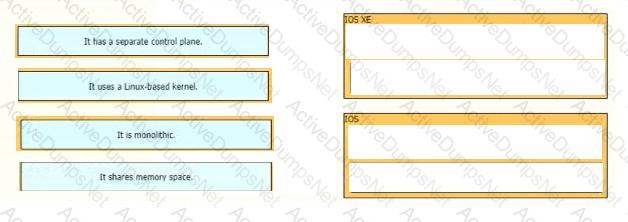
Question # 142

Options:

Question 143

What do Ansible and Salt Stack have in common?

Options:

A.

They both use DSL configuration language

B.

They both use YAML configuration language

C.

They both have agents running on the client machine

D.

They both can be designed with more than one master server

Question 144

Refer to the exhibit:

Question # 144

When implementing an LDP protocol, an engineer experienced an issue between two directly connected routers and noticed that no LDP neighbor exists for 1.1.1.1.

Which factor should be the reason for this situation?
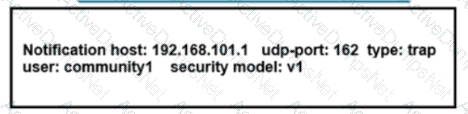
Options:

A.

LDP needs to be enabled on the R2 physical interface

B.

R2 does not see any hellos from R1

C.

LDP needs to be enabled on the R2 loopback interface

D.

R2 sees the wrong type of hellos from R1

Question 145

Question # 145

Refer to the exhibit. Over the last few months. ISP A has doubled Its user base. The IT Director asked the engineering team to monitor memory consumption and buffer statistics on all P and PE devices In the MPLS core. Most devices have CPU usage of 70% or more, so the solution must be targeted and secure. Which two commands must the engineering team implement on P and PE devices to meet these requirements? (Choose two.)

Options:

A.

snmp-server host 192.168.101.1 version 3 auth community1 memory

B.

snmp-server enable traps memory bufferpeak

C.

snmp-server host 192.168.101.1 version 2c community1 memory

D.

snmp-server host 192.168.101.1 version 1 community1 auth memory

E.

snmp-server enable snmp-traps community1 bufferpeak

Question 146

Refer to Exhibit.

Question # 146

A network engineer is trying to retrieve SNMP MIBs with RESTCONF on the Cisco switch but fails. End-to-end routing is in place. Which configuration must the engineer implement on the switch to complete?

Options:

A.

netconf-yang cisco-ia snamp-community -string Public

B.

snmp-server community cisco RW

C.

snmp-server community public RO

D.

netconf-yang cisco-Ia snmp-community-string Private

Question 147

Question # 147

Refer to the exhibit. An operations team recently located an archive of scripts for deploying routine network changes with an error-free approach. A junior network engineer, who is working to modify the scripts to support RESTCONF, has been asked to document the purpose of each updated script. Which two actions does the given script take? (Choose two.)

Options:

A.

Send a patch request to the API endpoint.

B.

Print a fail message when the response code is 204.

C.

Pass an XML data-format request in the API header.

D.

Print a success message when the device receives a full-content response code.

E.

Ignore SSL certificate verification.

Question 148

Refer to the exhibit:

Question # 148

With which router does IOSXRV-1 have LDP session protection capability enabled but session hold up is not active?
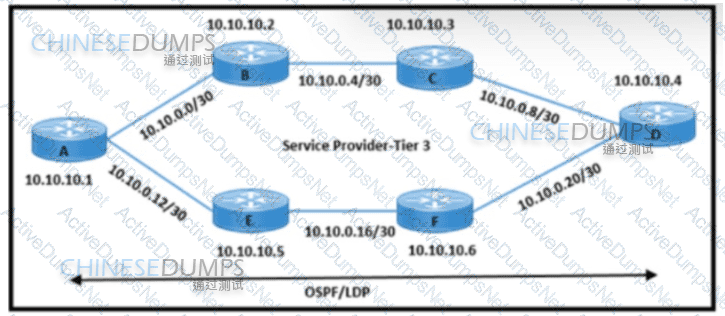
Options:

A.

192.168.0.1

B.

192.168.0.3

C.

192.168.0.4

D.

192.168.0.5

Question 149

Question # 149

Refer to the exhibit. An engineering team must update the network configuration so that data traffic from router A to router D continues in case of a network outage between routers B and C. During a recent outage on the B-C link, the IGP traffic path was switched to the alternate path via routers E and F. but label forwarding did not occur on the new path. Which action ensures that traffic on the end-to-end path continues?
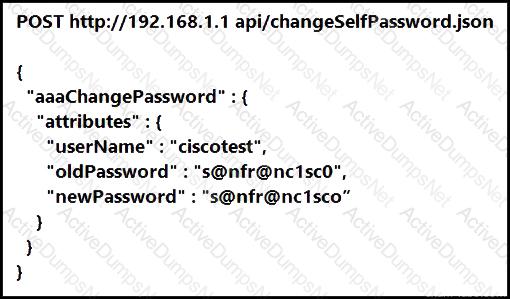
Options:

A.

Configure the same hello timer values for IGP and LDP

B.

Bind the BFD protocol with IGP on all routers

C.

Enable LDP Session Protection on routers A and D.

D.

Enable MPLS LDP IGP Synchronization on all routers

Question 150

Question # 150

Refer to the exhibit. What is the purpose of this JSON script?
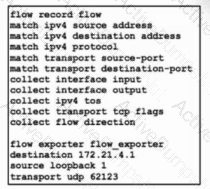
Options:

A.

It changes the existing password.

B.

It updates a user authentication record.

C.

It deletes a user’s authentication record.

D.

It confirms a user’s login credentials.

Question 151

Question # 151

Refer to the exhibit. The network administrator is enabling network visibility on the edge router. The flow exporter must be leveraging an RFC 7011–based protocol, and data streams must be sent every 3 seconds. Which two commands must the administrator apply to complete the task?

Options:

A.

export-protocol netflow-v5

B.

template data timeout 3

C.

export-protocol netflow-v9

D.

export-protocol ipfix

E.

template data timeout 180

Question 152

A network engineer must configure a router for Flexible NetFlow IPFIX export. The IP address of the destination server is 172.17.12.1. The source address must be set to the Loopback0 IPv4 address and exported packets must be set to DSCP CS3. The TTL must be 64 and the transport protocol must be set to UDP with destination port 4739. Which configuration must the engineer apply to the router?

Options:

A.

configure terminal

flow exporter EXPORTER-1

destination 172.17.12.1

source Loopback0

dscp 3

ttl 64

export-protocol netflow-v9

transport udp 4739

end

B.

configure terminal

flow exporter EXPORTER-1

destination 172.17.12.1

source Loopback0

dscp 24

ttl 64

export-protocol ipfix

end

C.

configure terminal

flow exporter EXPORTER-1

destination 172.17.12.1

source Loopback0

dscp 24

ttl 64

export-protocol netflow-v9

transport udp 4739

end

D.

configure terminal

flow exporter EXPORTER-1

destination 172.17.12.1

source Loopback0

dscp 3

ttl 64

export-protocol ipfix

end

Question 153

Which additional configuration is required for NetFlow to provide traceback information?

Options:

A.

Cisco Express Forwarding must be configured for traffic that is egressing from the router to be properly reported.

B.

A classification ACL must be configured to identify which type of traffic will be analyzed.

C.

The BGP routing process must be started for any ingress or egress data to be reported when using NetFlow. Version 5.

D.

LLDP must be configured or the device will be unable to locate a NetFlow analyzer.

Question 154

Refer to the exhibit.

Question # 154

Router 1 and router 2 are running IBGP. and router 2 and router 3 are running OSPF Area 0. Router 1 is advertising loopback interlaces Lo0 and Lo2 and router 2 is redistributing BGP into OSPF Area 0. Which configuration must an administrator apply so that router 2 uses a route map to redistribute only the internal route from Lo 2?

A)
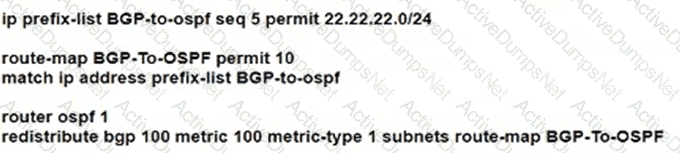
Question # 154

B)

Question # 154

C)

Question # 154

D)

Question # 154

Options:

A.

Option A

B.

Option B

C.

Option C

D.

Option D

Question 155

Question # 155

Refer to the exhibit. The company is running IS-IS in its core. A network engineer must segment the network into two areas to isolate departments. However, some networks must be shared from area 2 to area 1, so the engineer has decided to implement route filtering between devices.

Which action must the engineer take so that the correct networks are shared between IS-IS areas?

Options:

A.

Apply an ACL on RE to deny unnecessary routes from exiting the interface toward RD.

B.

Implement a route map and attach it to a distribute list on RD to filter inbound routes from RE.

C.

Set a unique area ID on each router to fully segment the network.

D.

Implement route-tagging on RB and RD to identify and allow only the routes that should be shared from area 2.

Question 156

Which type of attack is a Protocol attack?

Options:

A.

HTTP flood

B.

TFTP flood

C.

SYN flood

D.

Slowlorls

Question 157

Refer to the exhibit:

Question # 157

A network engineer is implementing a BGP routing policy.

Which effect of this configuration is true?

Options:

A.

All traffic that matches acl10 is allowed without any change to its local-preference

B.

All traffic that matches acl10 is dropped without any change to its local-preference

C.

If traffic matches acl10, it is allowed and its local-preference is set to 300

D.

All traffic is assigned a local-preference of 30O regardless of its destination

Question 158

A customer site is being connected to a Frame Relay network via a T1 link. The customer has a contract for 512 kbps service with a Tc value of 125 ms. Under peak line conditions, customer traffic can reach four times the contracted speed. Which QoS configuration must the service provider implement to limit the customer to the contracted values?
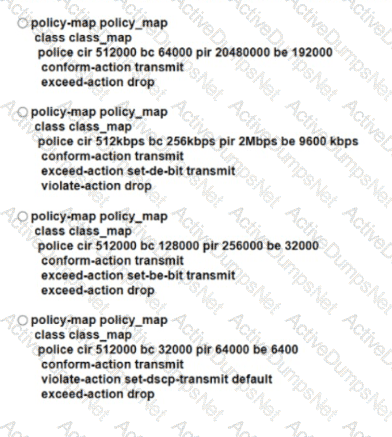
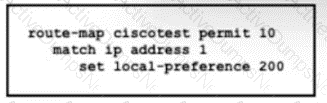
Question # 158

Options:

A.

Option A

B.

Option B

C.

Option C

D.

Option D

Question 159

Question # 159

Refer to the exhibit. An engineer is implementing the BGP attribute on the customer's network to select the preferred path. Only BGP's well-known discretionary attribute must be used FTP prefixes should not be selected as part of this implementation. Which configuration must the engineer implement to complete the task?
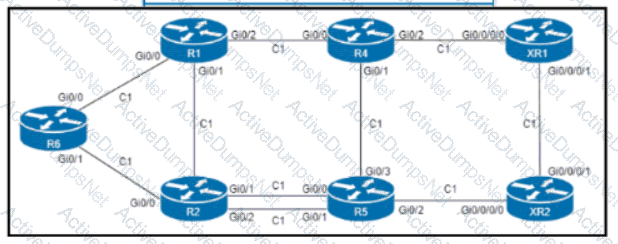
Options:

A.

router bgp 100

neighbor 10.0.0.1 remote-as 500

neighbor 10.0.0.1 route-map ciscotest in

B.

router bgp 100

neighbor 10.0.0.1 remote-as 500

neighbor 10.0.0.1 route-map ciscotest

C.

router bgp 100

neighbor 10.0.0.1 remote-as 500

neighbor 10.0.0.1 route-map ciscotest both

D.

router bgp 100

neighbor 10.0.0.1 remote-as 500

neighbor 10.0.0.1 route-map ciscotest out

Question 160

Question # 160

Refer to the exhibit. An engineer configured R6 as the headend LSR of an RSVP-TE LSP to router XR2, with the dynamic path signaled as R6-R2-R5-XR2. and set the OSPF cost of all links to 1. MPLS autotunnel backup Is enabled on all routers to protect the LSP. Which two NNHOP backup tunnels should the engineer use to complete the implementation? (Choose two.)

Options:

A.

The R6 backup tunnel path R6-R1-R4-R5.

B.

The R2 backup tunnel path R2-R5 across the alternate link.

C.

The R2 backup tunnel path R2-R1-R4-XR1-XR2.

D.

The R6 backup tunnel path R6-R2-R5

E.

The R6 backup tunnel path R6-R1-R2.

Question 161

Refer to the exhibit.

Question # 161

Router 1 is missing the route for the router 2 loopback 0. What should the engineer change to fix the problem?

Options:

A.

the area numbers on Router 1 and Router 2 to be similar

B.

the wildcard mask network statement in OSPF of Router 2

C.

Router 1 to be an ABR

D.

the hello timers on Router 1 and Router 2 to be different

Question 162

Drag and drop the OSPF area types from the left onto the correct statements on the right
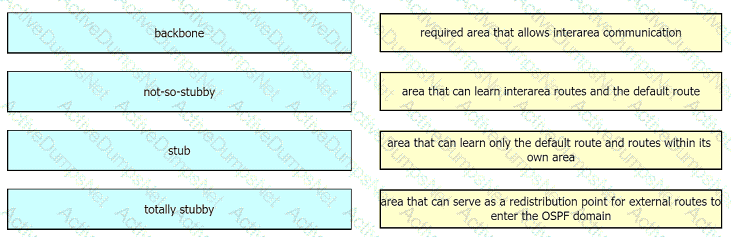
Question # 162

Options:

Question 163

Question # 163

Refer to the exhibit. An Ethernet access provider is configuring routers PE-1 and PE-2 to provide E-Access EVPL service between UNI and ENNI. ENNI service multiplexing is based on 802.1ad tag 150, and service-multiplexed UNI is based on 802.1q tag 10. Which EFP configurations must the provider implement on PE-1 and PE-2 to establish end-to-end connectivity between CE-1 and CE-2?

Options:

A.

On PE-1:

interface GigabitEthernet2

service instance 100 ethernet

encapsulation dot1ad 150

rewrite ingress tag pop 1 symmetric

On PE-2:

interface GigabitEthernet2

service instance 2 ethernet

encapsulation dot1q 10

B.

On PE-1:

interface GigabitEthernet2

service instance 100 ethernet

encapsulation dot1q 150

rewrite ingress tag pop 1 symmetric

On PE-2:

interface GigabitEthernet2

service instance 2 ethernet

encapsulation dot1q 10

C.

On PE-1:

interface GigabitEthernet2

service instance 100 ethernet

encapsulation dot1ad 150 dot1q 10

rewrite ingress tag pop 2 symmetric

On PE-2:

interface GigabitEthernet2

service instance 2 ethernet

encapsulation dot1q 10

D.

On PE-1:

interface GigabitEthernet2

service instance 100 ethernet

encapsulation dot1ad 150

rewrite ingress tag pop 1 symmetric

On PE-2:

interface GigabitEthernet2

service instance 2 ethernet

encapsulation dot1q 10

rewrite ingress tag pop 1 symmetric

Question 164

What is an enhancement that Cisco IOS XE Software has over Cisco IOS Software?

Options:

A.

It support symmetric multiprocessing

B.

It allows all processes to use the same pool of memory.

C.

It runs on a 32-bit operating system.

D.

It is built on a GNX Neutrino Microkernel.

Page: 1 / 55
Total 547 questions