
Cisco 300-640 Implementing Cisco Data Center AI Infrastructure (DCAI) Exam Practice Test
Implementing Cisco Data Center AI Infrastructure (DCAI) Questions and Answers
To support growing AI workload requirements, a regional medical practice is adding new X9516 X-Fabric module, UCS PCI Mezz cards, and UCS X580p PCIe nodes to their existing X-Series chassis.
Which two administrative actions must be taken before the X-Fabric module is added to the chassis? (Choose two.)
A bank is planning to deploy an AI inference solution at its branch locations. The solution must support workloads that require a balance of compute, memory, and potential GPU acceleration, and it must be suitable for installation by nontechnical onsite resources. The requirements are:
high availability of the chassis management plane.
support for up to 768 GB of memory for in-memory model storage and processing
remote server launch requiring no on-site IT staff
use of Cisco Intersight for SaaS-based infrastructure lifecycle management
Which solution meets the requirements?
A corporate network administrator manages a HyperFabric AI environment and wants to receive email notifications about assertions in the fabric. The administrator sets up a recipient email endpoint under the notification endpoints in the controller, but notifications are not received.
Which two configurations cause the issue? (Choose two.)
Refer to the exhibit.

Users report delayed response times and network latency when running certain AI workloads on a specific Cisco UCS Intersight Managed Mode Domain.
Based on the fault message and reported symptoms, which troubleshooting action must be taken first to address the network latency issues?
How does RAG enhance the capabilities of LLMs?
An organization deploys a new AI training fabric that uses RoCEv2 for GPU communication. The network architect designs the QoS configuration to ensure reliable RDMA transport and must meet these requirements:
Support 256 GPU servers with RDMA connectivity.
Prevent any packet loss that causes RDMA connection failures.
Maintain consistent low-latency communication with a target of less than 10 microseconds.
Use industry-standard protocols and configurations.
Which configuration ensures that RoCEv2 operates as a lossless transport?
An engineer configures quality of service in the Cisco ACI fabric to connect VAST storage servers.
Which combination of attributes must be selected?
A nationwide grocery chain has deployed Unified Edge to all its locations. Each store has 10 or more surveillance cameras that write approximately 1 Gb per hour. The surveillance retention policy requires maintaining 2 weeks of recording per camera.
Which type of cost-effective centralized storage solution must be evaluated with Unified Edge devices to adhere to this policy?
A global enterprise is deploying a new AI-driven analytics platform that requires high-performance GPU acceleration, large memory capacity, and robust virtualization support. The current compute environment must co-exist with the newly purposed GPU-enabled workload. This environment will continue to grow, so the customer wants to scale out the resources as needed.
Which Cisco product meets the requirements?
A network operations team deploys HyperFabric AI and wants to monitor fabric health to proactively identify performance issues. The team must track metrics specifically relevant to AI training workloads.
Which metric is most critical for identifying congestion issues that could impact AI training performance in a HyperFabric AI deployment?
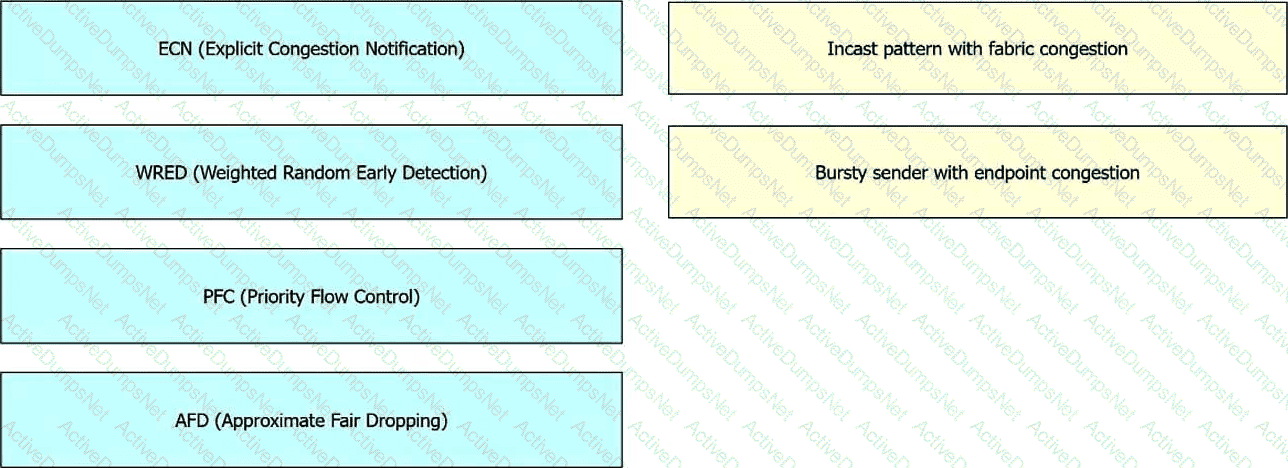
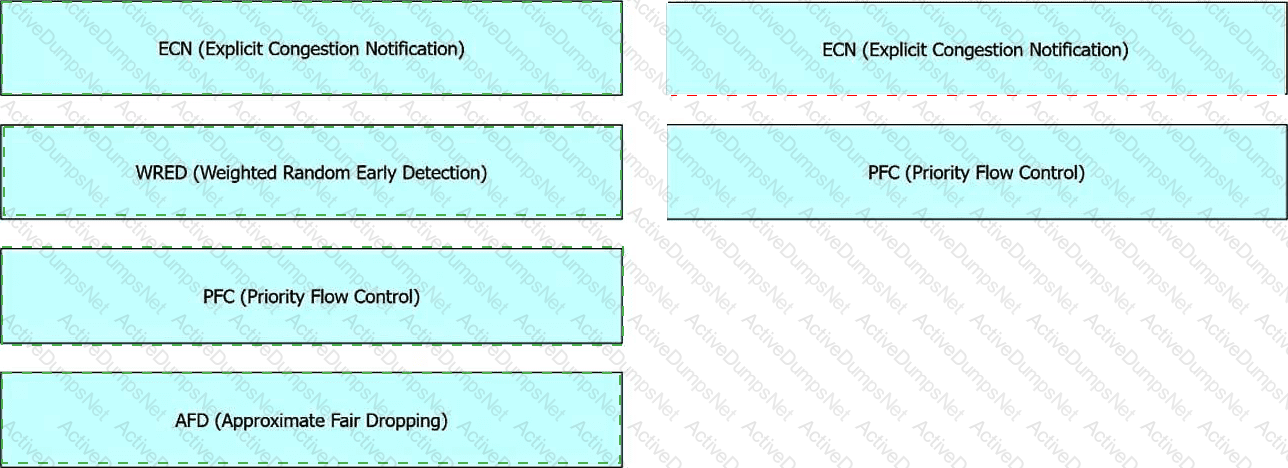
A network engineer is designing congestion management for an AI cluster using RoCEv2 transport. Based on Cisco best practices, the engineer must understand how ECN and PFC work together to provide lossless Ethernet transport.
Drag and drop the congestion management mechanisms from the left onto the corresponding descriptions on the right. Not all options are used.
A large-scale retail store manages many compute resources spread across branch offices, which enables AI workloads to be processed on-premises. Each workload and site location requires specific OS installation and configuration. To simplify management, configuration, and deployment of the workloads, a Cisco Intersight feature must be used that enables workload deployment at scale.
Which feature must be used to accomplish this functionality?
An engineer deploys an AI fabric on Cisco Nexus 9000 Series Switches connected to Cisco UCS nodes with NVIDIA GPUs. The requirements call for optimal network performance for training workloads. Adaptive routing is enabled on the NICs, and per-packet load balancing is enabled on the switches.
Which other configuration must be implemented for this integration to be fully operational?
A customer is deploying a new AI fabric with all new NVIDIA GPUs and must verify the performance between the nodes in the network.
Which tool must be used to validate the customer benchmarks?
A medium-sized breadmaking operation must deploy a fleet of GPU servers that meet these requirements for their flagship application: policy managed through cloud-based interface low latency between specific pairs of GPUs at least 2 GPUs per server all GPUs should be same model Intel CPU - well suited for Inferencing customer is power conscious
Which server meets the requirements?
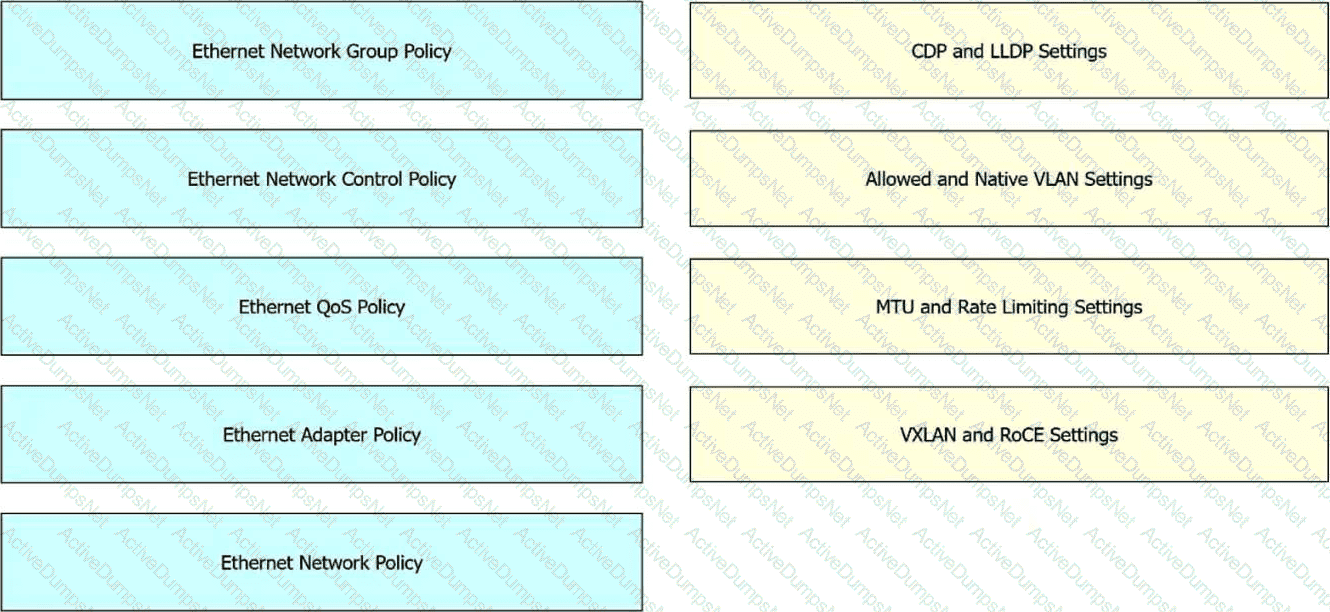
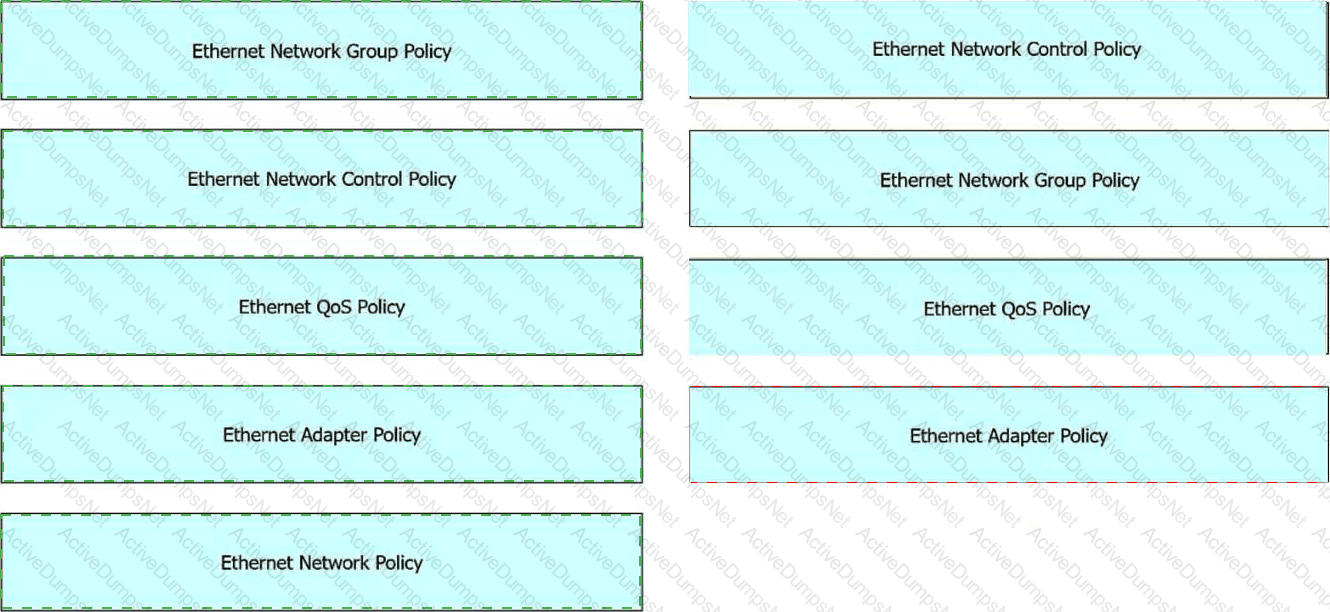
An engineer must configure vNIC templates for a UCS X-Series deployment.
Drag and drop the policy types from the left onto the corresponding configuration settings on the right. Not all options are used.
When considering a rail-only network design, when would adding spine switches make sense?
A network team is configuring quality of service (QoS) for RoCEv2 traffic on a VXLAN fabric. The team must ensure that congestion notification packets (CNP) generated by storage targets are never dropped in the network, as these packets are critical for congestion control feedback.
How must CNP packets be handled in the QoS configuration to ensure reliable delivery?