
Summer Sale Limited Time Flat 70% Discount offer - Ends in 0d 00h 00m 00s - Coupon code: 70spcl

CSI CSC2 Canadian Securities Course Exam 2 Exam Practice Test

Page: 1 / 23
Total 232 questions

Canadian Securities Course Exam 2 Questions and Answers

Question 1

How is the ex-port real rate of return calculated?

Options:

A.

The ex-ante nominal rate of return adjusted by portfolio beta.

B.

The ex-post nominal rate of return minus the risk-free rate.

C.

The ex-ante nominal rate of return minus the annual inflation rate.

D.

The ex-post nominal rate of return minus the annual inflation rate.

Question 2

When a futures contract is entered into, who sets the minimum initial margin rate?

Options:

A.

investment dealer

B.

Buyer

C.

Seller

D.

Exchange

Question 3

What is the next step after designing an investment policy statement?

Options:

A.

Outlining a list of acceptable and prohibited investments

B.

Developing the asset mix

C.

Determining investment objectives

D.

Determining investment constraints

Question 4

Maya invested $5,000 in a three-year ABC market-linked GIC for her non-registered account. Her GIC just matured and the return was based on the performance of the S & P/TSX Composite Index, with a 70% participation rate. Initial and ending reference index levels were 13,600 and 19,000, respectively. What amount of GIC return will be taxable for Maya in the year of maturity?

Options:

A.

$1,985.00.

B.

$694.75.

C.

$992.50.

D.

$1,389.71.

Question 5

What is name of the procedure used to calculate the income deemed to have been earned by segregated fund contract holders?

Options:

A.

Distribution.

B.

Payout.

C.

Allocation.

D.

Redemption.

Question 6

How are monthly Canada Pension Plan (CPP) benefits treated when both spouses are eligible for CPP?

Options:

A.

Each spouse receives the higher pension amount.

B.

Each spouse can only receive their own benefits.

C.

Each spouse receives the lower pension amount.

D.

Each spouse can share a portion of the total pension amount.

Question 7

What is a limitation of labour-sponsored venture capital corporations (LSVCCs)?

Options:

A.

Investments are available at a maximum of $5,000 invested in any one year

B.

Investments are subject to a 17.5% federal credit on an annual investment

C.

Tax credits need to be repaid if shares are redeemed within eight years

D.

Federal tax credits are available only if no provincial tax credit is available

Question 8

The price of FMA common stock is set to break through its 200-day moving average line from below on heavy volume. How might a technical analyst interpret this information?

Options:

A.

A buy signal as FMA ' s price is set to rise.

B.

A sell signal as FMA ' s price is set to fall.

C.

The upward price trend is reversing.

D.

The declining price trend will continue.

Question 9

What does a fundamental analyst believe that is contrary to the beliefs of a technical analyst?

Options:

A.

History repeats itself.

B.

Fiscal policy, monetary policy and inflation may be analyzed.

C.

The movements in price movements must be studied.

D.

The profitability of the issuer is paramount.

Question 10

Which primary value is violated if an advisor places an unsuitable order requested by a client?

Options:

A.

Compliance.

B.

Integrity.

C.

Duty of care.

D.

Professionalism.

Question 11

What industry stocks tend to have lower betas than the market?

Options:

A.

Transportation

B.

Capital goods

C.

Utilities

D.

Automobiles and components

Question 12

An investor has earned additional Income and is looking to invest in a security that guarantees returns over. The next seven years. What is the Best option for purchase?

Options:

A.

Proffered shares

B.

Provincial saving bond

C.

Common shares

D.

Exchange-traded fund.

Question 13

Soft-dollar arrangements can be used for which type of service?

Options:

A.

Advice.

B.

Sales.

C.

Research.

D.

Underwriting.

Question 14

TRU Fund portfolio manager decided to deviate from the portfolio long-term target asset mix in order to capitalize on investment opportunities in the domestic bond market. What type of asset allocation is the TRU Fund portfolio manager using?

Options:

A.

Strategic.

B.

Tactical.

C.

Timing.

D.

Dynamic.

Question 15

What is an example of a KYC requirement?

Options:

A.

KYC information can be shared between accounts for clients with multiple accounts.

B.

KYC information is limited to the main accountholder if account is joint.

C.

KYC information is discretionary when the client is not acting on the advisor’s recommendation.

D.

KYC information should include the customer’s personal circumstances.

Question 16

A company has the following earnings per share figures: Year 1 (base period): $2.12; Year 2: $2.26; Year 3: $2.42; Year 4: $2.56; and Year 5: $2.71. What is the trend ratio at the end of Year 3 for this company?

Options:

A.

88.

B.

114.

C.

242.

D.

106.

Question 17

How can an analyst use trend analysis to analyze a company’s financial statements?

Options:

A.

Computer the company’s current ratios with its ratios from prior years to determine a trend.

B.

Review the company’s ratio over the past year, as they provide the best estimate of near-term performance and future trends.

C.

Identity trends by selecting the lowest ratio for the base year, even if a loss is experienced, as it represents a good starting point for analyzing the growth in the ratios.

D.

Analyze the ratios against companies in a wide a range of industries to see how the company is trending in the current economic cycle.

Question 18

Ella has invested her RRSP in a mutual fund where the distributions are automatically reinvested in the same fund. What will be the consequences of these distributions?

Options:

A.

Ella will be sent a T3 form reporting the types of income distributed that year.

B.

Ella’s income from distributions will be taxed at her personal rate in the year received.

C.

Ella will have more mutual fund units worth less each.

D.

Ella will be sent a T5 form reporting the types of income distributed that year.

Question 19

What financial ratio reveals the nature of a company’s capital structure?

Options:

A.

Debt-to-net-income.

B.

Price-to-earnings.

C.

Return-on-equity.

D.

Debt-to-equity.

Question 20

What economic outcome does the government set out to achieve by increasing their own spending?

Options:

A.

To create inflationary pressure.

B.

To increase the spending power of individuals.

C.

To boost business profits and common share prices.

D.

To stimulate the economy in the short run.

Question 21

What method of trading claims to offer greater liquidity and lower transaction costs?

Options:

A.

Dark pool.

B.

High-frequency trading.

C.

Market timing.

D.

Algorithmic trading.

Question 22

What is the difference between sinking funds and purchase funds concerning the redemption of bonds poor to maturity?

Options:

A.

Sinking funds have mandated redemptions while purchase funds can redeem only upon certain market conditions.

B.

Sinking funds can redeem bonds only if they trade below a stipulated price while purchase runes do not have such a requirement.

C.

Sinking funds involve the issuer determining when bonds are redeemed while purchase funds Involve the investor determining when the bonds are redeemed.

D.

Sinking funds can redeem fie bones any time while purchase funds follow a prearranged schedule.

Question 23

The following table presents annual returns on TUV common stock and the S & P/TSX Composite Index

over a three-year period.

What is TUV ' s beta relative to the S & P/TSX Composite Index over this three-year period?

Options:

A.

Between 0 and 1.

B.

Greater than 1.

C.

Exactly 1.

D.

Less than 0.

Question 24

Which asset allocation technique is used to shift the portfolio away from its policy mix to take advantage of market opportunities?

Options:

A.

Dynamic

B.

Tactical

C.

Strategic

D.

Event-driven

Question 25

What is the normal shape of a yield curve?

Options:

A.

Downward slope

B.

inverted

C.

Upward slops

D.

Humped

Question 26

What correlation would an investor need in order to eliminate the variability in the total returns between two stocks?

Options:

A.

+0.5.

B.

-1.0.

C.

0.0.

D.

+1.0.

Question 27

What is the likely outcome at the end of a five-year term of a rate-reset preferred share if the issuer does not redeem the shares?

Options:

A.

The shareholder exchanges the rate-reset preferred share for a specified number of common shares.

B.

The shareholder exchanges the rate-reset preferred share for a fixed-rate preferred share.

C.

The shareholder exchanges the rate-reset preferred share for an unsecured bond

D.

The shareholder exchanges the rate-reset preferred share for a floating-rate preferred share

Question 28

How do the fees differ between an F-class and front-end version of the same fund?

Options:

A.

The management expense ratio is lower on the F-class fund.

B.

The management expense ratio is higher on the F-class fund.

C.

The fees are identical

D.

The commission changed is higher on the F-class fund.

Question 29

A shareholder receive rights from a company through direct ownership in shares. Not expecting to exercise them, she sells the right on the relevant exchange. What is her capital gain?

Options:

A.

The sale price of the rights.

B.

The sales price less the exercise price of the rights.

C.

The current price of the shares less the sale price of the rights.

D.

The current share price less the exercise price of the rights.

Question 30

How does beta help assess the risk of a mutual fund?

Options:

A.

Compares management expense ratios.

B.

Monitors trading volumes.

C.

Measures comparative performance.

D.

Relates its returns to the underlying markets.

Question 31

What type of equity analysis tracks the moving average in an attempt to identify buy or sell signals?

Options:

A.

Quantitative.

B.

Sentiment indicators.

C.

Cycle.

D.

Fundamental.

Question 32

Institutional clients tend to be more sophisticated than retail clients. What benefit does this translate into for CIRO dealer members?

Options:

A.

They are free of fiduciary obligations to their clients.

B.

They are subject to few, if any, investment restrictions.

C.

They can organize their firms based specifically on client needs.

D.

They are permitted to make trades on a discretionary basis for their clients.

Question 33

An emerging Canadian company is exploring the possibility of using hot water springs to produce clear energy for remote rural communities. The company has strong human resource capital and few assets, and raised SI 20,000 through the Capital Pool Company program. Which option is best for this company to continue maximizing public exposure and raising capital?

Options:

A.

Crowfunding

B.

Escrowing shares

C.

offering a greenshee option

D.

Filling disclosure documents with SEDAR+.

Question 34

Which method of technical analysis involves the use of devices for smoothing out fluctuating values in an individual stock or aggregate market over time?

Options:

A.

Moving average.

B.

Chart.

C.

Sentiment indicators.

D.

Cycle.

Question 35

Which type of trader specializes in managing block trades on behalf of institution clients?

Options:

A.

Responsible designated trader.

B.

Agency trader

C.

Liability trader

D.

Market maker

Question 36

What is one at the most important factors to determine how much of a product people buy or sell in a given marketplace?

Options:

A.

Consumer satisfaction

B.

Government spending

C.

Price level

D.

Maximized profits

Question 37

How does diversification work?

Options:

A.

It can eliminate systematic risk from a portfolio.

B.

It shows that the risk continues to fall proportionally as the number of stocks in the portfolio increases.

C.

It can reduce the risk that the price of a specific security will change in a different direction from the market.

D.

It is built on the concept of risk reduction by adding securities with perfect positive correlation to a portfolio.

Question 38

What type of investment typically involves massive amounts of capital provided by a small number of investors?

Options:

A.

Derivatives

B.

Infrastructure

C.

Bonds

D.

Commodities

Question 39

A fixed-rate bond was originally priced at $100 and paid $5 per year in interest. Currently, the bond is trading at $102.75. What is the impact on the current yield of coupon of the bond as a result of the change in price?

Options:

A.

The coupon is higher than 5%.

B.

The current yield is higher man 5%.

C.

The current yield is lower than 5%

D.

The coupon is lower than 5%.

Question 40

According to the life-cycle hypothesis, what is the single most important determinant of a client ' s asset allocation, regardless of stage?

Options:

A.

Anticipating remaining life expectancy.

B.

Psychological willingness to bear risk.

C.

Market expectations.

D.

Current financial burdens.

Question 41

What is the main benefit of investing in preferred shares?

Options:

A.

Priority to receive fixed dividends ahead of common shareholders.

B.

Priority to claim assets ahead of debt holders.

C.

Higher potential for capital appreciation than common shares.

D.

Guaranteed dividend payment.

Question 42

How does asset-backed commercial paper (ABCP) differ from mortgage-backed securities?

Options:

A.

ABCP minimizes roll-over risk.

B.

ABCP provides high liquidity.

C.

ABCP offers maturity dates of at least three years.

D.

ABCP guarantees principle repayment if held to maturity

Question 43

What is the main responsibility of the trustees of a mutual fund trust?

Options:

A.

Portfolio trading and implementation of investment strategy.

B.

Arranging cash distributions through dividend payments.

C.

Day-to-day supervision of the investment portfolio.

D.

Ensuring investments are in line with the fund ' s investment objectives.

Question 44

Which ratio gauges a company’s ability to repay its debts using funds generated from operating activities?

Options:

A.

Cash flow-to-total debt

B.

Interest coverage.

C.

Asset coverage.

D.

Debt-to-equity

Question 45

Siobhan designed an equity portfolio with a beta of 1.2. What is the expected return on the portfolio if the overall stock market return was 7.9%? (Round to the nearest decimal.)

Options:

A.

7.9%

B.

6.6%

C.

9.5%

D.

6.3%

Question 46

A business trust would typically purchase the underlying company assets of which type of operation?

Options:

A.

Senior housing

B.

Restaurants

C.

Industrial rentals

D.

Shopping centres

Question 47

An analyst compiles the following information for Theta Inc.
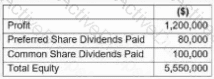
Question # 47

Based on the financial information provided, what will the dividend payout ratio be for Theta Inc.?

Options:

A.

1.80%

B.

6.66%

C.

8.33%

D.

3.24%

Question 48

What is the measure of risk commonly applied to portfolio and to individual securities within that portfolio?

Options:

A.

Beta

B.

Standard Deviation.

C.

Correlation.

D.

Alpha

Question 49

During which step of the financial planning process should an engagement be formalized with a professional service contract?

Options:

A.

Implement recommendations.

B.

Establish the client-advisor relationship.

C.

Recommend strategies to meet goals.

D.

Collect data and information.

Question 50

A client recently sold her holdings in JKL Equity Fund. The client ' s transactions in the fund are

Summarized below:
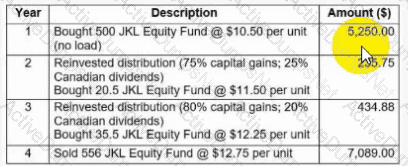
Question # 50

What is the client ' s capital gain from the sale of the fund in Year 47?

Options:

A.

$1,839.00

B.

$1,155.25

C.

$1,168.37

D.

$2,509.63

Question 51

When a company issues a number of common shares, some of which are held by institutional investors, what are the institutional investors ' shares known as?

Options:

A.

Market capitalization shares.

B.

Outstanding shares.

C.

issued shares

D.

Public float shares.

Question 52

What do the returns on treasury bills often represent?

Options:

A.

Bank prime rate.

B.

Inflation rate

C.

Risk-free rate

D.

Federal funds rate

Question 53

An advisor to explain the benefits of labour sponsored funds (LSVCC) to some of his clients.

With which client should the advisor have this discussion?
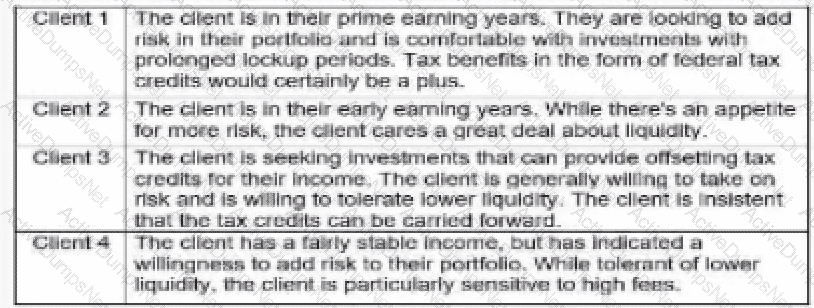
Question # 53

Options:

A.

Client 2

B.

Client 4

C.

Client 1

D.

Client 3

Question 54

Pierre has been plotting the price behaviour of QLT using a 100-day moving average. The 100-day moving average line has been above the daily market price for several weeks. However, the price of QLT broke through the moving average line with heavy trading volume, and the moving average line is moving higher. What action should Pierre take based on this information?

Options:

A.

Buy put option on QLT shares

B.

Sell QLT shares

C.

Buy QLT shares

D.

Sell call option on QLT shares

Question 55

What bond should an advisor recommend to someone who wants to hold bonds and maximize potential cap-tai gams when interest rates are expected to fall?

Options:

A.

A short-term bond with a low coupon.

B.

A long-term bond with a high coupon.

C.

A short-term bond with a high coupon.

D.

A long-term bond with a low coupon.

Question 56

What action must an investment advisor take when submitting a trade ticket for a short sale?

Options:

A.

Verify the client can borrow the shares.

B.

Mark the sell-order ticket as a short sate

C.

Obtain minimum margin amount from client

D.

Mark it as a margin order

Question 57

In Canada, which industries are categorized as defensive?

Options:

A.

Baking and materials

B.

Energy and materials.

C.

Energy and utilities.

D.

Banking and utilities.

Question 58

What investment becomes liquid when securitized?

Options:

A.

Airport.

B.

Real estate.

C.

Fine art.

D.

Gold.

Question 59

What do a hedge fund’s liquidity dates indicate?

Options:

A.

The period that the hedge fund manager is forced to unwind all its investment positions.

B.

The period that existing investors in the hedge fund can redeem their shares.

C.

The period that non-accredited investors can enter a hedge fund by purchasing newly issued shares.

D.

The period that a hedge fund is expected to cover its short positions.

Question 60

What is the bottom price of a security ' s trading range at which most investors would sense value and be willing to buy it?

Options:

A.

Reversal pattern.

B.

Sentiment indicator.

C.

Support level.

D.

Moving average.

Question 61

What legal authority does the done receive under the protection mandate in Quebec?

Options:

A.

The authority to get the will probated and take all the necessary steps for its execution.

B.

The authority to make decisions and to perform certain actions on behalf of the donor if they become incapacitated.

C.

The authority to make decisions and to perform certain action on behalf of the donor while they are capable.

D.

The authority to administrator and distribute the assets in the estate of a deceased after death.

Question 62

An investor has the following separate stock transactions:

Question # 62

What is the investor ' s overall adjusted cost base per share? (Round two decimal points.)

Options:

A.

$16.38

B.

$15.72

C.

$15.83

D.

$15.95

Question 63

What is typically discussed during the establishment of the client-advisor relationship step?

Options:

A.

The client ' s investment goals.

B.

The current financial and personal status.

C.

By what means does the client prefer to communicate with the advisor.

D.

What services will the advisor provide.

Question 64

Which statement best describes the Sharpe ratio?

Options:

A.

It compares the return of the portfolio with the return of the market as a whole, relative to the portfolio ' s risk as measured by its standard deviation.

B.

It compares the return of the portfolio with the riskless rate of return, relative to the portfolio ' s risk as measured by its standard deviation.

C.

It compares the return of the portfolio with the return of the market as a whole, relative to the portfolio ' s risk as measured by its beta.

D.

It compares the return of the portfolio with the riskless rate of return, relative to the market ' s risk as measured by its standard deviation.

Question 65

What is margin in an equity transaction?

Options:

A.

Loan that a dealer extends to a client to buy securities.

B.

Amount paid by a client when he uses credit to buy securities

C.

Good-faith deposit to ensure the client will make future financial obligations

D.

interest paid by the client to borrows securities.

Question 66

Melanie has RRSP contribution room of $17,500 for the current tax year. Her husband, Jack, has RRSP contribution room of $5,000. What is the maximum tax-deductible contribution Melanie can make to her RRSP and/or a spousal RRSP?

Options:

A.

$17,500.

B.

$20,000.

C.

$5,000.

D.

$22,500.

Question 67

Which investor right must be disclosed in a Fund Fact document?

Options:

A.

Investors have the right to rescind the purchase if these is misrepresentation in the document.

B.

Investors have a right to withdrawal from their purchase within 24 hours after confirmation of the purchase is received.

C.

Investors can request a paper copy of the simplified prospectus for a small charge.

D.

Investors have the right to act or claim damages without any limitation.

Question 68

Which ratio, when showing a decreasing trend, suggests declining operating efficiency?

Options:

A.

Price-earnings

B.

Return on common equity

C.

Dividend payout

D.

Debt/equity

Question 69

Which factor would deter an investor from investing in a company’s convertible preferred shares?

Options:

A.

Common stock outlook has been downgraded.

B.

Long life of the conversion privilege.

C.

High preferred dividend coverage ratio.

D.

The equity per preferred share decreased to three times the value of assets.

Page: 1 / 23
Total 232 questions