
CSI AFP-Exam-1 Applied Financial Planning Certification Exam 1 (AFP) Exam Practice Test
Applied Financial Planning Certification Exam 1 (AFP) Questions and Answers
Alexander and Irena, age 30 and 32 respectively, are married and have been working full-time for one year. They have a daughter, age 3, and are expecting their second child. They recently bought a home with a mortgage balance of $390,000 at 4% amortized over 25 years. Their financial planner is trying to determine their tolerance for risk. After completing the life-cycle analysis, how can their financial planner explain the stage in which the couple finds themselves and the risk tolerance associated with it?
Wendy, age 60, has a holding company whose sole asset is a commercial property. The property appreciated considerably in value over the last 10 years, and she expects the property value will continue to grow. Wendy is concerned about the tax implications this may have when she dies and leaves the property to her children. What strategy should Wendy's financial planner recommend to her?
Jackson, a wealth advisor, is helping Terry, a self-employed IT professional, determine his net income. The goal is to develop a budget and savings strategy for the year ahead Terry has provided the information below:
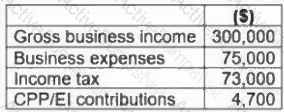
What is Terry’s net business income?
Edward is risk averse and has limited investment knowledge. He will only purchase 100% guaranteed products insured by the CDIC. Edward is meeting with his financial planner, Marissa, for the third time this year about rates, and starts the meeting by criticizing her employer for paying such low returns on GICs. Edward says he is considering taking his business elsewhere. How should Marissa respond to Edward’s comments?
A financial planner recently started her new role at the bank and decided to create a checklist when meeting with prospects. She wanted to include one item on the checklist that would allow her to understand her clients' tolerance for risk. What information should she add, that will help her achieve this objective?
Lois is reviewing her client Raj's retirement plan. To stay on track, Raj's TFSA (with a current balance of $10,000) will need to be worth $42,000 in five years. Raj is able to contribute his annual bonus of $5,000 at the end of each year. For Raj to stay on plan, what rate of return does Lois need to be targeting?
Alexis has an index-linked GIC with an adjusted cost base of $20,500. The GIC was issued one year ago, has four years remaining to maturity and provides her with 60% participation in the gains of the S & P/TSX 60 Index, based on the level of the Index at maturity or at redemption prior to maturity. The GIC has a 2% fee if redeemed in the first two years. Alexis notices that the S & P/TSX 60 Index is up 25% and she would like to redeem her GIC. She asked her financial planner if she redeems her GIC, how much she would receive upon redemption. What will her financial planner tell her?
Dianna is visiting with Karen, her Financial Planner, and is excited to report that she has just bought her dream home. She has also let Karen know she Is meeting with an insurance representative to purchase a whole life insurance to cover her 20-year mortgage. Why might Karen suggest Dianna consider term life insurance instead?
Kendrick, age 55, owns a successful small business, ZXC Inc., valued at $800,000. Kendrick has extensive savings outside of the business and would like to pass the company onto his son at some point in the future. Kendrick expects the business to increase in value $25,000 per year. If Kendrick decides to use an estate freeze to reduce the amount of taxes he will be required to pay, his financial planner should recommend that he implement the estate freeze at which point in relation to gifting the business to his son?
Consider the following information for a client's portfolio:
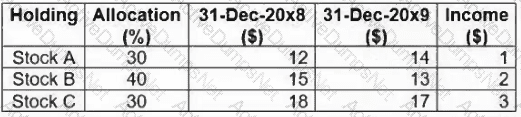
What is the annual rate of return for this portfolio?
Suzy, age 45, is meeting with a financial planner as she has recently inherited $1.25 million from her late aunt. Suzy has poor spending habits and would like to review options that would safeguard and help her receive stable cash flows. She does not have a lot of experience investing and would like to avoid making day-to-day investment decisions. Which type of investment account is most appropriate for Suzy?
Robert is meeting with his wealth advisor to review options to put a plan in place to save for his children's education. He has a daughter, age seven, and a disabled son, age four Robert would like to maximize his savings towards this goal, ensure the strategy is tax efficient and utilize available grants. Which option is most appropriate for Robert's plan?
A business owner completes an estate freeze, taking back preferred shares with a fixed redemption value while children receive common shares. What is a primary risk of this strategy for the owner?
Jonathan owns a medium size consulting firm and earns an average annual income of $150,000. He is reviewing his retirement plan with his financial planner. Jonathan asked his planner about retirement compensation arrangement and how this may benefit him. What should his financial planner tell him?
Priya grants her brother trading authority over her non-registered investment account. Her brother calls the financial planner and asks for Priya’s full net worth statement, tax return, and beneficiary information so he can “help with planning.” What should the planner do?
A client says she can emotionally tolerate a 30% portfolio decline, but she needs the money in 18 months for a home down payment and has no other savings. What should the planner conclude?
In which life cycle stage would a financial planner identify his client to be if they have a high mortgage balance and an unstable or lower income, and are willing to take on investment risk because of their longer time horizon?
Jonah is meeting with his client, Muhsina, who owns Myke Inc., a Canadian-controlled private corporation. Based on current market value, if he decides to sell Myke Inc., Muhsina will have a capital gain of $400.000. He expects the value of Myke Inc. to increase in future years and has a CNIL balance of $100,000. He wants the future increase in value to be taxed in the hands of his children, Teshi and Kaliyah, and to minimize the cost. What action should Jonah advise Muhsina to take to meet his goal?
Carla, a financial planner, is meeting with a long-standing client, Jonathan. Jonathan informs Carla that he is upset and disappointed with the negative returns experienced with his investment portfolio. After acknowledging Jonathan's concerns, what should Carla's first step be in addressing his complaint?
Henri and Jessica have recently moved in together and Henri has been helping Jessica with her investments. Jessica names Henri trading authority on her TFSA. Henri calls their financial planner requesting to make Jessica's TFSA contribution for this year but first requests the overall balance in Jessica's bank accounts (TFSA, high yield savings, chequing) to know if this is possible. What action would be most appropriate for their financial planner to take?
A higher-income spouse contributes to a spousal RRSP for the lower-income spouse. The lower-income spouse withdraws the contribution amount the following year. What should the planner warn them about?
Richard reviewed his divorce settlement from his partner Alex with his advisor Maria. He is deciding between providing a lump sum spousal support payment of $60,000 or making monthly payments. If Richard’s income is $200,000 and Alex’s income is $40,000, what should Maria advise Richard about the tax implications for both Richard and Alex in regard to the lump sum payment?
What information is least important for Harry as a financial planner in his assessment for insurance coverage for his client with respect to estate planning purposes?
Bill is reviewing his credit bureau after being declined for a loan. He believes a loan that does not belong to him is appearing on the report. Which section should he review most closely?
Lex's client, Phillip, has signed an agreement to purchase his uncle's business when his uncle retires in five years for $210,000. Phillip has $175,000 today, how should Lex recommend Philip invest his money?
A client believes that security prices quickly reflect public information and wants broad Canadian equity exposure with low cost and minimal manager discretion. What investment best matches this view?
During implementation, a client agrees to update her will, purchase disability insurance, and increase RRSP contributions. Which statement best describes the planner’s role?
Maya, a financial planner, is meeting with a new client who was recently referred to her. In determining the client's overall risk tolerance, what qualitative data should Maya capture as part of her process?
Mary, an accredited financial planner, recently met with clients Michael and Radha. They are high- net-worth clients who are in their mid-40s. Michael is a heavy equipment operator at a local oil field, and Radha is a homemaker. They are ready to retire in 10 years and very excited to start planning for the next chapter in their lives. Mary explained her planning process, her accreditation, and her remuneration. When Mary presented the client agreement letter, both clients were surprised. They said they did not know why they would sign a letter to get advice on their own finances. How should Mary answer their question?
Jenny and Herman are looking for tax strategies that will help them better manage their marginal annual tax rates. Jenny is currently the primary income earner in the household. She has a large non-registered portfolio that holds only plain vanilla S & P 500 index funds. Jenny and Herman have a 14-year-old daughter, and they would also like to know what income-splitting opportunities exist. They’ve presented several ideas to their tax planner, Isaac, for review. Which of the following will likely result in tax attribution to Jenny?
Sapphire, age 35, a recent widow, is still in the grieving stage. She has just received a large insurance payout. She has limited savings, a long-term time horizon, and a high tolerance for risk. What investment strategy should her financial planner recommend until Sapphire is better able to understand her new situation?
Derek recently inherited $900,000. He asks his financial planner to invest the entire amount in a concentrated portfolio of junior mining stocks. Derek has never invested before, has two young children, and is still deciding whether to purchase a home. What should the planner do first?
Miles tells Rasheed, his financial planner, that he would like to assign the growth assets in his portfolio to his children. Rasheed recommends Miles freeze his estate. What is the primary risk associated with an estate freeze?
A client wants a policy that pays a lump sum if she is diagnosed with a covered serious illness and survives the required waiting period. Which product matches this need?
A client asks when his RRSP must generally be converted to a retirement income vehicle. What should the planner explain?