Pre-Summer Sale Limited Time Flat 70% Discount offer - Ends in 0d 00h 00m 00s - Coupon code: 70spcl

Appian ACD101 Appian Associate Developer Exam Practice Test

Page: 1 / 12
Total 121 questions

Appian Associate Developer Questions and Answers

Question 1

A customer wants to display a small toolbar with three icons - a " sad face, " a " face with neutral expression, " and a " happy face " - on the bottom of every page in their application.

Users will be instructed to use the icon that best expresses their current experience using the application. This will allow the customer to collect valuable data about users.

Which object type should be called from each page to implement this feature?

Options:

A.

An interface, because the component must render user interface elements.

B.

An expression rule, because the component captures expressions of user sentiment for analysis.

C.

A decision, because the component captures a choice that users select from an array of custom selection components, rather than a standard dropdown or radio button.

Question 2

You have a record type ABC_Author, backed by a database table. You created a process that allows the user to modify an existing author.

When configuring the Write Records smart service, what should you consider regarding the record ID?

Options:

A.

The Write Records smart service will always update an existing record item.

B.

You have to call the a!getExistingRecordId() function to get the value for the primary key field.

C.

The primary key field must hold the ID of the existing author record item.

Question 3

You need to be able to define record type relationships.

What is a required prerequisite in Appian?

Options:

A.

The record types must have data sync enabled.

B.

The record types must be on a virtualized data source.

C.

The record types must be stored in the local Appian business database.

Question 4

What is the Appian Dev environment used for?

Options:

A.

Making updates to the app.

B.

Providing end users access to the finished product.

C.

User acceptance testing.

Question 5

You have two Custom Data Types (CDT): ACME_invoice and ACME_invoiceItem that have a flat relationship.

The invoice item table has a field that is a foreign key to the invoice table. You are leveraging the database to automatically generate their primary keys.

How should you structure the process model to add a new invoice and the new invoice items to the system?

Options:

A.

1. Write to Multiple Data Store Entities smart service (Writing to the ACME_invoiceItem table and ACME_invoice table).

B.

1. Write to Data Store Entity smart service (Writing to the ACME_invoiceItem table).

2. Script Task to update foreign keys.

3. Write to Data Store Entity smart service (Writing to the ACME_invoice table).

C.

1. Write to Data Store Entity smart service (Writing to the ACME_invoice table).

2. Script Task to update foreign keys.

3. Write to Data Store Entity smart service (Writing to the ACME_invoiceItem table).

Question 6

You are working on an existing process model with three process variables:

1. pv!vehicleID (integer)

2. pv!vehicle(Custom Data Type (CDT)

3. pv!dealershipName (text)

You have a script task with an output variable, defined as rule!VIM_getVehicle(vehicleID: pv!vehicleID). The result is saved to pv!vehicle.

The rule VIM_getDealershipName() accepts the dealership ID, which is a field on the vehicle CDT, and returns the dealership name.

What should you update in the process model to set the value for pv!dealershipName?

Options:

A.

Move the existing output variable to the inputs tab, and name it “vehicle”. Add output variable defined as rule!VIM_getDealershipName(ac!vehicle.dealershipId) and save that value to pv!dealershipName.

B.

Add another output variable defined as rule!VIM_getDealershipName(pv!vehicle.dealershipId) and save that value to pv!dealershipName.

C.

Add a new script task, and add an input variable defined as rule!VIM_getDealershipName(ac!vehicle.dealershipName) that saves into pv!dealershipName.

Question 7

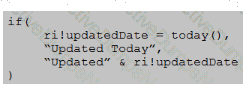
Review the following expression rule:

Question # 7

ri!name is defined as " Maria " .

ri!directory is defined as the following:

Question # 7

What is the expected output?

Options:

A.

Maria

B.

0

C.

1

Question 8

You need to create a record type with data sync enabled.

What are the supported data sources?

Options:

A.

Web Services, Salesforce, Database

B.

Web Services, Process Reports, Database

C.

Salesforce, Process Models, Database

Question 9

What is an Appian best practice for calling a query on your interface?

Options:

A.

Call the query once on a local variable.

B.

Call the query everywhere you need it to show data.

C.

Call the query once on a rule input

Question 10

You need to configure the database to have a one-to-many relationship between ACME_ORDER and ACME_ORDER_ITEM.

What is a valid method for configuring this relationship in the database?

Options:

A.

Add a new field “ORDER_ID” on the ACME_ORDER_ITEM table and set the field as a foreign key to the ACME_ORDER entry.

B.

Add a new field “ORDER_ITEM_ID” on the ACME_ORDER table and set the field as a foreign key of the ACME_ORDER_ITEM entry.

C.

Add a new field “ORDER ITEM_ID” on the ACME_ORDER table and set the field as a second primary key of the ACME_ORDER_ITEM entry.

Question 11

How can you prevent users from accessing Tempo?

Options:

A.

Remove the users from the Tempo Users system group.

B.

Change the default User Start Page.

C.

Ensure the user is in the Application Users group, which by default does not have access to Tempo.

Question 12

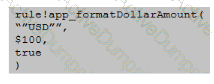
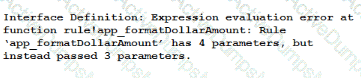
While calling this rule in your interface, you receive the following error message:

Question # 12

How could you have prevented this error from happening?

Question # 12

Options:

A.

Call the rule by using a local variable.

B.

Use the keyword syntax.

C.

Use Index().

Question 13

What are three ways to trigger a process from a process model? (Choose three.)

Options:

A.

Use a subprocess.

B.

Call a web API.

C.

Use a!recordActionItem().

D.

Use a Start Process smart service.

E.

Run a!startProcess() from a script task.

Question 14

You are using a local variable in an expression rule to describe the height of an applicant.

Which statement correctly describes the application of Appian best practices for naming your local variable?

Options:

A.

local!hoaa - This employs the naming convention of abbreviating " Height of an applicant " to minimize both the typing required by developers and the length of code Appian is required to parse.

B.

local!applicantHeight - This employs the naming convention of specifically describing the value contained by the variable.

C.

local!x - This employs the naming convention of using algebraic variables for a value that may either change over time or be used by future developers for other purposes.

Question 15

Which Appian feature is used to automate repetitive manual tasks such as extracting data from a system for which there is no API?

Options:

A.

RPA

B.

Process Mining

C.

Connected Systems

Question 16

While testing, the process consumes at least 2000 AMU of process memory for each instance.

What are four ways to reduce the overall memory footprint of your process instances? (Choose four.)

Options:

A.

Reduce your process’ delete and archival interval under Data Management > Automatic Process Clean-Up. Most Voted

B.

Split the process into subprocesses so that only a part of the overall process is active. Most Voted

C.

Start the process with the memory optimizer option toggled “On”.

D.

Reduce the number of process variables. Most Voted

E.

Do not store large data chunks like text strings in process variables. Most Voted

F.

Compress text into a .ZIP file before storing them in process variables.

Question 17

You are creating a new application with the prefix ACM.

Which four default folders are created by Appian when you select " Generate groups and folders to secure and organize objects " ? (Choose four.)

Options:

A.

ACM Users

B.

ACM Knowledge Center

C.

ACM Process Models

D.

ACM Rules & Constants

E.

ACM Application Documentation

Question 18

You need to quickly view the structure of an application, its packages, and supporting documentation.

Which Appian Designer view should you use?

Options:

A.

Monitor

B.

Deploy

C.

Explore

Question 19

You need to pass data into a process from other parts of your Appian application.

Which configuration is required in your process model?

Options:

A.

Toggle the Parameter field to ' True " on the configuration of a process variable.

B.

Create process variables on the Data Management tab of Process Model Properties.

C.

Add an interface as a Process Start Form.

Question 20

You created a user interface that has a text field. After you type into the text field, you notice the text disappears when you click out of the text field.

What could be the issue?

Options:

A.

The “Display value” and “saveInto” parameters are incorrectly mapped.

B.

The “readOnly” parameter is set to “True”.

C.

The “refreshAfter” parameter is incorrectly set.

Question 21

You are constructing an interface that is used as the form of a User Input Task in a process model.

The data entered on the form must be available in the process after the form is submitted.

Which domain prefix should be used for variables in the interface?

Options:

A.

ri!

B.

pv!

C.

local!

Question 22

You need to start a process using an email trigger.

How should you configure this process model using the Process Model Properties dialog?

Options:

A.

Go to File > Properties > Alerts. Configure the Custom Alert settings.

B.

Go to File > Properties Set the proper Process Display Name

C.

Go to File > Properties. Select the Public Events checkbox to allow anyone to fire triggers.

Question 23

Which statement about local variables is valid?

Options:

A.

The data type of a local variable is determined by its value.

B.

Local variables can only store primitive data types, such as numbers and strings.

C.

Local variables must have an initial value set when defining them.

Question 24

Actual exam question from Appian ' s ACD101

Question #: 15

Topic #: 1

[All ACD101 Questions]

Question # 24

What is the expected output?

Options:

A.

Maria

B.

0

C.

1

Question 25

You need to view a record type relationship diagram.

Where should you look in the record type?

Options:

A.

List

B.

Views

C.

Data model

Question 26

An interface references an expression rule.

What are the relationships between these objects?

Options:

A.

Dependents and Reliants

B.

Dependents and Precedents

C.

Inheritance and Association

Question 27

You want to replace any invalid email addresses in a list of email addresses with the word ‘invalid’.

A rule already exists within your application which determines if an email address format is valid:

“MAIL_isValidEmail()”. This rule takes in a single email address and returns either “True” or False”.

Which code snippet will return the desired output?

A)

Question # 27

B)

Question # 27

C)

Question # 27

Options:

A.

Option A

B.

Option B

C.

Option C

Question 28

Which variable type is used to store data used within a single node of a process model?

Options:

A.

Rule Inputs

B.

Process Variables

C.

Activity Class Parameters

Question 29

Which statement regarding the use of rule inputs for expression rules is true?

Options:

A.

Only basic data types should be used for rule inputs. Custom Data Types (CDTs) or records should always be queried within the expression rule rather than passed in via rule input.

B.

The data type for rule inputs should be set only for Custom Data Types (CDTs).

C.

If the value passed in via rule input may be a list of numbers, the rule input must be configured as an “Array”.

Question 30

You are building an interface that displays flight departure times. The data must update automatically every minute and without user interaction.

How should this be configured?

Options:

A.

Query the data inside a local variable used to display the departure times. Set the refreshinterval to “1”.

B.

Query the data inside a local variable used to display the departure times. Set the refreshAlways to “True”.

C.

Add a one minute timer to the process model to query the data and refresh the interface.

Question 31

A user needs to navigate from a record summary to an external URL.

Which interface component can be used to support this goal?

Options:

A.

Button

B.

Record Link

C.

Card Layout with a link

Question 32

A user wants to view a bulleted list of information on an interface.

Which component should you use?

Options:

A.

paragraphField

B.

textField

C.

richTextDisplayField

Question 33

Match each scenario to the correct relationship type in your data model design.

Note: Each relationship type will be used once. To change your responses, you may deselect your response by clicking the blank space at the top of the selection list.

Question # 33

Options:

Question 34

Review the following interface definition:
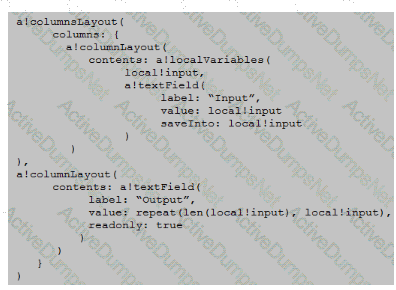
Question # 34

The interface does not display, and you get an error message.

What is the cause of the error?

Options:

A.

localinput needs to be configured with a!refreshVariable().

B.

len() is not a valid function and length() should be used instead.

C.

localinput is being referenced outside the scope it is defined in.

Question 35

You are working on a process model " VIM Update Vehicle. "

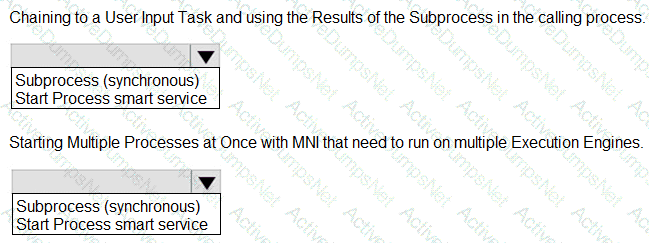
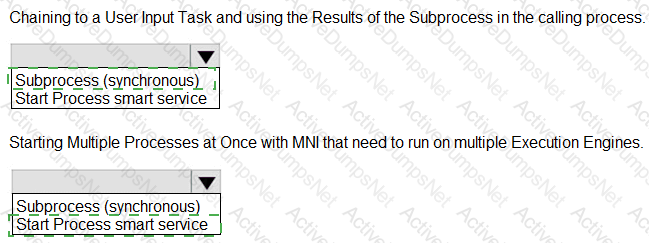
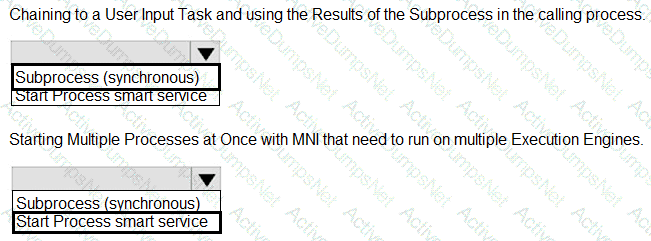
You want to call another process " VIM Get Service Date " that accepts pv!vehicleId as a process parameter and sets a value for pv!serviceDate. The next node in VIM Update Vehicle depends on the value of pv!serviceDate.

Which node should you use to execute " VIM Get Service Date " from VIM Update Vehicle?

Options:

A.

Start Process smart service

B.

Asynchronous subprocess with activity chaining

C.

Synchronous subprocess with input and output variables configured

Question 36

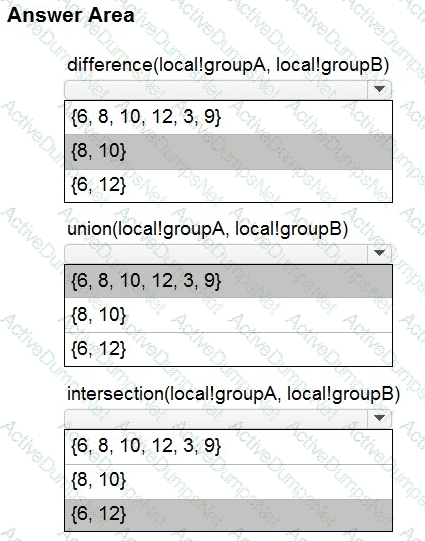
Review the following variables:

Question # 36

Match each expression rule to the expected output.

Note: Each output will be used once or not at all. To change your responses, you may deselect your response by clicking the blank space at the top of the selection list.
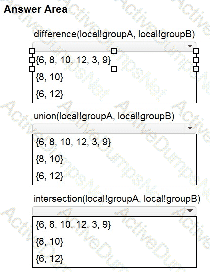
Question # 36

Options:

Page: 1 / 12
Total 121 questions