
Adobe AD0-E615 Adobe Real-Time Customer Data Platform Developer Expert Exam Practice Test
Adobe Real-Time Customer Data Platform Developer Expert Questions and Answers
A retailer is uploading a 25 GB CSV file for batch ingestion. The job completes with status "Partially Failed". Some records are visible in the dataset, but marketing reports are missing profiles.
Which next step would be taken to address this issue?
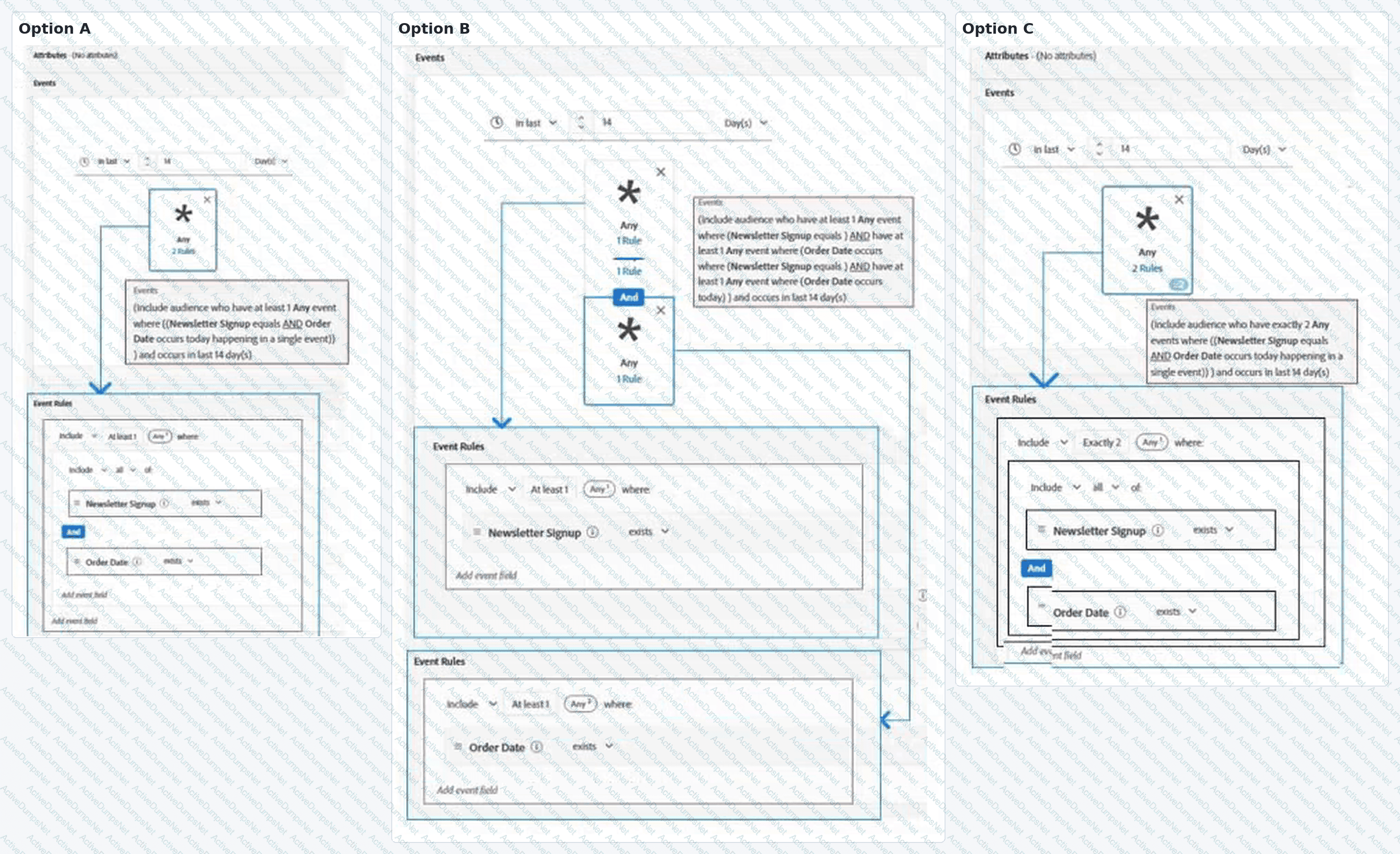
An organization wants to target its users who have signed up to its newsletter and made a purchase in the last 14 days.
What would be an appropriate way to create this audience segment?
A client is over their Addressable Audience contracted limit. After reviewing the Profile dashboard, it is determined that more than 50% of the profiles are single-identity ECID profiles.
Which steps should be taken to get the profile count under the contracted limit but keep all of the data for reporting?
A Developer is configuring a dataflow for a streaming data source using a schema enabled for Profile with a number of required fields. Upon inspecting the source data, the Developer notices that sometimes payloads will arrive without one of the required fields.
How could the Developer ensure ingestion proceeds without errors?
A financial organization wants to activate its audience to a cloud storage destination to share with a third party. When the segmentation workflow is created, it fails to activate some profiles from the audience to a cloud storage destination.
What could be the reason for the failure?
Which action is considered a breaking change in an XDM class schema in Adobe Real-Time CDP?
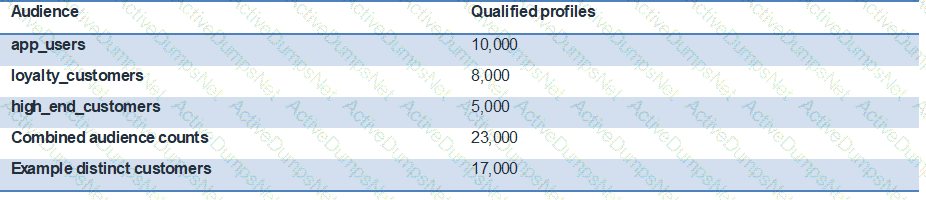
A telecom business has multiple segments like app_users, loyalty_customers, and high_end_customers. The streaming destination is configured to activate the segments immediately. When a Developer checks the counts, the added counts of individual segments are higher than the counts of customers activated in the destination.
What could be the reason for the lower counts in the destination?
Which type of data would be stored in the Hub profile but not in the Edge profile?
Which merge policy configuration would result in multiple profile fragments that share non-primary identities being treated as separate profiles?
A company is streaming web events into Adobe Real-Time CDP. Events appear in the streaming monitoring dashboard, but users are not qualifying into real-time segments.
What is the most likely configuration issue?
A cruise line brand wants to trigger a marketing campaign targeting customers whose loyalty status upgraded from Silver to Gold in the last 24 hours and is required for real-time segmentation.
An Adobe Real-Time CDP Developer is tasked with onboarding the customer loyalty data in Adobe Experience Platform and Real-Time Customer Profile.
Which schema class should be used to ingest loyalty data?
What are the required fields for all schemas based on XDM ExperienceEvent class to store time-series data?
An Adobe Experience Platform Developer is modeling a schema for collecting data sent through Web SDK.
Which suggestion helps the Developer maintain data integrity when creating the schema?
A global electronics manufacturer is using Adobe Experience Platform for cross-channel personalization use cases. There are multiple datasets stitched together to form the Real-Time Customer Profile:
• CRM Dataset is a trusted source for personal information and consent data.
• E-commerce Dataset records recent purchase activity and preferences.
• Support Center Dataset has profile updates from customer service tickets.
The team notices that several profiles have conflicting values for a key attribute named communicationPreference :
• In CRM, the value is "Email".
• In E-commerce, the value is "SMS".
• In Support, the value was changed to "Email" yesterday.
Marketing wants to use the most recent customer preference recorded in the attribute communicationPreference .
Which merge policy should be used?
A retail brand wants to target customers who have:
• Made a purchase in the last 30 days.
• NOT returned any item from that purchase.
Which option is the most appropriate segment definition?
A global retail organization is scaling its Adobe Real-Time CDP implementation across multiple business units. All configurations are being built within a single production sandbox.
Over time, the team has created:
• 95 batch and streaming destinations for advertising, cloud storage, and partner integrations.
• 5 Edge personalization destinations for custom on-site and in-app experiences.
When attempting to create an additional Edge personalization destination for a new mobile application, the system prevents the configuration from being saved. The Architect confirms that no configurations contain errors and that permissions are correctly assigned.
What is the most likely reason the new destination cannot be created?
An Adobe Experience Platform Architect is asked by a client why a Pseudonymous Profile with an ECID that was last seen 25 days ago has not been deleted, despite a 14-day TTL being in place. After investigation, they find the profile's identity graph contains ECID and a hashed email namespace (Email_LC_SHA256).
What could be the reason this profile still exists?
An Adobe Real-Time CDP Developer has created a segment with the following logic:
Attributes: Country equals Canada
Events: In last 24 hours
Clicked on an Email Campaign
Then
Proceeded to Checkout
Then
Did not Purchase
Which evaluation method should be used?